
In 2017 the tech/telecom sector continued to outperform the rest of the economy, on all relevant measures: Output, productivity, hours, and prices.
I analyzed the BEA’s initial release of industry GDP data for 2017, and combined it with BLS hours data. For the tech/telecom sector, I used computer and electronic products manufacturing; warehousing and storage (ecommerce fulfillment centers);publishing industries, including software; broadcasting and telecommunications; data processing, internet publishing, and other information services; and computer systems design and related services.
I found that in 2017, the tech/telecom sector showed 4.9% real output growth, more than double the 2.3% growth for the rest of the private nonfarm economy. Productivity growth in the tech/telecom sector was running at a strong 2.4% rate, compared to a meager 0.3% for the rest of the private nonfarm economy.
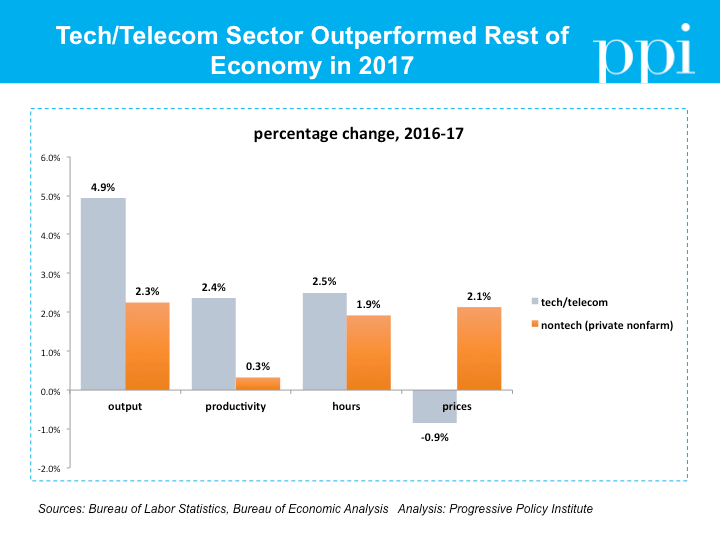
In 2017 worker hours in the tech/telecom sector grew by 2.5%, somewhat faster than the 1.9% gain in the rest of the economy. And finally, prices dropped in the tech/telecom sector, compared to an increase of 2.1% elsewhere.
Decomposing the price decline in the tech/telecom sector is particularly interesting. Historically hardware prices have declined sharply, but that’s not the main reason here. According to the BEA, the price change for value-added in the computer and electronics manufacturing industry was only -0.6% in 2017.
Instead, the main contributors to declining prices in the tech/telecom sector were broadcasting and telecommunications ( -2.2%); data processing, internet publishing, and other information services (-1.3%); and computer systems design and related services ( -0.3%). These figures are drawn right from BEA data.
Conclusion: Simple common sense says that if you own one car that’s broken down and another that makes weird noises but is still running well, you focus on fixing the broken-down vehicle first. The tech/telecom sector has some worrisome issues, but it’s still delivering value to both customers and workers. Meanwhile the rest of the economy has some bright spots, but overall most of those industries are stuck in the garage.
With productivity growth only running at 0.3% in the nontech private nonfarm economy, it’s little wonder that real wage growth has remained low across most of the economy. We need to digitize the physical industries to raise productivity and create more and better paying jobs.

