Based on newly revised Bureau of Economic Analysis data, we find that rising labor compensation for health care workers accounted for $55 billion, or 40%, of the increase in personal health care spending in 2016. By comparison, in May, 2017, we calculated that pharmaceuticals accounted for only $15 billion, or 11% of the rise in personal health care spending in 2016. In other words, the rising number of health care workers is by far the single most important factor driving higher health care costs.
This simple fact—which has held true every year we have done this analysis—makes us wonder about heavy-handed legislation like California’s SB17, now up for consideration. The bill would purportedly control rising health care costs by forcing pharma and biotech companies to give 60-day advance notification of most price increases. The bill would also require pharma and biotech companies to give “a description of the specific financial and nonfinancial factors used to make the decision to increase the wholesale acquisition cost of the drug“ – a regulatory requirement levied on almost no other sector of the economy.
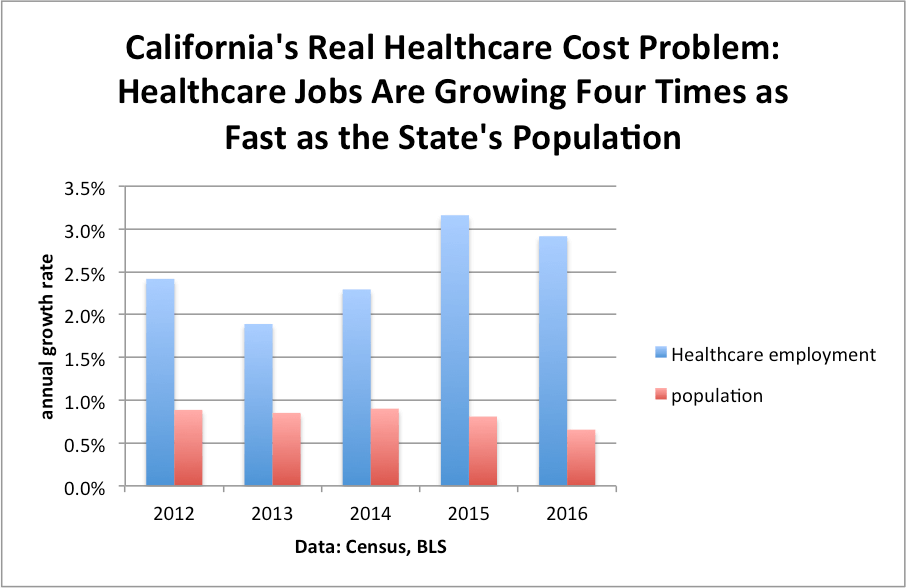
In fact, the real health care cost problem in California, as in the rest of the country, is not the cost of pharmaceuticals. The real health care cost driver is that health care employment growth is far outpacing population growth. In 2016, California health care employment rose by 2.9%, more than four times as fast as the 0.7% increase of the state’s population, as reported by the Census Bureau (below).. As long as health care employment keeps growing out of control, intrusive bills like SB17 risk doing damage to the pharma and biotech industries without having any significant effect on the cost of health care for patients and employers. All pain, no gain.