
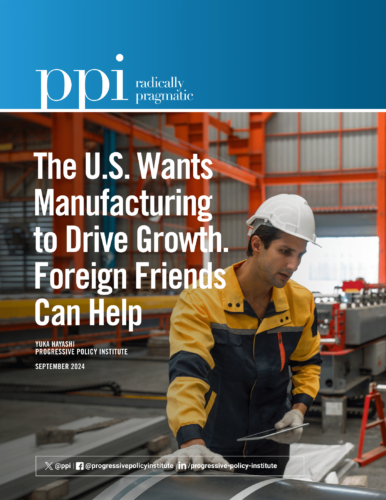
WASHINGTON — As the U.S. seeks to bolster its domestic manufacturing, the role of foreign direct investment (FDI) is more critical than ever, particularly from trusted allies. This insight is at the heart of a new report from the Progressive Policy Institute (PPI), titled “The U.S. Wants Manufacturing to Drive Growth. Foreign Friends Can Help.” The report examines the converse of U.S. “friendshoring” in friendly countries: the potential for allied nations like Japan, South Korea, Canada, the UK, and Germany to support U.S. economic growth through investment in sectors ranging from electric vehicles to biopharmaceuticals.
The report, authored by Yuka Hayashi, is the second in a two-part series. The first, “Behind Japan’s U.S. Steel Bid: An Aging, Shrinking Home Market,” provides a fresh perspective on Nippon Steel’s proposed acquisition of U.S. Steel and closely examines the economic realities behind Nippon Steel’s pursuit of the American industrial icon.
The new report highlights how these investments can create high-paying jobs, drive technological innovation, and strengthen America’s position in the global economy. Drawing on examples from states like Ohio, Michigan, and North Carolina, where Japanese companies have built major manufacturing hubs, the study argues that such partnerships are essential to America’s economic future.
“If the U.S. wants to strengthen domestic manufacturing, promoting foreign investment from friendly countries is a smart strategy,” said Hayashi. “Not only does it create good-paying jobs and spur innovation, but it also deepens our economic ties with trusted allies, ensuring that critical industries remain secure.”
The report stresses that the U.S. must be strategic in welcoming investment from allied nations, especially in the context of growing tensions with China. As part of this strategy, the report calls for expanding “friend-shoring” partnerships — moving supply chains to allied nations to ensure resilience and stability.
In light of the Inflation Reduction Act and the CHIPS and Science Act, both passed in 2022, PPI’s report underscores the opportunity for the U.S. to attract even more foreign investment, particularly in green technology and semiconductor manufacturing. It also warns that protectionist policies could deter friendly nations from further investing in the U.S. economy.
Read and download the report here.
The Progressive Policy Institute (PPI) is a catalyst for policy innovation and political reform based in Washington, D.C. Its mission is to create radically pragmatic ideas for moving America beyond ideological and partisan deadlock. Learn more about PPI by visiting progressivepolicy.org. Find an expert at PPI and follow us on Twitter.
###
Media Contact: Ian O’Keefe – iokeefe@ppionline.org

