
WASHINGTON — The U.S. space industry is booming with a 600% surge in satellite launches over the past decade. While space is a vacuum, the Earth’s upper atmosphere — which protects all life on the planet from radiation — may be harmed by pollutants emitted from space activities. At the same time, many government agencies and policymakers gain incredible insights from data that can only be provided from space, affecting all aspects of life, from food and water to disaster response. A new report by the Progressive Policy Institute (PPI) proposes new ways to address these potential environmental issues without sacrificing the benefits of America’s growing space presence.
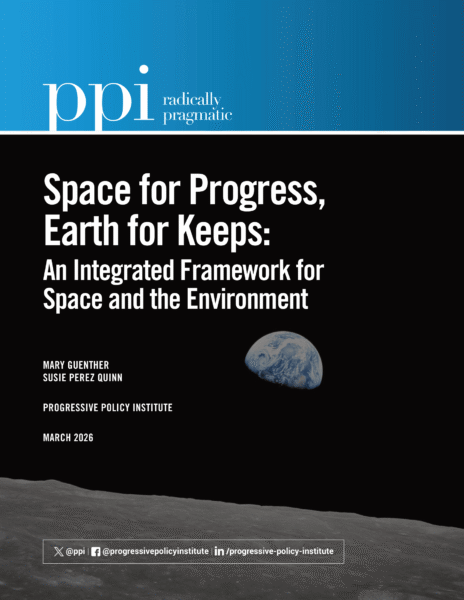
The report, “Space for Progress, Earth for Keeps: An Integrated Framework for Space and the Environment,” authored by Mary Guenther, PPI’s Head of Space Policy, and Susie Quinn, Founder of Plum and Talon and Former NASA Chief of Staff, provides a pragmatic, integrated path forward that engages both the space industry and U.S. government in finding ways to maximize rewards from space and minimize atmospheric effects.
While space already delivers major environmental benefits, America needs to fully harness its world-class science from federal space agencies and task them with developing an understanding of potential negative environmental effects of space activities in order to help inform how choices like materials, fuels, and mission architectures are made in the future.
“What happens in space touches many aspects of our day-to-day lives,” said Guenther. “As we continue to deploy more spacecraft into orbit, we must make sure we engage thoughtfully to understand and curb some of the negative environmental effects launches may produce without losing sight of all the benefits we get from space.”
Guenther and Quinn outline four integral steps policymakers must take in order to continue accelerating America’s space program and mitigate future environmental disaster:
There is a space race going to the moon with implications even closer to home as China begins to catch up with the United States in space. Policymakers cannot cut critical funding or research that supports Earth observation, as it is critical America wins the current space race for economic and national security reasons. For context, the Earth observation economy is predicted to contribute a cumulative $3.8 trillion to global GDP between 2023 and 2030 and this technology has been critical during the war in Iran as well as Ukraine. At the same time, Guenther and Quinn emphasize that there needs to be a way forward that expands the United States’s dynamic space economy and reduces risks to the planet.
“Space gives and space takes. On the give side, we reap the benefits of decades of US expertise, investment, and open science. From that, we have the industry, tools and experts to figure out what space takes from the planet. The only thing missing is the will.” said Quinn.
Read and download the report here.
Founded in 1989, PPI is a catalyst for policy innovation and political reform based in Washington, D.C. Its mission is to create radically pragmatic ideas for moving America beyond ideological and partisan deadlock. Find an expert and learn more about PPI by visiting progressivepolicy.org. Follow us @PPI.
###
Media Contact: Ian O’Keefe – iokeefe@ppionline.org

