
| 2026 | 12.70% |
| 2025 | 4.30% |
| 2024 | 4.60% |
| 2023 | 4.70% |
| 2022 | 4.20% |
* USITC Dataweb
Asking the Senate for budget money late last month, Howard Lutnick claims the administration’s first-year policy adventures “dramatically reduced the trade deficit, lowered imports, and increased exports to over $3.4 trillion, a 6% increase from 2024.”
Mr. Lutnick’s stats are rarely precise, and no exception here. Four factual claims in twenty words, two of them wrong, two right.
The errors are on imports and balance, and pretty easy to clear up. Each month, the Census Bureau — a branch of Mr. L’s Department! — publishes the official U.S. trade data. Their most recent report shows that imports rose from $4.1 trillion to $4.3 trillion rather than getting “lower.” Vis-à-vis trade balance, the 2025 deficit was down by 0.2% if you combine goods and services, or up by 2.0% if you count goods alone. Reasonable people can debate whether this is “very slightly down,” “a little bit up,” or “essentially the same.” But either way, it isn’t “dramatic.”
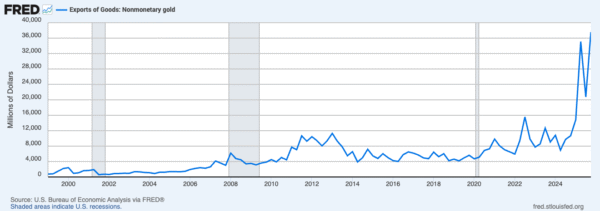
The points about export growth are more interesting — factually correct, but in a strange and unsettling way. The figures, if you look at them in a little detail, turn out mainly to be a sharp rise in transfers of precious metal abroad. That in turn suggests less a useful jump in selling things to foreigners than financial unease, fading confidence, and maybe an exotic form of capital flight. Background –
The Census Bureau statisticians say that last year, American exports (goods and services combined) rose from $3.23 trillion to $3.43 trillion. That, as Mr. Lutnick says, is 6%, or more precisely 6.2%. This makes 2025 exactly the 21st-century median year for export growth, and a bit below the long-term 7.2% export growth average since 1960.
In most cases, a modestly higher export number may be dull, but it means Americans are selling more cars, airplanes, and soybeans abroad, getting more software downloads and movie screenings, etc., and/or that prices have gone up a bit. There’s some of both involved in last year’s figures, but neither farm-and-factory goods nor inflation is the main story. About two thirds of last year’s goods export growth — $68 billion of $117 billion — comes not from ships full of grain, LNG tankers, ro/ros stacked with cars, planes delivering semiconductors to waiting factories, and so forth, but the physical shipment of about 260 tons of gold from U.S. vaults under Wall Street, along with 17 tons of platinum and lots of silver, to London, Zurich, and Hong Kong.
Early data for 2026 show this accelerating. Precious metals (HTS 72) typically make up about 4% of U.S. export values, and reached 7% over the course of 2025. By last February — the most recent month for which full data are up on the USITC’s Dataweb — they had reached 15%, overtaking energy, airplanes, agriculture, cars, chemicals, and other big items as the single largest U.S. export. (Yesterday’s Census trade release adds March figures, and appears about the same.) The jump — the St. Louis Fed presents gold shipments as a classic “hockey stick” graph – appears to reflect a combination of (a) higher prices, (b) investors guessing that precious metals may be better bets than stocks or dollars, and (c) central banks “repatriating” assets, likely thinking the U.S. isn’t as safe a place to hold valuable things as was a couple of years ago. A quick table of February’s top exports:
| Total February 2026 goods exports | $195.1 billion |
| Gold, silver, platinum, precious metal products (HTS 72) | $29.4 billion |
| Energy | $25.2 billion |
| Chemicals (excluding pharmaceuticals) | $16.0 billion |
| Agriculture (USDA definition) | $14.7 billion |
| Airplanes | $12.2 billion |
| Automotive (vehicles and parts) | $10.0 billion |
| Semiconductors | $7.0 billion |
| Pharmaceuticals | $6.9 billion |
So Mr. Lutnick was off on imports and balances. He did get export growth right, though, even though most of it seems to be money leaving the country. And he may well be right to say that Trump administration policies are at least in part responsible. As to whether that’s something to boast about …

PPI’s four principles for response to tariffs and economic isolationism:
Mr. Lutnick testifies at the Senate Appropriations Committee.
… Census’ monthly trade data has some correctives.
… and the St. Louis Federal Reserves “FRED” database has a classic “hockey stick” gold export graph.
Gold background –
Will the U.S. run out of gold? Not likely. The government owns 8,133 tons and so far hasn’t touched it. Also, the U.S. Geological Survey thinks there’s at least 15,000 tons still underground.
The U.S. Mint explains Fort Knox and the U.S. Bullion Depository.
USGS’ summary of gold production, trade, reserves, and uses as of 2025.
The World Gold Council tallies gold reserves by country
… and recaps prices since 2023.
Ed Gresser is Vice President and Director for Trade and Global Markets at PPI.
Ed returns to PPI after working for the think tank from 2001-2011. He most recently served as the Assistant U.S. Trade Representative for Trade Policy and Economics at the Office of the United States Trade Representative (USTR). In this position, he led USTR’s economic research unit from 2015-2021, and chaired the 21-agency Trade Policy Staff Committee.
Ed began his career on Capitol Hill before serving USTR as Policy Advisor to USTR Charlene Barshefsky from 1998 to 2001. He then led PPI’s Trade and Global Markets Project from 2001 to 2011. After PPI, he co-founded and directed the independent think tank ProgressiveEconomy until rejoining USTR in 2015. In 2013, the Washington International Trade Association presented him with its Lighthouse Award, awarded annually to an individual or group for significant contributions to trade policy.
Ed is the author of Freedom from Want: American Liberalism and the Global Economy (2007). He has published in a variety of journals and newspapers, and his research has been cited by leading academics and international organizations including the WTO, World Bank, and International Monetary Fund. He is a graduate of Stanford University and holds a Master’s Degree in International Affairs from Columbia Universities and a certificate from the Averell Harriman Institute for Advanced Study of the Soviet Union.

