
Yes, the productivity slump has hit the iron and steel mill industry as well.
Robert Samuelson wrote a long piece in the WaPo about productivity growth in the steel industry, arguing that “…[p]roductivity (a.k.a., efficiency) has increased dramatically.” His main source was a very careful academic study by Allan Collard-Wexler of Duke University and Jan De Loecker of Princeton University.
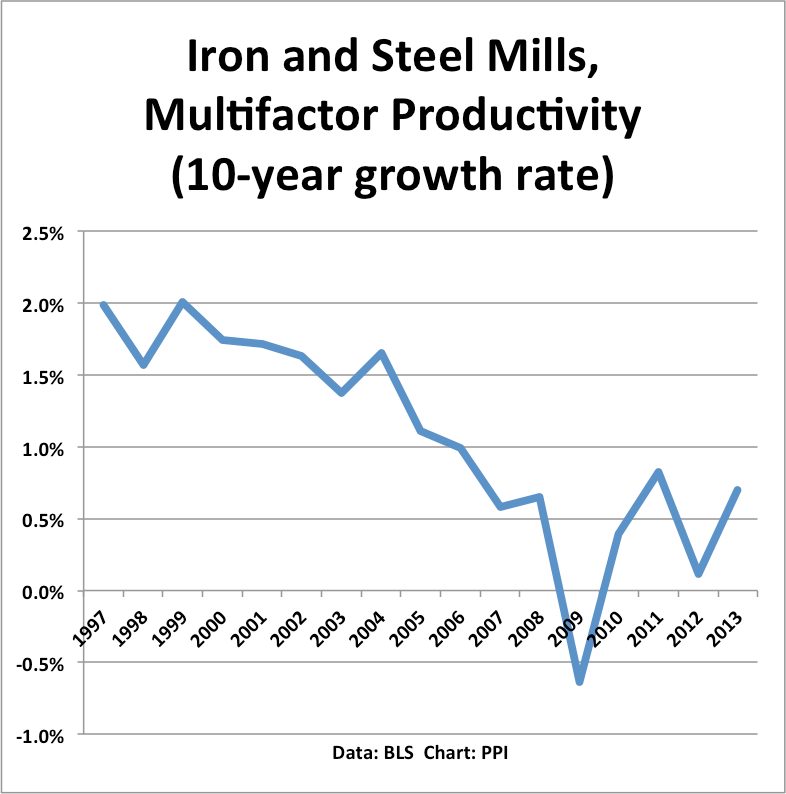
However, that study only used data up to 2002. Since then, multifactor productivity growth in the iron and steel mill industry has cratered, according to data from the Bureau of Labor Statistics (‘multifactor productivity’ growth, also called ‘total factor productivity’ growth, adjusts for use of capital, materials, energy, and purchased services. )
The chart below shows the growth rate of multifactor productivity was 2 percent annually in the 10 years ending in 1999. Then it slumped sharply. In the 10 years ending 2007–before the financial crisis–the average annual multifactor productivity gain was an excruciatingly slow 0.6%. That’s about where it is today.
Now, iron and steel mills are only a part of the steel industry. What’s happened to productivity growth in the primary metal industry, which also includes companies that buy steel and make it into steel products, foundries, and makers of non-ferrous metals such as aluminum and copper?
Nothing good, I’m afraid. In the 20 years between 1994 and 2014, multifactor productivity in the primary metal industry rose by only 1.7% in total. That averages out to an annual rate of less than 0.1%. In other words, any productivity gains in iron and steel mills since 1994 were swallowed up in the rest of the primary metal industry.
This is actually the central puzzle that economists have to unravel. Why has multifactor productivity growth been so slow across much of manufacturing over the past 20 years? (see the data here). Without significant productivity growth, it’s tough to produce rising wages or to compete against low-cost countries.

