
The ‘wedge’ between productivity growth and average real compensation growth has shrunk to the lowest level in at least fifteen years.* That’s because productivity growth is slowing, not because real compensation growth is accelerating significantly.
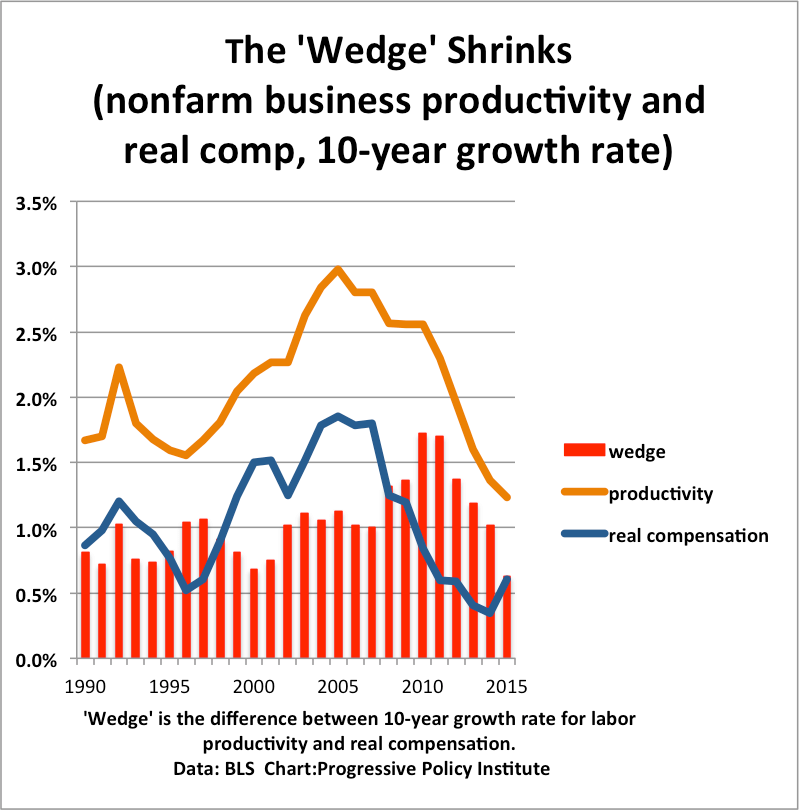
The top line is the ten-year growth rate of nonfarm business productivity, based on data reported by the Bureau of Labor Statistics. The bottom line is the ten-year growth rate of real labor compensation. The vertical lines represent the’wedge’–the difference between productivity growth and compensation growth.
What we see is that the wedge is 0.6 percentage points, the smallest difference between productivity growth and compensation growth in at least 15 years. To put it a different way, the slowdown of real compensation growth is very closely tied to the collapse of productivity growth.
This data does not mean there is no inequality problem. Because these figures report average compensation growth, they do not reflect increased inequality between workers, or the difference between median and average workers. However, they do imply that the problems facing American workers today have at least as much to do with weak productivity growth as with rising inequality.
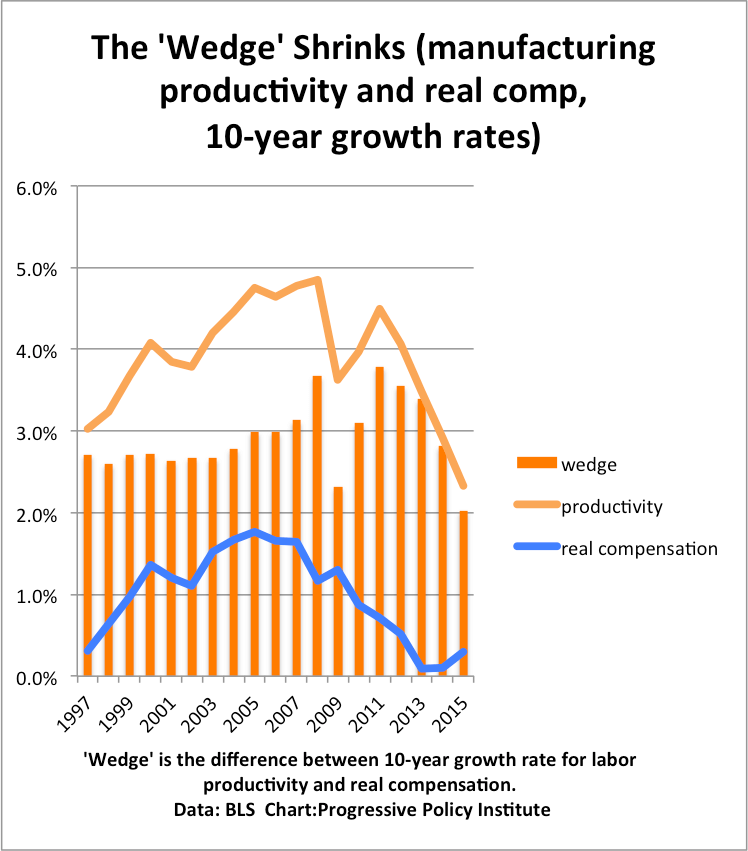
We see the exact same pattern in the manufacturing data, only more so. The growth rate of manufacturing productivity peaked in the mid-2000s, along with the growth of real compensation in manufacturing. Since then, productivity growth has collapsed by 2.4 percentage points, while real compensation growth has dropped by 1.5%. So even within the goods-producing sector, the extreme weakness in compensation growth is driven by the decline in productivity growth.
If we look at the 10-year growth rate of multifactor productivity, the importance of slowing productivity growth becomes even more vivid. Multifactor productivity growth in some sense represents the “innovation” component of growth. It measures the ‘vibrancy’ of an economy–the ability to get out more than we put in by being smarter.
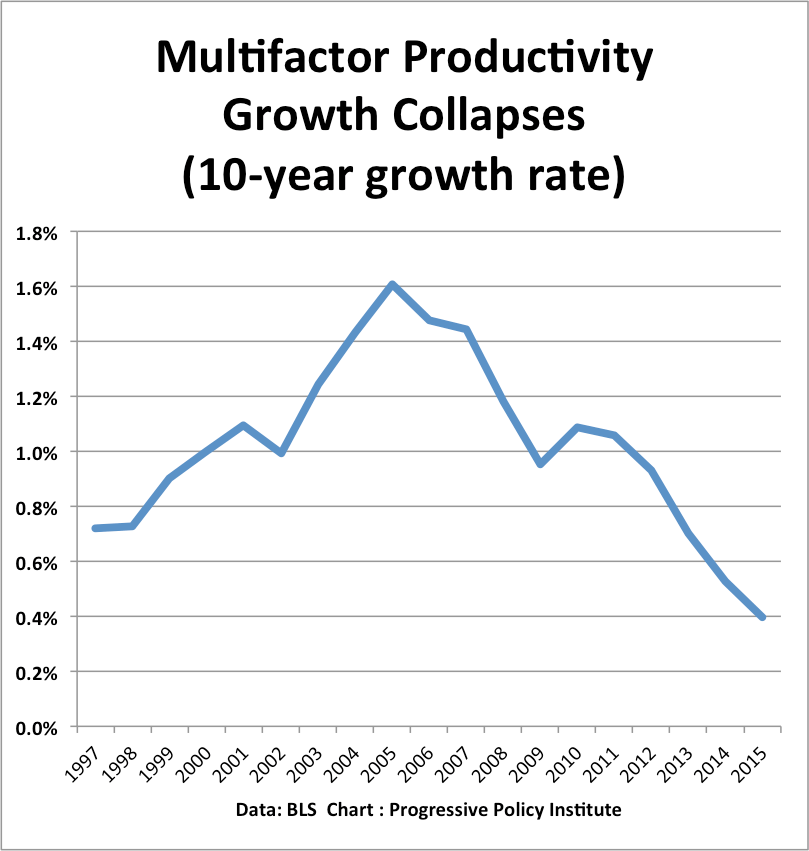
We see that multifactor productivity growth has collapsed to only 0.4% annually, well below the 0.7% growth in the 10 years before 1997. Indeed, as a recent blog item showed, many manufacturing industries have negative multifactor productivity growth since 1994. When the pie is shrinking, it can’t be cut in a way to make everyone happy.
Addressing the inequality problem is important. But Americans can’t prosper unless we fix the productivity problem as well.
*This discussion abstracts from a very wide range of substantive and technical issues, including: the difference between median and average workers; the correct measure of compensation; the best deflator to use, etc. A good review of some of these issues can be found here, though I disagree with some of the conclusions. In addition, I believe that productivity growth figures should be treated with some wariness, given the inability of statisticians to do a good job tracking global supply chains in goods, services, and data. Having said all that, there is little doubt that productivity growth has slumped sharply, not just in the US but across the developed world.

