
July 2026, The Argument: “[Do you] support or oppose free trade agreements with other countries?”
| Support | Oppose | Unsure | ||
| All respondents | 71% | 16% | 13% | |
| Self-identified Democrats | 81% | 7% | 12% |
June 2015, Pew Research Center: “Would the Trans-Pacific Partnership be a good thing or a bad thing for our country?
| Support | Oppose | Unsure | ||
| All respondents | 49% | 29% | 21% | |
| Self-identified Democrats | 51% | 26% | 22% |
Surveying trade findings in The Argument’s most recent poll, Center for New Liberalism co-founder Jeremiah Johnson finds a sea-change:
“[T]he political momentum that led to increased support for protectionism has stopped. Trump’s use of tariffs has been so lawless, so haphazardly implemented, and so offensive to so many of America’s traditional allies that the public has clearly turned against tariffs and back toward free trade.”
Some background on the last decade’s shifting tide to put The Argument’s survey in perspective –
Our early-2025 Trade Fact look at polling found about 60% of Americans disliking the Trump administration’s “IEEPA” tariff decrees on sight, while about 38% liked them. A second look last February, as the Supreme Court prepared to scrap that round of decrees, found about the same. The trade polls released this summer (though a bit fewer in number than last year’s) suggest a somewhat worse opinion. (Cross-tabs: Democrats overwhelmingly negative throughout; early Republican support weakened a bit; political independents moving from generally negative with a lot of ‘uncertains’” to very negative.) Two samples:
| CBS | “Approve” of tariffs | “Disapprove” of tariffs |
| July 2026 | 36% | 64% |
| April 2025 | 42% | 58% |
| Economist | “Approve” of tariffs | “Disapprove” of tariffs |
| July 2026 | 29% | 58% |
| April 2025 | 38% | 54% |
The Argument’s poll adds something new to these findings, since it asks not only about tariffs but about a hypothetical alternative — “Do [you] support or oppose free trade agreements with other countries?” — and finds a significant change.
The last time the U.S. government engaged in that sort of thing — trade liberalization, lower trade barriers — was about a decade ago. Rowing back across the waters to the polling of that era, opinion on trade agreements was generally positive but mixed. The Pew Center’s June 2015 survey of attitudes towards the Obama administration’s Trans-Pacific Partnership agreement, for example, got this result:
| For the U.S., TPP would be good/bad … | Good | Bad | Unsure/Don’t Know |
| Total | 49% | 29% | 21% |
| Democrats | 51% | 26% | 22% |
| Independents | 50% | 30% | 19% |
| Republicans | 43% | 34% | 23% |
So among the Americans of 2015, opposition to TPP was a minority position nationally, especially among self-identified Democrats. But it wasn’t a tiny minority, and influential interest groups and NGOs magnified its concerns (or errors) within the political system.
The Americans of 2026, by contrast, have a decade’s experience with elevated tariffs and “postneoliberalism,” and 18 months’ experience with the Depression-style protectionism of Mr. Trump’s second-term tariff decrees. So they have enough to evaluate these policies’ real-world results, and weigh rising prices against the relatively modest Biden-era claims of supply-chain resilience and manufacturing growth through selected “industrial strategies,” and the Trump administration’s more recent, extravagantly hollow promises of “millions and millions” of assembly-line factory jobs, 6% GDP growth, and a “new golden age.” The experience, at least in The Argument’s poll, seems not only to have turned the public against tariffs but dried up opposition to Obama-style trade liberalization:
| “I support/oppose new free trade agreements” | Support | Oppose | Unsure |
| All respondents | 71% | 16% | 13% |
| Democrats | 81% | 7% | 12% |
| Independents | 66% | 12% | 22% |
| Republicans | 65% | 20% | 15% |
One obvious qualifier on this: TPP was a real thing with lots of specific features to ponder. (And still is, having gone live in 2018 as the “Comprehensive and Progressive Trans-Pacific Partnership Agreement” for 11 Asia-Pacific countries, and added the United Kingdom in 2024.) The Argument’s question, by contrast, is about hypothetical future FTA possibilities without elaboration. So actual FTAs might elicit some more opposition than this polling shows.
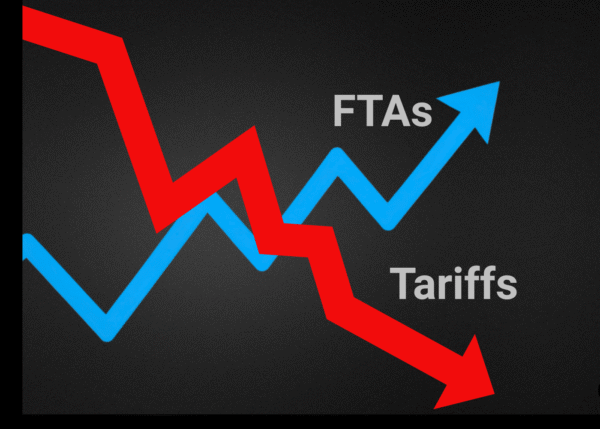
But overall, real-world “lived experience” with tariffs and trade barriers, or more jargon-ishly “postneoliberalism” and “economic nationalism”, seems to have had a powerful effect on public opinion. To the extent there was a modest tide of anti-FTA feeling in the 2010s, it seems to have gone out, leaving a few tidepools but no significant opinion reservoirs. The 2015 plurality support for TPP, meanwhile, now looks close to consensus, with Democratic opposition to trade liberalization nearly evaporated and Republican opposition sharply diminished. And the public generally seems to want something very different from what it’s been getting these last few years.
PPI’s four principles for response to tariffs and economic isolationism:
Then and now:
In 2015, Pew sees plurality support for TPP.
In 2026, The Argument finds consensus support for free trade agreements.
And perspectives on the CPTPP from founders Japan, Singapore, Canada, Australia, and Chile, and new member the United Kingdom.
Also then & now:
Trump admin’s April 2, 2025, tariff decree.
Commerce Sec. Lutnick pledges army of “millions and millions” of assembly-line workers in consumer electronics, and more recently predicts 6% GDP growth.
A year later, BLS finds all job growth at a standstill.
… and their colleagues at the Commerce Department’s Bureau of Economic Analysis report 1.5% GDP growth.
Ed Gresser is Vice President and Director for Trade and Global Markets at PPI.
Ed returns to PPI after working for the think tank from 2001-2011. He most recently served as the Assistant U.S. Trade Representative for Trade Policy and Economics at the Office of the United States Trade Representative (USTR). In this position, he led USTR’s economic research unit from 2015-2021, and chaired the 21-agency Trade Policy Staff Committee.
Ed began his career on Capitol Hill before serving USTR as Policy Advisor to USTR Charlene Barshefsky from 1998 to 2001. He then led PPI’s Trade and Global Markets Project from 2001 to 2011. After PPI, he co-founded and directed the independent think tank ProgressiveEconomy until rejoining USTR in 2015. In 2013, the Washington International Trade Association presented him with its Lighthouse Award, awarded annually to an individual or group for significant contributions to trade policy.
Ed is the author of Freedom from Want: American Liberalism and the Global Economy (2007). He has published in a variety of journals and newspapers, and his research has been cited by leading academics and international organizations including the WTO, World Bank, and International Monetary Fund. He is a graduate of Stanford University and holds a Master’s Degree in International Affairs from Columbia Universities and a certificate from the Averell Harriman Institute for Advanced Study of the Soviet Union.

