
| Total | $544 million |
| Cacao beans, paste, and cocoa butter | $313 million |
| Chocolates & cocoa powder | $231 million |
*Most recent data available.
WHAT THEY MEAN:
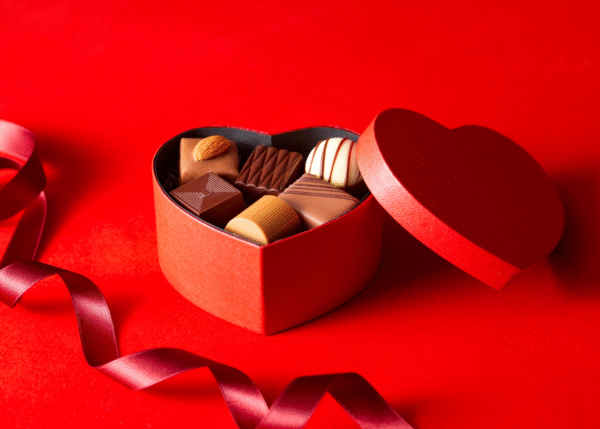
Why does your V-Day box of assorted cremes, darks, truffles, and ganache cost so much? Partly it’s an unavoidable natural consequence of last year’s bad weather in West Africa, and partly it’s self-inflicted via tariffs. A look at the chocolate world — trees and farmers, shippers and chocolatiers, retailers and lovers — and the impact of eccentric and ill-judged policy:
Sources, Trade, and Production: Chocolate comes from the cacao tree, a shade-loving evergreen native to the Amazon. About 20 feet high when mature, the tree produces a few dozen green, red, or purple “pods” annually, each weighing about a half kilo and containing 20 to 50 beans. It’s not quite true to say that no chocolate originates in the United States — artisanal Hawaiian and Puerto Rican farmers produce about 100 tons of beans a year —but that’s a tiny fraction of the quarter-million tons American chocolatiers use annually. Most come from West Africa: Cote d’Ivoire grows nearly half of the world’s annual 5.6 million tons of cacao beans and neighboring Ghana adds 0.6 million more, with Ecuador third and Indonesia fourth.
Cacao farmers pluck the pods twice a year, then extract, ferment, and dry the beans to prepare them for sale. The New York Botanical Gardens explain:
“The fruits are cut from the tree and split open with machetes to extract the seeds surrounded by the white pulp. Next, the seeds are put into wooden boxes to ferment for usually three to six days. The fermentation causes the development of the characteristic aroma and flavor of chocolate, and in the breakdown of the white pulp surrounding the seeds. The beans are dried, either in the sun or in ovens, and the remaining pulp is removed.”
American chocolatiers are the world’s fourth-largest buyers (Europeans do more), purchasing 235,000 tons last year, with 82,000 tons from Cote d’Ivoire, another 84,000 tons from Ghana and Ecuador combined, and the rest divided among about 15 other producers around the world. Along with this came 311,000 tons of semi-processed cocoa paste and cocoa butter, with Côte d’Ivoire, Indonesia, Malaysia, and Ghana the main sources. All are duty-free under the normal, Congressionally authorized U.S. tariff system. Next step:
“In the chocolate factory, the beans are roasted to further enhance the flavor [ed. note: turning them from “cacao” into “cocoa” beans] and then the seed husk is broken and blown away in a process called winnowing, which leaves only pieces of the embryo called nibs. The nibs are ground into chocolate liquor, which is run through a hydraulic press to yield cocoa butter on one side and cocoa powder (which also contains some cocoa butter) on the other side of the press.”
The powder goes to drinks, and the “butter” (mixed in various degrees with milk, sugar, etc.) to confections. Compressing the whole tree-to-tongue supply chain, one or two pods go into a chocolate bar (roughly one pod for milk, and two for dark), and a 14-piece assortment needs about five pods. U.S. chocolatiers produce about 2.1 million tons annually, while grocers and retailers import another 755,000 tons, mainly from Canada and Europe.
Prices, Weather, and Tariffs: If this Saturday’s Valentine gift seems especially expensive, you’re not wrong. A Lending Tree study this month found that prices for boxed assortments have jumped by 11.8% on average since last February, and in some cases nearly doubled.
One reason for the spike is natural and unavoidable. Drought and unusual heat in West Africa last year meant trees produced fewer beans. This pushed prices up from $2,000 to $3,000 per ton of beans to above $10,000. The other reason is artificial and self-inflicted: the Trump administration’s April 2 tariff decree imposed 21% tariffs on Ivorian beans, 10% on Ghanaian beans, 32% on Indonesian beans, and 10% on beans from Ecuador. (Again, all were previously duty-free.) On top of this, they added 20% tariffs on European Union confectionery and 31% on Swiss confectionery. Rates have shifted around a lot — a July rewrite of the decree reset them at 15% for the West African and Ecuadoran beans, 19% on the Indonesian butter and paste, and 15% for European and Swiss confectionery — but have been raising costs all year long.
Altogether, from April to November the tariffs put over half a billion dollars’ worth of new expenses into the U.S.’ chocolate supply chain. Averaging by month, that’s an extra $25 million in tariffs on $250 million in cacao and chocolate imports. About three-fifths of the cost fell on U.S. chocolatiers buying beans, paste, and butter to turn into bars, truffles, and kisses. (And on their workers: BLS’s most recent data showed confectionery employment down by 3,500 jobs since January.) Grocers and retailers buying finished confections and powder paid the rest. The financials:
| 2024 | 2025 | Extra payments | |
| Total | $71 million | $615 million | $544 million |
| Cacao beans | $0 million | $111 million | $111 million |
| Cocoa paste and butter | $0 million | $202 million | $202 million |
| Cocoa powder | $0.4 million | $59 million | $59 million |
| Chocolate confectionery | $71.million | $243 million | $172 million |
The administration backed off on the beans, paste, and butter tariffs in mid-November, so Ghirardelli and Hershey got some year-end relief. But your Cadbury, Valrhona, Nestle or Lindt box still comes with 15% tacked on.
In sum, the tariff experiment has had some clear results — more costs for chocolatiers, fewer jobs for confectionery workers, and higher prices for couples. To the extent there’s a bright spot: the National Retail Federation’s V-Day forecast — spending up $1.4 billion this year — suggests that couples, if with some regret, have mostly decided to absorb the extra expense rather than scale back. If so, tariffs have imposed a clear cost, but lovers haven’t let it kill the mood.
PPI’s four principles for response to tariffs and economic isolationism:
Data:
Lending Tree’s chocolate-price survey.
Growers & chocolatiers:
The New York Botanical Garden summarizes the trail, from pod on tree to candy in box.
The World Cocoa Foundation (a non-profit consortium of producers, confectioners, governments, and transport firms) has material on development and sustainability, trade and prices, small-farmer support, and more.
The Ghana Cocoa Board explains Ghana’s cacao industry.
The European Union-funded Sustainable Cocoa program supports labor law and reforestation in Cote d’Ivoire, Ghana, and Cameroon.
The Hawaii Chocolate and Cacao Growers Association introduces the U.S. cacao-growing industry.
And San Francisco-based Ghirardelli has chocolate-tasting pro tips.
Chocolate’s association with sensuality and romance, and the accompanying hints of possible aphrodisiac effects, are old and very durable. The specific tie to Valentine’s Day is originally British. Chocolate-bar inventor and marketing pioneer Richard Cadbury came up with the heart-shaped box as a romantic gift in the 1860s. Cadbury was taking advantage of a much older tradition, which seems to have originated in the Aztec Empire. Here’s Bernal Diaz del Castillo’s account of a banquet with the Aztec emperor Moctezuma in 1521:
“De cuando en cuando le traian en unas copas de oro fino con cierta bebidea del mismo cacao, que decian era para tener accesso con mujeres.”
English translations seem a little euphemistic — one reads “from time to time they brought him a certain drink made from cacao in cups of pure gold, which they said he took when he was going to visit his wives” — but Diaz del Castillo’s original Spanish doesn’t leave many doubts.
As a trade policy sidenote, cacao trees didn’t grow in the Aztec heartland — too dry — and the emperors, a bit like Americans today, got the cacao beans through a picturesque state trading enterprise. The Florentine Codex (Book 9) says they financed annual merchant expeditions to Maya principalities in modern-day Chiapas and Guatemala, carrying woven cotton clothes, rock crystal earrings, and gold jewelry to exchange for jade, quetzal and spoonbill feathers, and cacao beans.
For the big picture, The True History of Chocolate (Sophia and Michael Coe, 2013) takes you from Aztec nobles — they liked chocolate as a whipped drink, like a cappuccino — through 19th-century innovators Cadbury and Fry to modern mass markets and high-end tasting.
Is chocolate really an aphrodisiac? Italian researchers in 2006, having done a sex-life survey of two groups of women in 2006 — one eating a lot of chocolate and the other not — bleakly concluded that “no differences between the two groups were observed.” A more recent look in Southern California, this one with both male and female subjects, got the same result.
But via an earlier PPI Trade Fact, some other scientists reported in 2012 that it might actually, maybe, hold up for supposedly boring vanilla. This study used male lab rodents rather than human subjects, though.
PPI wishes friends and readers a romantic and happy Valentine’s Day, even if it’s a little harder to afford this year.
Ed Gresser is Vice President and Director for Trade and Global Markets at PPI.
Ed returns to PPI after working for the think tank from 2001-2011. He most recently served as the Assistant U.S. Trade Representative for Trade Policy and Economics at the Office of the United States Trade Representative (USTR). In this position, he led USTR’s economic research unit from 2015-2021, and chaired the 21-agency Trade Policy Staff Committee.
Ed began his career on Capitol Hill before serving USTR as Policy Advisor to USTR Charlene Barshefsky from 1998 to 2001. He then led PPI’s Trade and Global Markets Project from 2001 to 2011. After PPI, he co-founded and directed the independent think tank ProgressiveEconomy until rejoining USTR in 2015. In 2013, the Washington International Trade Association presented him with its Lighthouse Award, awarded annually to an individual or group for significant contributions to trade policy.
Ed is the author of Freedom from Want: American Liberalism and the Global Economy (2007). He has published in a variety of journals and newspapers, and his research has been cited by leading academics and international organizations including the WTO, World Bank, and International Monetary Fund. He is a graduate of Stanford University and holds a Master’s Degree in International Affairs from Columbia Universities and a certificate from the Averell Harriman Institute for Advanced Study of the Soviet Union.

