
PPI - Radically Pragmatic
  • Donate
Skip to content
  • Home
  • About
    • About Us
    • Locations
    • Careers
  • People
  • Projects
  • Our Work
  • Events
  • Donate

Our Work

20 Years of Reinvention: Education Reform in New Orleans

  • August 27, 2025
  • Emily Langhorne
  • Rachel Canter
Download PDF

EXECUTIVE SUMMARY

On August 29, 2005, Hurricane Katrina devastated New Orleans, accelerating the collapse of an already disintegrating city public school system. Prior to the storm, almost two-thirds of New Orleans public school students attended failing schools, half dropped out, and fewer than one in five enrolled in college. The school system suffered severe financial mismanagement, corruption, and crumbling school infrastructures.

Yet in the midst of a national tragedy came an unprecedented opportunity for education reform. Louisiana transferred 80% of the city’s public schools to the state-run Recovery School District (RSD), which, over the next decade, converted them all into charter schools. The elected Orleans Parish School Board (OPSB) turned most of its 17 remaining schools into charters as well. In 2018, the state “reunified” the RSD schools with the local school board. By 2020, the OPSB had converted its last two schools to charters, making New Orleans the first large U.S. school district composed entirely of charter schools.

This sweeping education reform led to remarkable academic gains. Over the last 20 years, student outcomes have grown substantially. Despite harder assessments, students have jumped ten percentage points in reading and math at fourth and eighth grade, and graduation and college enrollments have rocketed by more than twenty percentage points. In 2024, not a single New Orleans school was rated as “failing” by the state accountability system.

The New Orleans model will not translate perfectly to all American districts, given the unique circumstances of post-Katrina recovery. Nonetheless, elements of its approach provide a compelling blueprint for large bureaucratic districts. These include:

  • Significant school autonomy, so school leaders have the freedom they need to craft schools that meet their students’ needs.
  • Accountability for student performance, including the opportunity for schools to expand and/or replicate if successful, and to face replacement or closure if not.
  • Full choice between a diverse array of educational models.
  • Competition for students and dollars among schools.
  • A board and superintendent largely freed of responsibility for operating schools, enabling them to concentrate on system-wide needs and issues.

The reinvention of New Orleans’ public schools represents both stunning success and critical lessons. If every major American public school system could achieve similar improvements, the effect on children across the nation would be profound.
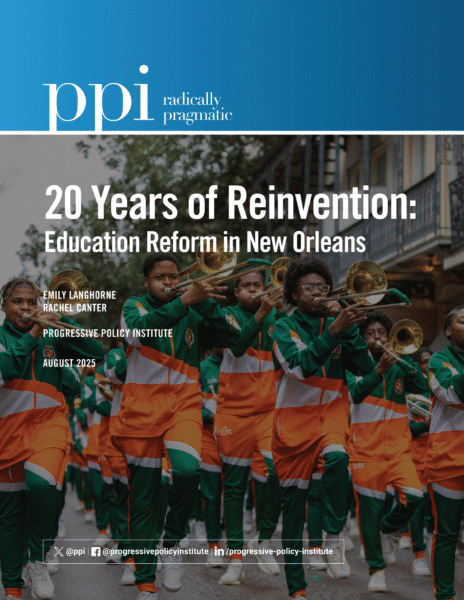
Read the full report.


Related Work

In the News  |  June 24, 2026

Manno for Education Next: When Government Eventually Gets It Right

  • Bruno Manno
In the News  |  June 22, 2026

Canter on New Books in Education: Inside the Mississippi Marathon How Mississippi Dramatically Improved Its Education System

  • Rachel Canter
Op-Ed  |  June 21, 2026

Manno for Community College Daily: Rebuilding the rules of higher ed’s opportunity ladder

  • Bruno Manno
Op-Ed  |  June 17, 2026

Manno for The 74: Faster, Cheaper, Job-Related: Students Demand Flexible Credentials After HS

  • Bruno Manno
Op-Ed  |  June 11, 2026

Manno for Real Clear Education: The Nation’s Report Card Delivers A Split Verdict That Demands A Civic Response

  • Bruno Manno
Op-Ed  |  June 3, 2026

Manno for Datia K12: The Expectations Trap: Teachers Need Clarity

  • Bruno Manno
  • Never miss an update:

  • Subscribe to our newsletter
PPI Logo
  • Twitter
  • LinkedIn
  • Facebook
  • Donate
  • Careers
  • © 2026 Progressive Policy Institute. All Rights Reserved.
  • |
  • Privacy Policy
  • |
  • Privacy Settings