The United States could save $46 trillion in economic and social losses by moving to a smart containment strategy involving aggressive testing and tracing. That’s according to UVA economists Anton Korinek and Zach Bethune, who spoke with PPI’s Mike Mandel on our weekly online discussion on Friday. The economic and social benefits from smart containment are so large, by their calculations, that it makes sense to pay for a virtual army of workers to do testing and tracing. By contrast, choosing the “herd immunity” strategy leads to a deep recession, slow recovery, and many lost lives.
The coronavirus crisis is a stark reminder of the grave costs of infrastructure neglect — in this case, neglect of our public health infrastructure.
Decades of hard-earned experience — with SARS in 2002, H1N1 in 2009, and Ebola in 2014 — gave us a roadmap for international and domestic rapid response systems to identify and isolate outbreaks before they could cause catastrophic damage.
Properly funding pandemic preparedness infrastructure might have cost us a few billion dollars. Instead, our lack of preparedness has cost the U.S. economy over $12 trillion in market value, $2 trillion in taxpayer-funded stimulus and bailouts (and counting), threatened the health of hundreds of millions of Americans, and plunged the world economy into a what could be a global depression.
On Monday, April 20th, President Trump tweeted that he would “temporarily suspend immigration into the United States!” By the middle of the week, the executive order he issued had suspended many forms of immigration for 60 days.
In some ways, this was merely pro forma. It is simply the latest in a string of policy actions taken in response to the pandemic and economic shutdown. Immigration court proceedings are on hold, visa processing is suspended, non-essential travel from abroad has been banned. These are unfortunate but understandable.
Almost immediately, Trump was accused of politically exploiting the pandemic to further his restrictionist immigration agenda. Neither Trump’s actions nor the criticisms are surprising — he is, after all, a politician and this is basically the definition of what they do. Besides, some urban liberals are doing the same thing.
One of the president’s stated reasons for his executive order is to “protect” Americans jobs in the midst of rising unemployment. In many parts of the country, the economic doldrums are expected to last into 2021.
This may sound paradoxical but, in contrast to the president’s erroneous “lump of labor” thinking — and in contrast to pre-crisis Democratic calls to throw open the borders — some modestly expanded immigration channels can help with economic recovery.
There are at least three areas where some loosening of immigration policy could kickstart the rebound — and perhaps generate bipartisan agreement.
The enormity of challenges posed by the coronavirus pandemic, and the speed at which crises can take root, demand that our leaders act boldly and quickly. But the need for decisive action also gives leaders an unfortunate opportunity to “not let a good crisis go to waste” by slipping unrelated policies into must-pass legislation. Congress has largely avoided this temptation to date, and it should continue to avoid it while preparing the next rounds of investment, relief, and stimulus.
Unfortunately, some of President Trump’s proposals for the next comprehensive relief bill would not meet this standard. Instead, these ideas risk exacerbating the spread of the disease while recklessly giving money away to those least in need. Although significantly less harmful, some Democrats have also put forth proposals that would do little to mitigate the current crisis and have no place in stimulus legislation. Policymakers in both parties should keep taking bold action to fight this historic pandemic without embracing these counterproductive or wasteful policies.
Limit Business Liability for Employees Who Contract the Coronavirus: Among the worst ideas proposed by the administration and its Republican allies in Congress is offering businesses immunity from legal liability if they make decisions that cause their employees to get sick. These decisions could include opening their business too quickly or failing to abide by social-distancing guidelines. There is no debate among top economists that social distancing should continue for as long as is necessary for the good of public health, including partial or full business closures. Liability protection would incentivize businesses to take risks with their employee’s health, likely exacerbating the spread of the disease. Moreover, it may not even achieve its goal of hastening the recovery — if consumers do not think it is safe to shop, then businesses will not thrive even if they have legal protections. This proposal would only double down on the public health blunders Trump has already made, such as cutting staffing and financing for vital public health offices, downplaying the virus’ threat, and neglecting states who tried to buy lifesaving equipment.
Restore the Food and Entertainment Deduction: President Trump has also proposed bringing back the full business deduction for food and entertainment expenses, which he claims would encourage people to patronize restaurants struggling for business amid the pandemic. Restoring this deduction, which has been curtailed over the years to prevent businesspeople from reducing their tax burden through extravagant purchases, will do nothing to encourage diners to eat out as long as they believe it is unsafe to do so. The main beneficiary would be someone like President Trump, a hotel owner with a financial interest in encouraging businesspeople to travel and dine at high-end destinations.
Cut Payroll Taxes: The Trump administration has repeatedlychampioned cutting payroll taxes as a preferred form of stimulus. Unfortunately, doing so would provide the greatest assistance to those that need it least. Workers who are laid off or otherwise unable to earn a paycheck would receive no benefit from a payroll tax cut, while someone earning six figures would receive a tax cut more than double the size of what a median-wage earner would receive. Moreover, cutting employer-side payroll taxes would give little benefit to businesses in the short-term as half of their tax payments have already been suspended until the end of 2021, and the other half until the end of 2022. If policymakers nevertheless choose to cut or suspend payroll taxes, these reductions should only apply to the first $15,000 of a worker’s earnings or the earnings of workers whose production capabilities have been idled by the coronavirus. They should also consider replacing the payroll tax with more-efficient tax policies to better meet our economy’s needs in both good times and bad after the current crisis has passed.
Cut Capital Gains Taxes: The administration has also proposed cutting the income taxes that investors pay on the gains they make from selling stocks and other assets that have appreciated in value. Income from capital gains is heavily tilted towards high-earners: households in the highest-income 1 percent make 22 percent of their income through capital gains in 2016, while less than 2 percent of income that went to all other households came from capital gains. Accordingly, cutting capital gains taxes would be extremely regressive. Additionally, temporarily incentivizing investors to sell their assets would only accelerate the recent crash in market prices.
Repeal the SALT Cap: The Trump administration has not been alone in using the coronavirus crisis to push for wasteful tax cuts. Some Democratic leaders have floated the idea of retroactively rolling back the $10,000 cap on the amount of state and local tax (SALT) liabilities households can deduct from their federal income taxes. Proponents argue any such proposal would target the benefit towards the middle class, but the SALT cap affects very few middle-class families. The only people affected by the cap are those who earn enough to both benefit from itemizing their deductions and have a large enough state liability to exceed the cap, so repealing the cap would mostly benefit the very wealthy. Ninety-six percent of the benefit of fully repealing the SALT cap would go to the highest-earning fifth of American households, and 56 percent of the benefit would go to the highest-income 1 percent. Further, making this change retroactive obviously would not affect taxpayers’ past decisions about where to live and pay taxes, and would simply offer a windfall to wealthy people in high-tax states.
Forgive Student Loan Debt:Some Democrats, echoing presidential campaign ideas from Sens. Bernie Sanders and Elizabeth Warren, have also proposed forgiving up to $10,000 of every student loan holder’s debt burden. There is no question that policymakers should be giving borrowers flexibility at a time when a short-term cash crunch will prevent many from making their required payments. But Congress has already addressed this need by suspending required minimum payments and additional interest accrual on public student loans for six months. Forgiving future debt won’t provide any economic benefit until long after the crisis and need for stimulus have passed. Further, untargeted student debt forgiveness would be a regressive policy. Students take on debt to increase their earning potential, and high-income people are more likely to have student debt than low-income people. The steps Congress has already taken achieve the same short-term financial relief as student loan forgiveness in a far more effective way.
Create Costly Permanent Programs:Some have argued that the government’s ability to spend trillions of dollars fighting the coronavirus and its economic impact now somehow proves that fiscal discipline in normal economic times is unnecessary. Although the government can pay back a one-time cost in future years, permanently large deficits will compound rather than fall over time. The federal government is fortunate to fight this battle against the pandemic at a time when interest rates are low, but those rates may well rise in the future if structural deficits are not brought under control. Rising interest costs threaten to crowd out critical public investments and reduce future economic growth. Accordingly, lawmakers should not accept policies that permanently increase deficits just because debt-financed stimulus is necessary to address temporary problems.
Enact Other Unrelated Policy Riders: The urgency of action to support the economy unfortunately makes it easy for leaders on both sides of the aisle to attach unrelated riders to emergency legislation. The CARES Act, although generally focused on the task at hand, included some policies that have nothing to do with the coronavirus pandemic, such as extending abstinence-only sex education programs and requiring the Food and Drug Administration to consider approving new kinds of sunscreen. The Trump administration has used the crisis as a pretext to weaken important environmental regulations and suspend applications for green cards. Democrats have also proposed including other policies, such as a permanent $15 minimum wage for workers at businesses that benefit from relief funds, that would not help mitigate the current crisis. These policies and others that do not relate to the immediate health and economic crisis could slow down the passage of much-needed support and should be debated separately on their own merits.
There is no shortage of good ideas to fight the coronavirus and mitigate the economic damage it’s doing to businesses and families. Lawmakers should reject inferior alternatives that would waste important public resources or otherwise exacerbate the crisis.
Since the coronavirus pandemic reached America’s shores, Congress has passed four major pieces of legislation to address the growing crisis. The $8 billion Coronavirus Preparedness and Response Supplemental Appropriations Act funded public health agencies at the federal, state, and local level and set money aside to lower the cost of any eventual vaccine. The Families First Coronavirus Response Act, which cost just under $200 billion, offered medical leave to many of those affected by the outbreak and expanded public support programs such as Medicaid. Finally, the $2.3 trillion Coronavirus Aid, Relief, and Economic Security (CARES) Act and a nearly $500 billion supplemental follow-up bill extended loans and grants to businesses, sent stimulus checks to most Americans, expanded unemployment insurance, and offered funding to hospital systems and state and local governments. Together, these laws have provided a powerful response to the crisis — but more still needs done, and leaders from both parties are beginning to consider what to include in the next piece of legislation.
Congress was right to bolster spending on the health-care system, as fighting the virus itself must be our top priority. Increasing production and distribution of personal protective equipment, ventilators, and other lifesaving equipment will help reduce the disease’s spread and death toll. Leaders must also continue to ensure that there are enough affordable tests to effectively track the disease before they gradually reopen the economy. And most importantly, policymakers should clear regulatory and funding barriers that inhibit the development of effective treatments and an eventual vaccine needed to end the pandemic once and for all.
But Washington must also do more to help businesses, people, and governments that are suffering financially. In the short-term, this means providing more “life support” to an economy that has been put into a temporary coma in order to facilitate public health measures. Policymakers must then put in place policies that will help revive the economy when it is safe to do so. This piece outlines a series of steps U.S. policymakers should take to facilitate both phases of this recovery and ensure future prosperity after the coronavirus.
Supporting State and Local Governments
People across the country are turning to their governors, mayors, and other state and local officials for support during this crisis. But many programs that support struggling citizens and are partially financed by state governments, such as unemployment insurance and Medicaid, are already being financially stressed by the economic freeze. State and local efforts to fight the pandemic itself are also expensive, and with much of the economy shut down, states are losing vital sales and income tax revenue. The result is a fiscal squeeze on state and local governments that with few exceptions are required to balance their budgets each year. Without adequate support from the federal government, states and municipalities will be forced to cut services or raise taxes at a time when doing so would undermine national efforts to prop up the economy.
Fortunately, Congress has already taken some steps to ease the financial burden these governments will experience. The first coronavirus bill allocated almost $1 billion to state and local health departments, which coordinate contact tracing, quarantines, and other essential efforts to contain the disease. The second bill increased the federal government’s matching rate for state Medicaid spending. And the CARES Act established a $150 billion fund to directly supplement the budgets of states, territories, tribal governments, and large cities.
But state and local leaders say this is not nearly enough. Over 2100 cities still expect budget shortfalls, and many say they will have no choice but to lay off workers and cut public safety spending this year if they don’t receive adequate financial support. New York City, which has the nation’s largest coronavirus outbreak, is already preparing to cut back on trash pick-up, traffic safety operations, and public transportation. And some governors are warning that they may need to cut teacher pay or lay off teachers before the next school year. Accordingly, the bipartisan leaders of the National Governors Association — Govs. Andrew Cuomo (D-NY) and Larry Hogan (R-MD) — are asking Congress to give states and territories at least $500 billion in additional aid. Depending on the severity of the current recession, PPI estimates that it is possible even more support could be needed over the coming year.
Democrats fought to include $150 billion in additional support for state and local governments in the most recent coronavirus relief legislation to help keep states afloat until federal leaders reach a larger deal, but they were rebuffed by their Republican counterparts. Some Republicans oppose offering federal aid because they believe doing so will make it easier for state and local governments to delay reopening their economies, even though those social distancing guidelines are currently essential for slowing the virus’ spread. Meanwhile, Senate Majority Leader Mitch McConnell has suggested that state and local governments themselves are responsible for their budget crunches because some had pre-existing shortfalls in their pension funds. But the coronavirus and the economic shutdowns required to contain it are imposing an additional squeeze government budgets completely unrelated to any earlier policy decisions. State and local governments, no matter how good their fiscal management before the current crisis began, will need financial help for as long it continues.
There are two main ways Congress can get money to state and local governments. As it did in the CARES Act, the federal government could offer states and localities a lump-sum amount based on a jurisdiction’s population or other metrics of need. For example, a bipartisan Senate proposal would create a $500 billion fund to support state and local governments with grants based on the virus’ spread in each jurisdiction and their lost revenues, in addition to their population size. A lump-sum structure such as this offers financial support immediately rather than as state and local governments spend, and ideally gives governments flexibility in their use of the funds to prevent layoffs or cuts to essential services. Although the CARES Act initially required aid go towards medical equipment and other spending priorities specifically relating to the coronavirus outbreak, Democrats have fought to allow state and local governments to use these funds to plug general revenue shortfalls as well.
Alternatively, Congress could increase the matching rate for existing state and local partnerships, as it did with Medicaid in the Families First Act. Doing so avoids the practical limitations of establishing new channels to move the money and oversee it while incentivizing state and local governments to maintain their pre-existing spending commitments. Tying aid to state programs such as Medicaid that grow with health-care expenses will also target aid somewhat towards the states with the greatest costs. Regardless of the mechanism Washington uses to support state and local governments, it is essential that sufficient aid is provided — and soon.
Strengthening Automatic Stabilizers
The path this crisis will take is unpredictable, so federal action should be designed to last as long as is necessary to protect public health and stabilize the economy. The best way to ensure this is through “automatic stabilizers” — policies that cause spending to rise or taxes to fall automatically when the economy contracts, and vice versa. These policies are responsive to real economic needs and are unconstrained by the political processes that often slow the passage of discretionary stimulus or end it prematurely. Tying relief to real economic conditions can also be politically beneficial because doing so ensures the public feels that federal actions are supportive enough to sustain them through the crisis.
The federal government should use automatic stabilizers to extend its relief measures for as long as the economy needs them. The Payroll Protection Program (PPP), which was established by the CARES Act to support small businesses, required an emergency infusion of funds when it ran out just three weeks after opening. Rather than continuing to provide limited pots of money that will only briefly stem the deluge of layoffs and closings, lawmakers should change the program to grow automatically with eligible business’ needs or replace it with more direct payroll subsidies. Similarly, the CARES Act’s $600-per-week increase in unemployment benefits will only last for 39 weeks, even though there is no guarantee workers can reasonably expect to find a job in that time. Policies such as this one should expire only when certain economic benchmarks are met rather than on an arbitrary calendar date.
Future stimulus packages will also give Congress an opportunity to address structural problems that couldn’t be addressed in their past legislation:
Let businesses access more forgivable loans to pay for fixed costs other than payroll (such as rent) so long as they don’t lay off workers.
Give states adequate resources to modernize their antiquated unemployment insurance systems, the limitations of which prevented federal policymakers from enacting targeted benefit increases and instead forced them to inefficiently increase all benefits by a flat amount, resulting in some workers receiving benefits even greater than their lost wages.
Plug holes in the Supplemental Nutritional Assistance Program (SNAP) expansion included in the Families First Coronavirus Response Act, which excluded the poorest families and will only last until the president’s national emergency declaration ends.
Perhaps most importantly, lawmakers must act decisively to ensure aid reaches those who need it by reigning in President Trump’s corrupt efforts to avoid accountability, such as his decision to unilaterally fire and replace the independent Inspector General who was supposed to lead the oversight of lending under the CARES Act.
Addressing these shortcomings to the extent possible during a crisis would ensure that relief efforts reach those who truly need them and would help people and businesses weather the economic storm.
Restarting the Economy
In the short term, policymakers should focus on efforts to bolster our public health response and give Americans the economic life support they need while the economy remains frozen. The policies above fulfill these objectives by keeping Americans attached to their jobs, giving them the money they need to pay for necessities and preventing otherwise viable businesses from failing. But policymakers should also begin developing policies that will help stimulate the economy into a robust recovery once it is reopened by encouraging businesses to invest, consumers to spend their money, and employers to hire more workers.
One example of a good “recovery” policy is increasing infrastructure investment. The U.S. already had a $1.5 trillion infrastructure deficit before the coronavirus crisis hit — rebuilding our aging infrastructure would create good-paying jobs, give those workers more money to stimulate the economy through consumption, and leave future generations with a robust public investment that will pay dividends for decades. Both President Trump and Speaker Pelosi have demonstrated interest in boosting infrastructure investment, making it a form of stimulus that in theory at least should have bipartisan support. But timing is everything: there is limited value in putting more people to work at a time public health experts are advising them to stay home, and putting money in their pockets will do little good when they are unable to spend it on anything but basic necessities because so many producers are closed. Creating jobs and encouraging consumption are goals best left for the end of the pandemic rather than when we’re in the middle of it.
Another good way for policymakers to encourage consumption as they reopen the economy is by reducing taxes that ordinarily discourage it. Forty-five states and many local jurisdictions have sales taxes that raise the cost of buying and selling goods. While economists generally favor taxes on consumption because they encourage saving and reduce economic distortions, temporarily reducing sales taxes in a weak economy can help boost demand when it’s most needed. Federal leaders should encourage state and local governments to cut sales taxes and compensate those governments for the lost revenue (states that do not have sales taxes to cut could instead offer refundable tax credits to residents for purchases they make during the crisis, the cost of which would be reimbursed by the U.S. Treasury). The cuts should be tied to economic indicators so that the taxes automatically rise back to normal as the economy improves. The entire subsidy from cutting sales taxes would encourage spending, making this policy an exceptionally potent stimulus tool. Lower-income people would disproportionately benefit from sales tax cuts because they must spend a larger share of their income just to get by.
Finally, after the pandemic has been defeated and our economy fully recovers, policymakers must confront our nation’s dire fiscal situation. The federal government is on track to spend at least $4 trillion more than it raises in revenues this year. The cost of action should not deter policymakers from taking any step necessary to combat this pandemic and its resulting economic damage, but leaders will need to deal with the debt we accumulate now after the crisis passes. The national debt was already on track to grow at an unsustainable rate in the coming years because of wasteful tax cuts, the rising cost of health care, and the strain our aging population will put on social insurance programs such as Social Security and Medicare. Adopting automatic stabilizers will help ensure that stimulus is no more expensive than it needs to be, but the only reliable way to preserve our fiscal capacity to address future economic crises is by adopting comprehensive solutions that close the structural gap between revenues and spending.
No one can predict all the challenges that lay ahead or how long they will take to resolve. Rather than enacting short-sighted solutions that only carry our country through one month at a time, policymakers should develop a comprehensive roadmap to recovery that will adequately meet our economy’s needs at each turn. Supporting state and local governments, strengthening automatic stabilizers, and putting in place a package of policies to stimulate the economy when it’s ready to reopen would put America back on the right track.
In a new special podcast series from the Progressive Policy Institute, small businesses owners sit down with PPI’s Director of Technology Policy Alec Stapp to share the stories behind their businesses and how they’re using technology to survive — and even thrive — during the pandemic.
Episode 1: The guests in this episode are Sas Simon and Lena Imamura from Name Glo, a New York City-based studio that specializes in unique and custom neon designs.
Episode 2: The guest in this episode is Lee Frank from This Corner, a Center City Philadelphia-based business that includes both a retail shop and a hair salon.
It is becoming clearer each day that the health and economic crisis created by the COVID-19 pandemic won’t just change the way we live and work, it will also change the way we educate.
It is becoming clearer each day that the health and economic crisis created by the Covid-19 pandemic won’t just change the way we live and work, it will also change the way we educate. Already colleges and universities across the nation have closed their campuses and shifted to online, video-teaching, or some combination of the two for the remainder of the spring semester.
But what will happen after that? Our higher education system will not go back to the status quo ante, that much is clear. The experience of shifting to remote learning will have long-lasting effects on the ways we think about teaching and learning.
That’s the upside, but there are also serious downsides that we need to start thinking about — now. And to address them we’ll need decision-makers in Washington and state capitals to prepare the groundwork.
Here are three things that will be different.
First, next year’s incoming students will have fewer resources than last year’s. Very likely these students and their families will be under greater financial strain and more concerned about the health consequences of living in dormitories and attending large classes with hundreds of their peers. According to a study conducting by the Art and Science Group, 1 out of 6 high school seniors who expected to attend college this fall are rethinking those plans.
Second, next fall we are going to have fewer colleges for new and current students to attend. A sizable number of small private colleges may have to close their doors because they are tuition-dependent and don’t have significant endowments. Many of these schools have lived on the margins for a long time, able to postpone tough budget choices as long students could access federal loans to finance the rising price of a college education. A 2016 report by Ernst & Young noted there are 800 colleges vulnerable to “critical strategic challenges” because they depend on tuition for more than 85% of their revenue. Already more than 90 colleges have closed in the last three years according to EducationDive — and that number will likely increase dramatically because of the impact of Covid-19.
Finally, many state schools (including 4-year and community colleges) are already overcrowded with students who can’t get into the classes they need to graduate. These schools will be unable to accommodate the increased number of students seeking less expensive alternatives to private schools.
Fortunately, a number of America’s leading public and private schools have large endowments (106 have endowments over $1 billion according to the Chronicle of Higher Education) and they have the resources — both technological and personnel — to help. How? By dramatically expanding online and virtual learning to those who — because of the crisis — can no longer afford the high cost of tuition, have lost their place at college because their school went out of business, or have lost their job.
There are four things institutions of higher education can do post-crisis to expand opportunities for less costly online learning at America’s best schools:
Leading universities — Harvard, Columbia, University of Texas at Austin, among others — offer online extension programs where students can take college-level courses and earn degrees. These schools, along with the others with endowments above $1 billion, should commit to expanding enrollments in these programs in the fall by 10 to 25 percent, at heavily discounted prices (most are already cheaper than comparable onsite courses). As we have seen from the recent closure of colleges across America, shifting quickly and smartly to virtual classrooms is possible, and in this time of crisis a necessity.
All colleges and universities should treat these programs the same as on-campus ones (and if they don’t Congress should make them). If students who are enrolled in these programs later decide to transfer to another school (or apply to a graduate program), all colleges and universities would be required to accept all successfully completed work in these courses (grade C or above) for full credit.
In order to ensure there are enough instructors, tenured and full-time faculty at the 160 schools mentioned above, should volunteer to teach one to two more online courses a semester than their contracts require — without additional compensation. As a director of a graduate program at Johns Hopkins University, my contract requires me to teach 3 courses a year. While teaching an extra two courses next year would be a challenge, it is nothing compared to the sacrifice being made by our medical community and others putting their lives on the line in the fight against Covid-19. According to the American Association of University Professors, there are over 52,000 tenured or non-tenured full time faculty in the U.S. If only half those agreed to teach two additional courses next academic year at 20 students per class, the number of course slots would increase by one million.
The well-endowed schools should commit to hiring more adjuncts to teach some of these courses at above the median adjunct pay salary — currently $2,700 per course according to an AAUP survey. Doing so would help reduce the economic impact of the crisis.
While college and university leaders need to take the lead on these initiatives, they need help from lawmakers in Washington and state capitals.
Financial Support. The recently enacted stimulus bill included $14 billion for higher education. The Secretary of Education has some flexibility over about 2.5 percent of that funding — which could be used to support the top private and public schools from expanding or creating online undergraduate programs at reduced costs. Congress should also provide additional funding for this effort if and when they enact a second COVID-19 stimulus bill.
Remove Regulatory Barriers.Governors and state legislatures should waive any licensing requirements and fees that might prevent these public and private schools from implementing launching this effort.
Provide Legal Protection for Schools.Some endowment funds are tied to specific projects or research. To give schools the ability to use their endowments in this national crisis, Congress should enact legislation that would shelter schools from legal action from past donors.
When our political leaders in Washington failed to recognize the seriousness of the Covid-19 crisis, America’s colleges and universities stepped up to the plate by shuttering their on-campus operations and swiftly moving students to virtual education for the rest of the spring semester. Undoubtedly this will save countless lives, but their work is not done. Colleges and universities will need to step up again this fall when the worst of the health crisis is hopefully over and the struggle to reboot America’s economy begins.
Financing Child Tax Credit refundability with taxes on high unearned incomes is a progressive anti-poverty model that Biden should take inspiration from.
By Brendan McDermott | Fiscal Policy Analyst for PPI
Vice President Joe Biden has begun the hard work of uniting the party against Donald Trump. Biden has tried to appeal to the party’s left wing with proposals to eliminate student loan debt and lower the age at which people qualify for Medicare from 65 to 60. But a better approach would be to adopt cost-effective policies that are targeted to support struggling families. A particularly promising example is a proposal former presidential candidate Sen. Michael Bennet introduced alongside Sen. Mitt Romney to extend the Child Tax Credit to the poorest families and offset the cost through progressive tax reforms.
Raising a child is expensive. Food, clothing, child care, and birth-related health care for both the mother and her child can easily strain a family’s finances. In spite of these high and rising costs, the Urban Institute projects that the federal government’s expenditures on children will fall from 2.4 percent of U.S. gross domestic product in 2018 to 2.1 percent by 2029. Although there are many causes of this decline (not all of which are cause for concern), a particularly worrying contributor is the fact that spending on children will compete for funding with programs that benefit the elderly, which are growing more expensive as America’s population ages.
The federal government provides the Child Tax Credit to help parents afford the cost of raising a child. The credit’s value phases in with parents’ income (families with no earned income receive no credit), until it reaches its maximum value of $2,000 for each child under 17 years old. The credit’s value begins phasing out if the parent earns more than $200,000 ($400,000 for married couples). If the credit is larger than the parent’s tax liability, the parent can receive a tax refund for up to $1,400 of the credit, but parents still need to earn at least $2,500 to qualify for any refund at all.
The Child Tax Credit lifted over four million children out of poverty in 2018. But because parents with very low incomes do not qualify for the credit or only qualify for a partial credit, the children who need financial support the most are often the ones whose families receive the smallest credit or none at all. The Tax Policy Center estimates that while almost all upper-middle and middle-income families receive the Child Tax Credit, just 75 percent of the poorest fifth of families do. PPI called for making the Child Tax Credit refundable in our budget proposal, Funding America’s Future, released last year. Democratic lawmakers also proposed making the credit fully refundable for six years as part of the negotiations over what would become the Coronavirus Aid, Relief, and Economic Security Act, Congress’ recent bill to mitigate the impact of the coronavirus pandemic.
The centerpiece of Bennet’s presidential campaign was an expansion of the Child Tax Credit, which he introduced in the Senate with Sen. Sherrod Brown. More recently, Bennet and Romney proposed a plan that would give parents of children under six years old a “Young Child Tax Credit” worth up to $2,500, $1,500 of which would be completely refundable regardless of the parents’ income. Parents of children from age 6–17 would receive the same credit they do today, but $1,000 of the credit would be refundable even if the parents had no income, and there would be no limit on how much of the credit a parent could receive as a tax refund if they received a larger credit. Since cash transfers to families are associated with better health, educational, and economic outcomes for children, especially poor children, ensuring that the children of parents with no or very low income still get financial support will pay off throughout the child’s life.
This Bennet-Romney plan is more modest than Bennet’s previous proposals but is the first to receive bipartisan legislative support. And while the plan’s cost has not been scored by the Congressional Budget Office, it is the first to include a pay-for. The senators would offset the cost of the credit by partially closing an egregious tax loophole — the “stepped-up basis” for taxing inherited assets. People pay capital gains taxes on the income they make by selling an asset for more than they bought it for. But if someone inherits an asset and sells it, they only have to pay tax on the increase in the item’s value since they inherited it, lowering their tax burden. Wealthy people are far more likely to have both capital and inheritances, so the stepped-up basis loophole specifically benefits the people who need it the least. The Bennet-Romney plan would still exempt $1.6 million of inherited assets per person ($3.7 million for spousal inheritance) from new capital gains taxes.
It is unclear whether this tax change would raise enough revenue to offset the full cost of expanding the Child Tax Credit under the Bennet-Romney plan, and Biden has already proposed using this revenue source to pay for some of his other priorities. Still, financing Child Tax Credit refundability with taxes on high unearned incomes is a progressive anti-poverty model that Biden should take inspiration from, both to substantively strengthen his platform and to help appeal to the party’s left without plunging the nation deeper into debt.
This year, thanks to the coronavirus, the dreaded “summer slide” will be worse than usual. Studies have found that students lose up to 25 to 30 percent of what they learned in an academic year over the following summer, with the worst losses, particularly in reading, among low-income kids.
A Gallup survey done in early April found that 83 percent of parents reported their children were involved in online distance learning. But Gallup conducted the survey online, so it excluded families with no internet connection. That means perhaps a third of students are not participating in remote learning this spring. For them, “summer” will last at least five months.
Some districts and charter schools may run summer schools after stay-at-home orders are lifted. But most are predicting funding problems ahead due to lower tax revenues, so it’s likely that few will be able to afford summer school.
Are there other solutions? Districts and charter organizations could switch to year-round schedules, which have developed in some places to combat summer slide. Typically, these schools close for only a month or so at the height of summer. They reopen in early August, then have two-week breaks in the fall, at Christmas, in February and in April. Some charter schools bring kids who are behind grade level in for intensive catch-up work during at least one of the two weeks off each quarter.
Fears about the novel coronavirus, the economic meltdown, and prolonged self-isolation are taking an emotional toll on Americans. Calls to the federal mental health crisis hotline are 900 percent greater than this time last year.
In normal times, one in five American adults deals with mental health issues. Anxiety is the most common mental disorder; 6.8 million people in the U.S. — roughly 3 percent of the adult population — suffer from generalized anxiety disorder.
But in the unique moment of time we find ourselves in today, Americans are currently dealing with increased stress, decreased cash flow, and an inability to leave their house to seek mental health services.
Tele-health poses an opportunity to address some of those issues.
Yesterday, the WSJ published an investigation with the headline: “Amazon Scooped Up Data From Its Own Sellers to Launch Competing Products.” As the article notes, in a Congressional hearing last year, an Amazon associate general counsel said, “We don’t use individual seller data directly to compete” with businesses on the company’s platform. The reporter for the WSJ claims to have seen evidence of Amazon managers violating this self-imposed rule in order to improve its private label goods business (i.e., Amazon-branded products).
There are two issues at play here. First, there is the question of whether Amazon violated Section 5 of the FTC Act by engaging in “unfair and deceptive practices” in order to entice third-party sellers onto its platform. Amazon is currently conducting an internal investigation into what occurred and a Congressional committee has already said it will be looking into the matter. These investigations are necessary and worthwhile for determining what exactly happened and who knew what when.
The second issue is about antitrust law. Stacy Mitchell, the executive director of the Institute for Local Self-Reliance, said, “An exec testified in July that Amazon doesn’t use data from sellers to create its own rival products. Turns out it does. This is monopoly behavior, hence the coverup.” But as Doug Melamed, a professor at Stanford Law School, said in comments about the situation, “Using the data to improve product offerings is not, and ought not be, unlawful under US law. The issue is whether Amazon obtained the data by misappropriation or misrepresentation.” Professor Melamed is correct on the question of antitrust law. To understand why, it’s useful to discuss the history of the retail industry and how it works today.
1. All major retailers use data on what sells in stores to build their private label businesses
It is common practice for retailers, including grocery stores and department stores, to use data to develop their own store brands to directly compete with name brand products. As Benedict Evans, an independent analyst, put it in reaction to the story, “It can be pretty entertaining to watch critics of Amazon discover ‘retail.’” The practice of using information about which products are selling well to develop private label goods is nearly as old as the retail industry itself. Sears launched its catalogue business in 1888. By 1927, the retailer was selling its own tools and appliances under the Craftsman and Kenmore in-house brands.
These days, selling private label goods is practically de rigueur for a company competing in the retail industry. Here are the shares of revenue from private label goods for some leading retailers according to data compiled by Morgan Stanley:
Kohl’s: 46%
JCPenney: 44%
Target: 33%
Kroger: 25%
Macy’s: 20%
Lowe’s: 20%
Costco: 20%
Office Depot: 20%
Dollar General: 20%
Walmart: 15%
By comparison, Amazon share of total retail sales from private label goods is only 1% (excluding its proprietary electronics such as Echo voice assistants, Fire TV, and Ring doorbells). As Jack Hough writes for Barron’s, “Private labels work best for products with decent turnover and excessive margins. […] Remember when HDMI cables sold for $30 a decade ago? Now, you can find them for $7.” Most private label goods are commodities akin to HDMI cables. The large and concrete benefit of lower prices to consumers outweighs the negligible effects on innovation (the HDMI cable has reached its final state and requires no new investment).
2. Amazon is not dominant in retail
While private label goods may be ubiquitous in retail, some critics argue that Amazon is so dominant it’s qualitatively different from when other retailers do it. Hal Singer, a managing director at Econ One, argued as much on Twitter: “It’s not just that Amazon has access to better information. It’s that, unlike a grocery chain, Amazon is DOMINANT PLATFORM PROVIDER.” But retail is a much more competitive market than many realize. For instance, Amazon is still much smaller than Walmart. Here are US retail sales figures for 2018 (the most recent year of data):
Walmart: $388 billion
Amazon: $121 billion
Kroger: $120 billion
Costco: $101 billion
Walgreens: $98 billion
Home Depot: $97 billion
CVS: $84 billion
Target: $74 billion
It seems difficult to argue that it’s a problem when Amazon uses data to inform its private label business, but not when a company more than three times its size ($388 billion vs. $121 billion) does the same thing at a rate 15 times higher (15% vs. 1%).
3. Online retail platforms are more open to competition than physical stores
But maybe it’s something special about the online retail market as opposed to the brick-and-mortar retail market? Perhaps sellers feel they have no option but to sell on Amazon if they want to sell online? That doesn’t seem to be the case. According to data from eMarketer, more than half of Amazon sellers also sell on eBay. Slightly less than half sell on a personal website as well. More than a third also sell on Walmart. It also seems worth noting that prior to the internet, third-party sellers had no option at all for selling directly to consumers. They had to negotiate with one of the big box retailers for placement on store shelves. Online platforms give them a new channel for reaching customers directly.
4. Retailers don’t have private data on cost structures for manufacturers
So, private label goods are not unique to Amazon in the retail industry and the company does not have a dominant position in the market. But maybe because Amazon is a “tech” company it has much more data than brick-and-mortar retailers and therefore has an anti-competitive advantage? Shaoul Sussman, a legal fellow at the Institute for Local Self-Reliance, tried to make that argument:
The key here is ad spend on Amazon! In the past, Amazon claimed that it only uses data that is widely available to brands-including sales, product ranking, and the like. But the amount a brand spends on ads is private information that only Amazon has!
I can reverse engineer the majority of another brand’s cost-including shipping, referral, and storage fees — but the missing piece would be ad spend! That is key for 2 reasons: (1) actual margins (2) how much the brand has to boost the product to hit optimal sales volume.
Sussman’s claim that a retailer could “reverse engineer the majority of another brand’s cost” is unfounded. No retailer has nonpublic information about the vast majority of a manufacturer’s fixed costs (property, plant, and equipment) or variable costs (raw materials, labor, etc.). Knowing the amount spent on shipping, storage, and marketing is only a small fraction of a company’s cost structure. Understanding marketing costs is helpful, but that doesn’t mean Amazon knows the cost structure of manufacturing the product. In some cases, that might be publicly available information. But that means every other competitor has access to it, too.
Yes, Amazon has more data than rival brick-and-mortar retailers (particularly on what consumers look at but never purchase), but the jury is still out on how much of a competitive advantage this affords them relative to big players like Walmart (which also has its own online marketplace and spends more on IT per year than Microsoft and Facebook). And even if this is an advantage, that would not necessarily be an antitrust issue if it’s used to deliver consumer benefits. (Of course, that does not absolve Amazon of the need to truthfully represent to sellers how it’s using that data.)
5. The only difference between a platform and a retailer is inventory risk
Sussman thinks there is another key difference in Amazon relative to other retailers:
Amazon is a *retailer*, a *platform*, and a *producer*. I have no problem with them using the data they have as a *retailer* to develop products — just like Walmart. I do have a problem with Amazon using information they gather as a *platform/ad biz.*
First, it’s important to know that ad fees on Amazon are analogous to slotting fees in brick and mortar stores. Brands have been paying for promotion in retail long before the e-commerce revolution. Prime shelf space and prime search rankings are both scarce resources that are auctioned off to the highest bidder. According to data from the Center for Science in the Public Interest, food manufacturers spend 70% of their marketing budgets on these “trade promotion fees” and 30% on advertising. At the end of the day, it’s all marketing.
Second, while it’s true that Amazon is simultaneously a retailer, producer, and platform, this is not economically different from traditional retailing. I’ve already explained how legacy retailers also engage in private label and are therefore “producers.” And while they are not “platforms” in the technical sense of being open to anyone (sounds… anticompetitive), the business model is not significantly different.
Traditional retail charges a markup on the price paid to wholesalers or manufacturers (a percentage of the final retail price). The retailer can either purchase that inventory outright and assume the risk of it not selling, or it can include a “sale or return” provision, which reserves the retailer the right to return the inventory to the wholesaler or manufacturer if it does not sell. Inventory risk is just another cost and can be traded off with other contract provisions during the negotiating process.
Platforms, on the other hand, do not take custody of the inventory and instead provide services to sellers. In exchange, the platform charges a percentage of the final retail price. Whether it’s a platform or a retailer, the business is the same: Partner with companies selling goods and collect a profit margin on the final retail price. The rest is just accounting.
Conclusion
In the debate over private label goods, it’s important to keep in mind why consumers prefer them. According to survey data from Nielsen, 70% of people say they purchase private label brands to save money. This is unsurprising as private label goods tend to be less expensive than name brand goods while offering similar levels of quality. It’s as clear an example there is of direct horizontal competition.
While the FTC should look into the allegations that Amazon violated its own Chinese wall — and therefore misled sellers — politicians such as Senator Warren and Congressman Cicilline are conflating a consumer protection issue with an antitrust issue to support their own ideological crusade. Contrary to what they may claim, the accusations of antitrust violations in this case are dubious.
PPI, R Street Institute, and the Alliance for Connected Care discuss the potential of telehealth to reach patients where they are — at home. Courtney Joslin, Krista Drobac and Michael Mandel shared how the Trump administration has reduced barriers to accessing telehealth, and what states can do to increase access to telehealth services during the COVID-19 pandemic. They highlight how this can help patients, what hurdles remain, and the limits to care delivery via telehealth.
President Trump, you’ve got company. The European Union also is on the hot seat for its tardy and ineffectual response to the coronavirus pandemic.
Come November, U.S. voters will have an opportunity to fire Trump for rank incompetence. But Americans should be rooting for the EU to raise its game. Otherwise, Europe could emerge from the COVID-19 crisis fatally weakened in every way — broke, politically fractured and unable to resume its role as America’s main partner in world affairs.
Euro-skepticism was rising even before the crisis hit. Britain emphatically reaffirmed its decision to quit the EU last December. Across the continent, insurgent populist parties have been gaining ground on the strength of promises to curb migration, shelter workers from globalization and “restore” national sovereignty.
Against this backdrop of rising nationalism, the pandemic is putting the EU to a stern test of efficacy and relevance. As Europeans struggle to contain the plague and keep their economies from unraveling, can Brussels organize mutual aid that’s equal to the magnitude of the crisis? So far, the answers haven’t been encouraging.
Italy was the first EU country to be hit hard by the virus. As the pandemic ravaged northern Italy and economic life sputtered to a stop, its neighbors were excruciatingly slow to lend a hand.
The transition to distance learning has caused unprecedented disruption to our education system. Many low-income students do not have internet access necessary for taking classes online. While some districts and charter schools are distributing devices and hotspots, in others, students are making do with paper packets.
With all this chaos, though, we still live in an economy in which most occupations will require more than a high school diploma in the near future. Students must be prepared with an adequate education.
So let’s think creatively about what we can do to help. One constant resource for kids of all ages is the local library. Why not begin by opening libraries and using them as one way to bridge the gap? Reading is the gateway to learning, and nothing is more valuable to children than developing a love of reading. Yet according to a recent survey, only 56 percent of American students read for enjoyment.
Could we use this moment to help cultivate that love?
Widely available antibody testing is inching closer to reality. It could soon be possible to partially staff libraries with employees who have recovered from the coronavirus, who are therefore more likely to be immune, and who volunteer to return to work.
After libraries are deep cleaned, librarians could curate recommended reading lists and encourage children to check out books from them. Teachers could also develop reading lists and periodically ask their students for book reports, to demonstrate that they’re participating.
This would not be a replacement for online learning; rather, it would be a supplemental solution that could reach all students equitably and without requiring too much parental assistance. For some families, it would provide a welcome break from their new teaching duties.
With at least 20 states already closing schools for the rest of this academic year, summer is starting early for many students. Even during a normal summer, many students, especially lower-income children, lose up to 30 percent of what they learned the prior year; an anticipated “COVID slide” is likely to make things even worse.
To combat summer slide, schools have long promoted summer reading programs, which have been shown to improve literacy for low-income students. Accessing good books could provide an escape during the long months between now and the fall. And perhaps students who never read for pleasure before could get hooked on books.
To communicate about the program, schools and districts could send out emails and put flyers in the free meals distributed to students at grab-and-go meal sites and bus stop deliveries.
To maintain social distancing, libraries could designate specific days of the week for different grades. Students would line up outside their library on their designated day, six feet apart, wearing masks and gloves. The libraries could make books from their reading lists available on tables just outside or inside the door. Children could then take turns choosing their next books.
A week later, they would return what they took in a paper bag and check out new books. Librarians would allow bags of returned books to sit for 72 hours — the virus’s lifespan on plastic — before handling. For an extra precaution, libraries could even remove the plastic covers typical of most library books.
Districts and charter schools that are distributing hotspots and devices to families with no internet connection could give them out at libraries as well, to reach any families who have not yet received them. Some libraries offered mobile hotspots to residents before COVID-19; there is even more reason to do so today.
As the program would gain in popularity, students would tell their classmates and friends about it. Teachers could even offer rewards for the number of books read and the number of other students recruited to read.
I expect many teachers would be excited to participate, on a voluntary basis, and have the opportunity to see their students again. Communities could organize book drives and create boxes outside libraries to be filled with donated books. The libraries could let the donation bin sit for at least three days, then allow students to take a few books to keep.
This initiative could help meaningful learning continue for all students, regardless of circumstance. And it could fuel a love of reading in a new wave of students, of all income levels.
As Dr. Seuss said, “The more that you read, the more things you will know. The more that you learn, the more places you’ll go.”
Bruce Arao, a spring 2020 intern at the Progressive Policy Institute, is a student at the University of California, Santa Barbara, double-majoring in economics and sociology.
The COVID-19 pandemic is already a world-historic event, both in terms of health and economics. For Brazil, no one knows how far the disease will go and how bad the damage will be.
Yet as people around the world engage in “social distancing” in order to stem the virus, the importance of connectivity and in particular wireless connectivity stand out. Mobile phones enable people and business to communicate and be productive even when they have to stay physically apart. In particular, mobile apps are becoming even more embedded into daily life.
In this paper, we focus on Brazil’s App Economy: Those app developers and other workers who create, maintain, and support an ever-expanding range of apps for health, communications, ecommerce, education, transportation, banking, and smart homes. The size of an App Economy workforce in a country is indicative of the rate at which that country is embracing the digital transformation and how well it will be positioned as the global economy recovers from the pandemic.
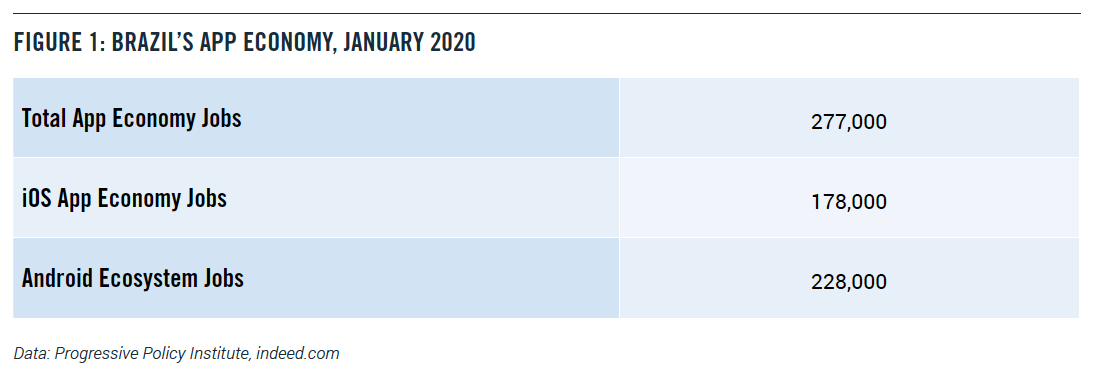
As of January 2020, before the global pandemic took hold, we estimate Brazil has 277,000 App Economy jobs.1 We find 178,000 App Economy jobs to belong to the iOS ecosystem, and the Android ecosystem to total 228,000 jobs. (These numbers sum to more than the total of Brazilian App Economy jobs because App Economy jobs can belong to multiple ecosystems).
INTERNATIONAL COMPARISONS
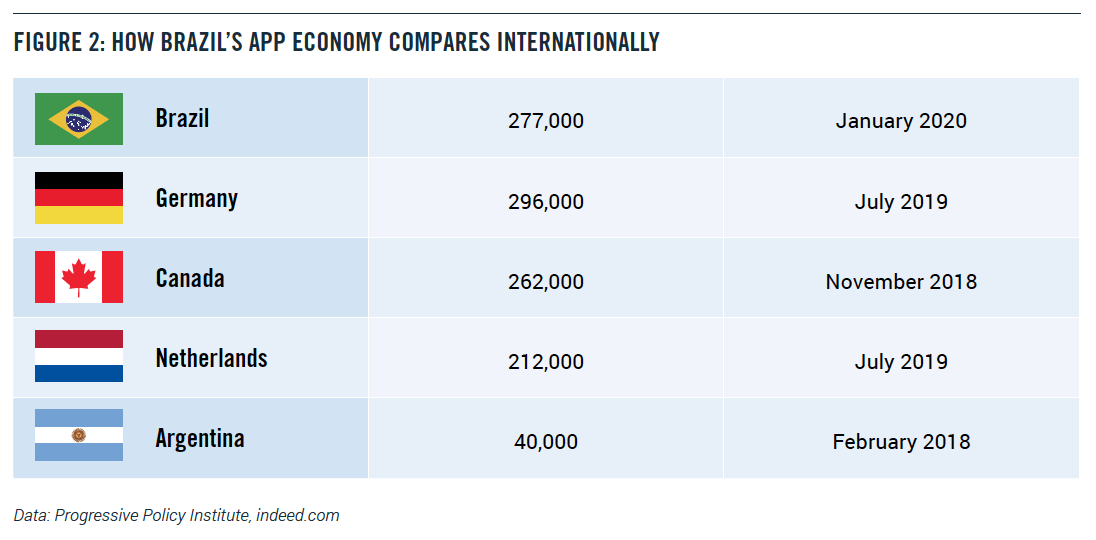
How does Brazil’s App Economy compare with other countries? In absolute terms, Brazil’s 277,000 App Economy jobs as of January 2020 compares well with Canada, which had 262,000 App Economy jobs as of November 2018.2 Brazil’s App Economy rivals that of some important European Union members.3
For example, we estimated Germany to have 296,000 App Economy jobs as of July 2019 and the Netherlands to total 212,000 App Economy jobs as of July 2019. On a smaller scale, Argentina had 40,000 App Economy jobs as of February 2018 (Figure 2).4
EXAMPLES OF APP ECONOMY JOBS
The Brazilian App Economy is extensive both in terms of its depth and range of industries. We examined App Economy job postings as of March 2020, as the global pandemic was starting to take hold.
The Brazilian ICT sector was undoubtedly hiring App Economy workers. As of March 2020, content platform Encripta S/A was searching for a senior Android developer in Sao Paulo. IT company Indra Sistemas, S.A. was seeking a senior Java developer with knowledge of iOS and Android in Sao Paulo. Software firm TOTVS was looking for a junior front-end developer to work on mobile apps in Joinville. Mobile app development company Tap4 Mobile was hiring a mobile developer with knowledge of Swift programming in Manaus. Software developer Supero was searching for an Android developer with experience in Kotlin and Swift in Florianópolis.
The financial sector was actively hiring App Economy workers. As of March 2020, payment processor Stone Tecnologia was seeking a front-end developer with experience in iOS and Android in Sao Paulo. Financial firm SPC Brasil was looking for a senior mobile developer with iOS experience in Sao Paulo. Banking cooperative Sicredi was searching for an iOS developer in Porto Alegre. Financial research firm Empiricus was hiring a senior mobile specialist with knowledge of iOS in Sao Paulo. Payment platform PicPay was seeking an iOS developer in Vitória. Banking company Banco Itau was looking for mobile engineers with iOS and Android experience in Sao Paulo.
But other industries are also hiring App Economy workers as digital technology spreads into the physical industries. Pulp company Eldorado Brasil was hiring an Android developer in Campinas. Farming equipment manufacturer John Deere was searching for a junior backend software engineer with knowledge of Java or Kotlin in Indaiatuba. As of February 2020, appliance manufacturer Whirlpool Corporation was seeking a senior information systems analyst with experience in iOS and Android in Sao Paulo. Agricultural company Cargill was looking for a senior software engineer with experience in Xamarin and Swift in Sao Paulo. Medical e-learning company MedMKT was hiring a developer with knowledge of iOS and Android in Moncoes.
As of March 2020, retail company Via Varejo SA was searching for an Android developer in São Caetano do Sul. Event platform Uhuu! was seeking an Android developer in Porto Alegre. Travel aggregator Hurb – Hotel Urbano was looking for an Android developer in Rio de Janeiro. As of February 2020, ecommerce logistics company ASAP Log was hiring a fullstack developer with Android experience in Curitiba.
Media company Grupo Global was searching for iOS and Android developers in Rio de Janeiro as of March 2020. News company globo.com was seeking an iOS developer in Rio de Janeiro. As of February 2020, content publisher Secad was looking for a mobile application developer with experience in iOS and Android in Porto Alegre.
Academic institution Fundação Armando Alvares Penteado was hiring a mobile iOS developer in Sao Paulo as of March 2020. Research nonprofit Instituto de Pesquisas Eldorado was searching for an Android developer in Brasília. As of February 2020, research organization Atlantico Institute was seeking a junior test analyst with knowledge in Android.
FUTURE GROWTH
The economic turmoil caused by the global pandemic is likely to depress demand for App Economy workers in the short-run in Brazil and elsewhere. But as that turmoil dies down, the economic and social changes triggered by COVID-19 are likely to expand demand for health related apps. Telehealth, or the ability to deliver healthcare at a distance, will become more important in the aftermath of the pandemic. Similarly, long distance learning will become more accepted, as will ecommerce delivery.
In a 2019 report, Brasscom, the Brazilian ICT industry association, projected the need for 70,000 new ICT professionals per year going forward. According to Brasscom, the demand is spread across such areas as mobile apps, the cloud, information security, Internet of Things, and big data.
But mobile apps are a key enabling technology, because it is only natural to use tablets or phones as the human interface for almost any technology. A farmer who accesses a program for boosting crop yields, for example, will almost invariably use an app.
And then there are gig economy apps such as Rappi, iFood, and Uber. Our figure for App Economy jobs does not include gig economy workers. However, according to the Instituto Locomotiva, approximately 17 million Brazilians regularly use an app to generate income.5 These gig economy jobs are suffering during the pandemic, but they will be a potent source of growth in the future.
POLICY DEVELOPMENTS
In August 2018, Brazil passed Lei Geral de Proteção de Dados (LGPD), a comprehensive data protection law. Similar to the European Union’s General Data Protection Regulation, LGPD regulates the use of personal and sensitive personal data and defines an individual’s data rights such as the right to access and delete data.6 Additionally, the law requires businesses and organizations handling data to hire a data protection officer, provides ten legal bases for processing data, allows fines of two percent of a company’s Brazil revenues up to 50 million reals, and applies to multina-tional companies doing business in Brazil.
As economies become increasingly connected through globalization and digital technology, multinational companies will naturally gravitate toward investing in countries with better business conditions. Additionally, costly and burdensome requirements like LGPD make it difficult for startups to innovate and provide new products and services.
CONCLUSION
The coronavirus pandemic will undoubtedly transform global health and the economy. Ways of doing business while limiting contact like telehealth, distance learning, and ecommerce will likely see increased demand. As a result, apps and data – which allow consumers to purchase goods and services without coming into contact with others – will play a critical role in the recovery. Brazil’s App Economy is already sizable, totaling 277,000 App Economy jobs by our estimates as of January 2020. That includes the digital sector but also physical industries such as banking, ecommerce, media, and education.
This number is not directly comparable to our February 2017 estimate of 312,000 Brazilian App Economy jobs because of a subsequent change in methodology. A description of our current methodology can be found in our October 2017 report, “The App Economy in Europe: Leading Countries and Cities, 2017.”
Gary Pearce on Politics and Public Policy in North Carolina
The virus has taken away President Trump’s biggest reelection weapon. But he has a big weapon left, and he’s wielding it relentlessly.
Gone is his economic message: “You’ve never had it so good, the stock market has never been so high, and unemployment has never been so low.”
But Trump hasn’t lost the weapon that got him elected and could get him reelected: his ability to divide and conquer.
That weapon is super-charged by the President’s willingness, eagerness and ability to dominate the public debate. He has turned his daily White House briefings into the most powerful of bully pulpits.
But therein lies a risk. For Trump can – and has – hurt himself as much as he helps himself in the briefings. Staying at a podium for more than an hour is like staying at a bar past midnight: Not much good can happen.
Trump reminds me of North Carolina’s Senator Jesse Helms. I still have scars from Governor Jim Hunt’s unsuccessful campaign against Helms for Senate in 1984. That race taught me some hard lessons about politics.
Helms’ team approached the race very differently from us. Hunt was a popular Governor, while Helms was controversial and unpopular. We thought that gave us an edge.
But the Helms campaign didn’t try to make him more popular than Hunt. They didn’t think that was possible, I later learned. So, they flipped the script.
Their goal was to make Hunt more unpopular than Helms.
They did a good job. They started running negative ads against Hunt 18 months before the election. They never stopped.
Much like Trump does to his opponents today, they tied Hunt to people and groups who were unpopular with a lot of North Carolina voters: Jesse Jackson and other civil rights leaders, Democratic presidential candidate Walter Mondale, abortion-rights supporters, labor unions and what Helms called “the homosexual lobby.”
This same strategy is Trump’s trump card, if you will. He played it against Hillary Clinton. He’ll play it against Joe Biden.
A Republican political consultant once explained to me the ironclad hold that Trump has on his famous base: “He’s fighting the people they hate.”
That’s why Trump constantly picks fights. He fights with Democrats in Congress, with bureaucrats in Washington and with politicians of both parties.
At his virus briefings, he picks fights with reporters, with governors and with his own public health experts.
He picks a fight with China by calling it the “Chinese virus.” He picks fights with the World Health Organization. He picks fights with his own staff, Cabinet and military commanders.
The day he announced his campaign for President, he picked a fight with Mexico and immigrants. He picked fights with John McCain and a Gold Star family. He picked fights with his Republican primary opponents – nasty, personal fights.
He’s a fighter. His base loves that. They love him for fighting, and they hate the people he fights.
But his greatest strength can also be his greatest weakness. Trump is President at a time when the nation is facing the greatest crisis in a generation.
It’s a double whammy: thousands of people are dying and getting sick, and millions of people are losing their jobs and businesses.
Ultimately, President Trump will face the voters’ judgment on how he has responded and on how he acts from here out. This election was always going to be a referendum on Trump. Now it’s even more so.
Voters know he’s good at fighting his enemies. They’ll judge how good he is at fighting for the country.
Gary Pearce writes on policy and politics in North Carolina, and is a guest writer for the Progressive Policy Institute. You can learn more about Gary by visiting www.NewDayforNC.com.