Langhorne for Forbes, “An Unlikely Alliance: Here’s What Can Happen If Teachers Unions Embrace Charter Schools”

For the past six months, education experts have speculated at length about the role of teachers unions after the Supreme Court decision in Janus v. American Federation of State, County, and Municipal Employees (AFSCME).

Some argue that the inability to charge all teachers agency fees, even if they don’t join the union, will force the unions to focus more on the needs of teachers and less on influencing election results. Others suggest that to attract new members the unions will need to highlight and increase the professional development opportunities– continuing education, technology training, leadership conferences, etc.– that they offer.

While the loss of agency fees may hurt teachers unions in the short term, it clearly presents an opportunity for them to reinvent themselves, to evolve and find their place in 21st century education systems.

In Minnesota, two local union leaders have spent the better part of the last decade doing just that. In 2011, Louise Sundin and Lynn Nordgren helped form The Minnesota Guild of Public Charter Schools, a union-backed charter school authorizer created to oversee schools that promote teacher leadership and professionalism.

Continue reading at Forbes.

Amazon, robots, ecommerce jobs, and business models

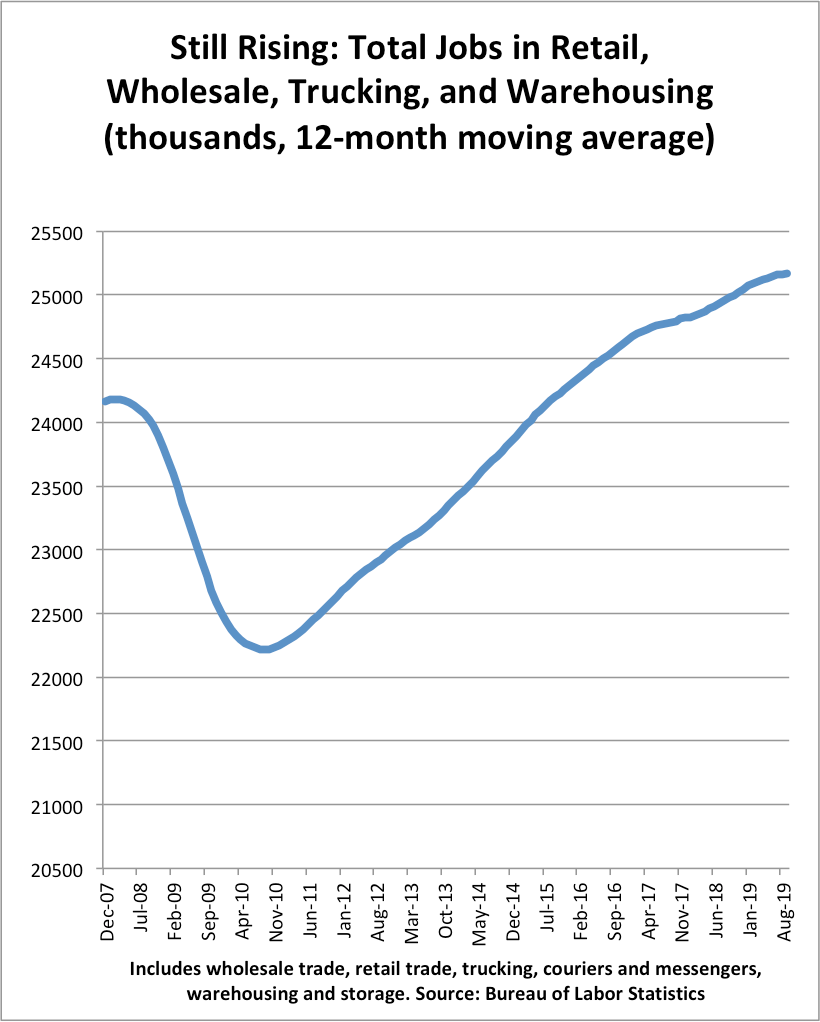
I’ve consistently argued that the ecommerce job boom has 5 or more years to run before employment peaks. Moreover, as ecommerce gets more automated, it will open up new possibilities for distributed manufacturing and the Internet of Goods.

However, a new story from the Washington Post highlights an ecommerce fulfillment center in China where

hundreds of robots pack roughly 200,000 boxes each day and ship them to customers across China. Four humans babysit.

With only 4 workers in this fulfillment center, owned by Chinese ecommerce giant JD.com,  has the automated wave of the future already arrived?

Well, no.  For example,  where are the people handling the returns? That was the question in my mind, since robots are not (yet) capable of opening return boxes, assessing damage or wear in multiple dimensions, and making the appropriate decision.

A quick look at JD.com’s return policy gives the answer–the company actively discourages returns. A customer who wants to return an item has to make a return request within 5 days, including “photo evidence clearly supporting the damaged/faulty item.”  Then the request has to be approved, with the company clearly noting that “the need to return items will be assessed on a case-by-case basis.” Finally, the customer is responsible for returning the item within a short time window

we must receive your package at our warehouse processing facility within 10 working days from the date we approved your request. We will inspect all returned items and if eligible, we will award a refund or resend you a brand new item.

Very few customers will choose to run this gauntlet unless the item is clearly not working.

By contrast, Amazon has adopted a business model of easy returns.*

Items shipped from Amazon.com, including Amazon Warehouse, can be returned within 30 days of receipt of shipment in most cases. Some products have different policies or requirements associated with them.

This is not a small difference. Amazon’s approach of rapid delivery and easy returns make ecommerce Pareto-superior to brick-and-mortar retail for most products, where Pareto-superior means better on every dimension. Why wouldn’t you shop from home, if you can get the product very fast and return it if it doesn’t suit you?

Moreover, an integrated procedure for handling returns is important because it sets up a two-way flow between the distribution centers and consumers. This is a genuine breakthrough in distribution that will create new business models for retail and for manufacturing.

By contrast, JD.com roboticized the easiest part of the process–picking a limited selection of identical boxes off the shelf.  But handling identical boxes was never the most expensive part of distribution.

Amazon’s approach has several advantages. First, consumers benefit, because they get improved service and the same quality of product without having to travel to the store. Second,  many more workers are employed in ecommerce, since more fulfillment centers are required to meet the rapid delivery requirement and because robots can’t (yet) handle returns. Third, Amazon’s holistic approach, by tackling the hard problems in distribution, ends up improving the productivity of the whole distribution system, and thus the economy.

Lesson: Fewer workers is not necessarily better.

*Jet.com, owned by Walmart, has roughly the same return policy.


New book by PPI Senior Fellow Andrew Yarrow

Today marks the publication of a new book by PPI Senior Fellow Andrew Yarrow, Man Out: Men on the Sidelines of American Life. The former New York Times reporter has documented the spread of online misogyny and other disturbing signs of a peculiarly masculine malaise pervading our country. Cultural and economic changes, Yarrow contends, have combined to leave many men confused about their role and drifting resentfully to the margins of society. You can learn more about this provocative book here.

The Progressive Choice: Creating 21st Century School Systems

Progressives have long understood that access to a quality education is the one factor that consistently and permanently changes the trajectory of a life. As such, creating a strong public school system has been at the epicenter of our decades-long struggle to promote equal rights and equal opportunity for all.

For many of America’s families of color, a public school education has historically been the path to the middle class. Unfortunately, America’s public education system is stagnant. Scores on the most widely respected test, the National Assessment of Educational Progress (NAEP), have been flat for a decade. Without transformation, our school districts will be unable to prepare students for the demands of the future, and our kids won’t be productive in tomorrow’s global workforce. As President Barack Obama said, “In a global economy, where the most valuable skill you can sell is your knowledge, a good education is no longer just a pathway to opportunity – it is a prerequisite.”

It’s a prerequisite we’re not close to attaining. America’s public education system continues to function like one designed for the industrial era. While other industries have adapted to the Information Age and the global marketplace, most of America’s school districts remain trapped in a structural model of centralized decision making and top-down bureaucracy.


The Real Story of Those Empty New York City Storefronts

Last week, the New York Times produced a visually stunning story about shuttered storefronts in NYC. The story’s premise, told in pictures, was a simple one:

New York City’s streetscape has been transformed — visually and economically — by the staggering numbers of vacant storefronts now dotting its most popular retail corridors.

We’ve all seen the empty storefronts, and they are certainly striking.  However, while the story had data on retail vacancy rates, there were no figures on retail employment or active retail establishments. I thought I’d fill in the gap.

First, here’s a chart of retail jobs in NYC, courtesy of the BLS. It turns out that despite the empty storefronts, NYC retail employment is at a 30-yr high. Retail jobs even rose in 2018, based on the first 7 months of the year.

Retail employment is rising, in part, because of job growth outside of Manhattan.  For example, retail employment in Brooklyn is up 34% since 2007.  Retail employment in the Bronx is up 30%, albeit off a low base. People can now shop in their home boroughs, rather than coming into Manhattan. This is a good thing.

The BLS also counts the number of retail establishments with employees. This is especially interesting, given the emphasis in the NY Times article on empty storefronts. What we see is that the number of retail establishments has fallen in Manhattan since 2007. But every other borough is up significantly. For example, the number of retail establishments in Brooklyn is up by 31% since 2007. Overall, the number of retail establishments in NYC is up 15% since 2007.

How can we explain this? In part, the vacant storefronts are the unintended result of  prosperity.  New York City has seen an enormous amount of development in recent years, including construction of ground-level retail as part of housing and office construction.  That’s how we can simultaneously get growing retail employment and empty storefronts.

But there’s another factor as well. Government figures tell us that retail is a low-productivity, low-pay industry (auto dealership are an exception).  Real wages for production and nonsupervisory workers in retail are at the same level as they were thirty years ago.   Productivity growth for grocery stores and department stores has been stunningly slow for thirty years (annual productivity growth rates of 0.4% and 0.7%, respectively, since 1987).

So the piled-up mountains of imported clothing and food shipped from afar found in most stores may no longer be the best use of some of the most expensive real estate in the world.  Perhaps we need to be thinking in terms of alternative uses for ground level space, like a return to light manufacturing of custom goods based on advanced technologies.  That may need a change in zoning, and a change in thinking about urban space as well.  But for now, realize that empty storefronts do not mean that the jobs have gone away.

Ecommerce wage boom

The ecommerce revolution is driving an employment and wage boom in the warehousing industry. Over the past 3 years, the number of production and nonsupervisory workers in general warehousing has gone from 642K to 810K, propelled by the rapid expansion of ecommerce fulfillment centers around the country.

Our earlier research showed that ecommerce fulfillment centers pay about 30% more than brick-and-mortar retail jobs in the same area. That’s the best comparison, since presumably ecommerce is shifting jobs from brick-and-mortar retail to fulfillment centers.

But equally important, the rapid growth of ecommerce fulfillment centers is driving up demand for workers, leading to soaring real wages. Over the past three years, real hourly earnings for productivity and nonsupervisory workers in general warehousing has risen by 10.4%. By comparison, real wages for production and nonsupervisory workers in the private sector as a whole are up only 2.8%. In healthcare, the comparable figure is up only 2.0%.

Now, I don’t pretend there aren’t issues. Fulfillment center jobs are not easy work, requiring much more physical labor than offices or brick-and-mortar retail.  There’s an open question of what a career ladder looks like in ecommerce. And we know from past technological revolutions that capital-labor conflict doesn’t disappear even when the overall economic pie is growing.

But in the big picture, ecommerce labor markets are behaving exactly as we would hope–strong demand and high productivity are driving up real wages for ecommerce workers. In fact, ecommerce is one of the few sectors producing big wage gains for less skilled workers, and they should lauded rather than demonized.


Marshall for The Daily Beast, “Hey, Democratic Socialists: More Big Government Won’t Fix What Ails Us”

More bureaucracies in Washington won’t do much to improve lives. The public-sector success stories of today are the nimble and innovative metro regions.

Kim for Governing, “When Cities Rely on Fines and Fees, Everybody Loses”

They’re a tempting alternative to raising taxes, but their long-term costs far outweigh the revenue they bring in.

Raising taxes is painful. That may be why, since 2010, 47 states and a number of cities have instead raised both civil and criminal fines and fees. These increases are often viewed as a conflict-free way to plug budget holes.

In the last decade, for example, New York City grew its revenues from fines by 35 percent, raking in $993 million in fiscal 2016 alone. The monies came largely from parking and red light camera violations, as well as stricter enforcement of “quality of life” offenses such as littering and noise. In California, routine traffic tickets now carry a multiplicity of revenue-boosting “surcharges.” As a result, the true price of a $100 traffic ticket is more like $490 — and up to $815 with late fees, according to the Lawyers’ Committee for Civil Rights of the San Francisco Bay Area.

This increasing reliance on fines and fees comes despite what we learned following the shooting in 2014 of Michael Brown by a police officer in Ferguson, Mo. A federal investigation of the city’s police department subsequently revealed that as much as a quarter of the city’s budget was derived from fines and fees. Police officers, under pressure to “produce” revenue, extracted millions of dollars in penalties from lower-income and African-American residents. In 2017, the U.S. Commission on Civil Rights issued a follow-up report finding that the “targeting” of low-income and minority communities for fines and fees is far from unique to Ferguson.

Continue reading at Governing.

In Memory of John McCain

Sen. John McCain deserves more than a tweet.

Yet that’s all our graceless and petty president could muster to mark the death of an authentic American hero and patriot. Perhaps that’s because John McCain was everything Donald Trump is not -– unflinchingly honest, brave, selfless, and respectful of others, including his political opponents.

The Navy flyer was no saint, and never pretended to be. McCain also could be impulsive, stubborn, cantankerous, and as opportunistic as any candidate in pursuit of his political ambitions. I still find it hard to forgive him for inflicting Sarah Palin on the nation. But McCain knew his faults and often turned his wicked sense of humor against himself. He managed to live a deeply purposeful life without taking himself too seriously. That’s an appealing combination.

Although McCain was genuinely conservative, he was too intellectually honest to toe anyone’s party line. He earned his reputation as a political maverick by working across party lines to advance what he saw as a national interest that transcends mere party allegiance. His bipartisanship was not that of a moderate who splits the difference, but that of someone who always puts the country first. Right up to the end, he stood as a vivid reproof to gutless Republicans who fail everyday to stand up to Trump’s toxic assaults on American ideals and institutions.

Although we were on opposing political teams, we at PPI had the pleasure of working with Sen. McCain on a variety of causes. These included enlarging national service (which he personified); defending and leading the world’s community of democracies; creating a nationwide “cap and trade” system for carbon emissions; and, eliminating “corporate welfare” by closing special tax breaks for business. I sometimes accompanied Sen. McCain to the annual Munich Security Conference, where he advocated for the collective defense of liberal democracy with passion, intelligence and wit.

John McCain possessed in abundance an old-fashioned quality that, in these low, dishonest times, our elected leaders need more than ever – a sense of honor. We were fortunate to count him as a friend, and will miss him.

Kim for Washington Monthly, “Degrees of Separation”

Geography is a barrier to higher education for tens of millions of rural Americans. A few states have hit on an innovative solution.

fter graduating from her rural Pennsylvania high school in 2005, Tesla Rae Moore did what many, perhaps most American high school seniors today expect to do: she left home for college with her sights set on a four-year degree. But when she was a sophomore in nursing school at the University of Pittsburgh at Bradford, the unexpected intervened: she became pregnant with her son.

“It was a high-risk pregnancy, and I decided to stop the program,” she said. Moore returned to her hometown of Kane, a community of about 3,500 nestled at the edge of the Allegheny National Forest in northwestern Pennsylvania. At first just intending to take a break, she ended up dropping out. “I was going to go back, and then it was just one of those things,” she said. “Life happened.”

Moore didn’t lose her desire to return to school; she just couldn’t figure out how to make it work as the years went by and her family grew. “I’m a single mom, and the only income earner, so I couldn’t quit my job to go to school,” she said. “And if I took classes all day, I’d have to work at night, and who would take care of the kids?” Given her work and family obligations, Moore couldn’t fit in college unless she could attend classes nearby. But getting to Pitt-Bradford, the nearest four-year school, required a round-trip commute of an hour and a half. The nearest community college, in Butler County, was a two-hour drive each way. Moore didn’t have that kind of time to spare. Online-only classes might have been a solution, but Moore felt she needed more structure to succeed. “Especially for somebody that’s been out of school, it takes a lot of discipline,” she said.

A surprising number of Americans face the same problem Moore did. According to the Urban Institute, nearly one in five American adults—as many as forty-one million people—lives twenty-five miles or more from the nearest college or university, or in areas where a single community college is the only source of broad-access public higher education within that distance. Three million of the Americans in these so-called “higher education deserts” lack broadband internet, as well.

Continue reading at Washington Monthly.

Kim for Inside Higher Ed, “Higher Ed Solutions for Rural Students”

More states should consider creating rural higher education centers, writes Anne Kim, and colleges should embrace such centers as a way to help more students succeed.

Career Tech Academy at Southern Virginia Higher Education Center (Credit: Inside Higher Ed)

After graduating from her rural Pennsylvania high school in 2005, Tesla Rae Moore did what most American high school seniors today expect to do: she left home for college with her sights on a four-year degree. But when she was a sophomore in nursing school at the University of Pittsburgh at Bradford, the unexpected intervened: she became pregnant with her son.

“It was a high-risk pregnancy, and I decided to stop the program,” she said. Moore returned to her hometown of Kane, a community of about 3,500 in northwestern Pennsylvania. At first intending just to take a break, she ended up dropping out. “I was going to go back, and then it was just one of those things,” she said. “Life happened.”

Moore didn’t lose her desire to return to college; she just couldn’t figure out how to make it work. As a single mom, she couldn’t quit her job. Moreover, getting to Pitt-Bradford, the nearest four-year institution, required a ninety-minute round-trip commute. The closest two-year college, in Butler County, was a two-hour drive each way. Online-only classes might have been a solution, but Moore felt she needed more structure to succeed. “Especially for somebody that’s been out of school, it takes a lot of discipline,” she said.

Continue reading at Inside Higher Ed.

Langhorne for Forbes, “Five Reasons Why Independent Charters Outperform In-District Autonomous Schools”

Over the past 15 years, cities across the country have experienced rapid growth in the number of public charter schools serving their students. Charter schools are public schools operated by independent organizations, usually nonprofits. They are freed from many of the rules that constrain district-operated schools. In exchange for increased autonomy, they are normally held accountable for their performance by their authorizers, who close or replace them if they fail to educate children. Most are schools of choice, and unlike magnet schools in traditional districts, they are not allowed to select their students. If too many students apply, they hold lotteries to see who gets in.

The charter formula – autonomy, accountability, diversity of learning models, choice and operation by nonprofits – is transforming urban education. In states with strong charter laws and equally strong authorizers, charter schools have produced impressive students gains, especially in schools with high-minority, high-poverty populations.

Recently, districts from Boston to Los Angeles have tried to increase student achievement by replicating parts of this formula, in particular giving their school leaders more autonomy.

Continue reading at Forbes.

Comments submitted to the FTC on “Competition and Consumer Protection in the 21st Century”

The FTC recently asked for comments on “Competition and Consumer Protection in the 21st Century.”

PPI submitted  two excerpts from a forthcoming paper, “Taking Competition Policy Seriously: Macro Indicators for Regulators.”  Here is a summary of the first excerpt, the introduction:

Recent work has linked increased concentration to poor macroeconomic outcomes. In this spirit, this paper describes a set of quantitative market and labor indicators that can help competition regulators identify those sectors that are showing signs of impeding growth, overcharging customers, or underpaying workers. Conversely, these same indicators can be used to identify sectors that are exerting a positive influence on growth, benefiting customers, and providing jobs and higher pay to workers.

The paper finds that the tech/telecom/ecommerce (TTE) sector—also known as the digital economy–has outperformed the rest of the private sector on every macroeconomic indicator. Indeed, the evidence suggests that to the degree that there are competition problems in the US economy, they are more likely to be found outside the TTE sector.

Here is a summary of the second excerpt, on Assessing Labor Market Outcomes:

The lack of real wage growth has raised the suspicion that corporations are using their market power to artificially hold down employment, pay, and labor share. In particular, the tech/telecom/ecommerce (TTE) sector has received sustained criticism for its “bigness”.

However, we find that the TTE sector has generated significantly faster hours growth and bigger real pay increases since 2007 than the rest of the private sector. We also find that labor share in the TTE sector has risen significantly since 2007, while falling in the rest of the private sector.

These results are consistent with strong competition in the labor markets associated with TTE industries. Competition regulators concerned with labor market monopsony should be looking outside the TTE sector, at industries where employment and real wage growth are weak and the labor share is falling.

The links to the comments on the FTC site can be found here and here.


Osborne & Langhorne for The 74, “Can Urban Districts Get Charter-Like Performance With Charter-Lite Schools? The Answer Lies in Autonomy”

Over the past 15 years, cities across the country have experienced rapid growth in the number of public charter schools serving their students. In states with strong charter laws and equally strong authorizers, charter schools have produced impressive students gains, especially in schools with high-minority, high-poverty populations.

According to the Center for Research on Education Outcomes (CREDO) 2015 study on 41 urban regions, the academic gains made by students in charter schools increase with each year students spend at the school. Those who have spent four or more years at a charter gain the equivalent of 108 more days of learning in math and 72 more days in reading each year than their traditional public school peers. In other words, they learn about 50 percent more every year than those with similar demographics and past test scores who stayed in a district school.

Urban districts have spent a lot of time and money trying to compete with the charter sector’s formula for success — autonomy, choice, diversity of school designs, and real accountability. Recently, however, many districts have attempted to replicate parts of it instead. Districts from Boston to Denver to Los Angeles have tried to spur charter-like innovation and increase student achievement by granting school leaders more autonomy.

Continue reading at The 74.

Can Urban Districts Get Charter-like Performance With Charter-lite Schools?

Over the past 15 years, cities across the country have experienced rapid growth in the number of public charter schools serving their students. When implemented with fidelity, the charter formula – autonomy, choice, diversity of school designs, and real accountability –produces continuous improvements in school quality, with impressive student gains in charter schools serving high-minority, high-poverty populations.

Facing competition from public charters, urban school districts from Boston to Denver to Los Angeles began to look for ways to increase student achievement in their schools. Some attempted to spur charter-like innovation by granting traditional public school leaders more autonomy. District-run “autonomous” schools are a hybrid model – a halfway point between charters and traditional public schools. They’re still operated and supported by district employees, but they can opt out of many district policies and, in some models, union contracts.

The theory behind school-level autonomy is that students can achieve more if those who understand their needs best – namely, principals and teachers, not the central office – make the decisions that affect their learning. While the amount of autonomy afforded district run autonomous schools differs from district to district, quite a few have invested in this strategy. In this report – which is based on analysis of test scores from 2015 and 2016 and interviews with participants in Boston, Memphis, Denver, and Los Angeles – we will examine different models, look at their results, and draw out lessons for other districts considering an autonomy strategy.


Two Cheers for Sen. Warren’s “Accountable Capitalism Act”

This week, Sen. Elizabeth Warren (D-MA) unveiled new legislation aimed at turning American’s largest companies into better corporate citizens.

Under Warren’s “Accountable Capitalism Act,” companies earning more than $1 billion a year in revenues would be required to obtain a new federal corporate charter her legislation would create. Among other things, this charter would mandate directors to “consider the interests of all major corporate stakeholders—not only shareholders—in company decisions,” as Warren wrote in a companion Wall Street Journal op-ed.

There is much to like about Sen. Warren’s approach.

For one thing, she rightly attacks the culture of “shareholder primacy” that has dictated corporate behavior in recent decades. As Warren points out, companies once spent a much greater share of their earnings on workers’ wages and long-term investment. “But between 2007 and 2016,” she writes, “large American companies dedicated 93% of their earnings to shareholders.” Recent evidence of this shift has been the spate of disgracefully large share buybacks in the wake of last year’s corporate tax cuts, which one analysis estimates could exceed $800 billion in 2018. Meanwhile, the modest gains in wages workers have seen have already been wiped out by inflation. Workers would likely indeed be better off if their employers spent more money on wages and less on fattening shareholders’ wallets.

A second appealing aspect of Warren’s approach is her adoption of the “benefit corporation” as a model for corporate reform. As I explain in this PPI policy brief, companies that choose to charter themselves as “benefit corporations” legally commit themselves to corporate purposes other than the sheer pursuit of profit.

Since 2010, 32 states and the District of Columbia have passed benefit corporation statutes, including the corporate powerhouse state of Delaware. Thousands of “double bottom line” companies are chartered as benefit corporations, including such well-known brands as Etsy and Warby Parker. Many further choose to become “certified B Corps,” adhering to the strict standards for corporate responsibility promoted by the nonprofit B Lab.

By organizing as benefit corporations, these companies are directly refusing to kowtow to the tyranny of shareholder primacy. In return, they are legally shielded from shareholder liability for decisions that don’t maximize profit. They also send a signal to consumers and investors looking for socially responsible firms.

Benefit corporations are a relatively new invention, but the already significant growth in these firms and the ready adoption by states of benefit corporation statutes shows the enormous potential of this model as well as the interest and capacity of companies to reform themselves.

It would be a pity if Sen. Warren’s legislation were to wreck this potential.

Set aside what the creation of a federal corporate charter would mean to the states, which have traditionally been the arbiters of corporate governance. From a sheer practical standpoint, corporate culture is not something that can be easily dictated by fiat, and Warren’s legislation will be difficult to enforce. Companies seeking to evade their new obligations will no doubt litigate what the new federal charter means, as will stakeholders – not necessarily workers – who see an opening to claim a stake in corporate spoils. Meanwhile, the workers intended as the legislation’s beneficiaries will still end up holding the bag.

Second, by requiring all companies of a certain size to become benefit corporations, Warren goes too far in dictating how companies should govern themselves. One of the most important principles in corporate law is the so-called “business judgment rule,” under which courts restrain themselves from second-guessing the business decisions a company makes, so long as the board of directors can show it acted in good faith on an informed basis and in the honest belief it was acting in the best interests of the company.

Companies that choose to become benefit corporations are exercising a business judgment that this is the right corporate status for them. Warren’s legislation essentially substitutes the federal government’s business judgment for that of individual companies in deciding how to run themselves. Government has traditionally had a poor track of interfering in the markets this way. Among the unintended potential results are that companies either keep themselves small enough not to trigger the $1 billion threshold (not a good thing when we want companies to grow) or that they leave the country once they reach a certain size.

There are, however, potentially effective ways to tip companies’ business judgment in favor of behaving like benefit corporations, which is the approach we propose in this brief. Rather than mandating companies to behave as we’d like them to see, government should offer an incentive attractive enough that they’ll do so on their own. In particular, we propose a preferred corporate tax rate for benefit corporations, provided they also supply sufficient evidence of their commitment to other aims besides shareholder profit.

A voluntary embrace of corporate responsibility is more likely to be an authentic one. This approach also builds on and accelerates a reform that is already happening, which means more room for innovation and less likelihood of litigation.

Sen. Warren deserves applause for beginning an important conversation about the rights and responsibilities of the nation’s most powerful “citizens.” The introduction of this bill could also serve as welcome wake-up call to the nation’s CEOs – if they do not work soon to reform themselves, reforms will be thrust upon them, and perhaps in ways they will not like.