Moynihan was right: The GOP tax giveaway will lead to safety net cuts

When Congress passed a massive tax giveaway to the richest that will add at least $1 trillion to America’s debt late last year, GOP lawmakers were remarkably candid about the next step: cutting the safety net for hundreds of millions of Americans by going after Social Security, Medicare and Medicaid benefits.

As Sen. Marco Rubio (R-Fla.) noted recently when asked about the huge debt the tax bill creates, he said Republicans plan on “instituting structural changes to Social Security and Medicare for the future” to pay for their tax cuts. House Speaker Paul Ryan (R-Wis.) agreed: “We’re going to have to get back next year at entitlement reform, which is how you tackle the debt and the deficit,” he said in December.

This unusual candor may owe something to history.

In many quarters of Washington, the connection between the GOP’s history of reckless tax cuts to the rich and desire to slash the social safety net has been an open secret for almost three decades, thanks largely to former New York Sen. Daniel Patrick Moynihan (D).

In the 1980s, as U.S. debt ballooned because of President Reagan’s tax cuts and defense spending increases, Moynihan maintained that piling up debt to unsustainable levels was part of a deliberate strategy by Republicans, providing them an excuse to then cut the social safety net.

Continue reading at The Hill.

Rotherham for U.S. News, “Why the new tax break for private schools is such bad policy”

Education was mostly a sideshow in the massive tax overhaul Congress passed just before Christmas. But one marginal issue passed in the dead of night may end up playing a big role in the school choice debate going forward.

Under the new law, money from 529 college savings accounts can now be used for private elementary and secondary education expenses. 529s are savings accounts where you can put after-tax dollars earmarked for college expenses (and now elementary and secondary expenses) into an account where that money grows tax free.

That change was the result of a late-night amendment by Republican Texas Sen. Ted Cruz that only passed with Vice President Pence casting a tie breaking vote. The provision is lousy public policy and even many choice advocates opposed it, but it’s a big political win for proponents of education tax credits and using the tax code rather than direct spending to advance school choice.

Although proponents of school choice are frequently lumped together, there are actually lively and important policy differences around preferred strategies to expand choice. The role of government regulation is a particularly acute flashpoint. For some choice proponents, tax policy offers the advantage of side-stepping a variety of regulatory questions. Tax credits or accounts like 529s allow parents to spend money as they see fit without various rules about everything from student assessments to civil rights. In addition, tax proposals are an easier budget lift than direct government expenditures.

Continue reading at U.S. News.

Yarrow for SF Chronicle, “If our children are so ‘precious,’ we must invest in them”

We often hear how “precious” a child is, what a “treasure” she is, and how our kids are “our greatest resource.” Neuroscientists tell us that ages 0-3 are the most critical years for cognitive, social and moral development. Economists and business leaders tell us that early childhood education offers one of the best lifetime returns on investment and guarantors of a prosperous economy.

Nonetheless, the United States ranks behind about 30 other rich nations in providing quality, affordable child care, and California is well behind states like Oklahoma and Florida. As Arne Duncan, former U.S. Secretary of Education, told the Atlantic: “I think we value our children less than other nations do. I don’t have an easier or softer or kinder way to say that.”

Three of the nation’s most pressing needs meet when it comes to caring for and educating young children, although they are often treated as separate issues:

•Nearly half of America’s 3- and 4-year-olds aren’t in preschool, and most young children from 0 to 5 years do not have quality child care or pre-kindergarten, compromising their academic and social development and later-in-life productivity as workers.

•Millions of parents cannot afford child care or preschool, forcing them — mostly mothers — either into the stressful “balancing” of work and young children, or to leave the workforce entirely.

•The 2 million child-care and preschool workers are paid abysmally (in California, on average, the annual income of child-care workers is $27,170), have little prestige, and often lack credentials certifying their competence.

Continue reading at SF Chronicle.

Marshall for The Hill, “The GOP’s pyrrhic tax victory”

“Another such victory and we are lost,” King Pyrrhus of Epirus lamented after suffering staggering losses in defeating the Romans in 279 B.C. This bit of ancient history seems relevant now as President Trump and the Republicans celebrate a pyrrhic victory of their own on taxes.

In ramming through Congress a huge package of tax cuts the Trump Republicans finally racked up their first and only major legislative “win” of 2017. But at what a cost: the betrayal of their professed principles and political commitments, all to achieve a result likely to be fleeting because Republicans spurned every opportunity to anchor tax changes in solid, bipartisan support.

With this sorry excuse for a tax bill, Trump might as well be slapping working Americans in the face. Wall Street, on the other hand, should be purring contentedly since Republicans couldn’t even bring themselves to close the egregious “carried interest” loophole for hedge fund and private equity investors. There’s no way to reconcile Trump’s populist rhetoric with a bill that lavishes the lion’s share of its benefits on the rich and powerful.

Continue reading at The Hill. 

Langhorne for US News, “The Truth About ‘Segregated’ Charter Schools”

The Associated Press recently published an analysis that claims charter schools increase segregation in America’s public schools.

Charter schools are public schools operated by independent organizations, usually nonprofits. Freed from many of the rules that constrain district-operated schools, they can craft programs that meet the needs of their students. In exchange for increased autonomy, they are normally held accountable for their performance by their authorizers, who close or replace them if their students are falling too far behind. Most are schools of choice, and unlike magnet schools in traditional districts, they are not allowed to select their students.

The AP’s analysis relies on the previously discredited methodology of UCLA professor Gary Orfield’s 2012 study. Education reformers and civil rights activists have already spoken out against the report and its unfair condemnation of charters. But one can’t help but fear that such falsehoods will be turned into “truths” by anti-charter crusaders, especially those – like American Federation of Teachers President Randi Weingarten – who were quick to promote the badly done analysis as “damning evidence” of the failure of public charter schools.

The truth is that public charter schools are giving long overdue opportunities to minority children by providing high quality educations. America should be praising them. Instead, crusaders like Weingarten use their lies to influence Americans and disempower thousands of minority families.

Continued reading at US News.

Osborne for The Detroit News, “Commission could help clean up Detroit’s charter sector”

Public education in Detroit is a mess. In a new national study, Detroit emerged as one of the nation’s worst big cities, with district eighth-graders performing at a fifth-grade level, on average.

Even charter schools, which enroll the majority of public school students, lag behind those of many cities. Though we have the nation’s second highest percentage of students in charters, the best charter operators and philanthropic funders avoid the city like the plague.

If Mayor Mike Duggan and other civic leaders want to change that, they should create an “advisory” Detroit Education Commission, as called for by state legislation last year, and appoint visible, respected leaders to it. That commission could shame charter authorizers into cleaning up Detroit’s charter sector by closing failing schools.

Charter authorizers give organizations their charters and withdraw them if they fail. Nationally, most are state boards or elected school boards, but in Michigan public colleges and universities do most of the authorizing. Twelve of them authorize in Detroit — and too many of those let failing schools survive, year after year.

Read more at The Detroit News. 

Happy Holidays from PPI

It’s been a surreal political year, but PPI has much to celebrate this holiday season. Throughout 2017, we expanded our productive capacity and the scope of our political and media outreach significantly. For example, PPI organized 150 meetings with prominent elected officials; visited 10 state capitals and 10 foreign capitals, published an influential book and more than 40 original research papers, and hosted nearly 30 private salon dinners on a variety of topical issues.
Best of all, we saw PPI’s research, analysis, and innovative ideas breaking through the political static and changing the way people think about some critical issues, including how to revive U.S. economic dynamism, spread innovation and jobs to people and places left behind by economic growth, and modernize the ways we prepare young people for work and citizenship.
Let me give you some highlights:
  • This fall, David Osborne’s new book, Reinventing America’s Schools, was published on the 25th anniversary of the nation’s first charter school in Minnesota. David, who heads PPI’s Reinventing America’s Schools project, documents the emergence of a new “21st Century” model for organizing and modernizing our public school system around the principles of school autonomy, accountability, choice, and diversity. David is just winding up a remarkable 20-city book tour that drew wide attention from education, political, and civic leaders, as well as the media. Because David is a great storyteller, as well as analyst, it’s a highly readable book that offers a cogent picture of a K-12 school system geared to the demands of the knowledge economy. It makes a great holiday gift!
  • Dr. Michael Mandel’s pioneering research on e-commerce and job creation also upended conventional wisdom and caught the attention of top economic commentators. Dr. Mandel, PPI’s chief economic strategist, found that online commerce has actually created more jobs in retail than it destroys, and that these new jobs (many in fulfillment centers in outlying areas) pay considerably better than traditional ones. His research buttresses the main premise of PPI’s progressive pro-growth agenda: that spreading digital innovation to the physical economy will create new jobs and businesses, raise labor productivity, and reduce inequality.
  • PPI challenged the dubious panacea of “free college” and proposed a progressive alternative – a robust system of post-secondary learning and credentials for the roughly 70 percent of young Americans who don’t get college degrees. PPI Senior Fellow Harry Holzer developed a creative menu of ways to create more “hybrid learning” opportunities combining work-based and classroom instruction. And PPI Senior Fellow Anne Kim highlighted the inequity of current government policies that subsidize college-bound youth (e.g., Pell Grants), but provide no help for people earning credentials certifying skills that employers value.
  • Building on last year’s opening of a PPI office in Brussels, we expanded our overseas work considerably in 2017. In January, I endeavored to explain the outcome of the U.S. election to shell-shocked audiences in London, Brussels, and Berlin. In April, we led our annual Congressional senior staff delegation to Paris, Brussels, and Berlin to engage European policymakers on the French presidential election and other U.S-E.U. issues, including international taxation, competition policy, and trade. PPI also took its message of data-driven innovation and growth to Australia, Brazil, Japan and a number of other countries.
Other 2017 highlights included a strategy retreat in February with two dozen top elected leaders to explore ideas for a new, radically pragmatic agenda for progressives; a Washington conference with our longtime friend Janet Napolitano (now President of the University of California system) on how to update and preserve NAFTA; public forums in Washington on pricing carbon, infrastructure, tax reform, and other pressing issues; creative policy reports on varied subjects; and a robust output of articles, op-eds, blogs, and social media activity.
I’m also happy to report many terrific additions to PPI in 2017. Rob Keast joined to manage our external relations and new policy development; Paul Bledsoe assumed a new role as Strategic Adviser as well as guiding our work on energy and climate policy; and Emily Langhorne joined as Education Policy Analyst. We will also be adding a fiscal project next year.
All this leaves us poised for a high-impact year in 2018. In this midterm-election year, our top priority will be crafting and building support for a new progressive platform — a radically pragmatic alternative to the political tribalism throttling America’s progress. That starts with new and better ideas for solving peoples’ problems that look forward, not backward, and that speak to their hopes and aspirations, not their anger and mistrust.
It’s a tall order, and we cannot succeed without your help and support. Thanks for all you have done over past years, and we look forward to working with you in 2018.
Happy holidays and New Year!

David Osborne Answers Frequently Asked Education Reform Questions

As I travel around the country on a 24-city book tour, giving talks and meeting with education reform leaders and activists, I get a lot of questions. I thought it might be useful to answer a few of them in print. These are a set I received in Oakland, California, at an event sponsored by GO Public Schools, Educate78, and the Rogers Family Foundation.


When will cities face the brutal reality of failing schools, name that as the reality, and use that as the impetus for change?

 Some cities—Denver, New Orleans, Washington, D.C., Indianapolis, Memphis, and others—have done so. It requires strong leaders, and they must win the inevitable political battles that result—something that is not always easy.

Replacing failing schools with high quality schools inevitably means some people will lose their jobs, and that usually drives the teachers union to oppose such changes. Some community leaders will also oppose replacing schools in their neighborhoods, even though the new school operators have outstanding track records. Reformers need to win the resulting political battles with unions and work with the communities involved to help parents help pick the replacement operator they prefer.

Sometimes cities won’t improve without outside influence. Bureaucracy is slow to change, and patronage politics runs deep in many urban districts. In New Orleans, Newark, and Camden, New Jersey, the wake-up call came when the state took over the local school district (or most of its schools, in New Orleans) because of perpetually failing schools. People don’t like losing local control, so even if the state improves the schools, a takeover is often met with hostility. But in all three cities, the reforms have won many parents over, because the resulting schools are so much better that those they replaced.

 Community engagement and parent empowerment are key factors to support the development of our schools. How do they fit in?

 Systems of choice and charter schools have helped empower parents in many cities. In these systems, the tax dollars usually follow the students, so parents have some leverage with the schools, since they can move their children and the dollars will follow. Many charter schools also have a history of encouraging parent engagement. Home visits, regular parents’ nights at school, and other ways to involve parents were initiated in charter schools and then adopted by district schools, in cities such as Washington D.C. and Denver.

Many parent empowerment organizations, such as The Memphis Lift and Stand for Children, have helped organize and give voice to parents who support charter schools and school choice. These organizations play an important role in giving parents political influence and allowing their voices to be heard.

In Newark, where more than 30 percent of the students are in charters, Mayor Ras Baraka was anti-charter until local charter supporters registered more than 3,000 parents of charter school students to vote. Baraka then decided to back “unity slates” for the District Advisory Board, which will become the school board when control returns to Newark citizens. Newark had some of the strongest charters in the nation, but without mobilizing charter parents, charter advocates would not have been successful in winning seats on the board.

What might be the unintended consequences of this 21st century strategy?

 Any idea can be poorly done. In states that don’t have strong charter laws, authorizers aren’t held accountable to anyone but parents. Unfortunately, some parents are happy if a school is warm and nurturing and will leave their children in a school where kids are falling further behind grade level every year. But if the kids aren’t learning, we’re cheating them, denying them future opportunities. We’re also cheating the taxpayers, who fund public schools to produce an educated citizenry and workforce. So charter authorizers need to hold schools accountable.

That means vetting applications thoroughly before giving charters out, then replacing schools that fail to meet their performance goals by large margins. In states where authorizers abdicate this role, charter schools don’t perform much better than district schools. School systems need both autonomy and accountability.

Also, places with weak authorizers or multiple authorizers usually can’t resolve the equity issues that arise in any school system. Do special needs, low-income, and kids learning English have an equal shot at high-quality schools, for instance? Only if authorizers ensure they do by creating common enrollment systems, workable funding systems for special education, services for those who don’t speak English, and publicly funded transportation to school. This has happened in places with strong authorizers, such as New Orleans, D.C., and Denver, but not in cities with multiple authorizers or district authorizers too preoccupied with operating schools—with rowing—to meet their responsibilities to steer.

Is common enrollment for district and charter schools required for this change?

 Ideally, yes. As noted above, enrollment is an equity issue. Without a common enrollment system, parents with more education, time, and know-how can get their kids into better schools.

In 2011, Denver Public Schools rolled out its common enrollment system, “SchoolChoice.” Before then, parents who wanted their children to attend a school other than their neighborhood school had to research and apply to multiple schools. The district had more than 60 enrollment systems for its own schools alone, plus many more for charter schools.

Community organizations such as Metro Organizations for People pushed for a common enrollment system on equity grounds. Many low-income parents didn’t have the time or language skills to fill out multiple applications, and they found the previous process intimidating, so they were less likely to apply.

SchoolChoice has clearly increased equity, leading to a jump in the percentage of low-income students and English-language learners attending in-demand schools.

Without common enrollment systems, parents and schools can more easily circumvent the “required” procedures for applying to certain schools. In Denver, a 2010 study proved that 60 percent of those whose kids attended an elementary school outside their neighborhood got them in through “unofficial” means, such as baking brownies for the principal. Common enrollment put a stop to that.

Is transportation required in what you call “21st century school systems”?

 If we want equal opportunity, yes. There is no true equity unless all students have equal access to high quality schools. If parents can’t get their kids to school each day, they’re going to send them to the closest school, which means they don’t really have a choice. Those who have the means will take their kids to a better school and those who don’t will stay with what’s geographically close.

In systems of choice, there should also be a variety of school models—different schools for different kids. Without transportation, this won’t work as well. Imagine if a student wants to go to a STEM school, but the school in his or her neighborhood is a dual-language immersion school. That student needs transportation to the STEM school; otherwise, he’s forced to attend an educational model that isn’t engaging for him.

How do you reconcile choice and the inclusion of “non-choosers” (kids without advocates and families without agency)?

 Most families want their children to have the best education they can, but some lack the resources, “know-how,” or wherewithal to get their kids into good schools. A few are simply not paying attention, for one reason or another.

In 21st century systems, authorizers and/or school boards are freed of the daily tasks of running schools, so they can focus on steering, which includes ensuring equal access to quality schools. In districts such as Denver, New Orleans, Washington D.C., and Newark, the implementation of common enrollment systems has helped level the playing fields so that all students have equal access. (Soon Indianapolis will follow suit.) After implementing common enrollment systems, districts and authorizers must provide good information about schools in multiple languages, and they must create centers where parents can go to learn about the schools, as the Recovery School District did in New Orleans. Then they should reach out to families who aren’t reaching out to them, to make sure they get the information and help they need to make good choices. Many have not yet met this challenge.

If districts or authorizers fail to do this, outside organizations can step into the breach. In New Orleans, a nonprofit called EdNavigator now contracts with a series of large employers to help their employees make good decisions about their children’s schooling and deal with any problems that come up involving their schools.

Finally, choice, competition, and school accountability help all students, even if their families are not actively choosing. Schools that have to compete often work hard to improve. And if districts and authorizers replace failing schools with stronger operators, as they do in 21st century systems, the students in those failing schools benefit.

There are other districts that have improved their academic performance using a totally different strategy (e.g. Long Beach, Ca., and Union City, N.J.). Why shouldn’t our district just use that approach?

 These districts have not improved as fast as New Orleans, Washington, D.C., or Denver. In addition, they have required political stability for a long time. Long Beach has had two superintendents over the past 25 years, the second of which was the first’s deputy. It took five years for reform efforts to begin to show progress in student learning, but the board and superintendent stuck with it. In Union City, profiled in David Kirp’s excellent book, Improbable Scholars, the leadership of the mayor (who was an important force for improvement) and district also remained consistent for more than two decades. Under such conditions, even centralized bureaucracies can make significant progress. Union City, after more than 20 years, reached roughly the state average in performance. But New Orleans, with a far tougher population, did so in less than a decade.

If your district can afford to go more slowly, can guarantee political stability for two decades, and cannot use charter and charter-like schools for some reason, by all means emulate Long Beach and Union City. Their children are much better off after 25 years of steady system improvement.

What if a city has too many buildings for the number of schools appropriate to the number of students it has?

There are a number of alternatives. Perhaps the best is to lease empty buildings to charter operators, who are often desperate for buildings they can afford. Some districts, such as Denver, Washington, D.C., and New York City, have also shared buildings between district and charter schools, leasing one wing or one floor of a building. This brings in district revenue while helping the charter schools.

The final alternative is to close half-empty schools and sell the surplus buildings. But this is disruptive to students and families, and it is politically difficult. It might also leave a district with too few buildings if enrollment later grew.

Districts should note that D.C., New Orleans, and Denver are all growing districts. An embrace of charter schools and choice has turned out to be the best strategy for increasing enrollment.

How does a district close schools while also pursuing new models and approaches?

Closing schools is always tough, but ultimately, if we let failing schools continue to operate, we hurt kids. So districts should engage with school communities, including parents, to demonstrate that the school is not educating their children effectively and show them other operators that might come in to run the school.

The goal is not to close schools put to replace them with better schools. In New Orleans, D.C., and Denver, the districts/authorizers have learned to bring in two or three potential operators and let the parents talk to them about their school models. They also encourage parents to visit the operators’ existing schools. Then they give parents a say in the decision about which operator comes into their neighborhood and educates their children.

States with strong charter laws and funding tend to attract better charter management organizations, which often have more experience with replicating schools and taking over failing schools. So the quality of state legislation is also important.

Can you share a few examples of similar transitions in other parts of government that are farther along, and how you know that it has “worked?”

 Contracting of public services is very common in today’s world. Head Start programs contract with nonprofit organizations to operate their centers. Many human services are contracted to nonprofit organizations. Cities contract with for-profit firms to build and maintain their roads, bridges, and highways. Garbage collection is often contracted out to competing private companies, as are myriad other public services.

Consider our largest public programs, Medicare, Medicaid, and Obamacare. All use public funds but private service delivery, by private doctors and hospitals. Indeed, the majority of publicly funded services are now delivered by private organizations. Public education is well behind the curve, too often stuck with an Industrial Era model in the Information Age.

When our district granted more autonomy to principals, it worked for some leaders but some didn’t use their autonomy well. What kind of training and preparation do school leaders need for this to be effective? And what do districts that have made this transition do with principals that don’t want to or can’t make the switch?

 Leaders of all organizations need leadership and management training, something school principals rarely get. We also need to make principals’ jobs easier by using multiple school leaders, as so many charter schools do: one for academics, another for operations, and sometimes a third for culture and discipline. And we need to provide mentors and coaches to principals who struggle with autonomy.

If a school or program is new, giving the leader(s) enough preparation time is critical. When starting a school, they need time to plan and to build a leadership team well before the school opens. In Indianapolis, an organization called The Mind Trust provides financial and other support to leaders planning new school models, typically for a year or two. The district provides at least a year of planning time for the schools after the application is approved but prior to the opening of the school.

 Asking strong school leaders to share best practices with others can also be effective. The superintendent of Denver Public Schools, Tom Boasberg, has hired dozens of people from charters and worked hard to spread successful charter practices to district-operated schools. For example, DPS brought in charter leaders from successful networks such as Uncommon Schools and KIPP to lead professional development for DPS principals. The district also gave aspiring school leaders a year to work in a strong charter school—and to visit outstanding schools around the nation—to learn how it’s done. By 2015, 84 percent of Denver teachers rated their principals “effective” or “very effective,” a big improvement. Though turnover of principals in low-income schools was a problem for years, by 2016–17 it had slowed dramatically.

Principals who don’t want to operate in an environment of school autonomy can always move on to other positions, as teachers or in central administration—or with a different district or business. Most Americans lack lifetime job security, after all; there’s no reason principals should be an exception. Finally, principals who fail in an environment of autonomy must be removed, for the sake of the children.

More autonomy for principals has actually increased the cost of some services in our district – e.g. centralized food service. How should a district balance the need for efficiency through centralized services with this desire for autonomy?

Services that are efficient but not effective are a waste of time. Most teachers, for instance, think the professional development their districts force on them is a waste of time. Making it more efficient would be no help at all.

We should pursue the most cost-effective methods to educate children possible. Often centralized food services do not provide the nutritious meals that school leaders want for their children—instead loading them up with carbohydrates and sugar. If we let school leaders choose their food services, we’re likely to get better nutrition, leading to more learning. In addition, competition between food service providers can lower costs. But if a district contracts out food services competitively, it can also get those lower costs. If school leaders are satisfied with the quality of the food, a centrally managed food service can work—though the power to go elsewhere does help school leaders get what they want from food service providers.

Even in areas where a monopoly clearly offers efficiency advantages, such as school busing, those advantages can sometimes be illusory. Before Hurricane Katrina, New Orleans used one bus system, which was centrally managed. But there was so much corruption and inefficiency that it was quite expensive. (Some bus drivers used their district credit cards to sell gas to truck drivers.) Today each school manages its own busing, which should be more expensive. But the system spends the same percentage of its funds on transportation as it did before the reforms.

A few services may need to remain centralized monopolies, but most do not. Forty years ago, the school district in Edmonton, Alberta, figured out how to decentralize district services, and their model has been used widely since, by governments at all levels. Most central services are turned into public enterprises and capitalized, but their monopoly is withdrawn, so schools can go elsewhere to purchase the service. Then the funds are distributed to the schools, and the new service enterprises must earn their revenue by selling to the schools. This works like a charm, and every district should do it. To learn more about it, see my chapter on this strategy at https://reinventgov.com/wp-content/uploads/2014/02/09.0EnterpriseManagement.pdf.

How have districts worked collaboratively with unions on this strategy?

 For the most part, they haven’t. Twenty-first century systems are decentralized, giving power back to the schools and the people who run them. As a result, they take power away from the unions. While some charter schools have chosen to unionize, most have not. Even in charter-lite models, if teachers in a school can vote to leave the collective bargaining agreement, they often do—which means there’s little incentive for the union to support that model either.

The unions have publically supported teacher-run schools, an educational model used in both district and charter schools, because it increases teacher professionalism and teacher voice. In Minnesota the teachers union created a charter authorizer, primarily to authorize teacher-run schools. And in Springfield, Massachusetts, the teachers union agreed to participate in an Empowerment Zone Partnership with the state, which is overseen by a board that now authorizes 10 of Springfield’s schools. Four of the members are appointed by the state, three are local leaders. The union agreed to a longer school day and slightly higher pay, in part because the Partnership offered to require leadership councils at each zone school, with four teachers elected by the teaching staff and one appointed by the principal. The councils work with the principal to make decisions, and they must approve his or her annual plans for the school. (For more information, see our report on Springfield at https://www.progressivepolicy.org/issues/education/springfield-empowerment-zone-partnership/.)

Springfield’s example offers a route other districts could take to convince unions to support 21st century strategies. Most teachers want more say in how their schools run, and sometimes their unions will back reforms they would otherwise oppose if they increase teacher power. Sadly, however, the statewide union in Massachusetts is fighting against a bill to allow other districts to do what Springfield has.

New York’s Costly Tort Laws and How to Fix Them

New York has long been a battleground over civil justice issues with progressives on both sides of the issues. A recent report by the non-partisan, non-profit think tank, the Empire Center for Public Policy, shows how many of New York’s laws, though, have been bent over the years to overly favor personal injury lawyers and their lawsuit industry.

Part of the problem the report notes is that the Empire State has more lawyers per capita than any other state in the nation – 1 in every 112 residents of New York is a lawyer, which is more than twice the national average. The overabundance of lawyers, which include both plaintiff and defense lawyers, shows no sign of leveling off. The report found that the state’s population of lawyers is growing at 10 times the rate of the overall citizenry. Litigation feeds the lawyers, and the laws have long been written to spur litigation.

There is a high cost to this excessive litigation for everyone else. The Empire Center’s report also found that the runaway growth of the lawsuit industry hurts New York’s overall economy, including the public sector. New York has some of the highest insurance costs, highest medical costs, and highest taxes in the nation, due in large part to the draconian and outdated liability laws put in place at the behest of the legal industry, and most notably, the plaintiff’s bar.

In the 1980s, Governor Mario Cuomo, who was no shrinking progressive, understood the negative effects the state’s liability laws even back then were having on his beloved state. In 1986, Cuomo created a bi-partisan commission, chaired by former Court of Appeals Justice Hugh R. Jones, to make recommendations on how to make the state’s civil justice rules more just.

The Jones’ Commission released a two-volume report filled with proposals to fix New York’s imbalanced legal system. Yesterday’s report from the Empire Center shows that many of the proposals recommended by the Jones’ Commission were never implemented, and sadly, many of the predictions of high auto insurance rates, high medical costs, and high taxes have all come to pass.

In addition to cataloging the myriad ways in which New York’s civil justice system stymies public and private sector growth, the Empire Center report identifies four areas of excessive liability in New York:

· Construction and real estate liability under the so-called “Scaffold Law”
· Unbounded medical liability due to plaintiff-friendly court rules
· Auto Insurance liability where accidents are down, but lawsuit filings are up
· Asbestos litigation and the ongoing travesty in the New York City asbestos court

After detailed analysis of each of the areas above, the report offers recommendations for reform, many of which echo the recommendations from the Jones’ report years before.

The current Governor, Andrew Cuomo, would be wise to champion the recommendations of the commission his father created. Saying that the “trial lawyers are the single most powerful political force in Albany,” as Andrew Cuomo did in 2014, should not be an excuse, but a call to action. New York cannot, and should not, be beholden to any special interests, particularly the trial lawyers. Mario Cuomo knew that, and his son Andrew Cuomo should aim to carry out his late father’s vision by enacting some of the mainstream reforms recommended thirty years ago.

Tom Stebbins, PPI Center for Civil Justice Advisory Board Member

Marshall for The Daily News, “The embrace of Roy Moore reveals the corrosive, all-consuming corruption of Donald Trump’s Republican Party”

Last week, Republicans played elves to President Trump’s Santa, cobbling together an atrocious package of tax giveaways that will mostly help wealthy Americans while piling at least $1 trillion on the national debt. So much for GOP claims to be the party of working people and fiscal responsibility.

Now Trump and the Republican National Committee are trying to rally their party behind the odious figure of Roy Moore, who is running in next week’s special U.S. Senate election in Alabama. To put it mildly, this poses difficult ethical questions for the nation’s governing party: Is there any limit to what party solidarity can justify? Is Trump’s addiction to winning at any price now the Republican Party’s animating political principle?

Moore is a religious extremist ousted not once but twice from the Alabama Supreme Court for refusing to abide by one of the U.S. Constitution’s core principles: the separation of church and state. That alone should disqualify him from running for local dog catcher, let alone the Senate. So much for the GOP’s professed reverence for constitutional government.

Continue reading at The New York Daily News.

Weinstein for The Hill, “The right way to create greater competition in consumer credit scoring”

Why is the decision to promote competition in the credit scoring model industry complicated? At first blush it would seem to make perfect sense. More competition could lead to lower costs for those who use the scores. Furthermore, it might increase the likelihood that some qualified individuals — who may not be approved for a loan under the criteria utilized by the FICO model — get access to credit.

The problem is not of course more competition. The credit scoring industry — and ultimately consumers — would benefit from more alternatives to FICO. This was discussed at an event I moderated this week in Washington, D.C. hosted by the Progressive Policy Institute.

The issue is the legislation to push for alternative scoring models may simply trade one dominant player (FICO) for another (Vantage).

The reason? Because the owners of Vantage control the supply of information currently used by FICO to make its determination. And given the history of monopolies, it would not be surprising to see Equifax, Experian, and TransUnion use that leverage to the advantage of Vantage, and eventually force FICO out of business.

Continue reading at The Hill.

Updated Credit Scoring and the Mortgage Market

Our past event featured newly issued white papers from respected industry experts related to the ongoing GSE credit score evaluation. Topics include: Research from a leading analytics firm on the value that updated credit scoring models will add to the mortgage market; Economic and competitive issues in the credit scoring market as detailed by an industry economist; and Legal and regulatory matters to consider as outlined by a former state banking commissioner.


Read the reports:

“Risks and Opportunities in Expanndinng Mortgage Credit Availability Through New Credit Scores” by Tom Parrent

Alternate Credit Scores and the Mortgage Market: Opportunities and Limitations” by Ann B. Schnare

Kim for The Hill, “Let’s tax college endowments to pay for students’ education”

In 2016, the 50 richest universities in America owned $331 billion in endowment wealth, a figure roughly three times the size of California’s entire state budget last year — and ten times the estimated net worth of President Donald Trump. Seventy-five percent of that wealth was held by less by four percent of schools, including such elite institutions as Harvard University, whose endowment was $34.5 billion in 2016), Stanford ($22.4 billion), Princeton ($22.2 billion) and Yale ($25.4 billion).

These outsized sums made college endowments a ripe target in the House GOP’s tax plan, which proposes a 1.4 percent excise tax on the nation’s largest endowments. Though only about 70 schools would be subject to the levy as currently contemplated, it would raise an estimated $3 billion over 10 years.

As a piggy bank for financing lower personal and corporate tax rates, an endowment tax is a terrible idea, and colleges are right to protest. But as a mechanism for correcting some of the current inequities in higher education, endowment reform is well worth pursuing.

Continue reading at The Hill. 

Shining a Light on Small Business Credit: Promoting a Transparent Marketplace

For many Americans, self-employment and running  a small business can be an important pathway to the middle class, yet accessing credit to start or grow a business is more difficult, and potentially even more dangerous, than most realize.

While banks have historically provided the majority of small business credit in the United States, and still do, there’s a hitch: Small business lending has high fixed costs relative to the returns banks can expect from their loans. This decline in profitability has meant a widening small business credit gap – even during an economic recovery.

Into the breach have stepped a host of companies hoping to leverage advancements in technology and the proliferation of data about small businesses to lower the cost of extending credit. As more small businesses utilize internet-based services for shipping, ordering, or record keeping; make or accept digital payments; and engage with social media, they are creating large, real-time datasets about their businesses that can be applied to credit underwriting. These developments are encouraging many new companies – or, in some cases, established companies with no history of extending credit – to begin offering small business financing products, often without the regulatory oversight and supervision applied to banks.

Marshall for The Hill, “GOP tax bill: Wrong debate at the wrong time”

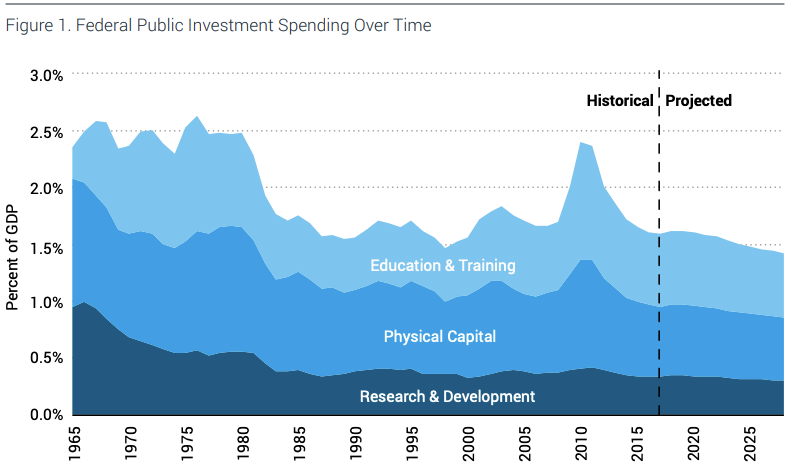
As President Trump and Republicans go full throttle to ram a partisan tax bill through Congress this week, let’s step back and ask a basic question: What does the U.S. economy need most today? The answer isn’t tax cuts – it’s public investment in modern infrastructure.

Having wasted most of 2017 trying to kill ObamaCare, however, Trump and his party have accomplished next to nothing and are desperate for a political “win.” Their budget-busting tax plan is designed to solve Republicans’ political problems, not the country’s economic problems.

From an economic perspective, the Republicans are fighting the wrong war in the wrong place at the wrong time.  Tax cuts may make sense when the economy is slowing down and needs a jolt. But with healthy business profits, a surging stock market and tight labor markets pushing up wages, there’s little need now for a dose of fiscal stimulus.

In fact, average working families finally are beginning to reap the gains of the long economic expansion that started under President Obama. Blue collar wages have soared in the last two years, growing even faster than those for professionals and managers. Despite all the populist angst about a “rigged economy,” stronger growth is narrowing economic inequality.

Continue reading at The Hill.

Osborne and Langhorne for US News, “A Bright Spot in School Diversity”

The Albert Shanker Institute recently released a report that analyzed the negative effects of private schools on integrated public education in Washington, D.C.

While only 15 percent of students in the nation’s capital attend private schools, 57 percent of white students do. Private schools essentially create the segregation equivalent of white flight to the suburbs, without the physical “flight.”

In America, socioeconomic status and race are highly correlated, and parents with means often choose private schools. A 2013 Friedman Foundation study found that parents cite a series of reasons: increased safety, better discipline, smaller class sizes, improved learning environments and more individual attention.

Urban public schools are usually hamstrung by centralized rules and budgeting, but many public charter schools can replicate the elements of a private school climate: Each school has the autonomy to craft its own culture. Public school choice can increase integration by income and race, as we argued in a recent column, and charters can also create “diverse-by-design” schools to attract parents of all races.

Continue reading here.