PPI WEEKLY WRAP-UP: Trade for the 99 Percent, UK Elections and EU Digital Agenda

TRADE FOR THE 99%: On Tuesday, PPI released The Digital Opportunity: Democratizing Trade for the 99 Percent. Authored by Ed Gerwin, PPI Senior Fellow for Trade and Global Opportunity, the new policy brief highlights some of the many ways in which “democratized” trade in the global digital economy benefits America’s 99 percent—from entrepreneurs and small businesses to consumers and communities. The brief details why it is critical for America to lead in writing modern trade rules that promote the free flow of data and open digital commerce. Gerwin summarized the findings of his policy brief in an op-ed for Republic 3.0, The Digital Economy, Trade Agreements and the 99 Percent.

UK ELECTIONS: Earlier this week, PPI President Will Marshall wrote an op-ed for CNN on how the fracturing of Britain’s once stable political order will make it difficult for the incoming Prime Minister to form a strong and coherent government, and the implications that will have on Britain’s role in the EU and their relationship with the US.

Today, the day after the election, Marshall provided a follow-up piece to CNN distilling a few key lessons from the oddest British election in memory.

EU DIGITAL AGENDA: On Thursday, the European Commission unveiled a digital single market for Europe. PPI Chief Economist Dr. Michael Mandel wrote this week that the digital single market is essential for the success of the EU economy, but it should be built on principles of openness and encouragement of innovation, not higher levels of regulation that will discourage both.

LABOR PRODUCTIVITY: Mandel penned a response on Wednesday to the release of the Bureau of Labor Statistics (BLS) first quarter labor productivity and costs report. Mandel calculates that ten-year productivity growth plunged to a startling 1.4% in the first quarter of 2015, the lowest level since the 1980s. Moreover, Mandel estimates that the slowdown in productivity growth since 2000 is responsible for two-thirds of the decline in real compensation growth, a key measure of living standards. His conclusion: The sharp fall in productivity growth is the major reason why Americans feel so squeezed. Growth policies are key.

HEALTHCARE JOB BUBBLE?
: A recent policy report on tech employment, authored by Mandel and PPI Economist Diana Carew, calculated that women have been getting three times as many healthcare-related bachelor’s degrees as men. But according to Mandel, the healthcare employment boom may actually represent a bubble, warning that college students and administrators may be overestimating the safety and security of healthcare careers. If the bubble bursts, women may bear the brunt. Given the strong possibility of such a change, progressives should support a diversification of college degrees out of healthcare and into other growing areas such as tech.

MOTOR CITY SCHOOLS MAKEOVER: In an op-ed for U.S. News & World Report, PPI senior fellow and director of the Reinventing America’s Schools Project, David Osborne examines a new plan by Michigan Governor Rick Snyder to set up a Detroit Education Commission that would have the power to measure school performance, create a common enrollment system for all public schools, close mediocre schools (charter and traditional) and replace them with new schools (charter and traditional). Osborne writes, “This would be a huge step forward: For the first time, Detroit would have a citywide portfolio manager with the power to steer both the traditional and charter sectors toward higher performance.”

Marshall for CNN: Can Cameron hold U.K. together?

In what must surely rank as the oddest British election in memory, the Conservative Party has won a smashing victory. But so did its nemesis, the Scottish National Party, which ran the table north of Hadrian’s Wall. The vote leaves three big questions hanging: Will Scotland leave Britain, will Britain leave Europe, and will the Labour Party learn how to win again?

Although pre-election polls showed the Conservatives and Labour running neck and neck, the Tories look set to win an outright Parliamentary majority of 331. Labour, annihilated in Scotland, also failed to make inroads in England. Top Labour figures like Ed Balls and Douglas Alexander lost their seats and party leader Ed Miliband announced his resignation.

Election night was even bleaker for the Liberal Democrats, the junior partner in the governing coalition. Getting a paltry 8% of the national vote, they went from having 57 MPs to just nine. That makes the upstart SNP Britain’s third largest party.

Even though the incumbent Tories won, the election confirmed a new configuration in British politics shaped by resurgent nationalism and the rise of new parties that are chipping away at the long-dominant Conservative-Labour duopoly. As analysts sift through the election results, some clear conclusions and lessons are emerging…

Continue reading at CNN.

Why the Healthcare Job Boom May Be a Bubble, and Why Progressives Should Care

Our recent report on tech employment, authored by myself and Diana Carew,  calculated that women have been getting three times as many healthcare-related bachelors degrees as men. A NYT article from February 2015 lauded women for taking advantage of the stable, middle class jobs in healthcare, observing that

As the job market has shifted, women, in general, have more skillfully negotiated the twists and turns of the new economy, rushing to secure jobs in health care and other industries that demand more education and training. Men, by contrast, have been less successful at keeping up.

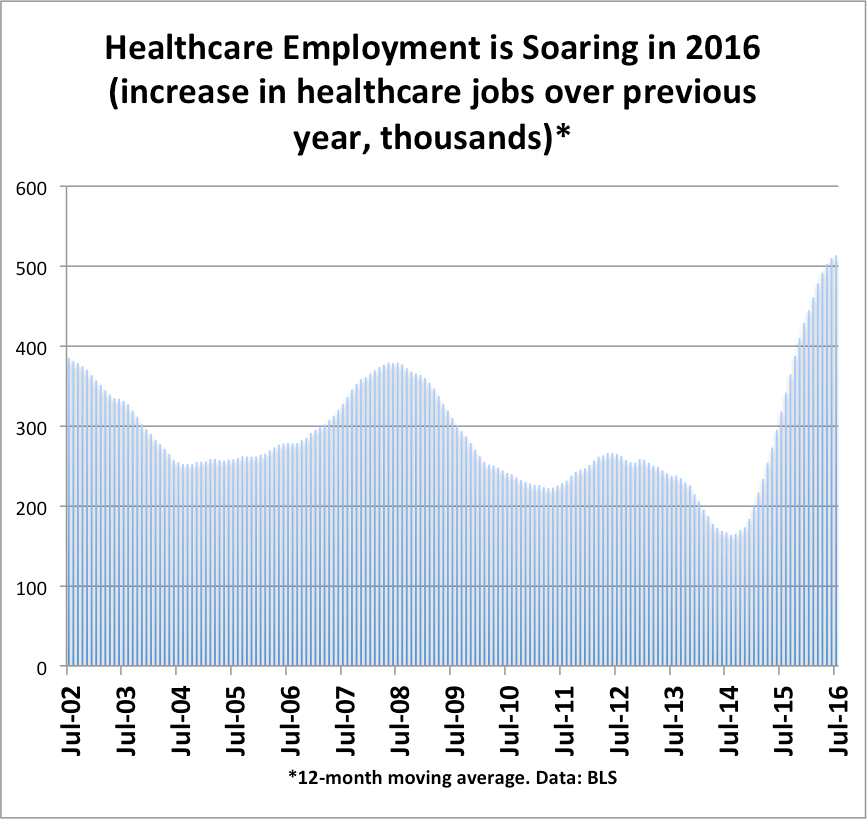
And indeed, the number of healthcare jobs have soared, even during the recession, propelled by government spending and the aging of the population. In fact, college administrators, students, and policymakers have encouraged young Americans and mid-career switchers to go into healthcare.

But the healthcare employment boom may actually represent a bubble. College students and administrators may be overestimating the safety and security of healthcare careers, especially in an era where the healthcare sector is under increasing pressure to control costs. And if the bubble bursts, women may bear the brunt. Consider the following chart.

healthprod1
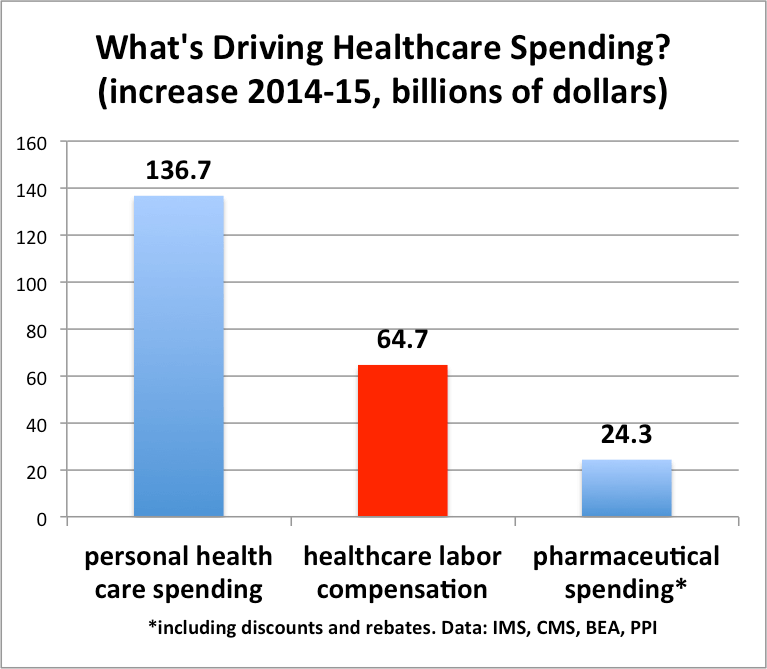
The first bar of the chart shows that total population grew by 3.1% between 2010 and 2014. The second bar adjusts population to account for higher spending on the elderly, by effectively tripling the contribution of 65-and-over Americans. So demographics by itself would argue that healthcare spending and employment would rise by 5.4% between 2010 and 2014.

In fact, healthcare employment rose by 6.6% over the same stretch. The fact that healthcare employment is outpacing adjusted population is the most tangible manifestation of healthcare costs being out of control.

We calculated what we call “gross medical productivity”–adjusted population divided by the number of healthcare workers. We’d like to see gross medical productivity rise, which would mean that fewer healthcare workers are needed per potential patient, adjusted for demographics. In fact, the exact opposite is happening–even after we adjust for demographics, more healthcare workers are needed for each potential patient in the population.

So the healthcare employment boom is being fueled by falling gross medical productivity, or, conversely, rising costs. As we note in the tech employment paper:

Containing healthcare costs therefore means incorporating productivity enhancing—or cost- cutting—technology into the sector…That means that to increase productivity and reduce costs long-term, the rate of increase of healthcare employment needs to slow.

Note that we are not saying that healthcare employment will fall, as manufacturing employment did. Healthcare jobs are still relatively protected from foreign competition, and people value health as much as anything else. Yet given the number of young people and mid-career switchers going into healthcare, we could easily have a situation where the mere slowdown in healthcare employment growth by 1 percentage point could dramatically shift the balance of supply and demand in the field.

Given the strong possibility of such a change, we suggest that progressives should strongly support a diversification of college degrees out of healthcare and into other growing areas such as tech. This is especially important for women, who according to our calculations got more than 20 healthcare-related bachelors degrees for every tech-related degree in 2013.


Osborne for US News: Motor City Schools Makeover

Public education in Detroit, where 57 percent of children live below the poverty line, is a mess. Detroit Public Schools, which ranked last out of 21 large districts on the 2013 National Assessment of Education Progress tests, is almost bankrupt, shrinking so fast it has about a third of the students it had a decade ago.

Last week, Michigan Gov. Rick Snyder released his much-anticipated plan to straighten out the mess. Most of the press reports focused on the financial issues: The proposal would require state taxpayers to subsidize the district to the tune of $53 million to $72 million per year, so its schools could continue to function while also paying down $483 million in operating debt.

But the most important aspect of the proposal got little attention. The governor wants to set up a Detroit Education Commission that would have the power to measure school performance, create a common enrollment system for all public schools, close mediocre schools (charter and traditional) and replace them with new schools (charter and traditional). This would be a huge step forward: For the first time, Detroit would have a citywide portfolio manager with the power to steer both the traditional and charter sectors toward higher performance.

Continue reading at US News & World Report.

Productivity Growth Continues to Plunge: Why A Growth Policy Is Necessary

Should progressives focus more on promoting growth, or fostering redistribution? The unfortunate fact is that we live in an era of weak productivity growth.  That means growth policies to encourage investment and innovation are essential for broad prosperity.

Based on today’s release from the BLS, ten-year productivity growth has now plunged to 1.4%, the lowest level since the 1980s (see chart below).  By comparison, ten-year productivity growth was 2.2% when Bill Clinton left office at the end of 2000, and hit a high of 3% at the end of 2005.

Productivity growth is the central force determining the size of the economic pie. Without productivity gains, living standards cannot show a sustainable rise.


Certainly real compensation growth is very weak as well. However, the difference between ten-year productivity growth and ten-year real compensation growth has also been narrowing.  It was 1.1 percentage points as of the first quarter of 2015, after peaking at 1.7 percentage points in 2011. That difference of 1.1 percentage points is only slightly above the 50-year average of 0.8 percentage points.

To put it a slight different way, real compensation growth has fallen from 1.5% in 2000 to 0.3% today, a catastrophic drop. However, two-thirds of that plunge can be attributed to a drop in productivity growth (from 2.2% to 1.4%), and only one-third to a widening of the gap between productivity and compensation growth. 

My conclusion: The sharp fall in productivity growth is the major reason why Americans feel so squeezed. Growth policies are key.


Marshall for CNN: Suddenly Britain looks like Italy

Staid old Britain suddenly looks more like Italy. No less than seven parties are vying for seats in the parliamentary election taking place Thursday, a contest that has underscored the unraveling of any national consensus around certain fundamental assumptions about Britain’s role in Europe, its special relationship with the United States and even its own political cohesion and identity. But perhaps what’s most distressing about the campaign debate, from a trans-Atlantic perspective, is its utter insularity.

On Prime Minister David Cameron’s watch, Britain’s customary global role seems to be shrinking before our eyes. Indeed, London has been absent from the Ukraine crisis and has played only a marginal role in the U.S.-led campaign against ISIS. Meanwhile, to the consternation of UK military chiefs, Cameron reportedly refused to guarantee defense spending would not sink below the NATO-recommended threshold of 2% of gross domestic product. Britain’s army is reportedly set to be smaller than it was in Napoleonic times.

“David Cameron has presided over the biggest loss of influence for our country in a generation,” charges Ed Miliband, the main opposition Labour Party leader. While chiding the government’s “pessimistic isolationism,” however, Miliband seems likely to disappoint those looking to revive Anglo-American ties. His outlook on foreign policy seems to be an amalgam of soft multilateralism and post-Iraq wariness of security cooperation with Washington. Indeed, when challenged to show he is tough enough to confront Vladimir Putin, Miliband instead cited his opposition to President Barack Obama’s calls for strikes on Syria in response to chemical attacks on civilians. “I think standing up to the leader of the free world shows a certain toughness,” he said.

Continue reading at CNN.

Gerwin for Republic 3.0: The Digital Economy, Trade Agreements and the 99 Percent

Who benefits from trade deals like the Trans-Pacific Partnership (TPP)?

Critics—like Joseph Stiglitz and Senator Elizabeth Warren—charge that these agreements would primarily help the world’s one percent. Stiglitz, for example, claims there’s a real risk that TPP will “benefit the wealthiest sliver of the American and global elite at the expense of everyone else.”

But a rapidly growing segment of the 99 percent—entrepreneurs, small businesses, and consumers who trade globally on the Internet—likely sees things differently. For these newly empowered traders, the TPP—and pacts like the Transatlantic Trade and Investment Partnership (TTIP) and the Trade in Services Agreement (TiSA)—can play a critical role in supporting their businesses by writing new rules that promote and protect electronic trade.

Continue Reading at Republic 3.0.

The Digital Opportunity: Democratizing Trade for the 99 Percent

Trade critics often charge that proposed trade agreements like the Trans Pacific Partnership (TPP) essentially serve the one percent—while harming virtually everyone else. But new trade pacts actually present a significant opportunity to drive more inclusive trade—especially by supporting the revolution in digitally enabled global commerce.

In this policy brief, we explain why it is critical for America to lead in writing modern trade rules that promote the free flow of data and open digital commerce. And we highlight some of the many ways in which the 99 percent—from entrepreneurs and small businesses to consumers and communities—benefit from “democratized” trade in a global digital economy that is both open and fair.

Who Benefits from New Trade Deals?
Over the past three decades, America’s trade agreements have become increasingly complex. While early trade agreements were focused on eliminating high tariffs, modern trade pacts also address non-tariff and “behind the border” barriers, like standards that discriminate against imported products or rules that discourage foreign investment.

To President Obama and supporters of trade promotion authority (TPA) legislation, addressing “21st Century” issues in the TPP and other new trade pacts would enable America to benefit broadly from expanding trade with a growing global economy.

Download “2015.05-Gerwin_The-Digital-Economy-Trade-Agreements-and-the-99-Percent”

Governor Markell for The Atlantic: Americans Need Jobs, Not Populism

In an op-ed for The Atlantic, Governor Jack Markell (D-Del.) argues that instead of raging against a “rigged” system, Democrats should work together with business to build an economy that distributes its benefits more broadly.

The bottom line is that private enterprise creates the primary condition for reducing poverty and want: economic growth. Governments don’t create jobs; however, government has an ability and responsibility to create a nurturing environment where business leaders and entrepreneurs want to locate and expand. What that means is that government has an active role in creating an economic environment that creates middle class success and prosperity. …

Long-term success requires an active government that partners with business to ensure that the bounty of economic growth is shared broadly. Sharing this bounty is not about having a “bleeding heart.” It’s a matter of cold economic sense.  

I am hugely bullish about the future of the American economy because I believe in investing in people, engaging with the world and sharing broadly the bounty that economic growth will generate. Growing without sharing won’t get it done.  And neither will redistribution without growth. Americans really are in this together.

Read the piece in its entirety at The Atlantic.

Playing Digital Catch-Up with the US-The Wrong Way

If you are losing a race because of a pebble in your shoe, do you take the pebble out, or do you trip your competitor?

European digital entrepreneurs have a problem, a big one. The so-called single market—the biggest economic achievement of the European Union—has turned out to be anything but single when it comes to digital goods and services. A wide variety of outmoded national rules and restrictions hamper cross-border ecommerce within Europe. It’s as if a resident of New York couldn’t buy online from a website based in New Jersey, or had to pay a higher price, or couldn’t get packages shipped.

As a consequence, European digital start-ups have struggled to gain critical mass. Indeed, old-line incumbent European firms have often lobbied to keep these restrictions in place, fearing, quite correctly, that European digital competitors would force down prices and undercut their cozy control over national markets.

But now many European politicians and business leaders are realizing that this defensive strategy was short-sighted. American firms such as Google, Apple, Amazon, and Facebook have leapt ahead in the digital race, fueled by a combination of innovation, better access to capital, and a larger home market.

So what’s the solution? The European Commission, lead by President Jean-Claude Juncker, is mounting a full scale effort to create a “Digital Single Market”. On May 6th the Commission will come out with its proposals for removing the barriers that stop European firms and startups from offering digital services across European borders—in effect, removing several of the pebbles hobbling European digital competitors.

Unfortunately, recent news articles indicate that the European proposals will also make an attempt to trip competitors—in this case, US tech giants. Rumored measures, which may not make it into the final proposal, call for starting the process of regulating large digital platforms–such as Google search, Facebook, eBay, Etsy, Skype (owned by Microsoft), Amazon shopping, and the iTunes store–as public utilities.

It’s not hard to understand the motivation of European politicians here. They see the success of the American tech companies, and want to make sure their tech sector companies have a chance to catch up. Moreover, they fear, with little evidence, that unsupervised digital platforms will exercise market power.

The problem is that by combining the Digital Single Market with intense regulation of the most innovative and successful companies, European bureaucrats are sending a message to their own companies and startups: “Innovation is not welcome in Europe. Success is not welcome in Europe.”

The Digital Single Market is essential for the success of the European economy. But it should be built on the principles of openness and encouragement of innovation, not higher levels of regulation that will discourage growth.

Huffington Post: Science, Not Politics, Should Drive Trade and Regulatory Decisions

The Obama administration issued a stinging rebuke of the European Union’s decision this week to allow countries in Europe to “opt-out” of U.S. imports of genetically modified (GM) foods and feed. The U.S. Trade Representative said that such a rule “ignore[s] science-based safety and environmental determinations” that modifying crops in laboratories is no more harmful than traditional cross-breeding crops in the fields. Yet, in today’s hyper-politicized culture, the regulatory process in the United States is also often hijacked by special interest groups that subvert science in favor of their own emotional “narratives” that can be deeply misleading.

Modern advances in food science, both in how we produce and deliver food, have become key battlegrounds in the science versus fear-mongering debate. On the production side, GM foods can offer a much-needed path to feeding the world’s population. In the United States, the Food and Drug Administration (FDA) and the Environmental Protection Agency (EPA) have carefully studied GM foods and found them safe. The lack of any scientifically valid concerns, though, has not stopped special interest groups from seeking federal and state laws requiring that GM foods be labeled. Also, as much as the federal government may want to cast aspersions, the USDA has held up approval of modified salmon despite clear science that such fish are safe.

The politicization of the federal regulatory process takes on a whole new level, though, when one federal agency funds special interest studies that undermine another agency’s scientific conclusions key to federal regulations. This has been happening with bisphenol-A (BPA), which has been used since the 1960s to coat metal food cans to stop germs from growing in the cans that can be harmful to consumers. It has long been well understood that BPA molecules can migrate from the packaging to the food, and the FDA regulates BPA as an indirect food additive.

Here, the global community is united. The FDA, along with the European Food Safety Authority, Health Canada, and the World Health Organization, has studied BPA extensively and found its use in food containers to be safe. These groups have grounded their decisions in science. In short, they have found that humans rapidly metabolize BPA and that any BPA ingested is excreted in urine. Since 2000, though, National Institutes of Health (NIH) has funded $172 million in research of BPA. Many grants have gone to scientists supported by the same groups that oppose GM foods regardless of science — Greenpeace, Natural Resources Defense Council, and others. Not surprisingly, these scientists produce studies critical of BPA.

In response to alarmist reports, a subcommittee of the FDA’s science board recommended in 2008 that the agency re-examine the scientific basis for approving BPA. Last year, the FDA completed a four-year review of more than 300 scientific studies and once again found no evidence that BPA is harmful to humans when used in food containers and packaging. The broader scientific community found the studies critical of BPA to be fundamentally flawed. At this point, NIH must stop funding scientifically questionable studies or it will risk harming the American government’s credibility to be stewards over important scientific issues.

The tactic of trying to influence regulations by undermining science is not unique to food science or any political party or cause. Several years ago, reproductive rights groups rightly called foul when the FDA, under pressure from conservative activists, held up the Plan B over-the-counter pill despite science proving the drug’s safety and effectiveness. We saw what happened with the measles outbreak last year when libertarians across the political spectrum refused to follow regulations based on sound science that children be immunized from certain diseases, including the measles.

Progressives who believe in a strong regulatory regime should follow the U.S. Trade Representative’s sentiment and oppose the use of junk science to undermine the credibility of federal regulations. Since Vice President Gore’s Reinventing Government efforts in the 1990s, progressives have grabbed the pragmatic position in the debate over appropriate levels of government regulation. Federal agencies should get smart on an issue, develop targeted regulations, and effectively facilitate commerce while assuring appropriate protections.

As technology advancements continually push against our political and moral boundaries and regulatory agencies grow their footprints, it becomes increasingly important that science, not politics drive regulatory decisions. Especially when it comes to life’s basics needs, such as finding ways to make food more plentiful and less expensive, if scientific facts become undermined for political expediency, the most vulnerable people among us will lose.

This piece was cross-posted on The Huffington Post.

Wall Street Journal: Tech Employment: More Diverse Than You Think

PPI Chief Economic Strategist Michael Mandel and Economist Diana Carew’s new report, Tech Opportunity for Minorities and Women: A Good News, Bad News Story, was featured in the Wall Street Journal on the growth in employment for minorities the tech labor market.

“Tech jobs are growing faster and are more diverse than people think,” said Michael Mandel, chief economic strategist at the Progressive Policy Institute and an author of the paper. He wrote it with Diana Carew, another economist at the Institute.

The authors point out that tech startups cluster in dense urban hubs, “creating inner-city jobs and positive local economic spillovers” in places with diverse populations, they write. “Few of today’s tech entrepreneurs want to put their start-ups out somewhere in a suburban office park. Instead, they place their new firms in places that are attractive to young tech workers. This has enormous potential benefits for high poverty urban populations, by promoting better education and social infrastructure.”

Progress for women is much slower. Of the 730,000 high-skill tech jobs created between 2009 and 2014, 26% went to women, who make up 47% of the total workforce. Part of the reason for the gap, Mandel said, is that science-oriented women are choosing to work in healthcare rather than tech. A Google study on the issue identified four key reasons why women say they are reluctant to pursue tech careers: Social encouragement, self-perception, academic exposure, and career perception.

Continue reading at the Wall Street Journal.

Tech Opportunity for Minorities and Women: A Good News, Bad News Story

Can tech jobs be a source of economic opportunity and upward mobility for an increasingly diverse American population?

Yes—consider two key facts about the labor market recovery, both of which show the potential for tech jobs to empower communities and bring shared prosperity.

First, since the recovery began in 2009, tech has created almost as many jobs for college graduates as healthcare. Tech jobs, here defined as all computer and mathematical occupations across industries, include computer systems analysts, network architects, and statisticians. Over 2009-2014, these tech jobs added about 730,000 college-educated workers. By comparison, healthcare occupations—which include everything from doctors and nurses to lab technicians and therapists—added 787,000 workers with a college degree.

This near parity in tech and healthcare job creation is significant given healthcare has long been regarded as the most dependable force for job creation. A growing and aging U.S. population, alongside rising medical costs, are widely seen as keeping healthcare jobs in high demand.

Second, we find that college-educated blacks and Hispanics have benefited enormously from the tech jobs boom. From 2009 to 2014, blacks with a college degree gained slightly more tech jobs than healthcare jobs—employment rose by 79,000 in computer and mathematical occupations (a 58% increase), compared to 76,000 gain in healthcare occupations (an 18% increase). The number of Hispanics with a bachelor’s degree increased by 104,000 in the healthcare occupations (a 40% increase), not so far ahead of the 81,000 gain in computer and mathematical occupations (an impressive 103% increase).

Indeed, the opportunity tech jobs are creating for non-Asian minorities defies conventional stereotypes. That’s because the tech/info jobs boom is much broader than in Silicon Valley. Tech jobs are increasingly found across all industries and the country. Tech jobs are in finance, education, and government, and urban tech clusters are forming in U.S. cities such as New Orleans, New York, and Denver.

Download “2015.04_Mandel-Carew_Tech-Opportunity-for-Minorities-and-Women_A-Good-News-Bad-News-Story/”


London Shines in Tech/Info Employment; The Rest of the UK Struggles

Approximately one year ago, I undertook a study of the London tech/info economy, together with Dr. Jonathan Liebenau of the London School of Economics. In that study, titled “London: Digital City On The Rise,” we showed that London’s tech/info performance compared favorably with the other two major global tech hubs, New York and San Francisco/Silicon Valley.[i] Our analysis ran through 2013.

In this brief note, I update some of the earlier results to include 2014. As before, I focus on what I call the tech/info economy, rather than the conventional tech sector. The tech/info economy has three legs—Internet, telecom, and content. The first leg, Internet, includes companies such as Google, Facebook, LinkedIn, and other search, social media, and cloud companies. The second leg, telecom, includes household names such as BT and Verizon, as well as global companies such as Level 3 Communications and Akamai. The third leg, content, includes television, movies, music, games, and publishing companies, as well as new giants such as Netflix.

The reason for combining the three legs into one group is that their boundaries have become increasingly permeable. Internet companies provide more and more telecom-like services directly, as well as hosting and creating content. Many telecom companies are content producers as well. Meanwhile, content companies have seen more and more of their content be delivered by the Internet, leading them to often be major employers of tech workers. (The exact definition of the tech/info sector is found in the 2014 paper.)

Here are some of the key results of the update:

  • Since 2010, when David Cameron took office, London tech/info employment has risen by 23%. That compares favorably to New York City’s 16% tech/info gain for the same period. However, tech/info employment in the San Francisco/Silicon Valley region rose by 31% over the same period.[ii]
  • The top three regions for tech/info employment in the United Kingdom are London, the South East (including Oxford) and the East (including Cambridge). Together the combined London-East-South East regions employ more tech/info workers than California (808,000 tech/info workers versus 721,000 tech/info workers in California as of 2014). Since 2010, tech/info employment in the combined London-East-South East regions grew by 21%, compared to 15% for California. [iii]
  • Outside of the combined London-East-South East regions, tech/info employment has grown by only 2% since 2010 (see chart below). Tech/info employment in the United Kingdom has become increasingly concentrated since 2010.

Endnotes

[i] Michael Mandel and Jonathan Liebenau, “London: Digital City on the Rise,” South Mountain Economics LLC, 2014. https://southmountaineconomics.files.wordpress.com/2014/06/london-digital-city-on-the-rise.pdf

[ii] For this comparison, I am comparing London with New York City and the combined San Francisco/San Jose metropolitan statistical areas. My analysis does not include the computer and electronic product manufacturing industry, which employs a substantial number of people in California but is not growing.

[iii] As previously noted, these figures do not include the computer and electronics products manufacturing industry in California. Add in this industry would increase the size of employment, but lower the growth rate. ­­­


Download “2015.04-Mandel_London-Shines-in-Tech-Info-Employment.pdf”

Don’t Ban Zero-Rating in India

Zero-rating – a practice where mobile operators provide select Internet content for free – is coming under heavy fire in India. Indeed the Indian government is likely to ban the practice as early as next month. But given that zero-rating could enable tremendous social and economic opportunity to developing countries like India, banning it now would be a mistake.

Widespread media attention has put India’s approach to Internet regulation and “net neutrality” into the global spotlight. It started with a report issued last month from their telecommunications regulator (TRAI) asking for public comments on how to regulate “over-the-top” content offering from mobile providers. A large public outpouring of information (and misinformation) ensued, leading one Indian Member of Parliament to write, “TRAI cannot control the internet by charging separately for services that are created by the very people who believe in the idea of free access to information and knowledge.”

Already several companies providing content through zero-rating programs have backed out over the backlash, lest they be charged with enabling Internet discrimination. Adding more fuel to the fire, this week a group of Indian tech entrepreneurs sent a letter to India’s Prime Minister arguing that zero-rating could stunt economic growth as Internet start-ups are unable to compete with free content. “These practices, if allowed, will exclude promising startups from the Internet and end our dream of seeing them flourish,” they said.

It’s unlikely, however, that zero rating will crush anyone’s dreams. In fact, as we’ve recently argued in our paper “Zero-Rating: Kick-Starting Internet Ecosystems in Developing Countries,” zero-rating could be a powerful vehicle for economic growth and prosperity in countries like India, where large segments of the population aren’t online.

In the developing world, zero-rating has the potential to jumpstart local Internet ecosystems. Consumers that have previously used up their monthly data allotments on sites like Google, Twitter, and Facebook could now use them instead to surf local content. Moreover, people who are currently not connected to the Internet may have a stronger incentive to sign up for a monthly data plan, seeing a higher value in accessing the Internet. The larger customer base for local content would then provide a greater incentive for tech entrepreneurs to invest in turning their ideas into the latest online site or service. As more local content becomes available, a resulting boost in local demand will follow in a virtuous economic feedback loop.

Consider, for example, a local business collecting agricultural prices across a poor country that would like to post them online. Such data could be extremely valuable for the country’s farmers, who stand to benefit greatly from access to better information. Yet if there are too few farmers or other consumers of this data online, no one has an incentive to collect the data and create an online platform. Yet if offerings such as zero-rating encouraged more farmers to get connected, this business could get off the ground – and more could follow – enabling locally-driven economic growth.

Although many zero-rating programs are relatively new, early results are promising. Countries across the globe, from the Philippines to Egypt, and in sub-Saharan Africa, have seen large increases in connectivity alongside zero-rating offerings. And perhaps most importantly, there is no evidence that zero-rating has caused any economic damage in underserved areas with low connectivity.

India’s politicians and regulators would be well-served to see zero-rating as an opportunity to increase local business potential, not as a threat to it. Local businesses could even use Twitter, Google, and Facebook to advertise their services, as part of the local Internet ecosystem.

Our report instead proposes guiding principles for zero-rating. For example, such offerings should be non-exclusive, to guard against anti-competitive behavior across mobile operators, and zero-rating programs should be regularly evaluated. These principles would promote transparency and accountability, and most importantly, increase public trust.

Of course, zero-rating is not a silver bullet for dispelling inequality or eradicating poverty. But it is an important part of a pro-growth strategy that will boost local economies. It could make the difference between a would-be Internet entrepreneur creating new apps for local services and data or going to another country with higher connectivity.

That’s why banning zero-rating in India now would be a mistake. The best path forward for India’s Internet economy is to promote policies that enable its citizens and businesses to fully participate in the data-driven economy. That means keeping every pathway to future global growth, opportunity, and prosperity open, including zero-rating.

The Hill: Pelosi’s choice: Obama or left?

Ed Gerwin, PPI Senior Fellow for Trade and Global Opportunity, was quoted in the The Hill on how Nancy Pelosi is confronting a conundrum on trade as she walks a delicate line between the president she champions and the caucus she leads:

Ed Gerwin, a trade expert with the Progressive Policy Institute, a rare liberal group that supports the fast-track bill, said Pelosi’s reticence is bolstering Obama’s hand.

“Whether or not she ends up as a supporter, what she has been doing is very helpful in trying to get to yes, on trade,” Gerwin said. “What Pelosi has been doing, combined with the significant efforts by Wyden in the Senate, may allow Democrats to put more of a stamp on trade and may help some members keep an open mind on TPA and eventual trade deals.”

Read the piece in its entirety at The Hill.