The Atlantic: It’s Time for a New United Nations

In March of 2011 and just hours before the United Nations Security Council vote, Libyan dictator Muammar Ghaddafi promised citizens of Benghazi–his own countrymen–that he was “coming tonight” and that would show them “no mercy and no pity.” Gaddafi’s brazen statement telegraphed an impending attack with a high possibility massive civilian casualties.

In the Security Council immediately following Gaddafi’s threats, Russia and China–two permanent members with noted authoritarian governments themselves–abstained from voting on resolution 1973, which authorized “all necessary measures to protect civilians… including Benghazi.” (Germany, Brazil, and India, then-rotating members of the Security Council, abstained as well for their own reasons.)

In hindsight, Russia seems to have regretted its abstention. In January 2012, speaking about the growing civil war in Syria, Foreign Minister Sergei Lavrov told Australian TV that “the international community unfortunately did take sides in Libya and we would never allow the Security Council to authorize anything similar to what happened in Libya” in Syria.

That seems odd, because “what happened in Libya” was, on balance, a good thing: A sustained NATO air campaign unquestionably protected many more innocent civilians than it harmed and weakened Gaddafi’s forces en route to his downfall. What’s more, the Libya operation served as validation for those supporting the “responsibility to protect,” a 2006 Security Council mandate that called on parties involved in armed conflict to bear primary responsibility to protect civilians, approved by a unanimous 15-0 vote.

Continue reading at the Atlantic.

Don’t Make Credit Unions Die for Banks’ Sins

Five years ago this week, a collapsing housing bubble plunged America into its worst financial crisis since the Depression. Wall Street’s near meltdown midwifed both the tea party and the Occupy movement, and triggered a bitter debate about the big banks that continues to this day.

The ongoing controversy over whether we have solved or compounded the “too big to fail” problem may have cost Larry Summers his shot at the Federal Reserve’s big chair. But amid all the focus on the handful of U.S. mega-banks, policymakers have paid scant attention to their little cousins – America’s credit unions.

Now, however, credit unions are drawing fire from the banking industry for their not-for-profit tax status. The banks claim this exemption should be revoked because it gives credit unions an unfair competitive advantage over for-profit banks. “Credit unions were never intended to be untaxed banks, yet that is what many have become,” according to Frank Keating, president and CEO of the American Bankers Association.

Keating’s sentiment is representative of many in the banking industry, but ultimately his words ring hollow. His association boasts a diverse membership of large and small banks. Last time I checked, there aren’t any credit unions that maintain a profitable global derivatives business and an essential investment-banking unit that underwrites multi-billion dollar corporate mergers and acquisitions like some of his members.

Eliminating the tax exemption is a terrible idea that would deal a fatal blow to 6,815 credit unions that provide low-cost financial services to 93.8 million members nationwide. It would also eliminate one of the safest and soundest segments of the financial services industry that stewards more than $1 trillion.

Continue reading at U.S. News & World Report.

Forbes: The Net Neutrality Parable Provides Clues Of How To Fix The FCC

The net neutrality debate reached a fever pitch last week when the D.C. Circuit heard oral arguments in Verizon v. FCC. Although many pundits have predicted what the appeals court will do, let’s search instead for an instructive lesson for reforming the FCC, something that policy wonks on all sides of the debate agree is necessary.

For years, I have been peddling a “compromise” on net neutrality between the folks who want to level the playing field for websites (or “edge providers”) and the folks who want to turn down the lights at the FCC.

Before explaining the idea, a quick backgrounder is in order: In December 2010, the FCC issued its Open Internet Order, which effectively proscribed certain practices by Internet service providers (ISPs), including selectively blocking traffic and contracting for priority delivery with websites. Rather than imposing an outright ban on “pay for priority” contracts, the FCC sternly warned ISPs that “as a general matter, it is unlikely that pay for priority would satisfy the ‘no unreasonable discrimination’ standard.” Put differently, such arrangements would presumptively violate the FCC’s new “non-discrimination” rule, and the burden would be on the ISP to reverse that presumption if it was ever foolish enough to try such a thing.

Of course, these rules have nothing to do with discrimination in the classic sense—that is, treating someone or something differently on the basis of some exogenous attribute (such as age, race, or lack of affiliation). For example, under the FCC’s Open Internet Order, if Time Warner  (an ISP) entered into a pay-for-priority arrangement with Sony (a website) to support a Sony online-gaming application, that contract would presumptively violate the FCC’s “non-discrimination” rules even if Time Warner stood ready to extend the same economic terms to all comers. Calling these rules the “zero-price rule” or the “no-economic-relation” rule would have been more accurate, but less politically appealing.

Continue reading at Forbes.

The Atlantic: Could the ‘Internet of Things’ Really Save the U.S. Economy?

The Atlantic‘s Tim Fernholz wrote an article referencing PPI’s Chief economic strategist Michael Mandel and his opinion on the Internet of Things being the key solution to saving America from “economic ruin”:

The “internet of things”–the increasing number of machines equipped with internet-connected sensors–will expand the US economy by $600 billion and $1.4 trillion in 2025, roughly the equivalent of boosting GDP by 2% to 5% over the intervening time period. That could be the difference between so-so growth to the kind of stable growth that drives down debt and unemployment.

Fernholz also quoted Michael Mandel on his hope that America could make “on-the-job-training easier by making machines more responsive to their users”.

Read the entire article on The Atlantic website here.

Foreign Policy: Absent Without Leave

In the late 1960s, Britain signaled the end of its long run as a world power by withdrawing from major military bases east of the Suez Canal. Today, as the White House confronts the crisis in Syria, could America be facing its own “east of Suez” moment?

The historical parallels aren’t exact. Britain was an empire; the United States isn’t — despite the tendentious polemics of inveterate anti-Americans, from Noam Chomsky to Glenn Greenwald. Britain had already been surpassed by bigger superpowers by the 1960s. That hasn’t happened to America and isn’t likely to happen in the foreseeable future. But the debate over intervention in Syria has illuminated large and growing cracks in the internationalist consensus that has underpinned U.S. global leadership since World War II.

That consensus has been strained to a breaking point by feral partisanship and by a Republican Party increasingly in thrall to libertarian ideas. As a skeptical Congress awaits a possible vote on President Barack Obama’s proposal to use military force against Bashar al-Assad’s regime, the big question is whether the United States can still muster the internal cohesion to play a decisive role in world affairs.

In his prime-time address Sept. 10, Obama asked Congress to postpone the vote pending a possible deal with Russia that would transfer Syria’s chemical arsenal to international custody. The scheme could spare Obama the embarrassment of being rebuffed by Congress, where sentiment against a U.S. strike has been hardening. But the fact that Russian President Vladimir Putin, Assad’s enabler and the U.S. president’s tormentor in chief, is the one throwing Obama a political lifeline should give us pause about the deal’s merits. To be sure, the deal would be good for Obama, allowing him to boast that his threat to use force compelled Assad to give up his chemical weapons. It might also earn Putin a Nobel Peace Prize. But it won’t end the agony of the Syrian people, because it would leave Assad free to go right on killing them with conventional weapons.

If Washington forswears the use of force against Syria, as Putin is demanding, it will have paid a very high price for reinforcing the norm against chemical warfare. The Russian gambit, moreover, may founder on its sheer impracticality: Will Assad, his back to the wall, really give up his most fearsome weapon? And how will U.N. weapons inspectors be able to find and remove all the regime’s chemical weapons in the middle of a war zone? Even from a purely logistical standpoint, the Russian proposal may be close to impossible.

Read the piece at Foreign Policy.

Can the Internet of Everything bring back the High-Growth Economy?

The United States and the other major advanced economies are currently stuck in a seemingly endless twilight of slow growth. The numbers are ugly: The April 2013 forecast from the International Monetary Fund predicts that economic growth in Europe will average only 1.7% over the next five years. Japan is projected to average only 1.2% growth. Germany, held up as a paragon of success, is expected to grow at only 1.3% annually.

The United States is doing better than Europe and Japan, but not by much. The nonpartisan Congressional Budget Office is currently projecting that the underlying growth rate of the U.S. economy—the so-called ‘potential’ growth—is around 2.2% annually, compared to an average of roughly 3.3% in the post-war period.

Both Democrats and Republicans in Washington, miles apart on most issues, have accepted the slow growth scenario. That helps explain, in part, the political gridlock in Washington. An economy growing at barely over 2% per year doesn’t generate enough income to pay for everything that Americans need: Social Security and Medicare for the aging population, defense spending sufficient to handle critical threats, and support for essential government investment in basic research, education, and infrastructure. The longer that the slow-growth assumption gets locked in, the more it becomes a self-fulfilling prophecy.

Yet we are not stuck with the slow-growth scenario and the endless and frustrating Washington policy debates about dividing a shrinking pie. Over the past year, a series of studies from research institutes and industry have laid out a compelling new vision of a highgrowth future—one that that could revolutionize manufacturing and energy, create employment for the jobless generation, and bring back rising living standards.

These new studies—from organizations such as the McKinsey Global Institute, GE, Cisco, and AT&T—describe the economic potential of a new wave of technological innovations known as the Internet of Everything (IoE)—also sometimes called the Internet of Things, the Industrial Internet or Machine to Machine. (Though as discussed below, the Internet of Everything is a broader, more accurate concept than the other terms, encompassing much more than just ‘things’.)

Taking the McKinsey projections as a base, we estimate that the Internet of Everything could raise the level of U.S. gross domestic product by 2%-5% by 2025. This gain from the IoE, if realized, would boost the annual U.S. GDP growth rate by 0.2-0.4 percentage points over this period, bringing growth closer to 3% per year. This would go a long way toward regaining the output—and jobs—lost in the Great Recession.

Equally important, from the macro perspective, the result will be a shift to growth that is not just faster, but higher quality. Rather than being fueled by consumption and borrowing, the Internet of Everything will lead to an economy built on production and investment, with much more extensive education and training built right into the fabric of the economy rather than being separated out.

Download the memo.

A Housing Reform Test Drive

U.S. housing officials are preparing to reduce the government’s abnormally large footprint in mortgage markets, one of the most visible remaining legacies of the subprime lending crisis. It’s the right move at the right time.

The Wall Street Journal reported Monday that the Federal Housing Finance Authority will order Fannie Mae and Freddie Mac to cut the size of mortgage loans they will guarantee. The idea is that with the government backing nine out every 10 loans, taxpayers are bearing too much risk, and it’s time for private capital to step in and take on a greater share.

That’s the right call, but it will meet resistance from the housing industry and consumer advocates who worry, quite reasonably, that it might mean even tighter credit for middle-income homebuyers in certain high-priced markets (typically found along the coasts), such as San Francisco, New York and Washington, D.C. Such advocates of maintaining the status quo say the recovery is still too shaky and investors are still leery about buying and making loans to any but the most affluent, low-risk borrowers.

But private mortgage investors, on the other hand, are likely to applaud the FHFA’s move. Investors and securitization firms like Redwood Trust and Two Harbors have been eager for the opportunity to show what they can do when they don’t have to compete with the federal government. They say there is plenty of appetite for private lending, so long as they aren’t undercut by the ultra-low rates the government can offer. Continue reading “A Housing Reform Test Drive”

Let Everyone Bid in the Spectrum Auction

In our new paper released today, we examine the economics and policies related to an upcoming spectrum auction by the Federal Communications Commission, illustrating that a more efficient regulatory system that facilitates competition and innovation can also provide essential consumer protection.

The auction, which the FCC hopes to conduct next year, is designed to enable continued expansion of mobile broadband and other wireless services by buying back spectrum now belonging to TV broadcasters and making it available to wireless service providers. As often happens in Washington, there’s a fight over how the auction should be structured—specifically a push by some smaller competitors to limit bidding by the largest providers, AT&T and Verizon. Such limits would effectively set aside a portion of low-frequency spectrum for the smaller rivals at discounted prices.

But we argue that such regulatory structures would needlessly complicate the auction process, undermine competition in the overall broadband marketplace, and make it difficult to meet consumers’ expectations for wireless service. Moreover, putting a thumb on the scales of the auction process is unnecessary. Rather than achieve the goal of enhanced innovation, we show that the rules proposed by smaller competitors could make innovation more difficult. Continue reading “Let Everyone Bid in the Spectrum Auction”

The FCC’s Incentive Auction: Getting Spectrum Policy Right

As the Federal Communications Commission (FCC) considers how to allocate the broadcasters’ spectrum in the upcoming “incentive auction,” it should be guided by economic principles designed to maximize social benefits. To date, the spectrum policy debate largely has been driven by considerations of the private benefits of carriers such as Sprint, T-Mobile/MetroPCS, U.S. Cellular, and other small carriers (collectively, the “smaller carriers.”).

In April, the Department of Justice (DOJ) weighed into this debate by advocating “rules that ensure the smaller nationwide networks, which currently lack substantial low-frequency spectrum, have an opportunity to acquire such spectrum.” Although it is natural instinct to root for the little guy, ensuring the livelihood of smaller carriers is not an appropriate policy objective, as that would counsel a range of subsidies and tax credits for handpicked competitors. Indeed, maximizing the number of wireless competitors is not the appropriate objective either; using spectrum allocation as a tool for reducing wireless concentration would require divvying up the spectrum in such thin slices as to render the resulting allocation virtually useless. The problem with these narrow objectives is that, if pursued to their logical extreme, the resulting policies would sacrifice massive (and growing) economies of scale associated with providing the capacity needed to support mobile video, telemedicine, distance learning, and a host of other bandwidth-intensive applications that consumers and small businesses are demanding from their mobile devices.

The spectrum policy debate must be informed by the tradeoffs inherent in spectrum aggregation: more (smaller) firms versus more robust wireless networks. As wireless consumers increasingly demand that their wireless devices support bandwidth-intensive applications such as mobile video, the optimal allocation of spectrum tilts in favor of more robust wireless networks. Focusing narrowly on reducing wireless concentration could result in a spectrum allocation under which wireless carriers lack the incentive to deploy next-generation technologies. If policymakers fear that “too much” spectrum in the hands of any one carrier raises anticompetitive issues, there are several ways to address those concerns that do not undermine investment in next-generation wireless broadband networks, and the attendant innovation that such investment engenders.

Download the entire backgrounder.

How a Regulatory Improvement Commission Can Improve SBA’s Disaster Response

Last week, New Jersey Governor Chris Christie blasted the Small Business Administration for being a “disaster” in providing disaster relief to New Jersey’s businesses after Hurricane Sandy.

At issue? According to the Governor, SBA’s disaster loan programs were too complicated for residents and business owners that needed a fast, simple funding stream to recover and rebuild. The Star Ledger article noted these words from Gov. Christie to a Jersey Shore crowd:

“Basically, the Small Business Administration is a disaster,” he [Gov. Christie] said to an appreciative crowd. “We should send FEMA to the Small Business Administration to clean up after the disaster that is the Small Business Administration and what they did to small business people in this state.”

“The good news is the Small Business Administration has left New Jersey and we are stationing troopers on every border to make sure they do not come back,” he added.

Does the Governor have a point – are there too many rules and regulations on SBA disaster programs hampering the effectiveness of the federal government’s disaster response?

An effective federal disaster relief system is essential to having economic continuity after a disaster hits. If the disaster loan application process is overly cumbersome, and not being utilized while residents and businesses flounder, it’s worth taking such claims seriously.

A quick look at SBA’s website shows 80 rules (consisting of 7 subparts of Title 13, Chapter 1, Part 123) in the Code of Federal Regulations that apply to their disaster loan programs, and SBA’s Standard Operating Procedure for disaster loans is an impressive 269 pages. Of course, federal loans backstopped by taxpayer money should enforce responsible lending and credit-checking criteria. But in times of disaster it may be sensible to simplify the process.

It’s examples like this why PPI proposed Congress authorize a “Regulatory Improvement Commission” (RIC), an independent Commission with the explicit purpose of reviewing outdated or duplicative federal regulations. The Commission, authorized only on an as-needed basis, could review the rules and regulations that govern SBA’s disaster loan programs and provide suggestions to improve or remove them. Their recommendations would then go to Congress for an up-or-down vote.

In the case of SBA’s disaster loan programs, the RIC could improve the speed at which disaster aid is distributed while still protecting taxpayers. For example, perhaps the number of required application forms – 6 for businesses – and corresponding financial documentation could be consolidated. In times of disaster, especially natural disasters like Hurricane Sandy, local business owners may not have immediate access to all of the required documentation which could impose major delays in aid. Likewise, some legal restrictions on disaster loan eligibility may not be feasible or practical and merit review. For example, requiring borrowers in designated “special flood hazard areas” to purchase flood insurance to be eligible for aid may be prohibitively expensive.

There is currently no effective process in place on the federal level to retrospectively review and improve such regulations. Yet the build-up of regulations over time is plaguing many U.S. businesses, and in cases like this, homeowners, which could have long-term economic affects. The RIC would address this problem, and as an independent body would do so in a politically viable way.

The Right Way to Shrink the Digital Divide

Writing about the importance of making broadband accessible for all in The Huffington Post, Former Congresswoman Eva Clayton cites Ev Ehrlich’s recent PPI policy paper that outlines the best steps forward:

Recently, economist Ev Erlich, former Undersecretary of Commerce in the Clinton administration, and the Progressive Policy Institute released a must-read paper on broadband policy, “Shaping the Digital Age: A Progressive Broadband Agenda.” The paper outlines an agenda that would return broadband policy to its progressive roots by:

“(F)inishing the job of creating a truly national high-speed network, using the remarkable capabilities of broadband to improve education, health care, government, and other social sectors, creating the terms on which more connectivity can be created (for example, liberating spectrum), and protecting the individual right to privacy using both legal means and market forces.”

What do all of these policies have in common? They will deliver real benefits to Americans in both urban to rural America. Expanding broadband availability and improving adoption rates should be at the heart of any progressive broadband policy agenda.

Ehrlich also advises progressives to keep their eye on the ball and not let debates over divisive issues like “net neutrality” distract from more important goals, as this issue “does nothing to address the leading obstacles to a ubiquitous broadband Internet: Indifference and the absence of computers.”

Read the entire piece at The Huffington Post.

Regulation Nation: Obama rule-making seen as deeply flawed

The Hill quotes PPI’s Diana G. Carew in a recent piece on federal regulation and cites PPI’s Regulatory Improvement Commission proposal being championed by Sen. Angus King.

Democrats, unions and public interest groups, meanwhile, say agencies are already hamstrung by existing restrictions on their authority, and argue that open-ended White House reviews have led to a pattern of delays in important protections.

“It’s definitely the way you approach the issue,” said Diana Carew, an economist at the Progressive Policy Institute, which aligns itself with pro-business New Democrats.

“So what’s basically happened is that nothing’s happened, and now we see this massive buildup of regulation over time, and it is actually causing a hindrance on business and business growth, and for small businesses.”

Read the entire piece at The Hill.

More Evidence That Ending Fannie Mae and Freddie Mac Is a Mistake

Last week, I argued against Congressional proposals to “get government out of housing” by killing government backed mortgage firms Fannie Mae and Freddie Mac. Now comes fresh evidence that buttresses my view that the private sector just isn’t ready to take up the slack if the two mortgage giants are eliminated.

This week, Redwood Trust, one of the largest issuers of private residential mortgages, released details of its latest securitization package. The good news is that it was Redwood’s 11th deal of the year, which shows private investors are coming back into the mortgage market totally dominated by Fannie and Freddie over the past five years. The bad news: A close reading of the package shows that private investors are still looking for ultra-safe, plain vanilla loans to pool and sell as securities. And they’re harder to come by.

No one doubts that since Fannie and Freddie were taken into conservatorship in 2008, private capital in mortgage markets has been scarce. Having lost billions when the housing bubble burst, private investors were in no hurry to resume lending. That’s why Fannie and Freddie were forced to expand their lending, from roughly 40 percent of the market pre-crisis to 77 percent in 2012.

Everybody knows we won’t return to “normalcy” in housing until their footprint shrinks and that of private investors expands. But House Republicans, who imagine that housing markets can get along just fine without the government guarantees Fannie and Freddie offer, might want to take a good look at Redwood’s latest package. It offers insight into the current appetite of private investors for mortgage risk.

Continue reading at U.S. News and World Report.

The Young and the Jobless

New York Daily News cites PPI Director of Young American Prosperity Project Diana Carew’s recent research on youth employment in a piece on the economic struggles of young people:

As of July, just 36% of Americans in that age group who are not enrolled in school were working full-time. Among the young people hunting for work — 23.5 million, or 60.5% of the total of 38.86 million — the unemployment rate is a whopping 16.3%.

And, like the overall unemployment figure, even that too-high figure conceals profound structural problems.

As Diana Carew, an economist at the left-leaning Progressive Policy Institute, put it: “ young Americans appear stuck in their post-recessionary state.”

Read the entire piece here.

Can Obama Redefine the Role of College?

President Obama’s speech in Buffalo yesterday launched a new conversation on the role of higher education as a platform for social and economic mobility. The speech represents a major policy shift on higher education policy toward a performance-based funding approach that holds colleges accountable for how graduates do in the job market. Though it is true such a formula for assessing college performance may be imperfect, changing how colleges think about their role in workforce preparation is essential. For young Americans to succeed in today’s global economy we must smartly invest in higher education that will enhance our competitiveness.

In the speech, President Obama finally acknowledged the current structure of the federal student aid program – a structure that now doles out over $100 billion in new loans annually while asking few questions – is unsustainable. In this context he unveiled a new proposed strategy for federal student aid distribution that holds both colleges more accountable by creating a new ranking that rewards schools for low student debt levels and high job placement rates. Students will also be held more accountable by having to show good grades from the year before to get next year’s loans.

President Obama is right to propose drastic changes to the federal student aid program. Federal aid for higher education has quadrupled in size over the last decade, yet the program itself remains essentially unchanged from its establishment in 1965. And now is the right time: the Higher Education Act, the legislation that determines eligibility criteria for federal student aid programs, is set for reauthorization at the end of this year. Hopefully this new proposal sets the tone for a serious review of current programs.

The current federal student aid party cannot go on forever. Doling out essentially unlimited federal aid to colleges will only delay an industry reorganization and consolidation that is both necessary and inevitable, especially at second and third tier schools. In its current form federal student aid subsidizes ineffective schools and transfers those costs to its graduates, who likely will struggle most to repay the average $26,000 per borrower student debt. The fact that President Obama reckoned the government would end up footing the bill for these schools shows he probably agrees. It’s time for higher ed to fully embrace the cost-saving education technology revolution that is finally gaining traction.

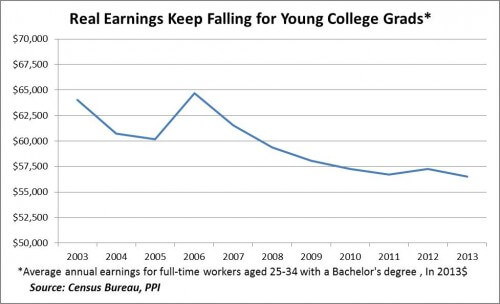
Early dissenters of the proposed changes to federal aid distribution, including the American Council on Higher Education, a major higher ed lobbying group, are concerned the ranking will overemphasize college’s role in job preparation. But isn’t that exactly what college’s major role is, and what colleges should be held accountable for?  Perhaps such dissenters should explain their view to the 50 percent of young college graduates who are currently underemployed or unemployed and try again.

RealClearWorld: A Tipping Point in Syria?

As political violence engulfs the Middle East, the White House seems to sink deeper into incoherence and passivity. Will reports of a massive chemical attack on Syrian civilians finally rouse President Obama from his torpor, or will they become just the latest outrage du jour in the region’s never-ending horror show?

The Syrian opposition claimed that forces loyal to Syrian dictator Bashar Assad used chemical weapons to kill over 1,000 civilians in the Ghouta suburb of Damascus. Buttressing these reports were harrowing videos of people struggling to breath and photos of scores of bodies that born no outward signs of injury. If confirmed, the poison gas attack would put Assad in the same league as Iraq‘s Saddam Hussein, who used chemical bombs to wipe out 5,000 Kurds in the town of Halabja in 1988.

The alleged massacre coincides with the arrival in Syria of a UN team charged with investigating reports that the regime unleashed small-scale chemical attacks against opponents last spring. The timing suggests how little Assad worries about crossing the “red line” President Obama has drawn against the use of chemical weapons. Or perhaps it’s a veiled warning about what he’s prepared to do if Western powers intervene in Syria.

Although warmly applauded by foreign policy “realists,” the administration’s resolve to stand aloof from crisis has been a strategic and moral failure. What began as a civil uprising has morphed into something worse: a full-fledged proxy war that is inflaming the region’s sectarian divisions. As Shia Iran and Hezbollah fight to save their ally Assad, Sunni jihadis — some marching under the banner of al Qaeda – are pouring into Syria. This makes it easier for Assad to posture as a protector of Alawite and Christian minorities and a bulwark against the very Salafist terrorists that keep U.S. intelligence agencies awake at night.

But this is emphatically not a case of “the enemy of my enemy is my friend.” America has no interest in the survival of a homicidal tyrant and war criminal like Assad, even if his fall presents openings to Sunni extremists in Syria. And in truth, the United States isn’t very good — thankfully — at the kind of cold blooded realpolitik that counsels standing by while Assad, Iran and Hezbollah and Sunni fanatics bleed each other in Syria.

Continue reading at RealClearWorld.