
| 2025 | 18.20% |
| 2016 | 19.50% |
| 2008 | 23.30% |
| 2000 | 19.70% |
| 1980 | 16.60% |
| 1790 | 22.3%? |
* Modern GDP and goods trade figures from BEA and Census. 1790 GDP estimates and trade from measuringworth.com and Almanac of Statistical Abstracts.
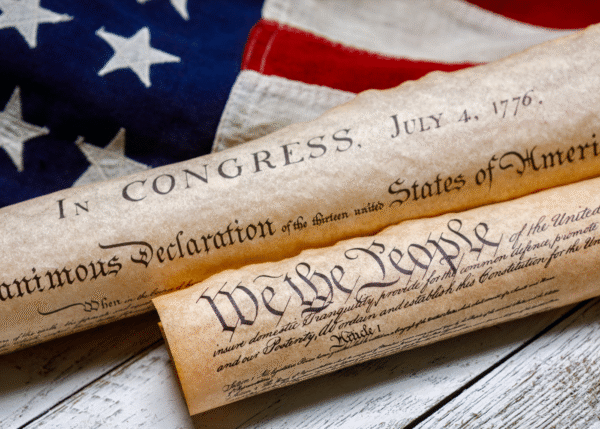
Two of the Declaration’s 27 grievances relate to tariffs and trade:
The abstract question of taxation and representation aside, the Continental Congress delegates and their successors in early-republic government had lots of practical reasons to think about these things. Data illustrate:
Nobody really knows how large America’s early economy was; www.measuringworth.com, a Virginia-based economic history project, makes an admirable try. They believe that in 1790, the 13 states and 3.9 million Americans combined to produce a GDP of $193 million. Alexander Hamilton’s 119 newly hired Customs agents counted $23 million in imports and $20 million in exports that year. Assuming the GDP estimate is reasonable, the early republic’s trade-to-GDP ratio would have been 22 percent, about equal to the 23% modern-era peak in 2008. (We’re a bit lower now: the Bureau of Economic Analysis put U.S. GDP at $30.8 trillion in 2025 while Census reported $3.4 trillion in goods imports and $2.2 trillion in exports, for an 18.2% ratio.)
Similar circumstances can elicit similar thoughts. So, for this July 4th weekend, three post-Independence perspectives on “globalization”:
1. Alexander Hamilton’s Report on Manufactures (1791): In the first U.S. government paper on trade policy and “competitiveness,” Hamilton — then in his third year as Treasury Secretary — patiently refutes claims that low-wage foreign competition (from Industrial Revolution Britain and continental Europe) makes it impossible for American manufacturing to succeed:
2. Thomas Jefferson’s Report on Foreign Commerce (1793): Jefferson’s alternative to Hamilton’s ideas came two years later. His “Report on Foreign Commerce,” the first U.S. government catalog of foreign trade barriers, is a lot like the “National Trade Estimate Report” the U.S. Trade Representative Office has published since 1985. It tallies trade barriers — tariff rates, product exclusions, state trading monopolies, and shipping (“navigation”) restrictions — in Britain, France, Spain, Portugal, Denmark, Sweden, the Netherlands, and their various western-hemisphere colonial possessions, and advocates a “reciprocity” program based on FTA relationships when possible, and when not, matching U.S. tariff rates and port practices to those of other countries.
“Instead of embarrassing commerce under piles of regulating laws, duties, and prohibitions, could it be relieved from all its shackles in all parts of the world, could every country be employed in producing that which nature has best fitted it to produce, and each be free to exchange with others mutual surplusses for mutual wants, the greatest mass possible would then be produced of those things which contribute to human life and human happiness; the numbers of mankind would be increased, and their condition bettered. Would even a single nation begin with the United States this system of free commerce, it would be advisable to begin it with that nation; since it is one by one only that it can be extended to all. … But should any nation, contrary to our wishes, suppose it may better find its advantage by continuing its system of prohibitions, duties and regulations, it behooves us to protect our citizens, their commerce and navigation, by counter prohibitions, duties and regulations, also. Free commerce and navigation are not to be given in exchange for restrictions and vexations; nor are they likely to produce a relaxation of them.”
Sample findings:
“Our bread stuff is at most times under prohibitory duties in England, and considerably dutied on re-exportation from Spain to her colonies. Our tobaccoes are heavily dutied in England, Sweden and France, and prohibited in Spain and Portugal. Our rice is heavily dutied in England and Sweden, and prohibited in Portugal. Our fish and salted provisions are prohibited in England, and under prohibitory duties in France. Our whale oils are prohibited in England and Portugal. And our vessels are denied naturalization in England, and of late in France. … Spain and Portugal refuse, to all those parts of America which they govern, all direct intercourse with any people but themselves. … We can carry no article, not of our own production, to the British ports in Europe, nor even our own produce to her American possessions.”
3. Thomas Paine’s Rights of Man (1790): From a non-government, dissenting-
intellectual perspective, Common Sense author Paine argues that international trade helps deter war and strengthen peace:
“I have been an advocate for commerce, because I am a friend to its effects. It is a pacific system, operating to cordialise mankind, by rendering nations, as well as individuals, useful to each other. If commerce were permitted to act to the universal extent it is capable, it would extirpate the system of war, and produce a revolution in the uncivilised state of governments. … Commerce is no other than the traffic of two individuals, multiplied on a scale of numbers; and by the same rule that nature intended for the intercourse of two, she intended that of all. For this purpose she has distributed the materials of manufactures and commerce, in various and distant parts of a nation and of the world; and as they cannot be procured by war so cheaply or so commodiously as by commerce, she has rendered the latter the means of extirpating the former.”
Cautionary note: Those looking to enlist the Founders as allies in modern global- economy debates should do so with care. As first-generation policymakers, they were learning on the job and often changed their minds. Hamilton’s arguments supporting the 1794 “Jay Treaty” with the U.K. — the first post-Constitution U.S. trade agreement — diverge radically from those in the Report on Manufactures. Jefferson likewise took at least three irreconcilable positions in 30 years in government: first Paine-like unilateral free trade as Minister to France in the 1780s; then “reciprocity” as Secretary of State in the Report on Foreign Commerce a decade later; finally, enthusiasm (ill-advised, as it turned out) for trade sanctions as a foreign policy tool as President in the 1800s. Paine remained consistent throughout, though maybe in part since, as an independent intellectual, he didn’t have to put his ideas into real-world practice.
We wish readers and friends, whatever their views, a happy and reflective 4th of July.
PPI’s four principles for response to tariffs and economic isolationism:
Happy 250th:
The National Archives’ official Declaration transcript.
PPI’s newly launched American Identity Project, led by Richard Kahlenberg, expresses faith in a common American identity and seeks a “deep and healthy sense of reflective patriotism.”
… and joins the Center for New Liberalism to publish three prize-winning 2026 essays by young Americans on “what it means to be an American.” They respond through the lenses of immigrant experience and individual liberty, America seen from abroad, and family.
Some classics:
Hamilton’s Report on Manufactures (1791)
Jefferson’s 7-country Report on Foreign Commerce (1793)
And Paine’s Rights of Man, 1790; passage on commerce in chapter 5.
Then & now:
Census (1970) reprints colonial-era and early republic trade data.
“Measuring Worth” estimates GDP, per capita income, etc. for the U.S., Australia, the U.K., and Spain from the 1790s forward.
BEA’s modern GDP data.
Census’s trade data.
Ed Gresser is Vice President and Director for Trade and Global Markets at PPI.
Ed returns to PPI after working for the think tank from 2001-2011. He most recently served as the Assistant U.S. Trade Representative for Trade Policy and Economics at the Office of the United States Trade Representative (USTR). In this position, he led USTR’s economic research unit from 2015-2021, and chaired the 21-agency Trade Policy Staff Committee.
Ed began his career on Capitol Hill before serving USTR as Policy Advisor to USTR Charlene Barshefsky from 1998 to 2001. He then led PPI’s Trade and Global Markets Project from 2001 to 2011. After PPI, he co-founded and directed the independent think tank ProgressiveEconomy until rejoining USTR in 2015. In 2013, the Washington International Trade Association presented him with its Lighthouse Award, awarded annually to an individual or group for significant contributions to trade policy.
Ed is the author of Freedom from Want: American Liberalism and the Global Economy (2007). He has published in a variety of journals and newspapers, and his research has been cited by leading academics and international organizations including the WTO, World Bank, and International Monetary Fund. He is a graduate of Stanford University and holds a Master’s Degree in International Affairs from Columbia Universities and a certificate from the Averell Harriman Institute for Advanced Study of the Soviet Union.

