Playing Digital Catch-Up with the US-The Wrong Way

If you are losing a race because of a pebble in your shoe, do you take the pebble out, or do you trip your competitor?

European digital entrepreneurs have a problem, a big one. The so-called single market—the biggest economic achievement of the European Union—has turned out to be anything but single when it comes to digital goods and services. A wide variety of outmoded national rules and restrictions hamper cross-border ecommerce within Europe. It’s as if a resident of New York couldn’t buy online from a website based in New Jersey, or had to pay a higher price, or couldn’t get packages shipped.

As a consequence, European digital start-ups have struggled to gain critical mass. Indeed, old-line incumbent European firms have often lobbied to keep these restrictions in place, fearing, quite correctly, that European digital competitors would force down prices and undercut their cozy control over national markets.

But now many European politicians and business leaders are realizing that this defensive strategy was short-sighted. American firms such as Google, Apple, Amazon, and Facebook have leapt ahead in the digital race, fueled by a combination of innovation, better access to capital, and a larger home market.

So what’s the solution? The European Commission, lead by President Jean-Claude Juncker, is mounting a full scale effort to create a “Digital Single Market”. On May 6th the Commission will come out with its proposals for removing the barriers that stop European firms and startups from offering digital services across European borders—in effect, removing several of the pebbles hobbling European digital competitors.

Unfortunately, recent news articles indicate that the European proposals will also make an attempt to trip competitors—in this case, US tech giants. Rumored measures, which may not make it into the final proposal, call for starting the process of regulating large digital platforms–such as Google search, Facebook, eBay, Etsy, Skype (owned by Microsoft), Amazon shopping, and the iTunes store–as public utilities.

It’s not hard to understand the motivation of European politicians here. They see the success of the American tech companies, and want to make sure their tech sector companies have a chance to catch up. Moreover, they fear, with little evidence, that unsupervised digital platforms will exercise market power.

The problem is that by combining the Digital Single Market with intense regulation of the most innovative and successful companies, European bureaucrats are sending a message to their own companies and startups: “Innovation is not welcome in Europe. Success is not welcome in Europe.”

The Digital Single Market is essential for the success of the European economy. But it should be built on the principles of openness and encouragement of innovation, not higher levels of regulation that will discourage growth.

Huffington Post: Science, Not Politics, Should Drive Trade and Regulatory Decisions

The Obama administration issued a stinging rebuke of the European Union’s decision this week to allow countries in Europe to “opt-out” of U.S. imports of genetically modified (GM) foods and feed. The U.S. Trade Representative said that such a rule “ignore[s] science-based safety and environmental determinations” that modifying crops in laboratories is no more harmful than traditional cross-breeding crops in the fields. Yet, in today’s hyper-politicized culture, the regulatory process in the United States is also often hijacked by special interest groups that subvert science in favor of their own emotional “narratives” that can be deeply misleading.

Modern advances in food science, both in how we produce and deliver food, have become key battlegrounds in the science versus fear-mongering debate. On the production side, GM foods can offer a much-needed path to feeding the world’s population. In the United States, the Food and Drug Administration (FDA) and the Environmental Protection Agency (EPA) have carefully studied GM foods and found them safe. The lack of any scientifically valid concerns, though, has not stopped special interest groups from seeking federal and state laws requiring that GM foods be labeled. Also, as much as the federal government may want to cast aspersions, the USDA has held up approval of modified salmon despite clear science that such fish are safe.

The politicization of the federal regulatory process takes on a whole new level, though, when one federal agency funds special interest studies that undermine another agency’s scientific conclusions key to federal regulations. This has been happening with bisphenol-A (BPA), which has been used since the 1960s to coat metal food cans to stop germs from growing in the cans that can be harmful to consumers. It has long been well understood that BPA molecules can migrate from the packaging to the food, and the FDA regulates BPA as an indirect food additive.

Here, the global community is united. The FDA, along with the European Food Safety Authority, Health Canada, and the World Health Organization, has studied BPA extensively and found its use in food containers to be safe. These groups have grounded their decisions in science. In short, they have found that humans rapidly metabolize BPA and that any BPA ingested is excreted in urine. Since 2000, though, National Institutes of Health (NIH) has funded $172 million in research of BPA. Many grants have gone to scientists supported by the same groups that oppose GM foods regardless of science — Greenpeace, Natural Resources Defense Council, and others. Not surprisingly, these scientists produce studies critical of BPA.

In response to alarmist reports, a subcommittee of the FDA’s science board recommended in 2008 that the agency re-examine the scientific basis for approving BPA. Last year, the FDA completed a four-year review of more than 300 scientific studies and once again found no evidence that BPA is harmful to humans when used in food containers and packaging. The broader scientific community found the studies critical of BPA to be fundamentally flawed. At this point, NIH must stop funding scientifically questionable studies or it will risk harming the American government’s credibility to be stewards over important scientific issues.

The tactic of trying to influence regulations by undermining science is not unique to food science or any political party or cause. Several years ago, reproductive rights groups rightly called foul when the FDA, under pressure from conservative activists, held up the Plan B over-the-counter pill despite science proving the drug’s safety and effectiveness. We saw what happened with the measles outbreak last year when libertarians across the political spectrum refused to follow regulations based on sound science that children be immunized from certain diseases, including the measles.

Progressives who believe in a strong regulatory regime should follow the U.S. Trade Representative’s sentiment and oppose the use of junk science to undermine the credibility of federal regulations. Since Vice President Gore’s Reinventing Government efforts in the 1990s, progressives have grabbed the pragmatic position in the debate over appropriate levels of government regulation. Federal agencies should get smart on an issue, develop targeted regulations, and effectively facilitate commerce while assuring appropriate protections.

As technology advancements continually push against our political and moral boundaries and regulatory agencies grow their footprints, it becomes increasingly important that science, not politics drive regulatory decisions. Especially when it comes to life’s basics needs, such as finding ways to make food more plentiful and less expensive, if scientific facts become undermined for political expediency, the most vulnerable people among us will lose.

This piece was cross-posted on The Huffington Post.

Wall Street Journal: Tech Employment: More Diverse Than You Think

PPI Chief Economic Strategist Michael Mandel and Economist Diana Carew’s new report, Tech Opportunity for Minorities and Women: A Good News, Bad News Story, was featured in the Wall Street Journal on the growth in employment for minorities the tech labor market.

“Tech jobs are growing faster and are more diverse than people think,” said Michael Mandel, chief economic strategist at the Progressive Policy Institute and an author of the paper. He wrote it with Diana Carew, another economist at the Institute.

The authors point out that tech startups cluster in dense urban hubs, “creating inner-city jobs and positive local economic spillovers” in places with diverse populations, they write. “Few of today’s tech entrepreneurs want to put their start-ups out somewhere in a suburban office park. Instead, they place their new firms in places that are attractive to young tech workers. This has enormous potential benefits for high poverty urban populations, by promoting better education and social infrastructure.”

Progress for women is much slower. Of the 730,000 high-skill tech jobs created between 2009 and 2014, 26% went to women, who make up 47% of the total workforce. Part of the reason for the gap, Mandel said, is that science-oriented women are choosing to work in healthcare rather than tech. A Google study on the issue identified four key reasons why women say they are reluctant to pursue tech careers: Social encouragement, self-perception, academic exposure, and career perception.

Continue reading at the Wall Street Journal.

Tech Opportunity for Minorities and Women: A Good News, Bad News Story

Can tech jobs be a source of economic opportunity and upward mobility for an increasingly diverse American population?

Yes—consider two key facts about the labor market recovery, both of which show the potential for tech jobs to empower communities and bring shared prosperity.

First, since the recovery began in 2009, tech has created almost as many jobs for college graduates as healthcare. Tech jobs, here defined as all computer and mathematical occupations across industries, include computer systems analysts, network architects, and statisticians. Over 2009-2014, these tech jobs added about 730,000 college-educated workers. By comparison, healthcare occupations—which include everything from doctors and nurses to lab technicians and therapists—added 787,000 workers with a college degree.

This near parity in tech and healthcare job creation is significant given healthcare has long been regarded as the most dependable force for job creation. A growing and aging U.S. population, alongside rising medical costs, are widely seen as keeping healthcare jobs in high demand.

Second, we find that college-educated blacks and Hispanics have benefited enormously from the tech jobs boom. From 2009 to 2014, blacks with a college degree gained slightly more tech jobs than healthcare jobs—employment rose by 79,000 in computer and mathematical occupations (a 58% increase), compared to 76,000 gain in healthcare occupations (an 18% increase). The number of Hispanics with a bachelor’s degree increased by 104,000 in the healthcare occupations (a 40% increase), not so far ahead of the 81,000 gain in computer and mathematical occupations (an impressive 103% increase).

Indeed, the opportunity tech jobs are creating for non-Asian minorities defies conventional stereotypes. That’s because the tech/info jobs boom is much broader than in Silicon Valley. Tech jobs are increasingly found across all industries and the country. Tech jobs are in finance, education, and government, and urban tech clusters are forming in U.S. cities such as New Orleans, New York, and Denver.

Download “2015.04_Mandel-Carew_Tech-Opportunity-for-Minorities-and-Women_A-Good-News-Bad-News-Story/”


London Shines in Tech/Info Employment; The Rest of the UK Struggles

Approximately one year ago, I undertook a study of the London tech/info economy, together with Dr. Jonathan Liebenau of the London School of Economics. In that study, titled “London: Digital City On The Rise,” we showed that London’s tech/info performance compared favorably with the other two major global tech hubs, New York and San Francisco/Silicon Valley.[i] Our analysis ran through 2013.

In this brief note, I update some of the earlier results to include 2014. As before, I focus on what I call the tech/info economy, rather than the conventional tech sector. The tech/info economy has three legs—Internet, telecom, and content. The first leg, Internet, includes companies such as Google, Facebook, LinkedIn, and other search, social media, and cloud companies. The second leg, telecom, includes household names such as BT and Verizon, as well as global companies such as Level 3 Communications and Akamai. The third leg, content, includes television, movies, music, games, and publishing companies, as well as new giants such as Netflix.

The reason for combining the three legs into one group is that their boundaries have become increasingly permeable. Internet companies provide more and more telecom-like services directly, as well as hosting and creating content. Many telecom companies are content producers as well. Meanwhile, content companies have seen more and more of their content be delivered by the Internet, leading them to often be major employers of tech workers. (The exact definition of the tech/info sector is found in the 2014 paper.)

Here are some of the key results of the update:

  • Since 2010, when David Cameron took office, London tech/info employment has risen by 23%. That compares favorably to New York City’s 16% tech/info gain for the same period. However, tech/info employment in the San Francisco/Silicon Valley region rose by 31% over the same period.[ii]
  • The top three regions for tech/info employment in the United Kingdom are London, the South East (including Oxford) and the East (including Cambridge). Together the combined London-East-South East regions employ more tech/info workers than California (808,000 tech/info workers versus 721,000 tech/info workers in California as of 2014). Since 2010, tech/info employment in the combined London-East-South East regions grew by 21%, compared to 15% for California. [iii]
  • Outside of the combined London-East-South East regions, tech/info employment has grown by only 2% since 2010 (see chart below). Tech/info employment in the United Kingdom has become increasingly concentrated since 2010.

Endnotes

[i] Michael Mandel and Jonathan Liebenau, “London: Digital City on the Rise,” South Mountain Economics LLC, 2014. https://southmountaineconomics.files.wordpress.com/2014/06/london-digital-city-on-the-rise.pdf

[ii] For this comparison, I am comparing London with New York City and the combined San Francisco/San Jose metropolitan statistical areas. My analysis does not include the computer and electronic product manufacturing industry, which employs a substantial number of people in California but is not growing.

[iii] As previously noted, these figures do not include the computer and electronics products manufacturing industry in California. Add in this industry would increase the size of employment, but lower the growth rate. ­­­


Download “2015.04-Mandel_London-Shines-in-Tech-Info-Employment.pdf”

Don’t Ban Zero-Rating in India

Zero-rating – a practice where mobile operators provide select Internet content for free – is coming under heavy fire in India. Indeed the Indian government is likely to ban the practice as early as next month. But given that zero-rating could enable tremendous social and economic opportunity to developing countries like India, banning it now would be a mistake.

Widespread media attention has put India’s approach to Internet regulation and “net neutrality” into the global spotlight. It started with a report issued last month from their telecommunications regulator (TRAI) asking for public comments on how to regulate “over-the-top” content offering from mobile providers. A large public outpouring of information (and misinformation) ensued, leading one Indian Member of Parliament to write, “TRAI cannot control the internet by charging separately for services that are created by the very people who believe in the idea of free access to information and knowledge.”

Already several companies providing content through zero-rating programs have backed out over the backlash, lest they be charged with enabling Internet discrimination. Adding more fuel to the fire, this week a group of Indian tech entrepreneurs sent a letter to India’s Prime Minister arguing that zero-rating could stunt economic growth as Internet start-ups are unable to compete with free content. “These practices, if allowed, will exclude promising startups from the Internet and end our dream of seeing them flourish,” they said.

It’s unlikely, however, that zero rating will crush anyone’s dreams. In fact, as we’ve recently argued in our paper “Zero-Rating: Kick-Starting Internet Ecosystems in Developing Countries,” zero-rating could be a powerful vehicle for economic growth and prosperity in countries like India, where large segments of the population aren’t online.

In the developing world, zero-rating has the potential to jumpstart local Internet ecosystems. Consumers that have previously used up their monthly data allotments on sites like Google, Twitter, and Facebook could now use them instead to surf local content. Moreover, people who are currently not connected to the Internet may have a stronger incentive to sign up for a monthly data plan, seeing a higher value in accessing the Internet. The larger customer base for local content would then provide a greater incentive for tech entrepreneurs to invest in turning their ideas into the latest online site or service. As more local content becomes available, a resulting boost in local demand will follow in a virtuous economic feedback loop.

Consider, for example, a local business collecting agricultural prices across a poor country that would like to post them online. Such data could be extremely valuable for the country’s farmers, who stand to benefit greatly from access to better information. Yet if there are too few farmers or other consumers of this data online, no one has an incentive to collect the data and create an online platform. Yet if offerings such as zero-rating encouraged more farmers to get connected, this business could get off the ground – and more could follow – enabling locally-driven economic growth.

Although many zero-rating programs are relatively new, early results are promising. Countries across the globe, from the Philippines to Egypt, and in sub-Saharan Africa, have seen large increases in connectivity alongside zero-rating offerings. And perhaps most importantly, there is no evidence that zero-rating has caused any economic damage in underserved areas with low connectivity.

India’s politicians and regulators would be well-served to see zero-rating as an opportunity to increase local business potential, not as a threat to it. Local businesses could even use Twitter, Google, and Facebook to advertise their services, as part of the local Internet ecosystem.

Our report instead proposes guiding principles for zero-rating. For example, such offerings should be non-exclusive, to guard against anti-competitive behavior across mobile operators, and zero-rating programs should be regularly evaluated. These principles would promote transparency and accountability, and most importantly, increase public trust.

Of course, zero-rating is not a silver bullet for dispelling inequality or eradicating poverty. But it is an important part of a pro-growth strategy that will boost local economies. It could make the difference between a would-be Internet entrepreneur creating new apps for local services and data or going to another country with higher connectivity.

That’s why banning zero-rating in India now would be a mistake. The best path forward for India’s Internet economy is to promote policies that enable its citizens and businesses to fully participate in the data-driven economy. That means keeping every pathway to future global growth, opportunity, and prosperity open, including zero-rating.

The Hill: Pelosi’s choice: Obama or left?

Ed Gerwin, PPI Senior Fellow for Trade and Global Opportunity, was quoted in the The Hill on how Nancy Pelosi is confronting a conundrum on trade as she walks a delicate line between the president she champions and the caucus she leads:

Ed Gerwin, a trade expert with the Progressive Policy Institute, a rare liberal group that supports the fast-track bill, said Pelosi’s reticence is bolstering Obama’s hand.

“Whether or not she ends up as a supporter, what she has been doing is very helpful in trying to get to yes, on trade,” Gerwin said. “What Pelosi has been doing, combined with the significant efforts by Wyden in the Senate, may allow Democrats to put more of a stamp on trade and may help some members keep an open mind on TPA and eventual trade deals.”

Read the piece in its entirety at The Hill.

CNN: Why trade is in the national interest

Withstanding intense pressure from anti-trade “progressives” — an oxymoron if ever there was one — Sen. Ron Wyden, D-Oregon, has struck a deal with Congressional Republicans to move a bipartisan trade promotion authority bill.

Wyden’s display of grit is good news for the cooling U.S. economy, which needs a lift from export-led growth; for American workers, who need the jobs and rising pay that come with rising exports and stronger growth; and for President Barack Obama, who needs the authority to complete negotiations over three major trade pacts and get them through Congress.

Wyden is a staunch liberal, but one with an independent streak who’d rather solve problems than strike poses. But committing acts of political leadership is dangerous in Washington these days, and Wyden can expect more abuse from “populists” within his own party. That’s a shame, because the Oregon Democrat has actually moved trade promotion authority (TPA) in a more progressive direction.

Continue Reading at CNN

PPI Returns from 2015 Digital Trade Mission to Europe

Dear Friend,

We’re just back from Europe, where last week PPI led a bipartisan delegation of Congressional staff on a four-day swing through three capitals: London, Brussels and Berlin. Our goal was twofold: 1) to learn more about the European Union’s ambitious plan to create a “digital single market” and, 2) to press PPI’s case for moving digital trade from the periphery to the center of the transatlantic agenda.

Why is this so important? Consider these facts:

  • The free movement of data raises the productivity of businesses and reduces trade costs, creating jobs and growth on both sides of the Atlantic.
  • US/EU cross-border data flows are by far the highest in the world, 50 percent more than between the United States and Asia.
  • America runs a large trade surplus in services, of which 61 percent are delivered digitally.
  • The Internet is becoming a powerful export platform for small enterprises, connecting them to global customers at low cost.

As PPI has documented in a series of groundbreaking reports, digital innovation and commerce are increasingly driving economic investment and growth in America and Europe. We believe the transatlantic partners share a common interest in ensuring that digital trade enjoys the same legal protections as trade in physical goods and services. Instead of joining forces to extend free trade principles to digital commerce, however, Europe and America are embroiled in a raft of disputes that threaten to erect barriers to cross-border data flows.   

Such disputes, for example, involve calls for data localization, for national or European clouds, for taxing data flows and for imposing stringent privacy or data protection rules on businesses. Right now, the European Court of Justice is considering a challenge to the “safe harbor” rules that have allowed US tech companies to operate in Europe. In addition, new tensions have arisen around issues of copyright protection, “platform competition,” tax avoidance and many core provisions of the proposed Transatlantic Trade and Investment Partnership (T-TIP).

As you probably know, PPI has long been a catalyst for transatlantic dialogue, going back to the Clinton-Blair “Third Way” conversations we helped to launch in the 1990s. Over the last four years, our work in Europe  has focused on reviving transatlantic economic cooperation, with a particular emphasis on the rise of data-driven innovation and growth. At a time when authoritarian countries seek to limit the free flow of information, we think it’s crucial that the Western democracies work together to prevent the balkanization of the Internet and defend free digital trade.

That’s why we organized this second “Digital Trade Study Group”—a bipartisan group of 12 senior House and Senate staffers, whose bosses have oversight of issues related to trade, digital commerce, copyright, intellectual property, privacy, cyber security, and communications and technology. (We took the first such group to Europe in April 2014). Last week’s trip featured a productive round of high-level talks with prominent political, business, policy and media leaders.

Here are the highlights: 

  • In London, our traveling party met with Daniel Korski, Special Advisor to Prime Minister David Cameron, and Guy Levin, formerly special advisor to Chancellor of the Exchequer George Osborne, to discuss UK technology policy. As Michael Mandel, PPI’s chief economic strategist, has documented, London has emerged as one of the world’s premier centers for tech entrepreneurship.
  • Vanessa Houlder, who covers economics for the Financial Times, briefed our group on the Cameron government’s controversial new “diverted profits tax.” Aimed ostensibly at discouraging tax avoidance, it slaps a 25 percent tax on the local profits of U.S. and other foreign companies operating in the UK, and has been dubbed the “Google tax” by detractors. 
  • Also in London, PPI released a new policy brief by MandelTaxing Intangibles: The Law of Unintended Consequences. It notes that digitized information differs from physical goods and services in that it can be duplicated at negligible cost and used by different consumers at once. As such, Mandel argues, it makes little sense to tax this intangible knowledge as one would a car or the provision of a unique service. In fact, new proposals for taxing intangibles will undermine global growth and thus be self-defeating, the report argues.
  • In Brussels, two officials of the European Commission’s DG Connect unit, Eric Peters, Deputy Head of the Single Market Unit and Tamas Kenessey, Legal Officer, briefed the group. The Digital Single Market, they stressed, is the EU’s top priority. It would enable tech companies that start in one of the Union’s 28 countries to grow to continental scale, and speed the onset of what we call the “Internet of Things.”
  • Over dinner, the Digital Trade Study Group heard from Ken Propp, Legal Counsel with the US Mission to the EU, and Paul Hofheinz, President of the Lisbon Council, PPI’s think tank partner in Brussels. The discussion centered on the headwinds T-TIP has encountered and political differences within the EU on digital policy.
  • Then it was on to Berlin, for lunch with two leading Green Party officials, Konstantin von Notz, a Member of the German Bundestag, and Dieter Janacek, the party’s spokesman on economic issues. The Greens are strong backers of Europe’s Data Protection Regulation, which our speakers noted reflects Germany’s unhappy experience with secret police agencies of the past. Joining us for dinner was Torsten Riecke, an international correspondent for Handelsblatt, who gave our group an insider’s perspective of German domestic politics, as well as its increasingly central role in European politics. The next morning, we drilled deeper into German concerns about data protection and privacy with Marcus Loning of the Stiftung Neue Verantwortung and former Free Democratic Party Member of the German Bundestag.
  • Our group received an insightful briefing on Industrie 4.0—Germany’s equivalent of the “Internet of Things.” As explained by Boris Petschulat, Deputy Director General at the German Federal Ministry for Economic Affairs & Energy, Industrie 4.0 seeks to digitize production without disrupting its finely honed industrial export machine. 
  • We paid a visit to the Federal Association of German Newspaper and Magazine Publishers, which has been battling tech companies, especially Google, over copyrightand content issues. A lively debate ensued with Managing Director Christoph Fiedler and Christoph Keese, Vice President of the Axel Springer publishing empire. For more on this important subject, check out another just-released policy brief by Mandel, Copyright in the Digital Age: Key Economic Issues.
  • Thomas Jarzombek, a member of the German Bundestag, who sits on the committee responsible for the digital agenda, elaborated on the German government’s efforts to build a digital infrastructure and nurture a more entrepreneurial, start-up culture.
  • We finished our mission at the US Embassy in Berlin, where Ambassador John Emerson, a longtime PPI friend, offered a wide-ranging and insightful perspective on US-German relations.

PPI’s Digital Trade Study Group excursions to Europe serve two important purposes. First, they enable key Congressional staff from both parties to get a better understanding of European views on innovation policy, T-TIP, digital trade, privacy, copyright and other interests of mutual concern and transmit that knowledge to Members of Congress.  Second, they underscore to our European friends the importance Congress attaches to transatlantic commerce in general and to data trade specifically.

This year’s mission advanced both of these goals. And it added important new dimensions to the extensive network of European political leaders, industry professionals, and policy analysts that PPI has built over the years. As always, I welcome any feedback you may have. 

Sincerely,

Will Marshall
PPI President

Copyright in the Digital Age: Key Economic Issues

The bounds of traditional copyright are being stretched and broken by technological change. The ease of digital copying, combined with new forms of creativity and production, including 3D printing, is transforming the copyright landscape at an accelerated pace.

Creators, companies, and governments need to think clearly about which goal or goals of copyright is the most important to them, and move towards a system that supports those goals. Speaking in the broadest terms, copyright establishes the right of an author or creator to control and benefit from his or her artistic endeavor. Yet what is society trying to achieve by granting such a right?

There is no better time to consider this fundamental question. The European Commission, under President Jean-Claude Juncker, has put a high priority on creating a Digital Single Market, which among other things would replace national copyright systems with a single EU system. Meanwhile, over the next several months, the European Parliament will be considering a draft report that offers up its own version of an EU-wide copyright system.

Simultaneously, American and European T-TIP negotiators are talking about how to harmonize intellectual property protection across the Atlantic, which could affect copyright as well. And national governments in Germany and Spain extended their copyright systems in recent years for the explicit—and ultimately unsuccessful—purpose of charging Google News and other sites a fee for running snippets of stories from national newspapers.

Download “2015.04-Mandel_Copyright-in-the-Digital-Age_Key-Economic-Issues.pdf”

Taxing Intangibles: The Law of Unintended Consequences

Can efforts to put new and stricter tax rules on tech and other knowledge companies actually backfire and hurt global growth?

There’s a sense of outrage and worry in Europe that American tech giants such as Google and Apple seem to be beating European rivals soundly. At the same time, governments claim that many global companies—including but not exclusively American tech companies—have been able to game the international tax system to great advantage. Given the need for revenue to support social benefits, that puts global companies in the cross-hairs of policymakers.

In an effort to stop global companies from escaping the grasp of domestic tax collectors, experts at the Organisation for Economic Co-operation and Development (OECD), the Paris-based group of developed countries, are developing a new set of principles for international tax cooperation. This effort, known as the Base Ero-sion and Profit Shifting (BEPS) project, has resulted in a series of documents out-lining some of these new principles, with more to come over the next year

These new principles—called ‘Actions’—are intended to transform the global tax system. As one OECD document says: “The BEPS project marks a turning point in the history of international co-operation on taxation.” (OECD 2013). Moreover, even though international tax policy is generally a matter for bilateral treaties be-tween individual governments—the BEPS project is developing the first multilat-eral “instrument” that would supersede and modify existing bilateral treaties.

Download “2015.04-Mandel_Taxing-Intangibles_The-Law-of-Unintended-Consequences.pdf”

The Hill: How the Obama trade agenda can advance progressive goals

In the last month, protesters have camped out in the Washington office of Sen. Ron Wyden (D-Ore.) and have even flown a 30-foot blimp over his town halls in Oregon. The senator’s offense? As the ranking member of the Senate Finance Committee, Wyden is negotiating with the Obama administration and pro-trade Republicans and Democrats on Trade Promotion Authority (TPA)—legislation that would set requirements for new trade agreements and rules for how they’re considered by Congress.

Wyden believes that—if done right—new trade deals with Asia (TPP) and Europe (TTIP) coupled with strong enforcement can promote stronger growth and good jobs in his trade-dependent state, while also advancing important values like environmental protection, labor rights and an open Internet.

For the protesters, however, opposition to free trade agreements is an article of faith in their version of the progressive cannon.  Since the great NAFTA debate of the 1990s, trade has often been a polarizing issue among progressives. But key developments since then—the rise of China, the dramatic growth in digital trade via the Internet, and concerns about a long-term slowdown in U.S. growth—give progressives good reasons to think again.

Trade-skeptical Democrats should use the debate on Trade Promotion Authority to take a fresh look at President Obama’s far-reaching trade initiatives. As we’ve detailed in a recent Progressive Policy Institute report, open-minded progressives can find many examples of how the Administration is combining smart trade policy and progressive ideals to advance vital goals while strengthening both the United States and the global economy:

Tapping into Global Growth. Assuring that Americans have a fairer slice of the economic pie is easier when the pie is growing.

In the past, America’s middle class fueled growth in the rest of the world. Now, an exploding global middle class—especially in Asia—can return the favor. By 2030, Asia will add 1.2 billion new middle class consumers to the global economy. These global consumers will want to buy what America has to sell—from wholesome food and cutting-edge consumer products to modern financial services and health care.

Trade initiatives like the TPP can help America’s businesses and workers tap into growing global demand by eliminating high duties, discriminatory standards, and other significant barriers to U.S. exports.  And­—if combined with progressive initiatives in areas like education and training—growing trade can help support broad-based American prosperity.

Democratizing Trade. Trade agreements can also “democratize” trade by empowering small business and global consumers.

The Internet and services like eBay and FedEx make it increasingly possible for America’s small exporters to sell globally as easily as their bigger rivals. Small firms that export do well—with 20 percent greater productivity and 20 percent higher job growth than those that don’t. But an array of trade barriers—including high duties and fees and complex standards—still make it difficult for smaller exporters to compete.

U.S. trade negotiators are focusing intensively on eliminating small business trade barriers in the TPP and T-TIP. And they’re working to foster a robust trade ecosystem for small traders by promoting transparent rules, open electronic commerce, and strong protection for innovation. Opening up modern Internet-enabled trade can provide global consumers with greater choice, freedom, and economic power, as well.

Leading on Fairer Trade. Trade agreements like TPP and T-TIP help America lead coalitions of like-minded countries that seek a fairer global trading system in which abuses like exploiting workers, despoiling the environment, or blocking the Internet are not longer accepted means of competition.

Based on a 2007 deal initiated by House Democrats, U.S. trade agreements now include strong and enforceable rules that require trading partners to abide by and enforce fundamental labor rights and key environmental laws and agreements. TPP and T-TIP negotiations afford the opportunity to extend these—and other important progressive principles—to two-thirds of global trade. If America doesn’t lead, however, countries like China may succeed with a competing trade model—one that ignores values like worker rights, environmental protection, and an open Internet.

Updating Trade Rules.  New trade deals also provide the opportunity to update old trade rules and write important new ones.

Critics of NAFTA, for example, have long complained that its “side agreements” on labor and the environment contain weaker requirements that are neither part of NAFTA nor enforceable under that agreement. Negotiating with Canada and Mexico in the TPP can help assure that trade with America’s first and third largest trading partners is governed by strong, modern, and enforceable labor and environmental rules.

Additionally, new trade agreements can address an array of emerging challenges to U.S. trade, including State-Owned Enterprises that use government subsidies and special privileges to gain unfair advantages, and a growing list of barriers to innovation and electronic commerce.

Supporting a Progressive Growth Agenda. Finally, progressives can use a thoughtful trade debate to remind colleagues that trade is only one piece of America’s larger economic puzzle.

A new study by Progressive Economy concludes that trade is likely not a major cause—nor a major solution—for the serious problem of income inequality. The study notes that trade policy can make key contributions by, for example, driving stronger growth and reducing high duties that particularly impact lower-income Americans.  But, ultimately, solving America’s major economic problems will also require many domestic initiatives long championed by progressives, including better access to education and training, and investment in innovation and infrastructure.

When it comes to trade, not all progressive-leaning Americans are flying protest blimps. Indeed, according to recent polling, some 60 percent of Democrats and 65 percent of millennials believe that trade deals like TPP and T-TIP are “good” for America. It’s time for progressives to avoid reflexive opposition and take a fresh look at the U.S. trade agenda.

Jobs and Millennials: How are They Faring?

Economists everywhere are scrambling to determine how today’s weak jobs report impacts the strong recovery story of 3.2 million jobs created over the last year. But when it comes to millennials in the labor force, the monthly numbers are only a small part of the story. That’s why I’ve done some number crunching to see what’s really going on with my generation.

My research highlights two factors that are holding millennials back: too many are not completing college, and too many that do have skills that are not well-matched to labor market demands.

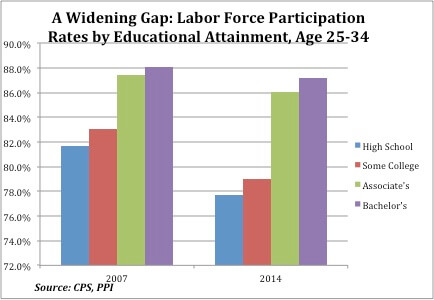
When it comes to young workers, aged 25-34, the gap in labor force participation for those with and without a degree is now roughly 10 percentage points – and the gap is widening.* The chart below illustrates this stark reality – having a college degree could make the difference in whether or not millennials find a job.

LaborForceMillennials

However, my research also shows that in today’s labor market, having a college degree may not be enough. That’s because, in addition to completing college, the economic prospects of millennials depends on having high-wage skills employers demand.

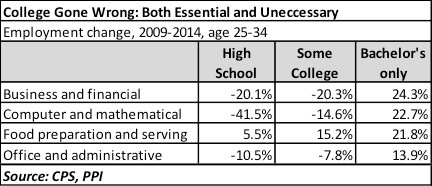
Since the recovery began in 2009, college graduates’ outcomes have diverged. Some have seen great success in the economic recovery, while others have floundered at the expense of their less educated peers. I call this phenomenon the “Great Squeeze,” and I have previously written on it here. That real average annual earnings for young college graduates fell by 12 percent over the last decade reinforces this divergence between workforce success and underemployment.

CollGoneWrong

It turns out that what you study matters, as not all graduates are struggling. Graduates in high-skill, high-demand fields such as computers and mathematical occupations, for example, are doing just fine. The most recent Conference Board data shows the ratio of unemployed workers to advertised jobs for computer and mathematical occupations is just 0.17.

The skills mismatch helps in part to explain why too many college graduates find themselves underemployed well after graduation. Our higher education system has not adjusted to the changing shape of the labor market, one where job creation is focused at the high and low end of the skills spectrum.

That’s why it is not obvious that while some postsecondary credential is necessary, a college degree for everyone is the right fix. Instead, these charts suggest we need to look outside status quo higher education, to encourage more pathways into the workforce that provide young people with the skills employers demand.

*Note: Few in the aged 25-34 cohort are enrolled in school, and both men and women with a high school diploma or some college, no degree had significantly lower labor force participation rates than college graduates.

The Hill: Obama trade agenda

PPI President Will Marshall was quoted by Kevin Cirilli in The Hill on the growing tensions in the Democratic party over President Obama’s trade agenda:

Will Marshall, president of centrist Democratic think tank the Progressive Policy Institute, said that “Democratic candidates in 2016 aren’t going to get into trouble for supporting” the trade agreements.

“Most voters understand that America can’t prosper in isolation and they have little interest in yet another reenactment of the long-ago battle of NAFTA,” he said.

Continue reading at The Hill.

Oregon Grapples with Broadband Regulation

The FCC’s “Open Internet” order was just released today. Plenty of people are hashing it over, including PPI (see statement here).

However, what’s less appreciated is how the FCC’s action puts the spotlight squarely on states and municipalities. No longer constrained by federal “light-touch” policies, state and local politicians and regulators must decide: Will they act in a way to encourage private investment in broadband networks? Or, instead, will they choose to discourage private investment in their region by regulating broadband prices and excessively taxing broadband providers?

Here’s the simple fact: States and municipalities that choose to place excess regulations and taxes on broadband providers will find themselves losing out on private investment in new networks, with negative long-term economic consequences.

One state struggling with this decision is Oregon. The Oregon situation is both complicated and illuminating, because it brings together so many different strands. Oregon currently has a set of rules for property tax called “central assessment.” As applied in Oregon, these rules mean that broadband providers such as Comcast pay property taxes based not just on the value of their facilities in Oregon, but on a tax base including intellectual property and other intangibles worldwide. This rule had the effect of driving up Comcast’s tax payments in Oregon by a factor of six, according to the company. The state legislature is considering a bill that allows the central assessment rule to be partly but not fully rolled back, leaving providers such as Comcast still exposed to substantially higher taxes.

The same high-tax rule would also apply to Google, if and when the company follows through on potential plans to build a gigabit fiber network in Portland, Oregon. The bill does offer potential relief for Google and other potential builders of gigabit broadband networks, with a tough caveat: They would have to meet certain build-out, price and performance characteristics in order to qualify for deeper tax reductions. In particular, the provider would have to

 …. offer communication services at or above a speed of 1 gigabit per second symmetrical service and at a price to customers that does not exceed 150 percent of the United States average price for the same speed of symmetrical service. The Public Utility Commission shall determine the maximum price of service and may update the standards for speed, type and price of service as the commission considers appropriate. The commission shall recertify each qualified project under this subparagraph every five years

In effect, the bill gives the PUC a mandate to set rates for gigabit networks–a return to the old-style top-down utility regulation that once helped throttle innovation. Rate regulation would make it much more difficult for providers to put together packages that would work for consumers and support investment. What’s more, because the regulators can change the price and speed standard at will, companies who build gigabit networks and qualify under this clause have no assurance that their tax bill won’t suddenly skyrocket, even if they have met their original promise. Indeed, regulators will be under political pressure to raise speed standards and lower maximum prices.

Now, the partial tax rollback, combined with the conditional tax reduction for gigabit providers, is better than the original tax rules. But if Oregon state legislators really want to attract private broadband investment and spur innovation and growth, they shouldn’t boost taxes on broadband providers and encourage regulators to micromanage prices and services. After the FCC’s open internet decision, that’s a lesson that all states and municipalities are going to have to learn.


CNN: Why liberals should get behind marriage

The collapse of marriage in our poorest communities — and its tragic impact — is a familiar story. But increasingly, marriage is becoming a marker of class privilege in America, something increasingly reserved for the affluent. If progressives want to tackle the scourge of inequality, then the retreat from marriage is an issue they can’t ignore.

The reality is that the retreat from marriage is pervading the working middle class — the two-thirds of Americans without a college degree. This is occurring even as in upscale America, marital bonds remain comparatively strong.

“This is the marriage gap, and it’s something new in America,” declares a manifesto on “marriage opportunity” unveiled in a recent Washington Monthly cover story. It was penned by four astute social and political analysts, David Blankenhorn, Jonathan Rauch, Barbara Dafoe Whitehead and Bill Galston. (Full disclosure: I’m a signer of their statement.)

“Over the past several decades, the norm of marriage has eroded across all economic and educational classes, but much less among the elite,” they write. “But for millions of middle- and lower-class Americans, marriage is increasingly beyond reach, creating more fractured and difficult family lives, more economic insecurity for single parents, less social mobility for those on the lower rungs of the economic ladder, more childhood stress, and a fraying of our common culture.”

True, overall U.S. marriage rates have fallen from 72% of U.S. adults in 1960 to just 51% in 2012, according to The Economist. But drill a little deeper into the data, and a marital class divide emerges. Less than half of men with high school degrees are married, compared with 76% of men with college degrees. The pattern is similar among women, except that those with graduate degrees have somewhat lower marriage rates than those with four-year college degrees. And because the college-educated tend to look for mates with similar education and earning power, their unions push them even higher up the income scale — further widening the economic gulf between marital haves and have-nots.

Continue reading at CNN.