College Cost at a Glance

PPI Senior Fellow Paul Weinstein lauds the White House’s creation of the College Scorecard:

If you haven’t yet, you should check out the new version of the College Scorecard launched by the White House this week.  The Scorecard is an example of the power of the President to act without Congress and the potential of “open” information to address social and economic problems—in this case the ability of colleges and universities to raise prices with little impact (to date) on demand, at a time when family incomes remain flat and more and more students are walking away after four or more years of college without degrees, without jobs, and with lots of debt.

Read the full piece at GovStud.

Booming Data Economy Puts EU to the Test

In an article for Euractiv, Jeremy Fleming calls for a new regulation adapted to the data economy in Europe. He cites Michael Mandel’s policy brief on the rise of the data-driven economy.

In a policy brief last autumn for the Progressive Policy Institute in Washington, Harvard economist Michael Mandel argued that “economic and regulatory policymakers around the world are not getting the data they need to understand the importance of data for the economy.”

Mandel cited the fact that Eurostat – the European statistical agency – reports how much European businesses invest in buildings and equipment, but not how much those same businesses spend on consumer or business databases, as evidence of a malaise.

“Since the modern concept of economic growth was developed in the 1930s, economists have been systematically trained to think of the economy as being divided into two big categories: ‘goods’ and ‘services’. But data is neither a good or service,” according to Mandel.

He believes that the key statistics watched by policymakers – economic growth, consumption, investment, and trade – dramatically understate the importance of data for the economy, and that “these misleading statistics distort government policy”.

Read the entire article here.

What Privacy Means to Americans vs. Europeans

Paul W. Taylor discusses the different attitudes towards privacy in American and European contexts in Governing Magazine, using PPI’s recent conference in Rome as a backdrop.

In October, I stopped for lunch at an outdoor osteria on Via della Lungara just east of the Tiber River. The pizza served there — puffy Neapolitan crust with buffalo mozzarella and fresh San Marzano tomatoes — was just the early part of a multicourse meal that always includes wine. Compare that to the American pie, a main course with its chewy crust smothered in tomato sauce, cheese and a seemingly endless variety of toppings. It almost always is accompanied by beer. All sorts of pies and slices get called pizza in the U.S., while the name and geographical distinctiveness of Neapolitan pizza is protected under European Union law.

On that trip, just two blocks from the osteria, an international gathering at John Cabot University, a private American liberal arts school in Rome, was considering another transatlantic divide — privacy in an era of big data — that has striking similarities to the different ways Americans and Europeans cook and serve pizza.

Read the entire article here.

The Secret Ingredient for Solving Economic Inequality: Savings

In his second inaugural address, President Obama laid out a bold vision for solving economic inequality. “We are true to our creed,” he said, “when a little girl born into the bleakest poverty knows that she has the same chance to succeed as anybody else because she is an American.”

The president has hinted at a variety of approaches for solving inequality, ranging from education reform to job training. But he has yet to spotlight one critical ingredient: savings. Without an aggressive plan to help all Americans save and build wealth, genuine equality of opportunity is impossible.

Stagnant household incomes are unquestionably inequality’s principal source of nourishment. The Census reports 2011 real median income was down nearly 9 percent from its high in 1999. Continue reading “The Secret Ingredient for Solving Economic Inequality: Savings”

Reframing the Marriage Debate

Listening to the political debate in Washington, you’d think the only important question about marriage is whether there’s any valid reason to bar gays from it. Few pay attention to the basic health of the institution we’re all fighting over.

David Blakenhorn is an exception. He and his colleagues at the Institute for American Values are calling public attention to the decline of marriage in the United States, and the profound social and economic implications it entails. They’ve just issued a call for a “new conversation on marriage,” which I’ve been pleased to endorse.

Our statement underscores that the erosion of marriage among non-college educated Americans (not just the poor) is reinforcing other baleful trends – wage stagnation and the concentration of economic gains at the top of the economic pyramid – that are deepening class divides in our supposedly classless society. And yet:

This hollowing out of marriage in mainstream America is among the most consequential social facts of our era. It’s contributing to the growth of inequality, harming countless children, and weakening, perhaps fatally, our formerly strong middle class. And amazingly, if you listen to political leaders of both parties and opinion leaders from both the left and right, you’ll discover that very few of them appear even to have noticed what’s happening.

The appeal ends by challenging the fatalistic view that the decline of marriage is some kind of historical or evolutionary inevitability. Marriage is an organic social institution, and we can take intelligent steps to strengthen it. By reframing the marriage debate, this statement begins that vital process of renewal.

Stop the Debt!

Writing for Politico, Will Marshall argues that President Obama should counter the Republican’s proposal of balancing the federal budget in 10 years with an achievable goal of stopping the debt growth this year:

Republicans have retreated twice this month on the fiscal front, but they aren’t giving up. After having been forced to swallow higher tax rates and a debt ceiling increase, they’ve regrouped behind a new demand: balance the federal budget in 10 years.

That’s not going to happen, but no matter: The GOP is making an ideological statement. President Barack Obama should counter with a realistic fiscal goal, one Congress could actually achieve this year: Stop the debt from growing.

It’s finally dawned on Republicans that control of the House doesn’t entitle them to dictate the nation’s agenda. Still, they want to keep debt reduction front and center in Washington, because it’s a proxy for what conservatives regard as the nation’s overriding priority: shrinking the federal government.

But Obama won the election, and he has other ideas. One of them is not letting the right hold America’s economy hostage to demands for brutally deep cuts in public spending. The public backs the president, as evidenced by polls showing Americans believe GOP rigidity is the chief obstacle to a fiscal compromise.

Read the piece at Politico.

San Bernardino County Strikes Measure to Use Eminent Domain

Earlier today the Joint Power Authority, municipal body constructed by the county of San Bernardino, California voted not to consider using the power of eminent domain to seize residential mortgages held in private label securitizations (PLS).

The proposed move, authored by “Mortgage Resolution Partners”, a private firm out of San Francisco, had long been a controversial measure strongly opposed by private investors. The concept would have used the local “takings” power to write down principal on underwater mortgages and refinance the new loans onto the books at The Federal Housing Administration (FHA).

In a policy brief titled “Can Eminent Domain Help Underwater Homeowners” published on  July, 2012, when this plan first began to surface, I argued that eminent domain deserved credit for being creative, but was not in the best interest of homeowners. Please see the memo here.

Is the Labor Market for Colleges Grads Looking Up?

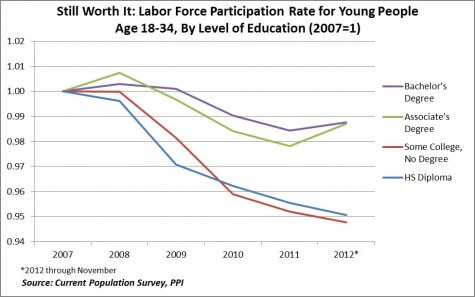
Young educated Americans are finally rejoining the workforce. According to BLS statistics, the labor force participation of Americans age 18-34 with a Bachelor’s or Associate’s degree is rising again. By comparison, young people without higher education are still dropping out of the labor force.

The chart below shows the divergence in labor force participation between young people with and without a degree. Having a degree makes a big difference in who shares in the labor market recovery and who is increasingly left behind. Interestingly, young people with a vocational Associates degree are having the best recovery in labor force participation, even better than those with a Bachelor’s degree.

To be sure, the news is not all good. College students are well aware of the challenges awaiting them, like rising average student debt and falling real earnings. Most young grads say their biggest ambition has come to finding a job that pays enough to cover rent.

Continue reading “Is the Labor Market for Colleges Grads Looking Up?”

What Americans Didn’t Get from the Fiscal Cliff Tax Deal

By all accounts, the recently passed tax deal averting the “fiscal cliff” was a big win for the American people.

Among other things, the agreement preserves the full package of Bush-era tax cuts for the middle class and raises rates only on the wealthiest Americans. It also permanently patches the Alternative Minimum Tax so it wouldn’t affect middle-class households.

Moreover, it extends for five more years an expansion of three major tax benefits for lower-income households: the earned income tax credit for low-income wage-earners, the child tax credit and the “American Opportunity Tax Credit,” aimed at helping families defray college costs.

But Americans may end up losing more than they’ve gained if this agreement is all that passes as “tax reform” this Congress. If so, Americans will have been robbed of an opportunity to rebuild a tax code that’s truly in their favor.

This means a tax code that’s not just less complex but whose benefits, as well as its burdens, are distributed more fairly. In particular, middle-and lower-income Americans deserve far more help than they’re getting to save and invest in their economic security. Continue reading “What Americans Didn’t Get from the Fiscal Cliff Tax Deal”

The Google Way: How Washington Can Regulate Without Killing Growth

In the Atlantic, Michael Mandel explains how the Federal Trade Commission’s looming antitrust settlement with the search giant shows that regulators can do their job without stifling innovation:

The Federal Trade Commission seems ready to announce a settlement with Google today, bringing to a close a 20-month antitrust investigation. The settlement reportedly would avoid antitrust charges against the search giant, while requiring Google to agreeing to change some of the practices that other companies have complained about.

On its own, the settlement is good news for consumers, workers, and the whole U.S. economy. Objectionable conduct would be moderated without dampening the incentive for Google to innovate and provide new services. It’s also true that it never made much sense to attack one of America’s prime innovative companies at a time when competitiveness, growth, and job creation are at the top of the economic agenda.

More importantly, the FTC’s approach to the Google investigation shows that regulatory agencies can be thoughtful about adopting pro-innovation, pro-growth policies without abandoning their core missions. A critical question facing the U.S. economy–and indeed, the European economy as well–is whether the existing regulatory structure is flexible enough to deal with the fast changing world of technology. If regulators apply old rules too strictly, they run the risk of squashing the very innovation needed to drive growth, job creation, and competitiveness.

Read the complete piece at the Atlantic.

Why the Housing Market Can’t Move On Without More First-Time Homebuyers

Writing for U.S. News & World Report, Jason Gold argues why the housing market needs more first-time homebuyers:

Home values are now increasing nationwide. While that’s certainly better than the alternative, a deeper dive into the data reveals a serious crack in the foundation: too few first-time homebuyers.

First-time homebuyers are the vital first rung on the home ownership ladder. They are usually buying from a seller who is “trading up” to a more expensive home or building a new one. When potential new buyers sit on the sidelines, existing homeowners are stuck, unable to move out and up.

In October, the first-time buyer’s share of the purchase market stood at about 35 percent according to the Campbell/Inside Mortgage Finance HousingPulse Survey. That’s down from 37 percent as recently as June and it’s the lowest percentage recorded in the survey’s history. Typically, a healthy housing market sees first-time homebuyers occupy around 40 percent of the purchase market.

The survey results also revealed that first-time homebuyers heavily relied on the Federal Housing Administration for financing, thanks to its low down-payment requirement of 3.5 percent. With the FHA’s recent announcement that it will tighten credit standards, first-time homebuyers will see the barrier to homeownership grow even more.

Read the entire piece at U.S. News & World Report.

Funding Cuts Hit College Students Harder Than Faculty

Fiscal cliff or not, the coming years are certain to bring cuts in public spending on higher education. The looming sequestration threatens to cut $500 billion in federal discretionary spending starting next year, leaving a multi-billion dollar hole in R&D funding at public universities. State governments have already begun higher education funding cutbacks. So as policymakers pledge austerity and deficit reduction, colleges and universities will be left in a financial pinch.

Students and university faculty and staff are the obvious targets to fill these budget holes. But who actually pays the price for cuts in university funding?

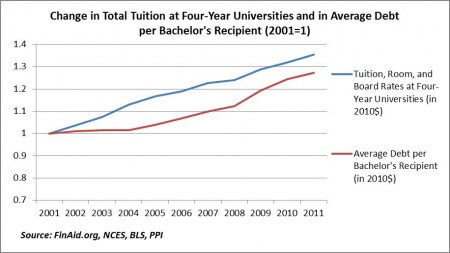
New PPI research suggests college students will bear the brunt of additional austerity imposed on colleges and universities. Looking at previous cuts in public funding, we found college students were unquestionably worse off relative to faculty and staff when it came to making up the difference. And the impact of this uneven allocation could be serious. If college students continue to pay the biggest price for austerity, the next generation of young people may think twice about the value of going to college.

That’s because college students paid a high price for cuts in university funding over the last decade, while faculty and staff were relatively unaffected.  As shown in this first graph, total tuition at four-year universities rose a staggering 35% over the last decade (in constant dollars). These rising prices are certainly behind the rising real average debt per graduate, up almost 30% over the same time.

Continue reading “Funding Cuts Hit College Students Harder Than Faculty”

Will Marshall on Obama’s Fiscal Cliff Policy

Writing for Politico‘s Arena , PPI President Will Marshall discuses Obama’s fiscal cliff policy:

President Obama holds the whip hand on taxes.

He campaigned and won on the explicit promise of raising tax rates on the wealthiest two percent of Americans. It’s the closet thing to a mandate the 2012 elections produced. And polls make it clear that the public will blame Republicans if there’s no deal and we go off the cliff.

Deal or no deal, tax rates on the rich are going up. Unless they have a political death wish, Republicans can no longer hold the Norquist line.  So they’d be wise to negotiate with the president, angling for a top rate lower than the default rate of 39.6, in return for a promise to revisit the issue next year in the context of comprehensive tax reform. The more lawmakers succeed next year in broadening the tax base – by closing tax loopholes and preferences – the stronger argument they can make for lowering tax rates.

Read it at Politico.


Washington Insiders Tackle ‘Fiscal Cliff’ Policy Solutions

Will Marshall was a panelist at the Fix The Debt policy conference on Tuesday, Dec. 4, discussing two of the biggest issues surrounding federal budget deficits and the national debt – tax reform and healthcare

The panel called on Pres. Obama and Congress to tackle the nation’s budget problems.  The group proposed fiscal policies for entitlements, discretionary spending and raising additional revenues.

Maya MacGuineas, head of the Washington-based Committee for a Responsible Federal Budget, provided introductory remarks and then Peter Cook, Bloomberg News, moderated discussions with leading corporate CEOs, top federal and state politicians along with advocacy groups and former World Bank President Robert Zoellick.

Watch the panel here.


Democrats Must Step Up on Entitlement Reform for Fiscal Cliff Deal

PPI President Will Marshall speaks to The Daily Beast regarding the compromises needed from the left to avoid the fiscal cliff:

‘It appears President Obama is serious about slowing the growth of public health and retirement costs, which is the key to bending down the curve of federal spending,’ says Will Marshall, president and founder of the Progressive Policy Institute. ‘The big question now is whether leading Democrats in Congress will stand up to the Norquists of the left and put real entitlement reform on the table.’

That is the big question. Labor unions rightly believe that they were essential to the president’s winning coalition and ground-game effort in the November election. They and many liberal partisans will insist that now is not the time to make any concessions, especially on core philosophic policies like Social Security and Medicaid. They will find comfort in the arguments of some party activists and pundits who say there is no problem, that the fiscal cliff is a myth, and that current levels of deficits and debt are perfectly sustainable, especially if we just soak the rich. They are, like their conservative corollaries, embracing a feel-good reality distortion field.

Math isn’t partisan. The Congressional Budget Office has projected that because of our aging population, cumulative spending on Social Security, Medicare, Medicaid, and interest on the debt could gobble all federal revenues by the end of the next decade. The status quo is unsustainable. We cannot simply tax or spend or borrow our way out of this problem. Striking the right decisive balance is critical to our long-term economic strength as a nation.

Read the entire article at The Daily Beast.