
Economists everywhere are scrambling to determine how today’s weak jobs report impacts the strong recovery story of 3.2 million jobs created over the last year. But when it comes to millennials in the labor force, the monthly numbers are only a small part of the story. That’s why I’ve done some number crunching to see what’s really going on with my generation.
My research highlights two factors that are holding millennials back: too many are not completing college, and too many that do have skills that are not well-matched to labor market demands.
When it comes to young workers, aged 25-34, the gap in labor force participation for those with and without a degree is now roughly 10 percentage points – and the gap is widening.* The chart below illustrates this stark reality – having a college degree could make the difference in whether or not millennials find a job.
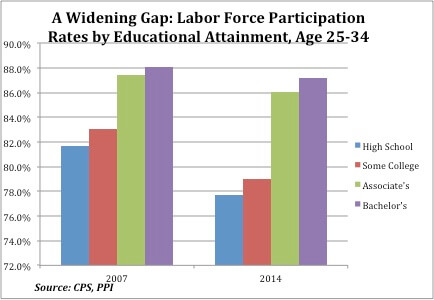
However, my research also shows that in today’s labor market, having a college degree may not be enough. That’s because, in addition to completing college, the economic prospects of millennials depends on having high-wage skills employers demand.
Since the recovery began in 2009, college graduates’ outcomes have diverged. Some have seen great success in the economic recovery, while others have floundered at the expense of their less educated peers. I call this phenomenon the “Great Squeeze,” and I have previously written on it here. That real average annual earnings for young college graduates fell by 12 percent over the last decade reinforces this divergence between workforce success and underemployment.
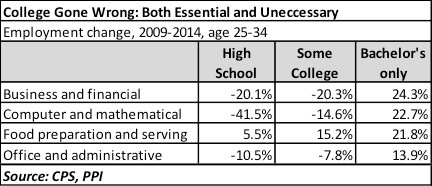
It turns out that what you study matters, as not all graduates are struggling. Graduates in high-skill, high-demand fields such as computers and mathematical occupations, for example, are doing just fine. The most recent Conference Board data shows the ratio of unemployed workers to advertised jobs for computer and mathematical occupations is just 0.17.
The skills mismatch helps in part to explain why too many college graduates find themselves underemployed well after graduation. Our higher education system has not adjusted to the changing shape of the labor market, one where job creation is focused at the high and low end of the skills spectrum.
That’s why it is not obvious that while some postsecondary credential is necessary, a college degree for everyone is the right fix. Instead, these charts suggest we need to look outside status quo higher education, to encourage more pathways into the workforce that provide young people with the skills employers demand.
*Note: Few in the aged 25-34 cohort are enrolled in school, and both men and women with a high school diploma or some college, no degree had significantly lower labor force participation rates than college graduates.

