


On this week’s episode of The Learning Curve, co-hosts Alisha Searcy of the Center for Strong Public Schools and Mary Tamer of MassPotential speak with Rachel Canter, Director of Education Policy for the Progressive Policy Institute’s Reinventing America’s Schools project and founder of Mississippi First, about Mississippi’s remarkable rise in K–12 student achievement and the policy reforms that helped drive it. Drawing on her experience as a former Teach For America teacher and longtime education advocate, Canter reflects on the leadership, accountability, and strategic reforms that helped Mississippi transform from one of the nation’s lowest-performing states to one of its fastest-improving on the National Assessment of Educational Progress. She discusses the science of reading, the debate between phonics and whole language instruction, and what schools must do to rebuild academic rigor in literacy, STEM, and civics. Canter also explores the importance of exposing students to great literature and roots music from William Faulkner and Delta bluesmen like Robert Johnson, drawing on Mississippi’s rich cultural legacy, and reflects on how lessons from Civil Rights era figures, including Emmett Till and Fannie Lou Hamer, can strengthen civics education today. She concludes by sharing policy recommendations for governors, legislators, educators, and parents seeking dramatic and lasting improvements in student outcomes nationwide.
Category: Uncategorized
Canter on Better Teaching: Only Stuff that Works: From Reforming Legislation to Classroom Practice with Rachel Canter
Rachel Canter didn’t just report on the Mississippi Marathon—she was involved from the beginning of the state’s long journey toward educational improvement. In this episode, we discuss why meaningful change took so long and what it took to move reform from legislation into actual classroom practice.
Moss in Straight from the Hut: Ticketmaster’s monopoly hits a snag in state legislatures, but its influence endures
[…]
This all comes after Democrats have tried to talk a big game about Ticketmaster, yet the monopoly’s state legislative efforts have largely gone under the radar.
“This is an enormous diversion away from the Live Nation – Ticketmaster monopoly,” says Diana Moss, the vice President and director of competition policy at the Progressive Policy Institute. “Don’t look over here at the monopoly, look over there at the resale market. Let’s call the resale market a bunch of scalpers, make unsubstantiated claims about how it functions, and lay the blame at the feet of the resale market.”
[…]
Read more in Straight from the Hut
Canter in Forbes: School Districts With Fast-Rising Test Scores Have 5 Things In Common
[…]
Many of those districts share something in common: a focus on literacy, instructional consistency, teacher coaching, accountability and human connection.
“The idea that there is some magical singular practice or policy or tool that, if we could just find it, would be like flipping a switch and then we could solve all the education problems is very seductive to people,” says Rachel Canter, director of education policy at the Progressive Policy Institute and founder of Mississippi First, a nonprofit that helped push successful literacy reforms in that state. “But change always takes time.”
[…]
Read more in Forbes
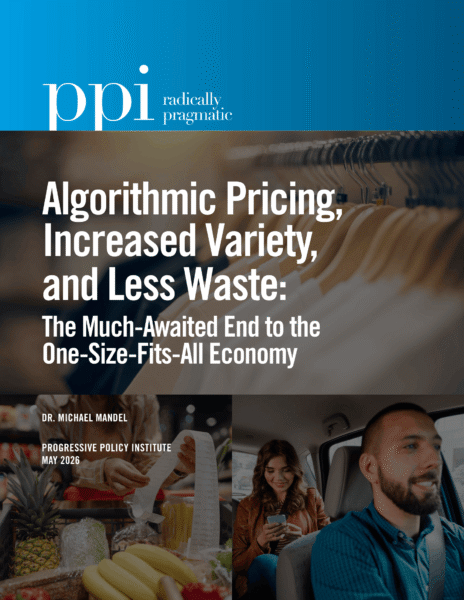
New PPI Report Shows Algorithmic Pricing as Path to Variety, Affordability, and Less Waste
WASHINGTON (May 19, 2026) — The Progressive Policy Institute (PPI) released a new report today arguing that algorithmic pricing and innovation can expand consumer choice, lower prices, and reduce waste, but only if policymakers set smart guardrails rather than sweeping bans.
“Algorithmic Pricing, Increased Variety, and Less Waste: The Much-Awaited End to the One-Size-Fits-All Economy,” by Michael Mandel, Vice President and Chief Economist at PPI, shows how data-driven pricing is already benefiting millions of Americans, from transit riders receiving automatic income-based discounts to grocery shoppers finding customized discounts tailored to their budgets.
Yet several states are considering legislation that would sharply reduce the scope of data-driven pricing. Such restrictions risk pushing the economy backward, toward mass-produced goods designed for the median consumer, leaving low-income and rural households with fewer choices and higher costs.
“The real question for policymakers isn’t whether to allow data-driven pricing, but how to foster its benefits while preventing harm,” said Mandel. “Legislation like Maryland’s Protection from Predatory Pricing Act can protect consumers in essential markets like groceries while preserving tools that help budget-conscious shoppers save money.”
The report highlights how algorithmic innovation is already reshaping markets. Too Good To Go, a platform that uses algorithmic pricing to sell surplus restaurant food at discounts, has expanded to more than 20 countries. Public transit systems in San Francisco and Philadelphia are using algorithmic means-testing to automatically enroll low-income riders in discount transit programs. Telehealth and at-home testing are allowing consumers to access care on their own schedules.
Economic research cited in the report shows that access to increased product variety alone generates enormous welfare gains.
“With affordability top of mind for Americans today, we should be encouraging pro-consumer innovation, not restricting it,” said Mandel. “Moving away from the one-size-fits-all economy acknowledges that households have different tastes and needs.”
Read and download the report here.
Founded in 1989, PPI is a catalyst for policy innovation and political reform based in Washington, D.C. Its mission is to create radically pragmatic ideas for moving America beyond ideological and partisan deadlock. Find an expert and learn more about PPI by visiting progressivepolicy.org. Follow us at @ppi.
###
Media Contact: Ian O’Keefe – iokeefe@ppionline.org
Marshall and Kahlenberg in The New York Times: Is There a Door No. 3 for Democrats?
[…]
Will Marshall, president and founder of the centrist-Democratic Progressive Policy Institute, argued that the only plausible path toward expanding the universe of Democratic voters “is to build a cross-class coalition that includes a lot more noncollege voters, who constitute a majority of the electorate. That entails changing the party’s self-marginalizing stances on economic redistribution, energy and climate and identity politics.”
Marshall cited an essay published last summer by a colleague, Richard Kahlenberg, director of Housing Policy and the American Identity Project at the institute, “Renewing the Democratic Party.”
After pointing to data on the public’s view of the Democratic Party similar to the poll findings I mentioned at the start of this essay, Kahlenberg argued: “Restoring the primacy of working-class priorities, on issues of culture as well as economics, provides the central path forward for a Democratic Party that wants to build a durable majority and restore its identity as the party of working people.”
But, he continued, as “racial gaps have narrowed in a variety of arenas, and class divides have mostly widened,” Democrats “have doubled down on framing challenges primarily in terms of racial and ethnic identity, rather than economic status.”
So why, Kahlenberg asked, “do Democrats engage in this self-defeating behavior? Two factors stand out.”
One is the shift in power of major Democratic interest groups from “organized labor, with its broad-based concerns about economic inequality,” to identity-based interest groups “for people of color, women and the L.G.B.T. community.”
The second “has been the rise of highly educated affluent white liberals, often referred to as ‘the Brahmin Left,’” who “are to the left of people of color on issues of race.”
Kahlenberg noted, “When issues are described in narrow racial terms, they are far less expensive to address and minimize the personal sacrifice required of upper-middle-class white liberals.”
[…]
Read more in The New York Times
Algorithmic Pricing, Increased Variety, and Less Waste: The Much-Awaited End to the One-Size-Fits-All Economy
To understand how data can increase variety and affordability while reducing waste, take a look at Too Good To Go, a company founded in Denmark in 2015 to allow consumers to purchase unsold food from restaurants and stores at significantly discounted prices. Since then, the company has expanded to more than 20 countries, including the U.S. and, most recently, Japan.
Users can purchase “surprise bags” for pickup at the end of the day, filled with varying selections of leftover goods that would have otherwise been thrown out. Too Good To Go sets surprise bag pricing based on time and previous sales data, helping businesses to further reduce waste by making sure more leftover food is sold. Meanwhile, buyers with the flexibility to place orders closer to pick up get lower prices, increasing affordability for budget-constrained consumers.
Companies like Too Good to Go show how variety, availability, and affordability can be expanded by algorithmic pricing, and its close cousin, algorithmic innovation — using data to create products and services that meet the real needs of consumers. More convenience and less waste are potential benefits of increased use of data.
Still, algorithmic pricing has encountered opposition because of fears that businesses will take advantage of consumers. Moreover, many people have the feeling that it’s unfair to charge different people different prices. “When New Yorkers place an order online or go to the grocery store, they should be able to trust that they are seeing the same prices as everyone else,” said New York Attorney General Letitia James.
Conversely, excessively tight restrictions on algorithmic pricing and innovation would move us towards a “one-size-fits-all” economy, where everyone would pay the same price, and everyone would have access to the same limited selection of goods and services. Businesses would produce for the median consumer. People whose tastes are near the norm would do well, while people with different preferences and capabilities would feel like a square peg shoved into a round hole.
That balance suggests a need to set guardrails on acceptable practices, without going too far. One model is Maryland’s recently enacted Protection from Predatory Pricing Act, which provides the state’s consumers with thoughtful protections against exploitative practices while preserving the flexibility to use tools like promotional discounts, loyalty programs, and demand-responsive pricing that can help consumers access an expanded range of goods at lower prices.
Read the full report.
Willett and Lewis for Health Affairs: A Pragmatic Path Forward On Flavored E-Cigarettes And The Illicit Market
The Food and Drug Administration (FDA) Center for Tobacco Products (CTP) recently issued draft guidance clarifying its approach on flavored e-cigarettes. The guidance outlines a “graduated risk-proportionate evaluation” establishing a lower evidentiary burden to authorize tobacco-flavored e-cigarettes, a greater burden for menthol and mint-flavored products, and the greatest burden for sweet-flavored products. To date, the CTP has authorized 45 e-cigarette products in primarily tobacco and menthol flavors—and these are the only e-cigarettes legally sold in the United States.
At the same time, there is strong consumer demand for e-cigarettes not authorized by the FDA. Multiple organizations, including the FDA and the Truth Initiative, estimate that most e-cigarettes currently sold in the US are illegal products that lack FDA authorization, and there is growing concern across government, public health, and industry that an illicit market for unauthorized e-cigarettes is posing increased public health and public safety concerns. Much of the discussion to date has focused on the need for greater enforcement actions to address the illegal import, distribution, and sale of illegal e-cigarette products.
To be sure, law enforcement actions against the import and distribution of illegal products are necessary. But the US can and should avoid a drug war approach to e-cigarettes.
Read more in Health Affairs
Manno for Daita K12: The Education Scorecard shows that K-12 learning recovery is a civic project
The pandemic may be over, but the K-12 education emergency it left behind has entered a new phase.
That’s the central message of the new Education Scorecard report by researchers at Harvard, Stanford, Dartmouth, and its partner organizations.
It’s more than an update to the story of pandemic learning loss, showing that America’s K-12 academic problem didn’t begin in March 2020 with COVID. The country entered a learning recession around 2013, when progress in reading and math achievement stalled and then declined.
Read more in Daita K-12
Kahlenberg in Washington Post: DOJ says Yale medical school discriminated against Asian, White applicants
[…]
It is not clear from the data presented that Yale is in fact discriminating on the basis of race, said Richard Kahlenberg, director of the American Identity Project at the Progressive Policy Institute. He advocates against racial preferences but favors preferences for lower-income students.
“Statistical disparities in academic qualifications between racial groups admitted [to the university] certainly raise red flags, but it is not definitive evidence of discrimination,” said Kahlenberg, who testified against Harvard’s policies in the court case challenging its admissions procedures. “We don’t know which of those two things are going on — economic affirmative action, which is perfectly legal, or racial, which is not,” he said.
[…]
For the Trump administration, a race-neutral strategy like this is also illegal if the true goal is racial diversity. Officials refer to this as using another factor as a “proxy” for race. Still, the Supreme Court has never said that proxies are illegal and has declined opportunities to issue rulings that could have done so, Kahlenberg noted.
“The Supreme Court never said that seeking educational benefits of racial diversity is illegal,” he said. “To the contrary, they said the goal of increasing cross racial understanding is laudable.”
[…]
Read more in The Washington Post
PPI Calls for Senate Banking Committee to Close Stablecoin Yield Loophole
WASHINGTON (May 13, 2026) — Today, Paul Weinstein Jr., Senior Fellow at the Progressive Policy Institute (PPI), issued the following statement ahead of the markup of the Digital Asset Market Clarity Act, also known as the CLARITY Act, by the Senate Banking Committee:
“Tomorrow, the Senate Banking Committee will begin marking up the CLARITY Act. The Committee has wanted to use the markup to clarify Section 4 of the GENIUS Act, which prohibits stablecoin issuers from paying yield like banks, but remains silent on stablecoin deposits on third-party platforms.
“But instead of closing the yield loophole, which will draw deposits away from regulated and insured banks and credit unions, the Committee is planning to consider a ‘compromise’ amendment that actually codifies the loophole into law.
“Senators Angela Alsobrooks (D-Md.) and Thom Tillis (R-N.C.) should be commended for their attempt to achieve a bipartisan compromise. But providing consumers with a less expensive payment processing tool does not require allowing stablecoins to offer customers yield-like rewards — and their proposed amendment should be strengthened to reflect that reality.”
Founded in 1989, PPI is a catalyst for policy innovation and political reform based in Washington, D.C. Its mission is to create radically pragmatic ideas for moving America beyond ideological and partisan deadlock. Find an expert and learn more about PPI by visiting progressivepolicy.org. Follow us at @PPI.
###
Media Contact: Ian O’Keefe – iokeefe@ppionline.org
No commercial rubber trees grow in the United States
FACT: No commercial rubber trees grow in the United States.
THE NUMBERS: Imports of goods by industry type (2024)* –
| Industry type | Import value | Share of Imports |
| All identifiable U.S. importers | $2.925 trillion | 89% |
| … Manufacturers | $1.220 trillion | 37% |
| … Wholesalers | $0.971 trillion | 29% |
| … All known others | $0.735 trillion | 22% |
| All else, not identified by importer type | $0.370 trillion | 11% |
* Census Bureau.
WHAT THEY MEAN:
As legal devices, the Trump administration’s tariff decrees are faring poorly. The Supreme Court killed most of Plan A — “emergency” declarations under the International Emergency Economic Powers Act — in February. The specialized Court of International Trade found Plan B, a Section 122 claim that the U.S. is in the midst of a “balance of payments crisis,” illegal last Thursday:
“Because the Proclamation’s use of trade and current account deficits to stand in the place of balance-of-payment deficits within the meaning of the statute renders the Proclamation ultra vires … Proclamation No. 11012 is invalid, and the tariffs imposed on Plaintiffs are unauthorized by law.”
Plan C, announced in March and probably going live in July, disinters a third old trade law (“Section 301”), hoping to use it to impose tariffs on allegations of “structural excess capacity” and forced labor law. (PPI’s unimpressed comment here.) Court rulings on this one will presumable coming next year. In the interim, a reality check: if the administration’s decrees are struggling as a legal matter, are they nonetheless achieving their real-world economic goals?
A year ago, the administration said that while tariff increases might cause pain, this would be transitory. Though prices might go up, and living standards for American waitresses, teachers, truck drivers, and auto mechanics might fall, new manufacturing output and jobs would compensate with better opportunities. A year later, this hasn’t happened: manufacturers have shed about 100,000 jobs, and their “GDP” share is down from 9.8% to 9.4%. Why not? A likely explanation is that the administration’s mental picture of both “trade” and “manufacturing” was naïve: manufacturers are far larger importers than it realized, and a lot of the tariff burden has fallen on them. Two examples, then the big-picture point:
- Metal tariffs and container chassis-making: Sitting next to PPI’s Ed Gresser at the U.S. Trade Representative Office’s “public hearing” on Plan C last Friday, a lawyer for U.S.-based makers of container chassis for trucks argued that foreign chassis-makers are getting various tax breaks and other supports from their governments, and unfairly competing to sell the low-priced result to American trucking companies, so tariffs on Chinese-made chassis have simply shifted production to other countries.
Whether or not foreign chassis have gotten too cheap, the administration’s tariff decrees are definitely making the U.S.-made version more expensive. Last June’s “Section 232” tariff decree — not legally challenged so far, and thus fully in force — imposed a 50% tariff on steel on “national security” grounds. According to the Commerce Department, American buyers of steel now pay an average of $971 per ton for their metal, more than twice the $460 average their overseas competitors pay. A 40-foot container chassis costing about $25,000 requires about three tons of steel, and this price gap means the U.S. version now starts out $1,500 in the hole against foreign rivals — even before the potential Plan C tariffs on screws, coatings, rivets, lathes, sandblasters, gantry welders, laser cutters, positioning tables, etc., and all the inputs and capital equipment needed to make things out of metal.
- Natural rubber tariffs and airplane tire-making: The March “Federal Register Notice” announcing Plan C cites a “trade surplus in rubber” as grounds for putting Thailand on its 16-country investigation list. Thailand does indeed have such a surplus, but this is natural — in economic terms, a consequence of Southeast Asia’s “absolute advantage” in rubber trees — and a Plan C tariff on Thai rubber would help nobody and harm lots of American manufacturers.
To explain, the U.S. uses about 3 million tons of rubber a year. This includes 1 million tons of natural rubber produced by rubber-tree tapping, and 2 million tons of artificial rubber produced in factories. They aren’t substitutes for one another: artificial rubber is less chemically active and therefore preferred for gaskets, fan belts, tubes, and the soles of shoes; natural rubber, being stretchier and more friction-resistant, is the main material for airplane and truck tires, as well as for condoms, surgical gloves, construction joints, and medical devices.
All natural rubber comes from abroad — mainly Southeast Asia, secondarily West Africa — because the rubber tree, Hevea brasiliensis, is a tropical plant which thrives in hot, rainy climates. (Curious D.C. Metro residents can see one in the U.S. Botanical Gardens’ climate-controlled Tropics Room near the Capitol.) Since rubber trees don’t grow in places with cold winters, the U.S. produces no natural rubber at all. Tariffs on natural rubber, no matter how high, won’t bring rubber-tree plantation jobs to Minnesota or North Carolina, but will raise costs and reduce sales for every U.S. manufacturer of airplane and truck tires, vibration dampers in bridges, specialized medical equipment, and so on.
These specific cases illustrate a systematic administration error: a belief that “trade” operates on something like 19th-century terms, with manufacturers buying raw materials, farmers and miners exporting bulk commodities, and countries competing to export finished manufactured goods. This wasn’t exactly true then, and hasn’t been close to reality since the 1950s. Just-in-time delivery, supply chains, and coordinated production mean the largest amount of trade is in “intermediate” goods — neither raw materials nor finished stuff, but parts and components used to assemble more complex things. The largest U.S. importers are accordingly not “buyers of finished goods” such as retail chains, hospitals, construction firms, restaurants, and so forth. Instead, they are the chassis-makers buying metals, the airplane-tire-makers buying natural rubber, and other manufacturers buying energy, paint, screws, semiconductor chips, etc., so as to turn these “inputs” into final products or “semi-finished goods” they then sell to others. So though tariffs on steel may benefit steel companies, those benefits only come at the expense of chassis-makers and other metal-users; and tariffs natural rubber are pure losses for U.S. manufacturing.
Statistically, the Census’s annual “Profile of Importing and Exporting Companies” release last Tuesday credits manufacturers with $1.2 trillion in imports — over 40% of the total import value they could identify by industry. That suggests last year’s tariff decrees likely hit U.S. manufacturers with $150 billion or so in new costs. So as the tariffs raised prices for the waitresses, teachers, truck operators, and repair-shop mechanics, they also made it more expensive to operate factories in the United States. Thus no industrial boom has materialized.
In sum: So far, legal judgments on the administration’s tariff decrees haven’t been positive. Real-world economic impacts, likewise.

FURTHER READING
PPI’s four principles for response to tariffs and economic isolationism:
- Defend the Constitution and oppose rule by decree;
- Connect tariff policy to growth, work, prices and family budgets, and living standards;
- Stand by America’s neighbors and allies;
- Offer a positive alternative.
Data:
Census counts U.S. importers and exporters by industry type, company size, etc., as of 2024 (see Table 1d for the importers), and finds that manufacturers are the largest importers.
Legal update:
Plan A: The April 2nd, 2025, “international emergency” decree. Now defunct.
… the Supreme Court’s February 20 ruling striking it down.
Plan A(ii): The June 3, 2025, steel “national security” decree is an exception since it hasn’t so far faced legal challenge and is still in effect.
Plan B: The February 26, 2026, “balance of payments crisis” decree, ruled illegal last week with appeal pending.
… the Court of International Trade’s ruling striking it down last Thursday.
Plan C: The U.S. Trade Representative Office’s “Structural Excess Capacity” investigation, with a gloomy assessment of how “reindustrialization” is going, and a memorably loopy explanation of “Structural Excess Capacity”:
“The Trump Administration’s reindustrialization efforts continue to face significant challenges due to foreign economies’ structural excess capacity and production in manufacturing sectors. Across numerous sectors, many U.S. trading partners are producing more goods than they can consume domestically. This overproduction displaces existing U.S. domestic production or prevents investment and expansion in U.S. manufacturing production that otherwise would have been brought online. In many sectors, the United States has lost substantial domestic production capacity or has fallen worryingly behind foreign competitors.”
PPI’s Gresser testified on the “Plan C” 301 investigation last week. (Quick summary: inconsistent with the statute and a breach of the separation of powers; economically irrational; data unpersuasive and at times irrelevant.)
… and in Monday’s Wall Street Journal (subs. req.)
ABOUT ED
Ed Gresser is Vice President and Director for Trade and Global Markets at PPI.
Ed returns to PPI after working for the think tank from 2001-2011. He most recently served as the Assistant U.S. Trade Representative for Trade Policy and Economics at the Office of the United States Trade Representative (USTR). In this position, he led USTR’s economic research unit from 2015-2021, and chaired the 21-agency Trade Policy Staff Committee.
Ed began his career on Capitol Hill before serving USTR as Policy Advisor to USTR Charlene Barshefsky from 1998 to 2001. He then led PPI’s Trade and Global Markets Project from 2001 to 2011. After PPI, he co-founded and directed the independent think tank ProgressiveEconomy until rejoining USTR in 2015. In 2013, the Washington International Trade Association presented him with its Lighthouse Award, awarded annually to an individual or group for significant contributions to trade policy.
Ed is the author of Freedom from Want: American Liberalism and the Global Economy (2007). He has published in a variety of journals and newspapers, and his research has been cited by leading academics and international organizations including the WTO, World Bank, and International Monetary Fund. He is a graduate of Stanford University and holds a Master’s Degree in International Affairs from Columbia Universities and a certificate from the Averell Harriman Institute for Advanced Study of the Soviet Union.
Read the full email and sign up for the Trade Fact of the Week.
Manno for Flypaper: The small federal charter school program that helped grow public school choice
National Charter Schools Week (May 10 to 16) rightly focuses our attention on the millions of students attending public charter schools. Less attention goes to the federal program that helped make much of that growth possible.
Today, charter schools are often treated as a partisan education fight. But the federal Charter Schools Program, or CSP, has a more practical, bipartisan story. Congress created it in 1994 as part of the Improving America’s Schools Act, the Clinton-era reauthorization of the Elementary and Secondary Education Act.
Created to help launch new charter schools, replicate strong models, and support facilities financing, CSP remains a modest federal tool with a large public purpose: helping communities create more quality K–12 public school options.
It remains the only federal program specifically dedicated to expanding public charter school choice nationwide. The National Alliance for Public Charter Schools describes CSP as a catalyst that helps educators and communities create new public school options rather than a federal effort to run schools from Washington.
Read more in Flypaper
Canter in The Heartlander: Mississippi’s educational turnaround was a marathon, not a miracle, experts say
[…]
Rachel Canter, one of the experts, directs education policy for the Progressive Policy Institute. She wrote a paper documenting changes over the last 20 years. Although the “Mississippi miracle” is associated with the rise in reading scores, the state has also boosted math scores as part of larger reforms.
“It’s a bigger story,” she said. The state met the national average in reading in 2019 and has exceeded it since COVID-19, a time when many states have struggled, but fourth- and eighth-grade math scores also now exceed the national average.
“If you adjust these data for our demographics, Mississippi is No. 1 in the country at both fourth- and eighth-grade math, and at fourth-grade reading, and we’re No. 4 in eighth-grade reading,” she said.
[…]
Read more in The Heartlander
Kahlenberg for The Atlantic: The Democrats Can’t Let Go of Racial Preferences
Racial preferences in college admissions have long been deeply unpopular, and three years ago, the Supreme Court declared them unlawful, in a sweeping ruling that portended doom for other race-conscious policies to promote diversity or remedy past discrimination. Some research indicates that, in the aftermath of the civil-rights era, the achievement gap between rich and poor students now dwarfs the gap between white and Black students. Even so, well-intentioned blue-state Democrats keep pushing for race-based affirmative action, to their own political detriment, rather than supporting a much fairer policy of providing a leg up to economically disadvantaged people of all races.
In February, the California State Assembly passed, by a 54–14 vote, a measure seeking to place on the November ballot a change in the state constitution to allow racial preferences in K–12 education and in higher-education scholarships. (The state Senate has not yet acted on the measure.) In New York City, Mayor Zohran Mamdani released a 375-page Racial Equity Plan last month that said, “New York’s history has been one of colonization, exploitation and racial oppression”; among other measures, the plan reaffirms the city’s intent to steer contracts to minority-owned businesses. Late last year, Democratic supermajorities in the Maryland House and Senate overrode Governor Wes Moore’s veto of legislation to study reparations for the descendants of enslaved people.
In huge swaths of the country, the Democratic brand has become anathema. The party will struggle to recapture the White House and reclaim the Senate unless it can persuade some red-state voters to take a fresh look at it. One obvious move would be for the Democrats, who have hemorrhaged working-class voters, to abandon their stubborn support for politically radioactive racial preferences. Significantly more Americans believe that economically disadvantaged people of any race deserve special consideration in admissions and employment decisions, and such efforts do not run afoul of laws against racial discrimination. Nevertheless, many Democrats cannot bring themselves to accept the Supreme Court’s ruling—or the public’s attitude—even when doing so would help their prospects immensely.
Read more in The Atlantic
Manno for The 74: How Charter Schools Can Help Strengthen K-12 Public Education for the Future
Charter schools are now an enduring part of American K-12 public education. It’s time for policymakers and K-12 stakeholders to stop the foolish argument about whether these schools should exist. They’re here and aren’t going away. The real question is what the next phase of chartering should aim to achieve.
There are several answers to that question. I think one at the top of the list is figuring out how to use the tools that chartering developed, like performance contracting, authorizing, school-level autonomy, mission-driven governance and better measures of student success, to modernize all of U.S. public education for a changing economy and society.
No doubt, some of this has already occurred, as the charter idea has increasingly shaped mainstream expectations about how public schools should operate. — for example, innovation zones and portfolio school management. The challenge now is to ensure that chartering becomes a quality-and-opportunity strategy for all of K-12 public education.