PODCAST: Rep. Brad Schneider Joins PPI’s Neoliberal Podcast

LISTEN NOW: Rep. Brad Schneider Join’s PPI’s Neoliberal Podcast

Schneider: What we have to do…is stay focused on those things that are going to advance the ball, improve people’s lives, and give them the confidence that we’re on the right path and to stick with this team.

Washington, D.C. – On this week’s Neoliberal Podcast, host Jeremiah Johnson sits down with Rep. Brad Schneider (IL-10), a leader of the New Democrat Coalition. They break down what role the New Democrats played in advancing the American Rescue Plan, whether bipartisanship is still possible in today’s Congress, why the GOP is so focused on obscure culture war fighting, and how history will remember the Trump years.

“The worst thing I think we can do is get into a debate of whether we should read Dr. Seuss books or not… what we have to do – as the New Dem Coalition, as the Democratic Caucus, as the new Biden administration – is stay focused on those things that are going to advance the ball, improve people’s lives, and give them the confidence that we’re on the right path and to stick with this team.  And that’s what my colleagues and I have every intention of doing,” said Rep. Brad Schneider on the podcast.

Listen here, and subscribe:

The Neoliberal Podcast dives into the deep end of policy, politics, and identity and hosts the economists, academics, industry leaders, thinkers and politicians whose ideas are shaping society.

The Neoliberal Project is a network of over sixty chapters and tens of thousands of people worldwide working to advance a liberal society by creating a neoliberal identity, facilitating communities to engage with our ideas, producing new media to spread our ideas and programming to debate our ideas. We develop policy proposals, mobilize our network to support those proposals, analyze the policy proposals of others, build relationships with like-minded individuals and groups and establish strong relationships with local, state and federal actors. The Neoliberal Project is a project of PPI.

The Progressive Policy Institute (PPI) is a catalyst for policy innovation and political reform based in Washington, D.C. Its mission is to create radically pragmatic ideas for moving America beyond ideological and partisan deadlock. Learn more about PPI by visiting progressivepolicy.org.

Follow the Neoliberal Project.

Follow the Progressive Policy Institute.

###

Media Contact: Aaron White – awhite@ppionline.org

Virtual Learning and the Health Risks of Excessive Screen Time for Kids

by Kaitlin Edwards

Read the rest of the piece here.

Why a Big Recovery Package is Necessary

Some have questioned the need for the size of the $1.9 trillion American Rescue Plan just signed into law by President Biden. Leaving aside the benefits of the individual pieces of the bill, there are several reasons why “going big” is the right thing to do.

  • As of February 2021, employment in service occupations is still down 14% compared to a year earlier.
  • The fall in employment has hit precisely the Americans with the least financial resources.
  • Because of loan forbearance, current bankruptcy and foreclosure rates underestimate the true hidden economic damage from the pandemic.
  • As we learn more about long-lasting health effects from even mild Covid infections, the full economic impact of the pandemic may take months to emerge as well, especially in states that were hit especially hard.

Economists will be writing papers for years about how to use fiscal policy to fight pandemic downturns. But as PPI President Will Marshall has written, “Biden correctly gauged the magnitude of the nation’s health and economic emergency. After a long, grinding year of loss, suffering and social isolation, his instinct to go big is right.”

Osborne for The 74: Test Scores Give Only a Partial Picture of How a School Is Doing. School Quality Reviews Can Help Fill the Gap

Standardized testing has become controversial in a way few predicted a decade ago. As I wrote in the first piece in this series, test scores give us important information about the quality of schools, but they leave out a lot of other important information.

Consider, for instance, the school that suddenly had to take in 60 new students midyear, because a nearby school closed. The newcomers’ scores on tests given two months later would not tell us much about the quality of that school.

Or how about schools that were closed for a month because of a hurricane and flooding? Wouldn’t their scores misrepresent their quality?

And what about specialized schools, like those that focus on dual-language immersion or the performing arts? Would reading and math scores really tell us what we need to know about their performance, if we don’t also rate them on how well kids are learning their second language or their singing, dancing or acting.

Outstanding schools do many things that test scores don’t measure, such as engaging families, motivating students, regularly assessing their progress, offering remedial help for those who are behind and paying attention to social-emotional learning. Science tells us that these are all important practices. Wouldn’t it be nice if state accountability systems encouraged schools to use them?

Read the rest of the piece here.

Dr. Robert Popovian Joins PPI as Senior Fellow for Health Policy

Today, the Progressive Policy Institute (PPI) announced that Dr. Robert Popovian will join PPI as a Senior Fellow for Health Policy.

“The Progressive Policy Institute is thrilled to welcome Robert Popovian and looks forward to benefiting from having one of the country’s greatest thought leaders on health policy on our team. Throughout his career, Robert has led the conversation around the intersection of biopharmaceuticals, state and federal policy, and health economics. He will help PPI advance our mission of political innovation and forward-thinking policy in this timely and rapidly evolving area,” said Will Marshall, President of the Progressive Policy Institute.

“I am thrilled to be joining PPI as a Senior Fellow; PPI has an unprecedented track record of advocating for cutting-edge healthcare care policy solutions that help reduce unnecessary spending while preserving patient access, principles that are important to me as a healthcare professional and an economist,” said Dr. Robert Popovian.

Dr. Robert Popovian has a distinguished career in health policy and is a national thought leader on biopharmaceuticals and the health care industry. In addition to his work with PPI, he is the Founder of the strategic consulting firm Conquest Advisors. He previously served as Vice President, U.S. Government Relations at Pfizer. He is also a recognized authority on health economics, policy, government relations, medical affairs, and strategic planning.

He is a frequent contributor to a variety of medical sources and media publications, including the Clinical Economics and Outcomes Research, The Oncologist, Journal of Vaccines and Vaccinations, Health Science Journal, USA Today, Managed Healthcare Executive and Morning Consult.

Dr. Popovian completed his Doctorate in Pharmacy and Master of Science in Pharmaceutical Economics and Policy degrees at the University of Southern California with honors.  He has also completed a residency in Pharmacy Practice/Adult Internal Medicine and Infectious Diseases at the Los Angeles County-USC Hospital and a fellowship in Pharmaceutical Economics and Policy at USC.

The Progressive Policy Institute (PPI) is a catalyst for policy innovation and political reform based in Washington, D.C. Its mission is to create radically pragmatic ideas for moving America beyond ideological and partisan deadlock. Learn more about PPI by visiting progressivepolicy.org.

Read more about PPI’s work on health care policy here.

Media Contact: Aaron White – awhite@ppionline.org

###

PPI Applauds Passage of the Biden Administration’s American Rescue Plan Act

Washington, D.C. – Today, Congress passed the Biden Administration’s American Rescue Plan Act, a $1.9 trillion emergency pandemic relief package that will help ramp up COVID-19 vaccine production and distribution, support small businesses and workers, and provide the necessary resources to safely reopen schools and communities.

Will Marshall, President of the Progressive Policy Institute (PPI), released the following statement:

“Passage of the American Rescue Plan is a landmark achievement for President Biden and the new Democratic Congress – one that gives us reason to hope our government may not be broken after all.

It’s not a perfect bill, but after a long, grinding year of sickness, economic privation and social isolation, this isn’t the time to make the perfect the enemy of the good. Policy disagreements aside, President Biden has rightly gauged the magnitude of the nation’s health and economic emergency and responded resolutely. His decision to “go big” was right, as was his desire to avoid vilifying his political opponents and deepening the nation’s paralyzing cultural rifts.

That’s the way our democracy is supposed to work.

By clearing his first big hurdle, President Biden has dealt himself a strong political hand for the next one: Winning passage of his coming “Build Back Better” plan for building a more just, clean and resilient U.S. economy.”

The Progressive Policy Institute is a catalyst for policy innovation and political reform based in Washington, D.C. Its mission is to create radically pragmatic ideas for moving America beyond ideological and partisan deadlock. Learn more about PPI by visiting progressivepolicy.org.

Media Contact: Aaron White – awhite@ppionline.org

How to Feed America Better Post-Covid

When teachers locked up their classrooms last March, few thought that a year later schools would still be shuttered and that millions of children would lack access to essential services, such as meals, and that millions of jobs would be lost, leaving many individuals and families struggling to put food on the table. America’s hunger crisis is now so acute that a recent analysis found that the number of children not getting enough to eat was ten times higher during the pandemic, while nearly 1 in 6 adults – or close to 24 million Americans – reported that their households did not have enough to eat sometimes or often in the past seven days.

The sharp rise of hunger during the pandemic is yet another woeful legacy of the Trump administration’s mishandling of the Covid crisis, including trying to deny access to food relief by placing unnecessary bureaucratic barriers on states and even attempting to kick nearly 700,000 unemployed people off of food assistance in the midst of a once-in-a-century public health crisis. President Biden has thankfully made quick progress to address the hunger crisis through executive action and proposed legislation, but there is more work to be done to make our federal anti-hunger policy more resilient going forward for the next crisis, and to address the structural barriers to food affordability and access.

In his first week in office, President Biden signed an executive order that will help alleviate the hunger crisis by increasing benefits of the Pandemic-EBT program (P-EBT) and the Supplemental Nutrition Assistance Program (SNAP), as well as calling for the Agriculture Department to modernize the Thrifty Food Plan to better reflect the cost of a market basket of foods upon which SNAP benefits are based. Biden’s American Rescue Plan will also significantly bolster food assistance programs around the country. Collectively, these changes should make food aid more generous and better targeted.

However, many anti-hunger innovations were born of necessity during the pandemic, and these should serve as lessons learned going forward to better prepare for a future crisis. The P-EBT program has been a success at bridging the gap in nutrition for low-income children who used to obtain meals through programs at their schools, but who could no longer do so with schools closed. This program should be studied to see if it can be converted to a Summer EBT option going forward. Furthermore, to stay ahead of a future crisis, researchers at the Center on Budget and Policy Priorities have suggested that Congress “leverage the P-EBT structure to create a permanent authorization for states to issue replacement benefits (similar to P-EBT, and perhaps renamed “emergency-” or E-EBT) in case of lengthy school or child care closures resulting from a future public health emergency or natural disaster.” This would make it easier for states to act quickly and not rely on Congressional action should schools need to close in the future. Finally, Rep. Suzanne Bonamici has introduced a bill that would more effectively allow schools to distribute free meals to students and other community members in need, and to extend meal service for afterschool meals and snack programs. These measures would make our systems nimbler and more responsive should a future disruption, national or local, occur.

America’s hunger crisis did not start with the pandemic, and policymakers should go further to address three key underlying causes and structural barriers to food access and affordability. First, the White House should focus on stricter antitrust enforcement in the food industry. The U.S. food and agriculture industry is concentrated, with a few large firms dominating many markets, which can drive up consumer prices on basic nutrition staples. Second, Congress should enact the HOPE Act, introduced by Reps. Joe Morelle and Jim McGovern and Senator Kirsten Gillibrand (D-NY) which would create online accounts that enable low-income families to apply once for all social programs they qualify for, rather than forcing them to run a bureaucratic gauntlet that makes it difficult for low-income Americans to get public assistance. Third, Congress should take up legislation, such as the bipartisan Healthy Food Access for All Americans (HFAAA) Act put forth by Sens. Mark R. Warner, Jerry Moran, Bob Casey, Shelley Moore Capito, that incentivizes food providers to set up shop in rural and hard-to-reach communities to improve food access for the estimated 40 million Americans living in “food deserts” that lack a nearby grocery store or food pantry or bank.

Food insecurity is not just a moral issue, it also has economic and social costs. Adults who go hungry are less productive and are more likely to suffer from chronic illness. Hungry children are more likely to get sick and fall behind in school. One in five Black and Hispanic households report they are unable to afford food. Poor nutrition and soaring rates of metabolic disease are a drag on the economy and contribute to rising healthcare costs and early deaths in minority and low-income families that are disproportionately more likely to experience poor nutrition and health as a result of food insecurity. And a boost in food assistance programs has even been found to speed economy recovery during a downturn and serve as an “automatic stabilizer”, an added bonus of fighting hunger during the Covid recession.

It’s time for a new national commitment to wiping out hunger and malnutrition in America. The pandemic and the associated hunger crisis have taught us valuable lessons that we should use so that we can be better prepared to face a future crisis and to curb hunger in America.

*Veronica Goodman is the Director of Social Policy at the Progressive Policy Institute. In her role, she develops and analyzes policies designed to help lift more Americans out of poverty and to strengthen the middle class, focusing on social mobility, inequality, labor, and modernizing social services. Veronica earned graduate degrees in economics and public management from Johns Hopkins University, and her undergraduate degree from The George Washington University.

You can find Goodman’s full paper on a comprehensive federal approach to the hunger crisis here.

This piece was published on On Food Law, a forum for food law scholars to discuss ideas and to share work, managed by the Food Law Lab at Harvard Law and the Resnick Center for Food Law & Policy at UCLA Law.

Biden Clears First Big Hurdle

Barring some 11th hour drama in the House, President Biden is expected to sign his $1.8 trillion American Rescue Plan into law this week. It’s a landmark achievement that gives us reason to hope our government may not be broken after all. 

Although he’s only been in office 46 days, Biden already has done more to lift the nation’s morale and make the economy work for everyone than his predecessor managed in four turbulent years. In case we’ve forgotten, this is what a real president looks like.

Biden’s plan focuses intently on defeating the coronavirus pandemic that has frozen normal life for a full year. It provides ample money to ramp up vaccinations, enable schools to reopen, help people who have lost their jobs and businesses, keep state and local governments running – all of which will speed economic recovery. 

In shaping and steering the package through Congress, Biden has drawn on a deep reservoir of political experience and cordial relationships. He also has been abetted by qualified and competent White House staff (another contrast with the man he replaced). He has radiated calm and showed impressive discipline in ignoring political distractions and media sideshows to deliver swiftly on his core campaign promise. 

The record will show the relief bill passed with almost zero votes from Republicans. But it will also show that Biden got the job done without vilifying his opponents or deepening the country’s paralyzing cultural rifts.    

Plenty of pragmatic progressives – myself included – have misgivings about parts of the bill. Its cash payments are not well-targeted, and $350 billion appears to be more than state and local governments actually need. Those dollars would be better spent on science and technology, high skills for non-college workers, clean energy infrastructure and other essential public investments. Amid $5-6 trillion deficits and cascading public debt, we could face some difficult fiscal adjustments in the years ahead.

On the other hand, the Biden package is deeply progressive. It throws lifelines to vulnerable Americans who have borne the brunt of the virus and the Covid recession:  the old, low-income workers, poor and minority communities with severe health challenges and hungry families. Through an expanded child tax credit, the bill also would create the equivalent of a child allowance that is expected to cut child poverty in half. 

Policy disagreements aside, Biden correctly gauged the magnitude of the nation’s health and economic emergency. After a long, grinding year of loss, suffering and social isolation, his instinct to go big is right. So is his desire to cultivate national “unity” and reach out to reasonable Republicans, who are beset by extremists in their party. 

This is what governing in a Constitutional democracy is supposed to look like. The public seems to approve, even if Biden’s left-wing detractors don’t. The most recent AP poll shows the president’s approval rating hitting 60 percent. 

By clearing his first big hurdle, Biden has dealt himself a strong political hand for the next one: Winning passage of his coming “Build Back Better” plan for building a more just, clean and resilient U.S. economy. 

This piece was also published on Medium.

Natural Gas and America’s Clean Energy Transition

President Biden has set the ambitious, important climate goal of achieving net zero emissions from the nation’s electric power sector by 2035.  Already, natural gas has played a key role in lowering U.S. carbon dioxide emissions in the past 15 years, in part by displacing higher emitting coal. But gas, which still provides more than a third of America’s electricity, must play an even greater part in America’s decarbonization plans going forward.

Right now, gas uniquely supports the expansion of renewable energy by providing an instantly dispatchable source of electricity. Unlike coal and nuclear plants, natural gas power plants turn on and off within minutes, allowing the grid to quickly match supply and demand even when the wind isn’t blowing and the sun isn’t shining. As a U.S. National Renewable Energy Laboratory report has noted, this unique flexibility of natural gas generation thereby facilitates the steady expansion of renewables.

Yet as we move toward decarbonization, maintaining an affordable and reliable grid is becoming more exacting, due to increased frequency of extreme weather events and the rapid growth of intermittent and variable wind and solar power. Retaining sufficient natural gas generation to backstop wind and solar power will reduce costs and increase reliability compared to a grid that relies entirely on renewables, or often more expensive electricity storage. Given these realities, demands to ban shale gas development and fracking are not consistent with an economically balanced approach to decarbonizing the electric grid, as President Biden and other administration officials have repeatedly noted.

Read the full piece by click here.

An Open Letter to Congress from the Mosaic Economic Project

Speaker Pelosi, Majority Leader Schumer and Members of the 117th Congress,

As a member of the first Cohort of the Mosaic Economic Project — an effort to advance women experts in the policy debate — and in the spirit of International Women’s Day 2021 “Choose to Challenge” theme, we ask you to choose to deepen your bench of economists, business leaders, and technology experts on Capitol Hill.

The under-representation of women in economics and technology, despite women constituting a larger share of the population and having a commensurately greater economic influence, has many causes, including lack of educational opportunity and unequal opportunity within the workplace and male-dominated professions. We need Congress to be part of the solution.

The lack of diverse experts in senior staff, as resources, and those called to provide informal expertise as well as formal testimony has long been a blind spot among policymakers. You—the most diverse Congress in history—can do better. Otherwise, Congress will continue to advance economic policies lacking the perspective of all Americans.

As authorities on pocketbook issues that affect us all, economists are highly sought-after, with celebrity-like status among reporters, investors and policymakers. Why? With increasingly frequent and severe episodes of economic volatility, that politicians seek guidance from those who specialize in rigorous analysis makes sense. Yet tens of thousands of hours of expert testimony show mostly men have been called upon. Despite our contributions, women still do not have equal opportunities to showcase our expertise.

It will take time to fix the broken educational pipeline, wherein elementary school girls too often don’t receive the same encouragement in math and science as boys do. Congress must dig a little deeper to find women experts in economics, business and technology. They are out there. We are out there. The Mosaic Economic Project will be happy to help you connect.

MOSAIC ECONOMIC PROJECT – COHORT 1:


The Tradeoff Between Openness and Trust in Digital Marketplaces

On Wednesday, the Arizona House of Representatives passed a bill that would require Google and Apple to allow Arizona-based app developers to choose their own alternate payment systems — and thus avoid the 15 to 30% commissions the app stores typically charge. This legislation follows on the heels of antitrust lawsuits by Epic Games, the developer of hit game Fortnite, against Google and Apple for monopolizing app stores. Many other states are considering similar bills. Some are also considering more extreme rules requiring the tech giants to allow sideloading, or the ability to download software programs outside of the default app stores. Google’s Android currently allows sideloading while Apple’s iOS does not.

What these proposed laws share in common is a highly prescriptive view of what technology platforms should allow and how their business models should work. The market has been running a decades-long test on consumer preferences for open vs. closed platforms: On desktop, consumers can choose Windows if they want a more open experience and macOS if they want a more closed experience. Similarly, on mobile devices, consumers can choose Android if they want to be able to sideload app stores and iOS if they want a more controlled experience. This diversity of approaches in tech seems to be working out for consumers, developers, and platforms, given the proliferation of these devices in recent years. According to estimates from PPI’s Michael Mandel, as of August 2020 the United States had 2.52 million App Economy jobs.

Apple pursues a highly integrated approach — they build the hardware, they build the operating system, they build the app store, they build the payments system, and they build many of the basic apps users need to get value out of their phones. Google — and many others — pursue a highly modular approach. Google developed Android, an open source operating system, but it doesn’t sell many phones (in 2019, Google sold 7.2 million Pixel phones; there were 1.5 billion smartphones sold worldwide). There are tradeoffs between the modular approach and the integrated approach. The modular approach can often deliver lower costs because vendors can mix and match different commodified components into a final product.

Read the rest of the piece here.

A Clear Vision for Modern Ocular Health Care in Georgia and Michigan

Michigan and Georgia state legislators are considering legislation that would expand access to telehealth services for contact lens and eyeglasses prescription renewals. While a seemingly small change, it would make it easier for consumers to get new glasses and contacts and help push the states toward more innovative health care more broadly. This week I had the opportunity to testify to both state legislatures why I agree with these proposed changes.

Under current law, both Michigan and Georgia treat ocular health differently than other types of health care. Patients can see physicians remotely to renew drug prescriptions but not eyeglass or contact lens prescriptions. The states legislatively limited access to telehealth over safety concerns rather than letting the governing boards of medicine decide where a person could receive ocular health care.

In recent years, renewing contact lens and eye glass prescriptions has become commonplace is many states. After an initial prescription is provided with an in-person exam, certain low-risk contact lens wearers can use home computers and mobile phones to check their vision and take a picture of their eye to renew prescriptions for up to five years. The information is sent to a local ophthalmologist, who reviews the results and issues a prescription renewal if appropriate.

But this type of renewal is banned in Michigan and Georgia. The good news is, the state legislatures are considering HB 4356 and HB 629, innovative bills which would roll back these limits and allow the residents of Michigan and Georgia, respectively, to use telehealth to renew lens prescriptions.

While telehealth will never be a panacea of all of health care, it does have the potential to increase access and reduce costs. But using state law to unnecessarily blocking access to certain telehealth services is just one (of many) reasons why health care costs too much in the United States. Here’s a technology that allows people to avoid unnecessary in-person visits, and yet it’s banned from being used for basic lens prescription renewals. And as we’ve seen from the Covid-19 pandemic, telehealth can BOTH improve access and reduce costs when used appropriately.

During Covid-19, it’s been laid bare how some parts of the health care system maintain barriers to access solely for revenue purposes. To reduce costs and improve access, we need to make it easier to access needed care – whether or not we are in a pandemic.

Michigan and Georgia should vote to approve these bills to make it easier for their constituents to get their eyeglass and contact lens prescriptions. 

This blog was also featured on Medium.

The Australian App Economy, 2021 Update

Amidst the turbulence of the global Covid-19 pandemic, Australia went through its first recession in almost 30 years. Yet the Australian App Economy has grown compared to 2019, when we last estimated Australia’s App Economy employment.


Remember also that the App Economy has a history of being recession resistant. Apple opened the first App Store in July 2008, just as the global economy was plunging into financial crisis. The App Store and the others that followed, including Google Play (originally Android Market) which launched in October 2008, were successful despite historic economic turmoil.

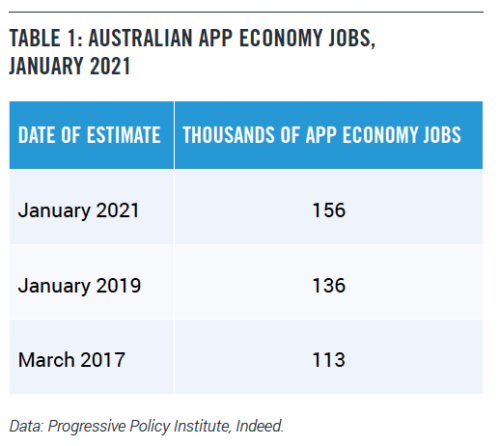
This report updates our 2019 paper, “The Australian App Economy, 2019 Update” and our 2017 paper, “The Rise of the Australian App Economy.” Based on our methodology that combines government occupational figures with comprehensive data on posted job openings, we estimate that Australia has 156,000 App Economy jobs as of January 2021, up from 136,000 in January 2019.

This 15 percent gain in App Economy jobs is partly driven by an increase in the overall number of ICT professionals, as reported by the Australian Bureau of Statistics, combined with a steady share of IT job openings that require App Economy skills, such as knowledge of iOS or Android.

The steady growth of the App Economy is particularly important for Australia, because mobile apps can be exported globally. Australian-based apps such as Procreate, Canva, Afterpay, Pocket Casts, and TripGo have significant global user bases.

ANALYSIS

For this study, a worker is in the App Economy if he or she is in:

• An IT-related job that uses App Economy skills—the ability to develop, maintain, or support mobile applications. We will call this a “core” App Economy job. Core App Economy jobs include app developers; software engineers whose work requires knowledge of mobile applications; security engineers who help keep mobile apps safe from being hacked; and help desk workers who support use of mobile apps.

• A non-IT job (such as sales, marketing, finance, human resources, or administrative staff) that supports core App Economy jobs in the same enterprise. We will call this an “indirect” App Economy job.

• A job in the local economy that is supported either by the goods and services purchased by the enterprise or by the income flowing to core and indirect App Economy workers. These “spillover” jobs include local professional services such as bank tellers, law offices, and building managers; telecom, electric, and cable installers and maintainers; education, recreation, lodging, and restaurant jobs; and all the other necessary services. We use a conservative estimate of the indirect and spillover effects.

We estimate the number of App Economy jobs by combining quarterly data on ICT professionals from the Australian Bureau of Statistics with comprehensive counts of “App Economy” job openings in Australia from Indeed.com. 1, 2 The methodology is described in the Appendix to the 2017 study. We estimate that Australia has 156,000 App Economy jobs as of January 2021, up from 136,000 in January 2019 and 113,000 in March 2017 (Table 1).


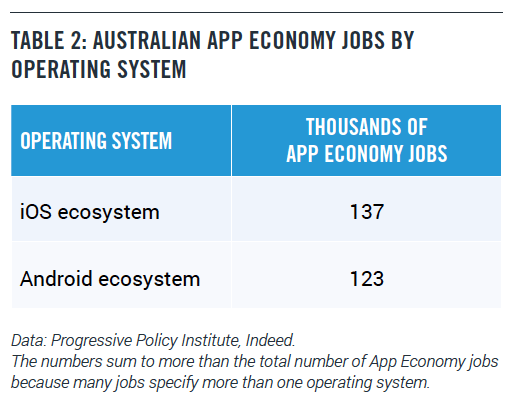
Many App Economy job postings list a mobile operating system or multiple mobile operating systems with which the job candidate is expected to be familiar. This allows us to assess the distribution of mobile operating systems in the Australian App Economy. We estimate that Australia has 137,000 jobs in the iOS ecosystem, and 123,000 jobs in the Android ecosystem. Compared to 2019, estimated iOS ecosystem jobs are up 14 percent, while estimated Android ecosystem jobs areup 16 percent.


How does Australia’s App Economy compare to other industrialized peers? Obviously countries such as the United States and the United Kingdom are much larger than Australia, making direct comparisons difficult.

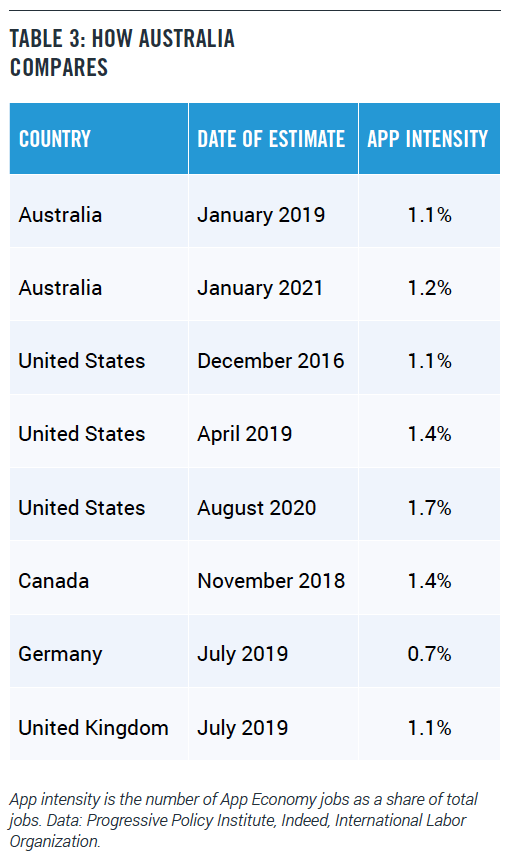
Instead, we calculate the “app intensity” of different countries, defined as the number of App Economy jobs as a share of total jobs. Table 3 compares Australia’s app intensity with that of the United States, Canada, Germany, and the United Kingdom.

As of January 2021, Australia had an app intensity of 1.2 percent, higher than Germany and roughly comparable to the United Kingdom but lagging Canada and the United States. Table 3 also shows that app intensity rose during the pandemic, which is not a surprise because the App Economy grew while the rest of the economy shrank.


GEOGRAPHY

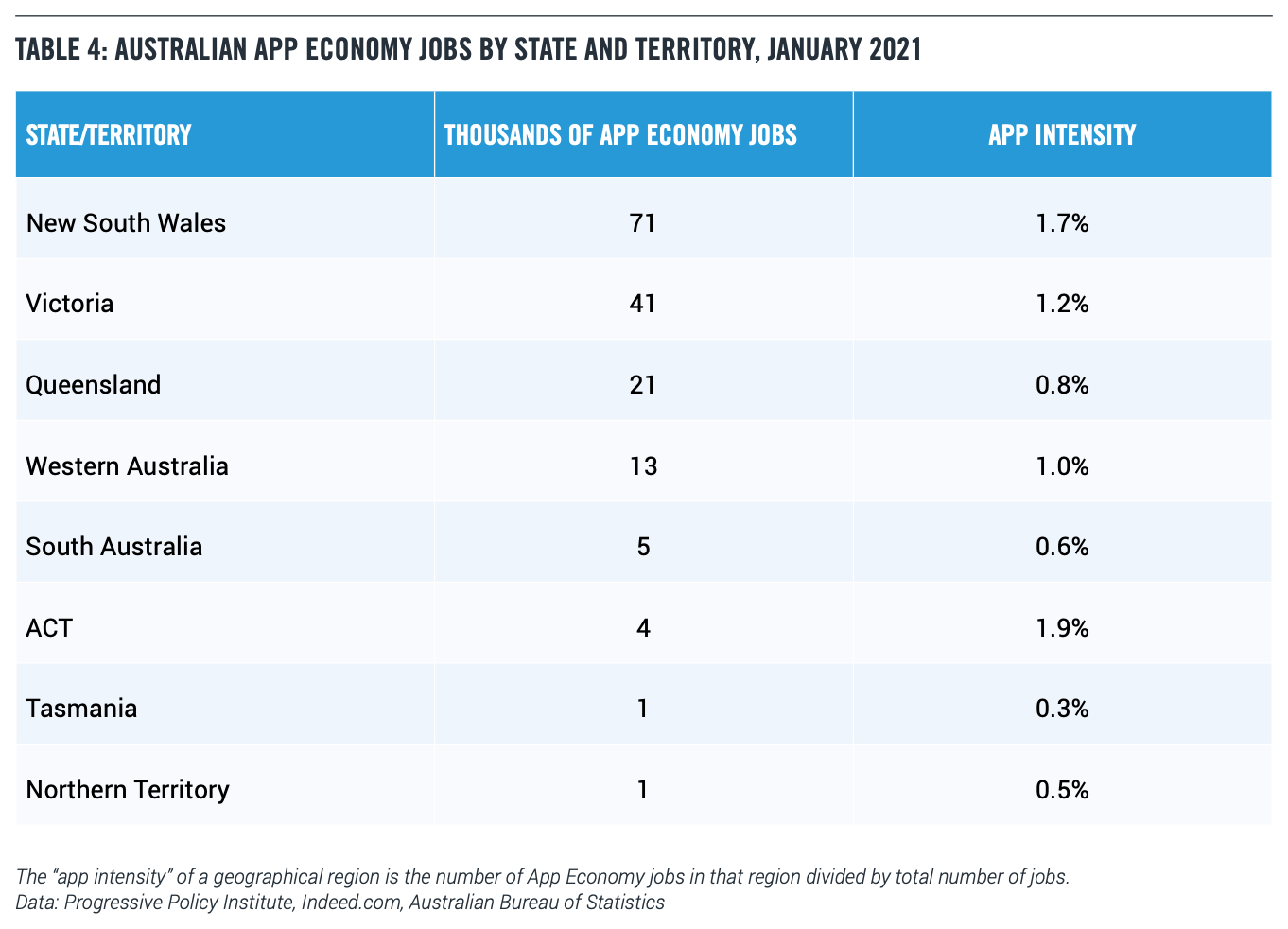
Our methodology enables us to estimate the geography of App Economy jobs, since job postings generally identify where the job is located. Table 4 lists App Economy jobs by state and territory and calculates app intensity.

Not surprisingly, New South Wales and Victoria lead in the number of App Economy jobs. Australian Capital Territory (ACT) has the top app intensity, followed by New South Wales. Note that with the Covid pandemic, more work is being done remotely. We have modified the methodology slightly to take account of this factor, but at least up to now, the number of Australian App Economy jobs being advertised as purely remote without a location is not large enough to substantially distort the results.

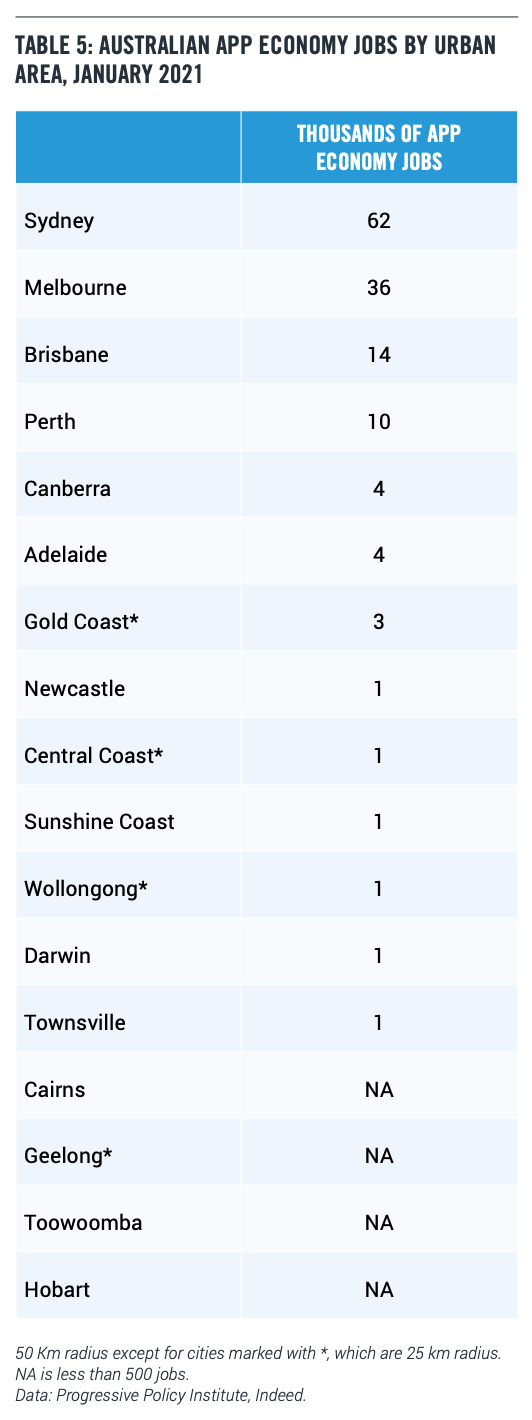
The same approach enables us to estimate App Economy jobs by urban areas. We use a radius of 50 kilometers as our measure of the urban area, except for a small number of cities that are sufficiently close to larger urban areas that a 50 km radius would pick up a significant number of jobs from the larger area. In those cases, marked by an asterisk, we use 25 kilometers as our measure.

Table 5 ranks the top urban areas by App Economy jobs, rounded to the nearest thousand. Note that urban areas with less than 500 jobs are reported as NA (not available). Sydney, Melbourne, Brisbane, and Perth are at the top of the list.

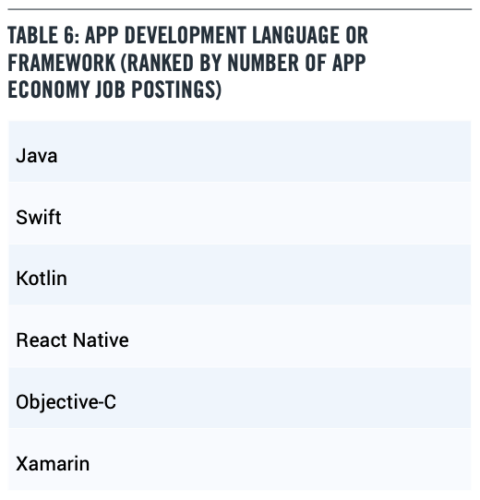
Finally, for this report we introduce a new analysis. Many core App Economy jobs require familiarity not only with iOS or Android, but with one of the app development languages or frameworks, such as Swift (iOS) or Kotlin (Android).

Table 6 below presents a list of app development languages and frameworks, ranked by the number of mentions on App Economy job postings. Java is first, followed by Swift. Because the methodology is new, we are not yet ready to quantify the list.

EXAMPLES

App Economy workers are found across most industries and geographic areas in Australia. Of course the tech sector is hiring workers with Android and iOS knowledge. As of February 2021, IT consulting firm Cognizant was searching for an iOS engineer in Melbourne. Digital product creator Roam Creative was seeking an intermediate iOS developer in Sydney. Zensys Technologies was looking for a developer with iOS and Android experience in Tamworth, New South Wales. ContentKeeper Technologies, which focuses on web security solutions, was hiring a quality assurance engineer with understanding of iOS and Android in the Australian Capital Territory.

Financial services is one key area where there is a lot of demand for App Economy workers. Banking company Bankwest was searching for a mobile developer with knowledge of Kotlin and Swift in Perth. Commonwealth Bank was looking for a senior software engineer with knowledge of iOS and Android applications in Perth. National Australia Bank was hiring a security consultant with testing experience on iOS and Android in Melbourne. Financial services firm Suncorp Group was searching for a senior developer with experience in Swift, Android or Xamarin in Brisbane.

Fintech firm Zip was seeking an Android engineer in Sydney. Zip, which specializes in point-of-sale credit and digital payment services, has operations across Australia, New Zealand, South Africa, and the United Kingdom and recently acquired US-based QuadPay.3 CoverMore Insurance Services was looking for an iOS developer in North Sydney.

But Australia’s App Economy continues to spread to other industries too. Online healthcare company HealthEngine was looking for iOS and Android engineers in Perth. HealthEngine bills itself as “Australia’s consumer healthcare platform.” Personal fitness app Today’s Plan was searching for a test engineer with iOS and Android experience in Canberra.

A company called Real Time Data—which “provides software applications which revolutionize the collection, reporting, and management of commercial fishing worldwide”— was searching for a full stack iOS developer in Adelaide.4 The company’s LinkedIn page states boldly that “We believe the future of humanity relies on sustainable oceans.” The Victorian Department of Environment, Land, Water and Planning was hiring for a software engineer with experience in Xamarin development for Android and iOS in Melbourne.

Global commercial real estate giant CBRE was looking for an Android software engineer in Brisbane. Sports betting platform Sportsbet.com.au was hiring an Android developer in Melbourne. Handmade goods company Tibet House was searching for a software engineer with knowledge of iOS and Android in Heidelberg West, Victoria. Consumer loyalty program flybuys was seeking a senior Android engineer in Melbourne. eBay Inc. was looking for an Android developer in Sydney. Online car selling platform carsales.com.au was hiring an iOS developer in Melbourne.

Accenture was seeking a lead security consultant with iOS and Android experience in Brisbane. Deloitte was looking for a digital technology consultant with experience in iOS and Android in Canberra. MCS Consulting was hiring a mobile software engineer with experience in iOS and Android in Melbourne. Marketing company Metigy was searching for a senior Android developer in North Sydney. New Zealand-based cloud accounting platform Xero was seeking a senior mobile product designer with knowledge of iOS in Melbourne.

Multi-modal public transportation company Keolis Downer was searching for an application support developer with experience in iOS and Android application development in Adelaide. Keolis Downer is the largest light rail operator in Australia and a major bus operator. RMIT University was seeking a senior developer with iOS and Android experience in Melbourne. Macleans Waste Management was looking for a full stack developer with experience in Kotlin development for Android in Penrith, New South Wales.

Truck and equipment tracking firm Teletrac Navman was hiring an Android lead in Melbourne. Honeywell, which recently acquired Adelaide-based Sine, a maker of a visitor and contractor management app, was hiring two Android developers there. Legal assisting app Smokeball-AU was seeking a software tester with iOS and Android experience in Sydney.

Media content creator Nine was hiring a senior software engineer with experience in iOS and Android programming in North Sydney. Social networking app Travello was seeking a full stack Android developer in Fortitude Valley, Queensland.

Examples of Export Apps
Our 2019 report noted that “Apps created in Australia can be easily delivered across the world, without expensive transportation, to generate jobs and income at home.” That’s even more true today. Graphic design platform Canva, cited in the 2019 report, is based in Sydney and now has more than 30 million users worldwide.5 Art app Procreate, also cited in the 2019 report, was developed by Hobart-based Savage Interactive. Procreate is used by artists at Pixar, Mattel, Ubisoft, DC Comics, and Disney.

Another “export” app is Afterpay, headquartered in Melbourne, which provides online post payment services and has more than 11 million global users.6 Pocket Casts, based in Adelaide, South Australia, is a podcast hosting app with global reach.7 And TripGo, developed by SkedGo in Sydney, lets users around the world compare and combine transport modes like train, bus, taxi, subway, metro, cab, tram, car, bike, motorcycle or ride share.8

CONCLUSION

While the Covid-19 pandemic induced Australia’s first recession in nearly three decades, Australia’s App Economy has once again served as an important source of growth. As of January 2021, we estimate that Australia has 156,000 App Economy jobs, an increase of 15 percent relative to our January 2019 estimate of 136,000 jobs. The country’s App Economy is competitive globally, with this growth spread throughout the states and territories in industries like tech, commerce, banking, government, and healthcare. Australia’s App Economy is also exportable, with a number of apps attaining a global following.


ABOUT THE AUTHORS

Dr. Michael Mandel is chief economic strategist at the Progressive Policy Institute and senior fellow at Wharton’s Mack Institute for Innovation Management at the University of Pennsylvania. Mandel received a Ph.D. in economics from Harvard University and formerly served as chief economist at BusinessWeek.

Elliott Long is senior economic policy analyst at the Progressive Policy Institute. Elliott holds a BA in Political Science from Florida Gulf Coast University and MPA from George Washington University.



Carolina Postcard: What is Roy Cooper’s Special Sauce?

A national reporter recently wrote a flattering article about Governor Roy Cooper, but seemed flummoxed by Cooper’s political success.

In “What Does This Man Know That Other Democrats Don’t?” in The Atlantic, Edward-Isaac Dovere wrote, “The governor is 16–0 in primary and general elections over the past three and a half decades—in good years and bad years for Democrats, in the North Carolina of his youth and in the very different place his state has become.”

Even after interviewing the Governor, he wrote, “Cooper doesn’t know why he keeps winning in North Carolina while other Democrats keep losing.” He added, “the secret to Cooper’s victories may be hard to replicate.”

Actually, there’s no secret here. Dovere touched on most of the explanations. But he underestimated some of them, and he missed a big one.

Cooper’s first key to success, the article noted, is “Make sure voters can see you running a competent and effective government.” Yep. The Governor’s handling of the Covid pandemic played a big part in his reelection last year.

Dovere mentioned “his identity as a white man (which) may have enabled him to hold on to moderate voters.” It’s more than that; Cooper comes across as what he is: a small-town boy from rural North Carolina who has worked his way up.

The article noted, in a master stroke of understatement, that Cooper has “built up his own fundraising apparatus.” In fact, the Governor raised more than $42 million for his reelection last year. His opponent, Dan Forest, raised about $5 million. Cooper outspent Forest 10-1 on TV. In 2016, Cooper outraised an incumbent Governor – a rare feat.

Dovere said Cooper “also established (and largely funded) a political operation (that) gave him centers of political support around the state.” Actually, he’s been building a network since he was a student at UNC. Through 35 years in politics, Cooper has built a stable and experienced team of governmental and political advisers; some have been with him since he ran for Attorney General in 2000.

The article adds, “Then there’s Cooper’s aggressive messaging.” Again, that’s an understatement. In his one debate with Forest last year, Cooper – unlike most incumbents – hit his opponent hard from his opening to close.

After all that, Dovere missed what may be the biggest factor in Cooper’s success: He has won because he has run against the legislature.

Thanks to a fluke off-year election in 2010 and gerrymandering since, Republicans run the legislature. They’ve cut corporate taxes, cut spending on public schools, pushed private schools, stopped Medicaid expansion, cut unemployment relief and cut health, safety and environmental regulations.

But gerrymandering doesn’t work for a statewide race. North Carolina has elected Democratic governors – with precisely the opposite priorities of our legislature – in seven of eight elections since 1992. The only exception was 2012, when incumbent Governor Beverly Perdue pulled out of the race late and left the door open to Republican Pat McCrory.

McCrory faithfully followed the legislature’s lead on most every issue. He signed the controversial “Bathroom Bill” that cost North Carolina millions of dollars in business. He promptly lost reelection to Cooper, even though Donald Trump carried the state, as he did again in 2020.

Cooper is squarely in the tradition of governors since Terry Sanford (1960-64), including Democrats and Republicans like Jim Holshouser and Jim Martin. They focused on better education as the path to a better future. Cooper has added better health care, racial and gender equity, climate-change action and rural Internet to the agenda.

His secret is that North Carolinians evidently share his priorities.

Link to Article.


How Senators Can Improve The Covid Relief Package

In the coming days, the Senate will take up the $1.9 trillion covid relief bill that passed the House of Representatives last week on a party-line vote. It’s an essential measure that would fund a robust public health response to end the covid pandemic and provide vital economic assistance to struggling families. But no bill is perfect, and the Senate should seize the opportunity to better target relief funds and thereby position the U.S. economy for the strongest post-pandemic recovery possible.

Read the full piece here.

MAGALand in Orlando

Orlando, a hub of fantasy theme parks, was the perfect setting for last weekend’s Conservative Political Action Conference (CPAC). The event showed that Republicans remain stuck in a looking-glass world of upside-down values.

The coronavirus pandemic has killed more Americans than World War II. But not a word of reproach was directed to the ex-president who presided over the nation’s COVID-19 debacle. Instead, conservatives gave South Dakota Gov. Kristi Noem a standing ovation when she jeered at Dr. Anthony Fauci.

Presidents who fail to win reelection usually have the decency to drop from public view and let their successor take the wheel. But in his closing speech to CPAC, Donald Trump pretended that the 2020 campaign never ended. He repeated the “rigged vote” lie that inspired the Jan. 6 assault on Congress and slurred President Biden with a farrago of false claims.

Read the rest of the piece here.