


What’s happening with Trump’s so-called Big Beautiful Bill? Jason Furman and Ben Ritz join the podcast to discuss the long run impact the bill would have, why Republicans are so comfortable blowing up the deficit, and whether the Biden administration’s mistakes are linked to the moment we’re in now.
Category: Uncategorized
Senate Changes to House Reconciliation Bill Are a Mixed Bag
On Monday, the Senate Finance Committee released legislative text for the most contentious parts of the Republican reconciliation package: changes to Medicaid and to the tax code. The Senate proposal makes some welcome improvements relative to the House-passed version, particularly by improving the tax treatment of pro-growth investments. But it doubles down on the biggest flaws of the bill by deepening cuts to Medicaid and saddling young Americans with trillions of dollars of debt.
As PPI noted in last week’s Budget Breakdown, the Senate GOP’s top priority for budget reconciliation was making business tax changes permanent. One such provision, which the House approved on a temporary basis, is allowing businesses to immediately deduct the full value of their research and development expenses. This change reverses a damaging provision of the Tax Cuts and Jobs Act, which discouraged research and development by forcing businesses to delay their tax deductions over several years. By fixing this mistake, the Senate budget proposal eliminates a backward tax penalty for research and development that almost no other developed countries have in their tax codes.
Senate Republicans made another pro-growth improvement to the reconciliation bill by modifying the House’s plan to phase out subsidies for producers of clean energy. The House-passed bill terminated these tax credits almost immediately, requiring that most new power plants begin construction within 60 days to be eligible for support. This approach would have devastated ongoing clean-energy projects, which can require years of planning before construction begins. In addition to worsening climate change, which imposes significant costs on our economy every year, this move would also hamper the nation’s ability to expand affordable energy sources. Senate Republicans partially — but not completely — mitigated this issue by phasing out these credits over multiple years, allowing businesses to continue ongoing clean energy investments without short-term disruption.
In order to offset changes to the business tax code, the Senate Finance Committee scaled back two of President Trump’s misguided campaign promises — ending taxes on overtime and tips — by capping the value of above-the-line deductions for both categories of income. Senate Republicans also pushed back against the House’s regressive change to quadruple the size of the state and local tax deduction, while the two chambers continue to negotiate. All of these policy changes are substantial improvements to the House’s budget plan because they save revenue by eliminating tax exceptions for special groups.
The Senate GOP also improved upon the House bill by tightening the limit on health-care provider taxes. States often increase Medicaid’s reimbursements to health-care providers to gain federal matching funds, but then raise taxes on these same providers to reclaim their lost revenue, effectively masking the true cost of providing benefits. Senate Republicans are right to crack down on this shell game in the interest of making Medicaid financing more efficient and more transparent — a move PPI has previously encouraged.
But redirecting the savings from this policy change to fund tax cuts for the rich instead of improving Medicaid would shutter many providers that operate on meager margins and deny care to millions of vulnerable beneficiaries as a result. According to an analysis from the Congressional Budget Office published this week, the House-passed bill would reduce incomes for the poorest tenth of Americans by 3.9% while increasing incomes for the richest tenth by 2.3%. The Senate’s decision to cut even more funding for Medicaid would undoubtedly make the bill even more regressive.
On top of redistributing resources from the poor to the rich, the Senate’s changes would redistribute from the young to the old. The Senate bill increases the size of a bonus standard deduction available to seniors, which is a tax policy that PPI has previously called to eliminate because today’s seniors are generally more financially secure than younger Americans, by even more than the House would. At the same time, it cuts back on the expanded Child Tax Credit passed by the House — even as child poverty remains higher than poverty rates for seniors.
But the biggest way the Senate proposal harms younger generations is by forcing future generations to pay for the deficits that the legislation would cause. The exact cost of the Senate legislation is still unknown, but it’s no doubt in the same ballpark as the House-passed bill that would add roughly $3 trillion to the debt over the coming decade — swelling to nearly $5 trillion if all the temporary policies included in it are made permanent. As PPI has previously warned, this increased debt burden will both reduce incomes for future taxpayers and put them on the hook for higher interest costs — all to finance a shortsighted tax cut today.
Senate Republicans have produced a tax plan that is more thoughtful and pro-growth than the one produced by their House counterparts. But their revised bill doubles down on regressive redistribution and deficit-financed giveaways that move American fiscal policy in the wrong direction, leaving low-income households and young Americans to pick up the tab.
Deeper Dive:
- House Republicans Pass ‘One, Big, Beautiful Bill’ Despite Big Red Flags, by Ben Ritz for Forbes
- Medicaid Provider Taxes Inflate Federal Matching Funds, by the Committee for a Responsible Federal Budget
- Senate Republicans cool to Finance Committee’s tax plan, by Politico
- Medicaid Changes in House and Senate Reconciliation Bills Would Increase Costs for 1.3 Million Low-Income Medicare Beneficiaries, by the Kaiser Family Foundation
Fiscal Fact:
According to new reports from the Social Security and Medicare trustees, trust funds for both programs will be insolvent by 2033 — just eight years from now. If no action is taken before then, Social Security benefits will automatically be cut by 23%, and Medicare payments to hospitals will be cut by 11%.
Other Fiscal News:
- Unusual Accounting Push Clouds Cost of Crapo’s Tax Package, by Politico
- GOP Megabill Faces Grim Polling for Republicans, by Politico
- How Much Would OBBBA Pay For Itself?, by the Committee for a Responsible Federal Budget
- Trump’s Tariffs Weaken America’s Military, by the Wall Street Journal
- Fed holds Rates Steady, Brushing Off Trump’s Calls for Cuts, by the Washington Post
More from PPI and the Center for Funding America’s Future:
- Breaking Down the Big Beautiful Bill, ft. Ben Ritz and Jason Furman on The New Liberal Podcast
- Ben Ritz talks about the Big Beautiful Bill on The Julie Mason Show
- Cuts to NASA Space Program Will Hurt Oklahoma and Help China, by Mary Guenther
- An Affordable Necessity: The Case for a Larger Defense Budget, by Peter Juul
- Factory Jobs Aren’t the Future Working Americans Want, by Will Marshall
- Red States’ School Vouchers Mark Biggest Shift in U.S. Education in a Century, by David Osborne
One U.S. measles death from 2000 to 2024; three so far this year
FACT: One U.S. measles death from 2000 to 2024; three so far this year.
THE NUMBERS: Measles cases in the United States –
| Jan.-June 2025 | 1,197 |
| 2024 | 285 |
| 2023 | 59 |
| Average 2000-2024 | 178 |
| 2000 | 86 |
| 1990 | 27,786 |
| 1970 | 47,351 |
| 1960 | 441,703 |
WHAT THEY MEAN:
Measles is an exceptionally “transmissible” disease — one infected person will typically pass it to 12-18 more — and survivors often suffer long-term immune system damage and a heightened risk of early dementia. In the 1950s, American health statistics typically showed about half a million cases and 500 deaths a year. The 1964 introduction of measles vaccines produced by Merck and Pfizer cut this by 90% — to 47,351 — by 1970, and to an average below 200 per year since 2000. That can make people complacent — and then near-vanished diseases can return. This year’s measles epidemic, centered in a low-vaccination Texas county, has already hospitalized 112 people and killed three. As long-time anti-vaccination crank Robert F. Kennedy Jr. purges immunization experts at the Department of Health and Human Services, and the Trump administration asks Congress to cancel U.S. contributions to GAVI (the international consortium providing 70 million no-cost vaccinations in low-income countries annually), some background on vaccines, malgovernance, and the possible future:
Vaccines are classes of medicine offering advance protection from 25 contagious diseases — smallpox, typhoid, hepatitis A and hepatitis B, tetanus, diphtheria, polio, measles, rabies, cholera, and encephalitis — borne by viruses or bacteria. The mRNA vaccine for COVID-19 is the most recent. Vaccines come into use in the United States after a scientific evaluation, formal government approval, and finally recommendations for use by medical professionals. Both here and worldwide, they have made life safer, longer, and better. For example:
Poliomyelitis: In the 1940s and 1950s, before the introduction of the Salk vaccine, America’s annual polio counts often topped 57,000 cases and 3,000 deaths. Since 1993, we have had one case, an unvaccinated man returning from abroad. Overseas, though some “wild” strains remain endemic in Afghanistan and Pakistan, universal vaccination programs run by the World Health Organization, USAID, the CDC, charities, and national health ministries have cut case levels by 99.99%. The numbers:
2024 96 polio cases
2020 6 polio cases
2010 650 polio cases
2000 3,500 polio cases
1988 350,000 polio cases
Neo-natal tetanus data are similar: U.S. case rates have dropped from about 500 a year in the 1950s to 30 or so since 2000. Abroad, campaigns to vaccinate pregnant women and guarantee antiseptic standards in poor-country maternity clinics have cut deaths by about 99%, from nearly a million to fewer than 10,000 annually.
2021 7,719 tetanus deaths
2018 25,000 tetanus deaths
2000 309,000 tetanus deaths
1988 787,000 tetanus deaths
To place these specific cases in wider perspective, worldwide vaccination campaigns such as those run by GAVI – which spends a modest $1.7 billion a year, with America providing $300 million of it, to vaccinate 70 million children in 59 developing countries — have joined with the invention of new treatments and improving primary care to cut world under-five mortality rates by half since 2000 and nearly three-quarters in a generation.
| 2023 | 37 deaths per 1000 children |
| 2020 | 39 deaths per 1000 children |
| 2010 | 53 deaths per 1000 children |
| 2000 | 77 deaths per 1000 children |
| 1990 | 94 deaths per 1000 children |
| 1980 | 132 deaths per 1000 children |
World Health Organization for 1990-2023; World Bank World Development Indicators for 1980.
In sum, vaccine work — by scientists in government and private-sector labs, by businesses inventing and producing medicines, by charities and international organizations, by nurses and doctors, and by clinics and hospitals — has vastly reduced disease case counts, saved many lives, and given young children better chances in life. The achievement may have been so impressive, in fact, as to encourage a dangerous complacency.
This year’s measles outbreak is a vivid example. The Centers for Disease Control notes that since 2020, America’s rate of “MMR” vaccination (the “measles, mumps, and rubella” combined shot) has fallen from 93.9% to 91.3% — that is, below the level thought necessary for the “herd immunity” which helps protect immune-suppressed people. Gaines County in Texas, the center of this year’s measles outbreak, has an especially low 83.7% rate. CDC’s count shows that within a few months, it has already infected 1197 people (including 347 children under 5, and 446 older children and teenagers), and will likely be the largest outbreak in three decades. The three people who died of it were all unvaccinated.
After decades of safety, then, Americans may be unwisely discounting disease risk and giving cranks and self-taught “contrarians” audiences they don’t deserve. The same may be true internationally. Worldwide measles deaths, having dropped by 92% from 1980 to 2020, have recently risen as global vaccination rates have slipped from 86% of children in 2020 to 83% in 2023.
| 2023 | 107,500 deaths |
| 2020 | 69,400 deaths |
| 2010 | 203,000 deaths |
| 2000 | 525,000 deaths |
| 1980 | 810,000 deaths |
Which brings us back to the Trump administration, this month’s ominous events at HHS, and Congress’ debate over health-aid “rescissions” this week.
Mr. Kennedy’s tragi-comic launch event — a “report” on children’s health apparently compiled by an AI program, stocked with invented quotes and cites to non-existent studies — has been followed by steadily escalating attempts to erode vaccination policy at home. Since May, Mr. Kennedy has canceled support for the development of second-generation mRNA vaccines and bypassed CDC professionals to remove scientific recommendations for COVID-19 vaccination updates; and, two weeks ago, fired the 17 members of the CDC’s voluntary expert advisory group, the Advisory Committee on Immunization Practices, a few weeks before their regular June meeting. The extraordinary op-ed (subs. req.) he used to announce this justifies the decision with (a) fact-free innuendo about “conflicts of interest” among the current ACIP members, without any specific claim to back it up, and (b) an open admission that the administration sees ACIP positions less as sources of impartial analysis than as patronage. (“[W]ithout removing the current members, the current Trump administration would not have been able to appoint a majority of new members until 2028”.) The American Medical Association’s comment:
“For generations, the Advisory Committee on Immunization Practices (ACIP) has been a trusted national source of science-and data-driven advice and guidance on the use of vaccines to prevent and control disease. Physicians, parents, community leaders and public health officials rely on them for clinical guidance, public health information, and knowledge. Today’s action to remove the 17 sitting members of ACIP undermines that trust and upends a transparent process that has saved countless lives. With an ongoing measles outbreak and routine child vaccination rates declining, this move will further fuel the spread of vaccine-preventable illnesses.”
The administration is matching this malgovernance abroad. Their “rescissions” bill cancels the entire U.S. contribution to GAVI, along with hundreds of millions of dollars meant for child and maternal health, HIV/AIDS, and other public health programs. (Sample justification, direct quote: “programs that are antithetical to American interests and worsen the lives of women and children, like ‘family planning’ and ‘reproductive health.’”) If the Senate approves it, the U.S.’ commitment to vaccination abroad will shrivel to pretty much nothing.
Both at home and abroad, then, public complacency has grown and government policy deteriorated. If the approach of the administration’s first five months persists, the next three years may be somber: an era in which long-vanished diseases return in force to America, children’s health erodes here and abroad, and life grows more dangerous. Congress, we hope, is aware that the right approach is diametrically opposite. Again, vaccines have made life longer, safer and better. We need more of them, not less.

FURTHER READING
PPI’s four principles for response to tariffs and economic isolationism:
- Defend the Constitution and oppose rule by decree;
- Connect tariff policy to growth, work, prices and family budgets, and living standards;
- Stand by America’s neighbors and allies;
- Offer a positive alternative.
The return of measles:
CDC on this year’s measles outbreak.
The American Academy of Pediatrics has a state-by-state map comparing vaccination rates.
And a Texas case count by county, from Texas’ Department of Health Services.
At HHS:
2024 membership for the Advisory Committee on Immunization Practices (ACIP).
Mr. Kennedy’s “Children’s Health Report” fiasco.
… and op-ed on ACIP.
Responses:
Alarmed comment from the American Public Health Association.
… likewise from the American Medical Association.
… and the American Academy of Pediatrics.
Abroad:
White House “rescissions” justifications.
Background and annual reports from GAVI, the Vaccine Alliance.
From the Kaiser Family Foundation, a review of U.S. global health budgeting.
… and a close-up on the Trump administration and GAVI.
From the World Health Organization, recommendations on vaccines.
… an update on measles trends.
… and data on under-5 mortality:
And a PPI flashback:
Ed Gresser testifies in June 2023 to the House Judiciary Committee’s Intellectual Property Subcommittee on WTO intellectual property rules, vaccine production, and the response to the COVID-19 pandemic.
ABOUT ED
Ed Gresser is Vice President and Director for Trade and Global Markets at PPI.
Ed returns to PPI after working for the think tank from 2001-2011. He most recently served as the Assistant U.S. Trade Representative for Trade Policy and Economics at the Office of the United States Trade Representative (USTR). In this position, he led USTR’s economic research unit from 2015-2021, and chaired the 21-agency Trade Policy Staff Committee.
Ed began his career on Capitol Hill before serving USTR as Policy Advisor to USTR Charlene Barshefsky from 1998 to 2001. He then led PPI’s Trade and Global Markets Project from 2001 to 2011. After PPI, he co-founded and directed the independent think tank Progressive Economy until rejoining USTR in 2015. In 2013, the Washington International Trade Association presented him with its Lighthouse Award, awarded annually to an individual or group for significant contributions to trade policy.
Ed is the author of Freedom from Want: American Liberalism and the Global Economy (2007). He has published in a variety of journals and newspapers, and his research has been cited by leading academics and international organizations including the WTO, World Bank, and International Monetary Fund. He is a graduate of Stanford University and holds a Master’s Degree in International Affairs from Columbia Universities and a certificate from the Averell Harriman Institute for Advanced Study of the Soviet Union.
Read the full email and sign up for the Trade Fact of the Week.
Osborne for The 74: Red States’ School Vouchers Mark Biggest Shift in U.S. Education in a Century
Do Americans want an education system in which the quality of children’s schools depends largely on their family’s wealth?
Not likely. Yet in Republican-dominated states, that’s exactly what the future holds. This is arguably the most profound change in American education since the development of universal public education over a century ago.
Over the past five years, 14 states have passed laws creating universal vouchers, often known as Education Savings Accounts — public money families can use to pay private school tuition. All are Republican states: Alabama, Arizona, Arkansas, Florida, Iowa, Louisiana, North Carolina, Ohio, Oklahoma, Tennessee, Texas, Utah, West Virginia and Wyoming. Two more, Oklahoma and Idaho, have passed refundable tax credits available to all families.
Every family in those states is eligible, or will be within a few years, for somewhere between West Virginia’s $4,600 and Texas’s $10,500 a year per student. Counting programs limited to low-income students, more than half of all K-12 students in the U.S. now qualify for some form of voucher.
Read more in The 74.
Guenther for The Oklahoman: Cuts to NASA Space Program will Hurt Oklahoma and Help China
It’s rare that Newt Gingrich and Chris Van Hollen agree, particularly on funding topics, but pigs must be flying, as there’s widespread outrage in light of the 50% cut proposed to NASA’s Science Mission Directorate in the President’s Budget Request.
These cuts are distressing on their face, as they represent our nation walking away from investments in scientific discovery and technological advancement with the associated economic boost that comes from these investments. But they’re even more concerning when considered against the backdrop of a rising global power: China.
NASA is the main agency that funds space science — and the agency primarily invests in basic research with no direct applications to specific components of the economy.
Keep reading in The Oklahoman.
Trump Courts Chaos With His Middle East Failures
We have no illusions about the brutal regime that rules Iran. It has repressed the Iranian people for more than four decades and declared itself the sworn enemy of the United States and Israel — and acted accordingly. Tehran’s incessant proxy wars against Israel, the United States, and other nations — typically carried out via terrorist groups like Hamas in the West Bank and Gaza, Hezbollah in Lebanon, the Houthis in Yemen, and Shia extremists in Iraq — are the chief source of the Middle East’s convulsive violence today.
The air campaign Israel launched against Iran on June 12 appears to primarily target Tehran’s ability to project power throughout the Middle East, including both its nuclear program and larger security apparatus. But an increasing rhetorical focus on regime change by Israeli political leaders risks trading the tactical gains Israel has made against the regime and its nuclear program for an open-ended military effort with an unclear strategic endgame.
Announcing the start of the air campaign against Iran, Israeli Prime Minister Benjamin Netanyahu claimed that Tehran “has taken steps that it has never taken before, steps to weaponize this enriched uranium.” But while Tehran had steadily increased its stockpile of highly enriched uranium in recent years, and the International Atomic Energy Agency passed a resolution declaring Iran to be in breach of its obligations under the Non-Proliferation Treaty the day Israeli strikes commenced, neither the IAEA nor American intelligence agencies assessed that Iran was nearing nuclear breakout capacity. Indeed, American and Iranian negotiators were slated to meet in Oman over the weekend to further discuss a de facto return to the 2015 international nuclear deal that President Trump withdrew from during his first term.
Across his two terms in office, President Trump’s Iran and Israel policies have been a disaster: his first term withdrawal from the original nuclear agreement left Iran free to pursue a nuclear program effectively unconstrained, while his administration consistently catered toward the Israeli right. In his second term, Trump’s unconditional support for Prime Minister Netanyahu in Gaza, the West Bank, and elsewhere was unsurprisingly interpreted in Jerusalem as a green light to launch the ongoing air campaign against Iran.
Trump’s apparent diffidence to his own preferred policy of negotiation and passivity in the face of an apparent Israeli determination to strike Iran left him unwilling or unable to insist that diplomacy be allowed to play out before Israel embarked upon any military action.
Nor is it at all clear what American policy toward the war is now. Secretary of State Marco Rubio issued an initial statement seemingly distancing the United States from the Israeli air campaign, but President Trump himself later sent a number of different signals on the war via social media posts and interviews. As a result, the United States has positioned itself as an unassertive bystander to the conflict. No matter what policy one might prefer going forward, however, there’s no good reason to believe the Trump administration could or would execute it with a modicum of competence.
That makes it difficult to recommend any course of action that goes beyond relying on the U.S. Central Command’s well-developed reflexes and muscle memory to prevent the conflict from expanding to include the United States, its allies, and its regional partners. American missile defense batteries deployed to Israel last year by President Biden have already helped defend Israelis and Palestinians against Iranian retaliatory missile attacks. The same goes for defending American and allied troops as well as Arab partners across the region against possible Iranian strikes.
It’s also hard to see what influence Trump has with either Israel or Iran at this point. From artificial intelligence-generated fantasies of a Trump-run Gaza to the removal of sanctions against Israeli settlers illegally grabbing Palestinian land in the West Bank, Trump has repeatedly given Netanyahu and his far-right coalition partners carte blanche to pursue whatever policies they see fit and abdicated America’s traditional role as an honest broker of peace negotiations — not to mention making the conflict between Israel and the Palestinians all the more difficult to solve. Nor is it likely the Iranians see Trump as a reliable interlocutor: he pulled out of the original nuclear agreement, then failed to restrain Israel while attempting to broker a return to the deal he once scorned, and now proclaims a lack of interest in peace talks.
Tehran may indeed offer to return to the table in order to relieve Israeli military pressure, but it’s uncertain whether Trump can restrain Israel now that it is in the midst of an air campaign against its chief regional rival — or whether Trump will stick to any deal he himself strikes. As usual, he has been incoherent and inconsistent in his public statements since the start of the conflict.
Whatever successes the Israeli air campaign may achieve in the near term — and they could be considerable — the United States and the world may well find themselves confronted with an Iran more determined than ever to acquire nuclear weapons over the medium-to-long term and few good options to prevent it from doing so. Trump’s diplomatic failures on Iran and Israel will haunt the United States, the Middle East, and the world for years to come.
New PPI Report Calls on Democrats to Reclaim National Security Leadership
WASHINGTON — Amid escalating global tensions, fractured alliances, reckless leadership, and a weakened domestic economy, a new report from the Progressive Policy Institute (PPI) calls on Democrats to lead the charge for a strategic and sustainable increase in U.S. defense spending to reach $1 trillion annually by 2029. The report argues that a stronger military is essential to safeguarding American interests in a more dangerous world and to counter rising threats from Russia, China, and Iran.
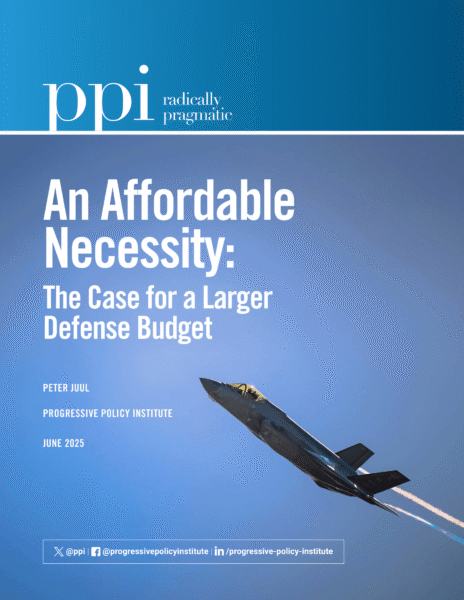
Titled “An Affordable Necessity: The Case for a Larger Defense Budget,” the report by PPI National Security Policy Director Peter Juul critiques the Trump administration’s defense posture as strategically incoherent and fiscally misleading. Despite rhetoric touting military strength and claiming to undo Biden’s “woke” policies, the administration’s budget proposals would underfund key capabilities while overinvesting in ill-conceived projects such as the $175 billion “Golden Dome” missile defense initiative.
“President Trump’s policies are not only misaligned with real strategic needs — they are driving up costs while undermining America’s alliances and industrial base,” said Juul. “Democrats must break from old habits and reclaim their heritage as the party of national security.”
The report recommends a phased increase of $37.5 billion annually over the next four years to rebuild naval and airpower capacity, modernize the nuclear deterrent, and expand munitions production. It also lays out a vision for a notional Democratic defense program focused on deterring authoritarian aggression, supporting allied nations like Ukraine and Taiwan, and securing U.S. technological leadership in military systems.
Key takeaways from the report include:
- A $1 trillion defense budget by 2029 remains below Cold War-era levels as a share of GDP and is fiscally sustainable within PPI’s broader deficit reduction plan.
- The U.S. military lacks sufficient capacity — including ships, bombers, and air defense systems — to meet global security commitments.
- Targeted investments can close gaps in naval shipbuilding, bomber forces, and munitions while avoiding waste on initiatives like the “Golden Dome.”
- Democrats should reject reflexive budget cuts and instead pursue strategic increases that strengthen alliances and national defense.
- Curbing the influence of partisan tech moguls and restoring professional leadership at the Pentagon is essential to sound defense policymaking.
Democrats face not just a security imperative but a political opportunity. By advancing a credible, cost-conscious plan to modernize the U.S. military and restore global leadership, they can reestablish public trust and define a forward-looking defense agenda rooted in democratic values and strategic realism.
Read and download the report here.
Founded in 1989, PPI is a catalyst for policy innovation and political reform based in Washington, D.C. Its mission is to create radically pragmatic ideas for moving America beyond ideological and partisan deadlock. Find an expert and learn more about PPI by visiting progressivepolicy.org. Follow us @PPI.
###
Media Contact: Ian O’Keefe – iokeefe@ppionline.org
An Affordable Necessity: The Case for a Larger Defense Budget
EXECUTIVE SUMMARY
To protect its essential interests around the globe and defend freedom in the world, the United States needs to devote more resources to its military. Democrats should lead the charge for the required increase in defense spending — and make sure it goes to the right places.
President Trump and his Republican Party talk a very big game when it comes to defense spending, but their own priorities remain unrealistic and misplaced. Despite their proposed funding increase, the Trump administration looks set to slash core military capabilities — including a possible 90,000-soldier cut to the Army — in order to pay for fantasies such as the so-called Golden Dome missile defense system. Secretary of Defense Pete Hegseth has made his focus on fighting domestic culture wars crystal clear and appears to believe that logistics contribute little, if anything, to successful military operations. Meanwhile, Elon Musk has expressed public antipathy toward weapons like the F-35 stealth fighter and favors replacing them with hypothetical drone swarms presumably built by new defense firms founded and owned by Silicon Valley venture capitalists.
Worse, Trump’s foreign policy threatens America’s own defense industry, which likely means each U.S. dollar will buy less in terms of defense. With his threats to Canadian and Danish sovereignty as well as his attempts to push Ukraine into an effective capitulation while offering unilateral concessions to the Kremlin, he has alienated America’s long- standing NATO allies in Europe — to the point where these traditional friends and allies question whether or not they can or even should rely on American military support. Trump’s blunderbuss tariffs, moreover, threaten American industries that depend on global supply chains and relationships with manufacturers among America’s allies in Europe and Asia. Fewer overseas sales and higher costs for industrial materials and inputs mean the Department of Defense will likely pay more for the weapons it buys for itself from U.S. defense firms. Even worse, ruptured alliances mean the United States will have to shoulder more of the burden for its own national security and spend more on defense than it would need to otherwise.
For their part, Democrats must reject predictable, knee-jerk calls from the left to cut the defense budget as well as claims that even modest increases in defense spending will prove unaffordable. In reality, a steady and significant rise in defense spending up to $1 trillion by 2029 is both warranted and within America’s means. A defense budget that sees an increase of roughly $37.5 billion a year over the next four years would provide the U.S. military with the resources it requires to secure American interests while remaining well within the lower bounds of historical defense spending — no matter the metric chosen to measure it.
It’s hard to make solid policy recommendations given the extraordinary uncertainty the United States and the world face over the next four years — to say nothing of the damage President Trump, Elon Musk, and others in the Trump administration have already done to the U.S. government. But even if it underestimates the scope of the defense policy challenges that will confront the next Democratic administration a modest increase in defense spending dedicated to the right priorities could still yield national security dividends well beyond the initial investment and plant the seeds of a robust national defense program.
As PPI previously argued, a Democratic defense program should pursue three main goals:
- Deter and defend American allies in Europe and
the Pacific against aggression from the likes of a belligerent Russia and an increasingly well-armed China. - Produce arms, ammunition, and equipment in sufficient quantities to supply the United States, its allies, and nations on the frontlines of freedom like Ukraine and Taiwan.
- Maintain and modernize America’s aging nuclear deterrent.
Without increased investment in defense, however, America’s military will not be able to attain these three goals. Indeed, the military has too few combat ships and aircraft available to meet the demands placed upon it — and many of these ships and planes have been in service for decades. What’s more, Russia’s war against Ukraine has revealed the limits and weaknesses of America’s own modern defense industry that have only begun to be addressed. Money alone cannot safeguard American national security, of course, but a defense budget that rises to $1 trillion by 2029 will certainly help do so.
A strong defense program along the lines proposed below can help Democrats reclaim their rightful place as the party of national security. It was Franklin D. Roosevelt, after all, who called on the United States to become “the great arsenal of democracy,” and John F. Kennedy who welcomed the responsibility of “defending freedom in its hour of maximum danger.” At a time when gangster powers like Russia, China, and Iran press their geopolitical advantage — including through force or its threat — Democrats can and must summon the same spirit today.
Read the full report.
Manno for Forbes: Are Micro-Credentials Democratizing K-12 Credentialing?
A quiet shift is underway in K-12 education that is democratizing the types of credentials awarded to students and educators. Increasingly, K-12 is using micro-credentials to verify and document what students and educators know and can do when assessed on particular learning outcomes.
The effect is potentially profound. Journalist Sara Weissman says that young people’s use of micro-credentials is creating “The micro-credential generation, a fast-growing number of traditionally college-age students [who] are bypassing degrees to pursue cheaper and faster alternative credentials.”
What follows examines the emerging use of micro-credentials in K-12 student learning and teacher professional development, the challenges involved in implementing this approach, and the lessons learned along the way.
The Union Podcast Episode 3
Ainsley on ABC Radio National: Lessons for Global Centre-Left Parties from Labor’s Win
Centre-left parties the world over are lamenting the loss of their heartland, as low paid, working-class and non-graduate voters defect to the right.
Claire Ainsley was a key aide to the UK Prime Minister Keir Starmer and is now part of the Progressive Policy Institute, a US-based group with close links to the former US president Bill Clinton. She’s been in Australia speaking to voters about Labor’s election victory.
Listen to the podcast episode.
Marshall for The Hill: Factory Jobs Aren’t the Future Working Americans Want
Undaunted by his predecessor’s failure to spark a manufacturing renaissance, President Trump also dreams of reindustrializing America. He won’t succeed either, because no president has the power to undo a half-century of post-industrial evolution.
Why have our two oldest presidents fixated on “bringing back” factory jobs? Both grew up in the ‘50s, when the United States bestrode a war-ravaged world like an industrial colossus. But the answer isn’t just nostalgia for a lost “golden age.”
There’s also a pervasive feeling that our country owes a promissory note to working families hit hard by deindustrialization. The disappearance of manufacturing jobs with decent pay and benefits — traditionally their ticket from high school to the middle class — has undermined their living standards and social standing.
Read more in The Hill.
There Can Be No Certainty In Unsustainable Tax Policy
As Senate Republicans work to develop their own version of the “One Big Beautiful Bill” (OBBB) passed by the House last month, one of their biggest priorities is making temporary tax provisions permanent. In a recent interview, Senate Finance Committee Chairman Mike Crapo argued that “certainty in the tax code” is essential for businesses to plan their operations. Senate Majority Leader John Thune also recently said that his conference “believe[s] that permanence is the way to create economic certainty.” But there can be no certainty in any tax policy so long as there remains an unsustainable mismatch between federal revenue and spending levels — which the OBBB would make significantly worse.
The United States is already on an increasingly unsustainable fiscal path. The national debt today is almost the same size as the country’s gross domestic product (GDP), while annual interest payments on that debt are bigger as a percent of GDP than at any other point in American history. If the OBBB becomes law, the government will be on track to borrow another $2 trillion to cover the difference between spending and revenues every single year going forward. But debt cannot grow faster than our economy forever because, at a certain point, there will not be enough economic activity for the government to tax or borrow from to continue paying ballooning interest costs. The policies in OBBB would only increase the probability that our economy will experience such a fiscal crisis within the next few decades.
Whether they do it to prevent a crisis or react to one, lawmakers will inevitably have to change fiscal policies that result in unsustainable deficits. So if Senate Republicans were truly interested in using permanent policy to provide certainty to taxpayers, they would prioritize policies that reduce the budget deficit over those that increase it.
Fortunately, there have been many policy options discussed in recent months that the Senate could adopt to bring down the OBBB’s costs. Lawmakers could tighten the deduction for state and local income taxes paid by businesses — as PPI suggested in our last Budget Breakdown. Preventing wasteful overpayments in Medicare Advantage, which the Senate considered this week before backing off, could reduce spending by hundreds of billions of dollars without cutting benefits. The Senate could also incorporate tax changes previously considered by their colleagues in the House, such as increasing the excise tax on stock buybacks to create parity with dividends or further limiting the business deduction for employee compensation. President Trump has proposed several possible offsets of his own that were omitted from the bill, such as closing the carried interest loophole or introducing a new top income tax bracket for households with the highest incomes. And lawmakers can find even more possible offsets in the budget blueprint published last year by PPI, which includes enough savings to put the budget on a path back to balance by 2050.
If Senate Republicans refuse to incorporate any of these common-sense proposals to mitigate the OBBB’s deficit impact and put the nation on a more sustainable fiscal path, whatever tax provisions they enact would be permanent in name only. Under pressure from out-of-control debt and interest costs, future Congresses will inevitably have to revisit the policies put in place by today’s. Senate Republicans must remember that the only way to truly provide tax certainty is by building a sustainable fiscal foundation.
Deeper Dive
- With Trump’s ‘Big, Beautiful Bill,’ Idaho’s Mike Crapo Aims to Make Tax Cuts Permanent, by the Spokesman-Review
- 7 Things Senate Republicans Hate About the House Megabill, by Politico
- Wall Street Is Sounding the Alarm on U.S. Debt. This Time, It’s Worth Listening, by the Wall Street Journal
- Capitol Agenda: The Tax Fights Trump Has to Settle, by Politico
- Estimated Budgetary Effects of H.R. 1, the One Big Beautiful Bill Act, by the Congressional Budget Office
Fiscal Fact
According to new analysis from the nonpartisan Congressional Budget Office, passing the OBBB would cause the bottom 10% of American households to lose roughly $1,600 per year, while the top 10% would gain $12,000 per year.
Further Reading
Other Fiscal News
- Elon Musk Calls Trump Megabill a ‘Disgusting Abomination,’ by The Wall Street Journal
- House Clears $9.4B in Funding Clawbacks Requested by White House, by Politico
- Tariffs Won’t Cover OBBBA’s Costs, by the Committee for a Responsible Federal Budget
- Who Would Pay America’s “Revenge Tax” on Foreigners?, by the Economist
- What the GOP is Planning Now is Even Worse Than All Those Debt Ceiling Fights, by the Washington Post
More from PPI and the Center for Funding America’s Future
- House Republicans Pass ‘One Big Beautiful Bill’ Despite Several Big Red Flags, by Ben Ritz
- GOP Doubles Down on Deceptive Budget-Busting Tax Plan, by Ben Ritz and Alex Kilander
- Economic Populism From Both Parties Fails Working Americans, by Will Marshall
- Denmark is a Four-Generation Ally and a Good Neighbor, by Ed Gresser
- Renewing the Democratic Party, by Richard Kahlenberg
Kahlenberg on NPR’s Here & Now: Author Calls for Class-Based Affirmative Action in Higher Education
Colleges and universities have had to adjust their admissions processes after the Supreme Court struck down race-based affirmative action a couple of years ago. Author Richard Kahlenberg argues that schools should turn to class-based affirmative action, which he says will also increase diversity.
Here & Now‘s Scott Tong speaks with Kahlenberg, author of “Class Matters: The Fight to Get Beyond Race Preferences, Reduce Inequality, and Build Real Diversity at American Colleges.” Kahlenberg is the director of the American Identity Project at the Progressive Policy Institute and teaches at George Washington University.
Marshall in Politico: ‘It’s a winner for him’: Dems work to turn LA debate from immigration to Trump’s executive powers
For Democrats, it’s a concern rooted in Trump’s historic strength on immigration with voters not in Los Angeles, but watching on social media and TV in swing states and districts across the country.
“There’s a background and a history, and so that limits the sympathy of lots of fair-minded Americans watching this spectacle unfold,” said Will Marshall, founder of Progressive Policy Institute, a center-left think tank.
New PPI Report Proposes Apprenticeship Degrees as Path to Upward Mobility Without Debt
WASHINGTON — As skepticism grows over the value of traditional four-year degrees, a new report from the Progressive Policy Institute (PPI) highlights an innovative, upwardly mobile alternative: apprenticeship degrees that blend paid, work-based learning with college credit, helping Americans advance their careers without taking on crushing debt.
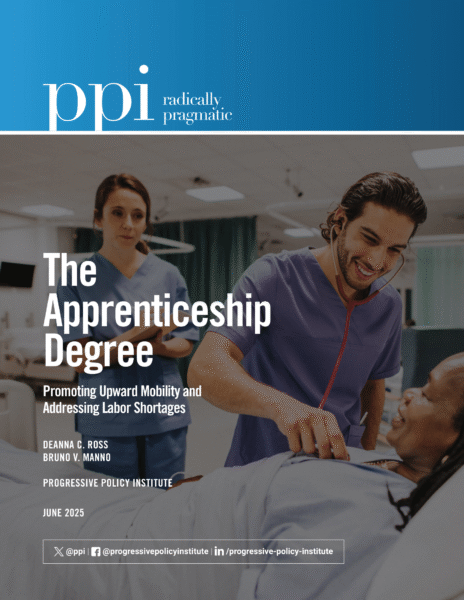
Titled “The Apprenticeship Degree: Promoting Upward Mobility and Addressing Labor Shortages,” the report by PPI’s Deanna Ross and Bruno Manno explores how this innovative model can expand career opportunities for working-class Americans while helping employers close persistent skills gaps.
The report is an output of PPI’s Campaign for Working America, launched last year in partnership with former U.S. Representative Tim Ryan (D-Ohio). The Campaign aims to develop and test new themes, ideas, and policy proposals that help Democrats and other center-left leaders make a compelling economic offer to working Americans, bridge divides on cultural issues like immigration and education, and rally public support for the defense of democracy and freedom globally.
“Apprenticeship degrees represent the kind of common-sense innovation we need to rebuild the American Dream for working families,” said Ryan. “They combine real-world work experience with a college degree, making higher education more affordable and more relevant. If we want to compete with China and restore economic dignity in the American Heartland, this is the kind of policy we ought to be championing.”
“Millions of young people and workers are being forced to choose between a job they need now and a degree that may — or may not — pay off later,” said Ross, PPI’s Director of Workforce Development Policy. “Apprenticeship degrees eliminate that false choice by integrating work and education into a single, debt-free path to upward mobility.”
The report reveals growing skepticism about the value of traditional college degrees and presents apprenticeship degrees as a promising, debt-free pathway to economic mobility. Key takeaways from the report include:
- Rising Doubts About College Value: 56% of Americans believe a four-year degree is not worth the cost — especially among younger graduates.
- A New Pathway: Apprenticeship degrees offer students the opportunity to earn wages, gain experience, and receive academic credit — all while avoiding student debt.
- Economic Mobility: Over 70 million Americans are “Skilled Through Alternative Routes” (STARs) but lack credentials to access higher-wage jobs.
- Policy Support: The report outlines a blended funding model and urges Congress to include apprenticeship degrees in new workforce and higher education legislation.
- Institutional Innovation: Reach University and Western Governors University are among the institutions pioneering this model, particularly in education and health care.
“Apprenticeship degrees are a bipartisan, practical solution to the intertwined problems of upward mobility, college affordability, and labor market readiness,” said Manno, Senior Advisor at PPI, who leads the What Works Lab. “With smart public investment and stronger employer partnerships, apprenticeship degrees can become a mainstream option across the country.”
Read and download the report here.
Founded in 1989, PPI is a catalyst for policy innovation and political reform based in Washington, D.C. Its mission is to create radically pragmatic ideas for moving America beyond ideological and partisan deadlock. Find an expert and learn more about PPI by visiting progressivepolicy.org. Follow us @PPI.
###
Media Contact: Ian O’Keefe – iokeefe@ppionline.org