Pennsylvania’s Energy Crossroads: Charting a Pragmatic Path to Decarbonization

BALANCING INDUSTRIAL HERITAGE WITH CLIMATE AMBITION 

Pennsylvania stands as a pivotal state in the American energy landscape, defined by a deep heritage as a major producer and consumer of fossil fuels. This legacy has powered its industries and communities for generations, but it also presents a formidable challenge in an era of accelerating climate change. Pennsylvania is therefore confronted with a defining question:  how to reconcile its climate ambitions with the economic realities of its industrial base and the affordability needs of its citizens, a tension that can only be resolved through pragmatism. 

ENERGY CONSUMPTION AND EMISSIONS 

Pennsylvania’s energy consumption and emissions per person are close to the national average, according to data from the U.S. Energy Information Administration (see Fig. 1). Coal fired generation has been cut by 90% since 2005, with nearly all electricity now coming from gas  and nuclear, reducing emissions from the power sector (see Fig. 2). Residential electricity prices are slightly above average, but consumption is well below, keeping bills in check. Total energy  spending per person on electricity, gas, and gasoline is about 5% below the national average  (see Fig. 3). But like other states in the PJM Interconnection, growing demand from data centers  and capacity shortages are putting upward pressure on power prices. 

Pennsylvania’s total emissions rank in line (4th) with its population (5th) and the size of its economy (6th). But the state has been more successful than most in lowering them: Emissions were cut to 201 million metric tons in 2023 from 276 million in 2005. The decline was significantly faster (1.9% per year) than the country as a whole (1.2% per year), mostly because gas has replaced coal-fired electricity generation while population growth has been slow.  

Emissions are relatively high given the size of the economy. Pennsylvania’s principal economic activities are finance, insurance, real estate, and professional and business services, which are not energy intensive. But chemicals, oil and gas extraction, mining, food manufacturing, metals,

and machinery are also significant and use far more energy. The state emitted 251 tons for  every $1 million of output in 2023, down from 450 tons in 2005, after adjusting for inflation.  Emissions per $1 million of output were the 23rd highest in the country and well above the  

national average (211 tons). Pennsylvania emits almost three times as much COas New York and twice as much as Connecticut to produce the same amount of economic output.  

The state has made slightly faster progress than most others in reducing the carbon intensity of its energy system (see Fig. 4). Fossil fuels accounted for 78% of primary energy consumption in  2023, down only marginally from 81% in 2025, but there has been a shift to lower-emission gas from oil and especially coal. As a result, Pennsylvania emitted 46 metric tons of COfor every 1  

billion British thermal units of energy supplied in 2023, down from 61 tons in 2005. Carbon  intensity was well above low-carbon leaders Vermont (38 tons), New Hampshire (39 tons), and  South Carolina (40 tons), but 9% below the national average (51 tons). 

Pennsylvania is the country’s third-largest electricity generator (after Texas and Florida), and it  exports more surplus power to neighboring states than any other. Fossil fuels accounted for  65% of generation in 2023, a slight increase from 63% in 2005. But coal-fired generation has  been slashed by 90%, replaced by lower-emission gas. Fossil fuels retained their market share for two reasons: First, while the state remains the second-highest nuclear generator in the country after Illinois, production from that source has remained flat over time. Meanwhile,  renewable growth has been slow: The state uses little hydro, wind, or solar power, with them  accounting for just 4% of its electricity generated in 2023.  

Pennsylvania’s energy consumption is in line with the national average, making the state something of a bellwether. Consumption per person (277 million BTUs) was indistinguishable from the national average (278 million BTUs) in 2023. But energy efficiency is low. Energy consumption per $1 million of output was 9% above the national average. Since 2005, the state  has been falling further behind, with consumption per unit of output declining more slowly (1.9%  per year) than across the country as a whole (2.2% per year).  

Read the full report.

Kahlenberg for Thomas B. Fordham Institute’s Flypaper: Montgomery County, MD’s Smart Plan to Improve Schools

This Thursday, the Montgomery County (Maryland) School Board is slated to vote on a proposal that would begin to address a long-festering problem in the state’s largest school district. The Montgomery County Public Schools (MCPS) system is, as a whole, wonderfully diverse, and yet for too long, many of its individual schools have been highly segregated. A promising new plan would use regional public school choice among magnet and specialty programs, rather than compulsory busing, to bring children of different backgrounds together to learn.

The school system’s student population boasts a stunning array of races and ethnicities: It is 35 percent Hispanic, 24 percent White, 22 percent Black and 14 percent Asian American. Systemwide, 45 percent of pupils are eligible for subsidized meals (which is available to students in a family of four making about $60,000 or less). The remaining 55 percent students are middle or upper class.

And yet the student populations in the system’s 25 high schools range dramatically from a 7 percent low-income and working-class population at Walt Whitman in Bethesda, where most students are White or Asian, to a 71 percent low-income and working-class population at John F. Kennedy in Silver Spring, where most students are Black or Hispanic.

This matters because segregation thwarts the central goals of public education: to promote academic achievement and social mobility and to foster good democratic citizenship and social cohesion.

Read more in Flypaper.

Kahlenberg and Shannon for The Chronicle of Higher Education: Economic Affirmative Action Is Working

In 2023 the U.S. Supreme Court’s landmark Students for Fair Admissions v. Harvard decision struck down racial preferences in college admissions. In the time since, the admissions systems of selective colleges have become fairer and more open to low-income and working-class students.

Pre-SFFA, elite colleges considered race as a major factor in admissions. They also employed a set of preferences that mostly helped well-off students, including the children of alumni or faculty. As a result many top colleges were racially integrated but economically segregated. At Harvard University, a majority of students were non-white but there were 15 times as many wealthy students as low-income students. Almost three quarters of the Black, Hispanic, and Native American students at Harvard came from the richest 20 percent of the Black, Hispanic, and Native American populations nationally. The paucity of students from working-class families, which typically have more culturally conservative values, perpetuated an ideological monoculture. The system was deeply unpopular and 68 percent of the public supported the Supreme Court ruling ending racial preferences.

Once affirmative action for upper-income minority students became unavailable, several highly selective universities announced new programs to enroll more low-income and working-class students, a disproportionate share of whom were likely to be Black and Hispanic. Some institutions eliminated legacy preferences. Many adopted new financial aid programs. Some began sending more recruiters to low-income high schools. Others set explicit goals for boosting economic diversity. In 2024 Duke University’s dean of admissions said that enhancing economic diversity “was clearly helpful for us this year in terms of racial diversity in enrollment.”

Those post-SFFA efforts are continuing to bear fruit. In a new Progressive Policy Institute study, my colleague Aidan Shannon and I found that the share of students eligible for federal Pell Grants (which go to low-income and working-class students) increased at 83 percent of top colleges for which data were available. The findings are in accord with a 2025 Associated Press analysis of 17 highly selective colleges, which found that “almost all saw increases in Pell-eligible students between 2023 and this year.”

Read more in The Chronicle of Higher Education

Manno for Thomas B. Fordham Institute’s Flypaper: Could Breaking Up the Education Department Actually Improve Federal Education Policy?

Republicans have spent decades promising to abolish the U.S. Department of Education. Usually, the threat has been more symbolic than serious. It’s been a reliable applause line in conservative politics, rarely followed by serious structural change.

The Trump administration, however, has moved beyond slogans. It has not offered a blueprint for reorganizing federal education policy—beyond returning the K–12 parts to the states. But through a series of interagency agreements, it has begun shifting education programs to other agencies of the federal government.

According to Education Week, 118 programs have been transferred, including initiatives related to community schools, family engagement, workforce preparation, and international higher-education oversight.

This appears driven more by politics than by any carefully reasoned theory of governance. Critics are right to see in it the familiar GOP hostility toward this department in particular that proceeds the Trump administration, layered onto this administration’s broader desire to hollow out the federal bureaucracy. Rick Hess has rightly described the effort as uneven and improvised. Simply moving a program from one agency to another does not automatically shrink Washington’s footprint or return authority to states and localities. Money, rules, and regulations can remain very much in place.

Still, even clumsy political action can surface a legitimate policy question. Which makes this moment interesting. What if the real issue is not whether the Department of Education survives intact but whether some federal education programs might actually work better outside it?

Read more in Thomas B. Fordham Institute

PPI Lays Out Strategy to Protect Earth While Powering America’s Booming Space Economy

WASHINGTON — The U.S. space industry is booming with a 600% surge in satellite launches over the past decade. While space is a vacuum, the Earth’s upper atmosphere — which protects all life on the planet from radiation — may be harmed by pollutants emitted from space activities. At the same time, many government agencies and policymakers gain incredible insights from data that can only be provided from space, affecting all aspects of life, from food and water to disaster response. A new report by the Progressive Policy Institute (PPI) proposes new ways to address these potential environmental issues without sacrificing the benefits of America’s growing space presence.

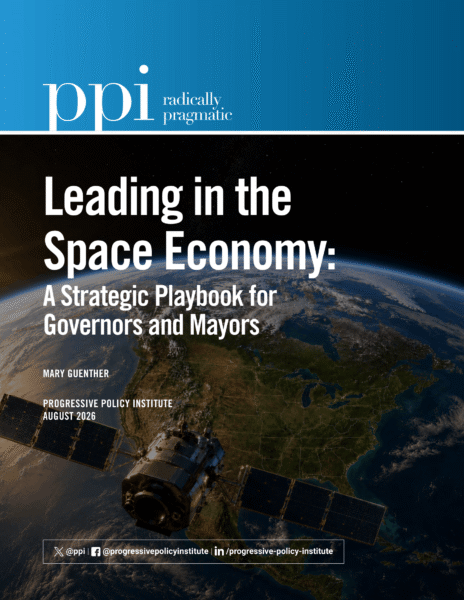
The report, “Space for Progress, Earth for Keeps: An Integrated Framework for Space and the Environment,” authored by Mary Guenther, PPI’s Head of Space Policy, and Susie Quinn, Founder of Plum and Talon and Former NASA Chief of Staff, provides a pragmatic, integrated path forward that engages both the space industry and U.S. government in finding ways to maximize rewards from space and minimize atmospheric effects.

While space already delivers major environmental benefits, America needs to fully harness its world-class science from federal space agencies and task them with developing an understanding of potential negative environmental effects of space activities in order to help inform how choices like materials, fuels, and mission architectures are made in the future.       

“What happens in space touches many aspects of our day-to-day lives,” said Guenther. “As we continue to deploy more spacecraft into orbit, we must make sure we engage thoughtfully to understand and curb some of the negative environmental effects launches may produce without losing sight of all the benefits we get from space.”

Guenther and Quinn outline four integral steps policymakers must take in order to continue accelerating America’s space program and mitigate future environmental disaster:

  1. Sustain and expand funding for NASA, NOAA, and the National Center for Atmospheric Research that the Trump Administration has cut in order to study space-related environmental impacts, as well as ensure the public data Americans rely on for weather forecasts, climate modeling, and more continues to be available
  2. Promote open science and data accessibility to ensure communities, researchers, and policymakers can act on space-based insights
  3. Strengthen public-private partnerships to accelerate innovation and expand access to Earth observation data
  4. Invest in real-world data collection, including in-situ atmospheric measurements during launches and reentries whenever feasible

There is a space race going to the moon with implications even closer to home as China begins to catch up with the United States in space. Policymakers cannot cut critical funding or research that supports Earth observation, as it is critical America wins the current space race for economic and national security reasons. For context, the Earth observation economy is predicted to contribute a cumulative $3.8 trillion to global GDP between 2023 and 2030 and this technology has been critical during the war in Iran as well as Ukraine. At the same time, Guenther and Quinn emphasize that there needs to be a way forward that expands the United States’s dynamic space economy and reduces risks to the planet.

“Space gives and space takes. On the give side, we reap the benefits of decades of US expertise, investment, and open science. From that, we have the industry, tools and experts to figure out what space takes from the planet. The only thing missing is the will.” said Quinn. 

Read and download the report here.

Founded in 1989, PPI is a catalyst for policy innovation and political reform based in Washington, D.C. Its mission is to create radically pragmatic ideas for moving America beyond ideological and partisan deadlock. Find an expert and learn more about PPI by visiting progressivepolicy.org. Follow us @PPI.

###

Media Contact: Ian O’Keefe – iokeefe@ppionline.org

Space for Progress, Earth for Keeps: An Integrated Framework for Space and the Environment

These are boom times for the space business.

In the U.S. alone, satellite launches have surged more than 600% over the past decade, and their pace is only expected to accelerate as the race to deploy data centers into orbit heats up. What happens in space now touches almost every aspect of modern life, from agriculture to national security to navigation to internet access.

But as our activity in space picks up, so does the need to study its effect on Earth’s atmosphere and find ways to prevent potential harm.

This paper is an attempt to jumpstart a nuanced conversation about how to address these environmental issues without sacrificing the benefits of our growing space presence, which are too great to lose and felt daily by everyday Americans.

In Washington, discussions about the space industry’s impact on our atmosphere often focus on a binary question about whether or not there should be more regulation. This is a mistake that ignores the many major questions still in need of answers. We believe it would instead be beneficial to find a pragmatic, integrated path forward that engages both industry and government in identifying ways to maximize our rewards from space and minimize atmospheric effects.

Crafting this integrated approach will require tying together several different policy and scientific conversations. To understand the potential harm side of the equation, it is essential to study the impact of rocket fuel emissions into the atmosphere and of satellites largely breaking up into particulate matter during reentry. While there are also concerns about the footprint of space activities on Earth from siting to discharges of pollutants, we already have established statutory and regulatory frameworks in place to govern them. Our focus in this report is on the less understood and unseen atmospheric and near-Earth environment.

To calculate the benefits, we need to broadly map the contributions that space-based science bring home in the areas of emergency and environmental management, agriculture, and conservation. Congress has fortunately resisted budget cuts to NASA and other climate agencies proposed by the Trump administration that would make this task much harder. But as we’re thinking about the environmental return on investment in space, the conversation should be evolving from merely sustaining research to how we maximize the impact of data gleaned from space using new tools, partnership structures, and audiences.

There are five primary questions policymakers need answers to in order inform thoughtful, integrated solutions:

  1. What exactly is the environmental impact of space activities on the atmosphere?
  2. Do different fuels and materials used in space activities have differing impacts on the atmosphere and near-Earth environment?
  3. If there is a negative environmental impact, are there ways of minimizing it beyond fuels and materials, such as changing concepts of operations?
  4. How can we apply lessons learned from other industries and experiences to avoid repeating the mistakes of the past?
  5. How can humanity squeeze as much environmental management and conservation benefit as possible out of space activities for people on Earth?

These questions are each insufficient on their own — they need to be considered holistically and in context with each other. But even before we learn their answers, there are clear next steps to be taken, covering a wide range of issues. They include:

  • Fighting to continue funding for NASA Earth Science, National Oceanic and Atmospheric Administration (NOAA) climate research, and interagency research on the climate costs of space activities, as well as preserving capabilities housed at the National Center for Atmospheric Research (NCAR), which uses satellites and other kinds of sensors to detect atmospheric changes
  • Building on the momentum of NASA programs that enable communities to productively engage with Earth systems information, including climate data
  • Encouraging more partnerships between local and state governments, nonprofits, industry, and others to expand our knowledge of Earth systems
  • Taking small steps now towards novel research and development initiatives, requiring and/or incentivizing government missions to carry sensors taking real-world (in situ) climate measurements whenever feasible, and extensive industry engagement on this topic


Read the full report


Manno for Commonplace Magazine: Building Blocks for Better Jobs

The ironclad, bipartisan belief in college as the “ticket to the middle class,” in former President Barack Obama’s preferred phrase, that every child should go to college, that the public education system’s primary task is to prepare everyone for college, has begun to crumble.

“For the first time in 50 years, college grads are losing their edge,” the Washington Post reported recently. “The unemployment gap between workers with bachelor’s degrees and those with occupational associate’s degrees—such as plumbers, electricians and pipe fitters—flipped in 2025, leaving trade workers with a slight edge for six months out of the past year, according to the Bureau of Labor Statistics. It’s the first time trade workers have had a leg up since the BLS started tracking this data in the 1990s.”

Commenting on the same trend in the Wall Street Journal, Allysia Finley observed, “unemployment among college grads age 22 to 27 rose to 5.6% in December, roughly what it was in February 2009 during the financial panic.”

“The real problem,” she suggested, “is a mismatch between labor supply and demand. Government subsidies and public schools have funneled too many young people to credential mills, which churn out grads who lack the skills that employers demand. Many would be better off training in skilled trades, for which demand is enormous.”

Read more in Commonplace Magazine

Trump admin accuses foreigners of excessive SExCiness, threatens them with tariffs

FACT: Trump admin accuses foreigners of excessive SExCiness, threatens them with tariffs.

THE NUMBERS: Per the U.S. Trade Representative Office, trading partners flagged for “Structural Excess Capacity”–

Bangladesh, Cambodia, China, the European Union, India, Indonesia, Japan, Korea, Malaysia, Mexico, Norway, Singapore, Switzerland, Thailand, Taiwan, Vietnam.

WHAT THEY MEAN: 

In the Reagan-era Washingtoon comic, Rep. Bob Forehead’s political consultants grow disenchanted with bland “buzzwords” such as “jobs” and “big spenders.” (Short and easy to grasp, yes, but voters sense a lack of intellectual weight.) Anticipating a presidential campaign launch and worried about “an emerging perception of Bob as being purely image and lacking in substance”, they supplement his buzzwords with “fuzzwords”. These are long polysyllables — e.g., “the Federal Reserve should abandon its targets of aggregates” — which also lack intellectual weight, but sound complicated and thus have a desirably confusing and numbing effect on the public.

Life imitates art: Four decades later, aware that short 2025 tariff slogans like “new golden age” and “reindustrialization” aren’t landing, the Trump administration is trying the same thing. Last week the U.S. Trade Representative Office published a Federal Register Notice introducing a nine-syllable neologism — “structural excess capacity” — as a new intellectual foundation for tariff increases:

“The Trump Administration’s reindustrialization efforts continue to face significant challenges due to foreign economies’ structural excess capacity and production in manufacturing sectors.  Across numerous sectors, many U.S. trading partners are producing more goods than they can consume domestically. This overproduction displaces existing U.S. domestic production or prevents investment and expansion in U.S. manufacturing production that otherwise would have been brought online.”

As policy, the Notice announces a “Section 301” investigation of 16 economies — Bangladesh, Cambodia, China, the European Union, India, Indonesia, Japan, Korea, Malaysia, Mexico, Norway, Singapore, Switzerland, Thailand, Taiwan, and Vietnam — for “structural excess capacity”. For readers new to trade-bar jargon, Section 301 is a 1974 statute giving administrations some ability to threaten tariffs on goods from particular countries, in hopes of getting them to remove objectionable policies. Typical uses, mostly in the 1980s and 1990s but more recently vis-à-vis China, were on specific things: limits on U.S. exports, intellectual property appropriation, etc.  Using this law for “structural excess capacity” — it seems essentially to mean a country’s overall industrial output; see below — is novel.

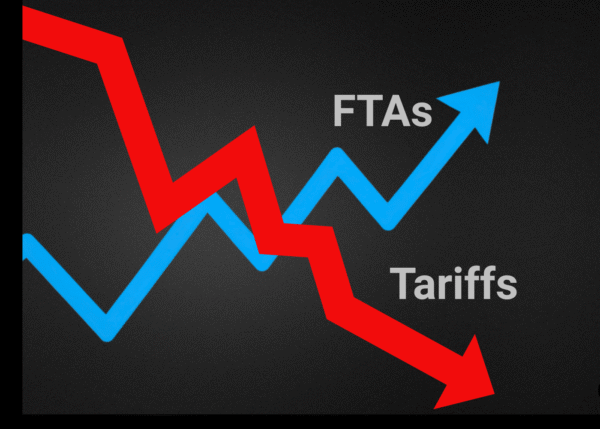
Obvious first question: Who is writing these Notices, anyway? As a fuzzword, “structural excess capacity” has the right murky tone, but astute readers quickly catch its natural acronym: “SExC.” So the administration is accusing the Euros, as well as the Japanese, Thais, Mexicans, Bangladeshis, etc., of excessive SExCiness and threatening them with tariffs for it. Too hot to fly! Americans above the age of twelve have learned over the last year that tariffs are taxes paid by buyers, so this isn’t technically a fine on foreigners for unreasonable hotness – they might pay willingly — but a demoralizing tax, probably in the tens of billions of dollars, on Americans for lacking it.

More analytically, the “structural excess capacity” concept rests on the premise that a country which makes more of something than it needs at home is doing something wrong. If it simply limited production to local needs, Americans would buy less from them and make the stuff ourselves instead.  The Notice uses two data points as evidence of SExCiness: (a) selling more goods abroad (in general, or to Americans specifically) than one buys, and (b) factories running at “capacity utilization” rates below 80%, a level its drafters claim indicates more supply of manufactured goods on the market than the world wants or needs. Samples:

Norway“Evidence of structural excess capacity and production exists for Norway. Norway maintains a global goods trade surplus, led by exports in sectors such as mineral fuels and oils, certain electronic equipment, and machinery. … At 77.7 percent in Q4 2025, Norway’s rate of capacity utilization was more than a full percentage point below what it was a year ago, and over two percentage points less than it was three years ago. In addition, Norway engages in policies and practices that have the effect of undervaluing its domestic currency, including the use of state-owned or -controlled enterprises to recycle oil revenues into non-domestic currencies, like the U.S. dollar, rather than its domestic currency.”

Cambodia“Evidence of structural excess capacity and production exists for Cambodia. Cambodia maintains a bilateral trade surplus with the United States, which in 2024 was approximately $1 billion. Evidence indicates its garment, footwear, and travel goods (GFT) sector exported $11.8 billion in the first nine months of 2025, a 16 percent increase from the same period in 2024. When Cambodia’s GFT industry was facing uncertainty with U.S. tariffs, Cambodia’s Deputy Secretary-General stated that enhancing capacity along the product chains was an option to further boost the manufacturing sector and create lucrative opportunities.”

So Norwegians produce more energy than they use at home, maliciously sell the extra Brent crude to refiners in other countries, and on top of that, use dollars (as energy traders everywhere typically do) rather than krone. Cambodians likewise stitch more clothes and rivet together more suitcases than Phnom Penh’s schoolchildren and business travelers need. The resulting sectoral trade surpluses not only demonstrate the two countries’ SExCiness but help frustrate Trump-team hopes of “reindustrialization” and “a new golden age.”

The ostensible goal of the “301” investigation, therefore, is that threats of tariffs will persuade the Norwegians and Cambodians to drill less oil and sew fewer duffel bags, and then someone will be better off.  Three observations:

1. “Structural excess capacity” is not a meaningful concept: The Notice’s premise is wrong, as American experience quickly shows.  U.S. factories produce more airplanes and artificial body parts than American air carriers and hospitals require. They sell the extras to customers abroad — three in every four U.S.-made airplanes, for example — which is good for foreign travelers and patients, and also brings in money to hire more workers and fund next-gen research.  American farmers grow almonds and wheat than American kitchens and restaurants need, and send respectively 75% and 45% overseas, mostly to Asia. Same with software, natural gas, music, and film. That’s how American aerospace, medical technologies, and agriculture, as well as tech, energy, and entertainment, succeed and grow. The same thing happens in other countries.

2. “Structural excess capacity” reduction is an implausible use of Section 301. The administration’s hope for less world SExCiness must mean either “increasing world demand for goods,” or “reducing output of goods.” The Notice makes pretty clear it’s the latter.  Its 16 economies account for about $10.7 trillion in manufacturing output, two-thirds of the world’s total. At a capacity utilization of 75%, that suggests a potential output of about $14.3 trillion. Raising utilization to 80% — again, the level the Notice claims would put supply in line with demand — by reducing production entails persuading foreign governments to take around $1 trillion worth of annual clothes, cars, toys, soap, helicopters, medicines, and other goods offline. Not likely.

3. And probably not the real goal anyway. Back in 1974, the authors of “Section 301” hoped to find ways to remove or mitigate policies they didn’t like. In 2026, the Treasury Secretary, Mr. Bessent, says the Trump administration just wants “alternative legal authorities” to replace the “international emergency” tariffs the Supreme Court axed in February. By that measure, the 301 investigation is simply another attempt to take Congress’ Constitutional authority over “Taxes, Duties, Imposts, and Excises,” impose tariffs by decree, and hope courts don’t stop it.

Coda: Rep. Forehead’s problem in Washingtoon wasn’t vocabulary choice. Rather, the public’s emerging perception of him as all-image and low-substance was correct. Likewise, in 2026, the administration’s problem isn’t one of “messaging”. It’s the conclusions Americans have drawn, after a year of rising costs, slowing growth, and falling hires, about the real-world impact of tariff increases. Replacing faded 2025 slogans with long new words — even with more dignified acronyms — won’t solve it.

FURTHER READING

PPI’s four principles for response to tariffs and economic isolationism:

  • Defend the Constitution and oppose rule by decree;
  • Connect tariff policy to growth, work, prices and family budgets, and living standards;
  • Stand by America’s neighbors and allies;
  • Offer a positive alternative.

Washingtoon (1983) explains the balance of buzzwords and fuzzwords.

U.S. Trade Representative Office test-markets “structural excess capacity,” launches “Section 301” investigation.

… while Sec. Bessent says the investigation’s real point is quite different.

From Congress, Sen. Ron Wyden and Rep. Richard Neal concisely pan the “investigation.”

Law:

Section 301 text. Note that it directs administrations to identify specific “acts, practices, or policies” that in some way unfairly burden American trade, and doesn’t mention “producing more [oil, clothes, etc.] than one can use at home”.

ABOUT ED

Ed Gresser is Vice President and Director for Trade and Global Markets at PPI.

Ed returns to PPI after working for the think tank from 2001-2011. He most recently served as the Assistant U.S. Trade Representative for Trade Policy and Economics at the Office of the United States Trade Representative (USTR). In this position, he led USTR’s economic research unit from 2015-2021, and chaired the 21-agency Trade Policy Staff Committee.

Ed began his career on Capitol Hill before serving USTR as Policy Advisor to USTR Charlene Barshefsky from 1998 to 2001. He then led PPI’s Trade and Global Markets Project from 2001 to 2011. After PPI, he co-founded and directed the independent think tank ProgressiveEconomy until rejoining USTR in 2015. In 2013, the Washington International Trade Association presented him with its Lighthouse Award, awarded annually to an individual or group for significant contributions to trade policy.

Ed is the author of Freedom from Want: American Liberalism and the Global Economy (2007). He has published in a variety of journals and newspapers, and his research has been cited by leading academics and international organizations including the WTO, World Bank, and International Monetary Fund. He is a graduate of Stanford University and holds a Master’s Degree in International Affairs from Columbia Universities and a certificate from the Averell Harriman Institute for Advanced Study of the Soviet Union.

Read the full email and sign up for the Trade Fact of the Week.

Ritz for The Atlantic: Democrats Learned the Wrong Lesson From 2024

Despite Donald Trump’s promises, America has not been Made Affordable Again. This has created an immense political opportunity for his opponents. But Democratic lawmakers are failing just as badly to articulate an alternative vision. Instead, some of them seem to be trying to out-Trump the president with their own brand of “slopulism”—half-baked policy proposals that sound good only if you don’t think too hard about them, and that would, if enacted, hurt the people they’re supposed to help. Others are simply reheating the leftovers of Joe Biden’s agenda. Few are reckoning with the fundamental problem that led to the party’s defeat in 2024: an inability to prioritize the most important parts of its agenda and make the case that they’re worth paying for.

These shortcomings might not prevent Democrats from riding an anti-Trump backlash to success in the midterms, but they could doom the chances of any future Democratic administration governing successfully.

Senators Cory Booker and Chris Van Hollen recently unveiled bills that would exempt most middle-class households from paying any federal income taxes. Booker’s plan would more than double the standard deduction, to $75,000 per couple, and increase the child tax credit to be even more generous than it was under Biden’s COVID-era expansion. Van Hollen’s would essentially create a parallel income-tax system under which a couple’s first $92,000 of income is exempt. His bill in particular appears to have broad support within the party, rolling out with 18 Senate co-sponsors and a slew of endorsements from major labor unions and activist groups.

Read more in The Atlantic

Manno for EducationNext: The Social Wealth Gap

In today’s economy, what you know still matters, but who you know—and who knows you—matters just as much.

Young people from affluent, well-connected families often inherit a quiet advantage that includes access to mentors, family friends, alumni networks, and managers who can offer advice, open doors, and vouch for them. Their peers from low-income or first-generation immigrant families are more likely to graduate socially impoverished. They earn their diploma but lack the relationships that turn credentials into opportunity.

Call it America’s social wealth gap.

We talk endlessly about the deficits K–12 and college students have in learning, skills, and finances. We talk much less about the missing ingredient that converts credentials into a career: social capital. If education leaders and policymakers want to expand opportunity and strengthen the talent pipeline, they have to treat students’ relationships—not just their diplomas and resumes—as critical infrastructure.

Read more in EducationNext

Manno for The 74: As Confidence in Higher Ed Erodes, Students Still Say Their Degrees Are Worth It

Public confidence in American higher education’s value has fallen sharply over the past decade. Yet the message from college students and graduates is different: Most say that their college experience is positive and worth it.

This gap between the American public and students’ experience reveals a college value disconnect highlighted in a new Lumina Foundation and Gallup reportThe College Reality Check, based on responses from about 4,000 undergraduates and 6,000 graduates.

Let’s start with the public mood.

Gallup’s long-running higher education confidence measure shows a steep slide from 2015, when 57% of U.S. adults said they had “a great deal” or “quite a lot” of confidence in colleges and universities, to 36% in 2024. Even with a modest 2025 rebound to about 42%, confidence remains well below the 2015 level.

Read more in The 74

PPI’s Moss Tells House Judiciary Committee That The Shipping Act Antitrust Exemption Enables Anticompetitive Behavior and Hurts Consumers

In testimony before the House Judiciary Committee, Diana Moss, Vice President and Director of Competition Policy at the Progressive Policy Institute, urged lawmakers to repeal the antitrust exemption in the Shipping Act that has consolidated the maritime shipping industry, essentially creating an oligopoly.

Moss warned that already the top four carriers went from controlling ~30% of the market in 2002 to ~60% today, with three major alliances controlling over 80% of capacity and 90% of U.S. trade, causing transportation costs to skyrocket. These transportation costs directly go into the costs of goods, including 13% of food prices, 16% of lumber, 8% of textiles.

During the hearing, Moss also called out the Department of Justice for failing to meet to moment during other antitrust enforcement measures, including weak settlements in the HP-Juniper, Live Nation-Ticketmaster, and RealPage cases.

Read the full testimony. 

Kahlenberg in Inside Higher Ed: Higher Ed Hopescrolling

[…]

I stand by that high-level assertion, but several recent analyses suggest that they’re making more headway in enrolling low-income learners. A report from the Progressive Policy Institute, analyzing data from the Associated Press and its own research, finds that enrollment of students eligible for Pell Grants has increased at most of the highly selective colleges and universities examined since the U.S. Supreme Court’s 2023 decision barring consideration of race in college admissions.

The report, co-written by Richard Kahlenberg, who has long advocated for affirmative action based on class rather than race, also suggests that enrollment of Black and Latino learners has declined modestly and concludes, per its title, that we’re seeing “the rise of economic affirmative action,” with universities finding “new and better paths to recovery.”

[…]

Read more in Inside Higher Ed

Kahlenberg in Education Next: The Education Exchange: Top Academic Journal Sees America Through a Glass Darkly

The Education Exchange · Ep. 434 – March 16, 2026 – Top Academic Journal Sees America Through a Glass Darkly


Richard D. Kahlenberg, Director of the American Identity Project at the Progressive Policy Institute, joins Paul E. Peterson to discuss Kahlenberg’s new report, which investigates how American Quarterly has covered American studies and history in the wake of President Donald Trump’s one-sided treatment.