Teaching Students What It Means to Be an American: It Provides the Key to Preserving Our Liberal Democracy

Executive Summary

Almost 250 years after the nation’s founding, there is broad agreement that American liberal democracy is in deep trouble. The leading Republican candidate for president has tried to thwart the peaceful transfer of power and speaks of suspending the Constitution, while activists on the left shout down speakers with whom they disagree and create a climate where large majorities feel they can’t speak their minds. Illiberal tendencies are worse on the political right than the left because they invoke the power of the state, while the left invokes the power of culture, but both are profoundly troubling and feed off of one another.

It has long been observed that authoritarian tendencies are greatest among those with less education and income, but today illiberalism on the left actually rises with increased education, the opposite of what one would hope. Disturbingly, the willingness to give up on democracy is much greater among young people than those who are older.

Why now? After a long period in which the Civil Rights movement helped make the country more democratic, why is America now backsliding? Central to the problem is the loss of a common American identity. White identity politics on the right, and racial identity politics on the left, make fights seem existential, which justifies cutting corners on democratic norms. Voters on the right are more likely to excuse authoritarian actions when they feel as though they are losing control of the country. Meanwhile, the left promotes critical race theory and antiracism policies that say racial oppression is a permanent feature of American life that can only be countered by discrimination in favor of oppressed groups.

These theories about the centrality of racial identity lead to an eerie convergence on the left and the right that questions a series of fundamental liberal democratic principles. For different reasons, both sides have become skeptical about treating Americans as individuals rather than members of racial groups. They both question concepts like advancement based on merit and the possibility of discerning objective truth. The hard right and the hard left agree that school integration makes little sense; and they both, in their own ways, are skeptical about free speech, press freedom, and the freedom to read controversial books. For different reasons, they both question academic freedom, and are both willing to embrace antisemitic beliefs.

What is the path out? Historically, public schools in America accomplished two pretty miraculous objectives. By placing a priority on teaching students the importance of liberal democratic principles, they helped keep a democratic republic going for over two centuries; and by instilling a common American identity, they provided the glue that held together people whose ancestors came from all corners of the world. In recent years, K-12 schools and colleges have moved away from this vision. They’ve placed more focus on economic competitiveness than democratic citizenship. And many focus on a vision of American and world history that divides the racial and ethnic groups neatly into categories of oppressed and oppressors, and undercut a shared American identity through poorly implemented ethnic studies programs. This new emphasis within public schools, in turn, promotes calls on the right for privatization of public education, which will only Balkanize the country further.

This report is the first in a series that will offer nine ways to once again teach students what it means to be an American.

The stakes of teaching American identity are enormous. Human beings have a natural yearning for identity and a larger purpose and if educators don’t provide young people with a love of country, authoritarians will offer false alternatives, often centered around race or ethnicity. The good news is that the public supports a better path. Instilling a renewed sense of American identity could inspire a “patriotism dividend” that could put the country on a better path for the next 250 years. Among the towering issues of our time, few are as important as this one.

Read the full report.

Regulators Deserve a Nudge, Not a Shove

SCOTUS just did away with Chevron deference, effectively trimming the discretion enjoyed by hundreds of thousands of federal regulators across 70+ agencies.

As expected, anti-regulation voices are sounding off with unbridled glee as conservative lawmakers blow the dust off of old legislative proposals that have never garnered bipartisan traction.

If such reactions are misplaced, then how should one process this admittedly momentous decision by the high court?

Let’s start by acknowledging a truth that some on the left are loathe to admit: the work of federal regulators—thousands of new mandates every year, imposing tens of billions of dollars in costs–largely escapes oversight by elected officials. In my recent report for the Progressive Policy Institute, I note that just 8% of all new rules are reviewed by the White House, and just 17% of all new rules are required by Congress. Regulators are most certainly driving the bus.

And let’s acknowledge another truth ignored by some on the right: the public benefits enormously from regulation. Benefits exceed costs by a large margin—a conclusion drawn across numerous studies, including annual reports from the Office of Management and Budget. And polling shows that the public overwhelmingly supports regulatory protections—think clean air, safe transportation, unadulterated medicines, fiscally sound banks.

So what can and should be done, if anything, to ensure appropriate checks and balances on the so-called administrative state?

Deferring to the courts is not a viable long-term solution. Judges are ill-equipped to play the role of regulator—they lack expertise in the very technical matters that are often at the heart of any rulemaking action.

Greater reliance on the president is better, but not much. Executive orders govern the regulatory review process, but executive orders do not have the force of law, and some of the most active regulatory agencies are, by design, not subject to White House control.

No, the key take-away from the SCOTUS ruling is that Congress, which delegates its authority to regulators, needs to elevate its game when it comes to oversight. It should pass a law that shines a light on troublesome rules before they are issued. But it should do so without sacrificing the issuance of necessary rules, which are legion. Regulators deserve a nudge, not a shove.

Fortunately, such a solution—in the form of regulatory early notice—was recently introduced in the House of Representatives. The bill, H.R. 8204, co-sponsored by Rep. Don Davis (D-NC), Guy Reschenthaler (R-PA), and Tim Burchett (R-TN), would require agencies to disclose to Congress every newly initiated rulemaking, along with an explanation of its necessity and the rationale behind it. And the public would be invited to submit ideas on how best to achieve the regulatory objective at the lowest cost.

In many ways, the bill does not break new ground. It borrows language from a Clinton-era executive order that has been in place since 1993 and affirmed by every President since. And it embraces recommendations of the Administrative Conference of the United States, which was established to convene legal scholars and other experts to identify needed reforms.

What is new is this: the bill would allow Congress to see exactly how federal agencies use their delegated authority long before a new rule is issued. Just as sunlight is the best disinfectant, disclosure is the best way to ensure stronger, more defensible regulation from the get-go. The concept is, to coin a phrase, radically pragmatic. Congress should act on it.

For more on the need for regulation reform that promotes transparency and accountability in federal rulemaking, check out a recent PPI paper titled “Stronger Regulation from the Get-Go.

About the Author

Keith B. Belton is Senior Director, Policy Analysis and Statistics, with the American Chemistry Council. His research and writings explore the intersection of public policy and private markets, with particular focus on economic development, regulation, and competitiveness.

Marshall for The Hill: The GOP’s pessimistic platform for the future is the worst of our past

By Will Marshall

Gathering in Charlotte four years ago to renominate President Donald Trump, Republicans didn’t bother to draft a party platform. Evidently, they figured, “more Trump” was all the public needed to know about their second-term plans.

It probably was, although not in the way Republicans had hoped, as the voters dumped Trump and hired Joe Biden.

Americans vote for people, not platforms. But these manifestoes, however platitudinous and boring, are like a quadrennial Rorschach test of a party’s state of mind. The GOP’s decision to recycle its 2016 platform seemed calculated to paper over internal ideological rifts as well as their nominee’s frequent lapses into incoherence.

This time, party leaders plan to write a new platform for next month’s Republican National Convention in Milwaukee. This time, having thoroughly routed traditional conservatives and the GOP’s dwindling band of dissenters from his “stolen election” fantasy, Trump can expect blind obedience from his party.

Keep reading in The Hill.

UK General Election Bulletin – 1 Week Remaining

This is the fourth and final of PPI’s weekly bulletin charting the course of the UK General Election, from PPI’s Claire Ainsley.

Claire is based in the UK, directing PPI’s project on center-left renewal, and is former director of policy to Labour leader Keir Starmer. She is supporting the Labour campaign, as a media commentator, as well as on the ground ahead of polling day next week on Thursday 4th July.

The U.K. is entering the final days of its general election campaign, and whilst the overall polls aren’t budging much with a sustained lead for Labour, there are some undercurrents that means the result is not a foregone conclusion.

A large minority of voters are undecided, even at this late stage. In the main, these are people who voted Conservative in 2019, don’t really want to vote for them again, but are holding back from changing their vote to Labour.

A good proportion of them are switching to new entrants Reform U.K.,  partly driven by their dissatisfaction with the Conservatives’ failure to manage immigration, and who want change not the status quo. Reform U.K. are set to do much better than the national political conversation is accounting for, taking votes mainly at the Conservatives’ expense but also from Labour. It may not translate into many MPs, but it doesn’t need to play havoc with British politics. Just look at Brexit.

Then there are the undecided voters who would normally vote Conservative, might have voted Labour under Tony Blair, but are yet to come over to Labour. Their concerns are primarily on tax and spend, which Starmer and shadow chancellor Rachel Reeves have been reassuring voters they will not put personal taxes up nor unleash public spending without the proceeds of improved growth to pay for it. The Tory campaign is now focussed on these two groups, and makes the overall result open to a broader range of election possibilities than the media coverage would suggest. Sunak threw punch after punch Starmer’s way in our final leaders’ television debate, which are not as widely watched as in the US, but signalled that’s where the Conservative strategy is at.

All this underscores the need to center-left parties to meet the voters where they are, and win the argument against the political right about destination. British voters want a better economy and better public services. They are sceptical any political party can really deliver that. Despite that, Labour’s lead is holding ahead of election day. If they do succeed, they will need to waste no time in delivering the change the country has voted for.

Ainsley in Bloomberg: Keir Starmer Builds a Big UK Election Victory on a Volatile Base

Starmer has also boxed himself in by saying he doesn’t plan to increase any taxes beyond those already announced. That risks angering voters if Labour reneges on its tax-and-spend pledges to balance the books.

“There’s a real challenge to be the party of stronger growth again, when the policies they might want to effect — state and private — feel outwith the capacity they have when they get there,” said Claire Ainsley, Starmer’s former director of policy and now a director at the Progressive Policy Institute.

Read more in Bloomberg.

Ryan for Ohio Capital Journal: To make progress on climate, Democrats must partner renewables with natural gas

By Tim Ryan

As a lifelong Democrat and a Co-Chair for Natural Allies for a Clean Energy Future, I am eager to quickly develop a secure and practical energy policy that drives down global carbon emissions. We owe it to our children and grandchildren. And we have a moral obligation to be stewards of God’s planet. To abate the worst impacts of climate change, the impartial data and real-world success stories show we must partner the carbon-free power generation of renewables with the affordability, reliability, and security of low-carbon natural gas.

Recent commentary and short sighted attacks about me in the Ohio Capital Journal reflect the simplicity of bumper sticker slogans, even though our national energy infrastructure is far more complex. Serious people need to understand that. Cutting back on natural gas exports abroad to allied economies that need it, and turning off natural gas here at home, would be bad politics, destructive economics, and atrocious climate policy.

Keep reading in the Ohio Capital Journal.

Trade Fact of the Week: The U.S. digital economy, on its own, would be the world’s eighth-largest economy.

FACT: The U.S. digital economy, on its own, would be the world’s eighth-largest economy.


THE NUMBERS: “GDP,” 2022* – 
World: $100.66 trillion
1. U.S. $25.74 trillion
… [China 2, Japan 3, Germany 4, India 5]
6.  U.K. $3.10 trillion
7.  France $2.78 trillion
U.S. digital economy $2.57 trillion
8.  Russia $2.27 trillion
9.  Canada $2.16 trillion

* IMF for world and countries; Bureau of Economic Analysis estimate for U.S. digital economy.


WHAT THEY MEAN:

Last December the Commerce Department’s Bureau of Economic Analysis statisticians ventured an estimate of the size of the American “digital economy.” After sifting the “digital” bytes and pixels out of the big manufacturing, services, mining, information, and other “sectors,” they then summed up the software, hardware, e-commerce, computer systems design, gaming, and other online (or online capable) industries. The arithmetic yielded a figure of $2.57 trillion for American digital “GDP” in 2022 — exactly a tenth of that year’s $25.7 trillion U.S. economy, and 2.5% of the $100.7 trillion world economy. Were the U.S. digital economy an independent country, it would have ranked eighth in the world, $200 billion below France and $300 billion above pre-war Russia.

Whether compared to the overall U.S. economy, the world, or other countries, the American digital economy has some distinctive features. First, it is fast-growing.  In 2022, it grew by 6.5%, nearly double the world economy’s 3.5% growth rate.  From 2017 to 2022 the gap was even larger, with the digital economy averaging 7.1% annual growth and world GDP 2.7%. Second, its population is modest: BEA estimates a total of 8.9 million U.S. digital-economy workers, slightly less than a third of the 28 million French workers for nearly the same “GDP” value.  (Alternatively, the Netherlands — a high-income country with 9.6 million workers, close to the U.S. digital-worker total — had a GDP of $1.01 trillion.) Third, it is affluent – U.S. digital-economy workers earn $2,195 per week on average, about 33% more than the $1,650 average for U.S. workers in general.  And finally, it is trade-reliant, earning 28% of its money from exports. This is about twice the U.S.’ overall 13% export reliance, and about equal to the world average.

For more on this last point, over to a smaller and equally cerebral agency — the White House’s Council of Economic Advisers, on the top floor of the Eisenhower Executive Office Building — whose data-heavy blogs serenely survey the U.S. and world economic landscapes each week. The latest, out last Tuesday, examines the interface between this U.S. digital economy and the outside world. Some of its findings:

Scale: As of 2022, digitally delivered services exports came to $719 billion, a quarter of the U.S. $3.02 trillion in total exports. This included $93 billion in exports of “ICT” services (telecommunications, computer services, and software licensing payments) plus $626 billion in “digitally deliverable” services, such as financial wires, telemedicine diagnoses, music downloads, Chatbot fails, memes, distance education, and so forth. The U.S. is easily the world’s largest supplier of these things — as an index, the WTO’s somewhat different overall “commercial services” total for the U.S. was $900 billion in 2022, about an eighth of the world’s $7.04 trillion total, and just about equal to the $492 billion of second-place U.K. and $422 billion of third-place China put together.

Exporters: The largest U.S. digital exporters are financial services providers, with 29% of the 2022 total. They aren’t far above labs and factories, though: manufacturers ranked second with 24%, much of it through revenue from “rights to use their patents, industrial processes, or software licenses abroad.” A 24% share of $719 billion is about $172 billion, so given 2022’s $1.6 trillion in exports of physical manufactured goods, U.S. manufacturers earn a tenth of their export money through digital services.  (And to complicate things a little, the physical goods themselves often incorporate digital trade — agricultural machinery communicates with its makers to analyze soil and water conditions, medical devices send data for analysis and return it to physicians, automobiles exchange data with headquarters to report signs of wear and signal drivers of the danger of collision.)  Information industries — Hollywood studios, software designers, gamers and influencers, social media and internet platforms, news and media — receive 23% of digital exports; a lengthy spectrum of service providers — architects, R&D scientists, hospitals, universities, advertisers, etc. — combine for the other 27%.

Trade Balance: As CEA notes, the U.S. is more of a seller than a buyer of digital things.  ICT services imports in 2022 were $63 billion and ICT-enabled imports were $370 billion, yielding a digital trade surplus of about $285 billion.

Future: Based purely on physical investment, digital trade seems likely to keep growing fast. Digital services move through space as radio waves via satellite beam, and along the sea-bottoms as pulses of light through fiber-optic cable. The more satellites and cables there are, and the more sophisticated they are, the more services can move, and deployment of both is fast. Last year alone saw 2,664 satellite launches. Cable-watcher TeleGeography reported 550 active and planned submarine cables in June 2023, and expects another 78 to go live by the end of 2025.  That all suggests a continuing boom.  On the other hand, as CEA concludes, growth opportunities also require openness and policy:

“The United States is poised to lead the growth in intangible flows given that the digitally-enabled services sector is one of the highest-paying and innovative segments of the economy.  The rapid growth of digital services will require careful consideration in both domestic and international regulatory regimes. While the United States ranks fifth among fifty countries in terms of having the least restrictive barriers to digital trade, African countries have the highest levels of restrictions, followed by the Asia-Pacific region. Continued consideration and consultation will be necessary to support a thriving digitally-enabled services sector in the United States.”

FURTHER READING

BEA on the U.S. digital economy.

And CEA on American digital trade.

Data:

The OECD tries to compare size and growth rates of digital sectors in Europe, Latin America, Canada, and the U.S.

Perspectives:

Geneva-based trade scholar Richard Baldwin looks at the growth of services trade and decides “peak globalization” is a myth.

Labor:

PPI’s poll of less-than-college Americans last fall finds respondents viewing ‘tech-sector’ jobs as the next generation’s best career options.

And last, on metal birds and glass wires:

Up above: Our World in Data counts last year’s 2,664 satellite launches.

Down below: Telegeography maps the world’s 600 submarine cables, and predicts 75 more lighting up over the next year.

ABOUT ED

Ed Gresser is Vice President and Director for Trade and Global Markets at PPI.

Ed returns to PPI after working for the think tank from 2001-2011. He most recently served as the Assistant U.S. Trade Representative for Trade Policy and Economics at the Office of the United States Trade Representative (USTR). In this position, he led USTR’s economic research unit from 2015-2021, and chaired the 21-agency Trade Policy Staff Committee.

Ed began his career on Capitol Hill before serving USTR as Policy Advisor to USTR Charlene Barshefsky from 1998 to 2001. He then led PPI’s Trade and Global Markets Project from 2001 to 2011. After PPI, he co-founded and directed the independent think tank ProgressiveEconomy until rejoining USTR in 2015. In 2013, the Washington International Trade Association presented him with its Lighthouse Award, awarded annually to an individual or group for significant contributions to trade policy.

Ed is the author of Freedom from Want: American Liberalism and the Global Economy (2007). He has published in a variety of journals and newspapers, and his research has been cited by leading academics and international organizations including the WTO, World Bank, and International Monetary Fund. He is a graduate of Stanford University and holds a Master’s Degree in International Affairs from Columbia Universities and a certificate from the Averell Harriman Institute for Advanced Study of the Soviet Union.

Read the full email and sign up for the Trade Fact of the Week.

Manno for Forbes: Britain’s Labour Party Promotes Opportunity Pluralism

By Bruno Manno

The United Kingdom holds a general election on July 4th, the day we former colonists celebrate Amexit—America’s 248th birthday of our self-proclaimed exit from that country. A 2024 Pew Research poll of British adults taken before the call for an election concluded that “Britons see the state of the UK in relatively bleak terms.”

Current U.K. polls show the opposition Labour Party crushing the governing Conservative Party, in power since 2010. Truth be told, the only poll that counts is what voters say on July 4th. But assuming polls are generally accurate, there is value in assessing how Labour’s proposed working family’s agenda for education and workforce training resembles U.S. conversations on what I call opportunity pluralism.

One must begin by acknowledging that U.S. education governance is more decentralized than in Great Britain. Hence, much of the information exchange between representatives from a new Labour government and the U.S. would involve initiatives implemented at the state and local levels in the U.S.

Keep reading in Forbes.

UK General Election Bulletin – 2 Weeks Away

This is the third of PPI’s weekly bulletin charting the course of the UK General Election, from PPI’s Claire Ainsley.

Claire is based in the UK, directing PPI’s project on center-left renewal, and is former director of policy to Labour leader Keir Starmer. She is supporting the Labour campaign, as a media commentator, as well as on the ground ahead of polling day on Thursday 4th July.

With less than two weeks to go before voters go to the polls in the UK, a change of governing party for the first time in 14 years is looking more and more likely.

It is important to note that any kind of parliamentary majority for the Labour Party would be a huge achievement. When Keir Starmer was elected leader of the Labour Party in April 2020, Labour were 26 points behind the Conservatives who had just won their fourth successive election and an 80-seat majority in parliament. Labour was a long way behind, and Starmer’s turnaround to the point where Labour looks electable again is nothing short of remarkable.

With a change of government looking closer in the UK, international attention on the election has increased. I’m writing this bulletin from Berlin with PPI, where European centre-left parties, and Democrats, are hopeful that a change of government in the UK will bring fresh energy to the global center-left and vital cooperation on international possibilities and challenges.

If UK voters do put their faith in Labour at the coming election, the party would do well to seek counsel from the center-left parties who have found that winning the war of an election campaign does not mean winning the peace in government. The SPD in Germany became the leading party in the governing coalition at the last federal election in 2021, but have seen popular support ebb away as their programme hit fiscal constraint and cost of living reality in post-Covid crisis times. And of course in the US, the strong performance of the US economy is eyed with envy this side of the Atlantic, but as Democrats well know, it is not as yet translating into support for Biden ahead of his re-election campaign.

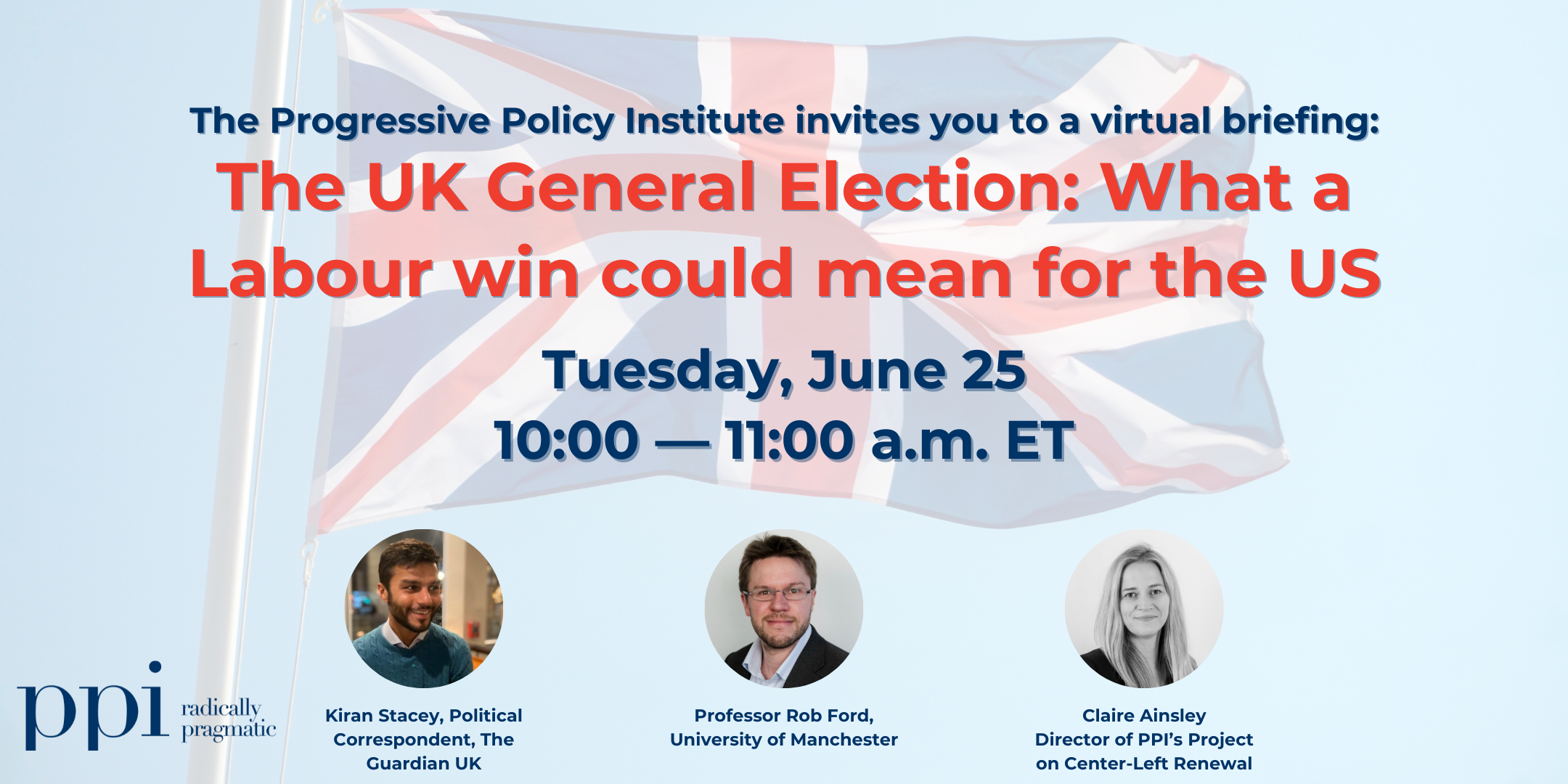
PPI will be hosting a webinar this coming Tuesday on the electoral politics behind the UK vote, and what a change of government in the UK could mean for the US. We will be joined by leading commentators Professor Rob Ford of the University of Manchester, one of the UK’s foremost political scientists, and Kiran Stacey, Political Correspondent at the Guardian and former Washington correspondent for the Financial Times. This is a unique opportunity to hear the insiders’ view on this potentially game-changing election, and you can sign up here.

Kahlenberg in The New York Times: Is It Possible to Desegregate the Nation’s Biggest School System?

Richard D. Kahlenberg, a researcher at the Progressive Policy Institute who has written about school segregation, said one challenge for the city’s kindergarten model was that “when you’re talking about 4-year-olds, the concept of merit isn’t all that relevant.”

“It’s probably the most problematic aspect of the system,” he said.

Read more in The New York Times.

Analyzing the Capital One-Discover Merger: A Test Case for the Biden Merger Agenda

Washington, D.C. — The proposed merger between Capital One Financial and Discover Financial Services, announced in February, signals a shift in the motivation for consolidation in the banking and credit card services sector. Unlike previous mergers focused on building digital payment technology ecosystems, the merger combines a national bank with a credit card payment network, marking new territory for antitrust enforcement.

Today, the Progressive Policy Institute (PPI) released an in-depth analysis of the proposed merger, titled “The Capital One Financial-Discover Financial Services Merger: A Test Case for the Biden Merger Agenda.” Report author Diana Moss, Vice President and Director of Competition Policy, provides a comprehensive look at the potential impact of the Capital One-Discover merger on competition in credit card purchasing and lending. The report calls for rigorous antitrust scrutiny of the deal by the U.S. Department of Justice.

PPI’s analysis, based on publicly available data, unpacks major competition questions that are likely to surface in the DOJ’s antitrust review of the credit card side of the Capital One-Discover merger. These issues range from a loss of competition and enhanced market power in credit card purchasing and lending, to vertically combining a credit card issuer with a payment processing network, and how the merger affects competition in digital payments ecosystems.

A major takeaway from PPI’s analysis is that the Capital One-Discover merger is unlikely to present a clear-cut case of a merger that is likely to “substantially lessen competition or tend to create a monopoly” under Section 7 of the Clayton Act. This applies under existing banking guidelines followed by the DOJ and the 2023 Merger Guidelines, should the government use them to guide an analysis of the competitive effects of the Capital One-Discover merger.

“The Capital One-Discover merger presents a test case for antitrust enforcement under the new guidelines,” said Diana Moss. “Challenging a merger in federal court that does not trigger, or strongly trigger, the thresholds in the merger guidelines would raise the government’s burden of proof. The DOJ would need to make a particularly strong case for anticompetitive effects in order to fend off rebuttal evidence from Capital One-Discover that the merger is pro-competitive. Strong merger enforcement will be particularly important in policing a new wave of consolidation in the financial services sector, so it is important that the DOJ chooses cases wisely,” Moss added.

Read and download the report here.

The Progressive Policy Institute (PPI) is a catalyst for policy innovation and political reform based in Washington, D.C. Its mission is to create radically pragmatic ideas for moving America beyond ideological and partisan deadlock. Learn more about PPI by visiting progressivepolicy.orgFind an expert at PPI and follow us on Twitter.

###

Media Contact: Tommy Kaelin – tkaelin@ppionline.org

The Capital One Financial-Discover Financial Services Merger: A Test for the Biden Merger Agenda?

Executive Summary

The proposed merger of Capital One Financial and Discover Financial Services is the largest in the banking and financial services sectors since the 2000s. The proposed merger signals a fundamental shift in the motivation for consolidation in banking and credit card services since the last swath of mergers. That is, acquisitions by the top credit card payment processing networks and card issuers over the last 15 years have focused on building out digital payment technology “ecosystems” in the migration to digital financial services.

The merger affects a number of important markets, ranging from banking to credit card purchasing and lending, and even digital payments ecosystems where Capital One-Discover will compete with newer market entrants. The impact on consumer credit card lending is getting particular attention. Credit card debt has skyrocketed since 2021 and the cost of that debt weighs heavily on working-class Americans. Any post-merger threat of higher credit card interest rates and fees, or a degradation in non-price benefits such as card rewards programs, therefore, will get very close scrutiny by regulators.

With many cooks in the regulatory “kitchen,” including the Federal Reserve Bank (FRB), Office of the Comptroller of the Currency (OCC), and U.S. Department of Justice (DOJ), the $35 billion Capital One-Discover merger will be under the microscope. But it comes at a time when updated bank merger guidelines from OCC and DOJ are far from finalized. This leaves the 1995 bank merger guidelines and, potentially, questions about if and how the DOJ might apply the new 2023 Merger Guidelines to the transaction.

PPI’s analysis unpacks major competition questions that are likely to surface in the DOJ’s antitrust review of the credit card side of the Capital One-Discover merger. These issues range from a loss of competition and enhanced market power in credit card purchasing and lending, to vertically combining a credit card issuer with a payment processing network, and how the merger affects competition in digital payments ecosystems.

A major takeaway from PPI’s analysis, which is based on publicly available data, is that the Capital One-Discover merger is unlikely to present a clear-cut case of a merger that is likely to “substantially lessen competition or tend to create a monopoly” under Section 7 of the Clayton Act. This applies under existing banking guidelines followed by the DOJ and the new 2023 Merger Guidelines, should the government use them to guide an analysis of the competitive effects of the Capital One-Discover merger.

Challenging a merger in federal court that does not trigger, or strongly trigger, the thresholds in the merger guidelines would raise the government’s burden of proof. The DOJ would need to make a particularly strong case for anticompetitive effects in order to fend off rebuttal evidence from Capital One-Discover that the merger is pro competitive. These dynamics increase the Biden DOJ’s risk of losing in a litigated merger case, an outcome that could set a poor precedent at a time when strong merger enforcement will be particularly important in policing a new wave of consolidation in the financial services sector.

Please read on for PPI’s analysis of the Capital One-Discover merger and what it means for antitrust enforcement, consumers, and the financial services sector.

Continue reading the report.

Manno for Education Next: Career and Technical Education Clears New Pathways to Opportunity

By Bruno Manno

Many Americans, including the last wave of Gen Z-ers now entering high schools, want schools to offer more education and training options for young people like career and technical education, or CTE. They broadly agree that the K–12 goal of “college for all” over the last several decades has not served all students well. It should be replaced with “opportunity pluralism,” or the recognition that a college degree is one of many pathways to post-secondary success.

School-based CTE programs (there are also programs for adults) typically prepare middle and high school students for a range of high-wage, high-skill, and high-demand careers. These include fields like advanced manufacturing, health sciences, and information technology which often do not require a two- or four-year college degree. CTE programs award students recognized credentials like industry certifications and licenses. Some programs also provide continuing opportunities for individuals to sequence credentials so that they can pursue associate and bachelor’s degrees if they choose.

Keep reading in Education Next.

Trade Fact of the Week: The U.S. manufacturing trade deficit rose by over 60% from 2016 to 2021.

FACT: The U.S. manufacturing trade deficit rose by over 60% from 2016 to 2021.


THE NUMBERS: Manufacturing sector share of U.S. GDP – 
2023: 10.3%
2018: 10.9%


WHAT THEY MEAN:

This fall’s core choice is more basic than a policy question: Can a person who has attempted to overthrow a settled election, and called for the “termination” of unspecified parts of the Constitution, keep an oath to “faithfully execute the office of President of the United States” and “preserve, protect, and defend the Constitution”?  But policy issues, even if they’re secondary this year, still have human consequences. Here’s a look at one:

The Trump campaign pitches a 10% tariff worldwide plus a 60% tariff on Chinese-made goods  — which as we’ve noted before, would be the highest U.S. tariff rate since the Depression. (Last week’s float of replacing the $2.2 trillion income tax with tariffs probably isn’t serious; for those interested in it, a bit more below.) The claim is that the higher prices tariff hikes bring are worth it because they will (a) lower the U.S. trade deficit, (b) put more people in factory jobs as opposed to the health, transport, construction, etc. jobs they now have, and (c) increase U.S. manufacturing output.

The smaller first-term tariffs imposed on steel, aluminum, and most Chinese-made goods in 2018 and 2019 provide some real-world experience for this. What’s happened since then is mostly the opposite of these claims: trade deficits have sharply risen, and grown fastest in manufacturing; U.S. manufacturing job growth has slowed, though not stopped; and the manufacturing share of U.S. GDP has fallen. The data:

1. Trade balance: In the 2017 edition of the “President’s Trade Agenda” (an annual report by the U.S. Trade Representative Office) the then-incoming Trump officials argued that a rise in the trade deficit* over time showed earlier administrations had got things wrong:

“In 2000, the U.S. trade deficit in manufactured goods was $317 billion. Last year [i.e. 2016] it was $648 billion — an increase of 100 percent.”

Economists argue among themselves as to whether trade balances matter much. But nobody disputes what happened after 2018. Tariff rates rose, and the U.S. trade deficit got both bigger in general and more concentrated in manufactured goods. Between 2018 and 2021, the “trade-weighted” U.S. tariff rate doubled from 1.4% to 3.0%, and actual tariff payments rose from $33 billion to $83 billion. Meanwhile, by 2021 the “manufacturing-only” trade deficit figure cited in the 2017 report had soared to $1.06 trillion — about 60% above the 2016 figure — and the overall U.S. goods/service deficit from $479 billion to $842 billion.**

The experience affirms the Econ 1 axiom: a country’s trade balance equals the difference between its savings and its investment. As a form of tax increase, higher tariffs (all else equal) should reduce government-sector “dissaving,” and so should reduce a deficit slightly. If accompanied by larger reductions in other taxes, though, “all else” isn’t equal, and government “dissavings” rise despite the tariff increase. Unless for some reason families and businesses decide to save more, trade deficits will rise. That’s what happened after 2017 (and also after the 1981 and 2001 tax bills).

The especially sharp rise in manufacturing deficits was less predictable. Here the 2018/2019 tariffs are likely a cause. Manufacturers import goods so as to turn them into other goods, and are big tariff payers. About 45% of all U.S. imports (per a San Francisco Fed paper) are this type of industrial input, or “intermediate good.” The permanent “MFN” tariff system mainly taxes consumer goods; the Trump tariffs more often tax industrial inputs. So the tariffs raised the costs of industries like automobiles, machinery, and toolmaking; they faced a bit more challenges competing against imports and succeeding as exporters; and the overall goods/services deficit grew more concentrated in manufacturing.

2. Manufacturing employment: Since 2018, manufacturing employment has continued to grow, but more slowly than before. Looking back to the Obama administration, the BLS’ count of factory jobs grew from 11.5 million in early 2010 to 12.4 million in January 2017, or by 900,000.  Since then, it’s grown to 13 million, i.e. by 600,000. On average, manufacturing employment rose an average of 105,000 a year from 2013 to 2018; since then, with tariffs up, it has continued to rise but by an average of only 50,000 per year. To take a broader view, manufacturing jobs now make up 8.2% of the 158 million non-agricultural U.S. jobs, down from 8.5% in late 2017.  Again, no reason to expect a bigger tariff experiment to fare better.

3. Manufacturing output: Job totals and employment growth, of course, don’t always directly relate to the health of “manufacturing” as such.  By adding computers, robots, and other productivity-boosting technology, some factories can raise output while employing fewer people.  In practice, though, U.S. manufacturing trends since 2018 seem to have paralleled those in employment: growth slower than before, and manufacturing output (though not down in actual dollars) reduced as a share of GDP. The Bureau of Economic Analysis reports that the manufacturing sector grew by $183 billion from 2013 to 2018 (from $2.03 trillion to $2.21 trillion) and accounted for 10.9% of U.S. GDP in pre-tariff 2018.  Output in 2023 was $2.29 trillion, meaning $78 billion in growth from 2018 to 2023, with a GDP share of 10.3%. Sectors that buy fewer goods, and so are less burdened by tariffs, grew noticeably faster — real estate from 7.0% to 7.6% of GDP, information from 5.0% to 5.4%, and professional and business services from 12.5% to 13.0%.

So:  Again, this fall’s policy debates aren’t as important as the constitutional and rule-of-law questions. But for those tracking policy, the 2017 assertions that tariffs would reduce trade deficits and pump up the manufacturing sector have gotten a fair test and proven wrong, and the 2024 claims shouldn’t get much credence.

* Use of nominal dollars, not inflation-adjusted “constant” dollars, is unsound. A better comparison, of the trade balance to GDP, shows a decline from the 3.7% of GDP deficit in 2000 to a 2.7% deficit in 2016.

** Since then it’s drifted back down a bit, to $773 billion in 2023, or more meaningfully from 3.6% to 2.9% of GDP.

FURTHER READING

Data:

The Census Bureau’s U.S. monthly trade data.

…  and for the big picture, U.S. exports, imports, and balances from 1960-2020 on one convenient page.

BEA’s GDP and GDP-by-Industry databases have the stats on trade balance/GDP, manufacturing/GDP, etc.

OMB’s Historical Tables tell you where the money comes from, and where it goes. Use Tables 2.1 and 2.5 for personal income tax and tariff revenue respectively.

San Francisco Fed staff explain intermediate imports.

Left/center/right on Trump campaign tariff proposals:

Brendan Duke of the Center for American Progress sees a $1500-per-family price hike.

Kimberly Clausing & Mary Lovely of Peterson Institute for International Economics estimate $1,700.

And Bryan Riley of the National Taxpayer’s Union evaluates the idea from a low-tax, small-government perspective.

A look back:

The 2017 President’s Trade Agenda report.

And just for the record:

Last week’s Trump campaign float of replacing the income tax with tariff money probably wasn’t a serious idea.  More likely, it was a partially successful effort to move press coverage of the candidate’s Washington visit to something other than the Jan. 6 attack and the recent New York state court criminal proceedings. For the record, though, the concept is financially unworkable, and liable to induce fiscal crisis and rationing if tried. Here’s the arithmetic and the logical endgame:

1. In FY2023, the U.S. government collected $4.44 trillion in revenue: $2.18 trillion from personal income taxes, $1.61 trillion from payroll taxes, $0.42 trillion from corporate taxes, $0.08 trillion from excise taxes (on tobacco, alcohol, gasoline, etc.), also $0.08 trillion from tariffs, and $0.16 trillion from miscellaneous other fees and taxes.  So, scrapping the personal income tax would cost the government half its revenue, and require a $2.18 trillion increase somewhere else simply to match the 2023 revenue.

2. If the tariff system is this “somewhere else,” a system now at $0.08 billion (and already inflated by the 2018/19 tariffs) must grow to $2.26 trillion. Imports of goods potentially subject to tariffs, meanwhile, totaled $3.1 trillion. So, where tariffs now raise $2.80 for every $100 spent on imports, they’d have to get $73. For example, U.S. hospitals, clinics, and drug stores bought $250 billion worth of medicines and medical devices from abroad last year, mostly duty-free. A 73% tax on them (assuming the buyers kept buying) would be $185 billion in new costs for the health system — for example, a $2 billion hike in hearing aid costs, $1.5 billion for crutches, etc.

3. In reality, of course, the buyers probably mostly wouldn’t keep buying; instead, a 73% tariff is likely to collapse trade, leaving us with oil shortages, OTC medicine price spikes, clothing and shoe rationing, and so on. Setting these aside, if imports collapse so does tariff revenue, leaving the U.S. Treasury without its extra $2.18 trillion but still on the hook to pay Social Security, Medicare, interest on previous debt, defense, and other bills. This in turn suggests a supplementary set of policies to prevent or reverse a collapse in revenue, interest rate spike, etc. The logical endgame, a year or so later, is pairing the new tariff system with a big “Buy Foreign” spending and subsidy scheme for businesses and consumers.

ABOUT ED

Ed Gresser is Vice President and Director for Trade and Global Markets at PPI.

Ed returns to PPI after working for the think tank from 2001-2011. He most recently served as the Assistant U.S. Trade Representative for Trade Policy and Economics at the Office of the United States Trade Representative (USTR). In this position, he led USTR’s economic research unit from 2015-2021, and chaired the 21-agency Trade Policy Staff Committee.

Ed began his career on Capitol Hill before serving USTR as Policy Advisor to USTR Charlene Barshefsky from 1998 to 2001. He then led PPI’s Trade and Global Markets Project from 2001 to 2011. After PPI, he co-founded and directed the independent think tank ProgressiveEconomy until rejoining USTR in 2015. In 2013, the Washington International Trade Association presented him with its Lighthouse Award, awarded annually to an individual or group for significant contributions to trade policy.

Ed is the author of Freedom from Want: American Liberalism and the Global Economy (2007). He has published in a variety of journals and newspapers, and his research has been cited by leading academics and international organizations including the WTO, World Bank, and International Monetary Fund. He is a graduate of Stanford University and holds a Master’s Degree in International Affairs from Columbia Universities and a certificate from the Averell Harriman Institute for Advanced Study of the Soviet Union.

Read the full email and sign up for the Trade Fact of the Week.

PPI’s Diana Moss Submits Testimony to the CA Assembly Privacy and Consumer Protection Committee on CA Senate Bill 785 Ticketing Legislation

The following is testimony submitted by Diana L. Moss, on behalf of the Progressive Policy Institute, for the upcoming hearing to be convened by the California Assembly’s Privacy and Consumer Protection Committee regarding Senate Bill 785 (“SB 785”).

PPI has advocated for antitrust enforcement to play a leading role in promoting competition in the live events industry. Live Nation-Ticketmaster has dominated the markets that comprise the live events supply chain for more than 15 years. The company’s consistent and abusive exercise of market power has long stifled competition from independent venues and, most recently, in the secondary or resale ticketing market, which Ticketmaster has grown rapidly to dominate. Fans are the direct casualties of anticompetitive practices, which they pay for through sky-high ticket fees, barriers to accessing events, poor quality service and glitchy ticketing platforms, and breaches of ticket buyers’ data privacy and security.

PPI’s Vice President and Director of Competition Policy, Diana Moss, has written extensively on the need for a U.S. Department of Justice (DOJ) monopolization case against Live Nation-Ticketmaster. Dr. Moss also analyzes federal and state legislative proposals to intervene in the resale ticket market. For the reasons explained below, some proposals have stumbled through federal and state legislatures. Many of them are supported by Live Nation-Ticketmaster, a clear indication that intervening in resale ticket markets would serve only to preserve and reinforce the company’s monopoly power.

The DOJ filed an antitrust case against Live Nation-Ticketmaster on May 23, 2024. The state of California, along with 29 other states, signed onto the DOJ’s complaint. Dr. Moss has explained that, in the likely event the DOJ prevails in its case, a breakup remedy is the only way to end the company’s monopolistic practices, promote competition, and protect fans and artists. On the other hand, some legislative proposals — despite their stated focus on protecting consumers — intervene in resale markets in ways that would exacerbate anticompetitive conduct by Live NationTicketmaster.

This outcome would limit competition from resale, which is the only source of competition in ticketing, to the detriment of fans and artists. Such legislative proposals, including some provisions in SB 785, would be at odds with the DOJ antitrust case that seeks to reintroduce competition in live events. For this reason, PPI urges this Committee and legislators in other states and at the federal level to “table” legislation directed at the resale market during the pendency and outcome of the DOJ litigation.

Watch the July 2nd hearing here.

Read Moss’ full testimony on CA Senate Bill 785.