

Michael Mandel, PPI’s chief economist strategist, appeared Friday on Fox Business to discuss his analysis of how the economy influenced the midterm elections.
Watch the video at Fox Business.

Michael Mandel, PPI’s chief economist strategist, appeared Friday on Fox Business to discuss his analysis of how the economy influenced the midterm elections.
Watch the video at Fox Business.
Although Republicans won a more sweeping victory than expected in yesterday’s midterm elections, the results tell us surprisingly little about what Americans expect of their political leaders.
Instead, the outcome confirms a new pattern of alternating partisan victories every two years, as Republicans dominate midterm elections and Democrats marshal superior electoral strength in presidential elections. The pressing political question today is how to break that pattern, which otherwise augurs deepening polarization and paralysis in Washington.
Exultant Republicans, of course, are hailing their sweep as a repudiation of President Obama. That’s true, up to a point. Midterm elections always are partly a barometer of public attitudes toward the sitting president, and there was no mistaking yesterday’s thumbs down verdict.
But if voters are dissatisfied with Obama’s performance, there’s little evidence they have fallen for Republicans or want the country to take a sharp right turn. On the contrary, exit polls found that voters disapprove of the Republican Party even more than Obama. Strikingly, 61 percent said they are dissatisfied or even angry with Republican leaders in Congress, even as they propelled GOP victories across the board.
Continue reading at The Hill.
Why were Democrats trounced so soundly? Many of the losers—including Mark Udall of Colorado, Mark Pryor of Arkansas, Michelle Nunn of Georgia, and Kay Hagan of North Carolina—were done in by state economies that are fundamentally a lot worse than the headline statistics show.
Consider Udall’s fate in Colorado, where the unemployment rate was only 4.7% in September, down from 8.5% only three years earlier, and not much above the 4% in 2007. Looks pretty healthy, right? The only problem is that Colorado’s labor force participation rate has plummeted by more than 5 percentage points since 2007, one of the biggest drops among the states. That means there are 220,000 Colorado residents who could be out looking for jobs, but aren’t, probably because they don’t like what they could get. Udall’s margin of defeat, as of this afternoon: roughly about 75,000 votes.
The same problem shows up in state after state. Mark Pryor faced an electorate where the labor force participation rate had dropped by almost 6 percentage points from 2007 to 2014, the largest decline of any state. That’s 135,000 Arkansas residents out of the workforce, who would have been there in 2007. Pryor’s margin of defeat is 143,000.
You get the picture. Here’s a list of the top worst states, ordered by decline in labor force participation rate since 2007.
Last Friday, Gautham Nagesh reported that the FCC was inching closer to adopting a proposal put forward by Mozilla as its solution to the net neutrality problem. Under this “hybrid” approach, the FCC would reclassify the portion of a broadband provider’s network that interfaces with edge providers as a Title II service, while regulating the remaining portion that interfaces with end users as an information service.
The key line from Mr. Nagesh’s article reads as follows: “While the FCC still believes there should be room for such [priority] deals, its latest plan would shift the burden to the broadband providers to prove that the arrangements would be beneficial to consumers and equally available to any company that would like to participate.”
This leak portends good and bad news. First the good news: The FCC is coming to recognize that some paid priority deals could be beneficial for all parties, including end users. This recognition puts the lie to the “zero-sum hypothesis” peddled by net neutrality proponents—namely, that any priority arrangement must come at the expense of non-prioritized traffic. Hooey, say the network engineers; paid priority has existed in other portions of the network, and can be readily engineered to keep others whole.
And now the bad news: In a bow to political pressure, the FCC seems intent on establishing a presumption that any priority deal violates its rules unless the broadband provider can prove otherwise. Mr. Nagesh’s phrase “shift the burden” was a misnomer, as the FCC’s 2010 Open Internet order established the same presumption by declaring that any paid priority deals “would raise significant cause for concern” and were “unlikely [to] satisfy the no-reasonable-discrimination standard.”
Moreover, the D.C. Circuit ruled that such a presumption effectively barred such deals and was tantamount to common carriage: “If the Commission will likely bar broadband providers from charging edge providers for using their service, thus forcing them to sell this service to all who ask at a price of $0, we see no room at all for ‘individualized bargaining.’” We’ve tried this presumption before and it failed.
Critically, the D.C. Circuit laid out a legal path for the FCC to regulate pay-for-priority deals without resort to common carriage. So long as broadband providers were free to bargain individually with edge providers, the court explained, these arrangements could be regulated under the FCC’s 706 authority.
And how to establish such freedom? By flipping the presumption around, so that priority deals are reasonable until a complaining edge provider can prove otherwise. One can envision two types of complaints arising under this case-by-case framework: (1) an edge provider was denied a priority offering that was extended to its rival, or (2) an edge provider who declined priority from a broadband provider suffered a degradation in its quality of service. After demonstrating discrimination or degraded service, the burden should shift back to the broadband provider, thereby sparing the edge provider of significant legal expense.
Quarantined from political forces, smart lawyers at the FCC set about drafting rules that would thread this needle—again, without resort to Title II reclassification. The agency released a Notice of Proposed Rulemaking (“NPRM”) a few months after the D.C. Circuit’s ruling, which explained that pay-for-priority deals would be subjected to a “commercial reasonable” standard, and “prohibited under that rule if they harm Internet openness.” In other words, such deals were presumed to be commercially reasonable unless an edge provider could prove otherwise. The NPRM also proposed to adopt a rebuttable presumption that a broadband provider’s exclusive pay-for-priority deal would be commercially unreasonable. From an economic perspective, those two strokes were utterly brilliant, as they efficiently placed the burden on the appropriate party.
Not so, said John Oliver and 3.7 million angry letters ostensibly submitted to the FCC. (Given the esoteric language of those letters, which invoked Title II authority, I suspect that a great many were form letters generated by public-interest groups clamoring for Title II-based solutions.) Ever since that political groundswell, the Chairman has backpedaled from the elegant, light-touch solution of the NPRM.
Indeed, key players at the FCC are trying their best to create the impression that every path to the finish line must be routed through Title II. Consider this October 27 FCC blog posting by three high-ranking FCC officials, explaining the remaining policy options on the table:
Panelists at the opening roundtable, which focused on tailoring policy to harms, debated paid prioritization—a topic central to many comments in our record. Some parties have urged a flat ban on these practices. Others believe a presumption that paid prioritization violates the law would protect Internet openness. This is a central issue: how best can the Commission prevent harm to the virtuous circle of innovation, consumer demand, and broadband deployment, which unites the interests of consumers, edge providers, and other stakeholders?
Say what? How about that option that the FCC outlined in the NPRM, urged on by the D.C. Circuit, in which pay-for-priority deals were presumptively reasonable unless a complainant could prove that they “harm Internet openness.” By removing that critical option from the conversation, Title II seems all but inevitable.
Notwithstanding this sleight of hand, the Chairman still has two solutions on the table: A political-free solution embodied in the NPRM that draws from the FCC’s 706 authority and hugs closely to the D.C. Circuit’s decision, and a highly politicized solution drafted by a conflicted party—seeking to coordinate a price-fixing conspiracy for an input (priority) via regulation—that would reclassify a portion of a broadband providers’ network as a Title II service.
If the Chairman can’t figure out which solution is better for the dual task of protecting consumers and promoting broadband investment, then perhaps the two Republican commissioners should toss him a line by touting the virtues of the forgotten NPRM. Without it, he will fall deep into the abyss.
This piece is cross-posted from Forbes.
WASHINGTON—The amount of regulation on the pharmaceutical industry has increased 40 percent since 2000, according to a policy memo released today by the Progressive Policy Institute (PPI). Moreover, some new draft regulations proposed by the Food and Drug Administration (FDA) this year fail to embrace data-driven innovation.
In FDA Regulation in the Data-Driven Economy, PPI Economist Diana Carew details new regulations proposed by the FDA designed for a slower, information-poor age. The memo concludes with policy recommendations for how the FDA can improve outcomes while still protecting consumers in a data-driven economy.
“In a data-driven economy, regulators should encourage greater information sharing, instead of pre-emptively regulating information in a way that controls and ultimately restricts it,” Carew writes. “Regulators should take the role of watchful guardians over data and information flows, taking action when there is evidence of harm or injury.”
“We hope that regulators within the FDA and across other regulatory agencies will be able to use this example as a guide for approaching future regulatory questions surrounding data. Embracing the data-driven economy is the best way to promote future prosperity and well-being for all Americans.”
The memo focuses on one draft FDA guidance in particular, issued in February 2014, entitled “Guidance for Industry: Distributing Scientific and Medical Publications on Unapproved New Uses— Recommended Practices,” which lays out a lengthy list of rules and restrictions for how drug and medical device manufacturers are allowed to communicate with healthcare professionals and “healthcare entities,” such as hospitals, on unapproved new uses. It discusses the draft guidance and explains why it is not adequate for the digital age. Finally, recommendations for the draft guidance are provided, and the memo concludes with an expansion of the discussion to how this case study can serve as an example for regulators struggling with rulemaking in this time of unprecedented economic transformation.
PPI has undertaken extensive research on regulation in the 21st century, aimed at guiding regulators and policymakers through this transition. Our work strives to strike the right balance between protecting consumers and encouraging innovation in an interconnected world.
In a collection of think tank reports on employment for recent college graduates, the Washington Examiner extensively quoted PPI Economist Diana G. Carew’s blog post “Surprising New Data on Young College Graduates.”
Diana Carew for the Progressive Policy Institute: Despite falling unemployment and a recovering labor market, young college graduates continue to struggle in today’s economy.
Analysis of new data reveals the real wages of young college graduates surprisingly fell in 2013, by 1.3 percent. The decline reverses a slight uptick in 2012, and continues along a 10-year trend in which real average earnings for young college graduates have fallen by a sizeable 12 percent since 2003.
Read the rest of the piece on Washington Examiner.
The PPI was cited by The Economist in a special report discussing the digital revolution and the potential job opportunities it provides to the very artisans it originally displaced:
“The ‘app economy’ has since grown by leaps and bounds. According to an estimate by the Progressive Policy Institute, a think-tank, in 2013 it provided work for more than 750,000 people in America alone. Many more take part in it from elsewhere in the world, including employees at Rovio, the Finnish firm behind the wildly popular “Angry Birds” line of mobile games, and people like Dong Nguyen, a young programmer in Vietnam who scored an unlikely app hit with “Flappy Bird”, a simple but addictive game that was at one point earning him $50,000 a day.”
Dr. Michael Mandel, Chief Economic Strategist at PPI, was also quoted:
Michael Mandel, a technology expert at the Progressive Policy Institute, reckons that innovation is generally followed by growth in employment. That is most obviously true in ICT, but also in sectors like energy, where fracking technology has generated an oil boom and a jobs bonanza in states such as North Dakota and Texas. Mr Mandel invites sceptics to imagine a future in which doctors can 3D-print livers (and other organs) on demand—a technology that looks increasingly realistic.
Read the whole story at The Economist.
WASHINGTON—Progressive Policy Institute Senior Fellow and Economist Hal Singer today served as a panelist for an Open Internet roundtable discussion hosted by the Federal Communications Commission (FCC). The roundtable, titled “Economics of Broadband: Market Successes and Market Failures,” first considered incentives to provide high quality open Internet access service and the relevance of market power. It then turned to policies to address market power, consumer protection, and shared benefits of the Internet.
Singer has long called for the FCC to eschew the heavy-handed approach of Title II regulation, and lean instead on its Section 706 authority to regulate potential abuses by ISPs on a case-by-case basis. Investment across both edge and content providers, he argues, will be greater compared to Title II, and the FCC can avoid any unintended consequences, such as creeping regulation, that encompasses content providers or other ISP services. Even an imperfect case-by-case approach to Internet discrimination is better and less costly than blanket prohibition, according to Singer.
“I would like to make five simple points in favor of a case-by-case approach to adjudicating discrimination complaints on the Internet,” Singer said in his remarks. “First, economists and engineers who have studied the issue of priority service unanimously believe that a market for priority could be a good thing for all parties to the transaction, including broadband customers. Second, not only do all parties to the priority transaction benefit, no third party is worse off with priority.
“Third, the leading proponent of strong net neutrality acknowledged in last week’s FCC Roundtable that priority could be a good thing so long as it is user-directed and users pick up the tab. Fourth, even if the FCC wanted to ban priority outright, there is no guarantee that Title II is up for the task. Fifth, the critiques of case-by-case should not persuade the Commission to embrace a blanket prohibition on priority.”
Download Singer’s prepared remarks.
# # #
Michael Mandel, PPI’s chief economic strategist, was quoted by the Telegraph in an article on U.S. companies moving their headquarters overseas to avoid American taxes. Last week, the White House introduced new measures intended to make so-called” tax inversion” more difficult:
However, another school of thought claims American companies will continue moving their headquarters overseas – only with the foreign firms calling the shots.
“The legislation encourages activist investors and foreign companies to work together to make takeover bids for US multinationals with large amounts of cash outside the country,” says Michael Mandel, chief economist at the Progressive Policy Institute. “No company, no matter how large, would be safe.
Read more on Telegraph.co.uk
In an article on net neutrality and the Transatlantic Trade and Investment Partnership, Forbes contributor Larry Downes mentioned speaking at “Growing the Transatlantic Digital Economy,” an event hosted last week by the Progressive Policy Institute and the Lisbon Council:
Later in the week, I spoke at a program co-sponsored by the Progressive Policy Institute, the Lisbon Council, and the Georgetown Center for Business and Public Policy on “Growing the Transatlantic Digital Economy,” which reviewed efforts to bridge what have often been large gaps in policy that make digital trade between the U.S. and the E.U. difficult, including differences our respective approaches to competition, privacy, and communications infrastructure regulation between the two economies.
Read the full piece on Forbes.com
Despite falling unemployment and a recovering labor market, young college graduates continue to struggle in today’s economy.
Analysis of new data reveals the real wages of young college graduates surprisingly fell in 2013, by 1.3 percent. The decline reverses a slight uptick in 2012, and continues along a ten-year trend in which real average earnings for young college graduates has fallen by a sizeable 12 percent since 2003. The chart below shows real average annual earnings for college graduates aged 25-34 working full-time with a Bachelor’s degree only.
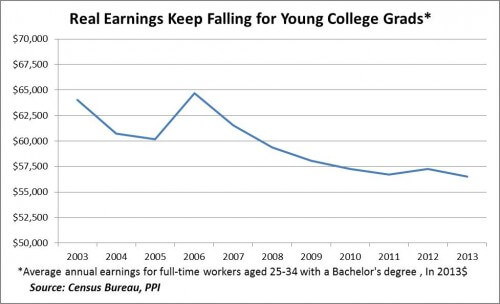
This troubling trend presents significant political and economic challenges that policymakers can no longer afford to ignore. As consumers and taxpayers in their prime earning years, young college graduates represent one of the most important segments of the working population.
Politically, the continued struggle of well-educated Millennials sends a clear warning to progressives to support a more convincing growth agenda. A pro-growth agenda must be based on investment and innovation, instead of redistribution and more of the same debt-driven consumption of the last decade. Otherwise, young Americans, the vast majority of which voted overwhelmingly for Obama in 2008 and 2012, may change parties or stay home on Election Day.
Economically, falling real wages for young college graduates is resulting from what I call The Great Squeeze. That is, more young college graduates are finding themselves underemployed – taking lower skill jobs for less pay at the expense of their less educated peers. The continuation of this trend, five years after the Great Recession, suggests this problem is more than just temporary. (While this is for BA only, the trend is the same for those with a BA or higher.)
The Great Squeeze is rooted in demand-side and supply-side factors. On the demand-side, the high underemployment plaguing young college graduates is connected back to the slow-growth economy. Our education, tax, and regulatory policies have failed to adapt to the realities of a data-driven world, keeping investment and high-wage job creation on the sidelines. Here simply having a college degree is not enough to guarantee success. In fact, a recent study from the Federal Reserve found that one-quarter of college graduates earned the same amount as those with a high school diploma or GED.
And on the supply-side, colleges are failing to adequately prepare college graduates for the high-skill, high-wage jobs that are being created in fields like data analytics and tech. For example, although far more women were awarded degrees in 2013 than men, most majored in business, health-related disciplines, education, and psychology.* It is hardly surprising that more data and tech employers are turning to alternative training models to meet their workforce needs. Yet in spite of the mismatch, if anything, our federal student aid system is exacerbating the imbalance.
In short, there are two main takeaways here for policymakers: (1) we need better policies in place to encourage employers to invest and create jobs domestically, and (2) young Americans need a postsecondary education system that is better aligned with the shifting nature of the labor force.
*Author’s tabulation of 2013 IPEDS data.
On August 3, 2014, the first cars drove the new and much-needed Port of Miami Tunnel. The project broke ground in 2010 and was intended to ease congestion in downtown Miami.
What set this project apart from others is the way it was financed – through a so-called “public-private partnership” (P3) – in which a consortium of private investors provide financing for projects and are repaid by a state or local government over time.
Traditionally, infrastructure projects have been largely funded by the federal government through grants to states, which in turn pass funding on to localities. Until recently, P3s have largely stayed in the background, accounting for just a small fraction of total infrastructure financing.
But projects like the Port of Miami Tunnel are likely to be more commonplace as cash-strapped governments look for other resources to replace crumbling infrastructure.
Continue reading at Republic 3.0.
This table updates Tables 1 and 2 in “Bridging the Data Gap: How Digital Innovation Can Drive Growth and Create Jobs,” April 2014. The updated numbers still show the same trend—most European countries are lagging in the data race.

Americans seem to have a love-hate relationship with major energy companies. On the one hand, our iconic brands are global leaders and symbols of U.S. technological and economic prowess. On the other hand, Big Energy takes the heat when the public gets restive over rising gas prices, or there’s an extended power outage.
A new Progressive Policy Institute (PPI) report highlights an underappreciated fact about energy companies—they are huge investors in the U.S. economy. In fact, along with telecoms and Internet-based businesses, they are leading our economic recovery.
Each year, PPI economists Michael Mandel and Diana Carew rank America’s top 25 “Investment Heroes”—the U.S. companies (excluding finance) that are making the biggest capital investments in economic innovation and jobs here at home. This year’s report shows that 10 U.S. energy companies made the list. These companies, involved in the exploration and production of oil and gas, or in energy distribution and power, invested a total of $57 billion in domestic capital expenditures last year. That figure represents 37 percent of the $152 billion that all 25 companies pumped into the U.S. economy in 2013. The energy companies on the list included many household names—Exxon (3), Chevron (4), ConocoPhillips (8), Exelon (10), and Duke Energy (11). But some lesser-known firms made the cut too, including Energy Transfer Equity (16), Enterprise Product Partners (18), and FreeportMcMoRan (24). All are helping to spur America’s energy transformation by investing in the nation’s shale oil and gas boom.
Continue reading at the Hill.
The American higher education system is the finest in the world. Our universities and colleges are unmatched, and we have more highly rated schools than all of our competitors combined. Students from across the globe continue to flock to American universities, while the competition among U.S. students for slots at our elite schools is tougher than ever.
What’s more, since end of World War II access to college has grown substantially as more and more young people pursue the dream of earning a college degree. Enrollments at U.S. colleges and universities has more than doubled since the 1980s, and the number of bachelor degrees awarded over the same time has grown by more than 75 percent.
For most graduates, a college degree remains the key to financial success. Even after the economic collapse of 2008 and the ensuing Great Recession, income and wealth for those holding a college degree has outpaced those without. Among those currently aged 25 to 32, median annual earnings for full-time working college-degree holders are $17,500 greater than for those with only high school diplomas. The earnings premium enjoyed by college graduates has risen for each successive generation since the latter half of the 20th century. By way of illustration, in 1979 the gap for that same age cohort was far smaller at $9,690.
But there are cracks in the fiscal foundations of higher education, and they are growing wider. Like a water leak in the ceiling, the problem is getting bigger and the damage is getting more expensive to fix each year we do not act.
The problem is money—specifically the ever-growing pile of cash students need to pay for college and graduate school.