The Hill quotes PPI’s Diana G. Carew in a recent piece on federal regulation and cites PPI’s Regulatory Improvement Commission proposal being championed by Sen. Angus King.
Democrats, unions and public interest groups, meanwhile, say agencies are already hamstrung by existing restrictions on their authority, and argue that open-ended White House reviews have led to a pattern of delays in important protections.
“It’s definitely the way you approach the issue,” said Diana Carew, an economist at the Progressive Policy Institute, which aligns itself with pro-business New Democrats.
“So what’s basically happened is that nothing’s happened, and now we see this massive buildup of regulation over time, and it is actually causing a hindrance on business and business growth, and for small businesses.”
Last week, I argued against Congressional proposals to “get government out of housing” by killing government backed mortgage firms Fannie Mae and Freddie Mac. Now comes fresh evidence that buttresses my view that the private sector just isn’t ready to take up the slack if the two mortgage giants are eliminated.
This week, Redwood Trust, one of the largest issuers of private residential mortgages, released details of its latest securitization package. The good news is that it was Redwood’s 11th deal of the year, which shows private investors are coming back into the mortgage market totally dominated by Fannie and Freddie over the past five years. The bad news: A close reading of the package shows that private investors are still looking for ultra-safe, plain vanilla loans to pool and sell as securities. And they’re harder to come by.
No one doubts that since Fannie and Freddie were taken into conservatorship in 2008, private capital in mortgage markets has been scarce. Having lost billions when the housing bubble burst, private investors were in no hurry to resume lending. That’s why Fannie and Freddie were forced to expand their lending, from roughly 40 percent of the market pre-crisis to 77 percent in 2012.
Everybody knows we won’t return to “normalcy” in housing until their footprint shrinks and that of private investors expands. But House Republicans, who imagine that housing markets can get along just fine without the government guarantees Fannie and Freddie offer, might want to take a good look at Redwood’s latest package. It offers insight into the current appetite of private investors for mortgage risk.
President Obama’s speech in Buffalo yesterday launched a new conversation on the role of higher education as a platform for social and economic mobility. The speech represents a major policy shift on higher education policy toward a performance-based funding approach that holds colleges accountable for how graduates do in the job market. Though it is true such a formula for assessing college performance may be imperfect, changing how colleges think about their role in workforce preparation is essential. For young Americans to succeed in today’s global economy we must smartly invest in higher education that will enhance our competitiveness.
In the speech, President Obama finally acknowledged the current structure of the federal student aid program – a structure that now doles out over $100 billion in new loans annually while asking few questions – is unsustainable. In this context he unveiled a new proposed strategy for federal student aid distribution that holds both colleges more accountable by creating a new ranking that rewards schools for low student debt levels and high job placement rates. Students will also be held more accountable by having to show good grades from the year before to get next year’s loans.
President Obama is right to propose drastic changes to the federal student aid program. Federal aid for higher education has quadrupled in size over the last decade, yet the program itself remains essentially unchanged from its establishment in 1965. And now is the right time: the Higher Education Act, the legislation that determines eligibility criteria for federal student aid programs, is set for reauthorization at the end of this year. Hopefully this new proposal sets the tone for a serious review of current programs.
The current federal student aid party cannot go on forever. Doling out essentially unlimited federal aid to colleges will only delay an industry reorganization and consolidation that is both necessary and inevitable, especially at second and third tier schools. In its current form federal student aid subsidizes ineffective schools and transfers those costs to its graduates, who likely will struggle most to repay the average $26,000 per borrower student debt. The fact that President Obama reckoned the government would end up footing the bill for these schools shows he probably agrees. It’s time for higher ed to fully embrace the cost-saving education technology revolution that is finally gaining traction.
Early dissenters of the proposed changes to federal aid distribution, including the American Council on Higher Education, a major higher ed lobbying group, are concerned the ranking will overemphasize college’s role in job preparation. But isn’t that exactly what college’s major role is, and what colleges should be held accountable for? Perhaps such dissenters should explain their view to the 50 percent of young college graduates who are currently underemployed or unemployed and try again.
Everyone is abuzz about 3D printing. President Obama gave it a shout out in his most recent State of the Union address. The Economist hailed it as a harbinger of a “3rd industrial revolution.” UPS is putting 3D printers in its retail stores. Some analysts think it’s the key to reviving advanced manufacturing in America.
With 60% of the global market, there’s no doubt that U.S. firms dominate the fledgling market for 3D printers. But as with other breakthrough technologies hatched in America, there’s no guarantee that our competitors – yes, especially China – won’t catch up and eventually surpass us. After all, China is a manufacturing powerhouse that desperately wants to move up the value chain, and has few scruples about filching U.S. technology.
Although 3D printing is still in its infancy, Washington needs a strategy for maintaining U.S. leadership as other countries strive to catch up. Its key elements should include robust public investment in 3D research, and beefed up safeguards against intellectual property theft. Continue reading “Can US Hold Its Lead on 3D Printing?”→
It appears that Washington is finally getting around to grappling with the largest unresolved question left over from America’s housing meltdown: What’s to become of the government-backed mortgage giants, Fannie Mae and Freddie Mac? Their fate has been in limbo since the federal government bailed them out and put them in conservatorship in 2008.
Now, however, the two government-sponsored enterprises (GSEs) are reaping enormous profits as housing markets rebound. This has gotten lawmakers’ attention. House Republicans have introduced a typically radical bill that would eliminate Fannie and Freddie altogether. A bipartisan Senate proposal would wind down Fannie and Freddie over five years and replace them with a similar functioning institution that charges a fee to insure loans in the event of catastrophic losses. And President Obama weighed in recently as well, saying it’s time to end Fannie and Freddie “as we know them.” Though widely misinterpreted as a call to eliminate the GSEs, this artfully ambiguous formulation actually left the president a lot of wiggle room.
On Thursday, Zillow released its quarterly Home Price Expectations Survey showing forecasters expect the website’s Home Value Index to end 2013 with prices up 6.7%. The numbers surveyed from 106 real estate experts across the country (I am a panel member), showed a significant jump from the 5.4% reported by the survey last quarter.
While price appreciation looks like it will show continuing strength through the end of the year, panelists mostly agreed that the sharp rise in prices we have seen over the last 12-18 months will begin a slower pace through 2017.
“Short-term expectations for home value appreciation through the end of this year are consistent with a nationwide housing market recovery that is both strengthening and widening, but still coping with high levels of negative equity, high demand and low inventory. Combined, these factors will continue putting upward pressure on home values for the next few months,” said Zillow Senior Economist Dr. Svenja Gudell. “But the days are numbered for these kinds of market dynamics, as investors begin to pull out of some markets, mortgage interest rates rise and more inventory becomes available. Over the next few years, these trends will help the market stabilize and will bring home value appreciation more in line with historic norms. As long as mortgage interest rates don’t rise too far and too fast, most markets should be able to absorb these changing dynamics while still remaining healthy.”
Panelist were also asked if a recent rise in mortgage rates, almost 100 basis points in the last 3 months, posed a serious threat to the recovery. A whopping 88% said no, and of those more than 60% said rates would need to hit 6% (currently around 4.5%) to reverse the bullish trend.
U.S. Energy, Motor Vehicles Attracting Foreign Investors
WASHINGTON — Seeking to capitalize on America’s shale gas boom, foreign companies are making major investments in the U.S. energy sector, a new PPI study shows. And while foreign investors still see making motor vehicles in the United States as good business, they seem less willing to place their bets on America’s greatly heralded manufacturing renaissance.
These are key findings of “Non-US Investment Heroes: Foreign Companies Betting on America” by PPI Economist Diana G. Carew. In the first study of its kind, Carew identified the top non-US based companies in three key industries – energy, motor vehicles, and industrial manufacturing – by their level of U.S. investment in 2011 and 2012.
In energy, the top company investing in America by their cumulative 2011 and 2012 capital expenditures was BP, followed by Shell, Statoil, and Total.
In the two remaining industries, we could not produce a ranking due to limitations in publicly available financial data. Still, we identified six motor vehicle and industrial manufacturers that had significant U.S. investment in 2011 and 2012 (listed in alphabetical order): BMW, Honda, Robert Bosch, Samsung, ThyssenKrupp, and Volvo. To obtain these results, PPI analyzed publicly available financial statements.
In general, the report found that foreign direct investment in the United States is still well below its pre-recession high of $310 billion. “We need investment from overseas to propel the U.S. economy, but we continue to be stuck in an investment drought,” Carew says.
However, as Carew notes, a paucity of good data on investment from many non-U.S. based companies, particularly those outside of the energy sector, presents a challenge for designing effective U.S. investment policy.
This report is part of our “Investment Heroes” series, and follows from our 2012 report “U.S. Investment Heroes: Who’s Betting on America’s Future?”
Our tax code is broken. It’s a simple fact that nearly everyone agrees on, yet year after year our government leaders fail to address it. Meanwhile, the consequences of the overly complex and poorly designed system are felt by middle-class families and entrepreneurs. They benefit little from the existing array of incentives and loopholes, which are mainly targeted to special interests and the wealthy.
However, the hard work of tax reform is now underway. House Ways & Means Chairman Dave Camp (R-Mich.) and Senate Finance Committee Chairman Max Baucus (D-Mont.) are barnstorming the country to hear directly from Americans – learning first-hand about the inefficiencies of the current system, and how taxpayers will be impacted by an array of proposed reforms.
Ultimately, the most likely feedback they will hear is the need for simplification of a system that has simply grown too complex for most Americans to understand, with damaging consequences to the nation’s economy. The tax code’s byzantine complexity costs business and individuals hundreds of billions in compliance. The IRS’s National Taxpayer Advocate estimated that individual and business taxpayers spend 6.1 billion hours to complete filings. This is money and time wasted.
Foreign Direct Investment (FDI)—investment in the United States by foreign-based companies—has yet to recover to pre-recessionary levels. In 2011, FDI remained 25 percent below 2008 levels, and preliminary 2012 figures suggest an even further drop.
Indeed, almost 6 years after the Great Recession began, the United States continues to wallow in an investment drought. Such weak investment—both from U.S. and non-U.S. based companies—is almost certainly a key factor behind today’s slow-growth economy.
Investment is a critical part of any high-growth strategy. It is the building block for innovation and economic growth. Investment that increases U.S. production— of goods, services and data—creates high-skill, globally competitive jobs and raises incomes.
This report highlights several important facts about foreign investment that shed light on sectors of the U.S. economy. First, energy is one of the fastest growing areas for foreign investment in America, just as it is for U.S.-based company investment. Official data shows foreign direct investment in “petroleum”—oil and gas extraction, refining, and distribution—more than doubled from 2008 to 2011.
Second, our research shows the United States continues to be an important platform for non-U.S. motor vehicle manufacturers. Moderate investment by non-U.S. motor vehicle manufacturers to upgrade and expand existing production lines show the U.S. market continues to be an important part of their business model.
Third, relatively low investment by non-U.S. industrial manufacturers suggests the greatly heralded manufacturing renaissance may not be as robust as some believe. Our research shows companies in this sector engaged in relatively little U.S. investment activity, and in some cases previous U.S. investments were unsuccessful. Such lackluster investment should be considered by policymakers on federal and state levels designing pro-investment growth strategies that target manufacturing.
Finally, a lack of good data on investment from many non-U.S. based companies, particularly those outside of the energy sector, presents a challenge for designing effective U.S. investment policy. Not having access to quality information on the U.S. activities of large non-U.S. companies makes it difficult to why certain companies are investing while others are not.
For this report, PPI considered three categories of investment: energy, motor vehicle, and non-motor vehicle industrial manufacturing. We chose these categories because of their importance to facilitating broader growth in the U.S. economy. We calculated the U.S. capital expenditures for companies in each category in 2011 and 2012, using publicly available financial reports.
This report is part of our “Investment Heroes” series, and follows from our 2012 report “U.S. Investment Heroes: Who’s Betting on America’s Future?” that ranked U.S.-based companies by their 2011 U.S. capital expenditures.
Writing on youth unemployment, Fortune’s Nin-Hai Tseng quotes Diana Carew:
“They’re not in school, so what are they doing?” says Diana Carew, economist at Progressive Policy Institute, who studies youth unemployment. She points out that July’s jobs report shows that the share of unemployed 16- to 24-year-olds not in school stood at 17.1%, compared with 11% six years ago. And while workers in general have been leaving the labor force, partly because they’re aging into retirement, it’s especially worrisome when young people drop out: In July, 8.4 million 16- to 24-year-olds stopped looking for work altogether, a rise from 6.8 million a year earlier.
However slowly the economy has been creating jobs, it’s still surprising why so many young people, particularly those who aren’t in school, are still having a tough time. The bulk of jobs created in July were in retail, restaurants, and bars. These certainly aren’t the highest-paying gigs, but they demand fewer skills and would naturally attract those with less education. What’s played out is what Carew calls “The Great Squeeze,” where the dearth of middle-skilled jobs have forced many workers to settle for whatever they can get, taking lower-skilled jobs for less pay and therefore squeezing those with less education and experience out of the workforce.
Does innovation create or destroy jobs? The rush of new ideas and new technologies can turn formerly rock-solid companies into sand that melts away even as we watch. The sale of the Washington Post is a case in point. By making that deal, the Graham family is acknowledging that they could not see a good strategy for survival.
We know what will happen next: Fewer journalists will be working at the Post a year from now than today. The Grahams allowed the operation to run mammoth losses which Jeff Bezos, rich as he is, will not tolerate. Many people will suffer.
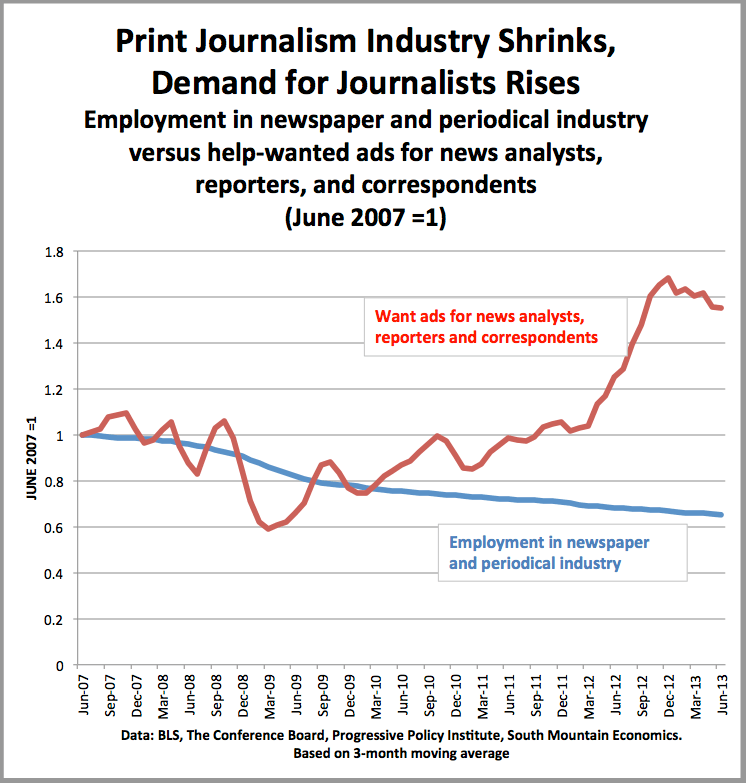
But remember this: Old industries can decline even as new jobs growth. In fact, the field of journalism is going through a massive innovative spurt that is creating jobs even as others are being destroyed. About a month ago I did a post on exactly this subject, where I looked at unpublished BLS data and help-wanted data from The Conference Board. Here’s what I found:
Employment at newspapers is down about 5% over the past year.
The number of help-wanted ads for “news analysts, reporters, and correspondents” is up 15% compared to a year ago.
More people are telling the BLS that they are working as a news analyst, reporter, or correspondent compared to a year ago.
Roughly half the want-ads for news analysts, reporters and correspondents contain the words ‘digital’, ‘internet’, ‘online’, or ‘mobile’.
Let me do this as a chart.This chart plots employment in the newspaper and periodical industry (the blue line) against want ads for “news analysts, reporters, and correspondents” (the red line) We start with June 2007, right before the recession started, and go to June 2013.
We see that print media employment and demand for journalists track pretty well through December 2009. Both drop around 20%. The annual data from the BLS CPS survey (not shown on chart) tells roughly the same story. From 2007 to 2009 employed “news analysts, reporters and correspondents” dropped from 84K to 65K, also roughly a 20% decline.
Ah, but starting with 2010, we see a divergence. Employment in the legacy print media business continues to drop, with no sign of a turnaround. Both newspapers and periodicals continue to close and lay off workers, undermined by online competition in both the news and ad business.
But the demand for journalists picks up sharply. According to data from The Conference Board, the number of want ads for news analysts, reporter, and correspondents more than doubled from early 2010 to today! Moreover, it is noteworthy that the BLS annual series show a 25% gain in the number of working journalists from 2009 to 2012 (not shown on chart)
Now, let’s be realistic. I’m not saying that the true demand for journalists doubled between the beginning of 2009 and today, although given that no one was hiring in the depths of the recession, that statement might be literally true. In fact, the help-wanted series is an example of naturally-generated ‘big data’, meaning that it can be affected by changes in business practices, such as the way jobs are posted. The nature of journalism jobs may also be changing.
However, there seems little doubt that technology and innovation in journalism is creating new jobs in different industries even as the old companies and old industries are being undermined. I’m pretty sure that jobs at Politico are not being reported not in the same industry as jobs at the Washington Post, even if Politico hires a WaPo reporter to cover more or less the same things.
As innovation accelerates, we’ll see more examples of this kind of divergence: Declining old industries, growing new jobs. Our task is to identify where the new jobs are and encourage them.
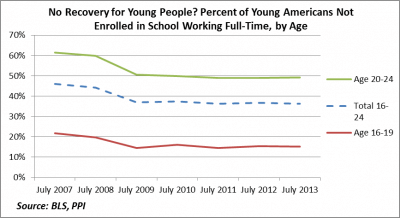
In July 2013, just 36 percent of Americans age 16-24 not enrolled in school worked full-time, 10 percent less than in July 2007. It’s no secret that young people are struggling economically, but my analysis of Friday’s BLS release sheds light to what extent. The fact that so many young people are not realizing their true earnings potential in these formative years could have serious long-term consequences.
Friday’s numbers are the latest sign the recovery is passing young Americans by. The below chart shows the share of young Americans not enrolled in school working full-time fell with the recession and have yet to return to 2007 levels. This is true even if we divide it by age – that is, for both young Americans age 16-19 and age 20-24 not enrolled in school in July.
While the initial drop in full-time employment is not surprising, what is startling is that is that either age group is showing much, if any, improvement since the recovery began four years ago. The same trend holds even if we look at months where more students are enrolled in school (i.e., January). The non-recovery is also true if we look at total employment and overall labor force participation.
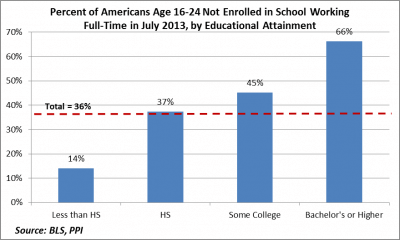
What’s more, education matters in how likely young people are to work full-time. As shown in the next chart, for those with less than a high school diploma, 14 percent worked full-time, compared to 66 percent with a Bachelor’s degree or higher. This re-emphasizes the importance of higher education in successfully finding full-time work in today’s economy.
Of the 17 million Americans age 16-24 not enrolled in school or working full-time in July 2013, 5.6 million were working part-time, 3.2 million were unemployed – a 17.1 percent unemployment rate – and another 8.4 million were not in the labor force altogether.
Together, these charts suggest the problem facing young Americans is structural. If worsening labor market conditions were a temporary effect of the recession, we would have expected to see improvement with the recovery. Instead, young Americans appear stuck in their post-recessionary state.
What could be behind the stubborn labor market for young Americans? One explanation is the Great Squeeze, which I’ve written about before. The dearth of middle-skill jobs is forcing workers unqualified for today’s high-skill, high-wage jobs to take lower skill jobs for less pay, squeezing those with less education and experience down and out of the workforce.
The struggles facing young Americans should not be ignored. It’s clear the policies in place now to prepare and integrate young Americans into the workforce are not sufficient. If we are serious about moving from a slow-growth economy to a high-growth economy, it’s something policymakers will have to address.
Note: For those interested in the effect of rising college enrollment on overall labor force participation of young people, there are several points to consider. One, in July most college students are not enrolled, and would be counted here. Second, the number of young Americans age 16-24 not enrolled in school and not working continues to rise. In July 2007 labor force participation for this group was 73.3 percent; in July 2013 it was 68.8 percent. Third, college enrollment has actually been falling for the last two years, with the decline actually accelerating. Finally, many college students also work. According to the same BLS data 42 percent of people age 16-24 enrolled in school also were in the labor force in July 2013.
As the housing sector continues its apparent recovery, some U.S. lawmakers are turning their attention to a looming crisis in the commercial real estate market, which is threatened by an avalanche of debt as loans made during the heady days of the early aughts start coming due over the next five years.
Reps. Kevin Brady, R-Texas and Joseph Crowley, D-N.Y., this week introduced a bill that would make it easier to finance this coming wave of debt. Following similar proposals in the Senate and President Obama’s budget, it would stop penalizing foreign investors in U.S. commercial property.
Here’s the problem they’re trying to solve: colossal amounts of real estate loans – totaling more than $1.7 trillion – are due to mature from now to 2018. Commercial mortgages are not like your average home mortgage. They aren’t fixed at a rate for 30 years. The standard commercial loan must be refinanced, paid down or sold after 10 years. What’s coming now is a huge wave of commercial debt that originated in the bubble years between 2003-2008.
Back then, real estate values were inflated and lending standards much looser. That means we can expect significant volumes of maturing mortgages to be in some sort of distressed state. In a 2010 Congressional oversight report, lawmaker’s panel served up this scary scenario:
A significant wave of commercial mortgage defaults would trigger economic damage that could touch the lives of nearly every American. Empty office complexes, hotels, and retail stores could lead directly to lost jobs. Foreclosures on apartment complexes could push families out of their residences, even if they had never missed a rent payment.
This is what progress looks like: Not easy, not pretty, but indispensable.
An article in the Wall Street Journal, Google’s Data-Trove Dance, graphically outlines the internal conflicts within Google about privacy versus more extensive of use of data. The article said.
under increased regulatory scrutiny in the U.S. and Europe, executives are engaged in wide-ranging internal debates and in some cases slowing product launches to address privacy concerns
The debates within Google mirror the debates in the broader society. On the one hand, embracing the data-driven economy will increase quality of life, create jobs, and improve fiscal trade-offs. On the other hand, the data-driven economy raises important privacy concerns that cannot be wished away.
What’s going on here? In the data-driven economy, data is an important new input to economic activity. In fact, just today the BEA released an important new revision to GDP which counts investment in ‘intangibles’.
The benefits of data are profound. Because people are contributing their data about their location, you know which traffic-clogged roads to avoid, and which restaurants to patronize. Because people are contributing their data about jobs and skills, we have much more transparency about career paths and the job market, so potential workers can learn what kind of education and training they need. Because people are contributing their words and pictures, we’ve been able to build communities that go beyond our immediate geographical borders.
Back in 2005, Benjamin Friedman of Harvard released a fascinating book entitled The Moral Consequences of Economic Growth. Friedman argued that “our conventional thinking about economic growth fails to reflect the breadth of what growth, or its absence, means for a society.” Growth encourages social virtues such as fairness, tolerance, and mobility, while the absence of growth undercuts social virtues such as democracy.
So the debate is not simply about privacy vs growth. We care about privacy, but we also care about the social benefits generated by growth. And that’s why I believe we should say ‘yes’ to the data-driven economy.
Today Senators King and Blunt introduced the Regulatory Improvement Act of 2013, which “would create a Regulatory Improvement Commission to review outdated regulations with the goal of modifying, consolidating, or repealing regulations in order to reduce compliance costs, encourage growth and innovation, and improve competitiveness.”
The framework for this new commission is modeled after PPI’s proposal for an independent Regulatory Improvement Commission (RIC). Under this proposal the RIC would review duplicative and outdated federal regulations as submitted by the public with the intention to either remove or improve them. The Commission would be authorized by Congress on an as-needed basis, with bipartisan participation, and would require complete transparency during each stage of the review process. At the end of the review, the RIC would submit a package of regulatory changes to Congress for an up or down vote.
The Regulatory Improvement Act of 2013 is a significant proposal that could have a tremendous economic impact. Regulatory accumulation – the natural accumulation of federal regulations over time – imposes an unintended but significant cost to businesses to businesses and economic growth. No satisfactory process currently exists for retrospectively improving or removing regulations.
PPI congratulates Senators King and Blunt for introducing a bill that could finally address this long-standing issue that affects the ability of America’s businesses to grow, invest, innovate, and succeed.
The GDP revisions which come out on Wednesday are likely to reshape our perception of the Great Recession. The BEA will have new data available, notably on corporate profits. Moreover, the BEA is adding in R&D and other intangible investments into GDP for the first time.
The BEA is a completely professional and nonpolitical organization, doing their best to improve statistics with a limited budget. Nevertheless, my best guess is that these changes will have several politically significant consequences. I could be very wrong, but I expect that: (added)
1. The savings rate will be revised up, something for President Obama to boost about.
2. The fall into recession in 2008 and 2009 will look steeper, as companies cut scientists and engineers. The President and his economists will highlight this drop as a sign that the situation was worse than it seemed when he took office.
3. The recovery will look weaker, as domestic business R&D has apparently languished. Not good news for the President.
4. Productivity gains will be slower.
Added: Let me reiterate: All of the statistical agencies, including the BEA, are devoted to producing the best possible statistics on a limited budget, with no politics involved. Nevertheless, whenever big revisions change our view of the economy, these will have political consequences.