Move Over Demand, Make Room for Investment

It’s become conventional wisdom: when the economy falters, it’s because people aren’t spending. Give people money and they will spend their troubles away (and our troubles, thanks to the money multiplier).  Everyone is a winner. This advice is at the top of campaign trail talking points. It has been given by economists ranging from Bruce Bartlett and Paul Krugman to Ben Bernanke.

But what if that isn’t the whole story – the government has spent hundreds of billions in a series of stimulus measures aimed at consumers and it hasn’t been enough.  Growth is painfully slow and today’s jobs report shows we are still not creating enough jobs–163,000 in July–to absorb recessionary losses. So what’s going on – was the stimulus too little?  Is demand being unusually stubborn?

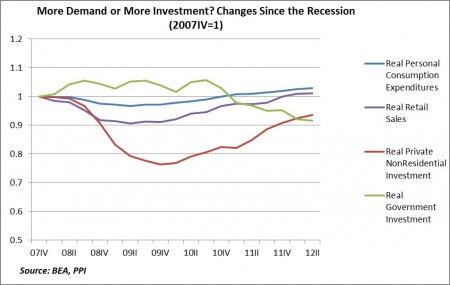
We’re missing something: it’s not only about demand; it’s also about investment. And the July 2012 annual revision to GDP confirms we are in an investment drought.  The graph below tells the story.

Halfway into 2012, real nonresidential private investment is still 7% below its pre-recessionary level. And after initially increasing, real government investment is now almost 10% below its pre-recession level – and falling. Meanwhile, demand appears to be doing fine. Both real personal consumption expenditures (PCE) and real retail sales, two commonly used measures of consumer demand, have fully recovered from the recession – and then some.

Continue reading “Move Over Demand, Make Room for Investment”

Why Bill Gross is Wrong: Innovation and Long-term Returns on Equity

Editor’s Note: This item is cross-posted from Innovation and Growth

Bill Gross of Pimco has just written a piece where he argues that the real return on stocks in the future will be much lower than the long-term historical average of 6.6%:

Yet the 6.6% real return belied a commonsensical flaw much like that of a chain letter or yes – a Ponzi scheme. If wealth or real GDP was only being created at an annual rate of 3.5% over the same period of time, then somehow stockholders must be skimming 3% off the top each and every year. If an economy’s GDP could only provide 3.5% more goods and services per year, then how could one segment (stockholders) so consistently profit at the expense of the others (lenders, laborers and government)?

He then goes on to argue that:

The Siegel constant of 6.6% real appreciation, therefore, is an historical freak, a mutation likely never to be seen again as far as we mortals are concerned.

In a world of slow innovation, Gross is likely to be correct.  The economy grows slowly, and it becomes difficult to justify compensating risk capital if risks are not paying off.

The calculation changes, however, if we have big disruptive innovations. Big disruptive innovations offer risk on both the upside and the downside. On the upside, disruptive innovations create a wave of high-growth companies that drive the stock market higher. On the downside, disruptive innovations offer the distinct possibility of driving existing companies out of business, once again accentuating risk. Continue reading “Why Bill Gross is Wrong: Innovation and Long-term Returns on Equity”

Home Economics: Pressure Mounting for Principal Reduction

U.S. Treasury Secretary Tim Geithner has added his voice to the growing chorus calling on U.S. housing regulators to help “underwater” homeowners dig out from under a mountain of negative equity.

Geithner fired off a letter yesterday to Edward DeMarco, acting director of the Federal Housing Finance Agency (FHFA), deploring his agency’s continued opposition to “principal reduction.” He urged DeMarco to reverse his decision not to allow Fannie Mae and Freddie Mac to write down the principal on mortgages held by distressed homeowners.

The day before, FHFA had reaffirmed its stance against principal reduction as a way to reduce costly foreclosures. DeMarco worries that principal reduction would encourage “strategic defaults,” meaning that underwater borrowers would stop making payments on their loans to qualify for a write down. With taxpayers already footing the bill for Fannie and Freddie to the tune of $180 billion, DeMarco is understandably wary of running the bill even higher.

But Geithner believes that reducing loan balances could save money, “the use of targeted principal reduction by the GSEs would provide much needed help to a significant number of troubled homeowners, help repair the nation’s housing market, and result in a net benefit to taxpapers.”

I think Geithner has the better argument. In fact, PPI recently published a creative proposal by Rick Morris, a former Fannie Mae executive, to test the potential of principal reduction as another tool, along with refinancing to help homeowners take advantage of rock-bottom interest rates, for preventing foreclosures.

“Fannie and Freddie can offer “short sales” back to the existing homeowners in return for a share of their home equity,” says Morris in ‘Another Tool in the Toolkit: Short Sales to Existing Homeowners.’ “Unlike foreclosure and traditional short sales, which are to third parties and usually at a discount to true market value, this approach would help support home prices, lower future default risk, and save taxpayers billions of dollars.”

We hope DeMarco will reconsider. But what’s really needed is explicit authorization from Congress to engage in the kind of demonstration project that Morris envisions. This will limit taxpayers’ exposure, while exploring new ways to speed the recovery of U.S. housing markets. Unfortunately, the timing of DeMarco’s decision, right before a five-week recess, probably means that throwing a lifeline to homeowners via principal reduction will be shelved until after the election.

Photo Credit: Lauren Wellicome

Can American Idol Tell Us if Young People are Going Back to Work?

Economists are constantly coming up with offbeat and fun economic indicators. We’ve seen the economy explained through hemlines, long-distance relationships and even the toughness of marine recruiting ads.

In this spirit, let me unveil a new indicator—the American Idol indicator.

This indicator uses the number people attending Idol auditions each year to tell us if younger workers are more discouraged about their employment prospects. The idea here is that people are more likely to go to an AI audition if they have a lot of time on their hands – presumably because they are unemployed, underemployed, or have given up looking for a job. So a rise in the number of auditions might correspond to a rise in the unemployment rate, while a drop in auditions might signal things are getting better.

As it turns out, PPI’s American Idol indicator suggests younger workers are feeling better about their employment prospects over the coming months. The graph below compares the unemployment rate of workers aged 16-29 with the number of American Idol auditions since 2007. Rules of AI auditions stipulate contestants must be American citizens that are between the ages of 15-28.

Continue reading “Can American Idol Tell Us if Young People are Going Back to Work?”

Some Good News That Obama Should Be Touting

Will Marshall compiled four positive economic stories for Real Clear Politics that President Obama should be making better use of in his campaign for re-election. From farming to exports there are positive signs in the economy according to Marshall.

Despite a string of doleful job and sales reports, there are signs that America is starting to get its productive mojo working again. The good news can’t come fast enough for President Obama, who needs some economic success stories he can point to.

So, at the risk of diverting readers from the cosmically important question of when, exactly, Mitt Romney stopped running Bain Capital, let’s examine four pinpricks of light that have begun to penetrate the economic gloom:

First, check out America’s phenomenally productive farmers; Monday’s Washington Post notes that the agriculture sector last year sold $136 billion worth of goods abroad, boosting farm income to a record $98 billion. When it comes to high quality and affordable food, America is still number one in the world.

But, in a perfect example of the disjuncture between what’s happening in the real world and Washington’s thralldom to entrenched interests, Congress is cooking up new justifications for costly federal subsidies for the thriving agricultural sector. The culprits include supposedly fiscally conservative Republicans, who added callousness to hypocrisy by also voting to slash food stamps for poor families.

Read the entire article HERE

Another Tool in the Toolkit: Short Sales to Existing Homeowners

Overview

Edward DeMarco, acting director of the Federal Housing Finance Agency (FHFA), is drawing fire from congressional Democrats for preventing Fannie Mae and Freddie Mac from writing down the principal on home mortgages held by underwater borrowers. With U.S. taxpayers already on the hook for nearly $200 billion in losses incurred by Fannie and Freddie since September 2008, DeMarco understandably doesn’t want to make a bad situation worse.

The lawmakers, however, have a point. The housing slump may be the most significant brake on America’s economic recovery. That’s why it’s worth experimenting with creative ways to help delinquent underwater homeowners dig out from under a mountain of “negative equity.”

Private sector experiences suggest that a carefully conceived principal reduction program could achieve significant savings for U.S. taxpayers by reducing losses at Fannie Mae and Freddie Mac. Such a program could be enacted responsibly and fairly without fueling moral hazard—the risk that borrowers who otherwise would make their mortgage payments go delinquent in an effort to get their principal balances reduced.

In effect, Fannie and Freddie can offer “short sales” back to the existing homeowners in return for a share of their home equity. Unlike foreclosure and traditional short sales, which are to third parties and usually at a discount to true market value, this approach would help support home prices, lower future default risk, and save taxpayers billions of dollars.

I propose that FHFA direct Fannie Mae and/or Freddie Mac to conduct a pilot program to test the technique’s viability and that Congress ask the Congressional Budget Office (CBO) to independently assess the potential savings for U.S. taxpayers should such a program be implemented on a full-scale basis.

The Principal Matter

Foreclosures are very expensive for lenders. In addition to the large costs of carrying, maintaining, and oftentimes improving homes they have foreclosed upon, disposing of the properties in foreclosure sales typically nets less than their fair market value. Similarly, short sales to third parties also usually suffer “distressed sale” discounts to the homes’ fair values. According to the latest LPS Home Price Index data, in today’s depressed real estate markets, foreclosed homes sell at an average discount of 29 percent and short sales at an average discount of 23 percent. And, of course, having on ongoing supply of such properties for sale adds pressure on home prices.

To avoid foreclosures, and thereby minimize their losses, many banks have already reduced principal balances on mortgage loans that they own. They have done this in two ways: by reducing the balances of outstanding mortgages through loan modifications, and by agreeing to short sales of homes which result in the borrowers’ loan obligations going away. In a short sale transaction, the bank lets the borrower sell her home for less than the mortgage loan balance without requiring her to repay the difference. This is a principal writedown for the borrower—it is equal to the amount by which the mortgage loan balance exceeded the sale price of the home in the short sale transaction.

Fannie Mae and Freddie Mac already provide underwater borrowers with relief on mortgage principal by allowing short sales of homes. In fact, both of the government-sponsored enterprises (GSEs) recently announced plans to streamline their short sales processes in order to stimulate the use of the technique. If they and FHFA are comfortable with granting principal reduction through short sales, then they must believe that doing so minimizes losses.

So the debate should not be about whether principal reduction per se can help minimize losses. It does. Rather, we should determine whether there is a better way to implement principal writedowns in order to reduce losses further for the GSEs without also creating meaningful additional moral hazard. Doing short sales of their homes to delinquent underwater homeowners, with them sacrificing some home equity as a cost, has the potential to save the GSEs (and, consequently, U.S. taxpayers) billions of dollars without stimulating moral hazard.

Download the entire report.

Telecom and oil companies top ‘Investment Heroes’ list

The Washington Post covers Diana Carew’s and Michael Mandel’s Investment Heroes paper, focusing on the strong telecoms and energy presence amongst the leading companies.

AT&T, Exxon Mobil and Wal-Mart are leaders among a top 25 list of corporations still investing within U.S. borders, according to a new study from a progressive think tank.

These “Investment Heroes,” according to the Progressive Policy Institute (PPI), continue to invest domestically in buildings, equipment and software — something most companies have slowed or stopped throughout the lackluster economic recovery. However, telecom and energy companies, which are ubiquitous on the list, are still building broadband infrastructure to keep up with demand and are investing in the discovery of new sources of oil and gas.

The report’s authors, PPI economists Diana Carew and Michael Mandel, have no misconceptions that these companies are doing everything right — they are often criticized for environmental issues, privacy concerns and low tax rates, among other things — but want to point out the positive impact these companies are having when it comes to creating jobs and growth through their domestic investment.

Read the full story here.

Manufacturing and Inflation

PPI’s Michael Mandel was cited over at Slate about the potential to decrease unemployment through an increase in manufacturing jobs in the United States. While Slate’s Yglesias views this as unlikely, the proposal is nevertheless intriguing.

It might seem odd for the United States to be running such a large trade deficit amid such high unemployment. One of the main reasons to import goods rather than make them yourself is that by importing goods you free up scarce labor to do other things. But right now we’ve freed up labor to enter the unemployment sector. Bad news.

One potentially useful way of thinking about this is through the calculation Michael Mandel deploys to ask what the economy-wide consequences would be of balancing America’s trade in nonoil manufactured goods (PDF). He thinks it would take 3.5 million to 4 million workers to make the requisite stuff. Potentially that would be a very costly change if it involved 4 million fewer people working in hospitals, schools, and restaurants just to get our hands on material goods that we already have. But unemployment is high. So under present circumstances, he writes that this could “reduce unemployment by about 2.3-2.6 percentage points,” which would be a lot.

However, firms don’t locate production abroad for no reason. They do it because it’s cheaper. So if we relied more on domestically made goods, prices would have to be higher

Read the entire article HERE

Libor Scandal and Public Data Manipulation

Editor’s Note: This item is cross-posted from Innovation and Growth.

I found myself reacting to the Libor scandal more strongly than a lot of the earlier revelations of financial institutions misdeeds. First, the banks were just blatant out-and-out lying about a simple number.

Second, their lying led to a distortion of a crucial piece of publicly available data–the Libor rate. In a market economy, intentional misrepresentation of a market price is not a victimless crime –in fact, the victims are everyone who relied on that price to make decisions.  That includes regulators who presumably watched Libor as one of their guides to the amount of stress in the global banking system. Here’s a chart of Libor across the key period (downloaded fromhttps://www.fedprimerate.com ).

Continue reading “Libor Scandal and Public Data Manipulation”

Libor scandal and public data manipulation

I found myself reacting to the Libor scandal more strongly than a lot of the earlier revelations of financial institutions misdeeds. First, the banks were just blatant out-and-out lying about a simple number.

Second, their lying led to a distortion of a crucial piece of publicly available data–the Libor rate. In a market economy, intentional misrepresentation of a market price is not a victimless crime –in fact, the victims are everyone who relied on that price to make decisions.  That includes regulators who presumably watched Libor as one of their guides to the amount of stress in the global banking system. Here’s a chart of Libor across the key period (downloaded fromhttps://www.fedprimerate.com ).

Would Libor have shown more signs of stress sooner if it wasn’t being manipulated in 2007 and 2008? And would banks, regulators, and investors reacted sooner? We’ll never know.

But this confirms what I’ve written in the past–the financial crisis was in part a data crisis, where all sorts of numbers were sending misleading signals. In particular, the strength of the financial position of the banks was overstated.

The question is whether the Libor scandal is a vestige of the past, or a sign of future troubles to come. My sense is that we’ll see a lot more opportunities for manipulation of private data to send misleading public signals. Forget about financial markets for the moment. I’m thinking now about the way that websites continually try to game Google’s search algorithms in order to get a higher ranking. Hotels and restaurants have a big incentive to try and manipulate their reviews on consumer sites such as Yelp. App developers have an incentive to game their reviews on the Apple and Google app stores.

Will the bad information drive out the good? Or can we build information aggregation mechanisms that are more difficult to manipulate?

This item is cross-posted from Michael Mandel’s blog, Mandel On Innovation and Growth.

Telecom Giants Top List of Companies Investing in U.S.

PPI’s recent report on Investment Heroes has continued to be picked up by major media outlets.  This time, National Journal focused on the investment in the U.S. economy made by telecom companies.

AT&T and Verizon top a list of 25 major companies investing in the United States, according to a report released by the Progressive Policy Institute.

The think tank named its top 25 “investment heroes” that are spending resources domestically.The list of non-financial companies also includes tech and telecom giants such as Intel, IBM, Comcast, Time Warner, Sprint, Google, and Apple.

Tech companies like Apple have faced scrutiny over their outsourcing policies as domestic joblessness remains high. Other companies have cited their relative economic strength and contributions to the broader economy as reasons why lawmakers should be hesitant to impose new regulations on issues like privacy, cybersecurity, or antitrust.

Read the entire article HERE


Betting On America: How Much Do Apple and Google Invest at Home?

The Atlantic recently published a piece on PPI’s most recent policy report Investment Heroes. The article provides analysis of the implications of Google and Apple’s investment and placement on Michael Mandel and Diana Carew’s list.

One of the more frustrating aspects of the thriving U.S. tech sector is that while its leading companies generate fabulous profits, they don’t actually employ that many American workers — especially compared to industrial titans of yore. At its 1970s peak, General Motors had more than 600,000 U.S. workers on its payroll. Apple, by comparison, claims just 47,000, most of whom are part of its retail operations. Google has about 18,500. They’ve perfected the low-employment, high-profit business model.

But measuring a tech company’s economic impact by its headcount alone is more than a bit misleading, in part for reasons I’ve written about previously. Michael Mandel of the Progressive Policy Institute, an occasional Atlantic contributor, has done some of the most interesting work on the topic, showing how California’s tech behemoths indirectly support hundreds of thousands of workers who produce and market mobile apps.

This week, Mandel and his PPI colleage Diana Carew, are out with a new report that illustrates another key way in which tech companies inject life into the economy: business investment, otherwise known as capital expenditures. That’s the money firms spend to upgrade and expand their operations, for instance by buying machinery, upgrading servers, or building new factories and offices. Google and Apple were numbers 24 and 25 on PPI’s list of companies investing most in the United States, right after Chrysler, and not far off from General Motors or Target (Their list excludes financial firms).

Read the entire article HERE.

American Economy: Points of Light

PPI’s Chief Economic Strategist Michael Mandel was cited in The Economist this week regarding the growth and potential in America’s mobile technology sector. The Economist points to Mandel’s numbers as a promising aspect of the growing U.S. services exported around the world.

Services have long been an American strength, consistently making up 30% of its exports. Within that sector, though, the share held by lower-value tourism and travel has slipped, while royalties and so-called private services—such as scientific, engineering and other consulting, plus financial services—have advanced. Exports of such services to Brazil, India and China nearly doubled between 2006 and 2010.

This trend has been pushed on by digital technology, which makes effortless the sale of many services across borders. Michael Mandel of the Progressive Policy Institute, a think-tank, reckons there are now 311,000 people employed making applications, games and so forth for smart devices such as Apple’s iPhone, and for Facebook. Zynga, one of the largest makers of online games and mobile entertainment applications, recorded $1.1 billion in revenue last year, largely from the sales of virtual goods in its games. A third of this came from players who live outside America.

Read the entire article HERE.