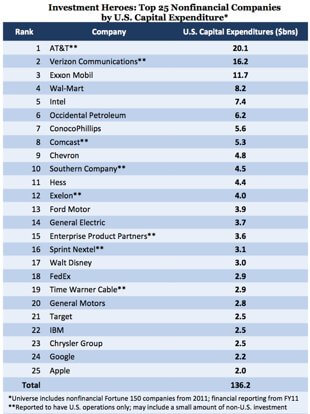
In a recent report, PPI compiled a list of the top 25 companies investing in the U.S. economy. Investing a combined total of 90 billion dollars in the U.S., the top ten companies are investing heavily in America’s economic future. Take a look at the report to find out who the other Investment Heroes are.
American voters are finding it hard to get excited about this year’s presidential election. Job growth is slow. Economic growth is slow. Real wages have been essentially stagnant since 2009. It’s the same old story as when the recovery began three years ago. We are in an atmosphere of economic uncertainty. Voters—swing voters especially—are looking for news that will boost their confidence from all the economic doom and gloom going around. We are a country that needs to hear more (if not have more) economic successes.
Such successes begin at home with investment—business investment, government investment, and household investment. Government has to invest in infrastructure, education, and research. Households have to invest in their own human capital. And businesses have to invest in buildings, equipment, and software. All are essential—but in this report we will focus on business investment. Domestic business investment generates growth, raises productivity, increases wages and creates jobs for Americans. It can span the gamut from new office buildings to improved production lines to faster communications equipment to deeper natural gas wells.
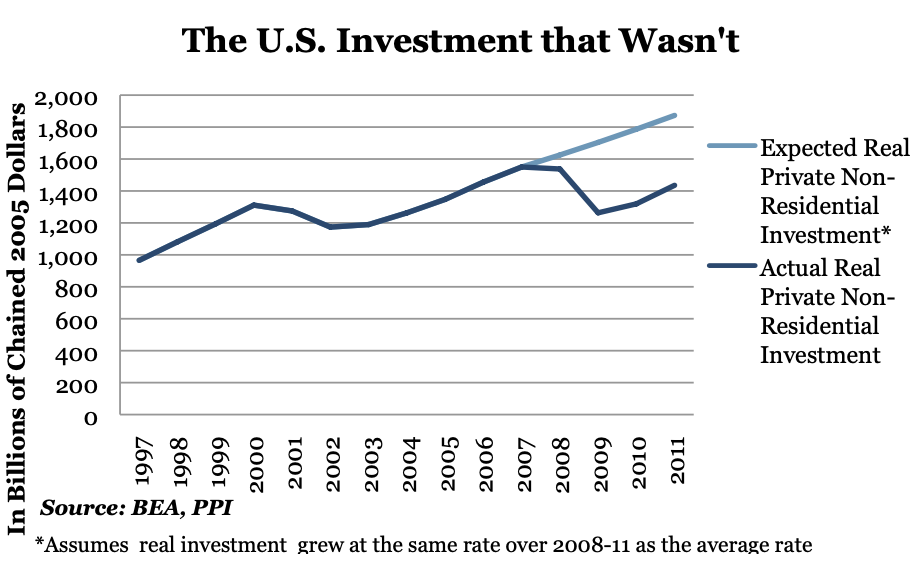
Unfortunately, U.S. business investment tanked during the Great Recession, and has yet to recover. The graph below shows the extent of the drop-off—in 2011, non-residential investment remained more than 7% below 2007 levels, adjusting for prices. By comparison, personal consumption in real terms was higher in 2011 compared to 2007. We find ourselves in an investment drought, not a consumption drought.
Equally as important, before the recession companies were expanding their domestic investment at a rapid pace. In fact, we estimate there would have been a total of $1.4 trillion more in non-residential business investment over 2008-2011, in 2005 dollars, had business investment continued to grow at the same average annual rate in the ten years before the recession (4.8% over 1997-2007). That extra investment could have gone a long way creating jobs, boosting productivity, and enhancing U.S. competitiveness.
The decline and lackluster recovery in business investment has a wide range of causes, including globalization, regulatory barriers, and weak demand. Many companies are investing overseas rather than in the United States. Multiple layers of regulation, even if well-intentioned, have the impact of discouraging capital investment and innovation. And the continued weakness in demand at home makes it difficult to justify building new factories. But no matter what the reason, this weakness is having an adverse effect on economic growth and is one of the main reasons behind the job drought.
That’s why PPI wants to highlight those companies that are still investing domestically in buildings, equipment, and software. Using publicly available financial reports, PPI constructed a list of the top 25 nonfinancial U.S.-based companies ranked by their U.S. capital spending in 2011. In many cases this required detailed calculations and assumptions, since companies often report global capital spending without breaking it down by country. Financial companies were excluded because they do not publicly report their capital expenditures. (A more detailed explanation of our methodology can be found later in this memo.)
PPI calls these companies “Investment Heroes” to make a key point: the U.S. economy is at its best—in terms of growth and job creation—when companies and workers are partners with the same objectives. Half of the leading companies are telecom and energy, but the list also includes tech, retail, automotive, and entertainment companies.
PPI President Will Marshall writes for Foreign Policy on the impact healthcare costs are having on the US economy and the “American decline.”
Lost in all the uproar over the U.S. Supreme Court’s June 28 “Obamacare” ruling was the crucial link between health-care reform and the issue voters care most about: the economy. America’s current health-care “system” isn’t just an ungainly, costly, and unjust mess. It also undercuts the United States’ ability to compete and win in world markets.
Amid the debate over “American decline,” this connection deserves a lot more attention than it’s getting. To revive U.S. international competitiveness, the country clearly needs to rein in runaway health-care costs. But it has to be done in the right way — not just by clamping down on spending, but also by boosting medical innovation and productivity.
Now that the court has upheld the individual mandate requiring most citizens to obtain health insurance, U.S. policymakers would ideally turn to the challenge of medical cost containment. This is unlikely to happen, however, because Republicans have vowed to make the repeal of the Affordable Care Act a centerpiece of their 2012 campaign message. Republican presidential candidate Mitt Romney dutifully promised Thursday to kill the “bad law,” even though it’s conceptually identical to the Massachusetts health plan he backed while governor of the state.
PPI’s Will Marshall on Germany setting the Euro tune over at CNN:
Despite all the attention lavished on the Greek election, the outcome barely registered in Europe’s financial markets. Everyone knows the eurozone’s fate won’t be decided by the shimmering Aegean Sea, but in drizzly Berlin.
Germany is the key, but it’s torn by conflicting impulses. As the main engine of European economic integration, Germany is determined to preserve the 17-nation eurozone. But as Europe’s lender of last resort, it’s loath to bail out countries that took advantage of the euro to borrow extravagantly and live beyond their means.
To avoid such “moral hazard,” German Chancellor Angela Merkel sternly insists that Greece and other debt-ridden nations, notably Spain and Italy, commit to stringent fiscal discipline in return for the loans they need to service their enormous debts and pay their bills.
PPI President Will Marshall discusses Germany’s role in solving the European crisis over at CNN:
“Despite all the attention lavished on the Greek election, the outcome barely registered in Europe’s financial markets. Everyone knows the eurozone’s fate won’t be decided by the shimmering Aegean Sea, but in drizzly Berlin.
Germany is the key, but it’s torn by conflicting impulses. As the main engine of European economic integration, Germany is determined to preserve the 17-nation eurozone. But as Europe’s lender of last resort, it’s loath to bail out countries that took advantage of the euro to borrow extravagantly and live beyond their means.
To avoid such “moral hazard,” German Chancellor Angela Merkel sternly insists that Greece and other debt-ridden nations, notably Spain and Italy, commit to stringent fiscal discipline in return for the loans they need to service their enormous debts and pay their bills. Greek voters were incensed by these Teutonic demands for spending cuts and tax hikes, but they narrowly chose to stick with the euro rather than risking a “Grexit” from the eurozone.”
According to new calculations by the Progressive Policy Institute, the strongest growth in employment for college grads aged 21-29 since the end of the recession has been in jobs like dental assistants, bus drivers, hairstylists, and event ticket takers.
This sobering news may make recent college grads – and their bill-paying parents – wonder what exactly they’re getting for all the years and dollars invested in getting a degree.
According to data compiled by PPI, since May 2009 young college grads have seen big employment gains in occupations once held by those workers with less than a college degree. That includes healthcare support, transportation, personal care & service, and production jobs, which all saw employment gains of over 20% for those with a college degree or higher aged 21-29. Employment growth in office and administrative jobs – secretaries, file clerks, bank tellers, payroll assistants, etc. – increased over 10% for young college grads. Meanwhile, young workers with less than a college degree saw substantial employment declines in similar jobs.
The disappointing May jobs report raises the question: what’s slamming the brakes on economic recovery? For one answer, look to the sector where the economic crisis started in the first place – housing. U.S. housing markets are still broken, and we can’t expect a full recovery until they are fixed.
That’s why Congress and the administration should act promptly to pass a major home refinancing initiative. Taking advantage of historically low interest rates, it would reduce mortgage payments and give millions of middle class families more money to spend. The idea is to stimulate economic demand while helping responsible homeowners hold onto their homes.
With 33 percent of homeowners still underwater (meaning they owe more than their house is worth), a massive wave of refinancing would allow borrowers who are current on their mortgages to lower their mortgage rate. Cutting their payments by thousands of dollars a year would help them pay down debt and put money back into the economy. The good news is that the benefits far outweigh any small costs the programs would incur. A bill that would allow 12 million borrowers with GSE loans to refinance would provide $2,600 in annual savings to these households. Approximately $1.83 trillion in refinanced mortgages would lower American mortgage payments by $31 billion a year. The GSEs would even see between $11 to $18 billion in new revenues from upfront costs.
Congress has been offered a raft of proposals that would streamline the process of refinancing home loans for a number of borrowers. These bills are aimed at loans backed by government guarantees from Fannie Mae and Freddie Mac, the mortgage giants currently in conservatorship by the Federal Government. By virtue of having bailed Fannie and Freddie out, taxpayers already “own” the risk of default on these loans. Why not allow refinancing that would reduce the number of home foreclosures?
PPI’s work on the growing debt burden facing young college graduates was cited in the Wall Street Journal:
The average debt load of all new graduates rose 24%, adjusted for inflation, from 2000 through 2010, to $16,932, according to the Progressive Policy Institute, a left-leaning think tank in Washington.
PPI Chief Economic Strategist, Michael Mandel, explains why the government should invest now to take advantage of historically low interest rates on treasury bonds over at CNBC:
PPI believes in the importance of smart regulation as part of a well-functioning economy. But we’ve also repeatedly advocated that regulation and legislation should aim to boost innovation, not get in its way.
Unfortunately, not all politicians in DC have gotten the message. Over the next couple of days Congress will be voting to reauthorize the Prescription Drug User Fee Act (PDUFA), which speeds up the process of reviewing new drugs by using fees collected from manufacturers.
On net, this is a pro-innovation bill which is strongly worth supporting. But it’s worth noting that one amendment, submitted by Senator Bernie Sanders (I-VT), would gratuitously undercut the incentives for innovation. The amendment, as I read it, would take away marketing exclusivity for a drug if a company was found guilty of any one of a long list of criminal or civil violations related to the drug, including illegal marketing.
The House Republicans appear to be conducting a war on economic data. They seem to think that defunding data collection is all gain and no loss.
In fact, the anti-data Republicans are really anti-business and anti-growth. Government spending on economic data collection should be thought of as fully equivalent to investment in long-lasting infrastructure. When we build highways or airports, we expect them to be used by the private sector for economically-valuable activities. Highways facilitate the sale and use of automobiles, the construction of homes, the transportation of goods. Airports make air transportation possible, fostering all sorts of jobs and growth.
Just like spending on highways and airports, government investment in economic data collection provides a long-lasting boost to private sector economic activity and to private sector growth. To give one very simple example: Political polling would be much more expensive and less accurate if the pollsters did not have access to government economic and demographic data. The government data enables the pollers to make sure their sample correctly represents the actual population.
Late yesterday marked a formal end to the two-year debate on whether the Export-Import Bank (Ex-Im), the U.S. export credit agency, deserves to live to see another day. (It does.) What was once a routine process for Ex-Im reauthorization was held back by congressional charges of corporate welfare by the Tea Party. But while the decision to reauthorize the Bank for another two and a half years is good, the fact that it took so long is not: at this rate negotiations for the next round will have to begin before this legislation is finalized. That is a heavy drain on congressional and Ex-Im Bank resources. One has to ask, is there a way to avoid the same extended debate next time around?
Yes, with a little more clarity on why two-year long ideological attacks on Ex-Im creates uncertainty that hurts U.S. companies and detracts from Ex-Im’s effectiveness. As someone who worked at the Bank for almost three years, I’d like to offer some of that clarity.
I was looking at the April CPI this morning, and I got to thinking about Dropbox. I use Dropbox literally 25-50 times a day. I’m working on a file on my Apple laptop, save it to the Dropbox folder, and I can be sure that the same file will show up on my PC when I get home.
Dropbox costs me nothing for 2.5 GB worth of storage. More important, I’m getting a valuable service for nothing.
Now comes along Google Drive, which supposedly functions much the same way, and offers 5 GB of storage. Now, I’m not going to switch any time soon because Dropbox is working fine for me. But a reasonable interpretation here is that the “price” of seamless online storage has fallen.
A new survey released today by Thumbtack.com gives more evidence that reforming regulations for new and small businesses at the state and local level could lead to valuable economic gains.
The survey, which assessed how “friendly” states and local areas were to new and small businesses, finds that those states with the friendliest climates had fewer licensing regulations and other legal hurdles that hindered business registration. In fact, the survey found small businesses viewed licensing requirements as almost twice as important as tax rates in determining how friendly a state was to its businesses. And states deemed the most friendly to business, including Texas, Idaho, and Oklahoma, were also the states where respondents claimed starting a new business was easy.
The survey, which received over 6,000 responses from small businesses across the country, was conducted by Thumbtack.com in partnership with the Kauffman Foundation. It found Texas was the friendliest state in the nation for small businesses, while California was ranked as the least friendly.
Small businesses are a crucial backbone to the U.S. economy, employing almost half of all American workers. That’s why it’s important to implement business regulations and policies that make establishing a new business a relatively smooth process. States that have excessive or redundant regulatory processes could be discouraging an important source of economic growth, or lose out on business opportunities to a more friendly state. And with those lost business ventures comes lost spillover effects to the local economy that are an important source of state and local revenue.
PPI has long advocated for reducing unnecessary regulatory hurdles, to encourage the development of new innovations and facilitate getting those innovations to market quickly and efficiently. That’s why PPI proposed a Regulatory Improvement Commission, a congressionally authorized body designed to reduce and remove unnecessary Federal regulations as submitted by the public, as part of our Regulatory Reform Initiative.
Given how many states have “unfriendly” regulations, emulating such a Commission at the state level could certainly have a significant impact on creating friendlier business climates. And given the slow economic recovery, it’s as important as ever policymakers at all levels of government work to balance consumer safety and business legitimacy with creating a more conducive climate for small and new businesses.
PPI Chief Economic Strategist Michael Mandel, explains in The Atlantic the surprising link between the future GOP presidential nominee and the upcoming Facebook initial public offering.
“Mitt Romney and his fellow Republicans are gleefully pounding President Barack Obama for the weaker-than-expected employment report released on May 4. Growth seems to be weakening and Romney is positioning himself as the business-minded economy savior for the country.
“At the same time, the Facebook IPO, anticipated to value the company at more than $75 billion, is a tangible sign of the vast amounts of wealth and income being generated by the communications boom and the so-called App Economy. Smartphones, broadband wireless, social media, apps — all are combining to provide a potent force for economic growth.
“So the question is: Should Romney be worried about an “App Surprise” — a sudden acceleration of growth and job creation fueled by the smartphone/communications boom?
“That might seem unreasonable given the other drags on the economy. Yet Romney and his advisers would be wise to remember the events of the 1996 election campaign.”
The Progressive Policy Institute would like to thank everyone who attended our economic policy forum on “Manufacturing in the Age of the App Economy”, which took place on Wednesday, May 2.
Michael Mandel, Jared Bernstein, Leo Hindery and Louis Uchitelle discussed the critical role manufacturing plays in today’s app-fueled economy. While there was certainly lively debate regarding the best tools and policy options available, the consensus that emerged was that the federal government must refocus and redouble its efforts to promote American manufacturing and make it more competitive. By creating a smart manufacturing agenda for the 21st century, we can add balance to our economy and put America back on the sustainable path of producers, not consumers.
An explicit jobs target is the first concrete step towards achieving that goal. PPI believes we should aim to boost manufacturing employment up to 15.5-16 million, a level last reached in 2001. The employment spillover effects of manufacturing are also significantly larger than commonly thought, so more manufacturing jobs would create more jobs elsewhere as well. With unemployment still unacceptably high, the imperative to act has rarely been more clear.





 PPI Chief Economic Strategist, Michael Mandel, explains why the government should invest now to take advantage of historically low interest rates on treasury bonds over at
  The House Republicans appear to be conducting a
 I was looking at the April CPI this morning, and I got to thinking about Dropbox. I use Dropbox literally 25-50 times a day. I’m working on a file on my Apple laptop, save it to the Dropbox folder, and I can be sure that the same file will show up on my PC when I get home.

 The Progressive Policy Institute would like to thank everyone who attended our economic policy forum on “Manufacturing in the Age of the App Economy”, which took place on Wednesday, May 2.