Paul Weinstein, Jr., a Senior Fellow at the Progressive Policy Institute, released the following statement:
The Progressive Policy Institute (PPI) today released a national opinion survey that highlights the surprising resilience of America’s pragmatic political center two years into Donald Trump’s deeply polarizing presidency. The poll reinforces a key takeaway from the 2018 midterm elections: Suburban voters – especially women – are repelled by the president’s racial and cultural demagoguery and are moving away from a Trump-dominated GOP.
“Our poll suggests that Donald Trump’s election in 2016 is more likely to be an aberration than any permanent shift in America’s political course,” said Anne Kim, PPI Director of Social and Domestic Policy and PPI President Will Marshall. “The defection of suburban voters creates a political landscape that favors Democrats in 2020 – if they stick to the ‘big tent’ approach that proved so effective in the midterm.”
The poll conducted by Pete Brodnitz at Expedition Strategies contains findings about what’s top of mind for voters, their ideological outlook and leanings, and their views on health care, trade, growth and inequality, the role of government, monopoly and competition, and other contentious issues.
“The agenda that could help Democrats sustain a governing majority, our poll suggests, is one that is progressive yet pragmatic—one that’s optimistic, aspirational and respects Americans’ beliefs in individual initiative and self-determination; one that broadens Americans’ opportunities for success in the private sector and strengthens the nation’s global economic role; one that demands more from business but doesn’t cross the line into stifling growth; and one that adopts a practical approach to big challenges such as immigration reform and climate change,” write Kim and Marshall.
“For Democrats to maintain and expand this near-majority advantage, they must craft a broadly appealing agenda that brings or keeps independents and less committed partisans—the majority of whom call themselves ‘moderate’—under the tent.”
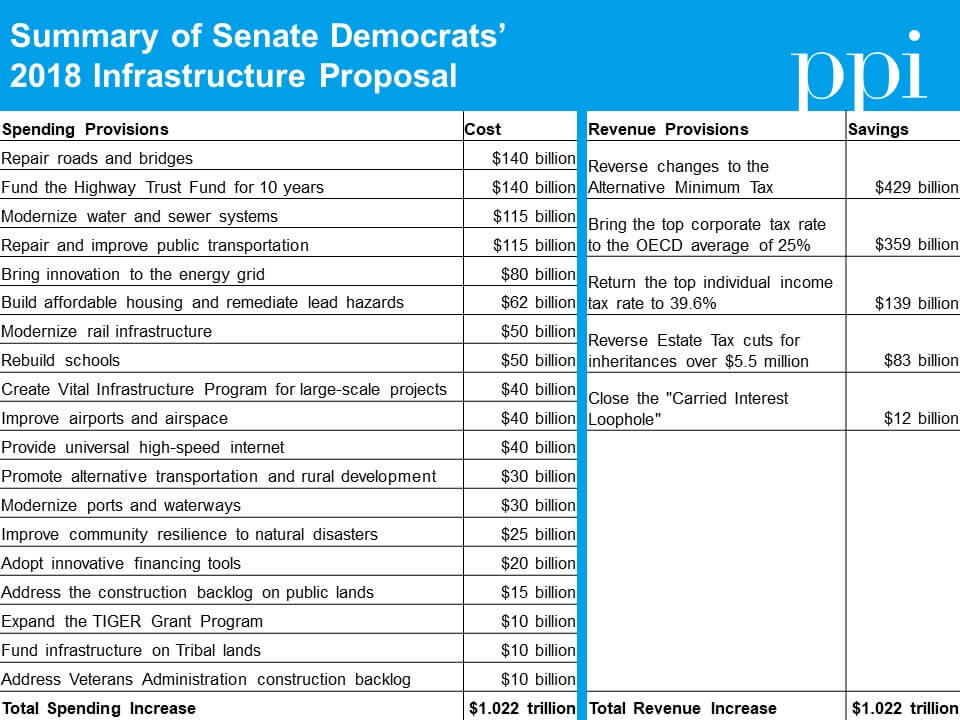
Senate Democrats yesterday unveiled an ambitious $1 trillion infrastructure proposal that would invest in everything from roads and railways to hospitals and high-speed broadband. And in sharp contrast to recent proposals by the Trump administration, this new Democratic proposal includes a plan to fully pay for itself.
The proposal calls for repealing three elements of the recently-enacted Republican tax bill that almost exclusively benefit the wealthiest taxpayers, as well as closing the “carried interest loophole” that allows certain earnings on Wall Street to be taxed at a lower rate than other compensation. It would also raise the top corporate tax rate from 21 percent to 25 percent – the average rate among OECD countries and the level originally proposed by House Ways and Means Chairman David Camp (R-MI) back in 2014.
Spending in the new proposal is broken down into 19 different categories, each with its own budget and parameters for implementation. The package as a whole includes additional guidelines, such as encouraging the adoption of innovative technologies and long-term financing mechanisms, to accompany proposed spending. If fully implemented, the proposal’s authors believe it would create 15 million good-paying jobs.
Compare that to the proposal offered last month by the Trump administration, which claims to increase infrastructure investment by $1.5 trillion even though the administration’s budget provided no additional funding for it. The Trump proposal would also privatize a wide variety of physical assets, such as waterways and interstate highways, that the Democratic proposal would retain for public use.
Another advantage of the Democratic proposal is that it makes clear to voters the true cost of the Republican tax cut enacted last year – something PPI has been urging Democrats to do since before passage of the bill. For less than half the cost of this terrible tax cut, voters could have gotten a robust 21st century infrastructure that would benefit our economy for generations to come. That message could be a powerful one heading into the midterm elections, especially if paired with a credible and comprehensive Democratic framework for “repealing and replacing” the GOP tax bill.
Senate Democrats should be commended for including suggested funding mechanisms in their proposal. Whereas Republicans added over $2 trillion of tax cuts to the national debt, the Democrats’ infrastructure proposal would be fully funded and deficit-neutral. If implemented in a timely and cost-effective way, their proposal might even reduce budget deficits because of the high economic returns on well-targeted infrastructure investment. The stark contrast between these two approaches to fiscal policy is just further evidence that only one of the two political parties in Washington is making any attempt to pay for its proposed policies.
But when they find themselves in a position to implement these policies, Democrats should keep in mind that simply paying for their new proposals isn’t sufficient.
The federal government is now spending $1 trillion more than it raises in revenue every year – a gap that is projected to more than double over the next decade. It will be impossible to sustain social programs as they’re currently structured, let alone fund new ones, without major reforms to both existing spending and the tax code. The government cannot afford to commit every dollar of additional revenue to new promises until it finds a way to pay for the ones we’ve already made.
For these reasons, Democrats would be wise to use yesterday’s proposal as merely the starting point for crafting a complete fiscal policy: one that sustainably finances both public investments and a strong social safety net without placing an undue burden on young Americans. A fiscally responsible public agenda along these lines is what the Democratic Party needs, and it’s what our country deserves.

Why is the decision to promote competition in the credit scoring model industry complicated? At first blush it would seem to make perfect sense. More competition could lead to lower costs for those who use the scores. Furthermore, it might increase the likelihood that some qualified individuals — who may not be approved for a loan under the criteria utilized by the FICO model — get access to credit.
The problem is not of course more competition. The credit scoring industry — and ultimately consumers — would benefit from more alternatives to FICO. This was discussed at an event I moderated this week in Washington, D.C. hosted by the Progressive Policy Institute.
The issue is the legislation to push for alternative scoring models may simply trade one dominant player (FICO) for another (Vantage).
The reason? Because the owners of Vantage control the supply of information currently used by FICO to make its determination. And given the history of monopolies, it would not be surprising to see Equifax, Experian, and TransUnion use that leverage to the advantage of Vantage, and eventually force FICO out of business.
Continue reading at The Hill.
Our past event featured newly issued white papers from respected industry experts related to the ongoing GSE credit score evaluation. Topics include: Research from a leading analytics firm on the value that updated credit scoring models will add to the mortgage market; Economic and competitive issues in the credit scoring market as detailed by an industry economist; and Legal and regulatory matters to consider as outlined by a former state banking commissioner.
Read the reports:
“Risks and Opportunities in Expanndinng Mortgage Credit Availability Through New Credit Scores” by Tom Parrent
“Alternate Credit Scores and the Mortgage Market: Opportunities and Limitations” by Ann B. Schnare
The election of Donald Trump to the presidency in 2016 has made policymakers and politicians in the U.S. much more aware of an important demographic group – the white working class – than before.
We have ignored their plight and their concerns for far too long, and have grown much too complacent about the extent to which they have fallen behind more-educated groups and shared insufficiently in the economic growth we’ve experienced in the past few decades.
Of course, even before the election, labor market analysts and demographers had been discovering that the economic and social outcomes we observe among a large group of less-educated Americans – particularly men with high school or less education – were stagnating or deteriorating.
Economists often apply the term “opportunity costs” to high and middle-income people, meaning that the time they spend on one task is time not available to perform other, potentially more valuable tasks. But social scientists rarely apply the concept to low-income people, acting as if their time is essentially worthless. Sort of like the spouse who doesn’t count your food shopping, cooking, cleaning, child-rearing, accounting for family finances, shuttling family member to appointments, taking care of your sick parents, etc., as work.
Yet, in addition to lacking money, low-income Americans frequently lack time. Just as many personal relationships collapse when people don’t have “quality time” with each other, a lack of time works mightily against the efforts of lowincome people to have constructive relationships with their families and with the broader society.
As Americans choose a new president in 2016, populist anger dominates the campaign. To hear Donald Trump or Senator Bernie Sanders tell it, America is either a global doormat or a sham democracy controlled by the “one percent.” These dark narratives are caricatures, but they do stem from a real dilemma: America is stuck in a slow- growth trap that holds down wages and living standards. How to break this long spell of economic stagnation is the central question in this election.
Today’s populists peddle nostalgia for our country’s past industrial glory but offer few practical ideas for building a new American prosperity in today’s global knowledge economy. Progressives owe U.S. voters a hopeful alternative to populist outrage and the false panaceas of nativism, protectionism, and democratic socialism. What America needs is a forward-looking plan to unleash innovation, stimulate productive investment, groom the world’s most talented workers, and put our economy back on a high-growth path. It’s time to banish fear and pessimism and trust instead in the liberal and individualist values and enterprising culture that have always made America great.
Download Unleashing Innovation and Growth: A Progressive Alternative to Populism
Simplicity is one of Bernie Sanders’ great strengths: Corporations and the rich have rigged the economy. His solutions sound simple, even when the plans behind them are complicated: college for all, health care for all, tax the rich, break up big banks. He trails Hillary Clinton in presidential delegates to this point, and he remains an underdog for the Democratic nomination, but Sanders has already pulled Clinton, and the party, toward a more populist, more socialist policy agenda, thanks in part to that clarity of message.
The centrist Democrats who oppose that leftward lurch have struggled to match his simplicity. They tend to view the economy through a lens of skills and adaptation, not power and treachery. Many of them pushed in the 1990s, under President Bill Clinton, to expand global trade and deregulate the financial sector. They now concede those efforts did not go according to script, particularly for middle-class workers, but they are not calling for a full rewrite in response.
Their risk, in this election and moving forward, is to define themselves solely as anti-Democratic-socialist – the folks who don’t like the stuff that a lot of Democrats like about Sanders.
The Progressive Policy Institute is the latest centrist Democratic institution to try to counter that image. Today it will release what its president, Will Marshall, calls a “radical” agenda to get America working for the working class again. The report is called “Unleashing Innovation and Growth: a Progressive Alternative to Populism,” and it is organized around a straightforward, if not perfectly simple, principle.
Read more at The Washington Post
Like so many issues in Washington these days, the debate over what to do with the nation’s housing Government Sponsored Enterprises (GSE)—Fannie Mae and Freddie Mac—has been caught up in the Jihad against the role of government in any form.
That’s a shame because last spring, with the announcement from Senate Banking Committee Chairman Tim Johnson (D-S.D.) and ranking member Mike Crapo (R-Idaho) of a bipartisan bill to reform the nation’s housing finance system, it appeared that the question of what to do with Fannie Mae and Freddie Mac had finally been answered.
Instead, the Johnson-Crapo bill became another victim of ultra-right ideology, as strident opposition to anything short of the elimination of any government role in the mortgage backed securities marketplace remains unacceptable to House Republicans. Their approach—which was incorporated in the PATH Act (which passed the House last year), proposed virtually eliminating the Federal guarantee of mortgages in five years.
That’s not to say the Johnson-Crapo bill was perfect by any means. Compromise isn’t about creating the best solution, but rather a better solution than the status quo.
In USA Today, Sam Zuckerman discusses the explosion of tech jobs and their impact on urban areas. While Zukerman notes the ability of tech jobs to bring economic growth to cities, he also highlights the negatives that come with the tech economy, primarily the increasingly high cost of housing that forces long-term resdients to move out. Zuckerman cites PPI Chief Economic Strategist Michael Mandel on an index he constructed to determine the importance of tech to a city’s economy. Zuckerman also quotes Mandel on the impact of the tech economy:
Areas with a faster growing tech sector tend to have faster growing non-tech employment as well,” Mandel said. Nationwide, private-sector non-tech wage and salary employment rose 5.4% from 2009 to 2013. But in the 10 large U.S. counties where growth of tech jobs had the biggest economic impact, non-tech jobs rose 10%, almost twice that rate, according to Mandel’s preliminary analysis.
“As techie ranks swell and the overall economy expands at a faster pace, demand for shelter heats up. That leaves more and more people priced out of the housing market.”
The full article can be found on USA Today’s website.
Writing for Triangle Business Journal, Sarah Chaney quotes PPI Economist Diana Carew on North Carolina’s higher rate of homeownership among Millennials. As the article describes, North Carolina has created an attractive economic climate, drawing in more first-time home owners than other states. According to Carew, this is a trend that will continue in North Carolina and the state should expect homeownership rates for Millennials to continue to rise.
Broadly speaking, some states are doing a better job than others at attracting young workers – and North Carolina happens to be one of them, says Diana Carew, an economist at the Progressive Policy Institute.
“That’s because they’ve got great apprenticeship programs, the Research Triangle, good regulatory policies,” she says.
Read the full article on Triangle Buisness Journal’s website.
Cities in Texas and North Carolina, where the cost of living is cheaper and jobs are more plentiful, may see homeownership rates for millennials rise faster, said Diana Carew, an economist at the Progressive Policy Institute.”
Read the full article on Bloomberg.
USA Today‘s Darrell Delamaide quoted PPI’s Jason Gold on GSE reform.
He recalled the debate over the future of the two government-controlled entities that back most mortgages today — Fannie Mae and Freddie Mac — caused by the new bipartisan Senate bill that would wind down and replace Fannie and Freddie with a complex mix of private lending and government guarantees. He reminded with PPI that reform should prevail over liquidation regarding Fannie and Freddie.
Shuttering the GSEs completely … makes little sense. The idea that you can completely dismantle a housing finance infrastructure that is the foundation of an $11 trillion market is a fantasy the likes of which is only found in Washington.
Read the entire USA Today article here.
The housing sector is one of the pillars of the U.S. economy. That’s why we have marveled at the many partisan and radical proposals to reform the federal housing finance system that would have trashed both what’s good and what’s bad with the current system. PPI continues to maintain that any reform proposal must stabilize U.S. housing markets, reduce the government’s over-sized footprint in housing finance and protect taxpayers from a repeat of the housing bailout.
While the full details aren’t yet available, a bipartisan proposal from Senators Tim Johnson (D-South Dakota) and John Crapo (R-Idaho) seems to move the housing debate out of the ideological realm and closer to reality. Their blueprint ensures the continued availability to homebuyers of long-term, fixed-rate mortgages, and proposes creation of a fee-based insurance fund, similar to the Federal Deposit Insurance, to shield taxpayers from having to bailout the housing finance sector in the future.
There are still many details in question, but we think Senators Johnson and Crapo have pointed the housing debate in a more promising direction.