For years, Viktor Orbán’s Hungary has long been idolized by MAGA Republicans and served as a point of reference for conservatism around the world. Now that he’s been knocked from power, Democrats could stand to take some lessons from the man responsible, Péter Magyar.
The new prime minister, who ended Orbán’s 16-year rule in Hungary’s April 12 elections, showed that it was possible to take down a corrupt authoritarian in a country where democracy had long been on the ropes. But crucially, he did it with a playbook that seems just as suited for America in the age of Trump as it was for Eastern Europe.
Lesson one? Wage a fight against the corrupt establishment. Magyar previously served in Orbán’s Fidesz government. But he broke with the party and rocketed to fame in 2024 as a whistleblower against official graft and fraud, releasing secret audio that revealed members of Orbán’s circle had interfered with a corruption prosecution case.
He had a flair for spectacle, too: In February, for instance, he filed a public police report accusing the government of surreptitiously recording a “honey trap” sex tape involving him and an ex-girlfriend as a means of blackmail.
Not only did Magyar present Orbán’s 16-year grip on Hungary as corrupt, he argued that the government’s entire structure was self-protecting and unaccountable — and because of this, working against the interests of everyday Hungarians.
Crucially, Magyar did not campaign on turning back the clock to Hungary’s era of pre-2010 economic stability. He argued for rebuilding Hungarian institutions in a way that would make them genuinely work for working families.
Democratic candidates will have to do more than just attack Trump’s character and his policies — which they are undoubtedly good at currently. They need to build a strong case that Trump damaged American institutions and, more importantly, a believable argument that resonates across the country that Democrats are the ones to rebuild them.
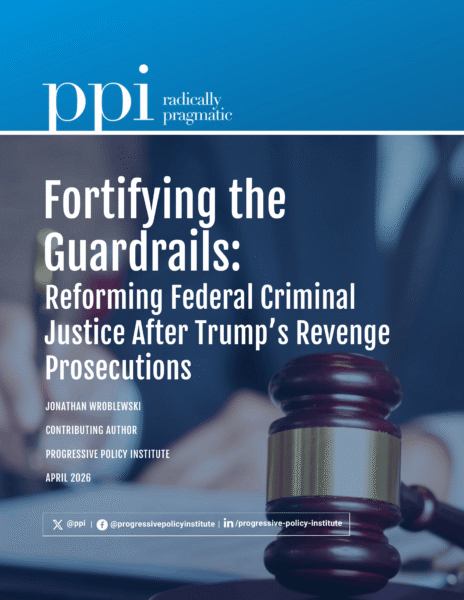
WASHINGTON (April 28, 2026) — The Progressive Policy Institute (PPI) today released “Fortifying the Guardrails: Reforming Federal Criminal Justice After Trump’s Revenge Prosecutions,” a comprehensive analysis by Jonathan Wroblewski, contributing author and former Director of the Office of Policy and Legislation in the Criminal Division of the U.S. Department of Justice. The report examines how the Trump administration weaponizes federal criminal law against political opponents and provides a blueprint for structural reforms to prevent future abuse.
The report documents how the current federal criminal justice system, despite constitutional safeguards, proved vulnerable to politicization during the first 15 months of Trump’s second term. Through case studies of high-profile targets, including former FBI Director James Comey, New York Attorney General Letitia James, Federal Reserve Chair Jerome Powell, and six Democratic lawmakers, the report reveals systemic weaknesses that enabled selective prosecution and investigative harassment.
The report identifies five critical areas requiring reform:
Criminal Code Reform: Federal criminal statutes are so vaguely defined and broadly written that they invite selective enforcement. The case against AG James, charging her with bank fraud for an allegedly misrepresented home purchase that caused no loss, exposed how prosecutors can manufacture serious felonies from minor conduct. Congress should undertake comprehensive code reform to clearly define crimes, distinguish degrees of severity, and eliminate undefined terms that prosecutors exploit.
Subpoena and Grand Jury Reform: Investigative subpoenas can be weaponized to intimidate and harass without court oversight. Pending amendments to Federal Rule 17 would allow prosecutors to issue subpoenas for sensitive personal information without judicial review or notice to the affected party.
DOJ Independence: While the Supreme Court’s decision in Trump v. United States limits congressional ability to insulate the DOJ from presidential direction, internal policy reforms remain viable. Future administrations should codify the Principles of Federal Prosecution, increase transparency around White House contacts with the DOJ, and empower career officials and inspectors general to report and resist improper directives.
Accountability: Those who designed and executed revenge prosecutions must face consequences. Disciplinary action, including potential termination of Department officials, referrals to state bar authorities, and congressional inquiry are essential to signal that weaponizing criminal power is incompatible with the rule of law.
Foundational Principle: Federal criminal law must not be so broad or easily manipulated that it becomes a tool of political or personal payback. As Justice Robert Jackson observed in 1940, federal prosecutors wield vast powers that demand “the highest level of ethical integrity” to deliver equal justice under law.
The report notes that some systemic resilience emerged. Grand juries refused to indict several targets despite prosecutorial pressure, and courts dismissed cases against Comey and James on constitutional grounds. Yet legal fees, psychological toll, and chilled speech impose costs that survive dismissal and demonstrate that the system requires deliberate strengthening to prevent future abuses.
The report calls on Congress and the next administration to enact these reforms without delay, building on existing bipartisan support for concerns about overcriminalization and criminal code modernization.
Founded in 1989, PPI is a catalyst for policy innovation and political reform based in Washington, D.C. Its mission is to create radically pragmatic ideas for moving America beyond ideological and partisan deadlock. Find an expert and learn more about PPI by visiting progressivepolicy.org. Follow us at @PPI.
President Trump is inflicting tariffs on America in a vain attempt to revive traditional manufacturing. Private investment is gushing instead into data centers, where the AI economy is being hatched.
The U.S. is the epicenter of this global investment boom in data centers, which support the internet, cloud computing and the training of ever-more capable artificial intelligence models. Spending on data centers is growing exponentially. Much of it comes from the “hyperscalers” like Amazon, Microsoft, Google, Meta, Oracle and OpenAI. The first four of these digital giants alone plowed $425 billion last year into centers, a figure expected to top $600 billion this year.
Surging capital investment in data centers and AI has helped propel the stock market to new heights. And for now, at least, it is making America the world’s foremost computing superpower, the pace car in a race against China and others to master AI. More than 4,000 data centers — almost 40 percent of the world total — are located here, compared to just 368 in China.
However, the U.S. digital goldrush is running into a groundswell of local resistance.
In Virginia, which has the nation’s biggest concentration of data centers (570), voters are having second thoughts. Three years ago, 69 percent said they were comfortable with new data centers in their community. That number has since dropped to 35 percent, with 59 percent voicing discomfort. Prince William County has nixed plans for a 1,700-acre campus near the Manassas civil war battlefield, which would have hosted dozens of data centers.
Maine recently became the first state to pause building large data centers pending a study of its energy needs. And Sen. Bernie Sanders (I-Vt.) and Rep. Alexandria Ocasio-Cortez (D-N.Y.) are pushing a bill in Washington to impose a national moratorium on construction.
The backlash springs from three main sources. First and most pervasive is the fear of soaring electricity bills. Data centers have a voracious appetite for power, putting pressure on utilities to generate more and upgrade local grids to transmit it. Residents worry that it portends higher monthly bills, even as energy costs already are rising faster than inflation. The centers also consume large volumes of water to cool servers, which could mean shortages and higher water bills. That has made them especially controversial in the desert West.
Second, a majority of Americans say they’re anxious about losing their jobs to AI. Such fears may be premature, but they cannot be airily dismissed. And while initially welcomed for creating construction jobs and generating substantial property tax revenues, data centers, essentially warehouses crammed with servers, have turned out to be only modest as job creators. An average facility might employ around 200 people.
Having paused U.S. attacks on Iran, can President Trump be persuaded to suspend hostilities against Europe as well?
His reckless rhetorical overkill is making the transatlantic alliance collateral damage in operation Epic Fury.
Trump has called key European allies “cowards” for not coming to America’s aid — specifically to reopen the Strait of Hormuz. He has dismissed NATO as a “paper tiger” and threatened to pull the U.S. out of the collective security pact.
He upped the ante earlier this week, comparing United Kingdom Prime Minister Keir Starmer to his Hitler-appeasing predecessor, Neville Chamberlain.
Accusing our NATO partners of being faithless allies is chutzpah on stilts. Trump didn’t consult European leaders before impulsively joining Israel Feb. 28 in launching air strikes against Iran and its Middle East proxies. Nor could he produce evidence to back his claim of an “imminent” Iranian threat to the U.S.
There’s a particular type of lie that dominates American political discourse these days. It’s not a factual lie, but a conceptual mistruth: the promise that you can make life more affordable without actually making anything cheaper. Call it affordability theater.
It’s easy to propose ideas that make things feel more affordable without actually making them less expensive. And while both parties traffic in this kind of theater, the GOP— especially under President Donald Trump—has turned it into a governing ethos.
The formula is simple. First, Trump will create an affordability problem through his own policies. Then, instead of fixing the underlying cause, he will propose to paper over the problem with a subsidy, a tax gimmick, or a check.
Tariffs are the most obvious example. Trump returned to office in 2025 in no small part because of voter anger about inflation and the cost of living. And his signature policy move was to tariff nearly everything Americans buy from abroad. Tariffs are taxes that raise prices, and analysis from the Budget Lab at Yale shows the costs of tariffs mostly manifest as higher prices for consumers. How does Trump aim to square this circle? Tariff stimulus checks. After worsening the cost-of-living crisis, Trump and his allies floated the idea of sending rebate checks to offset the pain.
It’s hard to imagine a cleaner example—make life more expensive, then offer to partially compensate you for the pain while taking credit for both moves. But after the check is spent, life is still more expensive than it was before.
WASHINGTON — PPI President Will Marshall released the following statement on the firing of Attorney General Pam Bondi:
“We cheer the news that President Trump has fired Pam Bondi as U.S. Attorney General. It was evident from the beginning that she was utterly unsuited by experience and temperament for the post and was picked only for her willingness to do the president’s bidding, no matter how virulently partisan or lawless it is.
“Which of course points to the bad news: Reportedly, the president pushed her out because she wasn’t aggressive enough in criminalizing political differences and launching spurious prosecutions of people he considers enemies or obstacles. Given the many ‘vengeance prosecutions’ by Bondi’s Department of Justice, the prospect of even more MAGA lawfare should alarm Congress.
“We can only hope that Republican Senators will not be derelict in their Constitutional duties again as they prepare to confirm her successor. The nation needs an Attorney General dedicated to defending the impartial rule of law, not bending it to the breaking point to punish Trump’s critics or reward his friends.”
Founded in 1989, PPI is a catalyst for policy innovation and political reform based in Washington, D.C. Its mission is to create radically pragmatic ideas for moving America beyond ideological and partisan deadlock. Find an expert and learn more about PPI by visiting progressivepolicy.org. Follow us @PPI.
“Marshall, the founder and president of the Progressive Policy Institute and a key adviser to Bill Clinton as policy director of the Democratic Leadership Council, is deeply suspicious of third parties:
‘I’m skeptical of third parties, especially ones purporting to represent independents or centrists. Even if you could organize one, it would only give the Democratic establishment another excuse not to make the changes necessary to stop shrinking their coalition and start expanding it.’
Party leaders, in Marshall’s view, “need to reject progressive purity tests and develop a new reform blueprint that accommodates the moral sentiments and economic aspirations of working families.”
There is, Marshall maintained, “no deus ex machina that’s going to save the party; the change has to come from within as rank-and-file Democrats get tired of losing.
Marshall did call for a specific reform:
‘Replace the party’s primary and caucus system with ranked-choice (also called instant runoff) voting. The current system empowers well-organized activists and interest groups to elect their favorites on the basis of narrow pluralities rather than broad political appeal. Under ranked choice, nominees would have to win an outright majority. This would introduce a centrist bias into candidate selection and change the balance of power within the party.’
Jentleson, Kessler and Marshall bring a combination of extensive experience in the political trenches, years of pondering the Democratic future and a deep interest in finding solutions to improve the party’s future prospects.”
Whether they march to the MAGA drumbeat or roost on the progressive left, populists share a need for scapegoats. To inflame public passions and convert them into votes, each side vows to stop nefarious villains from destroying America.
President Trump has built his political career upon demagogic attacks on “criminal aliens” and “radical left lunatics” who “hate America.” Progressive politicians, clearly envious of Trump’s grip on working-class voters, believe they can pry it loose by focusing their ire on billionaires instead.
That’s a long shot. Trump is the greatest of all time when it comes to mastering what author William Galston, in an illuminating new book, calls the “dark passions” shaping today’s politics — anger, fear and domination.
Trump’s populist elixir is more potent because it fuses working Americans’ cultural and economic grievances. While progressives fixate on the uneven distribution of wealth and power, non-college voters have more immediate concerns — the high cost of living — and worry that Democrats still lean too far left on social issues.
The fog of war seems to have enveloped President Trump and his minions. After two weeks of armed conflict with Iran, they have yet to offer a lucid and realistic explanation of America’s war aims.
The White House’s failure to dispatch top officials to last Sunday’s talk shows to drum up public support for the war was telling. Apparently, none could be trusted to speak for a president who himself lurches incoherently from one rationale to another.
Meanwhile, political battle lines have hardened at home. Republican lawmakers rubber stamp whatever Trump wants, while Democrats demand a halt to hostilities, pending a vote on a war powers resolution.
With American forces engaged in combat, this isn’t the best moment for a polarizing domestic fight over constitutional prerogatives. But Democrats are right to insist that the president bring his case for war before Congress for hearings, questions and debate.
Will Marshall, president of the Progressive Policy Institute, warns:
“We’re stuck thinking that mobilization is everything.”
He believes Democrats are well-positioned for the midterms because it’s a referendum on Trump—not a vote for Democrats. But the party has not reflected on why it lost in 2024.
“Many of the positions Democrats took in 2024 alienated voters because they were too far left—on immigration, crime, identity politics, and the economy,” he argues. That issue is currently overshadowed by anti-Trump sentiment but will resurface by 2028.
“The Democrats must not fail to change substantively if they ever want to win the White House again.”
George Washington’s tenacity in winning our war of independence (with French help), after losing many battles, forms the dramatic arc of Ken Burn’s gripping documentary, “The American Revolution.”
Looking ahead to this year’s midterm elections, Democrats should take the long view like Washington. As important as it is to win the House and possibly the Senate in November, it’s even more crucial for Democrats to take back the White House in 2028.
Taking control of the House would give heretofore impotent Democrats some ability to check President Trump’s flagrant abuses of presidential power. They could freeze funding for his outlandish decrees and probe his brazen politicization of federal law enforcement agencies and meddling in state elections.
The party out of power usually makes gains in midterm elections, and Democrats need only flip three seats to control the House. They are also riding a tailwind from Trump’s unpopular policies. By large margins, the public disapproves of his handling the economy, inflation and his signature issue, immigration.
Yet Trump’s fall doesn’t signal Democrats’ rise. Voters still trust Republicans more to address most of their top concerns. That’s why even a House and Senate sweep wouldn’t stop today’s realignment of U.S. politics along educational lines. It’s given Republicans a structural advantage because their base — non-college voters — constitute a supermajority (nearly 60 percent) and are spread more evenly across the country.
November’s US elections were Donald Trump’s first real electoral test since he swept to victory for the second time a year ago, and they produced plenty of results for the Republicans to be concerned about. The Democratic party did about as well as it could hope for, especially so given the party is without a central figure who could lead the opposition to Trump and crystallise to voters what the Democrats stand for.
The dynamic Zohran Mamdani attracted most of the attention this side of the Atlantic with his stunning win to become the new mayor of New York City, gaining plaudits from prominent Labour politicians including his London counterpart Sadiq Khan and members of the parliamentary Labour party. Mamdani’s campaign has been admired for its ground and social media mobilisation, especially when centre-left parties seem to be behind the populist right when it comes to commanding online attention.
The elections of two new Democrat governors in Virginia and New Jersey, however, may tell us more about what is happening in America than winning the mayoralty in a state that hasn’t voted Republican for 40 years. Abigail Spanberger took back the Virginia governorship from the Republicans, winning by 15 points, and Rep. Mikie Sherrill won by 13 points in New Jersey. At the 2024 presidential election, Kamala Harris won Virginia by just 5 points and New Jersey by 6 points. She won New York City by nearly 40 points.
Will Marshall, another Clinton cohort, concurred. “It would have been nice to see Dems not take part in an obvious attempt to pressure a former Democratic president to come to a MAGA show trial,” said Marshall, the founder of the Progressive Policy Institute, a center-left think tank that served as a policy incubator during the Clinton years.
[…]
Marshall, the PPI founder, said the new cohort of Democrats steering the party to the left are asking the wrong questions.
“If you’re a Democrat today, you have to be asking yourself why we’re in the minority, why do we lack the tools to stop Trump from criminalizing our political differences? And the answer is the party is shrinking,” he said. “The dilemma isn’t how to keep moving left. It’s how to get back the voters Clinton won twice in the ‘90s.”