With just 18 days left until Election Day, and with early voting picking up all over the country, it can be said that the state of the presidential race is as hard to figure as it ever was. A paucity of big national polls with data drawn after the vice presidential and the second presidential debate has made it difficult to determine if the president got the boost (at least in Democratic enthusiasm, if not swing-voter allegiance) many analysts expected. The tracking polls have shown varying results, and the most influential, from Gallup, has shown a steady rise in support for Mitt Romney—an astonishing seven-point lead among likely voters as of yesterday—that has perhaps been complicated by the firm’s implementation of new sampling practices and a likely voter screen. Battleground-state polls are also varying significantly, but many have shown Romney gaining pretty steadily, and perhaps even taking the lead in Virginia and Florida (even as almost everyone concedes NC to him) while drawing near even in Wisconsin. Just this morning NBC/WSJ/Marist surveys from Iowa and Wisconsin (including some post-second-debate data) were released indicating that Obama had regained robust leads in those two states, but this particular polling combine has regularly given Obama better-than-average numbers.
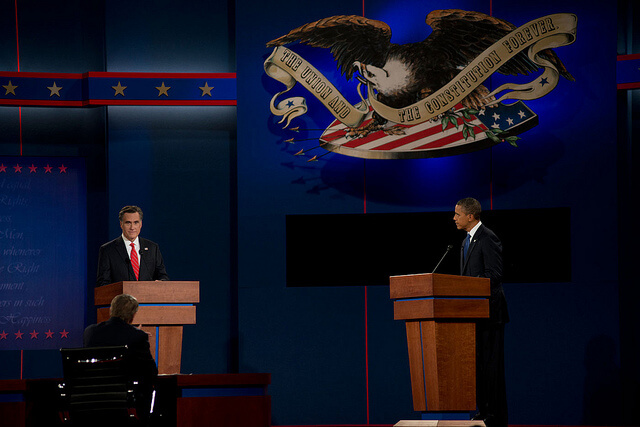
In terms of the dynamics of the race, the second presidential debate showed an invigorated incumbent attacking Romney’s moderate credentials, while the challenger refined his “failed economy” rap and repeated it very often. Both candidates exhibited swing-state obsessions, particularly in an extended argument over energy policies that seemed to become a battle over which of them was the best bet for the fossil-fuel industries. Foreign policy made its first appearance as a major issue, though it’s unclear who got the better of the exchange over Libya; it’s difficult to imagine quite how an entire debate over foreign policy will play out next Tuesday in the final debate. Both candidates appealed overtly to women, though again, it’s hard to determine who did better (unless Romney’s “binders of women” line migrates from the Twitterverse, where it’s everywhere, to broader venues). It’s important to remember, of course, that the final debate, strictly on foreign policy topics, is being held in just three days, so it may be very difficult to isolate reactions to individual debates.
Early voting estimates seem to indicate an Obama advantage in Iowa, Nevada, Wisconsin and perhaps Ohio, with a Romney advantage in Florida and North Carolina. A Supreme Court decision rebuffing Republican efforts to shut down Ohio voting the weekend before Election Day was very good news for Democrats, but Republican officials are managing to keep early voting hours limited.
It appears the campaigns will be roughly even in stretch-run paid advertising, despite earlier reports of a big pro-Romney advantage. But where the money is deployed is another subject, particularly with the standing of candidates in the battleground states so much in flux. And as always, assessment of GOTV efforts will be difficult to make before the November 6, though it’s assumed that Team Obama will have an advantage in most key states, but not as large as the one it enjoyed in 2008.
Down-ballot assessments haven’t changed a great deal in the last couple of weeks, though there is some Republican optimism that Romney’s improved performance could lift the entire ticket, particularly in battleground states. The one place that sort of effect could be measurably happening is in Wisconsin, where GOP Senate candidate Tommy Thompson, despite multiple major mistakes, seems to be again closing the gap with Democrat Tammy Baldwin. Observers will now be closely watching polls to see if Romney’s stronger numbers in Virginia and Florida will help George Allen break a long deadlock with Tim Kaine in the former and/or make Connie Mack competitive with Bill Nelson in the latter. Republicans desperately need a positive surprise to keep hopes of a Senate takeover alive.
Indeed, one of the more interesting subplots right now is the increased possibility that Romney could win without his party gaining control of the Senate. Most scenarios until recently, based on the early assumption that the Senate was an easy reach for the GOP, have figured otherwise. There was some debate back and forth as to whether Romney’s recent talk about “reaching out to Democrats” after the election disguised an implicit agreement with congressional Republicans to enact the Ryan Budget on a straight party-line vote using reconciliation procedures. That would become very difficult with a Democratic Senate, particularly one that will lose some of its most notable party heretics (e.g., Joe Lieberman and Ben Nelson). Expect a lot more speculation in the next few days about the extent to which Republicans might actually allow a President Romney to depart from the many very specific promises he made during the primaries.




 Twas another week when negative attention to comments by Mitt Romney combined with relatively strong poll showings by Barack Obama made observers wonder if the incumbent is still enjoying a post-convention “bounce,” is actually opening up a serious lead, or is fundamentally still in a very close race with the challenger.