
| 2026 | 2.53 billion tons |
| 2020 | 2.07 billion tons |
| 2010 | 1.28 billion tons |
| 2000 | 0.79 billion tons |
| 1990 | 0.63 billion tons |
Special note: Beginning in August, Trade Facts will be delivered through PPI’s newly launched Substack, “Radically Pragmatic.” Trade Fact emails will continue as usual, free and with no solicitations.
A strange proposal from Mr. Trump last week suggests permanent U.S. Navy policing Strait of Hormuz traffic in exchange for a rakeoff:
“All other countries will have fair and open use of the Strait,” [and the U.S.] “will be reimbursed, at therate of 20% on all cargo shipped, for any and all costs necessary to do the job of providing safety and security to this very volatile section of the World.”
As with the July 8 “embargo on Spain” idea, this looks more like an agitated search for a Gulf achievement than anything serious. Also like that one, it seems to have swiftly disappeared. The more traditional U.S. maritime principles are (a) “freedom of navigation” on oceans and in international waterways like the Strait, as a support for U.S. commerce and common-good contribution to world prosperity, and (b) the U.S. Navy is not for foreign rent or hire. (Very traditional maritime principles, continuous from the Jefferson administration’s 1807 response to the Orders in Council, through Admiral Mahan’s Gilded Age theorizing, the Fourteen Points and the Atlantic Charter, to the 21st-century FONOPS; see below.) In that spirit, the present-day big picture on commercial fleets and navies:
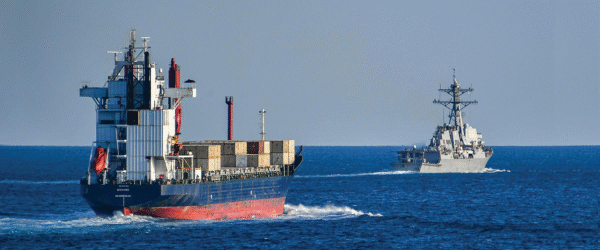
Ships: As of January 2026, according to UNCTAD’s “Review of Maritime Transport”, 116,000 merchant ships of 100 tons or more were on the water at the beginning of 2026, together capable of carrying 2.5 billion tons of cargo at any one time. (About 150 per day were transiting the Strait of Hormuz in that pre-war month; this week it’s about ten a day.) Steaming alongside this commercial fleet are about 45,000 large fishing vessels (by the UN FAO’s count), plus 14,000 cruise ships and large yachts; a few hundred icebreakers, cable ships, and other specialized vessels; and 4,000 naval ships. A basic tally:
| Cargo vessels, over 100 deadweight tons (DWT) | 116,000 | 2,529 million DWT |
| … bulk carriers | 14,000 | 1,067 million DWT |
| … oil tankers | 9,000 | 683 million DWT |
| … container ships | 7,600 | 389 million DWT |
| … general cargo | 16,000 | 84 million DWT |
| … roll-on/roll-off | 850 | 16 million DWT |
| … other cargo* | 69,000 | 190 million DWT |
| Fishing vessels, over 100 tons | 45,000 | 40 million DWT |
| Cruise vessels, ferries, yachts | 14,000 | 3 million DWT |
| Navies | 4,000 | 18 million DWT |
* “Other cargo” includes small coastal cargo ships, seagoing barges, refrigerated “reefers” carrying perishable cargoes, etc.
Fleet growth: Though government trade policies have mostly deadlocked over the last decade, the actual real-world commercial fleet has grown with startling speed. The 98,000 merchant ships of 2010 could ferry 1.28 billion tons of cargo around the oceans — half of this year’s 2.53 billion-ton capacity, with the container fleet growing from 169 million to 389 million deadweight tons and the bulk-carrier fleet from 457 million to 1.06 billion deadweight tons. Nor does this burst of growth look like it’s slowing down. Last year, 1,643 new vessels steamed out of the yards, and BRS Shipbrokers says 5,600 more are under construction this year: 4,055 in China, 731 in Korea, 633 in Japan, 320 in Europe, 306 everywhere else. (The U.S. is making 15 — not a lot, but a noticeable jump from the three a couple of years ago, after the Philly Shipyard’s 2024 purchase by Hanwha Oceans.) By 2029 or so, these new vessels will likely add another 470 million tons of cargo capacity.
Cargo: In a normal peacetime year, about $0.85 trillion worth of goods transit the Strait of Hormuz. (About $600 billion comes out in the form of oil, aluminum, fertilizer, helium, etc., and $250 billion goes in.) That would be about 3% of the $18 trillion in annual worldwide maritime goods trade. For context, this is roughly 60% of the world’s $26 trillion in goods exports, or, relative to output, about (a) 15% of the world’s $118 trillion ‘GDP’, and (b) 64% of the global $29 trillion in value-added manufacturing, agriculture, forestry, mining, and fisheries output. (Land trade and air cargo are about $6 trillion; the three transport ‘modes’ overlap a bit, so the numbers don’t sum perfectly to $26 trillion.) Here’s an evocative visualization —done in 2012, so a bit dated — of these ships as they move across oceans and through narrows.
The military arm: The world’s navies are much smaller than the commercial and fishing fleets, operating 4,000 warships with a combined tonnage of 18 million deadweight tons. The U.S. Navy’s 290 ships combine for 8.6 million DWT, or about 45% of the worldwide total. According to the U.S. Naval Institute’s fleet tracker, 18 of these ships, including two of the 11 carrier groups, are in the Persian Gulf at a cost of about $15 million a day:
Two Nimitz-class aircraft carriers with two Carrier Air Wings’ worth of fighters, strike aircraft, and helicopters (Wings 9 and 7) aboard
Twelve Arleigh Burke-class guided missile destroyers (DDGs)
One Ticonderoga-class guided missile cruiser
One amphibious assault ship
One amphibious dock landing ship
One amphibious transport dock ship
PPI’s four principles for response to tariffs and economic isolationism:
PPI’s Director of National Security Policy Danielle Steitz, a Joint Staff and House Armed Services Committee alumna, tracks U.S. military and security policy.Centcom reports on Gulf operations.
The U.S. Naval Institute’s Fleet Tracker tells you, more or less, where the Navy ships are.
Commercial vessels:
UNCTAD’s Review of Maritime Transport summarizes the world’s commercial fleet as of 2025.
… and a one-page data update for 2026.
BRS Shipbrokers tallies shipbuilding orderbooks.
The Hanwha Philly Shipyard, Hanwha Oceans’ joint-build project, hopes to revive U.S. civilian
shipbuilding.
Fishing fleets:
UN FAO tallies on the world fishing fleet – about 4.1 million vessels in total, of which 2.5 million have motors, and 45,000 are large vessels of 100 tons or more.
And the “freedom of navigation” backstory:
19th century: Thomas Jefferson’s spirited response (1807) to the U.K.’s Orders in Council during the Napoleonic Wars; Admiral Mahan argues (1890) for a powerful American fleet, as “the necessity of a navy springs from the existence of a peaceful commerce.”
20th century: The second of Wilson’s Fourteen Points (1918), on encouraging peaceful trade, starts with “absolute freedom of navigation upon the seas”; the Atlantic Charter’s seventh clause (1941) states a right for all to “traverse the high seas and oceans without hindrance.”
21st century: The Navy’s 21st-century “FONOPS” (“Freedom of Navigation Operations”) program asserts the right of passage in tense waters.
Ed Gresser is Vice President and Director for Trade and Global Markets at PPI.
Ed returns to PPI after working for the think tank from 2001-2011. He most recently served as the Assistant U.S. Trade Representative for Trade Policy and Economics at the Office of the United States Trade Representative (USTR). In this position, he led USTR’s economic research unit from 2015-2021, and chaired the 21-agency Trade Policy Staff Committee.
Ed began his career on Capitol Hill before serving USTR as Policy Advisor to USTR Charlene Barshefsky from 1998 to 2001. He then led PPI’s Trade and Global Markets Project from 2001 to 2011. After PPI, he co-founded and directed the independent think tank ProgressiveEconomy until rejoining USTR in 2015. In 2013, the Washington International Trade Association presented him with its Lighthouse Award, awarded annually to an individual or group for significant contributions to trade policy.
Ed is the author of Freedom from Want: American Liberalism and the Global Economy (2007). He has published in a variety of journals and newspapers, and his research has been cited by leading academics and international organizations including the WTO, World Bank, and International Monetary Fund. He is a graduate of Stanford University and holds a Master’s Degree in International Affairs from Columbia Universities and a certificate from the Averell Harriman Institute for Advanced Study of the Soviet Union.

