
| 2023 | 37.60% |
| 2013 | 32.00% |
| 2003 | 24.50% |
| 1975 | 10.00% |
* FAO State of World Fisheries and Aquaculture 2026. 2023 is the most recent available date.
It’s been sadly difficult to get countries to agree on good things in this century. But for those seeking sparks of hope, the World Trade Organization has one this week: The 166-member WTO’s most recent “multilateral” agreement — on fishery subsidies limits and transparency — marks its first anniversary next Tuesday. Background and implications:
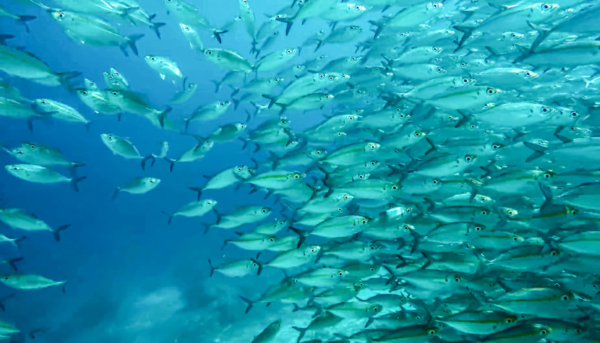
Fish and Boats: The State of World Fisheries and Aquaculture 2026, a biannual report from the UN’s Food and Agriculture Organization, estimates 4.7 million active fishing vessels around the world, of which 3.7 million are motorized, and 191,000 are large vessels above 24 meters long. Together they haul in 80 million tons of “capture” fish in the oceans and another 12 million tons from freshwater lakes and rivers. That is more than many fisheries can stand — FAO’s report says 37.6% of the world’s marine fish stocks were “overfished” as of 2023, up from 32% in 2013, 24.5% in 2003, and just 10% in the mid-1970s.
What to Do? A world whose 8 billion humans needing protein, but whose forests are badly stressed and has little new arable land, has no single way to ease pressure on marine life. Options range from aquaculture — fish farming produced 102.7 million tons of fish last year, about 11 million tons more than ocean and freshwater capture fisheries – to quota restrictions in relatively healthy fisheries, marine sanctuaries, limits on catches of particular species, bycatch reduction, and bans on especially destructive technologies. All have limits but can contribute in various ways. Another partial solution — the one the WTO members have been working on — is in principle among the simplest and easiest: stop paying people to catch more fish than they should.
Money: How much money are they spending? A widely used count of world subsidies to fishing fleets, done in 2019 by a University of British Columbia group (Sumaila et al), yields a figure of $35.4 billion. If the figures haven’t grown since then, this would be about 6.5% of the world’s $545 billion in annual fish sales, and a fifth of the $180 billion in annual fish trade. About $28 billion goes to the big boats — pretty easily identified as the least deserving recipients of free money — with $22 billion spent to enhance fishing capacity, including $7 billion to give them cheap fuel. By region and top eight countries (counting the EU as a single economy), Sumaila’s subsidy rundown looks like this:
| WORLD TOTAL | $35.4 billion |
| Asia | $19.5 billion |
| … China | $7.5 billion |
| … Korea | $3.2 billion |
| … Japan | $2.9 billion |
| … Thailand | $1.1 billion |
| … Indonesia | $0.9 billion |
| Europe | $6.4 billion |
| … European Union | $3.8 billion |
| … Russia (pre-war) | $1.5 billion |
| North America | $4.4 billion |
| … United States | $3.4 billion |
| Latin America | $2.0 billion |
| Africa | $2.1 billion |
| Pacific | $0.8 billion |
The WTO Agreement: So, a large environmental problem, a set of policies that make it worse, and money that (to put it mildly) would serve the world and its fishermen better if spent to support sustainable fishing. The WTO is well-placed to do something about it, in the abstract given its mission — agreements on trade and investment, policy reform, shared commitments and mutual benefits transparency in policy, mutual benefit from open markets – and in practice since its members include 49 of the world’s top 50 capture fishery countries (all but Iran) and catch about 97% of the fish.
The WTO members, despite taking frequent criticism for arguing more than agreeing on things, concluded a 9-page “Agreement on Fisheries Subsidies” in June 2022 — the largest “multilateral,” or essentially “worldwide,” agreement done in any forum in this decade, and maybe the only one. The Agreement bans three categories of subsidies: (i) those supporting illegal, unreported and unregulated (IUU) fishing; (ii) those supporting fishing in overfished stocks; and (iii) those supporting fleets on the unregulated high seas as opposed to national waters. It also requires the WTO members to file regular public reports — “notifications” in the jargon — on fishery health and catch levels, fishing fleet capacity and any subsidies the fleet might be getting (including identification of the specific vessels getting it), and any known “IUU” fishing. Finally, the agreement organizes a “Fish Fund” with about $20 million currently available to support small and very low-income countries as they implement the agreement.
The Agreement required ratification from two-thirds of the 166 WTO members — 111 of them — to “enter into force.” It got there on September 15th last year and now has 123 ratifiers, including all top ten fishing countries but Indonesia. As of last August, 21 WTO members had filed 33 “notifications,” and the Fish Fund has made 43 grants. One example: financing a readiness study for Pacific island state Tonga, where fisheries account for about 3% of GDP and 80% of the 107,000 Tongans engage in artisanal or professional fishing.
Next steps: The Agreement has a follow-up agenda, involving negotiations to limit subsidies contributing to “overcapacity” in national shipping fleets or to overfishing, in national waters as well as on the high seas. Right-minded WTO members are working on these in a fisheries subsidies negotiating group set to meet in two weeks. Their work entails not only improving but preserving the Agreement, whose high-stakes “Article 12” terminates the whole thing after four years (i.e., by September 2029) if the WTO members don’t agree on the additional subsidy limits.
And altogether: As much as the world of 2026 encourages pessimism and cynicism, this anniversary is sort of the opposite. Good news for the world environment; a success story for the too-often-undervalued WTO; and a reminder that governments, if they try, can cooperate for the common good.
The WTO Agreement:
The WTO’s Agreement on Fisheries Subsidies.
… the 123 ratifying Members as of September 2026.
… a Fish Fund update.
And evaluation and explanation from the Pew Center.
Fish and boats:
The FAO’s State of World Fisheries and Aquaculture 2026 reports on fish stocks, boat counts, the fishery workforce, policy, and more through 2026.
The World Bank has ‘capture’ fishery totals by country. The top ten are China, Indonesia, India, Peru, Russia, the U.S., Vietnam, Japan, Chile, and Norway. All have ratified, apart from Indonesia.
The National Oceanic and Atmospheric Administration “Status of Stocks” reports on the health of U.S. fisheries as of 2024.
And a local case study — The Great Lakes Fishery Commission explains fishery management on Lakes Superior, Huron, Michigan, Ontario, and Erie since 1981, with material on habitat, invasive species, tribal government roles, and more. This is an ‘inland water’ fishery, so outside the Agreement’s scope, but Canada and the U.S. are both Agreement ratifiers.
Money:
In Science Direct Rashid Sumaila et al. calculate a worldwide $35.4 billion in fishery subsidies by region, with breakdowns by subsidy purpose, large vs. small ships, and more.
Advocacy group Oceana estimates (2025) that these large boats account for about 60% of total world fish catch, and receive 80% of fisheries subsidies. Oceana’s earlier (2021) report found that $5.4 billion worth of subsidies were going to support fleets operating in other countries’ water.
Case studies:
The worst fishery-world offenders are the “IUU” — illegal, unreported, unregulated — fleets and vessels. Russian-flagged Vladivostok 2000 is a top-tier example: thought to be the world’s largest fishing vessel at 228 meters, it has been blacklisted for IUU offenses since 2014. Ship-tracking site marinetraffic.com places it in the Bering Sea this week.
And the really big picture:
From the Proceedings of the National Academy of Sciences, a guess (2018, in dry-carbon terms excluding water) at the weight of all forms of life. They get 700 million tons for fish, which is about a third of all animal life, and would imply a global water-and-all weight somewhere around 3 billion to 5 billion tons. Fish and arthropods combined account for 85% of all animal-world weight, but plants rule the world, with microorganisms and fungi next.
| All life | 545,200 million tons |
| Plants | 450,000 million tons |
| Microorganisms & viruses | 81,200 million tons |
| Fungi | 12,000 million tons |
| All animals | 2,000 million tons |
| Insects, spiders, crustaceans | 1,000 million tons |
| Fish | 700 million tons |
| Worms | 200 million tons |
| Farm animals | 100 million tons |
| Jellyfish & sponges | 100 million tons |
| Humans | 60 million tons |
| Mollusks | 20 million tons |
| Wild mammals, birds & reptiles | 10 million tons |
Ed Gresser is Vice President and Director for Trade and Global Markets at PPI.
Ed returns to PPI after working for the think tank from 2001-2011. He most recently served as the Assistant U.S. Trade Representative for Trade Policy and Economics at the Office of the United States Trade Representative (USTR). In this position, he led USTR’s economic research unit from 2015-2021, and chaired the 21-agency Trade Policy Staff Committee.
Ed began his career on Capitol Hill before serving USTR as Policy Advisor to USTR Charlene Barshefsky from 1998 to 2001. He then led PPI’s Trade and Global Markets Project from 2001 to 2011. After PPI, he co-founded and directed the independent think tank ProgressiveEconomy until rejoining USTR in 2015. In 2013, the Washington International Trade Association presented him with its Lighthouse Award, awarded annually to an individual or group for significant contributions to trade policy.
Ed is the author of Freedom from Want: American Liberalism and the Global Economy (2007). He has published in a variety of journals and newspapers, and his research has been cited by leading academics and international organizations including the WTO, World Bank, and International Monetary Fund. He is a graduate of Stanford University and holds a Master’s Degree in International Affairs from Columbia Universities and a certificate from the Averell Harriman Institute for Advanced Study of the Soviet Union.

