The Progressive Way to Ease Student Debt Burdens

Sens. Elizabeth Warren (D-Mass.) and Chuck Schumer (D-N.Y.) want to give up to $50,000 in debt relief to every American with student loans. Though they claim to be progressives, there is nothing progressive about this. It would benefit households in the top half of the income scale far more than those in the bottom half. Almost half of those with student debt have graduate degrees, after all.

It’s no wonder so many working-class voters have abandoned the Democratic Party. Bailing out college graduates with decent incomes will convince many that the Republicans are correct: The Democrats are elitists who don’t care about those without college degrees.

President Biden proposes to forgive only $10,000 in student debt, targeted to borrowers from low-income families. That is a more progressive approach, but it won’t help those who never went to college. According to the Census Bureau, only roughly 36 percent of Americans over age 25 have four-year college degrees, while 38 percent never attended a day of college. Only 20 percent of U.S. households have student debt.

With a little creativity, the president could help needy borrowers while also investing in non-college goers. Specifically, the administration should propose $10,000 per person in “career opportunity accounts” for working Americans aged 18 to 55 who earn less than $75,000 a year. Roughly two-thirds of all full-time, year-round workers earn less than $75,000. (To avoid penalizing those who earn just over $75,000, the money could be phased out between $70,000 and $80,000.)

Read the full piece here.

The Progressive Way to Slash Child Poverty

Written by Veronica Goodman and Ben Ritz 

On Monday, congressional Democrats unveiled a proposal to dramatically expand the Child Tax Credit (CTC), one of the bigger policies in President Biden’s $1.9 trillion American Rescue Plan. On the same day, Sen. Mitt Romney (R-Utah) gave the concept bipartisan backing by offering a Republican proposal for turning the CTC into an expanded child allowance. Both proposals would raise the current benefit from $2,000 per child to $3,000, provide additional credit for children under age six, make the full value of the benefit available for low-income families, deliver the payments in a monthly installment instead of a lump sum at the end of the year and dramatically reduce child poverty in America.

It’s no surprise that policymakers in both parties are prioritizing child poverty. As many as one in seven children, or close to 11 million, are poor. The United States consistently has among the highest levels of child poverty among the world’s wealthiest countries, many of which offer so-called “child allowances” to support low-income parents. The Democratic proposal would not just help these kids in the short term by lifting an estimated five million children out of poverty. It would also have long-run benefits for social mobility and support Black and Hispanic families the most. This Democratic proposal is estimated to cut child poverty nearly in half while the Romney proposal would reduce it by one-third.

Read the rest here.

Many Roads to a Living Wage

The Congressional Budget Office has dealt another blow to progressive hopes for swift action to raise the U.S. minimum wage to $15 an hour. It released a new study this week estimating that while the wage hike would lift 900,000 Americans out of poverty, it also would cost 1.4 million workers their jobs.

Liberal economists challenged the job loss figures, calling CBO’s methodology outdated. But the report feeds growing doubts that Senate Democrats will be able to shoehorn the measure into the big relief bill they hope to pass under “reconciliation” rules that allow for a simple majority vote. That means Republicans could filibuster it to death.

These setbacks raise an important tactical question: In a commendable effort to give working Americans a raise, are progressives fixating too narrowly on the minimum wage? After all, there are other policy tools at their disposal that could lift workers’ earnings without sacrificing jobs or harming small businesses. And these policies — essentially rewards for work delivered through the tax system — could be taken up under reconciliation.

It is abundantly clear that progressives, led by Sen. Bernie Sanders, have made several mistakes in their single-minded pursuit of the $15 wage boost. The first was claiming that it could pass through reconciliation. However, CBO had previously found that Sanders’s proposed “Raise the Wage Act” would have a negligible effect on the federal budget.

So Sanders pushed CBO to produce a new score using different methodology that he thought would make a persuasive fiscal case for the increase. Instead, CBO’s new analysis said that raising the minimum wage to $15/hour would kill over one million jobs while adding $70 billion to the federal deficit. As President Biden has noted, it’s unlikely the measure could get around Senate rules that prohibit the inclusion of non-fiscal policies for which the budgetary impacts are “merely incidental” in a reconciliation bill.

Moreover, West Virginia Sen. Joe Manchin already made clear he would oppose a $15 minimum wage because of the impact it would have in his low cost-of-living state, meaning the proposal wouldn’t have the simple majority needed to pass it.

Nonetheless, most Democrats, including Sen. Manchin, are united in their desire to raise the federal minimum wage, now stuck at a paltry $7.25 an hour. And not just Democrats: polls show solid majorities in favor of a $15 wage. Last November, even as Democratic candidates up and down the ticket got shellacked in a reddening Florida, 60 percent of voters backed a referendum to raise the state minimum to $15.

But as with many ideas that are simple and popular in concept, the apparent consensus breaks down when policymakers plunge into the devilish details: How high should the wage go, how quickly, and how uniformly should it be applied? Does it make sense to mandate $15 an hour in all 50 states, or allow for differences in the cost of living? What’s the impact of a big hike on jobs and small businesses in America’s less prosperous places?

Since Democrats evidently lack the votes to pass a $15 minimum wage, they should get what they can from Republicans who favor more modest increases, and look for other ways to make up the difference.

Specifically, they could expand tax credits designed to make work pay. The model here is the federal Earned Income Tax credit, which matches the earnings of low-wage workers dollar for dollar up to a certain threshold, after which it begins to phase out. It’s both an incentive and reward for work that’s become, after Social Security, America’s most successful anti-poverty policy.

What’s needed now is to move this “work bonus” principle up the income scale, with an eye toward raising incomes of non-college educated workers who have seen meager wage gains in recent decades.

For example, Brookings Institution economist Belle Sawhill has proposed giving all U.S. workers a 15 percent raise up to some annual ceiling, phasing out as earnings rise $40,000 a year.

PPI has proposed to absorb the EITC into an expanded Living Wage Credit that reaches deeper into the heart of the working class. The cost of these new credits could be defrayed by taxing the unearned incomes of wealthy Americans.

Such public subsidies for private work would lift wages for lower-skilled workers without pricing them out of labor markets or forcing the small companies that employ them out of business. And, as tax credits, they could be passed under budget reconciliation rules even without Republican support.

The minimum wage is a venerable policy, but progressives don’t need to put all of their eggs in this particular policy basket. Fortunately, there’s more than one road to establishing a genuine living wage in America that honors the dignity of work of all kinds and keeps working families from falling out of the middle class.

This piece was also posted on Medium.

Osborne for The 74: States Still Rely Too Heavily on Test Scores to Hold Schools Accountable. Here’s a Better Way for Them to Break It All Down

Despite heated rhetoric to the contrary, most Americans think we need standardized tests, to make sure kids are learning the basics. Last year, 61 percent of adults surveyed by Gallup and Phi Delta Kappa thought it appropriate to use test scores as a main factor in judging school quality. But in a previous version of the survey, five years ago, most respondents said other indicators, such as graduation rates, employment rates, and student engagement, were more important.

There is a lot of wisdom here. We need standardized tests to see if students are learning to read, do math, write, and understand science and history. If we don’t measure such things, how will we know which schools are failing and need to be replaced?

But for the last two decades, heavy reliance on test scores has encouraged cookie-cutter schools focused on preparing students for tests. Instead, we need diverse schools that cultivate the joy of learning, engage students in meaningful thinking and help them develop the character skills — such as conscientiousness and self-control — that lead to success in life.

Read the rest here.

Work from Home Opens Opportunity to Reexamine Federal Workforce Distribution

Contact: Carter Christensen, media@ppionline.org

WASHINGTON, D.C. – A new report from the Progressive Policy Institute highlights the opportunity posed by the current work-from-home mandate resulting from the coronavirus pandemic.

Covid-19 has taught employers the surprising lesson that for many more positions than expected, remote work is preferred by workers and seems to have little negative impact on workplace productivity. Within the federal government, a September poll showed that 53 percent of remote federal employees agreed they could perform their duties with minimal or no disruption and a November survey of managers at the Department of Transportation found 55 percent of units were more productive during the pandemic than before.

A more distributed federal government would likely raise real worker wages, improve recruiting, and lower the government’s overall operating costs. But the federal government has several additional reasons to prefer a more distributed workforce.

  • By allowing jobs to be performed by people who do not live in DC, a more distributed workforce can combat the trend of ever widening geographic inequality. Compared to policies like the relocation of federal agencies, it is more incremental, less political, spreads jobs to more areas, and will likely result in far less employee attrition.
  • Remote work brings the federal government closer to the governed, advancing the goal of recruiting a workforce drawn from all segments of society.
  • Property prices in DC have increasingly pulled away from national levels, but the federal presence in DC is large enough that a more distributed workforce could lead to meaningful downward pressure on residential and office rental prices in the city, benefiting residential and business renters who do not relocate.

Caleb Watney, the director of innovation policy at PPI, had this to say about the findings and key proposals: 

“The Biden Administration has a unique opportunity to help distribute the federal bureaucracy across the U.S. and thereby empower workers, improve hiring, and promote regional economic development. This natural experiment over the past year has shown that for more workers than previously anticipated, working remotely can be just as effective and has unexpected benefits. Moving to a model where even 20% of the federal workforce is distributed would be a significant change. The U.S. government has aspired to achieve a workforce from all segments of society and by embracing remote work, where appropriate, we can bring that closer to reality.”

The Case for a More Distributed Federal Workforce

The Biden administration has a unique and largely undiscussed opportunity. Prior to Covid-19, 5 percent of the U.S. workforce primarily worked from home. During the pandemic, this share rose as high as 50 percent; as of November, 36 percent of federal workers were still working remotely. With vaccines already beginning to roll out, this temporary arrangement is likely to end during the Biden administration. The government will face a choice between making what has been a temporary experiment permanent or returning to the status quo ante and bringing everyone back to the office. We believe the latter would be a mistake.

Covid-19 has taught employers the surprising lesson that for many more positions than expected, remote work is preferred by workers and seems to have little negative impact on workplace productivity. Within the federal government, a September poll showed that 53 percent of remote federal employees agreed they could perform their duties with minimal or no disruption and a November survey of managers at the Department of Transportation found 55 percent of units were more productive during the pandemic than before. Full-time remote work also decouples where workers live and work, allowing firms to employ workers from anywhere. Hiring from outside of expensive urban centers tends to lower costs and expands the pool of applicants from which an organization can hire. For these reasons, surveys indicate private companies anticipate a dramatic expansion of permanent remote work relative to before Covid-19.

The federal government should follow suit and give current workers the choice to continue to work remotely full-time if they were able to function well during the crisis. Going forward, the government should start with the assumption that new positions will offer workers the same choice, opening up federal positions to people living anywhere in the country. While not every position can be performed remotely, a large fraction of the 36 percent currently being done remotely can.

A more distributed federal government would likely raise real worker wages, improve recruiting, and lower the government’s overall operating costs. But the federal government has several additional reasons to prefer a more distributed workforce.

  • By allowing jobs to be performed by people who do not live in DC, a more distributed workforce can combat the trend of ever widening geographic inequality. Compared to policies like the relocation of federal agencies, it is more incremental, less political, spreads jobs to more areas, and will likely result in far less employee attrition.
  • Remote work brings the federal government closer to the governed, advancing the goal of recruiting a workforce drawn from all segments of society.
  • Property prices in DC have increasingly pulled away from national levels, but the federal presence in DC is large enough that a more distributed workforce could lead to meaningful downward pressure on residential and office rental prices in the city, benefiting residential and business renters who do not relocate.

With the end of the pandemic finally in sight, now is the time to move to a more distributed workforce. It will never be easier than it is now to reorganize the federal bureaucracy into a more decentralized model. Managed well, all these goals can be advanced without sacrificing the quality of federal government service.

A Historic Opportunity

This is a unique opportunity to reorganize the large federal bureaucracy. Moving from a co-located to a distributed labor force presents significant challenges for any organization: new technology must be acquired and allocated, processes rethought and rewritten, and employees trained to use new technology and follow new procedures. Even then, there will be uncertainty: what problems are unforeseen and will need to be solved? Will they be solvable? And looming above it all is a bias towards the status quo (don’t fix what isn’t broken). For all these reasons, firms have historically been hesitant to pivot to remote work, even when it was technically feasible.

But due to the Covid-19 global pandemic, many of these sources of friction have been overcome. Organizations that can operate remotely are likely to have more than a year’s experience doing so by the time they can safely bring workers back into the office. Technology has been acquired and allocated, processes have been changed, and workers have learned to use their new tools and procedures. Uncertainty is resolving and with practice organizations are getting better — not worse — at working remotely. Perhaps most importantly, remote work is now the status quo for much of the federal government.

Reinforcing this rationale is the unusually large employee turnover that is expected to occur during the Biden administration due to the retirement of the baby boomers. In 2018, just 14 percent of federal employees were eligible to retire, but this number is expected to rise to 30 percent by 2023. NASA, HUD, the Treasury, and the EPA are all forecast to have more than 40 percent of employees eligible for retirement by 2023.

This presents an unusual opportunity to reorient the federal workforce towards workers who prefer remote work. One potential challenge to a more distributed federal workforce is that federal workers may believe career advancement is more difficult for remote workers if senior managers have a preference for co-location. Indeed, in pre-Covid surveys, older workers do tend to be less interested in remote work than young ones. When this is the case, remote work may become unattractive to the most ambitious (young) workers, which can undermine the successful transition of an organization to remote work. Fortunately, the retirement wave presents an opportunity to give the federal government a large infusion of workers who are comfortable with managing and working remotely, which should help mitigate these concerns.

The Benefits of Decentralization

Allowing more remote and distributed federal work has several advantages.

Morale and Real Wages

Workers like remote work. As described in detail in another report, remote work is valued by workers for a variety of reasons. The freedom to work from anywhere allows workers to move to be closer to friends and family or to where they can live in their preferred lifestyle. Remote work also eliminates commuting time, tends to reduce meetings and distractions, and frequently increases schedule flexibility. In a pre-Covid study workers were willing to accept wages that were 8 percent lower in exchange for the opportunity to work remotely; another showed that remote work significantly reduced employee turnover.

In the era of Covid-19, greater experience with remote work has done little to dampen enthusiasm for it. Overall, 76.1 percent of workers who can work from home say they want to do so at least a day a week when the pandemic is over, and 27.3 percent want to be fully remote. Among tech workers, the desire to be remote is even higher: a November survey found that 95 percent with the option to work remotely permanently would choose to work remotely on a permanent basis, and that 6 in 10 would take a pay cut to work remotely. Giving federal workers the option to work fully remotely is a cost-effective way to raise employee morale.

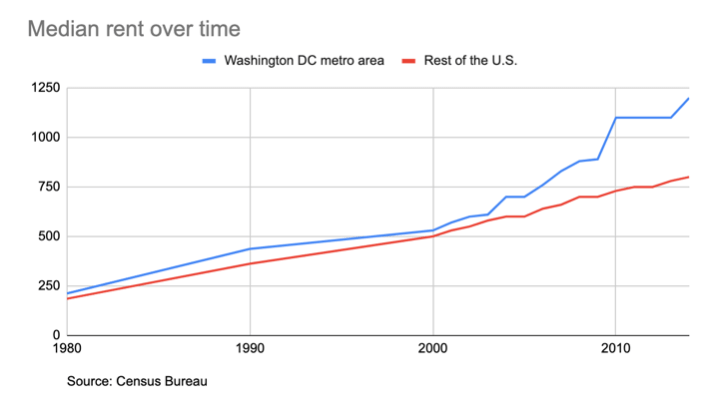
Remote work’s most salient benefit for federal workers may be its potential impact on the real wage of federal workers (i.e., the wage relative to their cost of living). A plurality of federal workers live in and around Washington, D.C., where the cost of living has diverged from the national average at an increasing rate. BEA data shows the overall cost of living in the DC metro area was 17.4 percent higher than the average for the U.S. in 2019. This difference is largely driven by significantly higher housing costs, which Census data show has increasingly pulled ahead of the rest of the country over the last two decades.

By allowing federal workers to relocate from the Washington metro region to areas with a lower cost of living, federal workers in Washington, D.C. can benefit from an increase in their real wage (that is, their wage relative to cost of living). Given the BEA’s estimate, D.C.-based federal employees can enjoy the equivalent of a 17.4 percent reduction in living expenses by moving to a region with a nationally representative cost of living.

This benefit, of course, depends on how much pay is adjusted for remote workers. In principle, the federal government could allow workers to retain their original pay, regardless of their location, or it can adjust pay to reflect local cost of living (as is current federal policy for full-time telework). The maximum benefit to federal workers would allow workers to retain their original salary, while the maximum savings to government would adjust pay to reflect cost of living.

It is important to note that D.C.-based federal workers could very well see their real wages rise if they relocate, even under the current system of locality-based pay. Federal workers are typically paid according to the general schedule, which includes locality pay adjustments based on the prevailing local wages for non-federal employees. For the year 2021, the location pay adjustment for the Washington, D.C. metro area was 30.5 percent, as compared to the lowest locality adjustment of 16.0 percent for “rest of the United States.” Thus, in general, a worker relocating to a place with nationally representative prices would see their cost of living decline by 17.4 percent according to BEA data, but would see their wages reduced at most by 14.5 percent.

This understates the potential gains from relocation, since the places with the lowest locality pay have lower than average costs of living. To take one example, the location pay adjustment for Des Moines, Iowa (where one of the authors of this report resides) is also 16.0 percent. A federal worker relocating from Washington, D.C. to Des Moines would see their salary reduced by 14.5 percent, but would see their cost of living fall by nearly twice as much (27.2 percent).

An alternative approach would be to default to the current system of locality wages in the new location while retaining the option for agencies to hire using the D.C adjusted pay scale on a case-by-case basis. Doing so would essentially allow agencies a 17.4 percent average increase in the real wage they could afford to pay under the General Schedule pay scale. This would enable the federal government to attract more qualified candidates than would ordinarily be the case.

Not everyone prefers remote work, but there is no reason the federal government cannot provide office space in D.C. for workers who prefer it. One of the main advantages of remote work is greater choice and autonomy for workers, including the choice to work in a traditional office environment. Others will prefer a hybrid arrangement, enjoying a less frequent commute into the office (as was already the norm for much of the federal workforce prior to Covid-19). Moreover, even federal workers who do not work remotely will likely benefit from a more remote friendly policy. In San Francisco, an exodus of tech workers due to the option to work remotely led to a 27 percent drop in real rental prices over the year. Downward pressure on rental prices in the D.C. area would also serve to raise the real wages of federal employees who are unable to relocate to areas with a cheaper cost of living. It could also reduce congestion and commuting times for D.C. residents. This is important since, as we discuss later, the majority of federal positions will probably remain co-located for the foreseeable future.

Lower Costs

Whether the government ultimately chooses to adjust pay based on locality, remote work will allow the work of the federal bureaucracy to be done at lower cost. Renting office space in Washington, DC is expensive. According to Moody’s Analytics, office space is 41.6 percent above average for the U.S., making the D.C. metro area the 7th most expensive in the country. The US Patent and Trademark Office, which already has a work-from-anywhere program for patent examiners, estimated remote work saved it $52.1mn on reduced office space requirements in 2019 alone. And just as workers unable to relocate from D.C. may benefit from lower property prices if a significant portion of D.C. workers relocate, D.C. based agencies may benefit from lower prices for office space due to reduced local demand.

Office space isn’t the only source of savings. Increased worker morale due to remote work has been found to reduce employee turnover in some settings. The USPTO estimated that increased retention accounted for $23mn in savings over 2019.

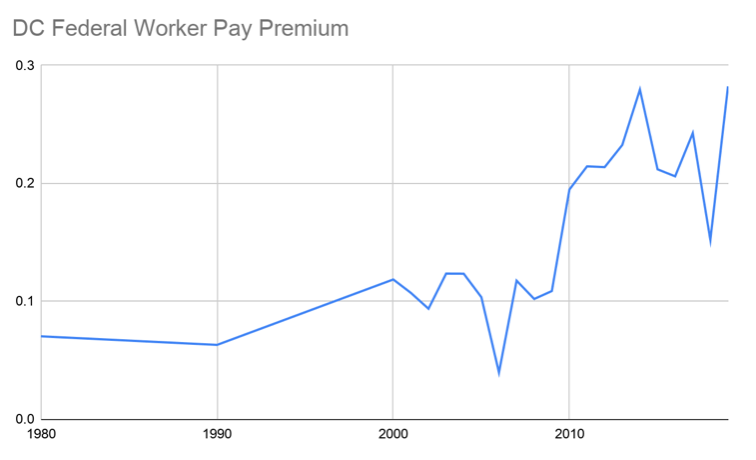
As noted above, a more distributed federal government could also choose to save money by adjusting pay by locality. To estimate the potential savings if some portion of D.C.-based federal workers relocated, we use data on 1.5 million federal government employees from U.S. Census data from 1980 through 2019 to estimate the DC pay premium with regression analysis. The results show that (conditional on age and time varying education premiums) the relative cost of employing workers in DC has gone from around 6 – 7 percent in the 1980s and 1990s, to 10 percent in the early 2000s, to around 22 percent in the most recent years, relative to federal workers in the rest of the country.

A Larger Labor Market

Remote capabilities can also improve government quality by facilitating access to the best job candidates in the nation, rather than the best in the local job market. Thus, even if a given worker is slightly less productive when working remotely than in an office (and they probably are not, as discussed later), this disadvantage can be more than outweighed by the benefits of access to a larger labor market. As an illustration, suppose it’s a bit harder to do some job remotely; any particular worker is 5 percent less productive performing their job remotely than they would be in an office. Since the remote job is open to anyone in the country, if that lets the government hire a worker who is 6 percent more productive than could be had locally, this will more than offset the decreased productivity of doing the job remotely.

These issues are particularly salient to the federal government.

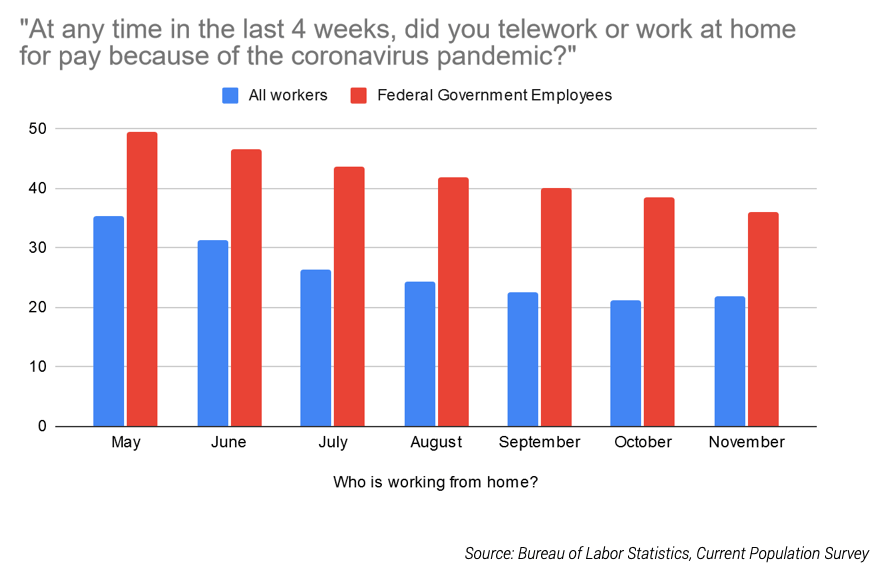
First, relative to the nation as a whole, the federal government is unusually suited to remote work. As indicated in the figure below, the share of federal workers who are working remotely has persistently been 15 percentage points higher than the national average of all workers.

Importantly, the estimates above are likely to be conservatively low, since BLS estimates only refer to working remotely due to the pandemic and exclude those who were already remote. In addition, other estimates find significantly higher rates of overall remote working than the BLS, suggesting it is on the conservative end of the spectrum.

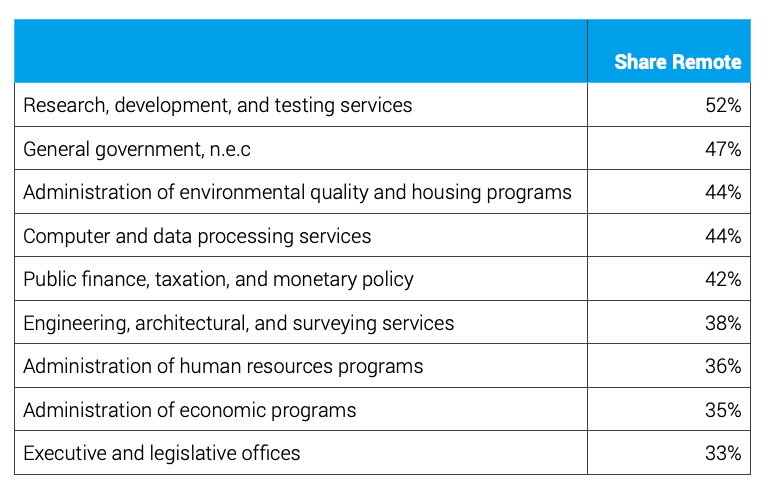
To get a better sense of the kinds of federal positions that can be done remotely, we can turn to the current population survey, which has asked employees if they are working remotely due to the pandemic since May. Over September, October, and November 2020, federal government position types with more than 30 percent remote workers are displayed below. 

Note: From 2020 CPS, limited to cells with a sample size of 100 responses or more.

Note that many of these position types require high levels of skills, education, or experience, which can make hiring challenging. This is important given the anticipated spike in retirement eligibility during the Biden administration as the baby boomers retire. Making the federal bureaucracy remote will facilitate filling these vacancies quickly with the best candidates in the country. Moreover, given the move to remote work by much of the private sector (one survey found 22 percent of US workdays will be remote even after the pandemic subsides), the US government will be at a significant hiring disadvantage if it insists workers relocate to accept positions and other organizations do not.

Finally, it’s worth considering new types of talent that wouldn’t previously have considered working for the federal government that would be open to public service under a permanent remote work arrangement. In particular, the federal government has struggled to increase its technical capacity with many workers earning higher salaries at firms like Google, Facebook, and Microsoft than are possible working under the General Schedule pay scale. To combat this, the federal government has attempted to increase the frequency of technical “tours of duty” that tech workers can undertake. However, take-up has remained low, with one reason being the difficulty of relocating to D.C. for a temporary fellowship. But if these workers could work remotely, opportunities within federal agencies will become more attractive.

Geographically Dispersed Workforce

A geographically dispersed workforce has several other advantages for the federal government. The first principal of the US Merit System is (emphasis added):

Recruitment should be from qualified individuals from appropriate sources in an endeavor to achieve a work force from all segments of society, and selection and advancement should be determined solely on the basis of relative ability, knowledge and skills, after fair and open competition which assures that all receive equal opportunity.

By removing relocation barriers to employment, more opportunities to work from anywhere would contribute to a more geographically representative workforce. These barriers can be significant, even when the monetary cost of relocation to D.C. is covered by the employers. A 2020 study found the typical U.S. adult would need to be paid an additional $24,000 (43 percent of the typical salary) to relocate to a job that took them away from friends and family.

Other studies have highlighted the importance of informal ties and social networks for finding jobs. Clustering federal jobs in a small number of locations means the social networks of government workers are geographically constrained, contributing to an information gap about job openings, the desirability of different positions, the kinds of experiences that would be valued, and so on, outside major federal clusters. Over time, a dispersed workforce would help erode these information gaps.

More speculatively, a geographically dispersed workforce could help rebuild trust in government, which has been nearing historic lows. Working from home during the Covid-19 pandemic has been associated with a 31 percent increase in white collar crime tips to the Securities and Exchange Commission, which may have been caused by a more arms-length and professional relationship between coworkers. A dispersed workforce may also be harder to improperly influence for similar reasons (it is harder to convince someone to bend the rules over email than dinner and drinks). Lastly, it is worth noting that historically, Americans have trusted their local government more than their state government, and their state government more than the federal government. No doubt this is partially due to the social and physical distance between the local, state and federal governments and the governed.

Economic Development

Finally, remote work could be a new tool for economic development in regions that are being increasingly left behind by the rising importance of agglomeration effects. The increased importance of agglomeration effects over the last several decades have led to economic prosperity for cities and economic decline in rural areas. This is one of the root causes of the serious political and social challenges we face today. A variety of policies have been suggested to revitalize or at least slow the decline of lagging US regions, including proposals to relocate several federal agencies outside of Washington, D.C. The purpose of relocation is to move jobs to regions with shrinking economies (and tax bases). These are not just the jobs of the workers in federal agencies, but also workers in related fields who work with the agencies (lawyers, lobbyists, etc.), and workers who provide services to high-paid government workers (barbers, restaurant workers, IT personnel, etc.).

Dispersing the federal bureaucracy is a much easier way to gain the benefits of economic development that is relocation’s goal.

  • It would distribute the gains of relocation more widely, including to rural areas, rather than concentrating them in a handful of expensive, urban cities.
  • It would allow more jobs to be moved out of Washington. Agencies that do not need to be physically present in Washington could go remote. But, even more workers from agencies that cannot relocate could also go remote, as long as their specific position does not require physical proximity.
  • It would be far less politically contentious than deciding centrally where to relocate entire agencies. Instead, workers would have the choice on if and where to relocate.
  • It would avoid the attrition and disruption that typically accompanies relocation. For example, the relocation of the USDA Economic Research Service to Kansas City led to the loss of at least half the staff (and up to 93 percent) as workers declined to move.
  • Moves could be implemented incrementally, one open position at a time.
  • It would be cheaper and logistically easier than organizing a move. The costs and logistics are borne by staff, not the Agency.
  • Embracing remote work at the federal level will help entrench remote work as a new mode of organizing business in general. As more firms adopt a remote-first orientation, geographic inequality will be further reduced.

Data from the BLS suggests approximately 40 percent of federal workers were working at home in September, and a survey of remote workers from the same month found that slightly over half agreed that they could perform their work remotely with minimal or no disruption. Taking these estimates seriously suggests 20 percent of federal jobs can already be performed remotely. Given that the federal government has consistently had more remote workers than the national average, this estimate is likely conservative: a survey from Upwork of 1,000 hiring managers found they were planning an average of 22.9 percent workers fully remote in the long-run.

Looking only at the 400,000 federal workers based in D.C., Maryland, and Virginia, 20 percent equals 80,000 workers. For comparison, a 2019 Brookings report about the potential economic development benefits of relocating federal agencies listed 19 greater D.C.-based agencies and sub-agencies as potentially able to be relocated. They collectively employ a similar number in the same three states: 89,000 workers. But remote work would also be available to the federal government’s other 1.4mn US-based federal workers, many of whom are also based in expensive urban centers.

Addressing Some Potential Fears of Remote and Distributed Work

Like any policy change, dispersing the federal workforce may entail some costs as well as benefits. In this section, we address two major concerns and conclude they are not significant enough to outweigh the benefits discussed above.

Does Remote Work Really Work?

A primary reason that remote work was not more widespread prior to Covid-19 was a perception that it was not as productive as a traditional office. Even if this was true, it would not necessarily mean remote work is undesirable, since any disadvantages associated with productivity might be more than offset by cost savings and access to a larger labor market. Fortunately, for a wide variety of job types, no such trade-off is necessary: for many positions, remote work appears to be just as productive as traditional office-based work.

A review of the economic literature about the efficacy of remote work prior to Covid-19 found little evidence that it results in any reduction in worker productivity for a wide variety of positions. Indeed, plenty of evidence —including a particularly relevant study from the US Patent and Trademark Office’s work-from-anywhere program —found remote workers were more productive than those in a traditional office environment. The fact that modern remote work is productive is the likely explanation for the steady rise of full-time working from home before Covid-19 from under 3 percent to 5 percent over 1980 to 2018 (with a marked acceleration after 2010). Even 5 percent understates the true extent of remote work prior to Covid-19, since it excludes work away from both the home and the office, such as in coworking spaces. Including these raises the share of full-time remote workers prior to Covid-19 to 10 percent. Even without Covid-19, businesses were (slowly) learning that remote work worked.

Extensive experience with remote work during Covid-19 has accelerated that process. It is now clear that in a wide variety of contexts, there really is no question that remote work can be at least as productive as traditional work. A number of high-profile companies have made the switch to permanent remote work after several months of experience with it (e.g., Microsoft, Facebook, Twitter). This is not limited to a few anecdotes either; in a survey of 1,000 hiring managers by Upwork, 60 percent planned to increase their use of remote work in the future, as a result of their experience with Covid-19.

Within the federal government, experience has also been broadly positive as workers gained experience. Whereas an April poll of federal workers working remotely found just 15 percent reporting minimal or no disruption due to the shift to remote work, a follow-up poll in September saw this number rise to 53 percent. A November survey of managers at the Department of Transportation found 55 percent of units were more productive during the pandemic than before.

Systematic evidence on the longer-term viability of remote work is unfortunately limited at the moment. While there are examples of organizations that have successfully organized in a distributed manner for many years (the USPTO has had a work-from-anywhere program since 2012, WordPress since 2005), any evidence about the long-term efficacy of remote work necessarily predates the recent transition to remote work due to Covid-19. It may be that longer term challenges to successful remote work will yet emerge. At the same time, it is likely that new organizational and technological solutions will emerge (indeed, the number of patent applications related to remote work technology has increased dramatically since February 2020), so that remote work is just as likely to function better in the long run than in the short run. The experience of remote work is also likely to improve once widespread vaccination allows children to return to full time childcare and social gatherings outside of work are viable.

Nonetheless, given long run uncertainty one possibility would be to implement a multi-year trial for remote work. To realize most of the benefits of remote work, such a trial needs to be sufficiently long, because if workers feel they will be required to return to a D.C. office in the near term, they will be unwilling to relocate. As an example, the U.S. Patent and Trademark Office’s work-from-anywhere program began as a five-year pilot program in 2017.

Benefits of Agglomeration

Another critique of remote work focuses not on the level of individual workers and businesses, but on the broader ecosystems in which they operate. Physically clustering a large number of workers in a particular industry has traditionally led to at least two major benefits: more efficient matching of workers to positions, and learning. One concern may be that these benefits will be lost if an organization goes remote, even though at the level of individual workers productivity is unaffected. Fortunately, the internet and cheaper travel has significantly eroded both of these advantages of physical proximity.

First, clustering workers together can make it easier to match the right worker with the right job. Physical proximity makes it easier to share information and form informal social networks (which can be just as important for helping people find jobs that are good fits). While these effects no doubt continue to exist, their relevance may be fading with the advent of online job markets, the use of algorithms for matching workers to jobs, and the growth of online social networks (which allow people to maintain geographically distributed networks of informal friends).

Second, economists frequently point to learning via “local knowledge spillovers” as another reason why organizations choose to cluster together. A variety of evidence shows innovative businesses learn from each other, borrowing and improving on the ideas and inventions of their neighbors. But here too, there is a lot of evidence that these effects are shrinking —possibly to the point of irrelevance in some sectors — as the internet and cheap travel makes it no longer necessary to physically reside near each other to learn from each other.

Moreover, it is unclear if these kinds of knowledge spillovers are relevant in the context of the federal government. Furthermore, while keeping the majority of federal employees clustered together in Washington, D.C. makes it easy for them to share knowledge with each other, it makes it harder to learn from the policies and processes of 50 state governments and thousands of local ones.

In sum, it is true that a more distributed federal workforce might find it benefits less from matching and learning than it would if it remained in D.C. But, at a minimum, the internet and cheaper travel have eroded the importance of these factors. And for learning, it may in fact be the case that a more distributed government would benefit more from learning than one clustered in DC. At any rate, the challenges associated with remote work are likely smaller than they have ever been, while the benefits remain as large as ever.

Conclusion

The Covid-19 pandemic has shown us that for many more positions than previously suspected, remote work has come of age. It is now possible for a significant share (perhaps 20 percent) of federal positions to be done effectively by a distributed workforce of full-time remote workers residing where they choose. Moving the federal workforce in this direction would have myriad advantages. It would make working for the federal government more attractive, both by giving workers the autonomy to work in the place and manner they prefer, and by potentially allowing for increased real wages for workers who choose to live in places with a lower cost of living. Combined with access to a larger national labor market, this would facilitate hiring and retaining quality employees. This is especially important given the expected retirement wave that will come in the years ahead. A more distributed federal workforce would also likely lead to lower costs for the government, in terms of office space and possibly wages. It may also benefit workers who continue to reside in Washington, D.C., through its beneficial impact on congestion and property prices. Lastly, a more distributed workforce would be a tool for economic development of lagging regions and allow the government to better achieve its goal of hiring a workforce that is representative of the population it governs.

For all these reasons, the government should give current workers the choice to continue to work remotely full-time if they were able to perform their job effectively during the crisis. Going forward, the government should start with the assumption that new positions will offer workers the same choice, opening up federal positions to people living anywhere in the country.

Acknowledgments: Matt Clancy wishes to thank Nicholas Rada for a conversation that sparked this piece.


ABOUT THE AUTHORS:

Matt Clancy is a progress studies fellow (Emergent Ventures) and assistant teaching professor at Iowa State University, and formerly a research economist on science policy for the USDA. He is the author of The Case for Remote Work. He currently lives in Des Moines, Iowa.

Adam Ozimek is the chief economist at Upwork, the world’s work marketplace, where he leads research on labor market trends. Upwork encourages remote work for the private sector but has no contracts with the federal government.

PPI Statement on the National Apprenticeship Act of 2021

Last Friday, the U.S. House of Representatives voted to dramatically expand investment and access to apprenticeships with the passage of the National Apprenticeship Act of 2021 under the leadership of Rep. Bobby Scott. This legislation had been passed in November in the last Congress, however, the Republican Senate Majority failed to take up the bill for a vote. With Democrats now in the majority, there is renewed hope that the country’s underfunded and outdated apprenticeship system can finally be modernized to meet our 21st-century workforce needs.

The reauthorization of The National Apprenticeship Act is estimated to create nearly one million high-quality apprenticeship opportunities and includes provisions that target opportunities for key groups, such as young adults, childcare workers, and veterans. The bill also aims to increase apprenticeships in industries that do not require a four-year degree for well-paid jobs, such as healthcare, IT, and financial services. 

For the more than 10 million workers who have lost jobs or been laid off, there is no guarantee that their jobs will be there once our country returns to normal. Some estimate that at least 3.7 million Americans will not have jobs to return to. Many will have to reinvent themselves and apprenticeships can play a critical role in helping workers get back to work better after the pandemic.

Apprenticeships are an overlooked option to put workers on a path to better employment and the National Apprenticeship Act would remedy this gap. The United States lags behind many other OECD countries in investments to apprenticeships to provide immediate options for laid-off workers. Currently, there are only about 440,000 registered apprentices in the U.S. and often, in states where apprenticeships are available, there are too few slots to meet demand. If the United States were to create as many apprenticeships as a share of our labor force as in Europe that number would be nearly ten times higher. 

As policymakers consider how to help American workers weather the Covid recession, PPI strongly supports an increase in public investment in apprenticeships and work-based “career pathways” training programs that connect workers, including those laid off during the pandemic, to well-paying careers. We look forward to its progress in the Senate Health Education Labor and Pensions Committee under Senator Patty Murray, and we encourage the Senate to pass this important workforce legislation. 

PPI Statement on Senator Klobuchar’s Proposed Antitrust Legislation

Senator Amy Klobuchar, the incoming chair of the U.S. Senate Judiciary Committee’s Antitrust Subcommittee, just released a draft of the Competition and Antitrust Law Enforcement Reform Act of 2021, which includes a slew of antitrust-related initiatives.

In comments on this new legislation, Alec Stapp, director of technology policy at the Progressive Policy Institute, said:

“Senator Klobuchar’s proposed antitrust legislation includes many urgently needed provisions to ensure the federal government is safeguarding competition in every sector of the economy. According to one recent analysis, appropriations for our two federal antitrust agencies have fallen by 18% since 2010. Antitrust enforcers desperately need more resources to police anticompetitive conduct across the economy and bring cases when necessary. Antitrust cases are notoriously expensive and require high-level legal talent — this is not an area the government should be skimping on.”

“The package also includes new transparency and data collection requirements that would be hugely beneficial for better understanding the state of competition and antitrust enforcement in the U.S. Proposed competition studies on institutional investors’ cross-ownership and the role of monopsony power in labor markets are long overdue. Furthermore, a series of Congressional hearings focused on monopoly power in various sectors of the economy, including healthcare and agriculture, would help shed light on the size and scope of the problem we face. Lastly, a requirement for parties to a merger settlement to provide post-merger data is a common-sense idea that would allow enforcers to learn from past decisions and update their analytical methods for future cases.”

“While there is much to like in this batch of proposals, there is also much reason for caution. While certainly not perfect, the current set of antitrust institutions is much improved from what prevailed from the early 20th century until the 1970s, when almost every merger was presumed illegal and most behavior by large firms was inherently suspect. Under the current standard, enforcers need to show evidence of market power, anticompetitive conduct, and consumer harm. The problem with the proposed bill is that it would drastically lower the bar for antitrust liability and might inadvertently criminalize pro-competitive conduct. A prohibition on “conduct that materially disadvantages competitors” would essentially degrade antitrust law to a “know it when you see it” standard for anticompetitive conduct. In reality, lots of corporate conduct is ambiguous at first glance. Enforcers need to do the work of economic analysis and fact-finding to determine whether it’s pro-competitive or anti-competitive. We shouldn’t short circuit that process.”

If you would like to speak to Alec Stapp you can reach him at astapp@ppionline.org or (480) 628-3863.

###

Biden’s commission on the judiciary must put justice over politics

Some Democrats want to seek political revenge for the Republicans’ unapologetic use of their power over the past decade to engineer a conservative judiciary. Since October, they have been calling on President Biden to expand and pack the Supreme Court and federal judiciary with liberal judges. Biden has wisely resisted these calls and is setting up a commission to provide thoughtful ways to repair the partisan damage done to the courts over the past decade.

When it comes to reforming the courts, Democrats need to tread carefully. Our criminal and civil justice systems are keystones of our economic and political liberty; they keep order and facilitate the peaceful resolution of disputes. Neither system is perfect, but these objectives are unachievable if there is a belief among enough Americans that cases are decided by partisan politics, not justice.

The good news is that Biden has entrusted this effort to two highly respected lawyers, former White House Counsel Bob Bauer and former Deputy Assistant Attorney General Cristina Rodriguez. The persistent guidepost for their work must but ensuring the impartiality of the courts. Their big challenge, therefore, is putting this political genie back in the bottle.

Read here.

WEBINAR: Parent Choice… Is It a Civil Right?

On Tuesday, February 2nd our Deputy Director Curtis Valentine moderated an engaging conversation on the rights of all parents to choose where their children attend school entitled “Parent Choice…is it a Civil Right?” The  all-star panel of experts in civil rights and education included George Parker (formerly with Washington Teacher’s Union), Lakisha Young (The Oakland REACH), Shavar Jeffries (Democrats for Education Reform), and T. Willard Fair (Urban League of Greater Miami).

With an audience of parents, educators, advocates, and policy makers, the panel debated the connection between parent choice and the promise of a quality education. As America celebrates Black History Month, our project celebrates those who fight for the civil rights of all parents, especially the right to a quality public education for their children.

Let’s Get to Yes: A Conversation with Congresswoman Suzan DelBene

PPI President Will Marshall welcomes Representative Suzan DelBene of Washington State’s First District to this episode of the PPI Podcast. The two discuss the Republican party’s identity crisis, the issue of Marjorie Taylor Greene, and the need for the GOP to come to the table on a broad relief package.

They also talk about DelBene’s involvement in the New Democrat Coalition, the House’s largest ideological caucus focused on a solutions-oriented approach to bipartisan legislation for economic growth and progress. Will Marshall hits on the importance of purple districts like DelBene’s, and she highlights the necessity of proving governance still works.

PODCAST: Congresswoman Suzan DelBene on “Getting to Yes”

PPI President Will Marshall welcomes Representative Suzan DelBene of Washington State’s First District to this episode of the PPI Podcast. The two discuss the Republican party’s identity crisis, the issue of Marjorie Taylor Greene, and the need for the GOP to come to the table on a broad relief package.

They also talk about DelBene’s involvement in the New Democrat Coalition, the House’s largest ideological caucus focused on a solutions-oriented approach to bipartisan legislation for economic growth and progress. Will Marshall hits on the importance of purple districts like DelBene’s, and she highlights the necessity of proving governance still works.

Biden’s Education secretary must seize the bully pulpit — and quickly

President Biden’s nominee for Education secretary appeared before the Senate’s education committee today. Miguel Cardona was asked about his stance on issues such as federal support for student civil rights and charter schools. The most pressing questions were centered on the pandemic: Under what circumstances should schools reopen? How much federal aid is needed? How should standardized testing be managed after months of lost learning?

Cardona’s answers are critical to families whose schools have been shuttered for nearly a year. But it’s Cardona’s leadership skills that senators should be most focused on. How strongly will Cardona advocate for America’s children, particularly when adult interests such as teacher unions push in the opposite direction? The secretary of Education doesn’t have authority to open or close schools; that falls to states and localities. But he does have a bully pulpit, and he should use it forcefully to support state and local officials struggling to reengage kids in learning.

Previous Education secretaries under Democratic presidents have forcefully used their voices to support education reforms. Richard Riley’s “America Reads Challenge” during the Clinton administration and Arne Duncan’s “Race to the Top” competition during the Obama administration come to mind. The challenges of this moment are even more daunting.

Read the full piece here.

Opportunity for Biden Administration to Boost Jobs and Economic Growth is Hiding in Plain Sight

WASHINGTON, D.C. – A new report co-authored by the Progressive Policy Institute’s Caleb Watney and Doug Rand and Lindsay Milliken of the Federation of American Scientists, highlights a significant opportunity for the Biden Administration to boost entrepreneurship and create up to a million new jobs through a little-known immigration rule.

For the United States in particular, foreign-born entrepreneurs have made up an extraordinary share of our most successful companies and technological achievements. To encourage the vitally important flow of immigrant entrepreneurs, and to accommodate the growing need for an entrepreneur-specific pathway into the country, the Department of Homeland Security (DHS) adopted the International Entrepreneur Rule (IER) in early 2017.

The rule was quickly put on hold by the incoming Trump Administration but was never removed from the Code of Federal Regulations. According to the new report, with support from the Biden Administration, the IER could quickly become an essential pathway to attract and retain foreign-born entrepreneurs who seek to build their businesses within the United States.

KEY PROPOSALS INCLUDE: 

  • Publicize the International Entrepreneur Rule and credibly signal to stakeholders that the IER will receive agency attention and resources
  • Issue new guidance documents to agency adjudicators to clarify evidentiary standards and make it reasonably straightforward for investors to prove they meet qualifying criteria
  • Issue new guidance directing U.S. Citizenship and Immigration Services (USCIS) and U.S. Customs and Border Protection (CBP) to grant beneficiaries the full initial 30 months of parole, absent extraordinary circumstances
  • Issue future rulemaking to improve the IER based on feedback from stakeholder groups
  • Pursue a long-term legislative solution to stabilize immigration pathways for entrepreneurs

Co-author Caleb Watney, the director of innovation policy at PPI, had this to say about the findings and key proposals: “Countries all over the world are competing to attract the best talent to their shores. Unlike Canada, Australia, and the United Kingdom, the United States has no statutory immigration pathway designed for entrepreneurs. The International Entrepreneur Rule is a powerful tool to help solve this gap and should be embraced by the Biden Administration to increase U.S. dynamism, economic growth, and job creation. Now is the time to build back better and ensure the United States’ place as the best place to start a new business and to welcome brilliant entrepreneurs from across the globe.”

Long Live the International Entrepreneur Rule: An Opportunity to Boost Jobs and Economic Growth Is Hiding in Plain Sight

Authors: Caleb Watney, Lindsay Milliken, and Doug Rand

Entrepreneurship is the engine of long-term economic growth and dynamism. For the United States in particular, foreign-born entrepreneurs have made up an extraordinary share of our most successful companies and technological achievements. To encourage the vitally important flow of immigrant entrepreneurs, and to accommodate the growing need for an entrepreneur-specific pathway into the country, the Department of Homeland Security (DHS) adopted the International Entrepreneur Rule (IER) in early 2017.

The rule was quickly put on hold by the incoming Trump Administration, but was never removed from the Code of Federal Regulations. With support from the new Biden Administration, the IER could quickly become an essential pathway to attract and retain foreign-born entrepreneurs who seek to build their businesses within the United States.

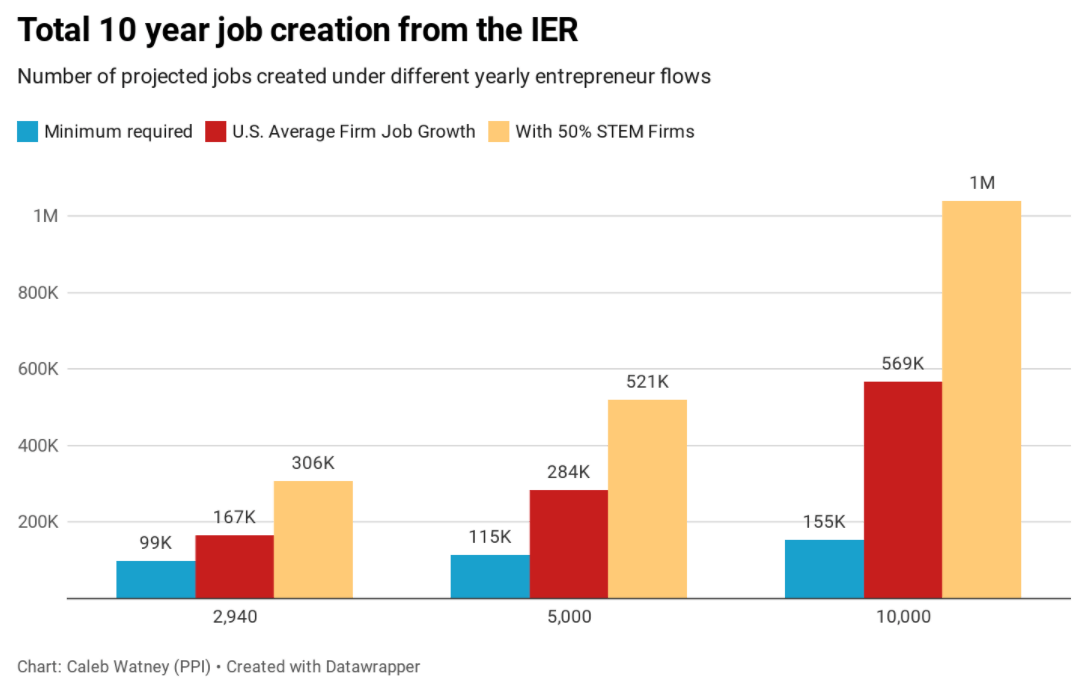
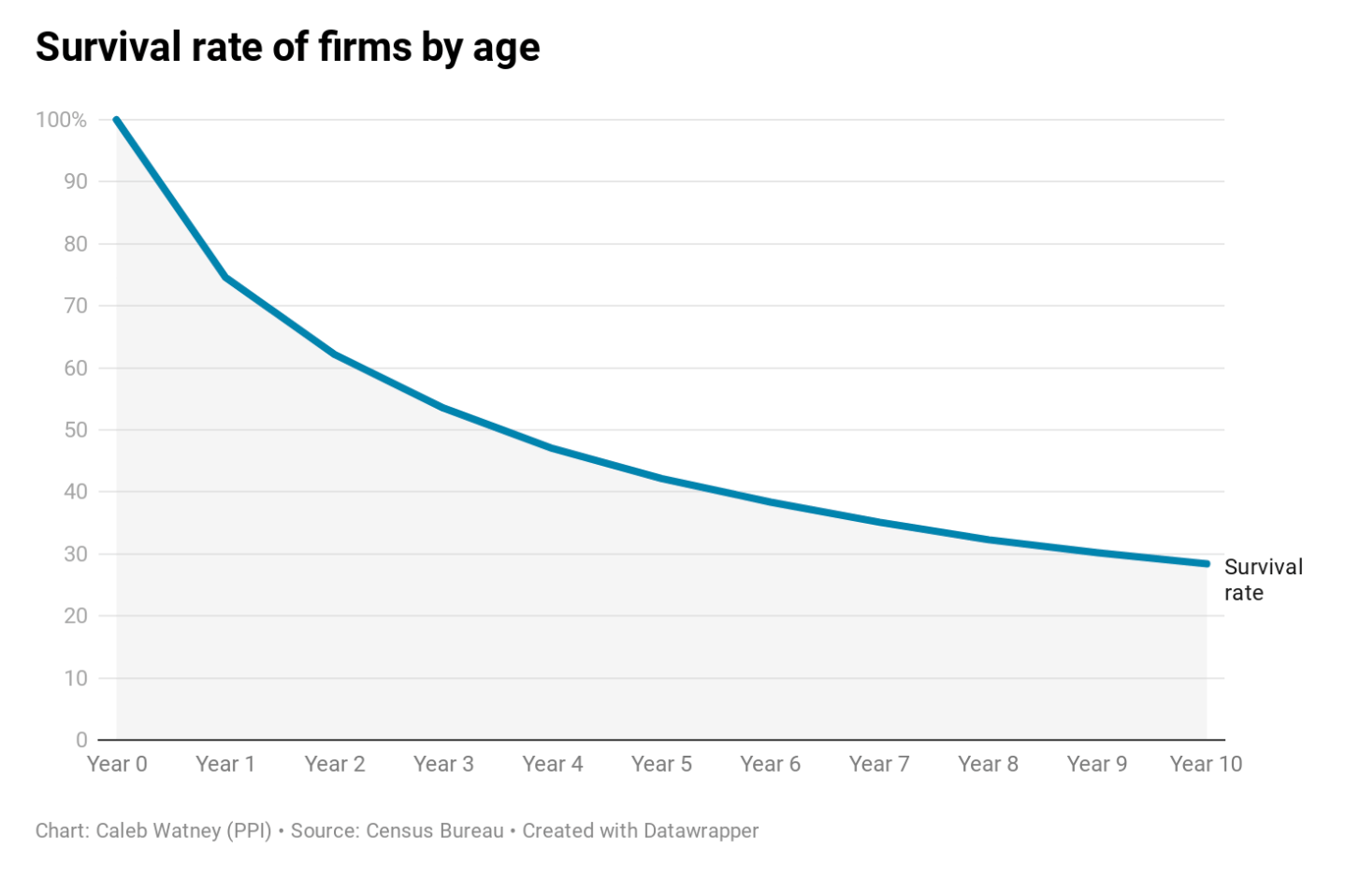
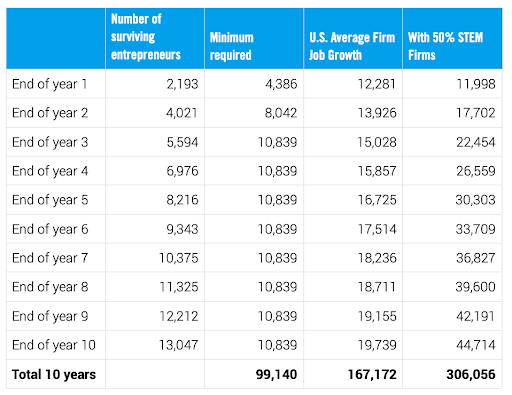
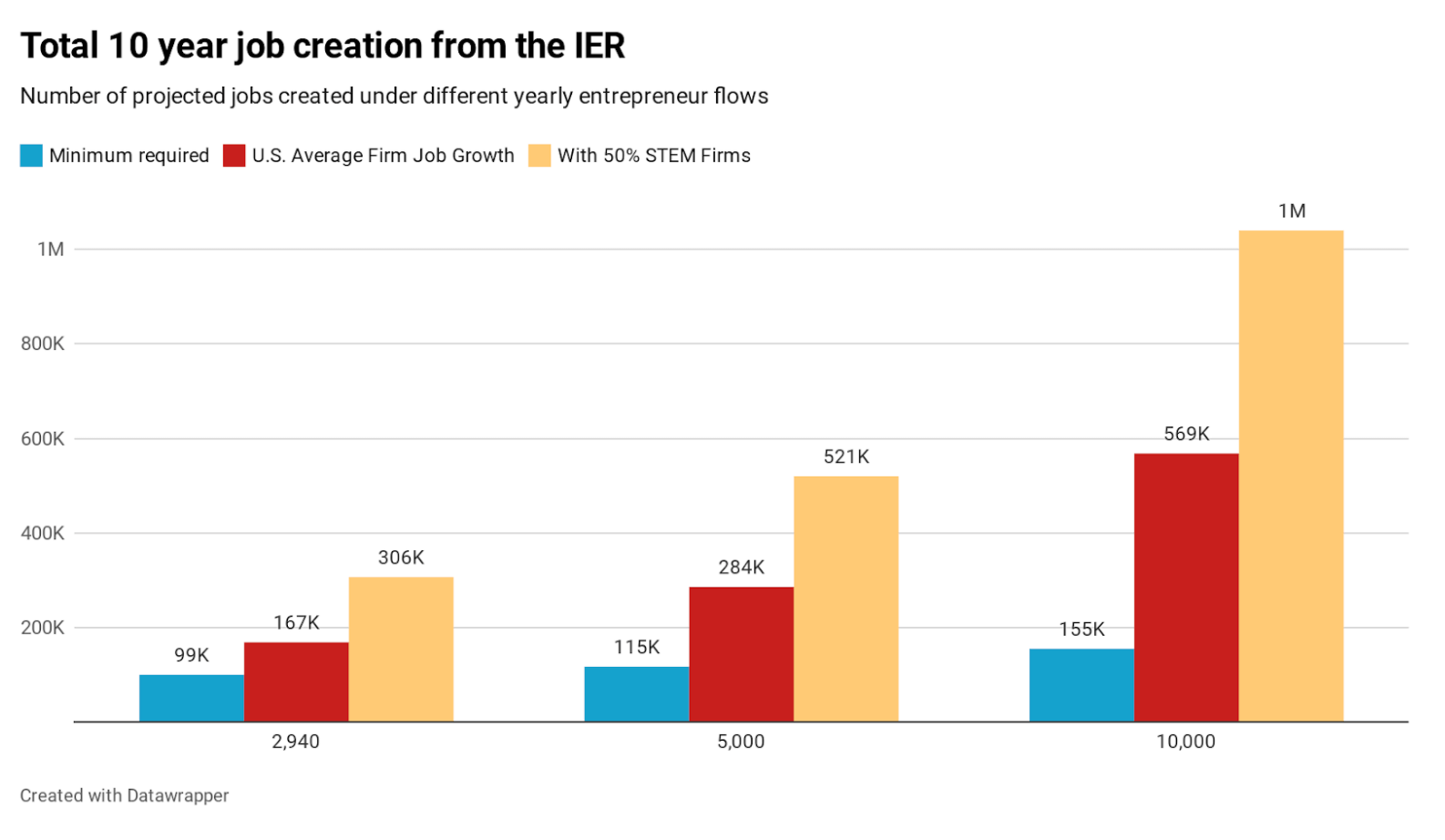
Using the DHS estimate that 2,940 entrepreneurs per year would come to the country through the IER, after adjusting for expected business failure rates, we project these entrepreneurs would produce approximately 100,000 jobs over ten years if they produce only the minimum number required for parole extension. If they mirror the average job growth of firms their age, we project more than 160,000 jobs over ten years. If 50 percent of them are high-growth STEM firms, we project more than 300,000 jobs over ten years.

If the number of yearly entrepreneurs is larger than DHS projected, job growth could be considerably higher:


This paper proposes the following recommendations for the new administration, both immediate and longer-term:

  • Publicize the International Entrepreneur Rule and credibly signal to stakeholders that the IER will receive agency attention and resources
  • Issue new guidance documents to agency adjudicators to clarify evidentiary standards and make it reasonably straightforward for investors to prove they meet qualifying criteria
  • Issue new guidance directing U.S. Citizenship and Immigration Services (USCIS) and U.S. Customs and Border Protection (CBP) to grant beneficiaries the full initial 30 months of parole, absent extraordinary circumstances
  • Issue future rulemaking to improve the IER based on feedback from stakeholder groups
  • Pursue a long-term legislative solution to stabilize immigration pathways for entrepreneurs

Introduction

More than half of America’s billion-dollar startups were founded by immigrants, and 80 percent have immigrants in a core product design or management role. Though immigrants make up only 18 percent of our workforce, they have won 39 percent of our Nobel Prizes in science, comprise 31 percent of our Ph.D. population, and produce 28 percent of our high-quality patents. To be clear, this is not because immigrants are inherently smarter than the average native-born worker, but instead because of strong selection effects wherein many of the talented and entrepreneurial people from many countries are the individuals most likely to emigrate in search of new opportunities.

Importantly, global competition for this population of international entrepreneurs is heating up rapidly. Countries like Canada, Australia, and the U.K. have adopted versions of a startup visa to create a dedicated pathway for international entrepreneurs, while other countries like China have elaborate talent recruitment programs to try and bring back talented students and workers who are living internationally. 

In contrast to this global trend, the United States does not have a statutory startup visa category, and trying to use traditional pathways such as the H-1B visa can be very difficult for an entrepreneur, if not impossible. Other pathways for highly skilled immigrants, including the O-1, EB-1, and EB-2 visas, rely on a strong record of prior accomplishments and are not a good fit for entrepreneurs whose potential accomplishments lie in the future. Entrepreneurs like Steve Jobs or Bill Gates had little track record of success before founding Apple and Microsoft; if they had been born in another country, it is unlikely that traditional employment-based U.S. immigration pathways would have let them start their respective firms here. This inability to recognize prospective success is one of the core deficiencies in our immigration system that the IER was designed to address.

Unfortunately, much damage has been done to the United States’ reputation as the prime destination for the world’s inventors and technical practitioners over the last four years. It is vitally important that under the new administration, we begin attracting this valuable global talent again and opening pathways for their legal residence. The IER has the advantage of already existing⸺quite literally⸺in the federal rulebook, and so it can be revived immediately. For policymakers looking to quickly re-establish the United States as the top stop for international entrepreneurs, strengthening the IER should be an appealing first step.

The Biden administration has made it clear that immigration makes the U.S. a stronger, more dynamic country. Nowhere is this more obvious than with international entrepreneurs who very directly grow the pie of economic opportunity for native-born Americans. The political moment is ripe for action on immigration with public support for increasing immigration at record highs ⸺  high-skill immigration is especially popular receiving support from 78 percent of the U.S. population.

Importantly, this proposal is complementary with the wide array of immigration proposals already being pursued by this administration. The IER operates through parole authority that does not impact existing visa caps for other programs, and not needing legislation or immediate regulatory action to operate means the IER is low-hanging fruit from an administrative perspective.

A Brief Primer on the International Entrepreneur Rule

The IER was finalized at the end of the Obama Administration as a way for the federal government to attract entrepreneurs to launch innovative startups in the United States. It is a federal regulation that was developed by DHS, rooted in the DHS Secretary’s statutory authority to grant parole on a case-by-case basis for “urgent humanitarian reasons or significant public benefit.” (In the context of immigration law, “parole” simply means temporary permission to be in the United States; it has nothing to do with “parole” in the context of criminal law.)

The Secretary’s discretionary parole power has historically been used for those with serious medical conditions who must seek treatment in the United States, individuals who are required to testify in court, individuals cooperating with law enforcement agencies, and volunteers who are assisting U.S. communities after natural or other disasters. Recipients of this temporary parole, however, do not have an official immigration status. They are merely permitted to stay in the United States for an amount of time determined by DHS, after which they must leave the country.

With the International Entrepreneur Rule, DHS first articulated its use of parole for individuals who could provide a “significant public benefit” by starting innovating businesses with high potential for growth in the United States. In the rule, DHS outlined the requirements for the types of entrepreneurs and startups that would be considered eligible for entry into the United States with parole. To be considered for parole, entrepreneurs must:

  • Have “recently formed a new entity in the United States that has lawfully done business since its creation and has substantial potential for rapid growth and job creation”;
  • Possess at least 10 percent ownership in the entity at the time of adjudication;
  • Have “an active and central role in the operations and future growth of the entity, such that his or her knowledge, skills, or experience would substantially assist the entity in conducting and growing its business in the United States”; and
  • Meet one of these thresholds:
    • Raise at least $250,000 from qualified U.S. investors with established track records; 
    • Win at least $100,000 in grants or awards from federal, state, or local government agencies; or 
    • Provide other “reliable and compelling” evidence that the startup will deliver a “significant public benefit.”

Up to three entrepreneurs per startup can qualify for IER parole. If an entrepreneur (or entrepreneurs) and their startup meet these requirements, DHS may grant them parole for up to 30 months. After this period, the entrepreneur can apply for a single extension of parole for at most another 30 months, if the startup continues to provide a “significant public benefit” as proven by increases in capital investment, job creation, or revenue. 

It is important to note that U.S. Citizenship and Immigration Services (USCIS) processes IER applications and U.S. Customs and Border Protection (CBP) officially grants IER parole at a port of entry. When an IER petition is approved, USCIS recommends that CBP grant the beneficiary entry into the United States for a certain amount of time up to 30 months. Then CBP can decide whether to follow that recommendation, or grant entry for a shorter period.

While the IER is not a typical immigration pathway, it fills a gap for entrepreneurs that more common immigration statuses cannot satisfy. Other statuses have lengthy processing times or backlogs which are incompatible with launching a startup (H-1B and EB-2), require a significant amount of personal wealth (EB-5), necessitate establishing the business in another country first (L-1, E-1, and E-2), or require the entrepreneur to already be at the top of their field (O-1 and EB-1), which is uncommon for most startup founders. 

The IER is currently the only path to work in the United States that was designed specifically for attracting talented startup entrepreneurs, and should be reimplemented swiftly so it can achieve its full potential. In addition, the IER gives U.S. investors a strong interest in ensuring that the entrepreneurs are successful and that they integrate well while in the United States. Qualified investor organizations are highly motivated to put their money into strong teams with a high capability to execute.

A Rocky Start: Key Takeaways from the Last Four Years 

Unfortunately, implementation of the IER has had a host of issues. On January 17, 2017, the final rule for the IER was published in the Federal Register, just days before President Trump was inaugurated. It was supposed to come into effect on July 17 of that year. On July 11, however, DHS delayed the effective date with the stated intention of rescinding the IER completely, thus dissuading potential applicants from taking advantage of it. The Trump Administration was against any expansion of parole authority and directed its energy to reducing immigration levels to an unprecedented extent. 

In December 2017, however, the U.S. District Court for Washington, DC ordered DHS to stop delaying and to begin accepting IER applications. It did so, grudgingly, warning applicants that the administration still sought to eliminate the program.

Then, in May 2018, DHS issued a proposed rule in the Federal Register to formally rescind the IER, creating even more confusion and casting another cloud over the program. Even though this rescission rule was never finalized and therefore never took effect, the contentious early history of the IER stunted its potential and convinced an untold number of entrepreneurs to look elsewhere to start their businesses.

For those few who nevertheless chose to pursue entrepreneurship in the United States via the IER, the application process was grueling. Attorney Elizabeth Goss, one of the few immigration lawyers in the country who had a client approved for IER parole thus far, notes that many of the difficulties she faced during the application process were likely related to the unfamiliarity DHS had with implementing the rule. The two biggest pain points were the difficulty of obtaining investment history information from her client’s investors and the discretionary nature of IER parole length. 

First, in order to be approved, the applicant must provide proof that their investors are “qualified” as defined in the IER. This includes having the investor organization prove that it has invested in startup entities worth no less than $600,000 over a five-year period and that at least two of these startups created at least five full-time jobs and generated at least $500,000 in revenue with an average annualized revenue growth of at least 20 percent—all information that is not commonly shared with outside parties. 

Next, after compiling all of the necessary evidence and fielding requests for additional information from the agency, Goss’ client was only granted a year-long parole by CBP instead of the full 30 months. The entire application process itself took one year.

Former USCIS Deputy Chief of the Adjudications Law Division Sharvari Dalal-Dheini, who observed the initial implementation of the IER within the agency, echoed some of Goss’ points about the difficulty of obtaining IER parole. She agreed that the standards in the IER regulations are very high and have likely dissuaded potential entrepreneurs from applying. In particular, the requirements to be considered a qualifying investor are restrictive, as the investor organization must be majority-owned by U.S. citizens or permanent residents. It is not uncommon, however, for high-profile investor organizations to have foreign investors.

That said, many groups have strongly advocated for the IER, noting that there is no other adequate pathway for startup entrepreneurs. Greg Siskind, another leading immigration lawyer, explained in a public comment that IER parole is no less risky than holding a nonimmigrant work visa, at least as long as USCIS has rescinded its policy of deference for prior determinations for status renewals. He also outlined how other immigration pathways are inadequate for startup entrepreneurs, a summary of which can be found in the table below.

Table 1: A comparison of alternative pathways for startup entrepreneurs and their drawbacks

Potential pathway for entrepreneurs Requirements Reasons pathways are not adequate for startup entrepreneurs
L-1 – Intracompany transferee (temporary status)
  • The business must be operating both inside and outside the U.S. for a year.
  • The executive, manager, or specialized knowledge employee must be employed abroad full-time for one year prior to transfer to the U.S.
  • The startup must be founded in another country and expand to the U.S., negating the benefits of starting a business in the U.S.
  • The entrepreneur must already have significant funding and a founder already in the U.S.
H-1B – Specialty occupation worker (temporary status)
  • Employers must be able to pay the candidate the prevailing wage according to the geographic area in which the business is located.
  • The number of H-1Bs is capped at 85,000 per year.
  • H-1B holders must legally be an “employee” who does not have sole decision-making authority, which can be difficult to structure as a startup founder.
  • Startup founders regularly underpay themselves to ensure more money goes to the business.
  • Startups often lose money in the first few years, making it difficult to prove that the business would be able to pay an employee the prevailing wage.
O-1 – Extraordinary ability or achievement (temporary status)
  • This status is reserved for those with extraordinary abilities “sustained by national or international acclaim.”
  • Current standards used to judge “extraordinary ability” are very high and create a bias towards those with very documentable awards/accomplishments, typically not recognizing investor funding.
  • This may help a small number of accomplished entrepreneurs, but renders many young professionals with innovative ideas ineligible.
E-1 and E-2 – Treaty traders and investors (temporary status),
  • These visas are only available for the countries which have signed certain treaties with the U.S.
  • To be eligible, investments must be made by those from the same country in which the business started.
  • The founder must have at least 50 percent ownership of the business.
  • This excludes entrepreneurs from many countries that do not have treaties with the U.S., including India, China, and Russia, among others.
  • It is common for startups to have founders from more than one country, or also have an American founder, rendering them ineligible.
  • It is necessary to give small portions of ownership to investors in each funding round, quickly making it very difficult for a startup founder to maintain at least 50 percent ownership.
EB-1 – First preference, employment-based (permanent residency)
  • One type of EB-1has requirements that are similar to O-1s in that beneficiaries must “demonstrate extraordinary ability.”
  • EB-1s for “multinational managers or executives” are for those who have been employed outside the U.S. for at least one year with a business that has been active in the U.S. for at least one year.
  • Many early-career entrepreneurs will not meet the extraordinary ability requirements.
  • The executive/manager pathway for EB-1s is inadequate as well, because the startup would have to be founded in a different country, negating the economic benefits of its launch in the U.S.
EB-2 – Second preference, employment-based (permanent residency)
  • Beneficiaries must have an advanced degree or 10 years of work experience
  • National Interest Waivers (NIWs)—which remove the requirement for a lengthy labor-market test—are only granted to those with exceptional ability and whose employment would “greatly benefit the nation.”
  • This high level of work experience may work for some founders but does not allow those earlier in their careers or without advanced degrees to benefit.
  • USCIS does not consistently approve NIWs for entrepreneurs.
  • NIW adjudications also take up to a year, which is too long for an entrepreneur looking to launch a startup.
EB-3 – Third preference, employment-based (permanent residency)
  • Approval requires an individual labor certification from the Department of Labor.
  • Founders cannot obtain an individual labor certification because they have ownership or control over the business and cannot conduct a typical market test for the position.
EB-5 – Immigrant investor program (permanent residency)
  • To be eligible, the beneficiary must invest at least $900,000 or $1.8 million (depending on the location) and create or preserve at least 10 full-time jobs for U.S. workers.
  • Only entrepreneurs who are independently wealthy would qualify for an EB-5, which is rare.
  • Processing times can also extend to over two years, with consular processing taking another six months, which is too long to wait to found a startup.


The Road Ahead: Getting the Most Out of the International Entrepreneur Rule

The IER, if allowed to work properly, fills an important gap in the immigration system. The Biden Administration has an opportunity not only to revive the IER but to address some of the implementation difficulties of the last several years and make the program more effective. There are three levels of changes that can be made to strengthen the IER:

  • Improve marketing and outreach to make it clear to practitioners and stakeholders that the IER is available and workable.
  • Implement non-regulatory changes such as improving program operations and issuing updated policy guidance to make evidentiary standards clearer.
  • Solidify the program through new regulations, such as adding a more durable qualified investor status. 

Program marketing and outreach improvements

At the broadest level, for the IER to live up to its full potential, it needs the credible backing of the administration, publicly committing to the rule and its improvement based on feedback from the broader community. Immigration lawyers play a vital role in guiding their clients through the labyrinthine process of navigating various immigration channels and they are unlikely to recommend their clients pursue the IER unless they believe that it is a “real” program with well-articulated standards and a reasonable processing timeline. 

This can be achieved in a number of ways. First, vocal support and recognition of the program by the White House and high-ranking administration officials will raise the profile of the IER and indicate that the program will be actively administered and improved over time. 

Second, DHS can make a concerted effort to market the program, highlight the IER specifically as an option for qualified candidates, compare the different pathways for legal residence for talented international students, and be sure to circulate such information with U.S. colleges and universities where many potential entrepreneurs will be studying. 

With the IER being a relatively new program, it is likely to face additional implementation barriers that are difficult to anticipate beforehand. Accordingly, it will be important to create and maintain real-time feedback mechanisms that allow external stakeholders to flag unnecessary bureaucratic hurdles or improperly targeted eligibility criteria. One option for facilitating feedback would be to use an existing DHS council under the Federal Advisory Committee Act (FACA) to get real-time implementation suggestions from such stakeholders as immigration lawyers, venture capital firms, and international student groups—for example, the Homeland Security Academic Advisory Council (HSAAC). Questions regarding the optimal investment size minimum, the structure of qualified investment groups, and the process for U.S. border entry will be better addressed with the buy-in and input of the communities that are most impacted by them. 

Guidance documents and operational improvements

Given the fairly wide scope for agency discretion in the administration of the IER, there are many ways of improving implementation simply by issuing new guidance documents and streamlining operations, among other subregulatory actions that do not require altering existing regulations.

As described above, past applicants to the IER program were approved by USCIS but granted entry by CBP for a shorter period of time than the full 30 months. This increases uncertainty for future applicants and makes it much more difficult for an entrepreneur to launch a startup and cultivate its success prior to the parole period ending. In addition, to obtain a renewal IER status, the startup must meet stringent requirements, and shortening the amount of time the entrepreneur has to satisfy those requirements adds a significant burden—dissuading future applicants and forcing entrepreneurs with innovative ideas out of the country prematurely. This could be mitigated by issuing internal guidance that directs USCIS and CBP to grant beneficiaries the full 30 months of parole, absent extraordinary circumstances.

In addition, one of the biggest pain points during the application process is proving that an entrepreneur’s investors are qualified. Often the information that is required is not publicly available or is proprietary. For Goss’ client, it took an entire year to gather the right information to satisfy the investor requirements. USCIS could simplify the process, making it clearer what documentation is necessary, and making it easier for investing organizations to provide information without compromising sensitive financial data in certain cases. In addition, once an investing organization has proven to USCIS that it is qualified, it should be allowed to refer back to its previous documentation for future IER approvals for a period of time (e.g. three years). This would encourage more U.S. investors to become willing participants in the IER program, since the bureaucratic hurdles would be viewed as more a one-time cost rather than a recurring issue.

An alternative approach to streamline the process of verifying qualified investor status would be to look to the “accredited investor” process adopted by the Securities and Exchange Commission (SEC) for private placements. Rather than have investors submit sensitive financial data to the SEC, the agency allows investors to submit a sworn affidavit that indicates the investor meets the standards for accreditation under penalty of perjury. This process is much simpler for investors and the SEC alike, and would surely save DHS both time and resources.

Lastly, DHS could issue further clarification on what would satisfy the “alternative evidence” standard for IER eligibility. If an entrepreneur does not have $250,000 in investor funds or $100,000 in government grants or awards, they can still qualify for IER parole if they can prove that their startup has “significant potential for rapid growth and job creation.” USCIS guidance in a Policy Memorandum could encourage adjudicators to place particular weight on evidence that the startup will:

  • Be headquartered and creating jobs in a rural area or region with high unemployment;
  • Commercialize new technologies in high-priority industries for the nation, such as cybersecurity, biotechnology, and artificial intelligence;
  • Tackle societal issues such as racial or economic disparities; or
  • Create not just a sufficient number of jobs to satisfy the minimum requirements of the IER, but also jobs that are sufficiently high-paying or high-quality as measured by salary or necessary skills.

Regulatory improvements

While guidance documents can be a useful near-term tool to improve the functioning of the IER and allow flexibility for the agency, ultimately the program will have more stability if long-term changes are established in regulation. 

First, new rulemaking should be used to formalize guidance once the agency has worked out more definitive and objective standards around a more durable definition of “qualified investor” and evidentiary standards for “rapid growth and job creation.” Increasing stakeholder certainty in the long-term viability of the rule will be key to its uptake and success. 

Second, new rulemaking should be used to help bridge the gap between the IER and existing immigration pathways for permanent residence. It would be a perverse outcome if successful entrepreneurs were forced out of the country after their parole term concluded. Policymakers should identify natural “bridge” statuses for individuals on the IER to graduate into, and make the operation of a growing U.S. business an explicit criterion for eligibility. For instance, the EB-2 green card overlaps well with the skill sets and purpose of the IER, as it is meant for a “foreign national who has exceptional ability.” Almost by definition, the successful launch of a growing U.S. business should demonstrate exceptional ability. Modifying the EB-2 and National Interest Waiver rules, as described in Table 1, to explicitly include entrepreneurship as a qualifying criterion will provide a natural on-ramp to permanent residence and the continued long-term operation of the entrepreneur’s business.

The role of Congress

Finally, it is important to note that while the IER is a promising tool for making the United States a welcoming home to international entrepreneurs in the immediate term, even with all the proposed changes above, it may not be sufficient. The uncertainty around long-term permanent resident status in the United States, which cannot be granted through parole alone, and uncertainty around future political changes to (or suspension of) the program could prevent the IER from being maximally effective. Over the longer term, Congress should pass more enduring startup visa legislation, expand the number of green cards available, and reform existing immigration pathways such that they would be more suitable for an international entrepreneur seeking to start a firm in the United States. 

In fact, not one but two statutory pathways for entrepreneurs were already passed by the Senate in its bipartisan 2013 comprehensive immigration bill. Congress should consider reintroducing these pathways, updating them with the best parts of the IER while maintaining DHS’ flexibility. Such changes include:

  • Removing the 2013 bill’s requirement for applicants to submit a business plan, which DHS adjudicators are unlikely to have adequate time and expertise to review—unlike professional investors with “skin in the game”; 
  • Allowing a simplified process to evaluate the qualifications of the startup’s investors, with deference to previous approvals;
  • Providing a more explicit way for adjudicators to account for the value of a startup being accepted into an exclusive accelerator program as evidence of its potential for rapid growth; and
  • Granting DHS the flexibility to adjust investment and revenue thresholds to account for changing industry standards.

In addition to these changes, Congress should make a point to gather stakeholder feedback on the details, particularly on the definition of a qualified investor, to ensure that no legitimate investors are barred from participating.

What is the potential impact of a fully implemented IER?

Baseline job creation estimate

We have developed a few baseline estimates as to the number of jobs that could be created through the IER by using a similar methodology as the one used by the Kauffman Foundation in their earlier paper estimating the job impacts of a statutory Startup Visa.

To begin with, we use the DHS estimate that the IER will attract 2,940 entrepreneurs per year with one founder for each firm. However, starting a business is difficult, and some percentage of firms will fail each year. Using the Business Employment Dynamics (BED) dataset from the U.S. Bureau of Labor Statistics, we can see the percentage of firms starting in 2010 that survived from year to year among the “Professional, scientific, and technical services,” category which we believe to be the closest analogue for the types of firms likely created under the IER.


Then, we can create an estimate for the total number of surviving entrepreneurs that remain in the country that entered through the IER and add the addition of a new entrepreneur class that joins each year.

Finally, we can apply a simple job creation rate under a number of scenarios. Under the most conservative scenario, we estimate the number of jobs created if surviving firms create only the required 5 jobs over a 30 month period to satisfy the terms of the program and be eligible for parole renewal. We then assume no further job growth while the firm survives.

In the second scenario, we estimate job growth under the assumption that each of these firms mirrors the average job creation rate of a U.S. firm its age so long as it survives. To estimate this we used the BED dataset and the average employment of firms at age 1, age 2, age 3, and so on starting in 2010. 

Finally, we consider the scenario in which 50 percent of these firms are in STEM fields and have a corresponding higher rate of job growth. We use the estimate of Vivek Wadhwa from a prior Kauffman study, which found that the average immigrant technology or engineering startup in their sample from 2006 – 2012 had 21.37 employees. The other 50 percent of firms are assumed to mirror the average U.S. job creation rate for a firm that age. Fundamentally, this third scenario is trying to capture the idea that while the average US firm begins to slow down the rate of job creation after the first several years, the types of entrepreneurs and investors likely to make use of the IER are those disproportionately in the” high-growth young firm” category that will sustain fast rates of job growth overtime. 

The table below shows these three scenarios applied to the projected entrepreneur population:


After 10 years, the IER could bring in more than 13,000 new businesses and create more than 300,000 jobs in the United States. While this projection is already promising, the IER has the potential to contribute even more to the economy.

Reasons for optimism

The above job creation projections are all based on the assumption by DHS that a fully implemented IER will attract 2,940 entrepreneurs per year—but there is good reason to expect a much higher level of uptake. Entrepreneurs, investors, and local communities are all responsive to potential opportunities, and if they perceive that the IER program is workable and stable for the immediate future, they are likely to adapt their own practices to better utilize this pathway. 

    ➤ Venture capitalists

For instance, firms and individuals that have a proven track record of investing in international entrepreneurs through the IER may begin to specialize in such cases and seek out promising potential entrepreneurs from around the world and encourage them to apply for IER status in the first place. Today a few groups like Unshackled Ventures specialize in finding, investing in, and bringing international entrepreneurs to the United States through the limited immigration pathways that already exist. With a dedicated path to entry for international entrepreneurs, many more such firms would likely come to exist. Similarly, major venture capital groups with significant foreign investment may reorganize their structure to ensure that their U.S. investment arms are majority-owned and controlled by U.S. citizens and permanent residents, thereby satisfying the eligibility requirements for qualified investors under the IER.

    ➤ State and local governments

States and local governments frequently award competitive research grants on a wide range of R&D and business development topics, and would likely expand these efforts if they also entailed a legal path to residence for international entrepreneurs. Legislative proposals like the Economic Innovation Group’s “Heartland Visa”—largely endorsed by the Biden presidential campaign—would have Congress create a new immigration pathway to promote regional economic development through state- and city-sponsored visas. Essentially, a pilot version of this proposal could be pursued immediately through the IER as states and localities that award at least $100,000 to promising international entrepreneurs could thereby ensure the creation of a new startup in their region.

    ➤ International students

In addition, international students studying here would know ahead of time that a path exists for those starting a successful business, and could organize their studies and plans accordingly. This could end up having a very large impact, given the startling finding that foreign-born STEM PhDs are not currently founding or working for U.S. startups at the rate we would expect given their stated career interests. 

Economists Michael Roacha and John Skrentny found that immigration barriers are a significant deterrent in these PhD graduates’ ability to realize their startup career interests, compelling them to either leave the country or work at larger U.S. firms where visa pathways are more well-established. 

“Foreign PhDs are as likely as U.S. PhDs to apply to and receive offers for startup jobs, but conditional on receiving an offer, they are 56 percent less likely to work in a startup. This disparity is partially explained by differences in visa sponsorship between startups and established firms and not by foreign PhDs’ preferences for established firm jobs, risk tolerance, or preference for higher pay. Foreign PhDs who first work in an established firm and subsequently receive a green card are more likely to move to a startup than another established firm, suggesting that permanent residency facilitates startup employment. These findings suggest that U.S. visa policies may deter foreign PhDs from working in startups, thereby restricting startups’ access to a large segment of the STEM PhD workforce and impairing startups’ ability to contribute to innovation and economic growth.”

This is further evidence that America has a latent population of foreign-born entrepreneurial talent that could be effectively unlocked by creating better pathways for them to stay in the United States while launching or working for a startup. 

In short, the prior estimate of IER leading to 100,000 – 300,000 jobs over 10 years, generated by fewer than 3,000 startups per year, is likely a lower bound. Consider that angel investors in the United States fund about 63,000 startups per year, most of them in STEM fields. Roughly one quarter of tech startups have at least one foreign-born founder, who was able to stay in the United States, thanks to an immigration pathway not designed for entrepreneurs.

With a permanent, predictable pathway for international entrepreneurs, it is reasonable to expect far more than 3,000 additional founders to choose the United States over other alternatives, leading to significant job creation in the aggregate. If we instead adjust the number of incoming immigrant entrepreneurs to 5,000, more than 500,000 jobs could be created over 10 years. And if 10,000 immigrant entrepreneurs came each year, more than a million jobs could be created over 10 years.

It is also worth remembering that today’s startup can become tomorrow’s industry-shaping giant. Among America’s first four trillion-dollar companies, one was co-founded by an immigrant (Google), two were founded by the children of immigrants (Amazon and Apple), and one is run by an immigrant (Microsoft). These four companies alone employ over 676,000 people in the United States.

The bigger picture

In addition to the direct job gains, adding more international entrepreneurs could help reverse the decades long decline in American economic dynamism. Fewer American firms are being started, fewer firms are exiting, and the resulting slowdown has coincided with a slowdown in productivity growth.

Stimulating the U.S. economy with more international entrepreneurs would very directly increase the number of firms started in the country, but increased competition could also force U.S. incumbents to become more nimble and adopt new technologies and products to survive and thrive. 

As concern continues to build on both the right and the left that the United States may be losing its status as the world’s leader in science and technology, one of the easiest ways to solidify this lead would be to allow international entrepreneurs to build their companies in the United States rather than in competitor nations. For emerging technologies like artificial intelligence, drones, quantum computing, and biotechnology, this is especially important.

Conclusion

Countries all over the world are competing to attract the best talent to their shores. These efforts include developing an environment that supports the establishment and growth of promising startups. The United States, however, has no statutory immigration pathway designed for entrepreneurs. To address this unnecessary handicap, DHS established the International Entrepreneur Rule in 2017 to welcome foreign-born entrepreneurs with innovative ideas with high growth potential. Unfortunately, the IER was never fully implemented by an administration determined to eliminate it.

IER has survived, however, and now is the time to strengthen it. This paper provides a suite of recommended improvements to bolster the IER and ensure that the United States is better positioned to attract international entrepreneurs. Tens of thousands of entrepreneurs and subsequent economic growth are at stake. The IER is a valuable tool in the economic toolbox—not only for the federal government but for states and localities as well—which can attract entrepreneurs to settle throughout the United States. It should be fully implemented and reinforced. The United States has a renewed opportunity to solidify its reputation as the best place on Earth to start and grow a new company.

 

Trump Pollster: Witness for the Prosecution?

Donald Trump reportedly plans to defend himself in the Senate impeachment trial by rehashing his bogus “stolen election” claims. To debunk this noxious myth, the prosecution has a new witness it can call: Trump’s own pollster.

Tony Fabrizio oversaw polling for the former president’s 2020 campaign. He’s just issued an unsparing post-mortem on how Trump actually lost to Joe Biden. The story has nothing to do with fraudulent voting and everything to do with Trump’s compulsive mendacity and inept response to the coronavirus pandemic.

Based on an analysis of exit polls from 10 key battleground states, five that flipped to Biden, and five that held for Trump, Fabrizio found “massive swings against POTUS” among independent voters. “Racially, POTUS suffered his greatest erosion with White voters, particularly White Men in both state groups,” the report says.

In the five states that flipped to Biden (Pennsylvania, Wisconsin, Michigan, Arizona, and Georgia), Trump’s margin among white voters fell from 23 percent in 2016 to 15 percent in 2020, with white men defecting at a higher rate than women. Trump also lost ground with white voters in the five battleground states he won in 2016 (Florida, Iowa, North Carolina, Ohio and Texas), albeit by smaller margins.

Fabrizio’s findings shred Trump’s fantasies about being cheated out of victory by a Democratic-deep state-media conspiracy, especially his allegations of ballot-stuffing in big cities with many black voters. They spotlight the truth that would shatter Trump’s fragile ego if he tried to face it: He blew a winnable race by convincing many white voters that he couldn’t be trusted to tell them the truth and couldn’t competently manage the pandemic.

Ironically, this conclusion also could prove discomfiting to the progressive left. Many activists have convinced themselves Biden won the election thanks to a tsunami of minority turnout. However, Fabrizio’s analysis suggests that wasn’t the decisive factor in these 10 pivotal states. On the contrary, he notes that Trump made double-digit gains with Hispanics while slightly exceeding his 2016 performance with black voters.

In the states that flipped, Trump lost ground (-8 points) among voters over 65, while older voters in the other five states stayed with him. But the ex-president’s most dramatic losses came among college-educated whites, who shifted 14 points toward Biden in the states that flipped and 18 points in those Trump held. So what happened?

The short answer: coronavirus. Voters in all 10 states said combatting the pandemic was a higher priority than handling the economy. Those who picked Covid as their top issue favored Biden by 73–26 in the flipped states and nearly the same margin in the states Trump held.

Conversely, Trump’s strength was the economy, even though the election occurred amid the worst recession since the Depression. Voters gave Trump better marks for handling the economy, 51–47 in the flipped states and 54–43 in the states he held.

In a sign of how badly Trump misjudged the public temper on Covid, mask mandates won overwhelming support (3–1) from voters in all 10 states. And while Trump was in negative territory on handling Covid in all the states, the man he itched to fire — Dr. Anthony Fauci — “garnered nearly a 3–1 positive job approval on the handling of CV overall with Fauci detractors voting overwhelmingly for POTUS while Fauci supporters voted for Biden by wide margins, especially in “Flipped’ states,” according to the report.

After Covid, the issue of character seemed to weigh most on voters’ minds. Asked which candidates were “honest and trustworthy,” they chose Biden by a crushing 18-point margin in the flipped states, while Trump narrowly edged Biden out (52–48) in the five states he won twice. Conservative pundits who dismissed Trump’s constant and well-documented lying as inconsequential or “performative” missed the demoralizing effect it had on a significant chunk of the people they considered his “base.”

Finally, the Fabrizio report makes clear that Trump’s defeat was very much a personal one. It notes that in all 10 states the 2020 electorate was more Republican than in 2016. That’s why Republicans overperformed in Congressional and state contests even as Biden was trouncing Trump nationally by more than seven million votes. Trump probably helped boost Republican turnout, but there is cosmic justice in the fact that he was one of the few Republican candidates who didn’t benefit from it.

We don’t yet know whether Trump has read Fabrizio’s report. That’s another benefit of the ex-president’s exile from Twitter. But it’s another piece of damning evidence, from a source Republicans will find hard to dismiss, that Trump is lying about a stolen election simply to hide his shame over blowing his reelection.

This piece was also shared on Medium.