Why Biden Has The Right Covid Relief Strategy

President Biden met with 10 Republican senators on Monday to discuss their proposed $600 billion alternative to his $1.9 trillion American Rescue Plan. Both the White House and Sen. Susan Collins described the meeting as a productive exchange of ideas and the start of continued talks. But some Democrats believe these discussions are doomed from the start and want Biden to focus on passing his plan through reconciliation – a complicated process that allows budgetary legislation to pass with just 51 votes instead of the 60 required to bypass the filibuster on all other legislation. Although Democrats are right to move forward with reconciliation, there are several reasons why it makes sense for Biden to pursue the talks further and seek common ground beyond just a platonic ideal of “bipartisanship.”

Read the full piece here.

Memo to President Biden: A Reality-Based Approach to Drug Pricing

Four Ways the Pharma Sector is Performing Well, Four Big Problems, and Three Straightforward Solutions

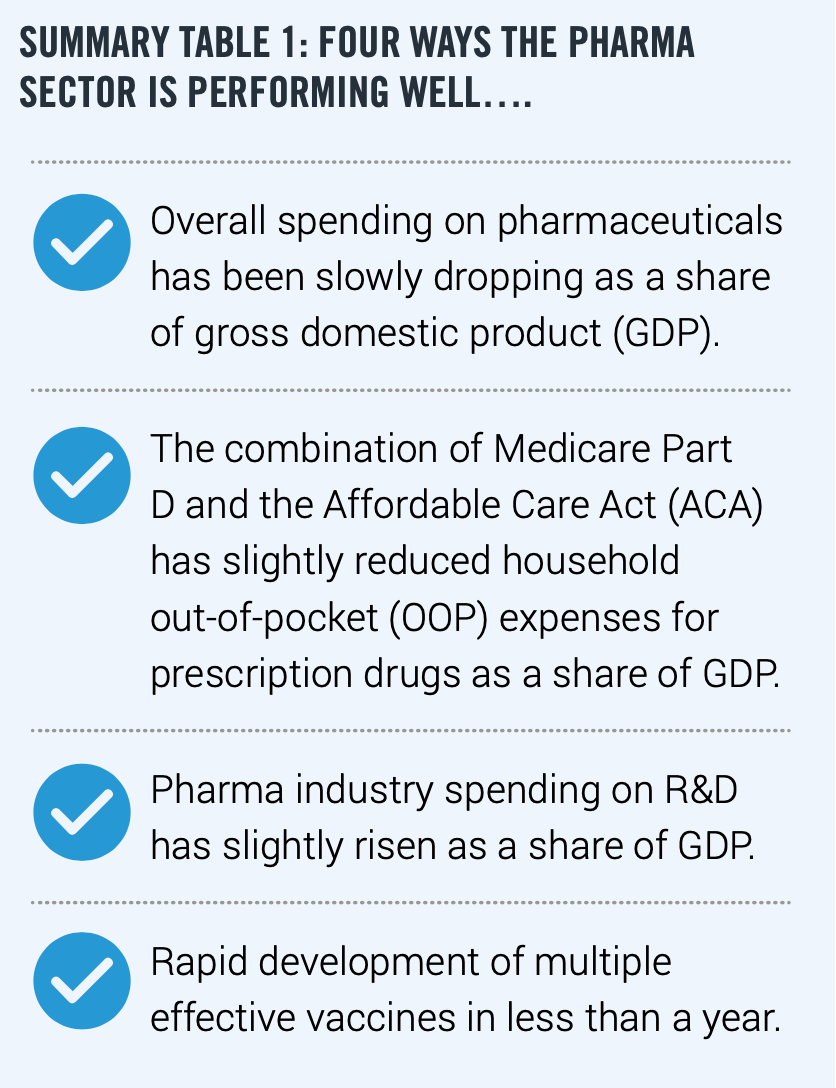
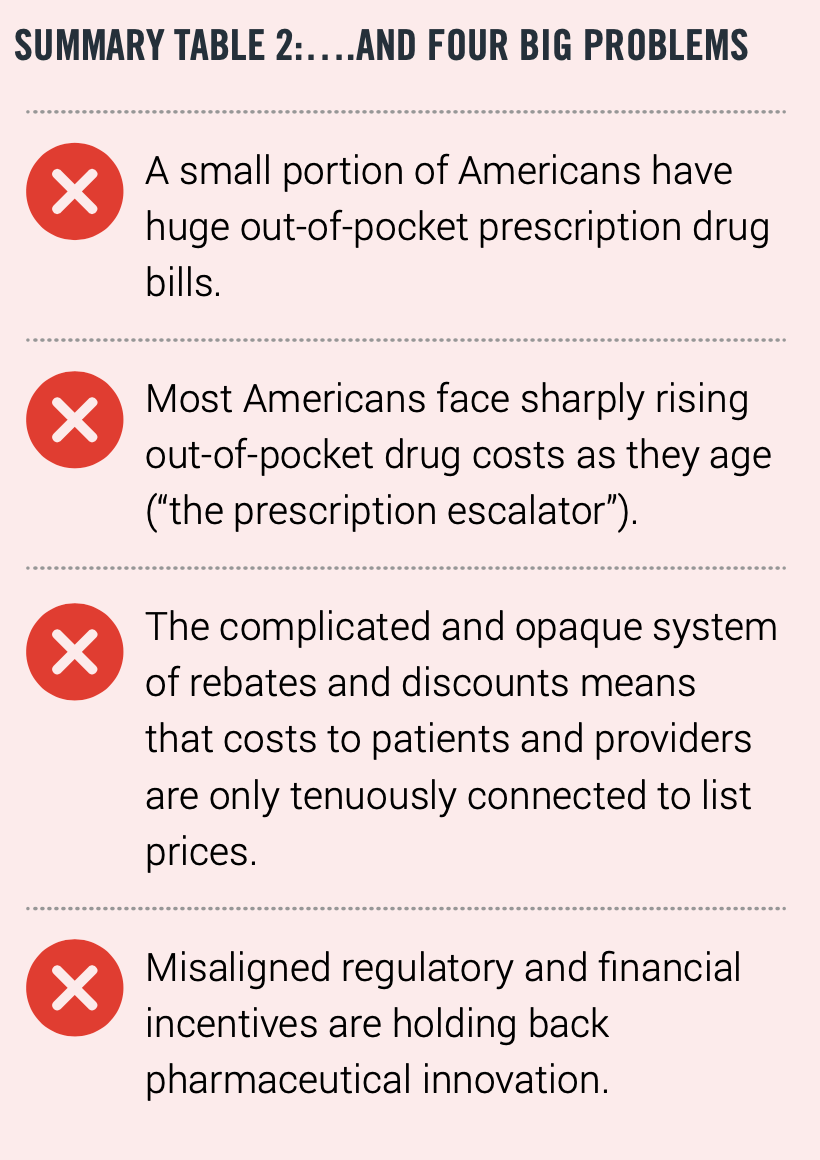
In this paper we summarize the state of today’s pharma sector with four ways it is performing well and four big problems.

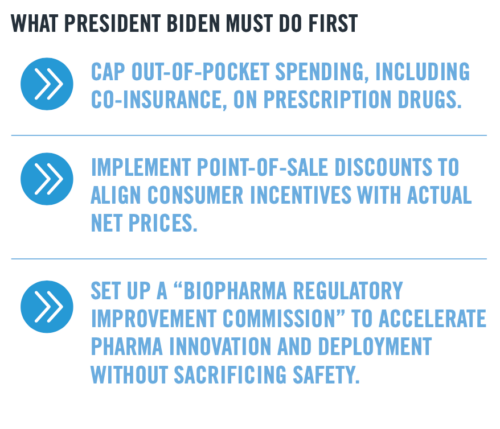
Then we propose three key policy proposals that the Biden Administration can use to address the problems:

  1. A cap on out-of-pocket costs, including co-pays, similar to legislation proposedin 2018, should dramatically improve Americans’ experiences with drug pricing.
  2. A shift to point-of sales rebates should benefit consumers and align their incentives with actual net prices.
  3. Building on the successful rapid creation and testing of the Covid vaccines, President Biden should convene a high- level “Biopharma Regulatory Improvement Commission” to accelerate pharma innovation and deployment in order to boost health and cut costs.


EXECUTIVE SUMMARY

The U.S. pharmaceutical industry is one of the nation’s crown economic jewels. It is also one of its knottiest policy problems. The pandemic performance of U.S. pharma companies, working in concert with global partners, has been nothing less than outstanding. Producing multiple safe and efficacious vaccines in less than a year is a testament to the expertise and capabilities of the industry.

On the other hand, Americans have a deeply held distrust of the pharma industry. A Gallup survey taken in summer 2020 still showed the pharmaceutical industry at the bottom of the American approval list, ahead of only the federal government. True, that’s a gain over the previous year, when it was literally rock bottom, but it still isn’t good.

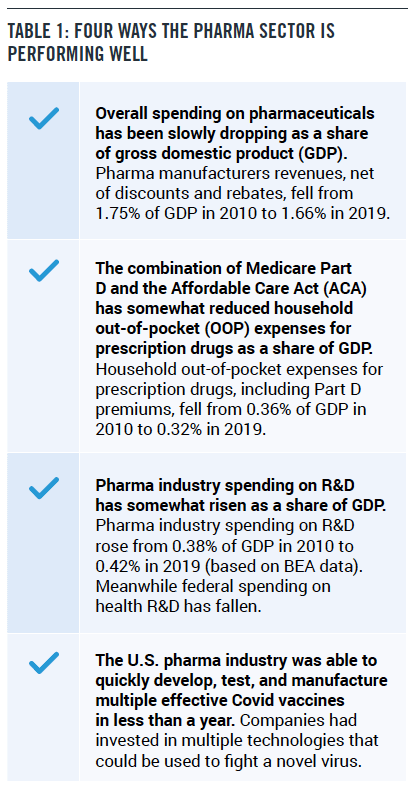
In this paper, we identify four ways that the U.S. pharma sector is performing well, and four big problems (Summary Table 1). Some of them are surprising, in a positive sense. For example, despite all of the headlines about cost pressures, overall spending on pharmaceuticals has been slowly dropping as a share of GDP. Pharma manufacturers revenues, net of discounts and rebates, fell from 1.75 percent of GDP in 2010 to 1.66 percent in 2019 (based on IQVIA Institute data). Also surprisingly, household out-of-pocket expenses for prescription drugs, including Part D premiums, fell from 0.36 percent of GDP in 2010 to 0.32 percent in 2019 (based on national health expenditures data from the Centers for Medicare and Medicaid).

On the negative side, a small portion of Americans have huge out-of-pocket prescription drug bills. In 2018, roughly 1 percent of Americans paid more than $2,000 in out-of- pocket drug expenses, not including Part D premiums (based on our analysis of Medical Panel Expenditure Survey data).

Equally worrisome, most Americans face sharply rising out-of-pocket drug costs as they age. This “prescription escalator”—the result of a steep age-usage curve and per-prescription copays— has the effect of increasing individual spending by 5-6 percent per year, even if underlying drug prices are flat.


How can President Joe Biden address these problems, while taking advantage of the good features of the U.S. system? To address the political and human toll of the current system of pharma insurance, Biden should support legislation to cap out-of-pocket drug payments. That’s the best way to control the low but real possibility of huge out-of-pocket payments. It’s also the best way to get a handle on the “prescription escalator”—the sharp rise in out-of- pocket payments as Americans age.

Second, Biden should preserve the recently finalized Medicare Part D Rebate Rule that replaces drug rebates with point-of-sale consumer discounts. Discounts paid directly to consumers at the point of sale, rather than rebates paid retrospectively to insurers or pharmacy benefit managers, would significantly lower out-of-pocket costs, clarify the true cost of prescription medications, and allow consumers and physicians to make better cost-benefit trade-offs. The would also be a good launching pad towards the introduction of new legislation to enact similar changes in the commercial market. Together, these changes would fix the opaque rebate system and could create the conditions for list prices to come down.


Third, Biden should take a page from the successful Covid vaccine effort. U.S. businesses and government agencies have spent almost $2 trillion since 1995 on biotech and other health-related R&D, and this knowledge was mobilized quickly to generate new vaccines and therapies. Still, in the normal course of business it would have taken years rather than months to bring the new technology to bear. What’s needed is a high-level “Biopharma Regulatory Improvement Commission” to identify the regulatory and financial impediments to faster useful biopharma innovation, without sacrificing safety at all.

INTRODUCTION

The U.S. pharmaceutical industry is one of the nation’s crown economic jewels. It is also one of knottiest policy problems faced by Washington. The pandemic performance of US. pharma companies, working in concert with global partners, has been nothing less than outstanding. The production of multiple safe and efficacious vaccines in less than a year is a testament to the expertise and capabilities of the industry.

On the other hand, Americans have a deeply held distrust of the pharma industry. A Gallup survey taken in summer 2020 still showed the pharmaceutical industry at the bottom of the American approval list, ahead of only the federal government. True, that’s a gain over the previous year, when it was literally rock bottom, but it still isn’t good.

President Joe Biden comes into office with a comprehensive plan for dealing with what he calls “runaway” drug prices, including establishing an independent review board to assess the value of new drugs, and limiting list price increases for all brand, biotech, and “abusively priced” generic drugs to the rate of inflation.

But Biden’s plan may be aiming at the wrong targets. The two best aggregate measures of the economic burden of pharma spending— overall net spending on pharmaceuticals as a share of GDP and household out-of-pocket drug spending, including Part D premiums, as a share of GDP—have been trending down, not up.

Proposals to restrain list prices are not likely to accelerate these aggregate declines. List prices are important, but because of rebates and discounts they do not directly correlate payments to manufacturers or with out-of-pocket spending by households.

While proposals to restrain list prices may be helpful for patients lacking insurance, and among those in plans with high deductibles and coinsurance, list prices do not typically reflect the price that most patients pay out of pocket due to the impact of rebates and discounts on plan benefit designs.

True, an increasing share of prescriptions are reimbursed by means of co-insurance, which apparently sets the out-of-pocket cost for a drug as a fixed percentage of the list price for that drug. But even then, remember that insurance companies control that apparently fixed percentage and can easily raise it any time they want. As a result, lowering the list price of a drug might or might not decrease the out-of-pocket cost, depending on how the insurance company adjusts the cost-sharing arrangements.

The real problem lies in the way the drug reimbursement system has evolved over the years, exposing Americans to co-pays that seemingly shift randomly from year to year, a small portion of Americans have huge out- of-pocket prescription drug bills, which is bad enough. Most Americans face sharply rising out-of-pocket drug costs as they age (“the prescription escalator”). In some ways the drip- drip of drug co-pays is a form of psychological torture.

To address the political and human toll of the current drug reimbursement system, Biden must support legislation to cap out-of-pocket drug payments. One model is the Capping Prescription Costs Act of 2018, introduced
by Sens. Elizabeth Warren (D-Mass.) and Ron Wyden (D-Ore.) which set caps for prescription drug copays at $250 per month for individuals and $500 per month for families. That’s the best way to control the low but real possibility of huge out-of-pocket payments. It’s also the best way to get a handle on the “prescription escalator”— the sharp rise in out-of-pocket payments as Americans age.

Equally important, Biden should support the implementation of the Medicare Part D rebate safe harbor final rule and propose follow-on legislation that would encourage point-of-sale discounts in the commercial market as well. These discounts would finally reach consumers directly (instead of insurers or pharmacy benefit managers). From an economic perspective, this approach has several virtues. It can lead to a substantial reduction in out-of-pocket costs at the point of sale, clarify the true cost of prescription medications, allow consumers and physicians to make better cost-benefit trade- offs. Importantly, it would ensure that patient coinsurance is based off of net prices (vs list prices), which is far easier for everyone to understand.

Finally, Biden should learn a lesson from the successful Covid vaccine effort. The mRNA vaccines from Pfizer and Moderna show
that with the right motivations, advanced biotechnology that might have otherwise languished on the shelf can innovate and createbeneficial medicines.

What we need now is a focused effort to get most useful drug innovations out of the almost $2 trillion that businesses and government agencies have spent in the U.S. on health- related R&D since 1995. With the successful Covid vaccine effort as a role model, what’s needed is a high-level “Biopharma Regulatory Improvement Commission” to identify the regulatory and financial impediments to useful innovation.

THE FACTS: HOW THE PHARMA SECTOR IS PERFORMING WELL

Before addressing policy changes, we must understand what’s working and what isn’t about the sprawling system of drug innovation, spending, and reimbursement. The common belief is that drug spending is out of control. But a reality-based analysis, based on solid statistics, paints a very different picture.

Let’s briefly go through each of these:

» Positive Fact #1:
Overall net spending on pharmaceuticals has been slowly dropping as a share of gross domestic product (GDP).

Net spending on pharmaceuticals is defined as the net amount that drug manufacturers receive for their products, after accounting for rebates and other price concessions. The difference between drug spending calculated with list prices vs net prices is huge and growing. In 2019, for example, the IQVIA Institute estimated that the net revenue received by manufacturers of $356 billion was 47 percent below drug spending valued at list prices, $671 billion. By comparison, this gap between net revenues and spending valued at list prices was only about 37 percent in 2014 and 34 percent in 2010.

Net revenues as a share of gross domestic product (GDP) are a good measure of the burden of pharmaceutical spending on the overall economy, representing the amount paid to manufacturers. Since 2010, net manufacturer revenue has increased by 36 percent, compared to a 48 percent increase in overall gross domestic product. As a result, net manufacturer revenue as a share of GDP fell from 1.75 percent of GDP in 2010 to 1.66 percent in 2019.

What this information tells us is that the overall burden of drug spending on the economy— consumers, private companies, government, hospitals, insurance companies, wholesalers, pharmacy benefit managers—has been falling slightly. But analyzing the impact on any particular market participant is very difficult, because the discounts and rebates are so opaque.

» Positive Fact #2:
The combination of Medicare Part D and the Affordable Care Act (ACA) has slightly reduced household out-of-pocket (OOP) expenses for prescription drugs as a share of GDP.

You wouldn’t know it from all the Congressional hearings that feature Americans having trouble paying for drugs. But on average, the drug cost burden on households has been falling over time, measured as a share of household income or GDP. That’s true, even if we include Medicare Part D premiums when calculating out-of-pocket spending, since from the perspective of Part D participants their premiums also come out of their pockets.

Based on the latest CMS data, released in December 2019, household out-of-pocket expenses for prescription drugs, including Part D premiums, fell from 0.36 percent of GDP in 2010 to 0.32 percent in 2019. Other data sources, such as the Consumer Expenditure Survey from the Bureau of Labor Statistics, show roughly the same pattern.

These figures measure the average burden on households. As we will see later, there are outliers who have to pay much more. But at least the aggregate data is positive.

» Positive Fact #3:
Pharma industry spending on R&D has slightly risen as a share of GDP.

One of the great paradoxes of the U.S. health care system is the poor perception many Americans have of the pharmaceutical industry. Nevertheless, pharma companies have been taking on more of the financial burden and risk-taking associated with drug research and development over the past decade, even while public sector funding has stagnated. Since 2010, federal and state spending on health-related R&D, mostly through NIH, has only risen by 7 percent, from $35.2 billion in 2010 to $37.6 billion in 2019.

The pharma industry spending on R&D items such as pre-clinical drug development and clinical trials has skyrocketed, from $57.3 billion in 2010 to $89.8 billion in 2019, according to figures from the Bureau of Economic Analysis (BEA). This corresponds to an increase of 57 percent, faster than the 48 percent gain in GDP over the same period. As a result, pharma industry spending on R&D rose from 0.38 percent of GDP in 2010 to 0.42 percent in 2019 (based on BEA data).

» Positive Fact #4:
The U.S. pharma industry was able to develop safe and efficacious vaccines within a year

Using a variety of different approaches, pharma firms in the United States and around the world were able to create safe and effective vaccines in less than a year. First out of the gate were Pfizer and Moderna with their mRNA-based vaccine technologies, never before successfully used for a vaccine. However, other vaccines using more familiar technologies are not far behind.

But the big advantage of mRNA vaccine technology is that it can be quickly adjusted to new variants of Covid. Moreover, now that the technology has been shown to be effective, it has the potential to quickly create vaccines against other viral scourges, such as influenza and HIV. So the silver lining from the Covid cloud is that it may have opened up new avenues for dealing with disease.

WHERE THE PROBLEMS ARE

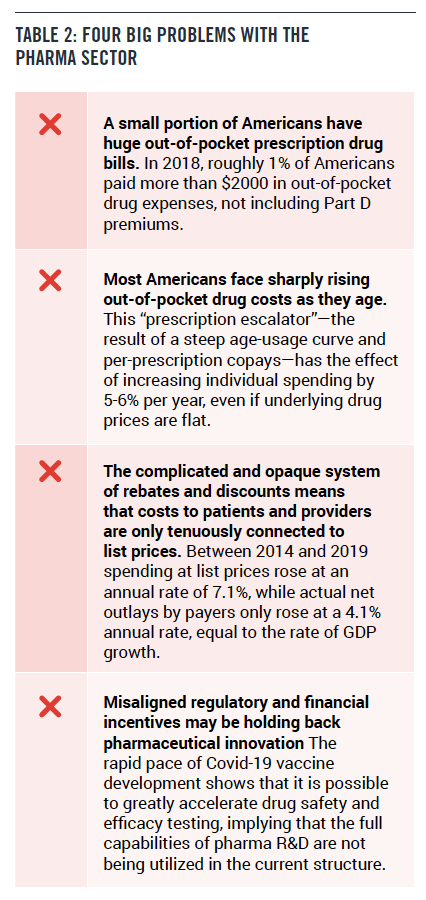
We certainly don’t want to leave the impression that the pharma sector and pharma pricing are free of blame. An honest approach also tells us where four big problems are, as shown in Table 2.

» Negative Fact #1:
A small portion of Americans have huge out-of-pocket prescription drug bills.

One staple of the drug price debate are congressional hearings that highlight heartbreaking stories of people who can’t afford to pay for their medicines. Are these people reflective of a broader problem?

The answer is yes and no. In fact, our analysis of 2018 MEPS data suggests that over 3 million Americans paid more than $2000 in out-of- pocket drug expenses in 2018, not including Part D premiums. That’s about 1 percent of the population, but it’s still an unacceptably high number that need to be addressed by policymakers.

Consider the high cost of insulin, a product with huge rebates. Indeed, rebates for insulin products often reach as much as 70 percent of the list price, so the net price after rebates is much lower than the list price. However, those rebates are typically paid to the health insurance company or the prescription benefit managers (PBM), rather than to the consumer.

As a result, patient coinsurance is often based on the list price, while high manufacturer rebates are collected by insurers. At the same time, benefit designs that place even higher out-of-pocket burdens on patients continue to grow, exacerbating affordability challenges for patients.

» Negative Fact #2:
Most Americans face sharply rising out-of- pocket drug costs as they age.

In addition to the small but significant fraction of the population with high out-of-pocket costs, the widespread anger of Americans at drug companies is fueled by what we call the “prescription escalator.”

It turns out that the use of medicines can rise steeply as people age. For example, in 2018, individuals between the ages of 35 and 44 filled an average of 7.2 prescriptions, including refills, compared to an average of 12.2 prescriptions for those between the ages of 45 and 54 and 18.1 prescriptions for those between the ages of 55 and 64. This 150 percent increase in the number of prescriptions as people age corresponds to an equivalent rise in prescription drug spending, since the structure of health insurance generally charges co-pays for each prescription. This “prescription escalator”—the result of a steep age-usage curve and per-prescription copays—has the effect of increasing the typical individual’s spending by 5-6 percent per year, even if underlying drug prices are flat.

Indeed, even if underlying drug prices are flat, most Americans see their drug spending rise year after year much faster than other types of medical spending. As a result, the share of out- of-pocket spending going to drugs increases as Americans age, making it seem like drug costs are more of a burden.

» Negative Fact #3:
The complicated and opaque system of rebates and discounts means that costs to patients and providers are only tenuously connected to list prices.

We have decent measures of how much consumers pay for drugs through various surveys. We also have good measures of how much pharma manufacturers receive in net revenues, because that number is reported on financial statements. But the flows of money back and forth through PBMs, insurance companies, and hospitals are much more opaque. The rebates and discounts are not simply a percentage of the price. Sometimes they are tied to volume, sometimes to the efficaciousness of the drug, and sometimes they are mandated by law. Much of the time, they are not public.

However, it’s clear that list prices bear only the slightest resemblance to the actual net costs. On an aggregate level, between 2014 and 2019 spending at list prices rose at an annual rate of 7.1 percent, far faster than GDP growth. Meanwhile, actual net outlays by payers only rose at a 4.1 percent annual rate, equal to the rate of GDP growth (based on data from the IQVIA Institute).

The lack of connection between list and net prices makes it very hard for consumers, doctors and policymakers to understand the true cost of drugs.

» Negative Fact #4:
Misaligned regulatory and financial incentives may be holding back pharmaceutical innovation.

Before the Covid pandemic, there was a sense among economists that the enormous spending on biopharma basic and applied research had underperformed. The promise of biotech had been cheaper, faster drug development and a raft of new cures. Instead, the cost of drug development had soared, and only 14 percent of drugs that enter clinical trials get approved.

There are three leading hypotheses, all of which may have some degree of truth:

  • The intricacies of medicine and the human body are more complicated than first thought.
  • The desire for profits could be diverting biopharma firms from truly important drug development.
  • Excessive or misdirected regulation could be raising drug development costs and slowing down biotech innovation.

Facing pressure from the pandemic, regulators and manufacturers were able to work together to greatly accelerate the pace of Covid-19 vaccine development, innovating to bring new technologies into the market without compromising drug safety and efficacy testing. Companies developed vaccines and tested them, even while building manufacturing facilities. The government issued fixed-price contracts for millions of doses to transfer risk to Washington, which could bear it.

As everyone knows, the process produced several successful vaccines. This implies that the full capabilities of private and public R&D are not being utilized in the current regulatory and financial structure.

IMPLICATIONS FOR POLICY

Americans deal with a very complicated reimbursement scheme for drugs, where the list price has very little connection with either the net price that manufacturers receive, or the out-of-pocket expenses paid by patients. Some out-of-pocket costs are set as a percentage of the list price in terms of co-insurance, but that’s variable as well, since the insurance companies can adjust the co-insurance percentage when they set up their plans each year.

To meaningfully improve prescription drug affordability, President Biden should pursue reform of plan benefit designs that directly reduces out-of-pocket costs for consumer. Capping out-of-pocket costs, for example, is both relatively simple and delivers significant political bang for the buck.

One particular model is the Capping Prescription Costs Act of 2018, introduced by Sens. Elizabeth Warren (D-Mass.) and Ron Wyden (D-Ore.) which set caps for prescription drug copays at $250 per month for individuals and $500 per month for families. That’s the best way to control the low but real possibility of huge out-of-pocket payments. It’s also the best way to get a handle on the “prescription escalator”—the sharp rise in out-of-pocket payments as Americans age.

How expensive would this or a similar program be? Suppose our target was to hold annual out-of-pocket costs down to $2000 per year for individuals. Based on our analysis of 2018 MEPS data, that cap would cost $2.4 billion annually for people 65 and over, less than 3 percent of total expenditures by Medicare Part D, the prescription drug benefit program, net of rebates.

As a complementary effort, President Biden should preserve the recently finalized Medicare Part D Rebate Rule that replaces drug rebates with point of sale consumer discounts. Such discounts would be paid directly to consumers rather than to insurers or pharmacy benefit managers. Such a program would have several effects. First of all, the rebates on expensive drugs would actually benefit the patients taking those drugs. That’s what Americans really want.

Point-of-sale consumer discounts would also clarify the true cost of prescription medications and allows consumers and physicians to make better cost-benefit trade-offs. And it would largely address the problems associated with the disconnect between list and net prices. An opaque system does not foster good decision- making. Finally, the Medicare Part D Rebate Rule could also serve as a launching pad towards similar legislation in the commercial market.

Finally, Biden should help regulators and companies learn the right lesson from the successful Covid vaccine effort. The biopharma sector had an enormous stockpile of knowledge and manufacturing know-how that mobilized quickly to generate new vaccines and therapies. The government supported the effort with funding and fixed-price contracts to buy hundreds of millions of doses of the still-yet unproven vaccines. While there are issues with distribution, the development and production worked as well as could be expected.

Still, under the usual regulatory framework and business decision-making it would have taken years rather than months to bring the new technology to bear. The FDA has its usual step-by-step procedures which tend to discourage disruptive but potentially beneficial innovations. Pharmaceutical manufacturers, which invest huge amounts in R&D, are naturally attuned to the regulators and the need to focus on drugs that will get through the approval process.

Biden should appoint a high-level “Biopharma Regulatory Improvement Commission” to identify the regulatory and financial impediments to faster useful biopharma innovation. PPI has in the past proposed a new approach to improve regulations without sacrificing consumer and worker protection. Such legislation has been introduced several times in Congress.

What Biden needs now, though, is a commission that is narrowly focused on finding a way to accelerate biopharma innovation, without sacrificing an ounce of safety. At the end of the day, the best way to reduce the cost of medications may be to improve the ease of innovation.


A Better Public Health Approach to Tobacco

For those concerned about nicotine addiction and tobacco consumption, a ban on flavored tobacco might sound like a good idea. But as Nkechi Taifa explains in this week’s PPI Podcast, such bans are going to almost entirely fall onto minority communities.

Several states are considering or have already banned flavored tobacco. Nkechi Taifa agrees with Crystal Swann that in time a time when we are rolling back the war on drugs in favor of a public health approach, we should be doing the same with tobacco.

PODCAST: A Better Public Health Approach to Tobacco

For those concerned about nicotine addiction and tobacco consumption, a ban on flavored tobacco might sound like a good idea. But as Nkechi Taifa explains in this week’s PPI Podcast, such bans are going to almost entirely fall onto minority communities.

Several states are considering or have already banned flavored tobacco. Nkechi Taifa agrees with Crystal Swann that in time a time when we are rolling back the war on drugs in favor of a public health approach, we should be doing the same with tobacco.

Tune in here or wherever you get your podcasts.

Moderate Democrats are the key to Biden’s success

Written by Ben Ritz and Will Marshall

It’s been less than a week since President Biden took office, but Washington’s tribal gladiators already are arming for mortal combat. Fortunately, pragmatic Democratic lawmakers are working to help Biden avert a relapse into political paralysis.

Senate Republicans are bewailing Biden’s $1.9 trillion American Rescue Plan to end the pandemic and help jobless workers and small businesses tread water until it’s over. Though few complained when his predecessor broke the trillion-dollar deficit barrier – despite a then surging economy – Republicans now profess to be shocked by the “colossal waste” (Sen. Pat Toomey) of Biden’s “massive spending” package (Sen. Rick Scott).

Such hypocrisy is galling, and it has tripped the progressive left’s hair-trigger outrage alarm. Activists who didn’t support him in the first place fret that Biden is too eager to compromise in the name of the national “unity” he movingly invoked during his inauguration. They insist he waste no time in pressuring Senate leadership to kill the filibuster so Democrats can steamroll Republicans, at least for the next two years.

Everyone should take a deep breath. President Biden is anything but a political naif. Having been on the receiving end of Sen. Mitch McConnell’s deeply unpatriotic strategy of total obstruction for eight years, he doesn’t need lectures from sectarians in his own party about how rabidly partisan the other side can be.

But Biden understands he was elected to save our democracy from an unhinged demagogue, not to join Republicans in fomenting intractable enmity between red and blue America. He also knows from bitter experience that one-party rule is inherently unstable and fuels political paranoia and extremism.

Read the full piece here.

Biden, Congressional Democrats Have Rare Chance to Highlight, Fix America’s Broken Higher Education Financing Model

WASHINGTON, D.C. — A new brief released today from the Progressive Policy Institute (PPI) commends President Biden’s bold vision to ease student debt burdens. The brief calls on the Administration to help borrowers in more meaningful ways by fixing America’s broken financing model for higher education, and investing in non-college pathways to good jobs.

Key highlights from the brief: 

  • More than 1/5 households hold a student loan, up from 1/10 in 1989.
  • Millennials, who are already saddled with lower wages and lingering economic pains from the Great Recession, hold $497.6 billion in outstanding loans.
  • Education debt is a generational/equity crisis. Borrowers are more likely to be lower-income, Black, and less likely to have generational wealth, making them more likely to default, which can lead to further worsening of poverty and the racial wealth gap.
  • Biden has faced calls to cancel $50,000 in education debt for borrowers but the evidence suggests that this could be regressive and benefit many high-income households who don’t need relief.
  • Education debt relief should not be a one-time fix. President Biden and Congress need to meaningfully address America’s broken financing model for higher education and invest in non-college pathways to good jobs.

The policy brief calls for the Biden Administration to take important key steps, including: 

  • Auto-enrollment in income-based repayment as opt-out for new and existing loans.
  • Modernize the Public Service Loan Forgiveness Program to reward national or community service for our public servants and create incentives for public service.
  • Accelerate attainment of credentials by making the process for earning college credit through Advanced Placement (AP), International Baccalaureate (IB) programs, and college courses taken in high school at community colleges, more transparent and accessible.

Veronica Goodman, PPI’s Director of Social Policy and author of the brief, said this:

“President Biden and Congressional Democrats have a rare opportunity to move fixing America’s broken higher education financing model to the center of the nation’s agenda.

They should follow targeted education debt relief with bold progressive reforms aimed at two critical national goals: Lowering college costs and thereby reduce the need for borrowing, and boosting public  investment in the skills and career prospects of the majority of young Americans who do not get college degrees.”

Read the full report here.

Memo to President Biden: The Progressive Way to Ease Student Debt Burdens

Note: In this brief, I use the term education debt, rather than student debt, since most affected borrowers are no longer students, and this category of debt affects a wide swath of society, not just students.          

After his inauguration on January 20, one of President Joe Biden’s first official acts was signing an executive order to extend the pandemic-related pause on student loan payments and interest, as well as to halt collection of student loans in default, through September 30. For millions of young Americans struggling to pay off college loans, the order will be a welcome down payment on Biden’s campaign promise to deliver major debt relief.

While campaigning for the presidency last spring, Biden unveiled a plan to forgive a minimum of $10,000 per borrower. The President’s advisers say the administration will submit a legislative proposal for debt relief to the new Congress. 

The case for relief is strong. Over the past four years, the Trump administration and Republican lawmakers have provided little in the way of help for struggling borrowers beyond the temporary pause on repayments. With young people struggling to keep their heads above water amid the Covid pandemic and recession, it is no surprise that Democratic policymakers are looking for ways to relieve their financial stress.  

In May 2020, House Democrats also called for $10,000 worth of education loan relief for “distressed” borrowers as part of their Health and Economic Recovery Omnibus Emergency Solutions (HEROES) bill. This category of borrowers included those with delinquent or defaulted loans, and others considered “financially distressed.” According to the U.S. Department of Education, as many as 20 percent of education loans are in default. This provision got caught up in partisan wrangling over the size and cost of the HEROES act, and was dropped from the compromise stimulus bill Congress passed in late December 2020. 

Since his victory last November, Biden has faced persistent calls from progressives to forgive education debt for the 45 million Americans who owe close to $1.6 trillion in loans. Sens. Elizabeth Warren and Chuck Schumer dramatically raised the bidding by urging Biden to take executive action to forgive up to $50,000 of federal education debt. Reps. Ayanna Pressley (D-MA), Ilhan Omar (D-MN), Alma Adams (D-NC), and Maxine Waters (D-CA) introduced a companion resolution in the House in December 2020.  

Although popular on the left, such calls to “go big” have drawn a skeptical response from many independent analysts. “In sheer magnitude, canceling $50,000 in student debt would rank among the largest transfer programs in U.S. history,” notes the Brookings Institution’s Adam Looney. “At a cost slightly above $1 trillion, it would equal the total amount spent on cash welfare since 1980. And its largest effect would be to improve the finances of college-educated workers, who have already tended to be winners in an economy marked by ever-rising inequality.” 

President Biden likewise has expressed skepticism about the distributive impact of these proposals. He’s also told Congressional Democrats he would prefer a legislative fix to an easily reversible executive order – something that looks more likely after the January 5 Georgia runoffs flipped control of the Senate to his party.

Digging into the data on the demographics of Americans with education debt, it becomes clear that Biden’s approach isn’t just more affordable, it’s also more progressive and equitable. Approximately 48 percent of outstanding student loans are held by those with graduate degrees; that is double the share of those who owe loans and earned an Associate’s degree or less. In fact, slightly over a third of all education debt is concentrated in the highest income quartile – households making over $97,000 per year.

Without better targeting, debt relief would mostly benefit higher-income households, which hold a third of student loans and have greater ability to pay them back. A 2019 analysis by the Urban Institute finds that “forgiving larger amounts of debt would distribute a larger share of benefits to higher-income households, and reducing the amount of debt forgiven should increase the share of benefits going to lower-income households.” Based on this analysis, the $50,000 proposed by Sens. Warren and Schumer would have regressive effects and distribute relief to households at the top of the income scale. 

In contrast, Biden’s plan aims at lower-income borrowers who need debt relief the most. Relief in the amount of $10,000 per borrower would eliminate all debt for 37 percent of borrowers (16.3 million people) and cut in half debts owed by another 9.3 million borrowers at an estimated cost between $250-300 billion. These borrowers are disproportionately young and low-income, and include veterans, single parents, and those in a minority group. Two-thirds of borrowers that default on their payments owe a comparatively low average amount of $9,625. These borrowers also are less likely to repay their loans because they never completed their college degrees or earned only a certificate.

However, it’s not clear whether President Biden’s plan will include an income-based eligibility test to ensure that relief is concentrated on needy rather than affluent families. PPI recommends that the administration target its plan by phasing out relief for borrowers making over $125,000. This would address concerns that about the regressive nature of untargeted debt relief and substantially reduce the cost of the proposal. 

Perhaps most important, the President’s approach recognizes the limits of debt relief and leaves fiscal space for tackling the fundamental problem: America’s broken financing model for higher education. Over the past two decades, the cost of higher education has approximately doubled and ballooning tuition prices have forced students to borrow more to finance their education.

Although federal subsidies – chiefly grants and loans – tilt heavily toward college-going young people, college is not the only pathway to good jobs for young adults and U.S. workers. It’s true that the average college-educated worker reaps a lifetime premium of higher earnings in the labor market. But most Americans don’t go to college. As of 2019, 70.1 percent of Americans 25 and older had not earned a four-year degree, while just 29.9 percent earned a four-year degree or higher. Given his well-known empathy for the struggles of America’s working-class families, PPI recommends that the President pair debt relief with increased public investment in apprenticeships and work-based “career pathways” training programs that connect workers, including those coming out of high school, to well-paying careers.  

PPI has proposed a suite of ideas for how to expand career pathways to employment for millions of Americans including investments for a 10-fold increase in apprenticeships, creating incentives for partnering public and private programs that focus on transferable skills and credentials, and incentivizing private intermediaries who create “outsourced” apprenticeships programs. Although they are beyond the scope of this memo, PPI believes these and related ideas are crucial to ending the bias in federal policy toward college-bound youth. We hope the Biden administration will give high priority to investing more in building a robust system of work-based learning, career training, and apprenticeships for the majority of young Americans who don’t attend four-year colleges.

Recommendations for the Biden Administration

  • Draft legislation to provide $10,000 in immediate education debt forgiveness for those with an annual income of less than $125,000 per year. This will deliver relief for those at greatest risk of defaulting on their student loans, especially students from low-income and minority families. The estimated cost of President Biden’s plan is $250-300 billion, and it would eliminate all education debt for 37 percent of borrowers (16.3 million people) and cut in half debts owed by another 9.3 million borrowers. Our recommendation of an income-based eligibility test is expected to reduce the overall cost.
  • Continue giving borrowers a break on payments and interest by extending the pause on federal student loan payments for the duration of the pandemic and Covid recession. President Biden has extended the pause through September 30.
  • Make income-based repayment more accessible and generous for borrowers. Switching to a universal IBR system that is opt-out for new and existing loans, and which automatically re-enrolls borrowers, would make payments more manageable and automatically tied to income, decreasing the likelihood of default and missed payments. 
  • Modernize the Public Service Loan Forgiveness Program to reward national or community service for our public servants by offering $10,000 of education debt relief for every year of service up to five years—after which the loan would be forgiven. This would include individuals with up to five years of prior service and automatically enroll workers in schools, government, and other nonprofit organizations. This would encourage workers to pursue careers in public service.
  • Accelerate attainment of credentials by making the process for earning college credit through Advanced Placement (AP), International Baccalaureate (IB) programs, and college courses taken in high school at community colleges, more transparent and accessible, as PPI’s Paul Weinstein has argued.

Education Debt Has Led to a Social Crisis, Which the Pandemic Has Made Worse

Those who have borrowed for degrees are more likely to be lower-income, Black, and less likely to have generational wealth, making them more likely to default, which can lead to further worsening of poverty and the racial wealth gap. To understand why the proposal of $10,000 relief per borrower could have the most impact on lower-income families and those most struggling during the pandemic, it is worth digging into the demographics of who is behind on payments and what groups are holding the most debt:

  • According to the U.S. Department of Education, 20 percent of borrowers are in default, and a million more go into default each year. Two-thirds of borrowers who default never completed their college degrees or earned only a certificate and owe a comparatively low average amount of $9,625. Those who default include veterans, parents, and first-generation college students who are more financially vulnerable to default. Without a credential and with limited access to good jobs, borrowers are forced to default and, in doing so, accrue additional interest and fees on the principal loan. These borrowers are in no position to pay back their defaulted loans.

Default can have catastrophic implications for future access to credit, and result in garnished wages, seized tax refunds, and harm other measures of financial wealth. Given the age at which most of these borrowers took out loans, many begin their adulthood at an economic disadvantage. At this scale, the education debt crisis is not only hurting those who are struggling the most, but it is holding back an entire generation with negative implications for their children’s generation. The financial strain the pandemic has inflicted on workers will make it more difficult for defaulted borrowers to get back on track with payments.

Debt Relief: Down Payment on Reform

As the pandemic rages, and more Americans lose their jobs and businesses, short-term education debt relief can help our most vulnerable borrowers ride out the storm. But we also need longer-term, structural reforms aimed at driving down the tuition costs for both college and post-secondary skills training. 

Short-Term Relief and Considerations

The Trump administration implemented limited short-term relief for education debt by temporarily suspending loan payments through February 2021 on federal educational loans as of March 2020. Further short-term relief is desirable, in line with President Biden’s proposal for $10,000 of forgiveness. As one of his first actions in office, President Biden signed an executive order extending the pause on student loan payments and interest through September 30. Biden should continue to extend the pause as long as the Covid recession continues to place financial strain on borrowers.

Reviewing the data, education debt forgiveness targeted at borrowers with low incomes and the unemployed would have the greatest impact. However, some concerns remain over how policymakers can target relief to those who need it the most. Some experts have suggested that policymakers could isolate undergraduate debt from graduate school debt in order to prioritize these more needy borrowers. This would avoid regressive effects that could give a large portion of relief to those with graduate school debt, such as doctors and lawyers, that are in a better financial position to pay back their loans. At the $10,000 level, however, the Biden plan avoids many of the greatest concerns about the potential for regressive outcomes relevant to higher dollar per borrower proposals. Adding an income cap of $125,000 for borrowers will target relief for households who need it the most.

Following dramatic victories in the Jan. 5 Georgia run-off elections, Democrats have taken control of the Senate. This likely clears the way for legislation to provide debt relief, as President Biden prefers. Citing the need for action during the pandemic and recession, some Democrats have been urging him to use a provision in the Higher Education Act to sidestep legislation and cancel the balances of millions of Americans. That would likely trigger legal challenges, and Biden is right to first seek a legislative fix using budget reconciliation.  

Advisers of President Biden have suggested that education debt relief could be included in anticipated stimulus legislation aimed at pandemic relief. On the other hand, a legislative path for education debt relief could also take longer if additional relief legislation proves difficult to enact in the near term, a worthy consideration given the present economic crisis. 

More difficult to measure are the intangible or second-order benefits that education debt relief would bring to borrowers, especially those who have defaulted. Worries about their debt burdens undoubtedly affect their career choices, such as whether to pursue a public interest job, and their life choices, such as whether and when to buy a house or have a child. Those with significant education debt are more likely to experience depression and anxiety as a direct result of their debt, which can lead to mental health issues down the road. Mental health experts point to Millennials coming of age with slower economic growth than any other generation in history as part of the reason for why their mortality rates, driven by suicides and drug overdoses, have risen sharply since 2008. It is also difficult to capture the effect that education debt relief would have on rates of entrepreneurship in younger generations or how intergenerational wealth might change if millions were no longer in default and saddled with debt.

Long Term Solutions

Targeted education debt relief is only a temporary fix. There are several other policy solutions that would help address the education debt crisis.

Congress should also adopt Biden’s proposal to modernize income-based repayment (IBR), loans. Such programs calculate a borrower’s monthly payment based on their income and other factors, such as family size and location. Currently, borrowers must opt-in to IBR through a lengthy process. Automatically enrolling new borrowers and re-enrolling existing borrowers in IBR and tying their payments to their eligible income would streamline the process, as well as making it easier for existing borrowers to take advantage of the program. By making enrollment automatic for borrowers and the terms much simpler, it is estimated that on-time payments will rise and default rates should decrease on net. 

The Public Service Loan Forgiveness program was introduced in 2007 as a way to reward workers who pursue public service by forgiving their federal student loans after 10 years if they make consistent payments and are an employee of a qualifying public service employer. Like IBR, the unnecessary complexity and difficulty of navigating the program has led to low enrollment and success in rewarding public servants. Automatically enrolling employees of qualifying employers would increase take-up and help reduce debt in a way that rewards work and service. The program should offer $10,000 of education debt relief for every year of service up to five years—with full forgiveness after five years. This would include individuals with up to five years of prior service in schools, government, and other nonprofit organizations.

To get at the root of the education debt problem, as President Biden has acknowledged, we need broad higher education reform and more pathways to good jobs beyond college. Periodic education debt relief should not become a band-aid solution for higher education’s broken financing system. Fully addressing these challenges is beyond the scope of this brief, but below are a few points to consider. 

Since the 1990s, the cost of higher education has approximately doubled and institutions have responded to declining state investment by passing off the cost to students through rising tuition prices. Told repeatedly that a college degree is the best pathway to the middle class, it’s little wonder that young Americans increasingly turned to loans to finance their education. For too many, however, the high price of going to college isn’t leading to jobs with earnings sufficient to propel them into the middle class and allow them to pay off their debts.

When considering how to create lasting reforms to higher education, the Biden administration should develop a plan for a systemic restructuring of higher education consisting of two parts: (a) creative ways to reduce college costs rather than expanding subsidies in an endless game of catchup; and (b) a big public investment in building a robust career ladders infrastructure of work-based learning as an alternative route to middle-income jobs.

Many progressives have been thinking creatively about how to tame the rising price of higher education in the longer term. For example, my PPI colleague Paul Weinstein proposes a set of imaginative reforms including leveraging direct federal spending on higher education to force institutions to cut tuition and fees by reducing “administrative bloat,” requiring faculty to teach more, thereby opening up additional spots for students, increasing tuition revenue, and, lastly, by moving U.S. colleges toward three-year bachelor’s degrees.

Conclusion

President Biden and Congressional Democrats have a rare opportunity to move fixing America’s broken higher education financing model to the center of the nation’s agenda. They should follow targeted education debt relief with bold progressive reforms aimed at two critical national goals: Lowering college costs and thereby reduce the need for borrowing, and boosting public  investment in the skills and career prospects of the majority of young Americans who do not get college degrees. 

Beyond “Buy American”: Why U.S. Manufacturing Needs A National Resilience Council

We strongly support President Biden’s signing of the Executive Order beefing up Buy American provisions for federal purchases. The executive order would use “the full force of current domestic preferences to support America’s workers and businesses.

But much more needs to be done, since domestic manufacturing is much weaker than most people realize.  Most important, multifactor productivity in domestic manufacturing–the broadest measure of the ability of U.S. factories to turn inputs into useful goods–actually fell from the previous business cycle peak in 2007 to 2019, before the Covid recession started.  In other words, domestic manufacturing is becoming less competitive, not more competitive.

That’s why Biden needs to go beyond Buy American in order to boost domestic manufacturing. In our August 2020 report on how to “Spur Digital Manufacturing in America,” we propose a  “National Resilience Council” to lead a push to stimulate local production, shorten supply chains, create high-wage factory jobs and make our manufacturing sector more resilient in crises.

The National Resilience Council would be tasked with identifying those industries and capabilities that are strategic, in the sense of improving the ability of the economy to deal with shocks like pandemics, wars, and climate changes. These areas are likely to be underinvested by private sector companies, who quite naturally don’t have an incentive to tackle these sorts of large-scale risks.

The goal would be a resilient manufacturing recovery,  based on flexible, local, distributed manufacturing—relatively small efficient factories that are spread around the country, using new technology, knitted together by manufacturing platforms that digitally route orders to the nearest or best supplier. To achieve this goal, we make four concrete proposals:

  • First, we should double the National Science Foundation’s roughly $8 billion budget, with more of an emphasis on manufacturing-related areas such as materials sciences.
  • Second, the government can shore up the nation’s supplier base by providing $200 million in low-cost loans and grants to help small and medium manufacturers test and adopt new production technologies, including digital advances such as robotics and additive manufacturing. Even in a low-interest rate environment, capital is relatively scarce for companies that are too small to tap the bond market
  • Third, the National Resilience Council should sponsor a Manufacturing Regulatory Improvement Commission, along the lines that PPI has suggested in the past. We have no desire to roll back essential environmental and occupational health regulations. But we do want to consider whether rules governing manufacturing have become so restrictive as to unnecessarily force out jobs
  • Fourth, the federal government should take the lead to create a common “language” so that product designers, manufacturers, and suppliers can more easily work together online, just like DARPA helped create the basic structure of the Internet in the late 1960s. Just as a young person can write an app, put it online, and find users around the world, it should be possible to create a design for a new product and easily find potential local manufacturers.

A more extensive set of policies to enhance the resilience of US manufacturing can be found here.

This blog was also posted to Medium. 


A Day of Deliverance and Hope

Presidential inaugurations are usually festive occasions in which Americans celebrate the orderly and peaceful transfer of power to new political leaders. With the coronavirus pandemic raging and thousands of troops on guard to deter violence by deranged followers of Donald Trump, that’s not exactly the mood in Washington today.

Overshadowed by these grotesque legacies of Trump’s presidency, the inauguration of President Joe Biden and Vice President Kamala Harris is a somber affair. Nonetheless, it’s a day of deliverance, and fresh hope, for America.

We are delivered from a pathological liar and demagogue who likely will go down in history as the most deformed character ever to occupy the White House. Our democracy has survived, though by an unnervingly narrow margin.

There will be much talk in the days ahead of healing, as there should be. President Biden wisely resists pressure from within his own party to govern in the same corrosive, zero-sum way that Trump and his Republican enablers have. The last thing America needs is for Democrats to join Republicans in fanning the flames of civil strife. 

But before there can be reconciliation, there must be truth and accountability. 

On Nov. 3, 2020, the American people fired President Trump. Psychologically unable to accept the peoples’ verdict, Trump concocted a myth of massive voter fraud and spent the next two months urging Republican election officials to falsify the election results. His seditious scheming culminated on Jan. 6, when a mob of supporters invaded the Capitol and threatened lawmakers certifying the 2020 vote. Five people died in the Trump riot. 

For this unprecedented assault on U.S. democracy from within, the House rightly impeached Trump for a second time. To drive home the gravity of his crime and uphold the authority of our Constitution, the Senate should swiftly convict him.

This is simple justice, not vengeance. It is a vital act of democratic self-preservation. 

And it’s crucial because if we are delivered today from Trump, we are not yet delivered from Trumpism. Americans should never forget his cowardly and disloyal accomplices, especially the eight Senate Republicans and 146 House Republicans who voted to reject the states’ certification of the electoral college vote. 

Most worrisome are the millions of Trump voters who apparently have swallowed his lies, not to mention the fanatics who subscribe to crackpot theories propagated by QAnon and alt-right sites that peddle hatred and call for armed insurrection. To counteract the online radicalization of the right, Congress should empanel a 9/11-style commission to study the election and its aftermath and report to the public what really happened.  

Ultimately, however, Republican leaders are going to have to rededicate themselves to dealing with facts, evidence and objective reality and purge their own ranks of extremists. We’ve never been fans of GOP Minority Leader Mitch McConnell, but his honesty about the Jan. 6 insurrection is a start. “The mob was fed by lies,” he told the Senate. “They were provoked by the president and other powerful people.”

Finally, we’re grateful today to President Biden and Vice President Harris for making a convincing case to the American people for denying Trump a second term. We’re confident that they will restore experience, reason, honesty and decency to the White House after a ruinous four-year detour into delusional populism. 

And we’re hopeful that the ambitious agenda our new president has outlined – at once progressive and pragmatic – will make our democratic government work again. That’s the best recipe for bringing Americans together. 

10 Questions About Trump, Big Tech, and Free Speech

Twitter permanently banned Trump. Facebook suspended his account for at least two weeks. Apple and Google pulled the Parler app from their app stores. Amazon booted Parler off AWS. Stripe stopped processing payments for the Trump campaign’s website.

These decisions, among others, have sparked a renewed debate over the power that Big Tech companies have in society, and whether we need to revisit Section 230, net neutrality, or the Fairness Doctrine. Currently, the public discussion is dominated by loud voices making extreme, and often incorrect, claims. In my opinion, these voices are only grappling with the surface-level issues related to tech platforms and speech, which I address in the first seven questions. The final three questions are much harder to answer and require thinking on the margin about what our society values and what tradeoffs we are willing to make. If we focus our time and attention on these latter questions, we can hope to make real progress over time.

1. Is Big Tech more powerful than the government?

Austen Allred, the founder and CEO of Lambda School, tweeted, “Twitter, Facebook, Apple and Google, especially when acting in concert, are much more powerful than the government.” This claim doesn’t hold up to any level of scrutiny. The government has the power to tax you, imprison you, and kill you; the tech companies can delete your free account. Some conservatives have even argued the government should “nationalize Facebook and Twitter to preserve free speech,” the mere possibility of which should tell you who’s more powerful.


Journalist Michael Tracey said that Big Tech is “more powerful than most if not all nation states”, which seems absurd considering nine nation states have nuclear weapons.  He also claimed that you “cannot create an ‘alternative’ … at this point” which is directly contradicted by the fact that TikTok went from zero to nearly a billion users in just the last few years.

2. Has President Trump been silenced by Twitter and Facebook?

Trump has been permanently banned from Twitter and suspended from Facebook for at least two weeks. Obviously, his ability to speak directly to his audiences on those platforms has been greatly diminished. But that doesn’t mean he has been silenced or censored. A recent Reuters article asked “How will Trump get his message out without social media?” In short: The same way that every president did prior to 2008. What communications and media networks existed back then? Newspapers, magazines, broadcast TV, cable TV, radio, podcasts, email, text messages, and the open web.

Twitter is not real life. As economist Adam Ozimek said, “Only 22% of adults use Twitter. In contrast almost every house has a TV. The idea that there is some monopoly over access to the public here is really not compelling. Maybe you spend too much time on Twitter if you think that.” Furthermore, only about 10% of Americans are daily active users of Twitter. So that means if you check Twitter at least once a day, then you’re more “online” than 90% of Americans. Active Twitter users likely overrate its importance in the average person’s life relative to newspapers, talk radio, broadcast TV, and cable TV.

It’s also important to remember that Trump’s words haven’t been banned from the platform, only his personal accounts. If the president gives a public speech, or if the White House issues a press release, thousands of journalists will still cover and broadcast his words, in tweets and Facebook posts of their own. For example, on Wednesday, the White House released a statement from Trump urging “NO violence, NO lawbreaking, and NO vandalism of any kind.” The statement was immediately shared on Twitter by reporters and sent out via text message to the Trump Campaign’s subscribers.

Twitter and Facebook suspending Trump’s account is significant, there is no denying that. But the president of the United States can still communicate with the public.

3. Is deplatforming extremists a civil rights issue?

Some conservatives have tried to argue that if liberals think a baker should be required to bake a cake for a gay wedding, then Amazon should be required to provide cloud hosting for Parler and Twitter shouldn’t be allowed to ban Trump. However, these cases are not similar. The case of the baker and the gay wedding was controversial because it involved the collision of two protected characteristics: religious beliefs (of the baker) and sexual orientation (the gay couple).


In the cases of Parler and Trump, they were not deplatformed for belonging to a protected class or because of an immutable characteristic — they were deplatformed for inciting violence and insurrection. Repeated antisocial behavior is a perfectly legitimate basis for a platform to remove a user (or for a company to cease doing business with a counterparty). The question is not “should Amazon be allowed to discriminate against conservatives” but actually “should Amazon be required to do business with groups hell-bent on breaking the law.”

No one believes that every user should be allowed on every platform. Not even Parler allows users to post whatever they want:

[Parler’s] community guidelines warn users to avoid spam, blackmail, bribery, plagiarism, support for terrorist organizations, spreading false rumors, suggesting people should die, describing “sexual organs or activity,” showing “female nipples,” and using language or visuals “that are offensive and offer no literary, artistic, political, or scientific value.” Parler also advises users against “any other speech federally illegal in USA,” which the platform incorrectly claims includes doxing and “content glorifying violence against animals.”

That’s why appeals to slippery slope-type arguments are so unpersuasive in this debate. Every platform draws the line somewhere, and that line might move over time as public opinion shifts and as new information arises about what is and isn’t working under the prevailing content moderation policy. We don’t need to protest Facebook’s decision to ban Paul Joseph Watson, Laura Loomer, Alex Jones, and Milo Yiannopoulos by comparing it to what African Americans experienced in the Deep South during Jim Crow, as Will Chamberlain did in this 2019 article for Human Events. These are not civil rights issues — these are questions about what kinds of behavior particular platforms are willing to allow in their communities.

4. Would repealing Section 230 prevent Big Tech from deplatforming users they disagree with?

There continues to be lots of misinformation regarding Section 230 of the Communications Decency Act. Many Republican elected officials and conservative activists argue that recent events show why we need to repeal Section 230, which provides platforms and other interactive computer services immunity for the content users post. This argument relies on an intentional misrepresentation of the statute and the relevant case law. Here is the key part of Section 230 — “the 26 words that created the internet”, as Jeff Kosseff put it:

No provider or user of an interactive computer service shall be treated as the publisher or speaker of any information provided by another information content provider.

Prior to Section 230, if a platform tried to moderate content (say by taking down hate speech or incitements to violence), then the platform owner became liable for all the content that remained on the platform. This created perverse incentives. Platform owners basically faced two choices: (1) Engage in zero moderation to retain immunity — and watch the platform get overrun by Nazis or (2) Engage in maximum moderation to avoid getting sued for libel or other harmful content. Section 230 fixed this incentive problem by granting immunity to platform providers for users’ speech, thus enabling the platforms to engage in reasonable levels of content moderation.


Repealing Section 230 would do nothing to alleviate concerns about bias or censorship. As Senator Ron Wyden, one of the authors of Section 230, said, “I remind my colleagues that it is the First Amendment, not Section 230, that protects hate speech, and misinformation and lies, on- and offline. Pretending that repealing one law will solve our country’s problems is a fantasy.” All repealing Section 230 would do is force platforms back into the “all or nothing” choice on moderation. And because advertisers will not advertise on a platform filled with Nazis and pornography, it wouldn’t really be a choice at all. It’s likely the platforms would become much more aggressive in how they moderate content (if they continue to allow users to post at all). In other words, without Section 230, Trump would have been banned from Twitter years ago.

5. Is Twitter consistently enforcing its terms of service?

Whenever Twitter deplatforms a prominent right-wing figure, conservatives and others concerned with censorship accuse the platform of being biased because it leaves up similarly violent or misleading information from authoritarian rulers in Iran and China. FCC Chairman Ajit Pai called out a few tweets from Ayatollah Khamenei, the Supreme Leader of Iran, last May:


More recently, a tweet from the Chinese Embassy in the US tried to paint the ongoing Uyghur genocide in a positive light by saying it was furthering women’s empowerment: “Study shows that in the process of eradicating extremism, the minds of Uygur women in Xinjiang were emancipated and gender equality and reproductive health were promoted, making them no longer baby-making machines. They are more confident and independent.” Twitter initially refused to take down the tweet after Ars Technica reporter Tim Lee reached out to ask why it didn’t violate Twitter’s policies. Only after many others publicly shamed Twitter for its decision did the company finally relent and remove the tweet.

Those who say Twitter has enforced its policies inconsistently are right. But that doesn’t mean Twitter should leave Trump and other extremists alone. Arguing “worse people have gotten away with it” is like saying we shouldn’t arrest a murderer because some serial killers are still roaming free. Twitter should also ban dictators from using its platform and more quickly remove content that promotes or condones violence against anyone or any group of people.

6. Does Europe repress speech less than the US now?

There is also renewed debate about whether there should be one unified internet, or whether a splinternet is a better approach, with each nation governing its own internet.


While a further splintering of the internet seems almost inevitable at this point, it would be strange if Europe splits apart over concerns about repression of speech in the US, as Bruno Maçães speculated. The EU has many current (or proposed) laws that repress speech much more than in the US, including:

That’s to say nothing of how the US compares to authoritarian countries such as Russia or China. As Garry Kasparov said, censorship in the USSR is “when the state attacks a company for offending an official … not the other way around.” Or as Jameel Jaffer put it, “forcing publishers to publish the government’s speech is what happens in China.”

7. Can private companies violate your First Amendment rights?

Any debate over a high-profile user getting banned from a social media platform quickly devolves into the two sides talking past each other. Those critical of the decision to ban a user say that it’s a violation of that person’s free speech or First Amendment rights. The other side immediately latches on to the First Amendment part of that claim, pointing out (correctly) that the First Amendment restrains the government from infringing on ability to speak, not private companies or individuals. Since it’s so short, let’s just look directly at the text to make sure we’re all on the same page (emphasis added):

Congress shall make no law respecting an establishment of religion, or prohibiting the free exercise thereof; or abridging the freedom of speech, or of the press; or the right of the people peaceably to assemble, and to petition the Government for a redress of grievances.

Clearly, the First Amendment was not meant to abridge the rights of private entities and citizens. But “free speech” is a much broader concept than what’s written in the Bill of Rights. That’s one of the harder questions.

8. How much should private companies restrict free speech and free expression?

In everyday use, “freedom of speech” means the ability for someone to express their views or opinions without fear of retaliation (beyond verbal criticism). In other words, it means that people can speak their mind without fear of a disproportionate response. That doesn’t mean those restraints on speech are bad! As a society we make tradeoffs all the time between different values depending on the context. It just means that “free speech” as a concept is not limited to the First Amendment.

Some conservatives and libertarians think that by pointing out that private companies have First Amendment rights too, that’s the end of the conversation, when in reality it’s only the beginning of the conversation. We must admit that these tech platforms are powerful and the decisions they make affect billions of people worldwide. It is legitimate to raise concerns about who gets to be on and off the platform (even while recognizing the companies themselves are under cross-pressures, with conservatives arguing for a more hands-off approach and liberals arguing for more aggressive moderation).

To start answering the tougher questions, we first need to move past the false dichotomy of the individual and the state. As Noah Smith wrote in his own post about Big Tech and free speech, “Between the government and individual citizens lie a variety of mezzanine authorities who have real power, and whose actions can lead to a real loss of liberty.” Noah continued by citing one his previous pieces (emphasis added):

An ideal libertarian society would leave the vast majority of people feeling profoundly constrained in many ways. This is because the freedom of the individual can be curtailed not only by the government, but by a large variety of intermediate powers like work bosses, neighborhood associations, self-organized ethnic movements, organized religions, tough violent men, or social conventions…whom I call “local bullies.”…

In a perfect libertarian world, it is therefore possible for rich people to buy all the beaches and charge admission fees to whomever they want (or simply ban anyone they choose). In a libertarian world, a self-organized cartel of white people can, under certain conditions, get together and effectively prohibit black people from being able to go out to dinner in their own city. In a libertarian world, a corporate boss can use the threat of unemployment to force you into accepting unsafe working conditions. In other words, the local bullies are free to revoke the freedoms of individuals, using methods more subtle than overt violent coercion.

Such a world wouldn’t feel incredibly free to the people in it.

That’s why merely citing the First Amendment rights of private companies in these cases can leave people feeling hollow. And it’s why we need to thoroughly examine the market power in each layer of the tech stack to decide which layers should have both the responsibility and the ability to moderate content.

The answer here is that there is no clear answer: The decision to ban or not ban accounts or types of speech is inherently political and it’s wrapped up in the profit-maximization desires of the relevant companies. There is no clear rule you can write that will cover every case and there will be backlash no matter what decision these companies make. The existence of the public debate is what constrains platforms. On one side, groups concerned with freedom of expression will limit the platforms’ willingness to moderate. On the other side, those concerned with the negative externalities of certain speech will push platforms to be more heavy handed with their moderation. It is in these debates that societies can determine the level of moderation that is appropriate.

9. Which layer of the tech stack should have the responsibility for moderating content?

Here’s a framework for thinking about these issues: How much capital investment and time does it take to construct or find an alternative vendor, especially given government regulation? How close to the end users on social media platforms are these services? You can think of the tech stack in roughly three layers:

  1. The top layer is the social media apps and websites themselves (e.g., Facebook, Twitter, Parler, etc.);
  2. The middle layer is intermediaries or aggregators of apps and websites (e.g., app stores, browsers, search engines, etc.);
  3. The bottom layer is infrastructure providers (e.g., cloud providers, content delivery networks, the Domain Name System, internet service providers, utilities, payments, etc.).

On the top layer, it is relatively easy for a company to create its own app or website. Scaling these platforms to take advantage of network effects can be difficult, but it’s by no means impossible (see TikTok, Discord, Telegram, Signal, Snapchat, etc.).

In the middle layer, Google and Apple have a virtual duopoly (99% market share) in the smartphone operating system market, which makes their decisions regarding the default app stores on Android and iOS devices very important. But while securing distribution in the two major app stores can be hugely beneficial, it’s not necessary for adoption. Users can navigate directly to a website in a browser and Progressive Web Apps are bringing more and more functionality to web apps that was previously limited to only native apps. Companies can also have their users sideload another app store on Android devices, like Epic Games did for Fortnite. Hypothetically, if Chrome were to block users from accessing websites like Parler at the browser level, then that would be worrisome, as Chrome controls 63% of the browser market (while still noting that users can download alternative browsers such as Firefox or Brave).

On the bottom layer, one troubling story is what an internet service provider did in rural Idaho: YourT1Wifi.com, an internet service provider based in Priest River, Idaho, decided to block access to Twitter and Facebook after some of its customers complained about the platforms banning President Trump. That’s why large ISPs have committed themselves to net neutrality principles that would require no blocking, and why we need net neutrality legislation that would require no blocking without going through Title II at the FCC. It’s also why it’s good news that Elon Musk’s Starlink, a satellite broadband service, is already in public beta.

The bottom layer includes services that would be harder for social media platforms to replicate on their own: utilities (e.g., electricity, natural gas, water, sewage, telephone), internet service providers (ISPs), content delivery networks (CDNs), the Domain Name System (DNS), credit card companies (Visa and MasterCard), cloud providers (e.g., AWS, Azure, Google Cloud) and other payment systems (e.g., Stripe, PayPal, etc.). It would be very hard for a business to lay its own internet fiber, build its own electrical grid, or create an alternative to the Domain Name System. Utilities are especially powerful because they have a lot of local market power (often they’re a de facto monopoly in a community). By contrast, payment processors and cloud providers compete in global markets that are highly competitive, giving companies alternative options if they’re banned by one service provider. Generally speaking, we should be more wary of imposing liability on this layer of the tech stack for what users post on social media. Instead, policy should hew towards neutrality (with exceptions for illegal activity).

10. When should we require neutrality?

Following the framework detailed above, Apple and Google banning Parler from their app stores is a bigger deal than Facebook and Twitter banning Trump from their platforms. And what occurred in the infrastructure layer (i.e., AWS banning Parler and Stripe banning the Trump Campaign) is a bigger deal than what the app stores did. That means we should closely examine the AWS and Stripe cases to make sure these are indeed competitive markets.

First, AWS does not have a monopoly on cloud services (it has a 32% market share). Gab, a free speech social media platform with zero censorship and lots of Nazis, and PornHub, a website that needs no explanation, both operate without relying on the Google and Apple app stores or AWS for cloud services. Parler put itself in this situation by relying on a risk-averse mainstream cloud provider when there were numerous other options for hosting (including self-hosting). (The latest news is the Parler is now switching over to Epik, the cloud provider that hosts Gab). The same is true for Stripe, which only has an 18% market share. While the payment processor is part of the infrastructure layer, there are dozens of other competitors in the market that are available to the Trump Campaign. If these companies in the infrastructure layer had been monopolies, policymakers should have stepped in to enforce a neutrality standard.


David Sacks, an entrepreneur and venture capitalist, expressed a common sentiment among those displeased with the recent bans by Big Tech: If individuals or apps get banned at every layer of the tech stack — from consumer-facing apps down to infrastructure services — then there is no recourse for those who have been deplatformed. But that’s not actually true. If a user gets banned from Facebook or Twitter, there are numerous alt-tech social media platforms they can join. And after Parler was banned from the Google Play Store and the Apple App Store, it could still be accessed directly from a browser on the open web (or downloaded from a sideloaded app store on Android devices).

As David Ulevitch, a venture capitalist at Andreessen Horowitz, pointed out, even AWS doesn’t “hold the keys to the internet.” There are dozens of other cloud providers, and many companies still self-host using their own servers on-premise (traditional on-prem spending exceeded cloud spending until just last year). While it might be preferable for infrastructure companies to remain neutral (and they might welcome a law taking the decision off their hands), in competitive segments of the infrastructure layer we shouldn’t be too worried about companies exercising their right to not do business with reckless social media platforms.

Conclusion

Somewhat overlooked in this whole debate is that it’s not just Big Tech that’s turned on Trump and his supporters. Virtually all of corporate America has decided enough is enough. The Wall Street Journal is collecting an ongoing list of corporations that have paused PAC donations to politicians. It’s up to more than 50 corporations and includes every household name you can think of, from AT&T to Boeing to Walmart. The most common targets of corporate ire are Trump and the Republican members of Congress that objected to the certification of the Electoral College. The House of Representatives just voted to impeach the president for a second time. Maybe this whole debate is missing the forest for the trees — maybe it’s about way more than Big Tech?

It’s also worth caveating that much of the foregoing analysis will look very different depending on whether law enforcement and national security agencies have been in direct contact with the tech companies regarding imminent threats of violence. If that’s the case, then I think many of the tech platforms decisions look different (save for the decisions to ban Trump). In that context, they wouldn’t be exercising their own discretion over what speech should or should not be allowed on their platforms so much as responding to an implicit or explicit government order. Given the lack of publicly available information right now, we can’t know for sure what the government did or did not tell the tech companies.

At the end of the day, these are complicated issues. Here are the bottom-line takeaways:

  • Social media apps and websites can survive without depending on Big Tech (many alt-tech sites already do).
  • Trump may be banned from Facebook and Twitter, but he’s still the president of the United States and he has not been silenced.
  • Banning right-wing extremists or those who incite violence is not a slippery slope toward an Orwellian dystopia, and it’s certainly not a civil rights issue.
  • No, Big Tech is not more powerful than the government; the government can tax you, imprison you, and kill you.
  • A private company can’t violate your First Amendment rights, but it can restrict your ability to speak freely.
  • Repealing Section 230 would not solve any of these issues; nationalizing the companies in question would cause even more problems.
  • Twitter should ban both Trump and the Supreme Leader of Iran from its platform (and CCP propaganda).
  • This is not about just Big Tech — most large corporations no longer want to be associated with Trump, Parler, or the Republicans who objected to the certification of the Electoral College.
  • Despite all this, the US still values free speech more than any other country in the world.


This piece was also published on Agglomerations here.

The Latest in Social Science Research

Earlier this month, I attended the annual meeting of the Allied Social Science Associations (ASSA), organized by the American Economic Association, on behalf of PPI. The three-day conference featured hundreds of presentations and papers on economics and social science research and was held virtually this year, sparing me a frigid trip to Chicago. The three topics that I highlight below from the conference address housing, inequality, and wealth building, with links to relevant PPI policy ideas.

Creating Moves to Opportunity: Experimental Evidence on Barriers to Neighborhood Choice

Raj Chetty and Nathaniel Hendren of Harvard University presented the latest findings from their housing mobility program in the Seattle area, Creating Moves to Opportunity. The researchers designed a randomized controlled trial that gave low-income families the choice to move to higher opportunity areas through housing vouchers. They “provided services to reduce barriers to moving to high-upward-mobility neighborhoods: customized search assistance, landlord engagement, and short-term financial assistance” and families were not required to move to high-opportunity neighborhoods to receive a voucher. 

Their services-based intervention proved successful. Families who received support in search assistance, landlord engagement, and short-term financial assistance moved to high-upward-mobility areas at a rate of 53%, compared with 15% of those who did not. Additionally, families who chose to move to higher opportunity areas reported higher levels of neighborhood satisfaction after moving, tended to stay in their new neighborhoods, and did not make sacrifices on other aspects of neighborhood quality. 

This study fits into a larger body of research and evidence illustrating that social programs are more effective when explicitly designed to reduce administrative burdens and search costs for participants. The authors note that “these findings imply that most low-income families do not have a strong preference to stay in low-opportunity areas; instead, barriers in the housing search process are a central driver of residential segregation by income. Interviews with families reveal that the capacity to address each family’s needs in a specific manner from emotional support to brokering with landlords to customized financial assistance was critical to the program’s success. The authors conclude that “redesigning affordable housing policies to provide customized assistance in housing search could reduce residential segregation and increase upward mobility substantially” and note that the intervention is relatively inexpensive given the induced outcomes and overall size of the programs.

Rethinking Inequality with James K. Galbraith, Joseph E. Stiglitz, Jason Furman, and Teresa Ghilarducci

This macroeconomics panel provided a sweeping assessment of different trends in inequality, shining a light on the way that the pandemic has revealed and worsened inequities. 

Of note, Jason Furman of Harvard University focused his discussion on several key points about inequality. He explained that while the pandemic has caused a massive increase in inequality, an overlooked outcome of government aid through stimulus checks and unemployment insurance might ultimately be a reduction in inequality as measured in many Americans’ after-tax income. Furman discussed that the causes of inequality are complex and that there is not one grand unifying theory for the widening gap over the past few decades. He did point to competition policy as one key area where inequality could be reduced through more “vigorous antitrust enforcement” to bring the market closer to competition.

With reference to his first point on a potential decrease in inequality during the pandemic, PPI’s Brendan McDermott recently discussed in a blog post the essential role that government assistance has played in poverty reduction during the Covid recession and how at the onset of the pandemic, researchers found that the poverty rate fell because of “a massive infusion of federal aid.”  

Can Baby Bonds Address Historic Racial Injustice?

Steven McMullen of Hope College shared his paper examining whether baby bonds can help reduce the racial wealth gap among Black families. A baby bond is a government-funded trust account which every child receives at birth. He considers higher deposits from the government for children in lower-income households, creating a progressive impact. The policy would be race-neutral, even if the effect is not. When the participants reach adulthood, the money would be released to be used for purposes such as education, housing, or retirement spending. The author concludes that this is a promising proposal to increase intergenerational wealth among Black and lower-income families and close the yawning racial wealth gap.

In a 2020 paper titled “Democratize Capital Ownership,” PPI’s Jason Gold discusses his idea for government-funded baby bonds linked to national service as a way to tackle the widening wealth gap. He proposes that the federal government seed an account at birth for every U.S. child and the initial investment would be put into a market index or target date fund. Families would be able to contribute post-tax earnings and the funds would be released at age 18 if the account holder agrees to perform a year of national service before they turn 25. The account savings could be used for “post-secondary education, a down payment on a first home, or starting a business.”

Thank you to the ASSA organizers and presenters for a smooth and productive conference this year despite the pandemic and virtual format!

Connecting America: A Radically Pragmatic Broadband Agenda for Joe Biden’s First 100 Days

President-Elect Biden ran on a commitment to be a President for all Americans, not just those who voted for him. To make good on that promise, he and his team will need to find opportunities for common ground and constructive compromise as they build their agenda for the first 100 days. One issue they would be smart to prioritize: Getting every American connected to broadband.

The COVID-19 pandemic, and the failed experiment in distance learning it forced upon our nations’ schools, have underscored the urgent need to close our digital divide. Unlike many other issues, broadband policy offers real promise for bipartisan consensus because it cuts across traditional red-blue and urban-rural lines. Infrastructure deployment gaps are found primarily in rural and tribal areas. Broadband adoption rates are lowest among low-income households and in communities of color. Plus, common sense consumer protections like net neutrality rules and consumer privacy safeguards enjoy overwhelming bipartisan support.

In a comprehensive broadband bill, there would be something for everyone to get behind.

The Biden administration has an opportunity to make historic progress expanding broadband access and accelerating adoption. And Biden will find bipartisan partners in these goals, so long as the Administration resists activist demands for the dead-end path of government micromanagement and instead focuses on targeted spending, smart reforms, and dynamic public-private partnerships.

The incoming Administration needs a radically pragmatic agenda that builds on the progress already being made, while accelerating efforts to close the most difficult and persistent gaps that remain.

Here are some ideas for where they should start:

Protect Consumers Online

Pass a Permanent Net Neutrality Law. To pass a broadband agenda that prepares us for the future, we first need to stop getting bogged down in dead-end fights from the past. For the last two decades, different versions of net neutrality have bounced between Congress, the Federal Communications Commission, the courts, and most recently the states, but the issue remains unresolved. While alarmist predictions about the imminent demise of “the internet as we know it” have proven unfounded, consumers and innovators all deserve the clarity and certainty of permanent net neutrality protections. The core principles – no blocking, no throttling, no paid prioritization – enjoy almost universal bipartisan support. President Biden and Congress should come together to pass clear, permanent net neutrality protections – while steering clear of the entirely unrelated (and much more controversial) idea of regulating the internet as a public utility under 1930s “common carrier” rules.

Protect Consumer Privacy. American voters overwhelmingly prefer a federal privacy law to a patchwork of inconsistent, contradictory state laws. The new Administration should work with Congress to pass a comprehensive new set of privacy protections that apply consistently to every company that collects or uses consumer data. Sensitive data – such as health, financial, or location information – demands a higher level of protection, and the Federal Trade Commission and state Attorneys General need clear authority to police and punish data privacy violations.

Connect Rural America

Make Historic Investments in Broadband Infrastructure. Joe Biden’s campaign platform called for investing $20 billion in rural broadband. This funding is urgently needed. While nearly $2 trillion in private investment over the past 25 years have built networks that reach 95% of American communities, market forces alone won’t be sufficient to attract private investment to get last-mile network infrastructure to every home in some remaining unserved pockets where low populations and difficult terrain make for much higher per-home deployment costs. A smart strategy won’t look to replace private funding, but will instead leverage even greater private investment by matching capable providers with project-based assistance on a transparent, competitive basis. Republicans will fight Biden on any number of spending priorities, but rural broadband programs may be an exception, since much of the funding would flow toward rural, Republican-held districts and states.

Set Clear Priorities. The Biden Administration will be keen to avoid the mis-steps of earlier federal broadband initiatives, such as the Commerce Department’s Broadband Technology Opportunities Program, which squandered millions in 2009 Recovery Act funding building duplicative broadband networks in communities that already had high-speed fiber infrastructure. This time around, federal funding must be targeted to truly unserved areas – those where high-speed broadband isn’t yet available. We can’t ask Americans living in broadband deserts to wait even longer while taxpayer funds get diverted to subsidize networks in areas that already have high-speed service.

Let Every Technology – and Every Capable Provider – Compete for Funds. Many federal broadband programs are hamstrung by outdated, dial-up era eligibility rules that actively discourage many capable providers from participating. With less competition for federal funds, progress is slowed and taxpayer dollars don’t stretch as far. Bipartisan bills introduced earlier this year in both the House and Senate proposed to scrap these obsolete, anti-competitive Eligible Telecommunication Carrier restrictions; the incoming Administration should embrace these bipartisan reforms. Federal broadband programs should set clear thresholds for speed and latency – and then allow every capable provider and every kind of broadband technology (fiber, cable, fixed wireless, etc.) that can meet these standards to apply and compete for funding.

Demand Real Accountability. Government watchdogs have documented how mismanagement and poor oversight undermined earlier federal rural broadband programs. For example, the USDA’s Rural Utility Service promised in 2011 that its $3.5 billion in stimulus funding would connect 7 million homes – but ended up connecting only a few hundred thousand. “We are left with a program that spent $3 billion, and we really don’t know what became of it,” concluded the GAO. We need much stronger oversight this time: every provider applying for federal funding must commit to connecting a specific number of homes by a certain date – and should be forced to return the funding if they fail to meet these commitments.

Accelerate Broadband Adoption

Understand the Challenge. While broadband service is available in 95% of U.S. neighborhoods, only 73% of American households subscribe to home broadband. This “adoption gap” is rooted in a complex set of underlying factors, exacerbated by digital literacy gaps and a lack of understanding in some quarters of the opportunities opened up by home broadband service. In fact, 60% of Americans who don’t have home broadband cite a lack of interest or need as their primary reason for not signing up, while fewer than 20% cite affordability as the main obstacle. Sen. Ed Markey (D-MA) introduced legislation earlier this year aimed at helping us better understand the barriers to broadband adoption, by authorizing new experiments and pilot programs and gathering more data on the challenge. The Biden Administration should embrace that proposal as a starting point, and recognize that broadband adoption is a complex and nuanced challenge.

Build on Models that Work. Most major broadband providers have offered low-cost broadband programs for years to eligible low-income customers. For example, the largest of these programs (Comcast’s Internet Essentials) has connected roughly 8 million low-income Americans since 2011, offering home broadband for just under $10 per month. These initiatives offer important lessons that need to be internalized into federal broadband adoption efforts – most critically, the importance of wrapping discounts or subsidies with comprehensive digital literacy training and comprehensive community outreach programs. The shortest path toward boosting broadband adoption is to build on top of models that are working – not tearing them down and starting from scratch.

Subsidize Low-Income Broadband Adoption. Broadband providers’ low-income adoption initiatives have brought home broadband service to millions of low-income families nationwide. Modernizing low-income FCC programs to support standalone fixed broadband service – and ensuring the program is open to every capable provider meeting defined speed thresholds – would further help vulnerable families, ensuring that every American can afford home broadband service. Democrats in Congress fought to include a $3 billion Emergency Broadband Benefit in the COVID-19 relief package passed in December, which will offer a subsidy of up to $50 per month help low-income and unemployed Americans stay connected during this pandemic. This is a welcome short-term solution, but Congress must remember that broadband adoption challenges will persist long after the COVID-19 emergency has subsided.

Americans need COVID-19 vaccinations now — here’s how Biden can ramp up the process

The advisers of President-elect Joe Biden have been developing plans to speed up COVID-19 vaccine distribution. One idea the transition team has announced is to release available doses immediately rather than holding back half to ensure second doses are available. While this could potentially delay some people from getting a second dose, the risk is worth it.

Americans have been warned this summer there will be a vaccine shortage. Health care officials were instructed to abide by a strict prioritization schedule and this created a “shortage mentality” that’s slowed the distribution of available vaccines. Of the 30.6 million doses of coronavirus vaccine distributed to health care facilities thus far, an abysmal 36 percent — about 11.1 million — have been administered. Releasing all available doses will help expedite this process.

To meet his goal of administering 100 million vaccine doses in his first 100 days in office, Biden will need to do more than releasing all available doses. Hospitals are already overwhelmed with a surge in coronavirus cases and have limited capacity to administer vaccines. With little federal support, overworked and under-resourced public health departments have been slow to deliver vaccines.

So how does Biden accomplish this important goal?

Read the rest here.

Follow Arielle Kane on Twitter @ariellesophia for daily updates and takes on U.S. health care policy.

PPI Applauds President-Elect Biden’s Ambitious Agenda to Get the Pandemic Under Control

America, it appears we have a real president again.

President-elect Joe Biden yesterday unveiled an ambitious agenda for getting the pandemic under control, helping jobless Americans recover through the Covid recession, throwing a lifeline to millions of small businesses, strengthening the safety net for our most vulnerable citizens, and opening public schools.

PPI applauds the President-elect for stepping boldly into a total vacuum of leadership in Washington. His decision to “go big” with a $1.9 trillion package is just the jolt we need to galvanize national action and spur the sharing of resources to vaccinate Americans faster, protect the vulnerable and speed up economic recovery.

Above all, it’s a welcome sign that experience, honesty and compassion are returning to the White House after a four-year absence. In Joe Biden, Americans will once again have a leader who can make their government work for them.

The details of the Biden plan will be worked out in the weeks ahead. What follows are reactions by PPI policy analysts to its key proposals.

History tells us that Biden’s front-loaded $1.9 trillion fiscal stimulus plan is essential for helping the U.S. economy accelerate out of the Covid Recession and bring jobs back to millions of Americans.  Small businesses, especially, will benefit from the flow of money to poor and middle-class Americans. And if the country has to take on more deficits, this period of low interest rates is the perfect time.

The Biden plan does come with some important risks. We may be facing a weaker dollar down the road, which would lead to rising import prices and higher inflation. Nevertheless, those potential problems are worthwhile given the magnitude of the current crisis. – Dr. Michael Mandel, Chief Economic Strategist 

President-Elect Biden’s proposed $1.9 trillion coronavirus relief plan extends the 15% increase in the Supplemental Nutrition Assistance Program (SNAP) benefits and proposes additional $3 billion in funding for the Women, Infant and Children program, both programs are incredibly essential to supporting the more than 30 million adults and over 12 million children suffering from food insecurity in the United States.  The plan also includes $350 billion in aid to state and local governments which is critically needed during this economic downturn because many cities and local governments use those flexible dollars to support their anti-hunger initiatives including food pantries, senior nutrition and other nutrition programming.  – Crystal Swann, Senior Policy Fellow

The American Rescue Plan is ambitious and boldly prioritizes the needs of working families and those struggling the most during this Covid recession. PPI supports President-elect Biden’s call for an increase in the minimum wage to $15, with a phased approach that takes into account regional differences. The expansions of the Child Tax Credit and Earned Income Tax Credit will reduce child poverty by an estimated 50 percent and alleviate economic hardship for workers without children. The Rescue Plan also has critical support for housing and unemployment, provides funding for childcare, and extends paid family and sick leave for workers affected by the pandemic through September, expanding these benefits to cover an additional 100 million workers. We encourage Congress to move forward swiftly to provide this relief to the American people. – Veronica Goodman, Social Policy Director

It’s refreshing to see the Biden-Harris administration release a policy plan that meets the gravity of this moment. After 20 million Americans have been infected with and almost 400,000 Americans have died from Covid-19, it’s clear that we need policies that will stem the tide of the raging pandemic. A national vaccination effort as proposed by President-elect Joe Biden is the quickest way to get back to normal life and improve the economy.

I am pleased to see the incoming administration prioritize many good policies including increasing surveillance of virus mutations, using the National Guard and the Defense Production Act to support vaccination and testing efforts, and investing $20 billion dollars in the ‘last mile’ of vaccine distribution to get it into more people’s arms faster. While the darkest days of the pandemic may still lie ahead, the plan put forth by the Biden-Harris administration is the quickest way to end this pandemic once and for all. – Arielle Kane, Director of Health Care

President-elect Biden should be commended for offering an ambitious action plan to end the covid pandemic and save the American economy. If even a fraction of these new relief measures were enacted, they would cement the United States’ fiscal response to the pandemic recession as the largest in the world. PPI also applauds the president-elect’s commitment to pursue automatic triggers and stands ready to support those efforts however we can. Lawmakers should enact such mechanisms to provide economic support consistent with the real needs of our economy while preserving fiscal space for the next component of Biden’s recovery agenda. Building back better will require making unprecedented investments in infrastructure and scientific research to mitigate climate change and lay the foundation for long-term growth. – Ben Ritz, Director of the Center for Funding America’s Future

Congressman Conor Lamb Talks Impeachment, Energy with PPI

PPI President Will Marshall welcomes Congressman Conor Lamb of Pennsylvania’s 17th District to the PPI Podcast, just days after Rep. Lamb’s dramatic floor speech following the insurrection in the Capitol, in which he lambasted Republicans for supporting the Trump lies that inspired the assault, plus his thoughts on impeaching the president again;

Rep. Lamb shares how he and Biden won their elections in the crucial swing state of Pennsylvania, and the critical importance in that state of energy issues — including Biden’s opposition to a ban on natural gas drilling and a balanced approach on energy which helped him return flip Pennsylvania blue.

The conversation shares the need for a new Democratic approach on energy and climate that recognizes that natural gas is speeding the deployment of renewable energy to the grid; and that our goal should be decarbonizing the economy, not abolishing fossil fuels precipitously, which would cost many Pennsylvania and other energy state workers their jobs and damage their economy.

PODCAST: Congressman Conor Lamb Talks Impeachment, Energy with PPI

PPI President Will Marshall welcomes Congressman Conor Lamb of Pennsylvania’s 17th District to the PPI Podcast, just days after Rep. Lamb’s dramatic floor speech following the insurrection in the Capitol, in which he lambasted Republicans for supporting the Trump lies that inspired the assault, plus his thoughts on impeaching the president again.

Rep. Lamb shares how he and Biden won their elections in the crucial swing state of Pennsylvania, and the critical importance in that state of energy issues — including Biden’s opposition to a ban on natural gas drilling and a balanced approach on energy which helped him flip Pennsylvania back to blue.

The conversation shares the need for a new Democratic approach on energy and climate that recognizes that natural gas is speeding the deployment of renewable energy to the grid; and that our goal should be decarbonizing the economy, not abolishing fossil fuels precipitously, which would cost many Pennsylvania and other energy state workers their jobs and damage their economy.

Listen to the podcast here.