How Concerned Should We Be About Deficits?

When President-elect Biden begins rolling out his ambitious recovery agenda on Thursday, economists and policymakers will debate to what extent it should be constrained by the $21.6 trillion national debt he inherits from Donald Trump. Self-proclaimed “fiscal conservatives” want the federal government to pursue deep spending cuts after running an unprecedented $3.1 trillion budget deficit in 2020, which has left the government owing more money than our economy produces annually for the first time since World War 2. But many progressives are urging Biden to spend trillions more to bolster the post-covid economy, arguing that deficits are inconsequential in an era of low interest rates and inflation.

Going all-in on either approach could be catastrophic for the American economy if the advocates of doing so turn out to be wrong about the ramifications. The best course for Biden, therefore, is to balance the risks on both sides by prioritizing critical public investments today while preserving fiscal flexibility to operate in any macroeconomic environment tomorrow.

Read the full piece here.

Why A Digital Advertising Services Tax Will Undercut the Small Business Recovery: The Maryland Case

EXECUTIVE SUMMARY

As of November 2020, employment in Maryland was down more than 4 percent compared to a year earlier. Small businesses are suffering. Nevertheless, the state’s revenues for the 2021 fiscal year are coming in better than expected in spring 2020, buoyed by federal stimulus and continued employment of white collar workers.

Under the circumstances, enacting a new tax that would be especially harmful to small businesses seems like a mistake. However, in spring 2020 Maryland state legislators approved a new tax on annual gross revenues derived from digital advertising services in Maryland, with the proceeds to be devoted to education. The bill, which broadly covered “advertisement services on a digital interface,” was vetoed in May 2020 by Governor Larry Hogan, with the veto potentially in line to be overridden by the state legislature in the session that began mid- January 2021.

In this paper we will explore the economics of digital advertising and the economics of a digital advertising services tax, with special attention to Maryland. We make four main points:

  • The price of digital advertising has fallen by 42 percent since 2010 across the United States. This decline has fueled a sharp reduction in ad spending as a share of GDP.
  • Our calculations suggest that the falling price of digital advertising is saving Maryland businesses and residents an estimated $1.2 billion to $2 billion per year, based on the size of the state’s economy.
  • Passing the digital advertising services tax is likely to reduce the cost benefits of digitaladvertising to Maryland businesses and residents. In particular, the tax will drive up the price of help-wanted ads in Maryland, making it harder to connect unemployed Maryland residents with local jobs. In addition, employers will rely less on public ads and more on personal connections with friends and family, disadvantaging less- connected groups such as minorities and immigrants.
  • Raising money for education is a worthwhile goal. But the appropriate source of funds are broad-based taxes such as sales tax or an income tax, rather than a narrow and distortionary tax on one small but vital segment of the economy. In addition, moving to a combined corporate income tax framework could help reduce income shifting and increase tax revenues.


THE ECONOMICS OF DIGITAL ADVERTISING

Before discussing the particulars of the Maryland digital advertising tax, we’ll consider the broader economics of digital advertising. Prior to the widespread use of the Internet, the legacy media–newspapers and local television and radio stations– had a near-stranglehold on local advertising. Newspapers, especially, used that market power to raise advertising rates, because local retailers and other businesses had no other good alternatives if they wanted to reach nearby consumers. According to data from the Bureau of Labor Statistics, the average price of newspaper advertising tripled between 1980 and 2000, rising far faster than the overall consumer price level (which doubled over the same period).1

As a result, businesses had to pay increasingly large sums for consumer-oriented advertising in the pre-Internet days. For retailers, restaurants and other local businesses who wanted to reach new customers, there were few viable alternatives.

Equally important, local employers had to shell out for “help-wanted” ads in newspapers in order to find good workers. Newspapers could and did jack up the price of these employment ads because businesses—especially small businesses—had no other way to reach potential employees before the era of digital advertising.

When we look back to the era before digital advertising, it is stunning how newspapers used help-wanted advertising as a high-priced cash cow. Consider, for example, the price of help-wanted ads in the Washington Post before the widespread use of digital advertising. In 1980 the Washington Post charged potential employers $1.98 for a single line in an employmentclassified ad, placed a single time in a dailyedition.

By 1990 the price of that same single line in a Washington Post help-wanted ad had risen to $6.70, a 240 percent increase. The price increases continued for the next decade, with the price of a line in a help-wanted ad rising to $11.06 by 2000, another 65 percent gain, far exceeding the 34 percent increase of the consumer price index over the same period.2

These ads were expensive—running just one five-line help wanted ad for just one week in 2000 would cost around $85, without volume discounts and including the more expensive Sunday edition. Small businesses who did not have their own HR departments, especially, had no other choice except to pay big bucks to the newspapers in order to hire.

Employers got huge price relief as the Internet became more important. Rather than being forced to run high-priced ads in newspapers, they could shift their help-wanted ads to online portals such as Craigslist, Monster.com and Indeed.com, which were both much cheaper and much easier for jobseekers to search. For comparison, today a Craigslist job posting in the DC area—which gives employers a full paragraph to work rather than just five lines–costs $45 for 30 days (Baltimore is priced at $35 per ad).3

Since 2010, the overall price of digital advertising has fallen by 42 percent, according to the BLS. (That figure excludes print publishers such as newspapers.). By comparison, the price of newspaper advertising, both print and digital, is down by only 7 percent since 2010.

This drop in price for digital advertising has been a tremendous boon for businesses, especially small businesses like restaurants and retailers, who used to have a limited set of options for consumer advertising. Businesses of all typesnow find it much cheaper and easier to post help wanted ads and find qualified help.

On a macro level, businesses and consumersare benefiting from the lower cost of digitaladvertising. In 2019, advertising amounted to about 1 percent of gross domestic product (GDP). That’s down from 1.5 percent in 2000, and an average of about 1.3 percent in the 1991-2000 period.4

In other words, the shift to digital advertising has lowered ad spending by about 0.3-0.5 percent of GDP. This is money that goes directly into the pockets of businesses and consumers.

What about Maryland? According to the Bureau of Economic Analysis (BEA), Maryland’s state GDP was roughly $400 billion in 2019.5 Applyingnational figures, that suggests digital advertisingis saving Maryland businesses and consumers about $1.2-2.0 billion per year.

IMPACT OF DIGITAL ADVERTISING TAX

Keeping in mind the lower price of digital advertising, what economic impacts would we expect from the proposed digital advertising services tax? H.B. 732 proposed a new tax on the annual gross revenues derived from digital advertising services in Maryland. The tax rate would vary from 2.5 percent to 10 percent of the annual gross revenues derived from digital advertising services in Maryland, depending on a taxpayer’s global annual gross revenues. To be required to pay the tax, a taxpayer must have at least $100 million of global annual gross revenues and at least $1 million of annual gross revenues derived from digital advertising services in Maryland.

Note that this is a tax on gross receipts, a type of state tax that has been judged by economists as intrinsically problematic.6 Gross receipt taxes are exceptionally sensitive to market structure, since the tax can be theoretically applied at each stage of the advertising production and sales process, which could lead to double (or multiple) taxation. In this case, the Maryland tax authorities will have to determine the “real” seller of the digital advertisements, which in many cases is not obvious.

Note also that the legislation does not actually specify what it means for digital advertising services to be “in Maryland.” That task is left up to the state’s Comptroller. But it seems clear that at a time when users are increasingly concerned about privacy, the legislation will effectively force advertisers to identify the location of people who view or click on digital ads. That is a move in the wrong direction, and might even violate the laws of some states or countries where the digital advertising companies are headquartered.

Because the digital advertising services tax, as proposed, is a tax on gross receipts rather than income, it has the potential to badly hurt profit margins. Consider Yelp, for example, the well-known company whose mission is to connect consumers with local businesses. As reported in Yelp’s 2019 annual report, the company has global revenues of $1 billion, virtually all fromdigital advertising, and an after-tax profit marginof 4 percent. Since Maryland accounts for 2 percent of U.S. GDP, that suggests Yelp’s Maryland revenues are $20 million, well over the threshold for applying the 10 percent tax rate in the proposed legislation.

The implication is that the proposed digital advertising services tax could turn Yelp’s Maryland business into a money-losing proposition. That’s insane. Yelp’s only options would be to either withdraw from the Maryland market or significantly raise its advertising prices (which would be difficult to do in a competitive market).

Whether digital advertising companies raise their rates or withdraw from Maryland, it would be bad news for local businesses trying to recover from the pandemic recession, and bad news for consumers who would just be crawling out of their pandemic-induced depression. Using digital advertising, owners are able to reach customers, showcase products, even confirm they are still open. Raising the price of digital advertising and reducing its availability could help slow those recovery efforts.

Or consider the impact of the proposed tax on “help wanted” postings. Since these ads have to identify a location of the job, it will be easy to connect the receipts to Maryland. Clearly what will happen is that Craigslist and other job sites will likely put a surcharge on Maryland- based help-wanted ads to account for the digital advertising services tax. The implication is that advertising for a job in Maryland will be more expensive than it was prior to the tax. That may even put Maryland employers at a disadvantage in attracting talented workers.

At the margin, Maryland employers will reduce their purchases of digital help-wanted advertising. In that way, the introduction of a digital advertising services tax will slow down the rate of hiring in the state.

The other likely effect is that employers will rely more on personal networks such as friends and family to fill positions, rather than advertising on the open internet. This is bad news for groups that are less well-connected, such as low-income workers, minorities and immigrants.

THE NEED TO RAISE REVENUE

Some people argue that taxing advertising to pay for education is a good trade-off for society. After all, the benefits of education are undeniable, while advertising is annoying to many people.

But advertising does have the virtue of allowing consumers to uncover cheaper and better goods and services, and aiding jobseekers in finding better employment opportunities. Recent economic research has actually looked at the plusses and minuses of taxing or fining advertising and transferring the proceeds to low-income workers.7 Calibrating the model using real world numbers, they found that the “advertising equilibrium modeled is surprisingly close to being efficient.” The implication, at least from the initial research, is that taxing digital advertising doesn’t gain much.

What are the alternative sources of revenue for education in Maryland? There is now the possibility of additional state support packages from the federal government in 2021. And in terms of taxes, without delving deeply into details, economists believe that the best taxes are broad and non-distortionary. That would argue in favor of increasing the top tier of the Maryland income tax, now set at 5.75 percent for taxable income over $250,000, especially since many high-income individuals have done well during the pandemic recession. Such an increase would raise revenues without imposing large deadweight losses on the state economy.

On the corporate income side, one possibility is for Maryland to shift to a system of “combined filing” for state corporate income tax. That would treat a parent company and its subsidiaries as one entity for state income tax purposes, according to the Center for Budget and Policy Priorities, “thereby helping prevent income shifting” and potentially raising money.8

By comparison, a tax on digital advertising would dampen the ability of Maryland businesses to reach out to customers precisely at the time when it is needed—coming out of the pandemic recession. Small Maryland businesses trying to regain their customers need as much access to digital advertising as possible. Putting a tax on digital advertising is like taxing the future—and that’s never a good idea.

Why America Should Go To Summer School

America’s school children are falling behind. They have been trailing their European and Asian counterparts in grade school for some time, but our nation’s management of Covid-19 has widened the gap further. One study from McKinsey and Company estimates that by June students will have lost on average 5 to 9 months of learning by June.

The situation in high poverty areas is even worse. According to a Rand Corporation study, 33 percent of teachers in the highest-poverty schools said that their students were significantly less prepared than last school year.

And while the rollout of Covid-19 vaccines offer some hope that we will eventually return to normalcy, their impact will likely not be enough to save the current school year.

But we can act to help our schoolchildren catch up—and give parents some needed relief—by offering free summer school for children grades K through 8.

Read the full piece here.

The IRS and the Second Stimulus Payments

It’s hard to take your eyes away from the ongoing political drama in Washington, as the presidential transition turns violent and even fatal. Yet at the same time, it’s important to note additional evidence that basic government competency functions have been ignored under the Trump Administration.

As the Washington Post reported earlier this week, the IRS has sent out about 68% of the second stimulus payments. But many Americans will have to file a 2020 tax return to get their money, much to their disappointment.

This problem should not have been a surprise to the IRS. As the  even-keeled “Accounting Today” noted: “The Internal Revenue Service is once again depositing the latest round of Economic Impact Payments in the wrong bank accounts in a replay of problems experienced last year by many taxpayers.”   According to the Post article, the National Consumer Law Center “blamed the IRS for not being ready after it had months to prepare for this second round of aid payments and said as many as 20 million people could be impacted.”

In a narrow sense, the IRS fumbled the ball on an issue that was clearly going to reoccur, perhaps because of all the other demands on the agency. Tax preparation companies sometimes set up temporary bank accounts for taxpayers to receive their refunds. Instead of mistakenly using those temporary accounts, and running the risk of the deposit being rejected, the IRS could have mailed the checks to the current address on the return.

That’s one of those problems which can be a surprise the first time, but should be easily fixable the second time around. Unfortunately, the IRS made it worse.  WHen this problem occurred for the first stimulus check, the IRS tried to issue new payments or allow updated information on the bank accounts. This time the needs of the upcoming tax season means that the IRS doesn’t have the human or computing resources to make fixes. As a result, it’s telling Americans to file their tax return to get their money.

In a broader sense, this points out long-standing issues with government IT spending and execution. In a September 2020 report, PPI showed that the government has fallen short on IT spending by hundreds of billions of dollars relative to the private sector.  An October 2020 PPI report focused directly on the IRS, and the dangers of pushing the IRS beyond its core mission of handling tax returns rather than giving out money for social policy purposes,  which the agency was never set up up to handle.

There’s no free lunch here. If we want the IRS to handle a wider scope of activities, it needs more resources and more attention to consumer service. In the short run, we should focus on making sure the agency does its core mission right.


Who Let Trump Happen?

President Trump’s misbegotten presidency crashed and burned yesterday with a treacherous assault on American democracy. It failed, as most of Trump’s half-baked schemes do. But now the country needs a reckoning with a Republican Party that let it happen.

Senator and soon-to-be Majority Leader Chuck Schumer (D-N.Y.) got it right last night: For Americans, January 6, 2021 is another day that will live in infamy. Our country was attacked not by a foreign power, but from within. The assailant was a lame-duck president the American people wisely fired last November.

I watched Trump harangue the mob he had summoned to Washington for his last-ditch effort to bully Congress into nullifying the 2020 election results. It was a performance worthy of a dictator: A farrago of big lies about his imagined “landslide” victory, paranoid attacks on his usual stock villains – the media, even Hillary Clinton – and threats to destroy the careers of “weak Republicans” who balked at his blatantly unconstitutional demand that Congress overrule the voters and award him a second term.

It was also an undisguised incitement to mob violence, with Trump promising to lead his supporters in a march up Capitol Hill. Actually, he retired to the White House to watch his handiwork on television. Waving Trump and Confederate flags, Trump supporters stormed America’s citadel of democracy, disrupting the certification vote, sending lawmakers into hiding, trashing the Capitol and raining obscenities and abuse on the police.

Trump lit the match, but he had plenty of accomplices. The shambolic MAGA insurrection would not have happened had not leading Republican politicians played along with Trump’s claims of having been cheated of reelection.

Read the rest of the piece here.

Trump vs. Democracy

It’s scoundrel time in Washington.

Biden won the popular vote by more than 7 million votes, yet Trump persists in peddling QAnon-is style conspiracy theories about stolen votes, and claims laughably to have won by a landslide. The choice facing U.S. lawmakers today couldn’t be more simple or stark: Fantasy or reality, Trump or democracy?

Incredibly, scores of Republicans appear poised to endorse Trump’s blatant bid to steal what he couldn’t win honestly. The motives animating this squalid band of coup plotters vary.

Some are True Believers — Trump cultists addled by conspiracy theories and conditioned by right-wing propaganda to regard Democrats as mortal enemies rather than worthy political competitors.

Others are spineless hacks who find it expedient to bow to Trump rather than incur his wrath, be hounded by MAGA mobs, and face primary opponents.

Then there is the third and worst category — the opportunists. They know Biden won fair and square, but pander to Trump’s fanatical base by pretending there may be something to his delusional claims. Leading the cynics’ caucus are Sens. Josh Hawley and Ted Cruz, who evidently want to run for president, and Sen. Ron Johnson, who seems intent on following in the footsteps of another Republican Senator from Wisconsin, Joe McCarthy.

Whatever their motives, all who side with Trump’s lies will betray the will of U.S. voters and break their oath to defend the Constitution. It’s a kind of sedition that should disqualify those who commit it from public service.

That’s why it’s important for citizens to watch what happens in Congress today, and take careful note of who stood up for American democracy and who didn’t.

This piece was also published on Medium. 

Trump’s crimes make Watergate look tame

President Trump has been caught on tape committing what would be considered a crime if you or I did it: pressuring public officials in Georgia to falsify the results of the 2020 presidential election. He urged Georgia Secretary of State Brad Raffensperger to “find” 11,780 votes — the exact number Trump needs to exceed Joe Biden’s winning margin.

I followed Richard Nixon’s Watergate scandal and impeachment proceedings intently as a college student. Trump’s push to nullify a democratic election and disenfranchise millions of U.S. voters is far more damaging to our country. Like Nixon, he must be held accountable so that his attempted putsch doesn’t set a precedent for future presidential losers.

Read the full piece here.

A Note to President-elect Biden: The Impact of the EU DMA on US Jobs

President-elect Joe Biden has got plenty on his plate to worry about. Covid, recession, uniting a divided country, rebuilding relationships with our allies. But if he wants a strong job recovery, he might want to make sure that someone on his staff is keeping an eye on the new draft legislation that the European Union just announced, the Digital Markets Act (DMA). If it goes into effect as written, it would create a new category of “gatekeepers” that targets the largest U.S. tech firms with extensive new regulations and the potential for huge fines, up to 10% of global revenues.

It will take a year or more before these draft regulations go into effect. But when they do, the new EU regulations may hold back the U.S. economic recovery that Biden and his team are counting on. The problem: Jobs generated by the tech/ecommerce sectors were a key part of the positive US labor market story before the pandemic.  Many of those jobs are “export-oriented,” in the sense of being tied to the global leadership of the big tech companies. So when the EU imposes tighter controls on tech firms in Europe, that’s likely to slow the job recovery at home as well.

How important is the tech/ecommerce sector for job growth? Our analysis of U.S. job data shows that tech/ecommerce sector jobs grew by almost 19 percent from 2016 to 2019, almost four times the 5 percent growth of overall private sector jobs. That means the tech/ecommerce industries directly accounted for 791,000 net new jobs from 2016 to 2019, without even accounting for spillover effects.  This total includes App Economy jobs, ecommerce fulfillment jobs, cloud computing jobs, database jobs, and customer tech support jobs.

During the pandemic, the tech/ecommerce sector has continued to hire while the rest of the economy has contracted. From October 2019 to October 2020, the tech/ecommerce sector gained 200,000 jobs while the rest of the private sector lost 8 million jobs. Historically, the pattern is that the particular industries which continue to grow during a recession are also the ones that lead the subsequent recovery. This is an unusual sort of recession, but if the pattern holds, the tech/ecommerce industries will be a key force propelling the Covid rebound.

But here’s the issue with the EU regulations. Many of the tech/ecommerce jobs in the U.S. are export-based, in that they are strongly tied to overseas sales. The big tech companies make huge people-intensive investments in research and product development at home which help support their overseas operations. To the degree that the EU regulations reduce the profitability of overseas operations of big U.S. tech firms, that will reduce employment at home, just like any restrictions on exports.

We will not go into detail on the new EU regulations here. It’s important to note, however, that if they are implemented in their current form, they would impose a long list of new obligations on “gatekeepers.” The definition of “gatekeepers” appears to be broad:

Providers of core platform providers can be deemed to be gatekeepers if they: (i) have a significant impact on the internal market, (ii) operate one or more important gateways to customers and (iii) enjoy or are expected to enjoy an entrenched and durable position in their operations.

However, because of the particular thresholds that are being proposed, it appears that the “gatekeeper” designation is only going to apply to American firms.

As we consider the domestic implications of the EU regulation,  it’s worthwhile to say a bit about the political impact of tech/ecommerce jobs in the aftermath of the presidential election. Our calculations show that jobs in the tech/ecommerce sector grew at roughly the same rate in the states that Biden won (19% from 2016 to 2019) versus the states that Trump won (18.7% over the same stretch) (Figure 1). In other words, both Biden states and Trump states have been benefiting from the global presence of the tech/ecommerce sector, with tech/ecommerce job growth far faster than that of the private sector in both cases.

Figure 1: Broad-based Tech/Ecommerce Job Gains (percentage change, 2016-19)
Tech/ecommerce jobs Private sector jobs
Biden states 19.0% 4.7%
Trump states 18.7% 5.0%
*NAICS 4541, 493, 5112, 518, 519, 5415.

Data: Bureau of Labor Statistics


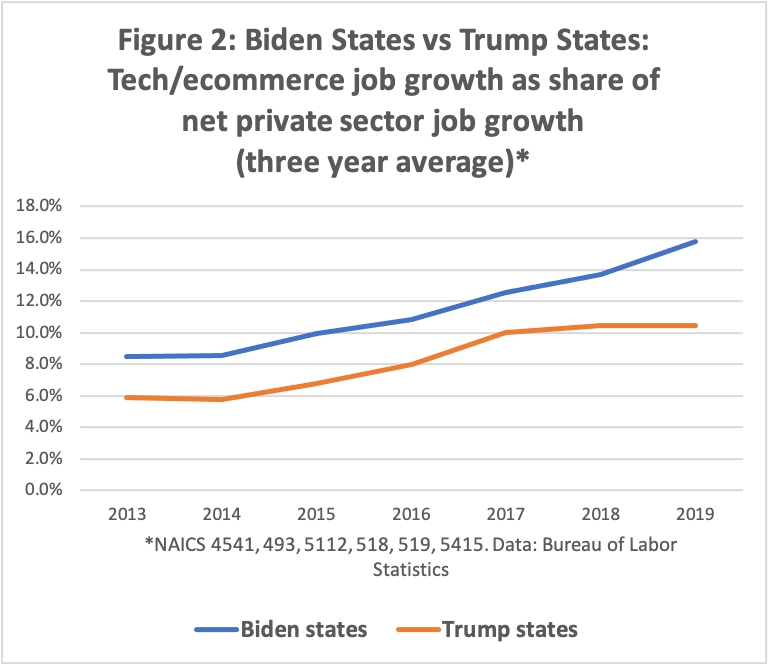
From another perspective, the contribution of the tech/ecommerce sector to overall job growth  has been rising in both the Biden and Trump states. For example, in the Trump states, the share of net private sector job creation coming from tech/ecommerce rose from 8% in the 2013-2016 period to 10.4% in the 2016-2019 period.  The Biden states show a similar trend. In both cases that upward arc would likely be interrupted  by the EU’s implementation of the DMA, undercutting a key industry needed for recovery from the Covid downturn.


How One Tax Might Make Matters Worse

Colin Mortimer, the Director of the Center for New Liberalism, is joined by two special guests. First is Adam Hartke, the co-owner of a music venue in Wichita, Kansas, and the co-chair of the advocacy committee at the National Independent Venues Association. We talk about what it has been like to be a music venue owner during this pandemic, suffering the brunt of the economic fallout. Second, PPI’s Chief Economic Strategist Michael Mandel comes on to talk about how an obscure tax cut that expires in December might make the recovery for music venues, bars, restaurants, brewers, and others even more difficult than it was already expected to be.

Republican Demands For Covid Relief Forced Some Bizarre Choices

The nearly 5600-page omnibus government funding and covid relief bill passed by Congress yesterday was an undeniable win for the American people, providing much-needed relief for those most affected by the pandemic. In addition to preventing a government shutdown, the bill extended and expanded unemployment insurance; provided aid to restaurants, airlines, and other businesses heavily impacted by the pandemic; and provided robust funding for vaccine distribution to help end the pandemic sooner and get people back to work. It also included other important policy developments, such as a long-stalled proposal to limit surprise medical billing and investments to combat climate change. But an arbitrary demand from Republicans that the bill not exceed $1 trillion, combined with their monomaniacal focus on business tax cuts, resulted in some bizarre and unfortunate tradeoffs.

Read the full piece here.

2020: PPI’s Year-End Letter

There’s no getting around it: 2020 has been an annus horribilis for America. We’ve had to endure a deadly pandemic, a frozen economy, a corrupt president’s bid to void an election he lost, and deep racial and civil discord.

And yet our national fortunes seem to be changing. Coronavirus vaccines – developed in record time by U.S. drug companies – will soon be widely available. Next month, America gets a real president in Joe Biden, who will restore honesty and decency in the White House, along with a commitment to bring our country together rather than tear it apart.

I’m also happy to report that the Progressive Policy Institute is ending the year on a high note. We have roughly doubled in size, adding new policy analysts and projects that also have brought youth and diversity to our team. We are poised to play a more forceful role in advocating for the kind of radically pragmatic solutions Americans voted for in 2020 and to help the new administration deliver them. 

Let me touch on just a few of 2020’s highlights.

Throughout the primaries, PPI worked to illuminate the critical choices before U.S. voters. This included analysis and comparisons of the Democratic presidential candidates’ positions, as well as intensive surveys of public opinion in the key battleground states of Pennsylvania, Michigan and Wisconsin. Our team also critiqued utopian demands from the sectarian left that repel swing voters in competitive districts and states. 

In March, as the coronavirus hit America, we turned swiftly to confront the crisis, which both revealed and exacerbated the nation’s deep racial and social inequities. For example, PPI began work on its ongoing Covid-19 chronology, which offers a definitive, step-by-step record of President Trump’s disastrous handling of the pandemic.     

Working remotely, PPI policy analysts have generated a prodigious output of policy reports, articles, op eds and blogs, podcasts and webinars, featuring creative ideas for containing the pandemic and mitigating the economic pain it’s caused. In late August, we published Building American Resilience, a compendium of bold ideas for spurring economic recovery and for making the private sector and government more resilient against future national emergencies. Our Reinventing America’s Schools team also produced a major report on the urgent challenge of keeping our children learning, remotely if necessary, during the pandemic. 

Also notable are three new projects PPI launched in 2020:

  • Center for New Liberalism. The center is an outgrowth of the Neoliberal Project, a virtual network of tens of thousands of young political activists and thinkers. With more than 60 chapters (including 12 overseas), the network provides a political home for young Americans who favor liberal rather than socialist solutions to the nation’s problems. 
  • Innovation Frontier Project. Building on PPI’s traditional strengths in innovation and entrepreneurship, this project aims at keeping America in the vanguard of scientific and technological progress. It’s run by two rising young economists, Alec Stapp and Caleb Watney, as well as PPI chief economic strategist Michael Mandel. The project plans to commission at least 20 research reports on public policies to encourage progress in such emerging fields as biotech, 5G and 6G networks, artificial intelligence, digitally enabled manufacturing and a 21st Century competition policy.
  • The Mosaic Project. The mission of the Mosaic Project is to raise the profile of women, including women of color, in national debates over economic and technology policy. It recruits classes of highly accomplished women to interaction with seasoned professionals in legislation, communications and dealing with new and old media. 

Meanwhile, we are beefing up our communications and outreach capacities to work more closely with our elected friends and allies on Capitol Hill, in local and state government, and in the incoming Biden administration. Over 30-plus years, in fact, PPI has never been in a stronger position to craft innovation ideas and solutions for pragmatic progressives determined to make American democracy work again. 

As we celebrate our good fortune after a difficult year of loss and sacrifice, we’re mindful of the crucial part that great friends and supporters like you have played in our success. We thank you and wish you and your families a very happy holiday! 


Considering eCommerce wages

Bloomberg recently ran an article about the impact of Amazon fulfillment centers on warehouse wages. The story’s point was simple: “A Bloomberg analysis of government labor statistics reveals that in community after community where Amazon sets up shop, warehouse wages tend to fall.”

A bit of background here: The once-sleepy warehousing industry, which was nobody’s idea of a growth sector, used to be the equivalent of serviceable shoes.  Companies would put up warehouses  to store parts that were heading to domestic factories, and to store finished products  that were on their way from domestic manufacturers to retailers and business purchasers. Later, as U.S. factories closed, warehouses held mountains of imports from China and other countries.

Prior to the ecommerce era, the whole notion of a governor or mayor  proclaiming “We need another warehouse as a source of good jobs!”  was laughable. Indeed, warehousing in most counties was a tiny source of jobs, often too small to be measured and reported by the Bureau of Labor Statistics.

But the ecommerce boom has supercharged the warehousing industry. Most eCommerce fulfillment centers are counted as warehouses by the BLS, but as I wrote in my 2017 report, these fulfillment centers  “bear the same relationship to ordinary warehouses as jet planes bear to bicycles. Whereas an ordinary retail warehouse is a stopping place for bulk shipments on the way to stores, a fulfillment center dynamically responds to orders from individual customers, integrating many different vendors.”

Thus, the Bloomberg story is covering an important topic, as I told the reporter. And given my long history as chief economist and economics writer at BusinessWeek (in its pre-Bloomberg days),  I strongly support journalistic organizations doing data-driven reporting. It’s the right way to go.

But based on my own analysis, I strongly disagree with the conclusions in the story. More broadly, I’m concerned with the need to put data into context.

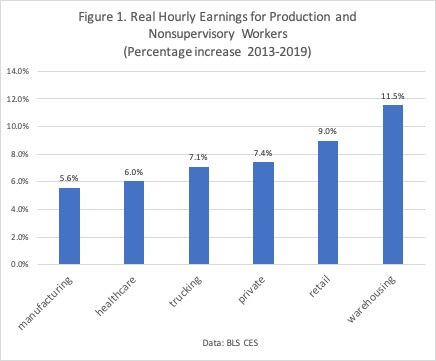
Let’s start by taking a closer look at BLS data for wages for production and nonsupervisory workers in the warehousing industry, which are the floor workers that we actually care about.   Rather than falling, as the story implies,  hourly earnings for production and nonsupervisory workers in the warehousing industry, adjusted for inflation,  have risen by  11.5% in the “e-commerce era” (2013-2019). (details available on request). That’s a far bigger gain than other major sectors, including retail, manufacturing and healthcare (Figure 1).


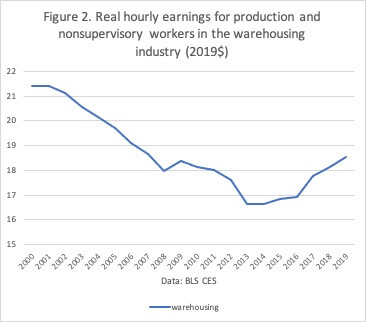
To put this in context, this increase in real wages for production and nonsupervisory workers—who make up almost 90 percent of the employees in the “warehousing and storage” industry (NAICS 493)—comes after many years of declining real wages in an industry that was moribund and stagnant before it was transformed by the coming of ecommerce (Figure 2)

Why do these figures paint a very different picture than the Bloomberg article? One key difference comes from  the limitations of the particular wage measure that Bloomberg used,  average weekly wages from the Quarterly Census of Employment and Wages (QCEW).  I will discuss here some of the strengths and weakness of the QCEW wage measure that the Bloomberg article uses.

Second, the Bloomberg piece misses the broader context of the ongoing transformation of consumer distribution, which has integrated retail, warehousing, and delivery in a way that was never possible before. Ecommerce uses technology to create jobs, boost productivity, and raise pay by shifting workers from low-paid brick-and-mortar retail jobs to much better paid ecommerce fulfillment jobs.  I will discuss this broader point as well.

We start with a description of the wage measure used by the Bloomberg article. The QCEW collects data on employment and wage payments on a detailed industry and county basis. It enables economists to say, for example, that there were 898 employees in the warehousing industry in Mercer County (NJ) in 2013, rising to 6115 employees in 2019.  (Mercer County is the location of the Robbinsville (NJ) Amazon facility featured in the Bloomberg story). The QCEW data also reports that wage payments to warehousing workers in Mercer County rose from $46,223,000 in 2013 to $222,356,000 in 2019, and that average weekly wage fell from $990 to $699 per week.

What do we make of this decline in average weekly wages? The QCEW data are very useful, if handled with care. But the QCEW has limitations. First, there is no information on hours of work on a county and industry level, so average weekly wages can rise or fall as workers work more or fewer hours per week. If there are more part-time workers, average weekly wages can fall, even if hourly wages stay the same.

Second, the lack of QCEW data on hours of work by industry and county means that  hourly earnings cannot be calculated from the QCEW data without making additional assumptions. (For example, the Bloomberg article appears to report hourly earnings for warehousing workers in Mercer County, saying that “Six years ago, before the company opened a giant fulfillment center in Robbinsville, New Jersey, warehouse workers made $24 an hour on average, according to BLS data. Last year the average hourly wage slipped to $17.50.”  I could be wrong, but it appears to me that this calculation was done by assuming that average hours worked per week in the warehousing industry in Mercer County did not change after Amazon opened its facility. If so, the Bloomberg piece should have reported that assumption.).

Third, QCEW weekly wages can change as the composition of the workforce changes. For example, if the composition of warehouses shift towards relatively fewer high-paid managers and relatively more nonsupervisory workers, that could lower average weekly wages even if the wages for the nonsupervisory workers was actually rising.

A simple example will make that point. Suppose that we start off with a sleepy little warehouse with 1 manager earning $1200 per week and 1 “picker and packer” earning $600 per week. Then the average weekly pay for the entire operations is $900 per week.  Now suppose that the operation expands to hire 7 more “picker and packer” and in order to attract the new workers their pay is raised to $660 per week. Then the average weekly pay falls to $720 per week, even though pay for individual workers has increased (Calculations available upon request).

A related point is that average weekly wages in the QCEW data can rise if younger and lower-paid workers are laid off. So in the example above, if the single picker and packer was laid off, leaving only the manager, the weekly wage at the “warehouse” would go from $900 to $1200. My analysis of the BLS county-level data (details available on request) shows a negative correlation between job growth and weekly wage growth in warehousing over the time period 2007 to 2019.. Indeed, many of the counties with the biggest wage growth in warehousing also have shrinking warehouse employment. Meanwhile, fast-growth counties, whether they have an Amazon facility or not, show relatively slow warehousing wage growth on average.

Fourth, the QCEW is sensitive to the form of compensation.  Employer payments for benefits such as health care and retirement contributions are not generally counted as part of QCEW wages (though some states do count 401k contributions).  So if there is a shift towards employers who pay better benefits, that does not show up in the QCEW wages.

In addition, most stock options are generally not counted as part of QCEW pay until they are exercised and become taxable income. Similarly, restricted stock units (RSU) are generally not counted as part of QCEW pay until they vest and become taxable.

This last point, while wonky, is relevant for analyzing Amazon pay in particular. According to press reports, many Amazon fulfillment center workers received restricted stock units during the years covered by the Bloomberg study. According to one source,  Amazon RSUs vest at 5% after one year, another 15% after two years, another 40% after three years, and the final 40% after four years. For example,  a big chunk of compensation paid to an Amazon fulfillment center worker in 2014  would not show up in the QCEW data until 2017 and 2018. That would artificially depress the initial reported wages when a new fulfillment center opens, especially given the rise in Amazon stock prices.

To further complicate matters, when Amazon raised its minimum wage to $15 in 2018, it also changed the form of its compensation package for fulfillment center workers, including phasing out RSUs. These changes make it very difficult to interpret the recent QCEW wage figures. My best guess is reported weekly wages in warehousing are significantly underestimated, but coming up with a quantitative figure would require an in-depth analysis of the Amazon pay package, which I have not done, as well as an estimate of worker churn.

The BLS offers alternative sources of pay data. The Current Employment Statistics  program asks a sample of businesses to report wages and hours by industry,  with an additional category of production and nonsupervisory employees. These figures, which do *not* include annual bonuses, were reported in Figures 1 and 2. As noted, they show strong growth in real hourly earnings for production and nonsupervisory workers in the warehousing industry.  The caveat is that they do not reflect changes in the annual bonus structure of the industry.

Another source of pay data is the Occupational Employment Statistics (OES) program, which offers detailed data on pay for occupations in different industries and locations. The OES enables us to compare “apples to apples,”  matching up the same occupations in different industries. In particular , laborers and material movers, who make up about 45% of the warehousing workforce, average $16.19 per hour in the warehousing industry. That’s more than workers in the same occupation make in manufacturing ($15.78) or the private sector as a whole ($14.64), as shown in Figure 3.

Taking these numbers on face value suggests that laborers and material movers  can do better in the warehousing industry than in the rest of the economy, which is probably the right comparison to make. Note, interestingly enough, that the overall wage in warehousing is lower than manufacturing or private, pulled down by a lower white-collar wage. However, as before, the key caveat is that these figures do not include annual bonuses, exercised stock options or tuition repayments. So the lower wages for white-collar workers should be taken with a grain of salt.

Figure 3. 2019 average hourly pay, dollars per hour (OES)
Warehousing Manufacturing Private sector
All occupations        19.77        26.09        25.20
Management Occupations        52.65        65.11        60.26
Business and financial operations        31.99        36.92        37.92
Computer and mathematical occupations        33.56        49.38        45.88
Office and Administrative Support        19.62        20.91        19.46
Installation, Maintenance, and Repair        24.82        25.98        23.95
Transportation and material moving occupations        17.96        17.58        18.01
Laborers and material movers        16.19        15.78        14.64
Packers and Packagers, Hand        15.01        13.94        13.30
Data: BLS (OES)

But that’s enough about the wonky dive into the data. Now let’s consider the broader question about how to best measure the impact on the labor market of the ongoing transformation of the retail, warehousing, and delivery industries.

Conventional retailing—especially big box retailing—turned the store into the warehouse, and consumers into pickers and packers.  Clothes, electronics, and building materials were stacked to the ceiling, as buyers roamed the “miles of aisles.” Households had to drive to stores and effectively be their own delivery services. In return, they could get everything they needed in one place.

E-commerce flips the equation.  The picking and packing function is done by ecommerce fulfillment workers, saving household time and creating jobs. These jobs are clearly better paid than the typical jobs in the brick-and-mortar retail sector, by about  30 percent.

Even during the pandemic, the  jobs  generated in electronic shopping, ecommerce fulfillment and delivery either more than or almost compensates for the jobs  lost in brick-and-mortar retail, depending on the month. For example, if we compare October 2019 to October 2020, brick-and-mortar lost 269,000 full-time-equivalent (FTE) jobs while ecommerce industries (NAICS 4541, 492, and 493) gained 295,000 FTE jobs, for a net plus.

Even as the new consumer distribution sector—retail, warehousing, and delivery–uses technology to improve productivity, it’s generating new higher-paying jobs. From October 2019 to October 2020,  average hourly earnings in the combined retail, warehousing, and delivery sector rose by 5.2 percent, far above the rate of inflation and beating the average private sector wage growth of 4.4 percent (by this time I don’t need to remind you of the multiple caveats).

What about the labor market in Mercer County, home of the Robbinsville (NJ) fulfillment center featured in the Bloomberg story? It turns out that looking at the broader consumer distribution sector–compromising retail, warehousing and couriers and messengers (local delivery)–gives a very different picture than simply focusing on warehousing (Figure 4).

Over the 2013-2019 period Mercer County employment in the consumer distribution sector—comprising retail, warehousing and couriers and messengers (local delivery) expanded by 25%, almost double the rate in the rest of the private sector (Figure 4). That’s all coming from warehousing, and it’s unalloyed good news for Mercer County workers, because they have access to many more job opportunities.

Similarly, total wage payments in the consumer distribution sector expanded by 42%, also much faster than the rest of the labor market. That’s good news for the local economy, and tax revenues.

And wage growth in the consumer distribution sector was somewhat faster than the rest of the labor market, as workers were hired in warehousing jobs that paid significantly more than brick-and-mortar retail in the county. These figures suggest that Mercer County’s workers and local economy benefited from the transformation of the consumer distribution sector (once again, all caveats apply).


Figure 4. Mercer County (NJ), percentage change, 2013-2019
Consumer distribution* private sector minus consumer distribution
Jobs 25.1% 13.0%
Total wage payments 42.4% 27.5%
Average weekly wages 13.8% 12.8%
*Retail, warehousing, couriers and messengers
Data: BLS QCEW


I’m going to stop this overly-long blog post here. The bottom line is that the Bloomberg story tackled an interesting and important question, but if reporters do data-driven stories, they need to be more sensitive to the strengths and weaknesses of the underlying data. Interrogate the data as they would interrogate a source, rather than taking it for granted. Let the readers know where the assumptions are and the problems are. Give them alternative perspectives and context.



Analysis of Election Results in Pennsylvania

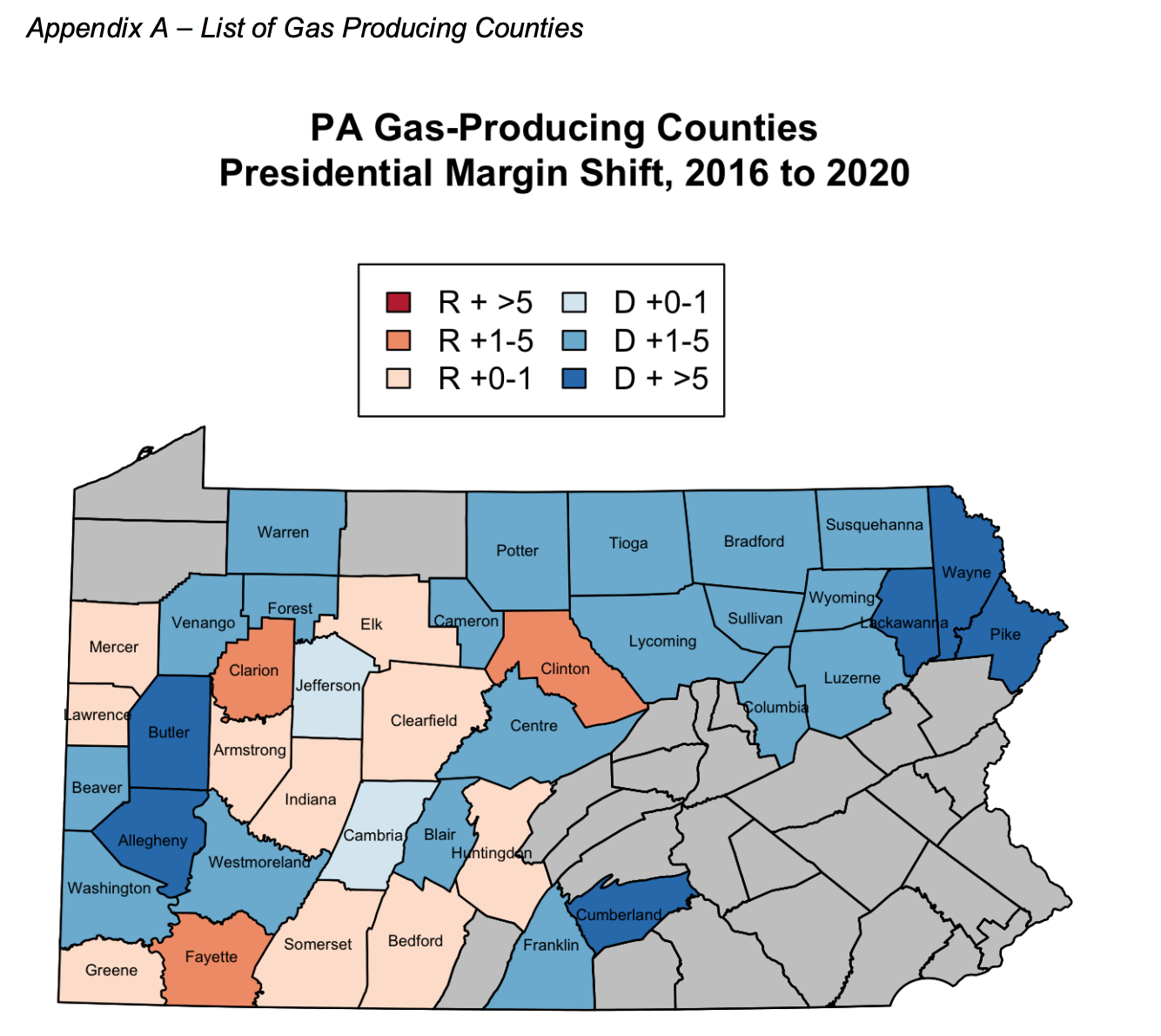
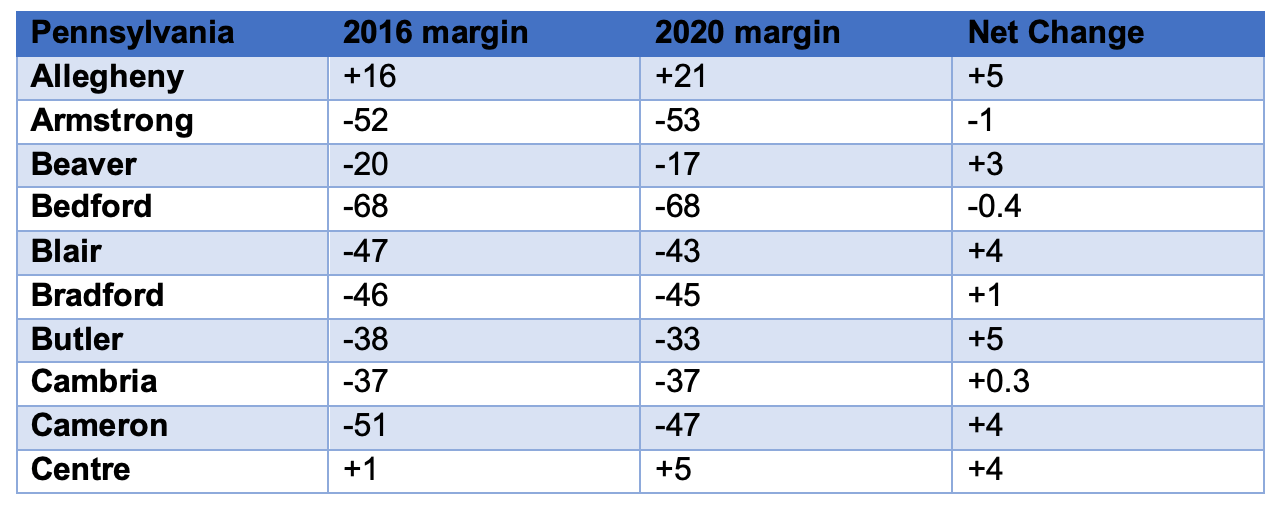
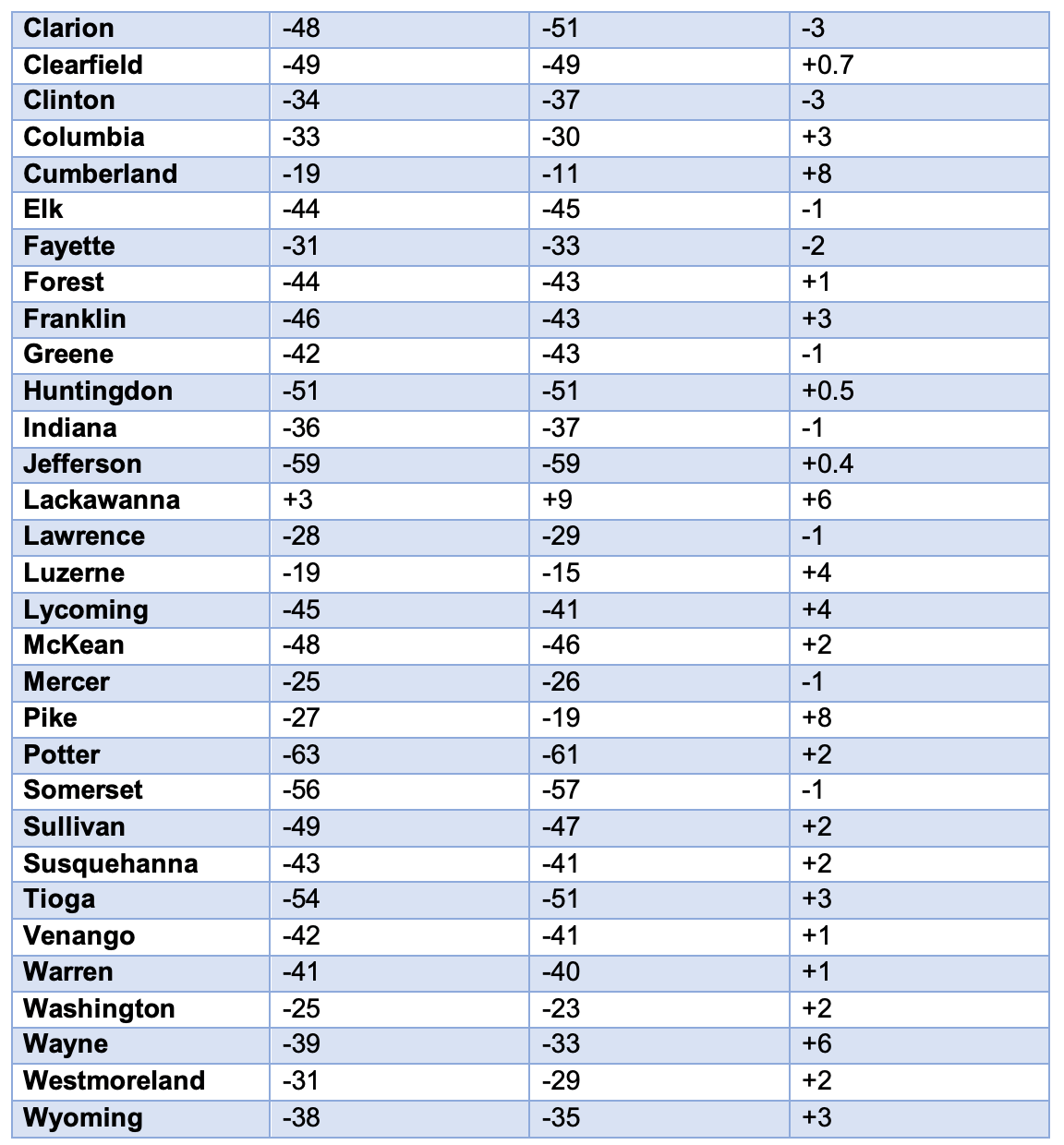
In gas-producing counties in Pennsylvania, Joe Biden gained enough votes over Hillary Clinton alone to wrest the state from Donald Trump. He improved on Clinton’s margin in these counties by three points (Biden -15 / Clinton -18), counties that represent 40% of the state.

In our pre-election polling in these Pennsylvania extraction counties, even as Trump held an eleven-point lead in them, voters wanted Biden’s “middle ground” energy policy.

Our September poll showed that:

These voters take climate change seriously and want to transition to renewable energy, just like Joe Biden.

  • Most (69%) voters in these gas-producing counties believe that climate change is a very serious or somewhat serious problem.
  • People see fossil fuels as a bridge to renewable energy, not a permanent solution. Which of these comes closer to your view?


  • The United States should use some fossil fuels as a bridge to renewable energy sources but work to eliminate it: 55%

  • The United States should continue to use fossil fuels for the foreseeable future: 29%

  • The United States should immediately transition to 100 percent renewable energy: 11%


They don’t want to immediately move away from natural gas.

  • 80% support an energy plan that includes a role for both gas and renewable energy,
  • They strongly oppose “an immediate ban on all natural-gas extraction in the United States” (19% support / 77% oppose) and “an immediate ban on all fracking in the United States” (32% support / 64% oppose).
  • 83% call natural gas a “big jobs provider in Pennsylvania”

These voters mostly didn’t buy Trump’s argument that Biden was “anti-energy”.

  • Only 48% of voters agreed that “Joe Biden is just like the liberal socialists in his party who want to pass the job-killing Green New Deal, kill the energy industry in our state, and drive up energy costs”.
  • After hearing Joe Biden’s actual energy policy—that he wants to “continue to use natural gas, he does not support an immediate ban on natural gas or fracking, and that he will pass a law to guarantee that we only use energy sources that do not contribute to climate change by the year 2050”— voters said they support it on balance (50% support / 46% oppose).


Progressive Policy Institute commissioned ALG Research to conduct this poll to assess the electoral landscape in Pennsylvania and understand voters’ attitudes towards energy policy and climate change. The survey consisted of N=500 likely 2020 general election voters in Pennsylvania, and it included an oversample in gas-producing counties which meant we interviewed 317 people in those counties. The overall margin of error is + 4.4% and in gas-producing counties is +5.5%.

Find the full poll results by clicking here. 

Trump Presidency Ends With One Last Threat Of A Government Shutdown

It was perhaps the most fitting end for a presidency plagued by crisis and mismanagement: the federal government spent the weekend racing to prevent one final shutdown under the administration of President Donald Trump. Fortunately, it seems unlikely that we will face another government shutdown for the next two years with Democrats retaining control of the House of Representatives and competent dealmaker Joe Biden ascending to the presidency in January. Simply keeping the lights on is the lowest of low bars for our elected leaders to clear, but the transition to an administration that will have no trouble doing so is a welcome one.

Read the full piece here.

Trump Raids Medicare To Swing an Election He Already Lost

Refusing to accept that the election is over, President Trump is moving forward with one of the most desperate gambits from his campaign: raiding Medicare to give 39 million seniors a $200 prescription drug card. Fortunately, Trump’s plan to bypass Congress and act by executive order did not come to fruition before the election. But this week, it cleared a regulatory roadblock and the administration says it will start sending the cards before the end of the month.

The idea is probably illegal, because the Constitution gives Congress alone the power to spend money. It is certainly bad policy, because it cuts into Medicare’s finances to pay for a blatant vote-buying scheme. That makes no sense now that the election is behind us, but then, little that Donald Trump has done or said since he lost decisively on Nov. 3 makes sense.

Before it finishes its work, the lame-duck Congress should act to protect Medicare by killing Trump’s effort to usurp its power of the purse. For Republicans in the Senate, the opportunity to reject this political maneuver will test whether they recognize the election is over, and with it the reckless rule-breaking of the Trump administration.

Trump’s proposal would send 39 million seniors $200 cards, similar in appearance to credit cards, that they could use to buy prescription drugs. Like many things Trump does, this plan may be illegal. The Constitution gives Congress alone the power to spend money, but Congress has not authorized this program or appropriated any money towards it. Congressional Democrats have rightfully asked the Government Accountability Office to investigate whether the program is legal.

Administration officials claim the President can authorize the cards without Congress through an existing “testing” program meant to find more efficient ways to administer Medicare. The program will supposedly “test” whether the cards make seniors more likely to take their medicine on time, but it will not establish a control group or any other practices typical of an experiment. While tests of this kind are normally small in scale and cost-neutral, Trump’s plan would involve tens of millions of seniors and cost billions of dollars.

The much more likely explanation for Trump’s card plan is that it was a political effort to ingratiate himself with seniors. Trump’s own officials say he only added mention of the cards to his speech a few hours before he gave it because he felt the need to cram health care successes in before the election. The general counsel of the Department of Health and Human Services sent an internal memo warning that the plan could draw legal challenges related to election law and advised the administration to get guidance from the Department of Justice’s Public Integrity Section, which handles elections-related offenses.

The plan’s political motivations are so glaring that they gummed up Trump’s initial attempts to accomplish it. A week before Trump’s announcement, pharmaceutical executives abandoned a deal between the Trump Administration and the industry that would have included similar cards because the executives believed the cards would make the deal look political.

President Trump has said he intends to get the $7.9 billion he will need for the cards from the Supplemental Medical Insurance Trust Fund, one of the two Medicare trust funds that pay for senior citizens’ health care. But Medicare does not have money to spare. The Congressional Budget Office estimates that the net cost of Medicare will grow from 3.5 percent of gross domestic product this year year to 6 percent in just 30 years because the population is growing older and health care is becoming more expensive, drawing money away from other vital spending priorities. Medicare’s other trust fund is projected to run out of money by 2024 thanks to this budget crunch, which would automatically prompt payment cuts. Elected officials need to control Medicare spending growth, not add to it without addressing its driving forces.

Until this week, the program appeared unlikely to materialize before Trump left office. Administrators had to pull the plan together in very little time, and the effort to get guidance from the Department of Justice slowed the process down. More recently, the Special Interest Group for Inventory Information Approval System Standards (SIGIS), an industry organization that helps the Internal Revenue Service set standards for federal benefit cards, has said for weeks that limiting the cards’ use to prescription drugs was inconsistent with the standards it sets for other benefit cards. Health officials told Politico that without the group’s approval, the administration cannot mass produce working cards.

Yet after appeals from the Trump administration, SIGIS dropped its objections on Monday, for unclear reasons. Thanks to this surprising reversal, the administration plans start sending the cards to seniors by the end of this month.

Voters care about drug prices for good reason. Prices are higher in the United States than in other developed countries, and the costs of the most popular prescription drugs are growing by nearly 10 percent per year. But one-time payments from the government cannot solve a systemic problem such as the rising cost of lifesaving and life-improving drugs — they can only paper over it. Congress should keep fighting Trump on this plan so neither he nor any other President thinks they can finance political gifts by raiding Medicare’s coffers.

Carolina Postcard: Learning from Jimmy Carter and John McCain

Watching Joe Biden prepare to take over the Presidency and Donald Trump try to overturn the election, it’s instructive to read two new books about politicians who represent the best of America: Jimmy Carter and John McCain.

They are two great men of great talents and, yes, great flaws. One a former President and one a two-time unsuccessful candidate for President. Both Navy men, graduates of Annapolis. Both veterans of the highs and lows of politics.

Their lives and legacies offer lessons about where we are today in America, how we got here and how we go forward.

“His Very Best: Jimmy Carter, a Life,” by Jonathan Alter, Simon & Schuster.

Alter’s book, like most accounts, praises the good works Jimmy Carter has done and the modest life he has led in the 40 years since he left the Presidency. Alter is far more positive than most writers, though, in assessing Carter’s four years in the White House – and why they’re overlooked:

“Carter’s farsighted domestic and foreign policy achievements would be largely forgotten when he shrank in the job and lost the 1980 election.”

What achievements? Alter’s list: “the nation’s first comprehensive energy policy,” “historic accomplishments on the environment,” consumer protection, ethics laws, civil service reform, two new Cabinet departments (Energy and Education), appointing Blacks and women to key positions, ending inflation, cutting the deficit and the growth of the federal workforce, requiring banks to invest in low-income communities, legalizing craft breweries (!), deregulating airlines and trucking, increasing the defense budget, championing human rights and challenging the Soviet Union on dissidents, aiding Afghan rebels, ratifying the Panama Canal Treaty, establishing full diplomatic relations with China and persuading Anwar Sadat and Menachem Begin to sign the Camp David Accords (“The Israelis and Egyptians have not fired a shot in anger in more than forty years.”)

And Carter appointed Ruth Bader Ginsburg to the federal appeals court. She later said he “literally changed the complexion of the federal judiciary.”

Yet Carter is remembered more for his failures and shortcomings. Alter, a journalist himself, says “the aggressive post-Watergate press tended to assume the worst about him.”

Democrats controlled Congress those four years, but Carter often was at odds with them. Ted Kennedy challenged him on health care and for the nomination in 1980, crippling Carter’s reelection. In those days, too, Washington Democrats had a pronounced bias against Southern Democrats; I saw it while working for Governor Jim Hunt.

Carter hurt himself. For all the political skill he and his Georgia Mafia showed in coming from nowhere (literally, 0% in the polls) to win the 1976 election, Carter was far better at deciding what was the right thing to do than at persuading the public and other politicians it was right.

(A sidelight: The first U.S. Senator to endorse Carter in the 1976 primaries was a 33-year-old first-termer named Joe Biden. Forty-four years later, Carter’s Georgia helped put Biden in the White House.)

Alter offers a not-so-positive picture of Carter’s early record on race: “While a quiet progressive since his experience in the integrated Navy in the late 1940s, he failed to oppose racial discrimination in public until sworn in as governor of Georgia in 1971.”

Carter was from one of the most racist parts of rural Georgia. He clearly was uncomfortable with the violent and virulent segregation of that place and time, but he didn’t speak out forcefully against it.

Former Governor and Senator Terry Sanford, who fought racism and segregation in North Carolina in the 1960s, never forgave Carter for his 1970 campaign against Carl Sanders. Carter’s campaign attacked Sanders, an owner of the NBA’s Atlanta Hawks, with a picture of a Black player dousing Sanders with champagne in a post-game locker room celebration.

But Carter changed, and he changed America. He was dragged down by an economic crisis and the Iran hostage crisis. He, like Donald Trump, suffered the ignominy of being a one-term President.

Yet Carter – in his four years as President and in the four decades since – set a standard for decency, integrity and service to his country, a standard that all Presidents, and all Americans, can admire and emulate.

“The Luckiest Man: Life With John McCain,” by Mark Salter, Simon & Schuster.

Carter’s biography was written by a journalist, a trained skeptic and critic. McCain’s was written by a more sympathetic observer; Mark Salter was for 30 years McCain’s aide, advisor and confidante, as well as coauthor of seven books. But Salter has written a book that is both insightful and balanced.

We know the highlights of McCain’s life  – POW, congressman, senator, maverick, unsuccessful presidential candidate, cancer victim and, in a role McCain both rued and relished at the end of his life, foil to Donald Trump.

Salter fills in the story – the hard-partying Navy flier, son and grandson of admirals, who finished near the bottom of his class at Annapolis, leading only in demerits.

Shot down on his sixth combat mission over Vietnam, McCain endured more than five years of imprisonment, marked by mistreatment, solitary confinement and torture. He was one of the most resistant and resilient of the POWs.

You can’t read about what he endured without wondering about the character of a man running for Commander-in-Chief who said: “He’s not a war hero. He was a war hero because he was captured. I like people who weren’t captured.”

Maybe there was a higher justice at work when Arizona flipped dramatically this year and, with Georgia, helped elect Biden, one of McCain’s close friends in the Senate. His widow Cindy endorsed Biden.

Where Jimmy Carter was a son of Georgia, McCain had no ties to Arizona. Salter, who has the novelist’s eye for telling detail, writes that on one day – March 27, 1981 – McCain buried his father, retired from the Navy after 22 years and moved to Arizona, where he went to work for his father-in-law’s lucrative beer distributorship and began running for Congress.

During a campaign debate, an opponent called him a carpetbagger. McCain delivered one of the most political devastating counterpunches ever. “Listen, pal,” McCain began. He talked about growing up as a Navy brat, then serving around the world and then: “As a matter of fact, when I think about it now, the place I lived longest in my life was Hanoi.”

McCain won that election. In years to come, friends and foes alike would come to dread his acid tongue.

Throughout his career – he served two terms in the House and was elected to the Senate six times – McCain had an openness and candor that won him good press. But that did him no good in two ill-starred campaigns for President. In 2000, he got run over by the Bush machine. In 2008, he had the bad luck to run against charismatic, historic Barack Obama.

McCain brought no credit to himself with his confused and confounding response to the financial collapse of 2008. Even worse, he gave us Sarah Palin.

He redeemed himself in a gracious concession speech to Obama on Election Night. It’s worth watching on YouTube.

It was as a Senator that McCain made his mark on America. He was a relentless champion of campaign finance reform. He cast the decisive vote to save the Affordable Care Act.

Democrats fond of McCain forget he was a rock-ribbed Ronald Reagan conservative and a searing critic of what he believed to be President Obama’s shaky and uncertain record on defense and foreign policy.

Above all, McCain believed in “regular order,” the traditional operating rules of the Senate that emphasized compromise over confrontation. He bemoaned that the Senate was becoming like the House, a gladiators’ arena of winner-take-all partisan power plays and score-settling.

After Trump’s election in 2016, McCain inevitably became viewed as the anti-Trump. Salter held Trump in contempt, but he writes that “McCain seemed largely indifferent” to Trump’s Twitter attacks. He chastised Salter: “I don’t know why you let him get you so worked up. That’s not how you beat him.”

Salter says McCain “preferred instead to take on Trumpism…opposing Trump’s most noxious views, mainly his nativism and affinity for autocrats, and making the case for the international order founded on the values of free people and free markets.”

McCain once said that he and Trump were “very different people,” with different backgrounds and upbringing: “He was in the business of making money.” McCain added, “I was raised in a military family. I was raised in the concept and belief that duty, honor and country is the lodestar for the behavior that we have to exhibit every single day.”

Our Best

Jimmy Carter and John McCain, both Navy men and politicians, were otherwise very different: from different parts of the country, different backgrounds, different political parties and different philosophies.

But both were men of duty, honor and country. Both represented the best of America. Both gave their best to America.

Their stories remind us how truly great America can be.

The original piece can be found here.