Successful Push For Stimulus Checks Worsens Covid Relief Bill

The bipartisan covid relief bill working its way through Congress appears to have worsened thanks to demands by the Congressional Progressive Caucus, along with Sens. Bernie Sanders (I-VT) and Josh Hawley (R-MO), that the package include a second round of stimulus checks. Because Senate Republicans have refused to support a package that costs more than $1 trillion, the inclusion of checks is likely coming at the expense of other provisions that would better target assistance where it is most needed. As Sens. Mark Warner (D-VA) and Joe Manchin (D-WV) have argued, there is nothing progressive about taking money from people directly affected by the covid pandemic to finance a poorly targeted stimulus check.

Read the full piece here.

Without Federal Aid, Poverty Will Rise

Dr. James X. Sullivan, a professor at the University of Notre Dame, was shocked when he and his colleagues discovered that poverty did not rise when the pandemic began, despite much of the economy freezing to a halt. He told the New York Times that “when we initially saw our results, we thought, ‘How could this be true?’… But when you look at the size of the government response, it makes sense.”

Normally, rising unemployment would increase the number of people living beneath the federal poverty line, which is $21,720 for a family of three. Unemployment certainly surged last spring as the pandemic shutdowns began, from just 3.5 percent in February to 14.7 percent in April. However, Sullivan and his partners at Notre Dame and the University of Chicago say the poverty rate actually fell from 11.0 percent before the pandemic to 9.3 percent in June, thanks to a massive infusion of federal aid.

About $560 billion of the $2.2 trillion Coronavirus Aid, Relief, and Economic Security (CARES) Act that Congress passed in March went towards stimulus checks for most Americans and for states to expand Unemployment Insurance (UI) benefits. The law expanded the size of all benefits by $600/week, created a new program that offered benefits for self-employed workers who do not typically qualify, and extended the duration of benefits from 26 weeks in most states to 39 weeks. The University of Chicago and Notre Dame researchers found those stimulus checks and unemployment benefits can explain the entire decline in poverty between March and June.

But the researchers also find the poverty rate began rising in July, reaching 11.7 percent in November, and is still rising. This is below the 15 percent high it reached during the Great Recession, in part because the economy was strong before the pandemic. But the figure may not capture the entire picture: the researchers’ poverty measurement understates the impact of sudden changes to a person’s income, so the rise in poverty might be more severe than their numbers show.

Meanwhile, researchers at Columbia University, whose method of measuring poverty responds more to short-term changes, found that poverty is only rising because federal aid is waning. Without stimulus checks and the unemployment expansions, poverty would have peaked at 20 percent in April, when unemployment was highest, and would have fallen by 2 percentage points by September. But that improvement was more than offset by a 4.3 percentage point decline in the impact of federal aid.

The CARES Act is not making as big of an impact as it used to because Congress let some of the law’s anti-poverty provisions expire. People only received stimulus checks once, and the CARES Act’s enhanced pandemic unemployment benefit of $600/week expired in July. Republicans refused to extend it over concerns, which have proven to be premature, that recipients would not go back to work if their UI benefits were larger than their potential wage.

The last of the CARES Act’s major anti-poverty interventions, the expansions of unemployment insurance eligibility and duration, will expire on the day after Christmas. Nine million Americans will lose their benefits, with 3 million more soon to follow, and the Columbia researchers estimate 4.8 million people will fall into poverty. Even if Congress extends the programs, it will take states so long to update their archaic information technology that many will not pay the benefits on time. The Center for Disease Control’s protections for tenants facing eviction – limited though they were– will also expire at the end of this month, when Moody’s Analytics estimates nearly 12 million Americans will owe an average of $5,850 in back rent and utilities.

Fortunately, congressional leaders are now finalizing a new aid deal built around a framework crafted by a bipartisan group of moderate members of Congress. As it stands, that bill would keep those vital unemployment expansions from expiring for 10 more weeks, boost the size of benefits by $300/week for 10 weeks as well, send most Americans a $600 stimulus check, and maintain the eviction ban along with $25 billion for rental assistance.

The bill Congress will vote on will likely do less to reduce poverty than the initial bipartisan framework would have. Republicans insist the bill must be smaller than $1 trillion, so negotiators are considering cutting the duration of the unemployment insurance provisions by 6 weeks to pay for the addition of stimulus checks. That trade would effectively take benefits from unemployed people who need the money to support themselves and give them to people who are just as well off as they were before the pandemic. Negotiators may also drop $160 billion in aid to state and local governments because Republicans fear it would be a “blue state bailout,” even though that aid would also go to red states and would prevent cuts to social services that low-income people rely on.

While those revisions would seriously undermine the bill’s protections for at-risk Americans, the deal would still offer a vital lifeline for people in or near poverty. A strong post-vaccine recovery that creates opportunities for economically vulnerable people is within sight, but elected officials should take this deal to ensure Americans can keep paying their bills as the world pushes across the pandemic’s finish line.

Thumbnail courtesy of Reuters. 

Wind, Solar, and Gas: Managing the Risks of America’s Clean Energy Transition

Executive Summary

President-elect Joe Biden has set an ambitious goal for achieving zero carbon emissions from the nation’s power sector by 2035. The U.S. electric grid therefore faces a dual challenge: meeting growing demand for power while also decarbonizing the energy it supplies, which is essential to avert catastrophic climate change. At the same time, the challenge of maintaining an affordable and reliable grid is becoming more complicated, because of the increased frequency of extreme weather and the rapid growth of distributed renewable power – especially wind and solar – that is variable and unpredictable. It’s imperative that U.S. policymakers keep the nation’s environmental and energy needs in balance as the shift to renewables accelerates.  

Natural gas can play an indispensable role in managing the risk that a precipitous leap to renewables will make electricity more expensive and potentially less reliable. Gas already supports the expansion of renewable energy by providing an instantly dispatchable source of electricity. Unlike coal and nuclear plants, natural gas power plants turn on and off within minutes, allowing the grid to quickly match supply and demand even when the wind isn’t blowing and the sun isn’t shining. As the National Renewable Energy Laboratory points out, this unique flexibility of natural gas generation thereby facilitates the steady expansion of renewables. As we move toward decarbonization, retaining sufficient natural gas generation to backstop wind and solar power would reduce costs and increase reliability compared to a grid that relies entirely on renewables. Given these realities, demands to “ban fracking” or keep shale gas “in the ground” are not consistent with a balanced approach to decarbonizing the electric grid. 

In the decades ahead, natural gas generation must move toward zero carbon emissions to be part of America’s clean energy transition. To this end, U.S. policy makers and the natural gas industry should join forces to (1) invest more heavily in carbon, capture, and storage (CCS) technologies to quickly move gas-fired plants toward zero carbon emissions; and, (2) adopt and enforce ambitious goals for dramatically reducing methane emissions – which are many times more injurious to the climate than carbon dioxide emissions – from the natural gas lifecycle. This includes methane originating from abandoned wells that are no longer in use and have not been properly decommissioned. 

Neither of these changes will be easy. Despite recent progress, the development of CCS technology is generally nascent and has yet to be specifically applied to a natural gas power plant in the United States. At the same time, methane emissions from the natural gas sector are underregulated at the federal level, a problem made worse by the Trump administration’s rollback of methane regulations proposed by the Obama administration. Yet America’s ability to use our abundant gas resources to backstop and expand renewable energy on the electric grid requires swift progress on both fronts. 

There also are other ways in which natural gas can contribute to a decarbonized electricity grid—including but not limited to fuel substitution with renewable natural gas, blending of hydrogen into gas pipelines, creation of “blue” hydrogen, and the potential of new generation technologies such as Allam Cycle plants—that are important and beyond the scope of this report. 

Yet the political debate around energy and climate policy often presents Americans with a false choice between natural gas and renewable energy. Today the two are intertwined. America needs natural gas now to enable and backstop the rapid deployment of renewable energy on the grid (not to mention supplying power to U.S. industries and homes, which lies beyond the scope of this report). 

Rather than trying to ban fossil fuel production, progressives should keep their eyes on the real prize: achieving net zero carbon emissions. Because of the uncertainties surrounding the success of any of the technologies and methods mentioned above, no one can precisely predict how long it will take America to decarbonize its economy.  If decarbonization techniques applied to fossil fuels fail, a successful clean energy transition will require phasing them out. If they succeed in driving greenhouse gas emissions toward zero, natural gas could play a role in the U.S. energy mix into the foreseeable future. 

Therefore, this report urges President-elect Biden to strike a new bargain between the federal government and natural gas companies for decarbonizing the natural gas sector.  Washington would acknowledge and support the role gas plays in enabling rapid deployment of renewable energy in exchange for industry’s commitment to make consistent progress toward zero carbon emissions, achieved through the rapid development of CCS technology and dramatic reduction of methane emissions throughout the natural gas lifecycle. 

Crucially, this approach also could help to depolarize the debate over what to do about climate change. By rejecting unrealistic demands to abolish fossil fuels now, and speeding the technological advances necessary to decarbonize them, the incoming Biden administration could build a broader base of political support for a clean energy transition that meets America’s climate and economic needs.  

The Urgent Case for Climate Action  

Climate change poses a dire threat to our planetary health. Biden’s victory will end a shameful four years in which the United States has been absent from the fight to slow down climate change. Biden pledged to resume U.S. international climate leadership by rejoining the Paris climate accords immediately upon taking office. 

The Paris Agreement envisions limiting global average temperature increases to two degrees Celsius through a balancing of emissions sources and carbon sinks by midcentury. Over 75 countries representing approximately 11 percent of global emissions recently submitted to the United Nations strategies or pledges to achieve carbon neutrality by 2050. Meanwhile, China, which generates 29 percent of global emissions, making it the world’s largest greenhouse gas emitter, recently pledged to reach net zero emissions by 2060, although its near-term targets are far less ambitious than what Biden has proposed. 

Unfortunately, experts expect that, even if they are kept, country-level commitments under the Paris Agreement still leave us on an unacceptably dangerous trajectory toward a 3.3 degrees Celsius global average temperature increase, revealing an alarming ambition gap. This degree of warming implies at least a 4 percent reduction in gross domestic product for the United States economy, with our poorest counties projected to lose between 2 and 20 percent of their income by the late 21st century. 

Climate policies that channel the power of American ingenuity toward zero-carbon innovations are the key to avoiding catastrophic climate change. Thanks to innovations over the last decade, the costs of operating solar photovoltaics and onshore wind turbines in the United States has dropped dramatically, from $359 to $41 and $135 to $40 per megawatt-hour, respectively. Consequently, solar and wind energy have become booming economic sectors that employ over 350,000 workers. 

Moreover, the United States Energy Information Administration predicts that generation from renewables will provide at least 38 percent of our electricity by 2050. The Biden administration is likely to press for a more ambitious target, possibly even approaching 100 percent. At high rates of deployment, however, the intermittency of renewables requires the installation of much more capacity than is necessary to meet demand, thereby resulting in high costs. , To avoid this dilemma, we need a comprehensive federal policy that achieves the dual objectives of high renewable energy deployment and low electricity prices. President-elect Biden’s climate plan envisions achieving a carbon pollution-free electric grid that is then used to electrify the transportation and industrial sectors.  That’s not likely to happen, however, if electricity prices spike.

That’s why we need backup power generation that moves toward zero carbon emissions. Potential sources of zero-carbon power generation include natural gas power plants with carbon capture and sequestration (CCS) technologies, geothermal, hydropower, nuclear power, and bioenergy. Natural gas is important because we already rely on it to generate about one-third of our electricity. 

In a zero-carbon electric grid, the role of natural gas power plants with CCS technologies would shift from producing bulk energy to supporting renewables with zero-carbon dispatchable backstop capacity. In this way, the pitfalls of a hasty rush to 100 percent renewable energy – high prices and low reliability – can be avoided.  Instead, natural gas power plants with CCS technology can work in partnership with renewable energy to rapidly achieve a decarbonized electric grid. 

Unfortunately, the politics of energy and climate are deeply polarized. On the left, activists demand fracking bans and insist that shale gas and oil be left “in the ground.” On the right, climate deniers want continued U.S. reliance on fossil fuels. Although their voices are the loudest, a poll commissioned by the Progressive Policy Institute (PPI) for the 2020 election suggests that neither of these camps represent majority opinion.  

The poll delved into public attitudes in two presidential battleground states, Pennsylvania and Ohio, that also happen to be among America’s top five gas-producing states. The poll found that voters – including those in the “shale belt” counties where gas is produced — overwhelming see climate change as a serious problem and want the government to take vigorous action against it. At the same time, voters also overwhelming oppose (by 74-21 percent) a ban on natural gas extraction. Even among liberal and younger voters, there’s little appetite for a ban on gas production. That shouldn’t come as a big surprise, considering how important shale gas is to jobs and the economies of both states.

But the PPI poll shows that most voters have a pragmatic streak when it comes to energy and climate policy. Seventy-seven percent of voters in Pennsylvania and Ohio support using natural gas and nuclear power to support the expansion of renewable wind and solar power. They understand that gas plays many roles – generating electricity, fueling U.S. industries, and heating and cooling homes. Perhaps they also understand the role that gas plays in improving local pollution by displacing coal in the East Coast and Midwest States. 

The bargain proposed in this report is grounded in that spirit of pragmatism. It would hold a seat at the clean energy table for natural gas generators in exchange for assurances that U.S. lawmakers and the natural gas industry join forces to achieve zero carbon emissions through CCS technologies and dramatic reductions in methane leaks and emissions. 

How to Decarbonize the U.S. Energy Grid 

Natural gas is pervasive in the American economy as a fuel and a feedstock. Ample supply and low gas prices also have powerfully stimulated growth in the U.S. chemical industry, yielding a host of useful applications and creating a substantial number of jobs. Recently, the United States also has become a significant exporter of natural gas. In the context of the electric grid, as illustrated by Figure 1, natural gas powers our electric grid about one-third of the time. 
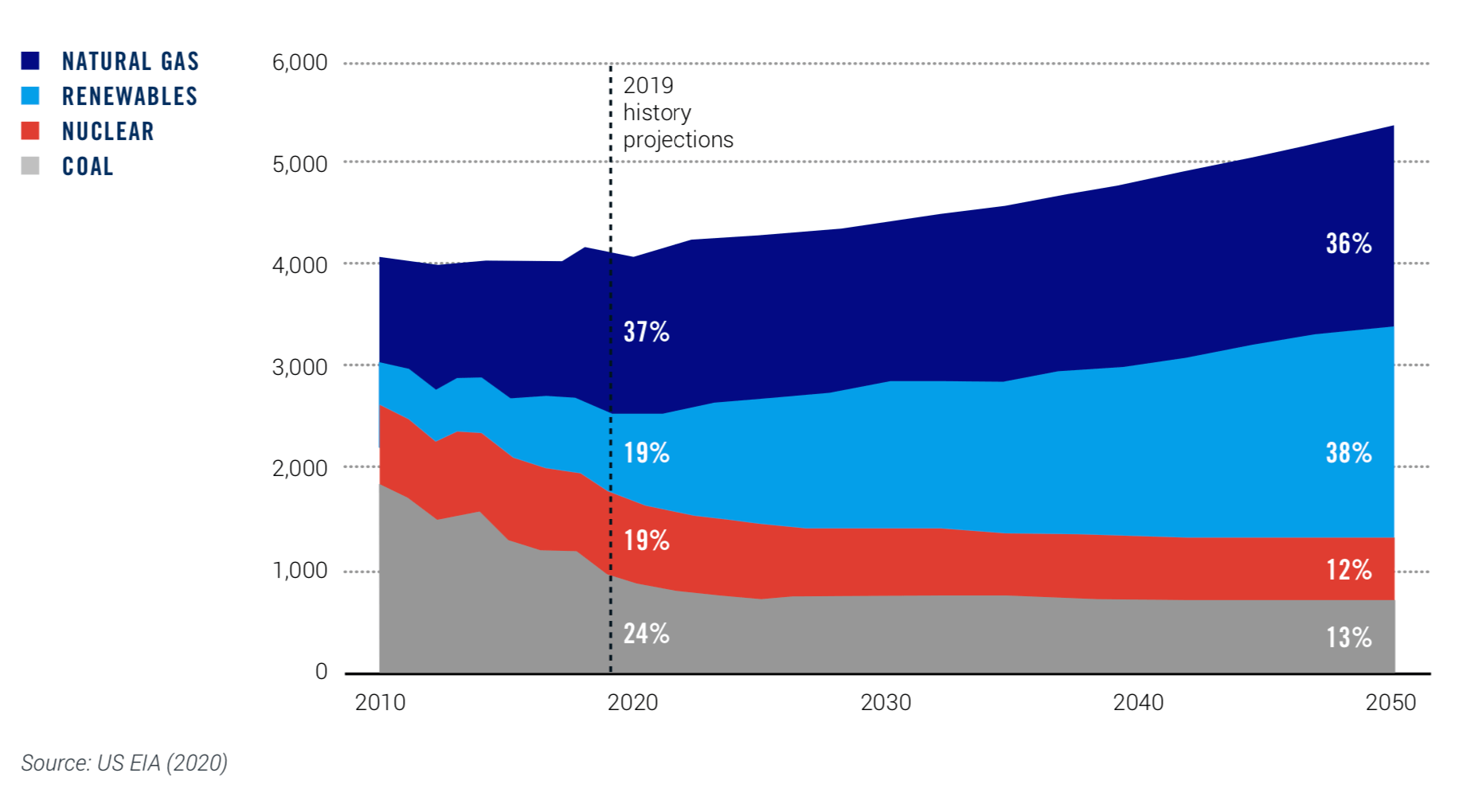
Figure 1
Projected Electric Generation from Natural Gas in the United States, Source: US EIA (2020)

Nearly all models that simulate what it would take for America to achieve deep decarbonization identify early action in the electricity sector as the linchpin to success. Models assume that a grid powered increasingly by renewable energy would then be used to electrify much of the transportation and industrial sectors, producing dramatic reductions in carbon emissions. For example, a study by Lawrence Berkeley and Pacific Northwest National Laboratories predicts a 60 to 110 percent increase in electricity demand by mid-century. 

In their comprehensive review of modeling efforts to date, Jenkins et al. (2018) identify two main paths to decarbonizing the electricity sector. The first path achieves a 100 percent renewable electric grid, primarily by relying on solar and wind. But there’s a big problem: the intermittency of renewables requires overbuilding total installed capacity to produce sufficient energy during periods when available short-term wind or solar output is well below average. One finding from the literature is that total installed renewable capacity should be three to eight times larger than peak demand. 

Such overcapacity directly increases electricity costs.  When the amount of available wind or solar power is above average, utilities are forced to reduce energy output because they can’t store the excess energy. When the amount of available wind or solar power is below average, then models rely on long-term expensive battery storage to keep the grid running. Finally, a 100 percent renewable grid tends to require optimistic modeling assumptions including continent-scale transmission lines and extremely flexible demand response.   

The second, more pragmatic path envisions a strategic backstop to wind and solar power by employing dispatchable forms of electricity. Most of the challenges associated with overreliance on renewables can be avoided by adopting a generation portfolio with some level of generation capable of fast ramp rates, low capital costs, and high variable costs. In this context, natural gas generators pair especially well with high buildouts of solar and wind.  

Adding a backstop like natural gas leads to total installed capacity that is much more closely sized to peak loads. This results in a reliable grid that delivers lower electricity prices. Moreover, the need for seasonal storage is completely avoided and grid reliability thereby is strengthened. Consequently, firm low-carbon resources are a consistent feature of the most affordable and reliable pathways to deeply decarbonizing the United States electricity grid. 

For example, a recent comprehensive exercise that models deep carbonization of the U.S. electrical grid finds that the availability of backstop power, such as natural gas generation with CCS, reduces electricity costs 10 to 62 percent compared to scenarios that rely exclusively on variable sources paired with energy storage. Cheap prices and reliable electricity are critical to achieving a decarbonized economy via mid-century, as envisioned in President-elect Biden’s climate plan.

As illustrated in Figure 2, a renewable-only approach is cheaper in the short-term but becomes exponentially expensive in the long-term the closer we get to a 100 percent renewable grid. Maintaining a role for natural gas with CCS technology can avoid the portion of the renewables only curve where costs grow exponentially and thereby lead to large cost savings. There’s no doubt that renewable energy can and should form the backbone of our zero-carbon electricity grid. But natural gas power plants with CCS technology would enable more rapid and strategic development of renewable energy by serving as an emissions-free backstop that secures lower electricity prices and ensures grid reliability.   
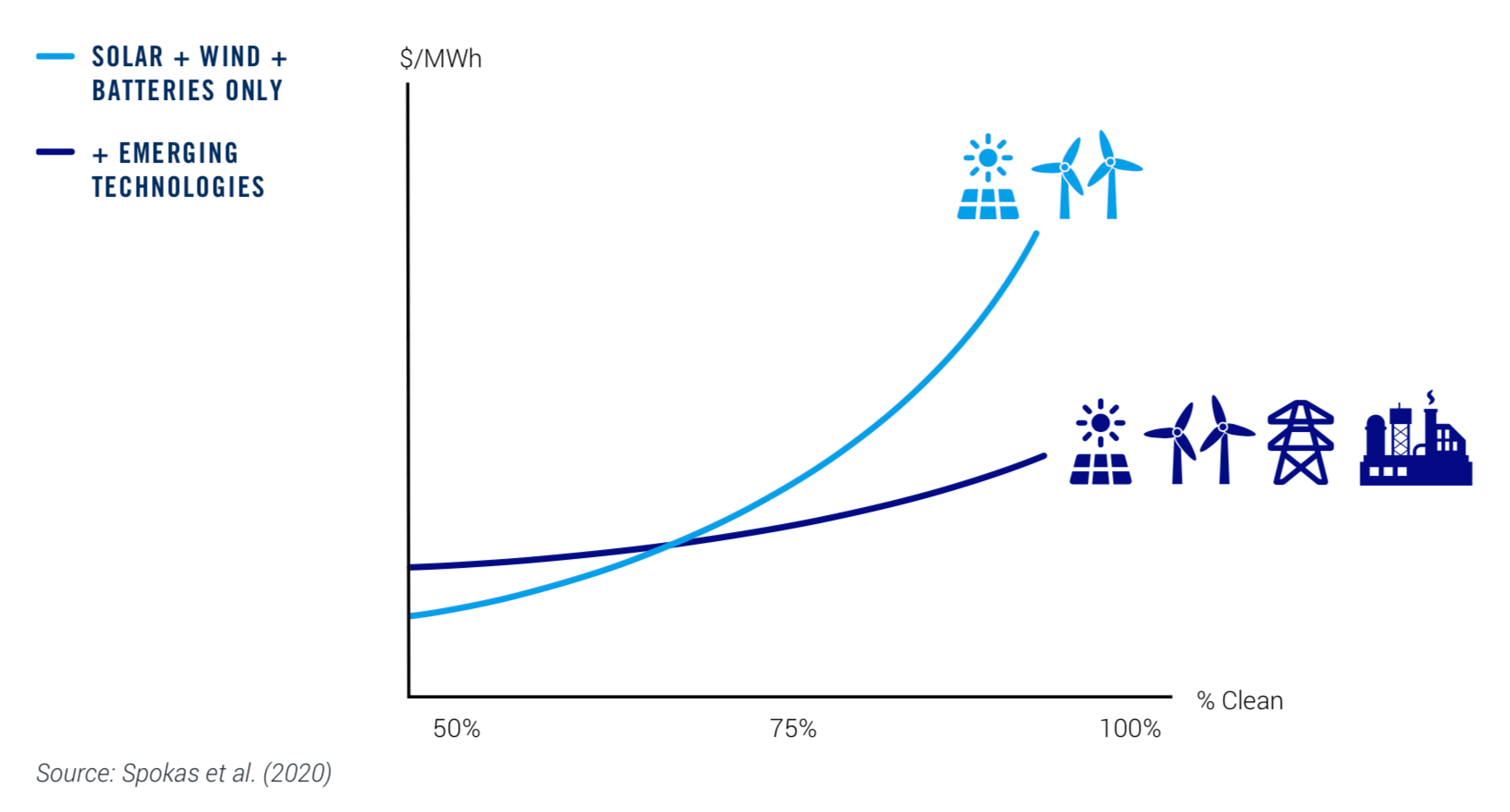
 

Figure 2
Electricity Costs and Renewable Penetrations for Different Decarbonization Strategies, Source: Spokas et al. (2020)

Generating Zero-Carbon Natural Gas 

Models that simulate decarbonization of the electric sector typically include natural gas generation with CCS technologies. For example, a recent study by the University of California Berkeley Goldman School of Public Policy assessed the feasibility of a 90 percent clean United States electricity grid by 2035 and relied on natural gas with CCS to provide dispatchable power. To achieve a 100 percent clean electricity grid, the authors highlighted two options: (1) further investments in CCS for natural gas, or, (2) further reliance on expensive alternatives—such as hydrogen or storage—that doubled marginal abatement costs into the range of 100 to 125 dollars per ton. 

Unfortunately, the use of CCS lags far behind what is required to meet America’s carbon-reduction targets under the Paris Agreement. The Petra Nova coal plant in Texas is the only U.S fossil-fuel powered plant capable of generating and capturing carbon in large quantities, but its operations were suspended earlier this year amid low oil prices and falling demand for energy as a result of the pandemic. Outside of the electricity sector, the U.S. has 10 of the world’s 19 large- scale CCS projects. Most operate in natural gas processing plants, fertilizer production, synthetic natural gas production, or ethanol production. There are no CCS projects operating on natural gas generators in the United States.

“Given the challenges now facing available firm low-carbon resources, it is tempting for policymakers, socially conscious businesses, and research efforts to bet exclusively on today’s apparent winners: solar photovoltaics, wind, and battery energy storage. That would be a mistake,” says Jenkins et al. (2020). Instead, the authors call for investing in a more technically diverse approach, which includes natural gas generation with CCS among other technologies, to secure low prices for zero-carbon electricity. 

Despite unfavorable economics today, the value of natural gas with CCS technology grows as renewable penetration or marginal costs of renewables become quite high. Therefore, Spokas et al. (2020) argue that excluding CCS technologies from our decarbonization toolkit based on present-day economics is likely shortsighted and fails to “recognize CCS may have significant value in the future and risks stunting CCS technology advancement.” 

A federal tax rule (45Q) provides an incentive for company investments in carbon sequestration. It is calculated by multiplying the metric tons of qualified carbon sequestered by a predetermined value. Depending on the type of project, the incentive ranges from $11.70 to $28.74 and rises annually accounting for inflation. The incentive requires secure geological storage of carbon emissions in deep saline formations, oil and gas reservoirs, or un-minable coal seams. The claimer of the credit must capture at least 500,000 metric tons of carbon annually. If the carbon captured somehow leaks out, the incentive must be repaid to the Treasury. 

At the state level, California has a low-carbon fuel standard that uses market trading to price credits for carbon savings. Credits recently have traded around $200 per ton. This also creates a strong incentive for producers to invest in CCS technologies, including direct air capture, CCS at oil and gas production facilities, and CCS at refineries. 

This patchwork of policies has led to an encouraging pipeline of new CCS projects across a broad range of geographies and technologies. The Clean Air Task Force’s CCUS Project Tracker reports 32 projects announced since 2018 that have the potential to sequester 40 million metric tons of carbon dioxide annually. Eight of these projects leverage financing through California’s low-carbon fuel standard in addition to using the federal 45Q incentive.  Six of these projects aim to apply CCS technologies to natural gas power plants. Spokas et al. (2020) argue that CCS technology on natural gas plants is technically feasible and could break even from an economic perspective if they combine 45Q with enhanced oil recovery, which is the use of captured carbon to extract oil that could not have otherwise been extracted.

Ultimately, natural gas generators with CCS must be deployed at scale to achieve an effective zero-carbon backstop for renewables. The policy and technical inertia surrounding CCS development must be expedited to ensure that CCS technologies develop quickly enough to be applied successfully to a natural gas generator as soon as possible. Therefore, the federal and state policies that have spurred new CCS projects should be strengthened. For example, the Clean Air Task Force has proposed a modification of the 45Q incentive to expand the effective window of eligibility for new CCS projects. 

Dramatically Reducing Methane Emissions from the Natural Gas Lifecycle 

Natural gas emits about half as much carbon dioxide as coal when combusted. That is a primary reason why switching from coal to gas generation led to big reductions in carbon emissions from the electricity sector after the shale gas revolution started. However, natural gas producers emit significant amounts of gas by venting, inefficient flaring, and “fugitive” emissions through leaks in wells and equipment. These emissions have a disproportionately large impact on the climate because the primary component of natural gas, methane, warms the globe 86 times more effectively than carbon dioxide over a 20-year time frame. Therefore, if not controlled, fugitive methane emissions could more than offset the climate gains of switching to gas from coal. 

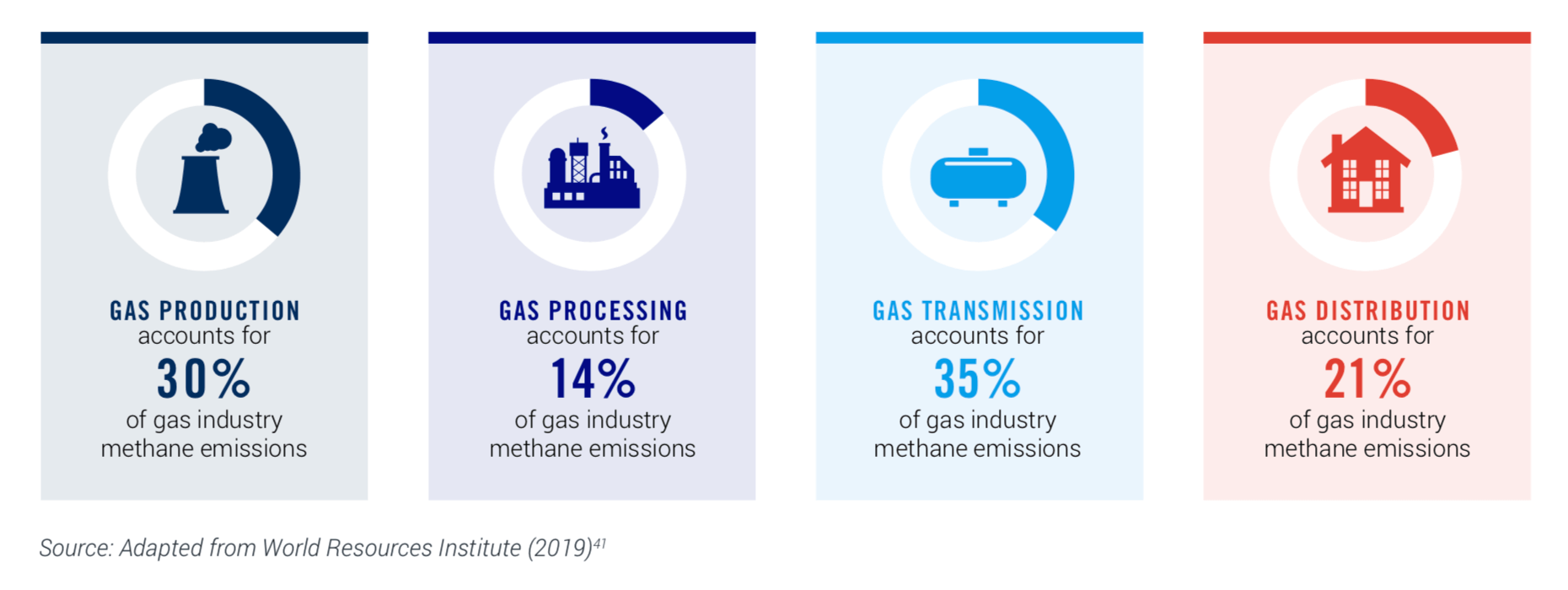
Studies show that gas is more climate friendly than coal so long as methane emissions are kept below 2.7 percent of gas production., As illustrated in Figure 3, methane emissions are generated in four natural gas “subsectors”: production, processing, transmission and distribution. A recent study estimates that national methane emissions were 2.3 percent of total gas production in 2015, suggesting only a slight advantage to using natural gas over coal in that year. Another recent study estimates that methane emissions from the Permian Basis, a major producing region in Texas, were 3.7 percent of production in 2018 and 2019, suggesting a significant disadvantage from using natural gas from this regional over coal. Moreover, comparisons to coal are less relevant as coal-fired generation decreases and renewable generation increases. In short, methane emissions must be reduced dramatically if natural gas is to play its crucial role as a zero-carbon firm resource to backstop renewables. 


Figure 3
Recent Estimates of Methane Emissions from United States Natural Gas Subsectors,

Source: Adapted from World Resources Institute (2019)

The Trump administration, unfortunately, moved in the opposite direction. It rolled back one of the last Obama-era climate regulations that would have reduced methane emissions from oil and gas wells constructed after 2016 and prompted regulations on existing oil and gas wells. Major oil and gas players including BP, Exxon, and Shell supported the regulation. The main opposition came from smaller oil and gas players. 

The Clean Air Task Force estimates that Trump’s collective rollback of methane regulations will increase emissions 4.3 million metrics tons in 2035 and warm the climate as much as the carbon emissions of nearly 100 coal-fired power plants. Beyond climatic costs, the Trump administration’s rollbacks threaten public health and safety. For example, methane leaks lead to ozone formation and often include emission of volatile organic compounds that are known to aggravate respiratory problems and can be carcinogenic. 

Several states have stepped into the leadership vacuum. Led by former Governor and now U.S. Senator John Hickenlooper, Colorado imposed several types of regulations, most notably a leak detection and repair program that began in early 2010s. My own 2017 study, with Alan Krupnick from Resources for the Future, reports that the number of estimated leaks in Colorado has fallen by 75 percent since these rules went into effect. California, Massachusetts, and New Mexico have followed Colorado’s lead with their own forms of regulation, but by and large methane emissions remain largely under-regulated by state governments. 

Some industry players are voluntarily reducing their emissions. ONE Future, for example, is a coalition of 30 natural gas companies working together to voluntarily reduce their methane emissions across the natural gas life cycle to 1 percent or less of produced natural gas by 2025. ONE Future reports that their methane emissions were well below one percent for 2017 and 2018. More recently, the American Gas Association and Edison Electric Institute launched the Natural Gas Sustainability Initiative which aims to measure methane emissions intensity across the natural gas lifecycle. As a final example, The Environmental Partnership is a newly formed group of companies voluntarily implementing best practices and installing certain equipment to reduce their methane emissions. Many of these efforts build upon EPA’s Methane Challenge Program, a voluntary program aimed at sharing information that facilitates methane emissions reduction.

In addition, a host of non-profits and start-ups also are measuring, labeling, and trading “green” or “climate differentiated” natural gas with low methane emissions.  My own 2020 study, with Alan Krupnick of Resources for the Future, surveys these efforts, which started with a “sustainable” gas transition between Southwestern Energy and New Jersey Resources in 2018. A similar trade for “carbon-neutral” liquified natural gas occurred in 2019 between Shell and Tokyo Gas. 

The Rocky Mountain Institute has recently launched a digital platform that will offer emissions data from satellites, aircrafts, and monitoring stations to help companies assess methane emission against performance benchmarks. While these efforts are encouraging, we argue that further federal government involvement in these voluntary markets is necessary to increase participation, enhance ambition, and improve both the accuracy and credibility of these efforts. 

Federal action is imperative because methane emissions from the natural gas sector are still too high and may even be trending in the wrong direction. Based on EPA data, which likely underestimates methane emissions on average, methane emissions from the natural gas system have slightly increased since 2016, from 135.8 to 140.0 MMTCO2-eq. Some methods for measuring methane emission carry high levels of uncertainty, which indicates a need for uniform standards. None of the voluntary efforts to date have achieved widespread industry participation that federal regulations could mandate. Nor have they set the type of ambitious targets that federal regulations could mandate, instead tending to identify modest reductions that ensure natural gas maintains its climate advantage over coal and gasoline, rather than prioritizing maximum abatement. 

Federal methane regulation should be designed both to cut methane emissions and to equate the private and social costs of methane, which amount to over 1,100 USD per ton.  Any methane regulation must address the downward bias and large uncertainties associated with the methane inventory maintained by the U.S. Environmental Protection Agency. 

For starters, Washington lawmakers should aim at replicating Colorado’s leak detection and repair programs, given that these programs can quickly remedy major leaks and potentially lead to improved inventories. My 2017 study, with Alan Krupnick of Resources for the Future, explores a variety of additional policies to reduce methane emissions that are compatible with other possible federal climate policies, such as carbon taxes or clean energy standards. For example, a nationwide carbon tax could be modified for methane by imposing an assumed default rate of emissions per ton of natural gas produced. 

This default rate is necessary because of uncertainties regarding the quantification of methane emissions and the rate itself could be challenged by polluters via a pre-defined regulatory process. In this way, the default rate ensures that estimated methane emissions are not lower than actual ones, while the challenge process allows companies that beat the default rate to make their case. Similarly, a tradable performance standard could be constructed to achieve a certain leakage rate in the natural gas sector, an approach that could pair well with a broader clean energy standard as envisioned in President-elect Biden’s climate plan. 

Other proposals contemplate requiring the reporting of financial liabilities associated with methane and carbon emission on a company’s financials, which would create a powerful incentive to maximize emission reductions. Tougher federal regulation, combining the approaches outlined here, is an essential component of a comprehensive and credible strategy for reducing U.S. methane emissions.

Plugging Old Gas Wells

I managed a small team of researchers at Resources for the Future in 2015 and 2016 that focused on estimating the economic and environmental impacts of end-of-life wells. We estimated that there are up to 2.67 million inactive oil and gas wells in the United States. Left unplugged, we found that these wells can emit methane, contribute to poor air quality, and contaminate surface water. Moreover, our research uncovered that bonds posted by gas drillers, although intended to cover the cost of properly plugging wells, are not nearly enough to cover plugging costs in most states. The result is a large pool of inactive wells that are improperly plugged. Methane emissions from abandoned wells are estimated to have the same climate impact as greenhouse gases emissions from 2.1 million passenger vehicles. 

Properly plugging abandoned wells is a prerequisite to achieve near-elimination of methane emissions from the entire natural gas lifecycle. For starters, regulators should increase bonding requirements at the state and federal levels. Another approach would be the creation of a federal agency with dedicated funding to plug abandoned wells. Raimi et al. (2020) suggest that the Covid-19 pandemic in conjunction with low employment rates in the oil and gas industry justify such a federal program. The authors estimate that a significant federal program to plug abandoned wells could create tens of thousands of jobs. 

Near-elimination of methane emissions would also create lucrative new opportunities for U.S. natural gas exporters. For example, a recent strategy from the European Union on methane emissions suggests an imminent surge in demand for “green” natural gas exports with low methane emissions. Indeed, natural gas exports with anything more than low methane emissions may not be permitted to trade internationally. Concerns over methane emissions led the French government to recently block a liquified natural gas deal between a Texas company called NextDecade and a French company called Engie. As methane emissions are controlled, exports of U.S. gas could help other countries reduce their carbon emissions. 

Managing Risk and Uncertainty in Energy Policy 

The evolution of America’s zero-carbon energy transition is fraught with uncertainty. It is contingent on the evolution of technologies in various stages of development. Policymakers should therefore approach the subject with a degree of humility. After all, no one predicted 20 years ago that new drilling technologies would create a shale boom that has propelled the United States back to the forefront of world’s leading oil and gas producers. Likewise, no one today can foresee the innovations and technological breakthroughs that could upend today’s prevailing assumptions about the best way to decarbonize our economy. 

Uncertainty implies risk and the prudent way to manage risk is through diversification. Putting all our eggs in a single basket – through policies based on a narrow vision of a zero-carbon grid powered by 100 percent renewables – is unwise. Unfortunately, some climate activists seem willing to bet everything on this single path to decarbonization. 

The risk in taking this single path is that it will expose Americans to high electricity prices and potentially periodic energy shortages on the way to our destination. It may also, of course, lead to premature or unnecessary destruction of good jobs in the natural gas sector. The resulting political fallout could slow or even block American’s clean energy transition. That is why President-elect Biden has made clear that, despite President Trump’s claims to the contrary, he opposes fracking bans. 

The pragmatic and progressive course forward is to pursue multiple avenues to decarbonization. Government and private industry should invest in a broad portfolio of energy sources and technologies that can lead us to zero-carbon energy generation and craft policies to ensure consistent and rapid progress. These energy sources and technologies include CCS and many other options including advancements in geothermal, hydrogen, and nuclear.

A bill introduced by Representative Diana DeGette, the Clean Energy Innovation and Deployment Act (CEIDA), embodies many of the principles discussed in this report. CEIDA would create a standard that transitions the electricity sector to 100 percent clean energy. As part of that standard, zero and low emitting technologies will be rewarded by receiving credits that can be sold to dirtier technologies.  Natural gas would receive partial credit, although associated methane emissions would be accounted for. Consequently, CEIDA strikes a balance between wind, solar, and gas that displays awareness about the risks of America’s clean energy transition. In part because of this awareness, CEIDA received positive reviews from a wide array of environmental, industry, and labor groups. Therefore, CEIDA provides a useful starting point for the Biden administration and Congress.  

Conclusion 

Natural gas generators can play an indispensable role in decarbonizing the electricity sector by providing dispatchable energy that backstops rapid deployment of renewable energy. A bargain that invests in CCS technologies while requiring that industry dramatically reduce methane emissions would facilitate the deployment of zero-carbon natural gas generation. Such a bargain would accelerate high penetrations of renewables while achieving low electricity prices and ensuring grid reliability. These conditions are tailored for achieving widespread decarbonization because cheap electricity prices in a zero-carbon electric grid can then be leveraged to electrify the entire economy, including industry and transport. Natural gas generators with CCS technologies paired with low methane emissions from the natural gas life cycle represents a strong path forward for achieving President-elect Biden’s goal of a carbon pollution-free electric sector by 2035 and a net-zero emissions economy by 2050.

 

How Natural Gas Can Play A Long-term Role in Meeting Growing Demand and Decarbonization Goals

Gas Currently Supports Solar and Wind Expansion But Must Reduce Emissions Further in Coming Decades to Meet U.S. Climate Goals

Contact: media@ppionline.org

WASHINGTON, D.C. – The Progressive Policy Institute released its latest “Memo to the President-elect” report on the urgent need for U.S. policymakers to both regulate and increase technologies incentives to reduce emissions from natural gas so that gas can continue to play an important role in long-term U.S. economic growth and decarbonization. 

“In meeting his ambitious electricity decarbonization goals, President-elect Biden should both regulate methane reductions and increase incentives for carbon capture, enabling gas to achieve deeper emission reductions and continuing its complementary role in the expansion of renewable energy,” said PPI President Will Marshal.

The report finds that to achieve Biden’s goal of net zero electricity emissions by 2035, the U.S. should use natural gas to both enable and backstop the rapid deployment of renewable energy on the grid.   Despite the role of natural gas in meeting climate goals to date, the political debate around energy and climate policy often presents Americans with a false choice between natural gas and renewable energy. The report details the way in which natural gas can make the clean energy transition, including the expansion of renewable energy, possible without making electricity more expensive and potentially less reliable, and therefore less politically feasible.

 “The U.S. electric grid faces a dual challenge: meeting growing demand for power while also decarbonizing the energy it supplies, which is essential to avert catastrophic climate change,”  said report author Clayton Munnings.  “If the report recommendations are adopted, natural gas can continue to play an important role in meeting these challenges, and achieving President-elect Biden’s zero carbon emissions goal for the nation’s power sector by 2035.”  


The report’s key highlights include: 

  • Natural gas can play an indispensable role in the expansion of renewable energy. Natural gas today already supports the expansion of renewable energy by providing an instantly dispatchable source of electricity. The unique flexibility of natural gas power plants to turn on and off within minutes, which coal and nuclear plants cannot offer, means gas quickly matches supply and demand even when the wind isn’t blowing and the sun isn’t shining.
  • Rather than trying to ban fossil fuel production, progressives should keep their eyes on the real prize: achieving net zero emissions. Uncertainties abound when it comes to nascent renewable and storage technologies and no one can precisely predict how long it will take America to decarbonize its economy. The U.S. should rely on natural gas to provide dispatchable energy to increase the chances of a successful clean energy transition.
  • Federal policy should encourage the natural gas sector to make consistent progress toward zero carbon emissions. Washington should acknowledge and support the critical role of natural gas in exchange for industry’s commitment to make consistent progress toward zero carbon emissions. Such progress will require the rapid development of CCS technology and dramatic reduction of methane emissions throughout the natural gas lifecycle. Federal policy should invest more heavily in CCS and adopt and enforce ambitious goals for dramatically reducing methane emissions.
  • American voters are pragmatic and support a balanced approach to energy. With some activists demanding fracking bans and climate deniers desiring continued U.S. reliance on fossil fuels, a 2020 poll commissioned by the Progressive Policy Institute (PPI) suggests that neither of these camps represent majority opinion. For example, seventy-seven percent of voters in Pennsylvania and Ohio support using natural gas and nuclear power to support the expansion of renewable wind and solar power, representing a pragmatic approach to energy and climate policy.
  • Federal policy should aim at the dual objectives of high renewable energy deployment and low electricity prices. If not properly balanced, a transition to a grid powered by renewable energy will expose Americans to high electricity prices, create potential periodic energy shortages, and lead to premature or unnecessary destruction of good jobs in the natural gas sector. In particular, low electricity prices would enable further electrification of the transport and industrial sectors. Federal policy should take care that energy goals don’t create adverse consequences for consumers. 

“Rather than trying to ban natural gas production, which is politically fraught, progressives should keep their eyes on the real prize: achieving net zero emissions,” said Munnings. 


How Biden Can Cut The Cost Of College

President-elect Joe Biden campaigned on a sweeping agenda to expand access to college — provide free tuition at public colleges and universities for all families with incomes below $125,000, double the maximum value of Pell Grants, and make community college free for up to two years. However, much of this agenda may be difficult to achieve unless Democrats, against formidable odds, can win both upcoming runoffs for the two Senate seats in Georgia. Fortunately, a President Biden could use his executive authority to expand access to college (and more affordable) by making the process for earning college credit through Advanced Placement (AP), International Baccalaureate (IB) programs, and college courses taken in high school at community colleges, more transparent and accessible.

During his campaign, President-elect Biden proposed creating a more seamless process for earning credit for college-level work completed prior to enrolling as an undergraduate (dual enrollment). A Biden-Harris administration could fast track this effort in two steps.

Read the full piece here.

PPI’s Osborne, Pankovits on Creating New Innovation Schools Guide at a Moment of Crisis

As our public education system continues to experience unprecedented challenges related to the pandemic, the Progressive Policy Institute’s David Osborne and Tressa Pankovits thought now would be a good time to offer a how-to guide on creating innovation schools.

In this 74 Interview, Osborne acknowledges that many districts are barely managing to operate — never mind innovate — during a crisis that also involves a collapsing economy and a national reckoning on race. But the author of 2017’s Reinventing America’s Schools sees a not-too-distant future when a vaccine is widely available, the system has begun to return to some level of normalcy and education leaders will have to consider fresh solutions to the fallout.

Read the full interview here.

PODCAST: How One Tax Might Make Matters Worse

Colin Mortimer, the Director of the Center for New Liberalism, is joined by two special guests. First is Adam Hartke, the co-owner of a music venue in Wichita, Kansas, and the co-chair of the advocacy committee at the National Independent Venues Association. We talk about what it has been like to be a music venue owner during this pandemic, suffering the brunt of the economic fallout. Second, PPI’s Chief Economic Strategist Michael Mandel comes on to talk about how an obscure tax cut that expires in December might make the recovery for music venues, bars, restaurants, brewers, and others even more difficult than it was already expected to be.

Listen here.

Unemployment And State Aid, Not Stimulus Checks, Must Be Priorities For Covid Relief

A promising bipartisan compromise for another round of covid relief ran into two roadblocks yesterday that threaten to derail the effort. Senate Majority Leader Mitch McConnell has called for $160 billion in critical assistance for state and local governments to be dropped from the proposal. Meanwhile, populists such as Sen. Bernie Sanders on the left and Sen. Josh Hawley on the right have threatened to oppose the $908 billion compromise if it doesn’t contain another round of $1200 stimulus checks. Both positions undermine the most important components of the next relief bill and should be rejected by those looking to get a much-needed relief bill across the finish line.

Read the full piece here.

The complexities of vaccine distribution: States need federal guidance and support

Ending the Covid-19 pandemic in the United States will require a large-scale vaccination effort. The good news is, vaccine makers have developed a vaccine in record time – almost exactly one year after the virus was first discovered, vaccines will start to become available. This is because of the hard work of researchers who have studied coronaviruses since the emergence of SARS nearly two decades ago. Prior to 2020, the fastest development of a vaccine was for Mumps and took four years.

But developing the vaccine is just the first challenge. Because some of the vaccine candidates for Covid-19 require multiple doses, successful vaccination of the population requires  manufacturing and distributing more than 600 million vaccines and making sure the majority of Americans are able and willing to receive it.

Now the challenge will be prioritizing who gets the vaccine in a strategic and fair way. At the beginning, when there is limited supply, it makes sense to have a centralized advisory body prioritizing where and who should get the vaccine. The Centers for Disease Control and Prevention’s (CDC) Advisory Committee on Immunization Practices (ACIP) is providing guidance on how to prioritize the limited supply. 

However, to be most effective states will need more than just general guidance. ACIP needs to collect real-world data and then use that data to provide recommendations of which vaccine works best for whom in what circumstances. Because there is public distrust of the vaccine, providing updated data and recommendations will be key to building trust and increasing compliance. Finally, states need additional funding to distribute and track the initial limited vaccine supply for the greatest societal benefit. 

A crucial question is: who should get the vaccine first? Last week the Centers for Disease Control and Prevention (CDC) recommended that nursing home residents and health care workers should be first in line. Intuitively, this makes sense. Nursing home and long-term care residents have borne the brunt of the pandemic and account for nearly 40 percent of all deaths. Depending on supply, it may make sense to break health care workers down into sub-categories and give the vaccine to those most likely to treat patients with the virus first, hence leaving them more susceptible to transmission.

Though the federal government has ordered and paid for millions of doses of these vaccines, it is leaving the bulk of the distribution work to the states. Governors will be working with vaccine manufacturers and health care providers to distribute and manage the inoculation effort, but  states are not always effective at large-scale vaccination efforts. In the 2009 H1N1 outbreak, states vaccinated only 23 percent of the adult population. Although the low rate was partially because of supply shortages early on, less than a quarter of the population is still a dismal vaccination rate. We cannot risk a similar outcome with a virus that is much more infectious and deadly.

Beyond the initial guidance to vaccinate health care workers and nursing home residents first, order of inoculation has been left up to state policymakers. These will be hard decisions to make and governors deserve clear federal guidance and real-world data analysis so they can make informed, timely decisions. Failure to provide this guidance leaves the results of the vaccination effort up to chance, with wide discrepancies across states.

Even after state policymakers establish prioritized groups for vaccination, they have to figure out how to distribute the doses, a veritable logistics nightmare. All of this is complicated by the different handling requirements of the four vaccine candidates likely to be approved. 

The Pfizer vaccine is unusually difficult to ship and store: It requires two doses 21 days apart and needs to be stored at -100° Fahrenheit. Its distribution is currently in dry ice-packed boxes holding 1,000 to 5,000 doses, though it’s trying to make smaller distributions available. The boxes will stay cold enough to store the vaccine for up to 10 days unopened but once opened, they can only be stored for five days if not opened more than twice a day. 

Moderna’s vaccine, based on similar technology as the Pfizer vaccine, has to be stored at -4 degrees, but can be refrigerated for up to 30 days. It also requires two doses, four weeks apart.

The Oxford/AstraZeneca vaccine can be refrigerated at 36 to 46 degrees Fahrenheit for up to six months. This vaccine is more traditional and uses a weakened version of the virus to stimulate an immune response. While the data is still forthcoming, it looks to be at least 70 percent effective in preventing Covid-19 infections. 

Johnson & Johnson is also in the final stages of a vaccine trial for a traditional “viral vector” vaccine, like AstraZeneca. However, its vaccine will only require one dose and can be stored for up to two years at -4° Fahrenheit. Further, once ready to go to health care providers, it will be stable at 35.6° to 46.4° Fahrenheit for up to three months.

These differences might mean that the Pfizer vaccine should go to large health care facilities with the capacity to store large doses of vaccines at -100 degrees while the Johnson & Johnson vaccine should go to health care clinics that serve vulnerable populations less likely to be able to come in for a second dose. 

Even with well-thought out logistical planning and decisions, distribution and public campaigns to vaccinate people will not be cheap. State budgets are already strained from economic downturn and will need financial assistance to effectively distribute the vaccine to all corners of the country. 

Once manufacturing has caught up with demand, centralized distribution efforts may no longer be necessary. But overtime, real-world data could show there are further differences across the vaccines. One of them may be particularly effective in people with compromised immune systems who cannot handle flu-like symptoms that may accompany inoculation. Similarly, one might work better among school children. It is vital that ACIP collect the data and make medical recommendations based on new information as it is available.

Though the end of shelter-at-home orders, shuttered restaurants, and children “learning” at home, may be near, the coronavirus will likely be around for years to come. We don’t know how long immunity from these vaccines will last, and like the flu, the virus could mutate and keep circling the globe.

Each of the forthcoming vaccines will have their own strengths and weaknesses. It will be important to continue to collect real world data so that scientific recommendations can evolve with the information that we have.


‘Targeted’ Relief Need Not Be Stingy When Stimulus Is Needed

After several months of gridlock, lawmakers offered two competing frameworks yesterday for giving the American people another round of much-needed economic relief from the covid pandemic. The first is a $908 billion compromise with support from 16 members of both parties in the U.S. House and Senate, while the second is a $553 billion partisan proposal from Senate Majority Mitch McConnell. McConnell has called his plan a “targeted relief package,” but this framing is deceptive: policymakers should not conflate penny-pinching with proper targeting. Amidst the worst economic crisis since the Great Depression, the appropriate response is guaranteed to be expensive even if it is well-targeted.

Our country is entering the most dangerous phase of the pandemic yet. As we head into the winter, the number of new covid cases in the United States is at the highest level it’s been since the pandemic began. Consumer spending growth is slowing right as we enter the holiday season, imposing a further drag on the economy. Although there had been strong job growth in the first few months of recovery, the number of people applying for unemployment benefits each week is starting to rise again after having never fallen below 700,000 since the pandemic began. Four months after most relief programs from the CARES Act expired, and less than one month before millions of people get kicked off of life-saving unemployment benefits, it’s urgent for the federal government to step in and provide fiscal support.

Republicans were somewhat justified in their concerns that the $3 trillion HEROES Act, which House Democrats introduced in May, was poorly-targeted. But the same cannot be said of yesterday’s compromise framework. For example, whereas the HEROES Act would have increased weekly unemployment benefits by $600/week, allowing many laid-off workers to receive more in benefits than they lost in wages, the compromise framework would only increase them by $300/week – a level many Republicans, including President Trump, have supported in the past. The HEROES Act would have given almost $1 trillion in aid to state and local governments, which is several times more than the budget shortfalls created by the pandemic. But the compromise framework offers $250 billion, a figure that is closer to their estimated needs for the current fiscal year and will help prevent the deep cuts to essential services. The coalition of leaders who put together this proposal, including Sens. Joe Manchin, Mark Warner, and Susan Collins, deserve praise for working to find a commonsense approach to break the fiscal impasse.

Read the rest of the piece here.

The Senate’s dereliction of duty: Republicans have the gall to call Joe Biden’s pick of Neera Tanden too partisan?

When the history of Donald Trump’s sordid presidency is written, the Republican Senate’s grotesque dereliction of duty will merit a long chapter.

Even as Trump’s own attorney general admits there’s no evidence to support the president’s wild claims of widespread voter fraud, most Senate Republicans have stood mute as Trump schemes to steal a U.S. election in broad daylight.

Let’s pause to note the honorable exceptions to the general rule of Republican cowardice. Sens. Mitt Romney, Lisa Murkowski. Susan Collins, Ben Sasse and Bill Cassidy have acknowledged Joe Biden’s victory. Most of the rest, including Majority Leader Mitch McConnell, have disingenuously supported Trump’s “right” to challenge the election results, thus lending credence to his lies without specifically endorsing them.

Rather than defend the integrity of America’s electoral system, these freedom-loving patriots have dummied up as Trump attempts to disenfranchise millions of U.S. voters. Yet they did manage to rouse their dormant sense of indignation this week in criticizing one of Biden’s choices for his administration — Neera Tanden — as “too partisan.”

Read the full piece here.

Let the littlest state lead us on COVID-19

With hospital beds filled and field hospitals scrambling to open, Gov. Gina Raimondo on Monday ordered Rhode Island to begin a two-week pause in an attempt to stop out-of-control coronavirus spread in her state. The governor ordered bars, gyms, movie theaters and the like closed — but she is keeping schools open.

Raimondo should be praised for recognizing what too many state and local leaders ignore: Hard data have proven, and America’s scientists have reached consensus, that students in classrooms are not significant spreaders of COVID-19.

One of the largest studies, led by Brown University economist Emily Oster PhD, analyzed in-school infection data from 47 states for two weeks at the end of September. Out of 200,000 students who returned to the classroom, just 0.13 percent tested positive for COVID-19. Positive tests for 63,000 staff clocked in at 0.24 percent. Cases nationwide have dramatically increased since then, but even in places that had low-positivity rates, schools remained closed while nonessential businesses welcomed customers — and likely contributed to community spread.

A Coalition of Education and Advocacy Organizations Released the Following Statement Regarding Recommendations for the Secretary of Education in the Biden Administration

logos 11302020

During this time of immense change and uncertainty for our nation, the newly elected Biden Administration faces many important decisions. Given the significant disruption to education in America this year due to the pandemic, and the likely long-term consequences, the appointment of the Secretary of Education is one of the most consequential cabinet posts.

Many individuals and organizations are offering suggestions and opining on the relative merit of potential candidates. Some of these candidates have strong ties to special interest groups, rather than the individuals and families who will rely on them to put their interests first.

We find it most productive to focus on a set of characteristics and basic qualifications that a new Secretary of Education must possess. As the president-elect has aptly noted, our nation is divided. To move beyond that division, the Secretary of Education must be someone who deeply values unity and collaboration, is willing to rise above partisan bickering, and will be agnostic about instructional delivery and governance models, so long as they are effective and meet the needs of all students. The Secretary must be committed to supporting the entire public-school ecosystem – both district and charter.

We will gauge the relative fitness of potential nominees against this set of criteria:

  1. Placing students and families first: The Secretary of Education should first and foremost serve the needs of the young people and adult learners who attend schools, and the parents who send their children to schools. This must supersede all other adult interests.
  2. Supporting high-quality schools: We must be a nation of high-quality schools, both K-12 and postsecondary. The Secretary of Education must be committed to ensuring students are well served, and to expanding public school opportunities for all. This requires students to be assessed and schools to be held accountable when they are not providing a high-quality education. This includes support for charter schools that have proven to deliver results for students and families across the country.
  3. Empowering diverse leaders and teachers: Educators deserve respect and support. The Secretary of Education must be a champion for teachers and leaders, committed to elevating the profession. The Secretary must also have a demonstrated commitment to supporting and promoting the empowerment of Black, Brown and indigenous education leaders. Leaders and teachers must be empowered with the flexibility and resources to meet the needs of their specific students.
  4. Re-imagining learning: The Secretary of Education must move beyond the status quo and support and seek new ideas, new models and opportunities that benefit learners. American students deserve the best educational options available, with an emphasis on evidence-based outcomes.
  5. Fighting for equity in education: As a nation, we must be relentless about ensuring all students, particularly those who have been historically marginalized – like Black, Brown, and indigenous students, and those from low-income families – achieve academic success, and have access to a high-quality public school. Educational outcomes, and ultimately life outcomes, must no longer be determined by zip code, and the Secretary of Education must have a demonstrated commitment to racial equity in education.
  6. Experience in K-12 education, preferably at a systems level: Serving the needs of a diverse group of students and families represented within a system of multiple schools requires a balanced perspective and the ability to support the academic as well as social and emotional wellbeing of students. The Secretary of Education must also have a track record of being responsive to all students, especially those impacted by trauma.
  1. Commitment to supporting the entire public-school ecosystem – both district and charter: All charter schools are public schools, and the Secretary of Education must acknowledge this fact. The Secretary must have a commitment to treating all public schools fairly with respect to funding, facilities and support. Seventy percent of charter school students are Black and Brown; to deny resources to their schools is a racial equity issue.

We urge the newly elected Biden Administration to strongly consider these recommendations when putting forth a nomination for Secretary of Education.

Alliance for Excellence in Education        National Alliance for Public Charter Schools
Charter School Growth Fund                   National Charter Collaborative
Diverse Charter Schools Coalition           National Parents Union
Freedom Coalition for Charter Schools    Powerful Parent Movement
KIPP Foundation                                      Progressive Policy Institute
Memphis Lift

About Public Charter Schools
Public charter schools are independent, public, and tuition-free schools that are given the freedom to be more innovative while being held accountable for advancing student achievement. Since 2010, many research studies have found that students in charter schools do better in school than their traditional school peers. For example, one study by the Center for Research on Education Outcomes at Stanford University found that charter schools do a better job teaching low income students, minority students, and students who are still learning English than traditional schools. Separate studies by the Center on Reinventing Public Education and Mathematica Policy Research have found that charter school students are more likely to graduate from high school, go on to college, stay in college and have higher earnings in early adulthood.

I Went Door to Door in Pennsylvania’s Lehigh Valley: This is What I Learned

With election day looming, my anxiety was spiking. To calm myself, I drove across four state lines to knock doors for Joe Biden. 

I had phone and text banked, but I wanted to canvas in one of the three Pennsylvania counties that flipped blue to red in 2016. My goal was to help, but I also wanted to interact with voters who may have helped usher in our recent national nightmare. 

When I arrived in the Lehigh Valley, the campaign was in “get out the vote” mode. Headquarters assigned me a list of registered Democrats who hadn’t yet voted. My mission: chase ballots. 

Over several days, I knocked hundreds of doors. Some voters needed logistical guidance. I met families waiting for election day to take a young member to the polls for their first presidential vote. The door was slammed in my face a few times. But I quickly observed a pattern with voters “sitting this one out.” 

Surprisingly, their beef wasn’t with Biden. It was with what they called the “radical liberalism” and “socialism” of the Democratic Party. One Democrat practically shouted, “You’re not going to like who I’m voting for because of Democrats’ radical liberal B.S.!” 

I was unable to catch that particular ballot. 

I was more successful with a voter still living with his parents. He probably wouldn’t have spoken to me, but I caught him in the driveway with a freshly lit cigarette. He was trapped. Smiling with my eyes above my mask, I gently disabused him of the idea that Democrats’ platform included “defunding the police.” By the time he crushed out his butt, he caved. “I’ll ride in with my dad and vote,” he promised. 

Of course, Trump furiously peddled disinformation about Biden’s record. But overheated “progressive” rhetoric from the primary campaign evidently lingered in voters’ memories, as well. That animus toward Democrats, in part, forced 76 million voters to hold their breath for a less-than-one-percent Pennsylvania win that didn’t come until Saturday. 

It also endangered down ballot candidates. For example, demands from Green New Deal advocates for a ban on fracking almost cost Rep. Conor Lamb (D-PA) his seat. Rep. Abigail Spanberger complained of constant questions about “defunding the police” from worried voters in her classic swing district in Central Virginia. 

Rep. Alexandria Ocasio Cortez, the democratic socialist firebrand, has another theory: poor spending choices and weak digital operations made vulnerable Democrats “sitting ducks” in close contests. She also criticized candidates for not accepting her help in swing districts. 

I can’t evaluate her other charges, but from personal experience I can say AOC’s “help” would not have been helpful with the voters I met. On the contrary, they worry about the direction in which she is trying to lead the Democrats. It was Biden’s refusal to endorse progressives’ dogmatic demands for fracking bans, defunding the police, abolishing private health insurance, open borders and more that made it possible for him to put Pennsylvania back in the blue column. 

Pennsylvania isn’t the only place demonstrating this anxiety. Consider Nebraska’s 2nd congressional district. It’s a true swing district that, since its creation in 1883, has only once been held by the same party for more than 25 years. It was blue as recently as 2017. 

There, progressive Kara Eastman, who ran on Medicare for All, lost by almost five percent to the incumbent Roll Call named the “most vulnerable of the cycle.” Simultaneously,  Biden carried the district by a six point margin − a critical win in a district that comes with its own electoral college vote. 

This should be a lesson for House progressives in safe seats who insist on trying to force voters to eat the elephant in one bite. AOC’s seat has been blue, with two exceptions, since 1927. Rep Rashida Tlaib’s (D-Mich.) seat has been blue since 1949. Rep. Ilhan Omar’s (D-Minn.) has been blue since 1963. Those are safe spaces from which to go big and bold, but indications are, voters prefer more incremental change. 

As the New York Times’ David Leonhardt observed, a small but crucial segment of Americans chose to vote for both Mr. Biden and Republican congressional candidates. He wrote, “Democrats are almost certainly fooling themselves if they conclude that America has turned into a left-leaning country that’s ready to get rid of private health insurance, defund the police, abolish immigration enforcement and vote out Republicans because they are filling the courts with anti-abortion judges.” Wise words. 

This is a fragile moment for the new administration. While Biden notched a solid win, more people voted against the 2020 Democratic ticket than any election in history. When members of the Biden-Sanders criminal justice task force called for defunding the police−something Biden never did−it cost votes in exurban Pennsylvania. 

Democrats need those voters, just as we need the urban centers and the Black women who were instrumental to Mr. Biden’s victory. He knows what matters to all of them. He won’t be able to deliver much though, if Democrats lose January’s Senate runoffs in Georgia. 

Georgia has voters like the people I met in the Lehigh Valley. It’s time to dial back left-wing daydreams and offer voters pragmatic help in solving their problems. Don’t make an already tough political battle tougher. And please, don’t make me drive to Georgia. 

Cracks in the Great Stagnation

For the last 60 years, we’ve seen consistently low productivity growth rates in the US and across the Western world. Meanwhile, recent scientific discoveries seem to be less fundamental to our understanding of the world than previous breakthroughs have been. While the growth of digital technology has been tremendous since the 1990s, it’s the only significant part of our world that seems to have been changing. To look up from our smartphones is to see a physical environment that looks basically the same as it did in 1970. Innovation has been constrained to the world of bits and left the world of atoms mostly untouched.

This might finally be changing. Last month, the economist Tyler Cowen speculated that we may be seeing signs that this Great Stagnation is ending. Since his article was published, we’ve already seen almost a dozen announcements that have only driven home the point further. There seem to be cracks in the Great Stagnation and light is peaking through on the other end.

Innovation in the physical world
Most obviously, the recent announcement of the successful development of several vaccines to the novel coronavirus are a sign that America (with some help from Germany) is still capable of achieving Big Things when we are pushed to it. Despite consistent failings of the US regulatory state in delaying the adoption of face masks and in slowing the rollout of mass testing, the US essentially bet the farm that our strong biotech clusters would be able to create a vaccine to a new disease in record time, and it looks like we’re going to be able to do it in under a year!

It’s worth highlighting just how speedy this development timeline is when compared to the vaccines for diseases like polio and measles.

And not only did we develop a new vaccine, we developed a new *type* of vaccine. mRNA vaccines have long been speculated to work, but this is the first instance of a successful vaccine application in humans using this technique.

In transportation, the promise of driverless cars has long been a centerpiece for a tech-optimistic vision of safer roads, better-designed cities, and eliminating the drudgery of a morning commute through traffic. But the technical delays of the last few years (when compared to the most optimistic timelines) have become a rallying cry for the tech-skeptic as well.

It seems like they may finally be getting here. A few weeks ago, Waymo announced that their long-running pilot program in Arizona is going to be open to the public without any safety driver in the front seat. Days later, Elon Musk and Tesla rolled out a new self-driving beta program.

This is a remarkable engineering feat, especially on Waymo’s end. It shows the company can successfully lead product development in an industry that relies on more stringent safety-critical engineering instead of the release-and-iterate model that its parent company grew up with. Waymo is evidence that Silicon Valley can “move at a moderate pace and not break things” when it needs to.

Granted, it’s unclear how long until and at what pace deployment of AVs to the rest of the country and the world will happen. If the Waymo model looks to be successful, it will be a steady, resource-intensive process of region-by-region expansion as the cars learn to handle new operational design domains and are rigorously validated in each city before the keys are turned over to the AI. In other words, expansion could look more like a cell phone coverage map than a software update that is instantaneously available everywhere.

But still, this is a significant, tangible mile marker that the industry has passed. AVs are operating in the wild now. We get to talk about *when* we reach the driverless future, not *if*.

In addition to the almost ho-hum daily progress in solar, wind, and battery technology where prices have fallen 90, 70, and 87 percent over the last ten years, we’ve also started to hear very promising reports about the development of more fundamental breakthroughs. The NYT reports that a compact nuclear fusion reactor is “Very Likely to Work” after a major theoretical advancement. There was also a fantastic David Robert’s deep dive into geothermal energy and the promise of advanced geothermal (whereby water pumped into the ground through a closed loop reaches a high enough temperature that it becomes “supercritical” and can carry 10x more energy per unit mass), in particular. Either technology, if perfected, would provide abundant, zero-carbon, baseload energy that is available anywhere around the world.

Cowen mentions briefly the huge market growth we’ve seen in lab-grown meat and plant-based alternatives. A few weeks ago it was announced that Impossible Foods, one of the largest actors in the industry is doubling their R&D team as they seek to take on plant-based milk, steak, and fish as well as improve the supply chains for plant proteins. In tandem, McDonald’s just announced that in 2021 they are going to be testing out a new McPlant menu.

Digital innovation continues apace

Not to be left out, in the digital world we’ve been seeing impressive progress as well. AI techniques like deepfakes which have been heralded as the death knell for democracy are now being deployed by NVIDIA to increase video fidelity while cutting bandwidth transmission for video calls by a factor of 10. In general, techniques to reduce bandwidth use are greatly underrated, and it’s going to be exciting to see the ways in which smarter compression can perhaps bring similar efficiency gains across the board.

And now factor in the steady rollout of 5G network technologies which promise to increase the raw bandwidth available to all mobile devices. With the combination of smarter compression and vastly increased bandwidth we could be looking at a baseline 50x increase in network capacity over the next decade. It’s hard to predict ahead of time what new applications will be enabled by all this new capacity, but in retrospect it could look like another example of parallel innovation that both enables and is driven by the growth of VR/AR, driverless vehicles, and telehealth.*

*For those who are skeptical that increased capacity will generate new applications because a few cities have tried gigabit broadband without much effect, I would argue that both hardware and app developers are optimizing for the baseline user experience and we won’t see a ton of investment in new applications until we’ve changed the baseline capacity that developers can expect a sizeable user base to have.

Equally as impressive, Apple’s new M1 chip that was launched on November 10th seems to have taken the world by storm. As John Gruber summarizes: “To acknowledge how good they are — and I am here to tell you they are astonishingly good — you must acknowledge that certain longstanding assumptions about how computers should be designed, about what makes a better computer better, about what good computers need, are wrong.” Just as interesting is how they did it. By miniaturizing the whole system architecture and integrating it onto a single chip (no discrete RAM, graphics card, etc.) Apple has managed to pump out massive efficiency gains both in processing power and in battery life. (There’s perhaps a metaphor here for the value of integration for large tech firms as well…)

Finally, the virtual reality space has seen its most impressive entrant in years with the arrival of the Quest 2 from Facebook on October 13th. There is no VR headset that matches it on a performance/cost basis, and the relative simplicity and elegance of the system makes it an ideal entry point. The deliberately low entry barrier of $299 is meant to entice a large enough user base that it kickstarts the virtuous cycle of having a significant enough market for dedicated VR developers to make significant investments in new applications, which then drives new user growth. Facebook believes we finally have a minimum viable product for VR that means this kind of two-sided market is possible, and it is betting billions of dollars to make it happen. Early signs seem to show that it is working as intended with pre-orders reportedly 5x larger than the original Quest, popular applications like Beat Saber seeing record growth, and all this with the upcoming holiday rush and a massive advertising blitz to come.

Notably, all of these announcements/developments I’ve outlined have occurred in just the last few months. This is by no means a comprehensive look at the exciting progress being made in many other fields. But the sheer scope and pace of tangible changes to our physical and digital words is something to be excited about.

A few caveats

Some of these innovations will boost productivity in the traditional ways that show up in economic growth statistics. We should strive for and celebrate those achievements. But some of these innovations won’t necessarily, instead they make human civilization more durable and sustainable in a variety of ways. In response, we should start to think of increased sustainability as a type of productivity.

A vaccine to the COVID pandemic is the most obvious example. While economic statistics won’t show a boost in productivity compared to the pre-COVID economy because of the vaccine, the ability to return to trend is itself incredibly valuable. In fact, measured labor productivity from the vaccine will likely fall as lower-wage service sector workers return to the labor force.

But true productivity will perhaps be at record highs as this new vaccine technology essentially unlocks millions of employees that wouldn’t otherwise be able to work.

Similarly, clean energy that hypothetically has the exact same energy density and cost as fossil fuels but doesn’t entail the same social cost of carbon mostly shows itself in the avoided counterfactual of a worse world with even more severe climate change disasters. Moving away from animal-based proteins simultaneously reduces carbon emissions while also lessening the large, unpriced animal welfare harm that industrial factory farms are causing.

If you think about the broad timescale of human society, progress can be attained in the growth *rate* and the growth *length*. How good is our civilization, and how long does it last? Many of these innovations we developed between the 1930s and 1970s aided the rate, and many today are increasing the length. Both are vitally important, but they will be measured differently.

Another caveat here is to what extent these innovations are one-time payoffs for investments we’ve been making for decades, or whether some of these can be general-purpose technologies that inspire further technological growth.

If VR is mostly a gaming console, if driverless cars never fully work without humans in the driver’s seat, if meatless burgers are just a fad, if we fail to address climate change because abundant clean energy never materializes, and if 50x bandwidth only lets us stream Netflix in 8K, then the Great Stagnation will have had a much deeper hold than we think.

But perhaps VR/AR can become the next consumer electronic platform with a whole suite of specialized productivity-enhancing features, similar to the previous waves of computers and mobile phones. It seems plausible that many future vaccines will be made more quickly using this same mRNA technique that (we hope) works for COVID. Maybe specialized AI manages to find 20 to 40% improvements to basically every informationally complex task we do. Finally we could see driverless cars/trains/trucks fulfill their promise and reshape American cities in a more healthy and human-centric way. With advanced geothermal or nuclear energy we would not only have clean energy, but abundant energy too cheap to meter, with all the economic applications downstream benefiting from that.

If some combination of those things happen, we will look back at the roaring 20’s as the decade which broke through the Great Stagnation.


Boston Globe: Are drug prices really soaring?

Featured in the Sunday Globe on November 22, 2020

A lot of attention and a bevy of proposals have focused on the rising cost of drugs, among all Americans, including older adults covered by Medicare.

But are these costs really rising as fast as people think? Or is the concern over drug spending due to something I call the prescription escalator?

The U.S. Bureau of Labor Statistics reported in September that the average spending by senior households for prescription and nonprescription drugs dropped in 2019 for the second straight year. In fact, households headed by Americans age 65 and older devoted only 1.5% of their total household outlays to out-of-pocket spending on drugs in 2019, the lowest level in at least 20 years.

Taking a broader look at Americans of all ages, average out-of-pocket drug spending in 2019 came to $486 per household, close to the amount spent in 2014. The long-term trend is that out-of-pocket drug spending is a falling share of household budgets.

If it’s not out-of-pocket spending, perhaps the cost of paying for essential medicines is putting an increasing burden on the economy. List prices are certainly rising. The IQVIA Institute calculates that spending for pharmaceuticals, taking list prices at face value, went up by $194 billion between 2014 and 2019. But after taking rebates and discounts into account, the report showed that net revenues to manufacturers rose by only $56 billion, or 19%, over the same stretch.

Read the rest of the piece here.

[gview file=”https://www.progressivepolicy.org/wp-content/uploads/2020/11/Mandel-Boston-globe.pdf” title=”Michael Mandel – Boston Globe”]