Carolina Postcard: Is Roy Cooper the Last of His Kind?

by Gary Pearce

Read other pieces by Gary Pearce:

North Carolina may never see another Democratic Governor like Roy Cooper. In fact, we may never see another Democratic statewide candidate like him.

By “like him,” I mean Democratic Governors like Jim Hunt who have dominated politics since World War II: farm boys and small-town boys who went off to college, acquired some urban polish and assembled broad centrist-progressive coalitions that propelled them to office.

They were attuned to the innate conservatism and religious faith of small-town and rural North Carolina. They blended that background with the progressive traditions of universities and urban areas. They understood both urban and rural areas.

That model may be outdated now.

The 2020 election pitted deep-red, Republican small towns and rural areas against deep-blue Democratic urban areas. Suburbs and exurbs voted red or blue depending on whether they’re closer to cities or the countryside.

From now on, few, if any, Democratic statewide candidates will come out of rural areas. For one thing, there won’t be many progressive Democrats living there. For another, it will be virtually impossible for such a creature to win a local or legislative election that will boost them onto the statewide stage.

By the same token, we’re not likely to see many statewide Republican candidates who fit the mold of North Carolina’s only three Republican Governors in modern times. They came out of Mecklenburg County (Pat McCrory and Jim Martin) and Watauga County (Jim Holshouser).

Both Mecklenburg and Watauga are now deep-blue Democratic.

Terry Sanford pioneered the Democratic model. He grew up in Laurinburg and went to UNC for undergrad and law school. After fighting in World War II, he moved to Fayetteville. He was elected Governor in 1960 by combining young WWII vets with the “branchhead boys,” farmers and country people who had bucked the establishment and elected Kerr Scott as Governor in 1948.

Jim Hunt perfected the model through five winning campaigns, Lieutenant Governor in 1972 and Governor in 1976, 1980, 1992 and 1996. Hunt grew up on a farm in Wilson County. He earned bachelors and master’s degrees at NC State and a law degree at UNC-Chapel Hill.

Governor Mike Easley (2001-2009) came from Rocky Mount. His father owned a tobacco warehouse. Easley went to UNC and N.C. Central Law School.

Bev Perdue (2009-2013) was a variation on the theme; she grew up in a Virginia coal town, graduated from the University of Kentucky and represented the New Bern area in the legislature.

Cooper is the epitome of the winning formula. He grew up in Nash County. His father was a lawyer and a farmer. Cooper worked on the farm growing up. Like Hunt, his mother was a teacher. Cooper went to UNC undergrad and law school. He moved his family to Raleigh after he was elected Attorney General in 2000.

He beat an incumbent Governor in 2016. This year, again, he won despite Donald Trump carrying the state. Cooper led all Democrats. He got over 2.8 million votes; his margin was 4.5%, a landslide in today’s politics.

(Only one candidate ran stronger: Republican Agriculture Commissioner Steve Troxler. He won over 2.9 million votes and a margin of 7.7%.)

Two questions arise about the future. First, what will the winning model be – for both Democrats and Republicans? Second, who can govern successfully?

North Carolina needs candidates who can speak to both rural and urban residents, as well as to all races, creeds and backgrounds.

We need leaders who can bring us together, not just politicians who drive us farther apart.

We need to find them, and they need to step forward.

District-Charter Partnerships Offer Another Route to Charter Expansion

Taxpayers own public school buildings, which should be available to all public school students. But as charter operators know, that’s not the reality. Access to affordable school buildings is one of the biggest obstacles to expanding charter schools. Yet in many of our cities, school districts have empty or half-empty buildings.

The logical solution—districts selling or leasing facilities to charter operators—is often rejected by district leaders, for political reasons. This is particularly egregious in cities like Washington, D.C., and New York City, where thousands of low-income students are on waitlists for charter school seats.

Happily, a better model is emerging. More than a dozen urban districts are partnering with nonprofit organizations to turn around failing schools, and that partnership usually includes a free district facility. This should interest charter school operators who fit the bill.

This new model has been implemented in Atlanta, Denver, Indianapolis, Philadelphia, San Antonio, Tulsa, Okla., Baton Rouge, Los Angeles, Camden, N.J., as well as Lawrence and Springfield, Mass., and Grand Prairie, Spring Branch, Midland, and Beaumont, Tex. The autonomous schools in these districts are known by various names: typically innovation schools, Renaissance schools, or partnership schools.

In these cities, it’s shaping up to be a win-win-win for charter schools, families, and districts. Charter operators get better funding and free facilities, allowing them to put more money in the classroom. And while they are autonomous, they are also part of a district, often viewed more as partners than enemies.

Families get better schools for their children, more choices, and often a variety of learning models to choose from (e.g. project-based, blended learning, Montessori, STEM, performing arts, etc.).

Read the full piece here.

Civil Rights Commission Should Retract Recommendations that Discriminate Against Low-Income, Minority Children

Responding to pressure from hundreds of public education advocates, the Michigan Civil Rights Commission (MCRC) on November 23 will hold a public hearing to “address concerns” over its characterization of charter schools.

The MCRC is charged with investigating and resolving civil rights violations in the state, not creating new ones. Yet that’s precisely what some recommendations do in an MCRC report released last month. The report,Equity in Education,caps a two-year investigation into public education inequities and makes recommendations to lawmakers for resolving them.

Many of the MCRC’s recommendations are solid: increasing access to early childhood education, improving food security for low-income children, adding summer and after-school programs, and more. But the report advises increasing discrimination against a particular group of low-income, minority children.

It recommends amending Michigan’s funding formula to punish public charter school students by giving them just 75 percent of the state per-pupil funding every other Michigan public school student receives. When all sources of school funding are considered, Michigan charter schools already receive about $2,780, or 20 percent, less per pupil than traditional district schools. Now, the MCRC wants to take a quarter of the state funds away from those students and give it to school districts they don’t attend.

Read the full piece here.

Biden Can Quickly Improve U.S. Health Care

So many of the good health-care proposals that President-elect Joe Biden made during his campaign — to expand insurance subsidies, lower the Medicare eligibility age, create a national public insurance option — now appear difficult to achieve unless his party can, against the odds, take control of the U.S. Senate after two special elections in January. Even if Republicans hold that chamber, however, there is one important health-care policy change that should still be possible: a ban on surprise medical bills.

These infamous bills are the ones a patient receives from emergency room doctors, anesthesiologists, ambulance companies and other care providers outside the patient’s insurance network. They can come from out-of-network hospitals or from independent providers or laboratories working at an in-network hospital.

One-sixth of hospital visits are estimated to result in such a surprise charge. During the pandemic, some patients have received bills amounting to more than $1,900 for a simple Covid test. Others have recovered from a coronavirus infection only to learn they owe hundreds of thousands dollars.

In Congress, Democrats and Republicans alike have voiced outrage at this practice and called for protecting patients from it through legislation. Last year, Congress came close to reaching a deal that would have outlawed the practice. The bipartisan bill would have capped charges at a “benchmark” price tied to average regional in-network rates. But some lawmakers disagreed with the strategy and the deal fell apart. However, some of those who declined to support the deal were voted out of office in the recent election, and this brings new hope that another agreement can be reached.

Read the rest of the piece here.

New Jobs with a Future: Six Ideas for Harnessing Technology to Create Good Work for Americans

The Covid Recession has accentuated labor market inequality, with some professions and occupations doing as well or better than before the pandemic hit. Employment in business and financial jobs, for example, is up 7 percent in the third quarter of 2020 compared to a year ago. Transportation and material moving jobs are up as well, aided by gains in ecommerce. Meanwhile personal care and service jobs are down 42 percent, and food preparation and service jobs are down 25 percent.

Repairing the employment damage done by the pandemic will require a fiscal stimulus package from the federal government. The money will be needed to restart the consumer spending engine, which in turn will revive demand for workers. But it won’t be enough to simply boost federal spending and hope that job growth lifts everyone. We also have to make sure that we are creating new jobs with a future—jobs that are lifted by the winds of technological change rather than dashed by them. Many Americans felt dissatisfied with their job prospects, even during the low unemployment rates of the pre-pandemic days. Real wages were hardly rising, and the old career ladders of the past seemed to have disappeared for many types of jobs.

In this paper we outline six ideas for harnessing technology to create good jobs with a future—not just for college graduates, but for everyone. These are all proposals that could garner support from both Democrats and Republicans. The terrible tragedy of the pandemic is also an opportunity to reset the labor market, and envision a world where individual workers can build on their growing experience, knowledge, and skills make them more productive and earn them higher pay.

IDEA #1: FOSTERING 5G-RELATED JOBS

Policy: Accelerate the creation of 5G-related jobs by implementing policies prioritizing allocation of new spectrum and deployment of small cells.

Objective: Generate 300,000 new5G-related jobs annually for both high- skill and mid-skill workers, while boosting productivity growth in physical industries.

A recent paper from the Progressive Policy Institute and the National Spectrum Consortium demonstrated that every major advance in mobile communications has brought a new wave of job creation. For example, the smartphone revolution, later super-charged by 4G cellular technology, helped create over 2 million App Economy jobs in the United States alone.

That paper projects that the nationwide application of 5G—what we called the “Third Wave”—will create an average of 300,000 jobs per year over the next 15 years, or 4.6 million jobs in total. These will include such jobs as telehealth installers, construction drone operators, agriculture sensor technicians, autonomous vehicle maintenance, and military tactical communications specialist.

We anticipate that the 5G revolution may be animportant force propelling the U.S. labor market out of the Covid recession. Remember that the recovery from the 2008-2009 recession was spurred in part by the introduction of the iPhone in July 2007, which in turn led to the App Store in 2008 and an explosion of App developers in the United States and around the world. The adoption of 4G LTE by mobile providers such as AT&T and Verizon helped accelerate the communications-driven rebound.

The same thing can happen this time, as a wide range of industries apply 5G technologies to become more productive and reach new markets. Our research focused on eight key use cases: agriculture, construction, utilities, manufacturing, transportation and warehousing, education, healthcare, and government. In all of these, 5G can be leveraged to create new jobs to replace the ones that were destroyed by the pandemic.

To encourage this 5G-related job growth, we should support allocation of new spectrum for 5G while speeding deployment of small cells. First, the Federal Communications Commission (FCC) haslaid out a good road map for increasing availability and usefulness of high-band, mid-band, low-band, and unlicensed spectrum. Telecom policy should balance raising money via spectrum auctions while not making spectrum too expensive.

Second, high-bandwidth applications of 5G require the deployment of many “small cells” to get the full benefit of the new technology. Each “small cell” is basically a box containing antennae and electronics, attached to a buildingor a utility pole, and connected to a largernetwork via fiber or some other means.

These small cells are subject to state and local approval procedures that can slow down deployment and make it much harder to extend the reach of 5G. The FCC has promulgated rules that emphasize the importance of 5G infrastructure, including establishing deadlines or “shot clocks” for state and local approval. These rules, which were mostly upheld by an August 2020 court decision, should be retained and expanded.

For more on 5G-related jobs, read Michael Mandel and Elliott Long, “The Third Wave: How 5G Will Drive Job Growth Over the Next Fifteen Years,” Progressive Policy Institute and National Spectrum Consortium, September 2020.

IDEA #2: REBUILDING THE PRODUCTION ECONOMY

Policy: President-elect Biden has laid out a plan to boost manufacturing. But whether or not that plan gets support in Congress, the federal government should adopt policies to support the adoption of digital manufacturing technology by small and medium domestic manufacturers.
Objective: To boost the competitiveness and flexibility of domestic manufacturing and create new factory jobs across the United States.

For years, economists advised us not to worry about the decline in manufacturing jobs. What mattered, it was said, was rising manufacturing output and productivity. Yet it turns out that the loss of jobs was an indication of a deeper malaise in domestic manufacturing. The business cycle that started with the 2007 peak and ended with the 2019 pre-pandemic peak was perhaps the worst business cycle for manufacturing in recent history. Over this stretch, manufacturing productivity gains were dismal. 12 out of 19 major manufacturing industries had lower output in 2019 compared to 2007. The non-oil goods trade deficit grew by 60% to record levels, showing the gap between what we produce and what we need. To avoid a repeat of this disaster, and to create new manufacturing jobs for the 21st century, we have to adopt a portfolio of strategies for rebuilding America’s production economy. Joe Biden has a plan for boosting U.S. manufacturing. Key elements that we support include his proposals for bringing back critical supply chains to America, boosting worker training, increasing R&D investment, building up the Manufacturing Extension Partnership, and providing capital for small and medium manufacturers. But we would go further. First, we would advocate setting up a National Resilience Council which would be tasked with identifying those industries and capabilities that are strategic, in the sense of improving the ability of the economy to deal with shocks like pandemics, wars, and climate changes. These areas are likely to be underinvested by private sector companies, who quite naturally don’t have an incentive to tackle these sorts of large-scale risks. For example, no single company has an incentive to invest in improving N95 mask technology so that it is easier to scale up production, but the U.S. government does. Or to harken back to an important historic example, the Defense Department’s original motivation for funding the research that led to packet switching and the Internet was to create a decentralized network that would be more survivable in case of nuclear attack. The National Resilience Council should sponsor a Manufacturing Regulatory Improvement Commission, along the lines that PPI has suggested in the past. We have no desire to roll back essential environmental and occupational health regulations. But we do want to consider
whether rules governing manufacturing have become so restrictive as to unnecessarily force out jobs.

Second, we need to put more emphasis on digital manufacturing, where the United States seems to be falling behind. The government can shore up the nation’s supplier base by providing $200 million in low-cost loans and grants to help small and medium manufacturers test and adopt new production technologies, including digital advances such as robotics and additive manufacturing. Even in a low-interest rate environment, capital is relatively scarce for companies that are too small to tap the bond market. A somewhat similar initiative to provide loan guarantees for investment in innovative manufacturing technologies, authorized under the America COMPETES Act and supervised by the Commerce Department, never got off the ground because of excessively restrictive terms. Under our proposal, the loans and grants to small and medium companies would be tied to improving the resilience of the domestic manufacturing base. Third, the federal government should take the lead to create a common “language” so that product designers, manufacturers, and suppliers can more easily work together online, just like DARPA helped create the basic structure of the Internet in the late 1960s. In the same way that a young person can write an app, put it online, and find users around the world, it should be possible to create a design for a new product and easily find potential local manufacturers. Note that this effort is linked to the first idea in this package, the support for 5G-related jobs. The key here is connectivity. Twenty-five years ago the rise of the Internet connected computers and made all sorts of new businesses possible, creating millions of jobs. Now it’s time to make even the smallest factory in Ohio or Michigan part of a larger manufacturing network that can compete on a level playing field with larger foreign competitors. Some manufacturing networks or “platforms,” with names like Xometry and Fictiv, are already starting to sprout. Such platforms can make it easier for buyers to find domestic suppliers who have the necessary capabilities, and then to shift producers quickly when shocks hit or when it becomes necessary to lower carbon emissions. Such platforms can also give manufacturing startups access to immediate markets, make it easier for entrepreneurs to create well-paying factory jobs. But this transformation of manufacturing is not happening fast enough to help American workers. A resilient manufacturing recovery requires the fostering of flexible, local, distributed manufacturing—relatively small efficient factories that are spread around the country, using new technology, knitted together by manufacturing platforms that digitally route orders to the nearest or best supplier. The government has an important role to play leading the way to the Internet of Goods.

For more on rebuilding digital manufacturing jobs, read Michael Mandel, Spur Digital Manufacturing in America, Progressive Policy Institute, August 2020 and Michael Mandel, “The Rise of the Internet of Goods,” Progressive Policy Institute and MAPI Foundation, August 2018.


IDEA #3: REDUCE INEQUALITY BY BUILDING ECOMMERCE-MANUFACTURING HUBS

Policy: Help Americans who lose their jobs in brick-and-mortar retail find better-paying work in ecommerce and distributed manufacturing.
Objective: Transition away from dead-end jobs in retail while reducing unnecessary shipping.

During the pre-pandemic economic boom, ecommerce was a potent source of well-paying jobs for low-income workers. From February 2018 to February 2020, the ecommerce sector—comprised of electronic shopping, warehousing (fulfillment) and couriers and messengers (delivery)— added 212,000 full-time-equivalent (FTE) positions for production and non-supervisory workers. By comparison, brick-and-mortar retail lost 8,000 FTE positions for production and non-supervisory workers (which
for brevity we’ll call “production-level” workers). The same trends held up during the pandemic as well, when expanded hiring by the ecommerce sector has helped compensate for the contraction of brick-and-mortar retail. From August 2019 to August 2020, the total number of hours worked by production-level workers in ecommerce and brick-and-mortar retail fell by only 0.4 percent. Brick-and-mortar retail hours were 2.2 percent lower in August 2020 compared to a year earlier, but hours worked in
ecommerce industries were 8.3 percent higher. What’s more, average pay is considerably higher in the ecommerce sector compared to brick- and-mortar retail. In February 2020, hourly pay for production-level workers in the ecommerce sector averaged 12 percent higher than in brick-and mortar retail. Weekly pay averaged 40 percent higher in ecommerce, because most brick-and-mortar retail employees don’t work full weeks.

Indeed, key ecommerce fulfillment occupations such as “laborers and material movers” and “hand packers and packagers” get substantially higher pay in the warehousing (fulfillment) industry than they do either in retail or manufacturing. As Table 3 shows, laborers and material movers—which make up about half the workforce of the warehousing industry—get paid $16.19 an hour, not including annual bonuses, in warehousing. That’s 23% than comparable workers in retail and 11% more than comparable workers in the private sector overall. And warehousing even pays laborers and material movers roughly the same as comparable workers in manufacturing, long held up as the gold standard for pay for blue-collar workers. But more is needed. As part of the effort to rebuild the production economy (idea #2), federal policy should support distributed manufacturing establishments co-locating with ecommerce fulfillment centers in order to create new hubs for goods production and distribution. This will create more competition for workers in these areas, and boost wages. The goal is to create a new manufacturing ecosystem, built around distribution centers. Equally important, co-locating manufacturing with ecommerce fulfilllment will reduce shipping costs, which is pro-competitiveness, pro-
consumer, and pro-environment. The cost of distribution makes up roughly half the retail price of many consumer items, according to Bureau of Economic Analysis figures. Locating manufacturing near distribution facilities will lower shipping costs, reduce turnaround time, and put fewer trucks on the road.

To read more about ecommerce jobs and wages, see Michael Mandel, “How Ecommerce Creates Jobs and Reduces Income Inequality,” Progressive Policy Institute, September 2017.


IDEA #4: SUPPORTING INDEPENDENT WORKERS

Policy: Change tax rules and use improved technology to get independent or “gig” workers better access to benefits.
Objective: Improve outcomes for independent workers and put them on a level playing field with employees in terms of retirement, health, and other benefits.

Coming out of the Covid Recession, businesses are going to be cautious about hiring permanent workers. Instead, they will prefer to take on independent workers at the beginning because of the flexibility. In order to accelerate the recovery, we want to make it easier for companies and platforms to give opportunities to independent workers. But we also want to rebuild the tax and labor laws to give independent workers equal access to benefits, which are so important for retirement, health, and other aspects of economic life. In a 2020 paper, we pointed out that the tax code is biased against benefits for independent workers. Most independent workers have to pay FICA taxes on the money they contribute to their tax-deferred Individual Retirement Accounts (IRA), Simplified Employee Pensions (SEP) or solo 401k accounts. By comparison, the contribution of employers to employee retirement accounts is exempt from both employer and employee FICA taxes. The same is true for contributions to healthcare and other benefits as well. This additional tax burden on independent workers can be worth thousands of dollars. In addition, it is very difficult by law for companies to provide benefits to independent workers without being forced to reclassify them as employees. These two regulatory issues alone explain why independent workers have trouble getting the benefits that they need. We propose putting independent workers on a level playing field with employees in terms of benefits. That means changing the tax rules so that independent workers, like employers, no longer have to pay FICA taxes on qualifying contributions to retirement and healthcare benefits. (Note that the loss of tax revenue is the same, in principle, as would be incurred by forcing companies to hire independent contractors as employees). The other key is to require a baseline level of benefits and protections for independent workers, including a cafeteria-style plan. Because of technological improvements, it is feasible for these benefit plans to be administered by third party providers, so that they would be portable. We also suggest a uniform national standard for determining who is an independent worker. For example, one possibility is that companies would have minimal control over hours of work, and no non-compete agreements. Here’s how it would work. Companies would pay a certain share of the worker’s earnings into a dedicated account for pre-tax benefits. There would be no required match from the beneficiary. The independent contractor would accrue benefits in proportion to the amount of money
he or she earned on the platform. A separate and important question is whether the new regulatory regime would be opt-in or mandatory. We lean towards opt-in given the wide variety of independent contractor arrangements that exist (e.g., doctors, realtors, etc.). If companies do not opt in, they would remain subject to existing legal tests for determining worker classification. If a company opts-in to this alternative classification — which we call “gig workers with benefits” — then once a worker reached a certain number of hours contracting with them, that worker would be entitled to a required set of tax-advantaged benefits — for example, portable benefits including paid leave, retirement savings accounts and contributions towards an individual’s health insurance premiums. All workers also should be covered by occupational accident insurance for on-the-job injuries. On the other hand, companies that opt-in to this new regulatory framework would be required to give workers the freedom to choose their hours as well as work for other companies in the same industry. In effect, this would give employers minimal control over hours or non-compete agreements. Companies would be required to choose, on a year by year basis, whether they apply this new category of worker to their independent contractors. Companies are incentivized to opt-in because the benefits independent workers receive under this model are tax-advantaged. On the margin, independent workers will choose to work with companies that offer these benefits because they are worth more than pure cash compensation (which is subject to payroll and income taxes). This choice would allow companies to offer benefits to independent contractors without worrying that they would be reclassified as employees at either the state or federal level, while preserving the flexibility and independence that are synonymous with independent contractor status. And independent contractors would be on equal footing with the tax-advantaged employees.

To read more about improving benefits for independent workers, see Michael Mandel and Alec Stapp, “Regulatory Improvement for Independent Workers: A New Vision,” Progressive Policy Institute, July 2020.


IDEA #5: SUBSIDIZING WORK AND CAREERS FOR THE DISADVANTAGED

Proposal: Use tax policy to get disadvantaged workers into jobs faster.
Objective: Get unemployed workers back into the labor market as soon as possible where they can start getting training for the future.

Even when the pandemic starts to ebb and the economy begins to rebound in earnest, employers will still be reluctant to risk hiring. One big issue is how to encourage them to take a chance on adding new workers, especially ones in disadvantaged categories that have been hit especially hard by the Covid Recession. Rather than start a new program, however, we can turn to an existing one that can be fine-tuned a bit for the current crisis. The Work Opportunity Tax Credit (WOTC)–originally passed in 1996 and reauthorized several times on a temporary basis since then–gives a tax credit to employers who want to hire workers out of 10 disadvantaged groups, including qualified veterans, qualified recipients of SNAP (supplemental nutrition assistance program), qualified long-term unemployment recipients, and qualified residents of empowerment zones, among others. In fiscal year 2019, about 2 million workers were certified eligible for the WOTC by state employment agencies. Under current law, the typical maximum tax credit is $2,400 for most of the qualified groups. The tax credit is due to expire at the end of 2020. In 2019, legislation to make WOTC permanent was introduced in both the House and Senate with bipartisan support, including Senator Sherrod Brown (D-OH). The key question: Is extending the WOTC a good way to accelerate post-Covid hiring, and do any changes need to be made? In a 2019 report, the nonpartisan Tax Foundation reviewed the available research, and summarized the pros and cons of the WOTC: The WOTC appears to have had at least a modest, but noticeable, positive impact on the short-term employment outcomes of disadvantaged groups. Moreover, the WOTC has accomplished this at a cost in line with other job tax credits and significantly lower than that of direct job programs. However, there is currently no evidence that the WOTC positively affects long-term employment outcomes for these groups. The WOTC also seems to suffer from large inframarginal effects, subsidizing firms for hiring workers that they would have already hired. Another plus for the WOTC: Because it is targeted to the disadvantaged and unemployed, it gives more bang for the buck than a payroll tax cut, which covers many workers who are already employed. On the minus side, the WOTC in its current form has proven to be difficult to administer by overworked state agencies. In addition to the 2 million certified claims in FY 2019, there were another 2 million claims that were listed as still pending.

One way to simplify the WOTC is to temporarily broaden it to all workers who are currently receiving jobless benefits, in addition to the long-term unemployed who were already covered. This has the advantage of being far easier for state agencies to administrate, since presumably they know who they are sending money to and who they aren’t. That means small businesses will be more likely to take advantage of the tax credit than they are now. At the margin, this broader credit is likely to be a potent supercharger for hiring workers who lost their jobs because of the Covid Recession. Employers will greatly accelerate their hiring plans in order to take advantage of the credit. In addition, by raising demand for workers, the benefits will spill over into higher wages. Obviously the cost of such a program will rise in proportion to its success. The more people are pulled off the jobless benefit rolls into jobs, the more expensive the tax credit will be. But because the tax credit is per person, the people who are most likely to be helped are the ones on the margin who will have their entry into the labor force greatly accelerated. How does WOTC compared to other approaches to accelerating job creation, such as payroll tax cuts, wage subsidies, and broad macro spending? The payroll tax cut is easier and faster to implement, because it doesn’t require certification. On the other hand, it strikes directly at the funding of Social Security and Medicare, which makes it more worrisome for progressives. Broad macro spending—say, on infrastructure—has the advantage of adding long-term capital improvements to the economy, and for that reason is an important part of any recovery plan from the Covid recession. However, an infrastructure program is much more expensive per job created than WOTC is.

IDEA #6: BUILDING CAREER LADDERS FOR LOW-INCOME WORKERS

Policy: Federal funding of post-Covid apprenticeship and training programs should encourage the use of digital credential systems.
Objective: Widespread use of interoperable digital credential systems, independent of formal degrees, can create sustainable career ladders that rewards the skills and experience of low-income workers.

Credentials like education or formal certificates are important, especially in a time of economic volatility. Observable credentials that are not tied to a single employer can help the earnings of workers rise as they get more experience, whether they stay at the same business or are forced to switch employers. Observable credentials also mean that worker incomes don’t fall all the way to entry-level pay when they lose their jobs. It goes without saying that high-income workers have access to credentials through the formal educational system. But more is needed for the rest of the population. As PPI has noted in a 2020 report, greatly expanding the number of formal apprenticeship programs and boosting funding for career education is essential for improving outcomes for low-skilled and medium skilled workers. U.S. lawmakers should create strong incentives for intermediaries (private or public) to organize apprenticeship training and placement and market them to employers. There are thousands of private firms and non-profits that are well positioned to supply purpose-trained talent to their clients. Many are already providing services to dozens or hundreds of clients in sectors facing talent shortages, notably technology or healthcare. The intermediaries incur the training expense and get paid only when they succeed in placing their apprentices in full-time jobs. In so doing, they can create frictionless pathways to good first jobs. Washington spend hundreds of billions each year on supporting college education. As a simple matter of equity, Washington should invest a roughly equal amount to expand access to high-quality career education and training for young workers who need post-secondary credentials. But it’s important to note that apprenticeship and career education programs don’t cover many Americans who have been traumatized by the Covid Recession. Workers in retail, restaurants, hotels, and other hospitality industries have no formal credential structure to provide a floor when things get tough. Their former employer knows their value, but that employer may not be re-opening its doors even after the Covid Recession is over. This lack of observable credentials for low-income workers is a long-term problem. Low-income workers tend to have very short tenures at individual employers. According to pre-pandemic data from the Bureau of Labor Statistics, the five lowest paid occupations have a median tenure with the same employer of only 3.1 years. Lower paid occupations have much more churn, and fewer opportunities to get formal credentials that demonstrate tangible skills and capabilities that can be carried over from job to job, especially since employers are in fluctuation as well. At the same time, employers are also hurt by the lack of credentials for low-income workers. Small businesses, especially, want to hire workers with good “soft skills”—punctuality, hard work, ability to take initiative, get along with others. It would be easier to hire and pay such workers if there was a way of tracking their competencies and skills across employers. At the same time, workers will be more willing to invest in developing such competencies if future employers could see them. This is an especially important issue coming out of the Covid Recession. If accumulated skills and experience doesn’t get tracked for the millions of people with a high school education or less who lost their jobs, then they will have a hard time regaining their place in the workforce. They go back to the bottom of the queue. Without career ladders, the less skilled are exposed in the case of major turmoil in the economy. Powered by advances in technology, there have been great efforts in recent years to develop such flexible credentialing systems. For example, the U.S Chamber of Commerce Foundation helped set up an innovation network with more than 400 organizations, with the goal of enabling job seekers “to display the breadth of their experience in a single, comprehensive learning record.” Companies like Badgr and Credly are building online systems for tracking worker achievements. Such “micro-credentialling” systems show what economists call positive externalities: They are more valuable for worker and employers the more widely they are used. For example, Millbrae, CA-Based Merit International has developed a system that it calls the “only interoperable ecosystem for all digital credentials, memberships, and opportunities from trusted organizations.” Merit currently works with over 1,000 public and private sector organizations, including state government agencies, to standardize and centralize digital records for professional licenses and qualifications. In particular, Merit’s platform hosts digital credentials known as “merits.” Merits can be defined by the issuing organization, but can correspond to anything from workforce skills to recognition of soft skills such as punctuality and initiative. Because these soft skills now
can be verified by future employers, they raise future wages and the speed of being rehired. These merits then become the building blocks of a career path that leads to higher wages and better jobs, even in the middle of labor market turmoil. A platform like Merit’s can also increase the value of both formal training programs and on the job training by creating a record of accomplishments that can be accessed by future employers. Moreover, these employers can see which types of training have a bigger payoff in terms of workplace productivity. It should be clear that the economics of micro-credentialing depends on relatively cheap data processing, and a system that protects both privacy and security. The other issue, of course, is getting a critical mass of employers and governments to adopt an interoperable standard. That’s where the Covid Recession comes in. As the U.S. emerges from the pandemic, federal and state governments are likely to be funding large-scale training and reemployment efforts across the country. This is a unique opportunity to accelerate the adoption of micro-credentialing at relatively low cost by tying it to training funds. Institutions and companies that provide training should also be required to connect with a micro-credentialing system, preferably a broad-based one. The goal would be to jumpstart a system of tracking competencies and skills that helps everyone, not just the workers at the top and the largest companies. New technologies enable us to create jobs with a future, and micro-credentials are part of that.

To read more about apprenticeships, see Will Marshall, “Get Everyone Back To Work – And Make Work Pay,” Progressive Policy Institute, August, 2020.

The Political Economy of the Beer Excise Tax

The presidential election is over, but for progressives, the process of winning back the working class has just begun.

In this note we’re going to focus on beer. Why beer? First, brewery employment is one of the great success stories in manufacturing in recent years. The number of jobs in the brewery industry increased a stunning 230% from 2007 to the pre-pandemic peak of 2019, making breweries the fastest growing manufacturing industry. With many communities—including the “Blue Wall” states—still traumatized by the long-term collapse in manufacturing jobs, the symbolic and actual importance of the health of the brewery industry, especially craft brewers, cannot be underestimated.

Second, beer exemplifies the complicatedpolitical calculation that progressives must make about tax policy. The Tax Cut and Jobs Act of 2017 (TCJA) gashed a huge hole in federal revenues that eventually needs to be plugged. Yet some provisions of the TCJA, such as the excise tax cuts for brewers, have been successful in generating job growth, and deserve to be made permanent.

Third, progressives need to face the regressive and almost punitive nature of excise taxes ingeneral. It’s difficult to build political supportwhen ordinary people feel like they are being nickeled and dimed by taxes and fees that they cannot get away from, whether it’s on beer, telephone service or some other essential product.

BREWERIES AND MANUFACTURING

Let’s start with manufacturing. The demise of many manufacturing jobs left painful scars in many state economies, wounds that were never fully healed under the Trump administration. As of 2019, before the pandemic hit, manufacturing employment in 40 out of 50 states was still below their 2007 level. In particular, the Blue Wall states—Minnesota, Michigan, Wisconsin, and Pennsylvania—were still down 114,000 manufacturing jobs in 2019 compared to 2007.

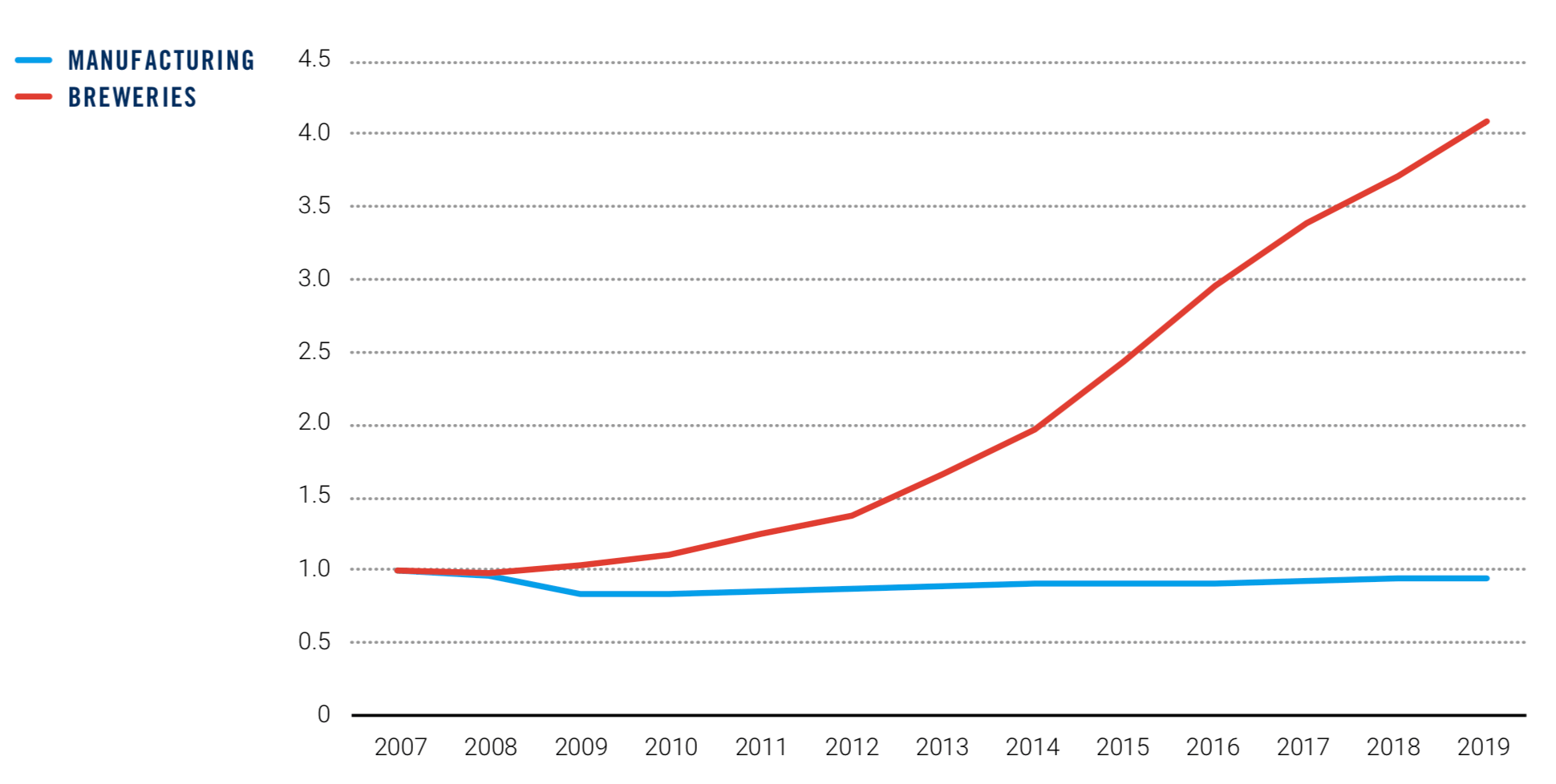
Against this dismal backdrop, the brewery industry has been a remarkably positive story. As noted, nationally brewer employment has shown the fastest growth of any manufacturing industry between the business cycle peaks of 2007 and 2019. In the Blue Wall states, brewery jobs quadrupled over this stretch, going from 3,000 in 2007 to more than 12,000 in 2019 (Figure 1).

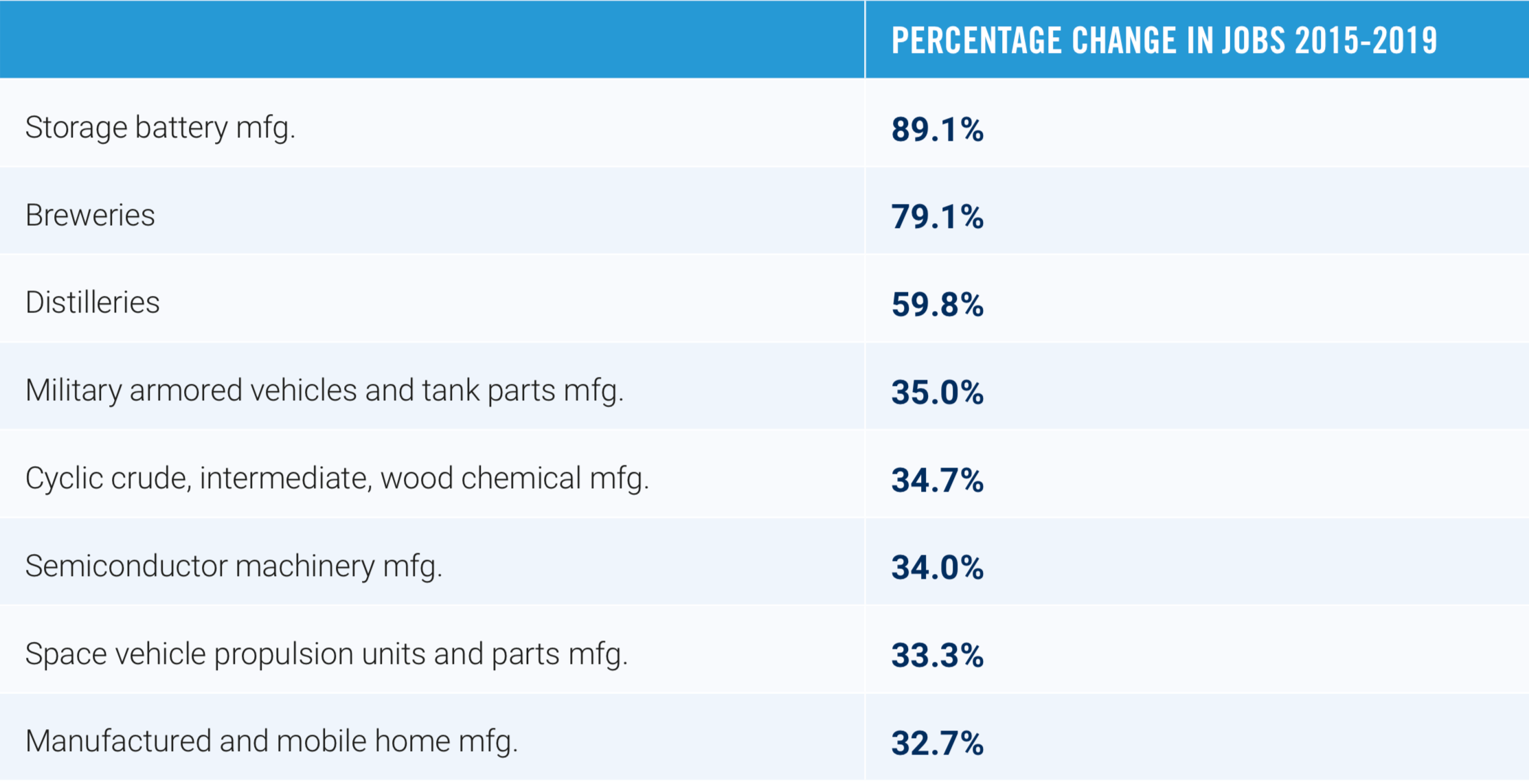
The importance of brewery jobs stands out when we look at the most recent years. From 2015 to 2019, brewery industry jobs rose by an astonishing 79 percent. As Table 1 shows, that makes brewing the second-fastest growing manufacturing industry by jobs over that stretch, second only to storage battery manufacturing (think Tesla and Elon Musk’s huge Gigafactory in Sparks, Nevada, which employs thousands of workers making lithium-ion batteries).

It’s worth noting that the brewery industry is in good company. Other top manufacturing industries in terms of job growth include military armored vehicles, semiconductor machinery and space vehicle propulsion units (another industry related to Musk).

Table 1. Top Manufacturing Industries by Growth, 2015-2019

Data: Bureau of Labor Statistics

TAXES AND JOBS

Brewery employment was boosted, in part, by the “Craft Beverage Modernization and Tax Reform” provisions of the TCJA. These provisions, due to expire on December 31, 2020, reduce federal excise taxes on both large and small domestic breweries. The excise tax rate is reduced on the first six million barrels brewed by any brewer.Small brewers, with less than two million barrels, get a deeper reduction on their first60,000 barrels.

Economic research suggests that these excise tax cuts are mostly passed onto the final consumer. Indeed, the price of beer rose
at only a 1.7 percent rate between 2016 and 2019, slower than the 2.1 percent rate of overallconsumer inflation during the same period. Inother words, beer has been getting relatively cheaper compared to other goods and services.

Should the excise tax reduction be extended? On the one hand, the federal government entered the post-election period with a $3.1 trillion federalbudget deficit for FY 2020, and the public holdingfederal debt equal to 100 percent of GDP. Under normal circumstances that would be seen as an opportunity to raise revenues by allowing the provisions to expire, immediately sending excise taxes on small brewers soaring.

Yet, with the pandemic on the upswing across the country and unemployment still high, the notion of raising taxes on an extremely successful job-creating industry seems misguided, at best. That’s the equivalent of removing a tire from your fastest, most reliable car in the biggest race of the year.

One political hurdle is that the excise tax reduction was originally enacted as part of the TCJA, which has a bad association among many progressives for its top-heavy individual rate cuts and large reductions in corporate income tax rates. Nevertheless, the TCJA contained some important progressive provisions, such as improvements in the U.S. international tax code that make it harder for multinationals to shift income to low-tax countries (the so-called BEAT, or “base erosion and anti-abuse tax”) and set a kind of minimum tax on multinationals (the so-called GILTI or tax on “global intangible low- taxed income”). Within this context, the lower excise tax on beer translates directly into lower prices for consumers and more manufacturing jobs for workers, a general plus. Indeed, the Craft Beverage Modernization and Tax Reform Act had strong bipartisan support when it was first introduced in 2017 and extending the current provisions has strong bipartisan support today.

Figure 1. Soaring Brewery Jobs in the “Blue Wall” States, 2007=1

*Michigan, Minnesota, Wisconsin, Pennsylvania, Data: Bureau of Labor Statistics

THE CASE AGAINST EXCISE TAXES

The next question: Should the excise tax reduction on beer not only be extended, but made permanent? To answer that question requires a discussion of the role of excise taxes in fiscal policy. It’s a general principle ofeconomics that broad-based taxes are moreefficient and less distortionary than a narrowexcise tax on a single good. So, a broad sales tax or value-added tax is better for the economy and economic growth than a narrow excise tax which raises the same amount of money. Similarly, a broad carbon tax is better, in a theoretical sense, than a narrow tax on gasoline.

Nevertheless, excise taxes persist. Generally, excise taxes have been justified on two grounds.First, they serve the purpose of use fees, as in the case of the gas tax, which is used to pay for highway maintenance. But in an era of electric vehicles and oversize trucks, there no longer is a direct link between gas taxes paid and damage to the roads.

Excise taxes have been also justified on social grounds, both negative and positive. The tobacco excise tax, of course, is intended to discourage smoking. Telephone companies pay a contribution to the federal government—effectively an excise tax—to support universal service initiatives. And of course, the excise tax on alcohol has been tied to the social costs of alcohol abuse.

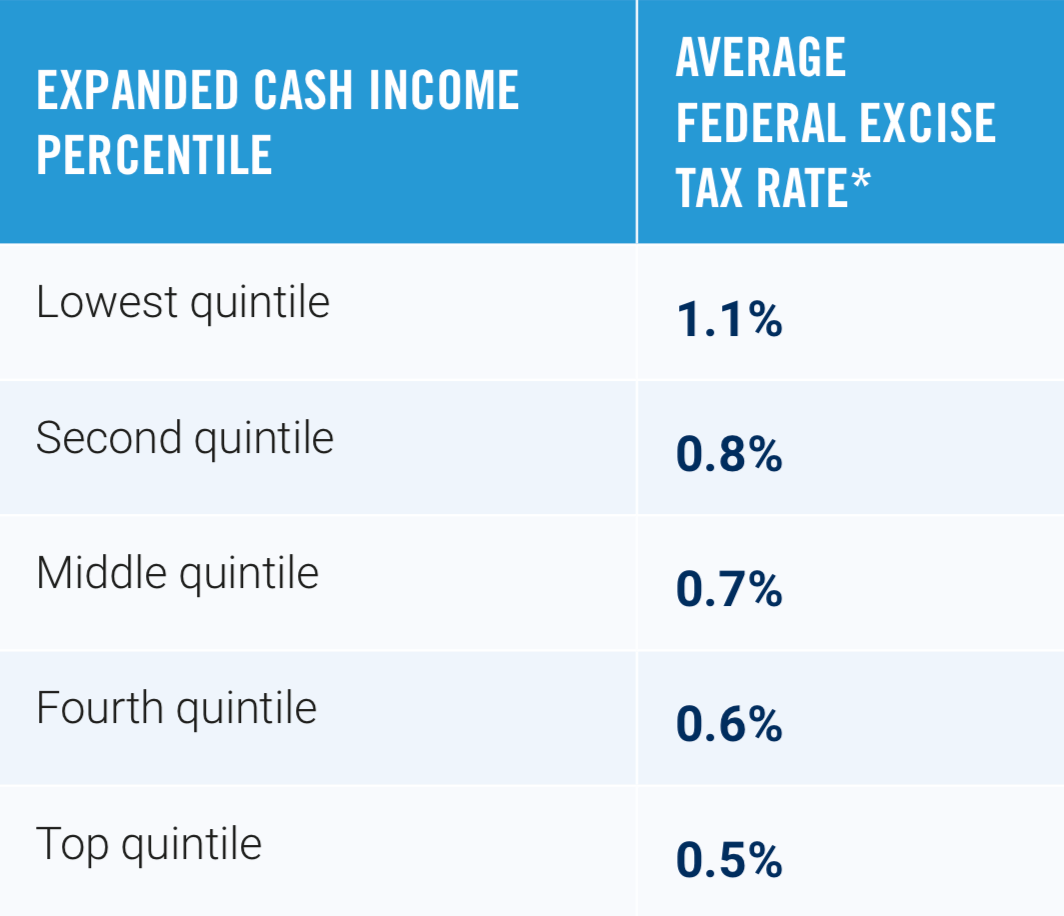
However, there are downsides to the use of excise taxes for any of these purposes. First, excise taxes tend to be regressive. A 2019 analysis by the Tax Policy Center showed that low-income households pay 1.1 percent of their income in federal excise taxes, compared to 0.5 percent for high income households (Table 2).

Table 2. Distribution of Federal Excise Taxes, 2019

*includes alcohol excise tax. Data: Tax Policy Center https://www.taxpolicycenter.org/briefing-book/who-bears-burden-federal-excise-taxes


In terms of alcohol, a 2015 study from the Congressional Research Service noted that excise taxes are generally regressive, alcohol included. Lower income households tend to spend a higher share of their pre- tax income on alcoholic beverages, but this distribution is not as uneven as spending on non-alcoholic beverages or food. In particular, economic studies have shown that beer is much less responsive to price changes than either wine or distilled spirits. This means that excise taxes on beer are much more likely to be transmitted to consumers, which puts more of a burden on low-income consumers. That makes the beer tax regressive.

And then there’s one more issue that’s especially important politically at this moment. A narrowly focused excise tax is perceived by many Americans as direct government interference in their choices. From the progressive perspective, that power should be used judiciously and notwith profligate abandon. That suggests as ageneral principle, we should move away from excise taxes towards broader-based taxes.

That principle obviously has wide applications. But getting back to beer, which is where we started: It’s time to get rid of the temptation to “tax sin” and let the excise tax reductions on beer be permanent. The U.S. needs more tax revenue, but it has to come from broader based taxes.

How Apple’s Latest Move Could Boost the Post-Pandemic Recovery

Apple announced this morning that it is reducing its commission on paid apps and in-app purchases from 30% to 15% for qualified small businesses and independent developers. This move obviously has plenty of implications for competition policy and business models.

But from the perspective of macroeconomic recovery,  this commission reduction comes at just the right time to simulate post-pandemic job growth.

It’s important to remember that the App Economy has been a potent source of jobs ever since Apple opened the first App Store in July 2008. In a September 2020 research note, we estimated that from the App Store’s opening in July 2008 to the pre-pandemic economic peak in February 2020,  the App Economy generated a total of 2.4 million jobs. That’s relative to the 15 million nonfarm payroll jobs created by the whole U.S. economy over the same period. The implication is that an estimated 16% of net job growth since the creation of the App Store in July 2008 has come from the App Economy.

The App Economy gains have continued through the pandemic recession, with our research showing that App Economy employment rising by 12% from April 2019 to August 2020, despite the weak economy. Employment in the iOS ecosystem and the Android ecosystem, respectively, are up up 15% and 14%  from the April 2019 estimates. (Note that many App Economy jobs belong to both ecosystems).

The commission reduction will build on these long-term trends, stimulating hiring by the “long tail” of small app developers and startups. Apple’s announcement says that the reduced commission will apply to existing developers who made up to $1 million in 2020 for all of their apps, as well as developers new to the App Store. So if you are a small business that is earning $500,000 in the App Store, the commission reduction may very well tip the scale for bringing on a new app developer, an extra sales person, or both.

It’s difficult to quantity the effect of the commission cut, but it certainly will make small businesses more willing to take chances and expand even in an uncertain economic climate. Climbing out of the pandemic, any action that encourages small business hiring  is good news for the U.S. recovery.


Carolina Postcard: New NC and Old NC Collide – Again

New North Carolina collided with Old North Carolina in the 2020 election. It was a split decision. The battle goes on.

New NC – younger voters, Blacks, urban residents, suburban women and college graduates – reelected Governor Roy Cooper and (apparently) Attorney General Josh Stein.

New NC helped President-elect Joe Biden come within 1.3% of carrying the state. It was Democrats’ best performance in a presidential race here since Barack Obama in 2008 and Jimmy Carter in 1976.

Old NC – rural and small-town voters, white evangelicals, older people and high-school graduates – carried the state for President Trump, despite predictions North Carolina would be his Waterloo.

Old NC (and gerrymandering) kept Republicans in control of the General Assembly. And in control of redistricting for the coming decade. The GOP won key judicial seats.

The race for Chief Justice is a virtual tie. In the Council of State, both parties kept the seats they held before.

Democrats had dreamed of flipping North Carolina decidedly blue this year. It didn’t happen.

Now the 2020s promise to be a decade of political trench warfare.

That’s why Democrats, despite unseating President Trump and reelecting Governor Cooper, look so grim and glum.

Democrats thought demographic trends were with them. They saw metropolitan areas growing, and they saw their strength growing there. They thought Trump would drive their voters to the polls.

He did. But he also drove Old NC voters to the polls.

If you live in a city, it’s hard to grasp how many people live in the state’s small towns and rural areas. And it’s hard to grasp how hostile they have become to the Democratic Party’s brand.

Is it race? Resentment over Covid-19 restrictions? “Defund the police”? The Green New Deal? Medicare for All? Taxes? Do Democrats look like “socialists”?

Whatever, it’s a reminder that North Carolina has the third-biggest rural and small-town population of any state – 2.9 million, behind only Texas (4.3 million) and California (3 million).

We have a lot of white evangelicals. Nationally, they’re an estimated 15% of the population, but 25% of voters. Their numbers are higher here. They voted 80% for Trump and Republicans.

Along with the rural-urban divide, we have a clear racial divide between the parties.

There’s an age divide. National exit polls showed Democrats stronger among voters under 40 and Republicans stronger among older voters.

There’s a diploma divide. The exit polls said Biden won 57% of voters with college degrees; Trump won 77% of whites with no college degree.

Such divisions aren’t new in our politics. Since World War II, North Carolina’s rapid growth has created a constant tension between what the state once was and what it’s becoming.

That tension has defined our politics. And it goes back to our very beginnings.

Historian William S. Powell wrote in his 1989 book “North Carolina Through Four Centuries”:

“Many key events in the state’s history came about because of rivalries and jealousies, first between northern and southern parts of the colony, next between east and west and more recently between urban and rural.”

“Rivalries and jealousies…between urban and rural”? Sounds like 2020.

In colonial days, Powell wrote, counties in the Albemarle region gerrymandered the state Assembly to dominate the Neuse and Cape Fear counties.

A century later, western North Carolinians resented the iron control that eastern landowners held on state government. The East-West split persisted through most elections in the 20thCentury.

This year, as throughout our first 400 years, New NC and Old NC battled again for control.

Don’t expect the conflict to end any time soon.

Original piece published here. 

What American voters just told us: How the electorate just shattered populist myths on both sides

The 2020 elections have shattered two populist myths: Donald Trump’s invincibility and the left’s ascendancy in U.S. politics.

Trump has spent a lifetime burnishing his legend as an unbeatable wheeler and dealer. Never mind that his business career is littered by failed ventures and six trips to bankruptcy court. Through sheer force of will, Trump always wins in the end.

Or so he wants his supporters to believe as he sulks in the White House and insists, without a shred of proof, that he’s been cheated out of reelection. In a sign of how badly negative partisanship has warped our politics, 70% of Trump’s supporters say they believe the vote somehow must have been rigged against their hero.

To paraphrase the late Sen. Daniel Patrick Moynihan, everyone is entitled to their opinion, but not to their own version of reality. In the real world, Joe Biden won about 5.5 million more votes than Trump and a comfortable Electoral College majority of 306-232.

Nonetheless, Trump is trying to milk cash from MAGAland, ostensibly for recounts and lawsuits, even as he privately tells White House staffers he’ll run in 2024 if things don’t go his way. But will Trump’s bulletproof mystique survive once he becomes a certified loser and joins the ranks of presidents denied a second term?

Read the full piece here.

Improving Oral Health Across America

Millions of Americans suffer from poor oral health with decaying teeth, gum disease and chronic tooth pain. Poor oral health can limit a person’s employment opportunities, increase the risk of certain cancers, cardiovascular disease, Alzheimer’s disease, premature births and lead to unnecessary emergency department (ED) visits.

Poor oral health can be a result of limited access to preventive dental health sources, among other causes. However, there are a variety of confounding factors that limit access to timely oral health care, including:

• Limited insurance coverage

• Provider shortages, particularly in rural areas

• Cultural barriers

These problems are not distributed evenly. In the U.S., if you live in a rural area, you are less likely to have dental insurance and access to a dentist, and more likely to have tooth loss.

Oral health is a vital component of overall health status. It is vital that people have access to regular dental care to learn good oral hygiene and to treat problems early. This paper will explore barriers to care and potential policy levers to address them.


INTRODUCTION

According to one study, toothaches were the number one avoidable reason for visiting the emergency department (ED). In some instances, patients leave dental issues untreated until they experience so much pain that they visit the ED, desperate for treatment. But EDs are poorly equipped to treat dental conditions and usually simply offer pain medications or antibiotics and refer patients to dental providers in the community.

LIMITED COVERAGE

Cost is the number one reason people cite for forgoing dental care. More than 114 million Americans lack dental health coverage, roughly four times the number of people who lack regular health insurance. And that number has likely grown considering the 5.4 million people who have lost their insurance during the pandemic. People without dental coverage include almost two-thirds of Medicare enrollees, roughly 10 percent of children and 33.6 percent of adults under the age of 64. But even among those who have dental coverage, it can be a bit of a misnomer. Most plans only cover $750 to $1,500 of care per year, requiring patients to pay for additional care out of pocket. While only a small percentage of people exceed this amount each year, a crown can run as high as $2,500, which can surpass even an insured person’s coverage.

Though we know that dental coverage is a vital first step to getting people dental care, expanding coverage does not fully solve the issue. The data shows that in states that expanded dental coverage to adults with Medicaid, emergency dental visits remained high, even in urban areas with numerous dentists. This suggests there are other barriers, besides coverage, to accessing care.

Dental care has long been perceived as secondary to medical care. Traditional Medicare does not cover preventive dental services and Medicaid is not required to cover dental benefits for adults (though 35 states provide some dental benefits to adults). The perception that dental care is secondary trickles down to even those with coverage. Many people with dental insurance don’t use their benefits until they are in pain.

PROVIDER SHORTAGES

Poor oral health is not distributed evenly: rural residents are twice as likely to have none of their natural teeth remaining when compared to urban residents. This is because, in some areas of the United States, even if you have dental coverage, you may be hard pressed to find a dentist or a dentist that takes your insurance. While there may not be a shortage of dentists
in the United States as a whole, they are poorly distributed – and rural areas often do not receive the resources they need to address oral health challenges. As dental students graduate with more and more student loan debt, many move to urban centers to set up their practices because they will have more privately-insured patients. Thus, there are some rural areas where, even if you did have health insurance that covered oralhealth services, it may be challenging to find anearby dentist to serve you. In remote areas with small populations and more people on public health insurance, it can be hard for a dental practice to survive.

To help address this challenge, the Health Resources and Services Administration (HRSA) created the health provider shortage area (HPSA) designation to allocate resources tounderserved areas. Specifically, students thatchose to practice in HPSAs are eligible for loan repayment and scholarships. Today, more than 30 federal programs23 allocate resources based on HPSA designations and many states use thedefinition for state funding as well.

However, due to the way the agency defines dental health shortage areas, shortages and other barriers to accessing care may be overstated. This means that providers across the nation are forced to compete for limited resources. The program received 7,000 applications in the last cycle and could only award funding to 40 percent of the applicants.

Dental health shortage areas are rated on a point system, 0-26. The higher the score, the greater the level of need in an area. However, certain factors may skew the rating, including the fact that a point is added if an area’s fluoridation rate is in the bottom quartile for the nation, region or state. HRSA estimates that one dentist is needed for every 5,000 people (or 4,000 people in very high need areas). Narrowing the factorsthat allow an area to be classified as a HPSA willhelp ensure that limited funds get where they are needed most.

Other barriers to care also tend to be under-reported. Many Medicaid-insured adults report trouble finding a dentist that will accept their Medicaid coverage because of their state’s low reimbursement rates. While there might be community health centers that are happy to treat Medicaid covered patients, they could have limited availability for appointments and many private practice dentists might limit the number of Medicaid patients they accept. Without assistance navigating the health system, these patients might not get the care they need.

It’s important to consider these comprehensive barriers to accessing care in rural areas rather than just looking at the number of dentists in an area.

CULTURAL BARRIERS

Because oral health has long been separated from physical health, some people view it as secondary, and often need help navigating the existing resources and overcoming individual barriers to care. For example, a lack of awareness of dental benefits, how to find a quality dentist and oral health literacy all prevent people from seeking treatment.

States have long acted as the “laboratories of democracy” piloting innovative policy solutions, that if proven successful, can be scaled. Oral health is no different. The federal government has an opportunity to learn from the states and increase access to dental health services.

POLICY SOLUTIONS

Expand coverage and increase reimbursement.

Medicaid covers dental benefits for children, but states are not required to cover dental services for adults. If Medicaid took the $520 million that it spends annually on dental ED visits and invested it in upfront oral health services, it would cover roughly one million dental visits. Though all states cover eligible children through Medicaid, coverage for adults is less consistent. Some states cover preventive services for adults, but many only cover emergency dental services. All states should expand Medicaid to cover all low-income adults and cover dental services for adults recognizing that the upfront investment improves health and reduces unnecessary emergency room expenditures.

But Medicaid coverage isn’t the only thing limiting access. On average, state Medicaid programs reimburse dentists 40 to 50
percent of what private insurance pays. The low rates limit the number of Medicaid patients that dentists will accept. Increasing reimbursement, particularly in underserved areas with high numbers of Medicaid enrollees, would encourage more dentists to see Medicaid patients.

States should also consider programs that would help people above the Medicaid income threshold afford dental health benefits. The ACA does not require compliant health plans cover dental and many people — particularly those below 300 percent of the federal poverty level — may not be able to afford dental benefits without government subsidies.

Traditional Medicare should also cover preventive dental services rather than forcing patients to buy secondary Medigap plans to get dental benefits. Almost two-thirds of Medicare enrollees don’t have dental coverage. There are a variety of conditions that are more likely with old age including edentulism – where a person has no natural teeth. Fifteen percent of seniors are edentulous and it is more likely among older and poorer seniors. Periodontal disease is the most common cause of tooth loss and can be prevented with proper preventive care. Expanding Medicare coverage of dental care can improve the overall health of seniors, particularly among long-income seniors with limited resources to spend on dental care.

Redefine Health Professional Shortage Areas.

According to the GAO, in 2005 more than 30 programs used federal health professional shortage areas (HPSA) designations to allocated funding and resources. But as discussed above, the scoring mechanism might not be the most accurate way to decide what is or isn’t a shortage area. Furthermore, HRSA has long used county boundaries to measure provider shortage areas, which can create artificial borders and over estimate the number of people living in shortage areas. Using geo-analysis to calculate the prevalence of dentists is more accurate than using county boundaries.

For these reasons and many more, HRSA is currently accepting ideas on how to best update the health professional shortage area (HPSA) designation. The revised HPSA criteria should be formulated in a way that directs limited resources to the most underserved rural areas and considers all barriers to care.

Address provider shortages in underserved areas.

There are a number of policy initiatives to address provider shortages. Thirty-three states and the District of Columbia provide dental loan repayment to encourage graduating dental students to practice underserved areas. But these programs are slow to address current shortages. In some very remote areas, such as Alaska, where it would take years to recruit dentists to small, isolated communities, policymakers created a two-year training program for “dental health therapists” to help fill in provider gaps. But before more states create these new programs, they need to accurately understand the barriers to access care within their borders. As part of the process of reevaluating the criteria to establish a HPSA, HRSA should use a new methodology to address provider shortages in underserved areas. Rather than simply increasing funding to loan repayment programs, while important, the government needs to better understand and address barriers to clinicians providing care in underserved communities.

Address individual barriers through community outreach and education.

Oftentimes, communities don’t need more dentists to address access to care issues, but instead need greater resources to help people with finding and navigating the existing oral health resources and navigating individual barriers to care. Roughly 80 percent of community health center clinics offer free or discounted dental services to people who need them. Unfortunately, many potential patients often don’t know that dental care is readily available at these facilities and delay care until they experience so much pain that they end up at the ED.

States have developed pilots with a new type of health worker: a community dental health coordinator (CDHC). Community dental health coordinators help patients better access dental care and navigate the health care system. Based on the community health worker model, where workers help patients bridge the gap between clinical and community services, CDHCs provide community-based prevention, care coordination and patient navigation to connect people with available services in their community. They can work for health centers, private dental practices and schools to better connect patients with the care they need. They may be able to perform some preventive services such as sealants and fluoride applications, as their state licensing laws allow, but they are not mid-level providers and must work under the supervision of a dentist.

CONCLUSION

This paper outlines the three main barriers to accessing dental care – coverage, dentist shortages and cultural barriers to oral health. There are a variety of ways to address these barriers, but an effective strategy will attempt to address all three. Expanding dental health coverage and increasing reimbursement –particularly in rural areas is a needed first step to improving oral health. HRSA needs to better define dental health professional shortage areas so that limited resources are appropriately targeted to underserved areas. Furthermore, the federal government needs to better understand the dental health workforce and how to better reach underserved populations. Finally, focusing on cultural barriers to care can be a cost-effective way to increase access and improve outcomes.

Black School Leaders Matter

Leadership matters. In a crisis, effective leadership matters that much more. In a pandemic the likes of which none of us have seen, leadership can be the difference between absolute success and complete failure.

America’s public education system was woefully unprepared for COVID-19. Our antiquated system of centralized school districts did little to empower its school leaders to rapidly adapt in such an emergency.  In contrast, the autonomy and independence that school leaders like Lagra Newman, Robert Marshall and Shawn Nelms enjoy, enable them to respond in ways that should be replicated.

According to a recent report by the Progressive Policy Institute (PPI), “America’s Remote Learning Imperative,” in order to shift to effective remote learning during the pandemic, our schools need more than laptops and wifi hotspots for students. They also need to make changes in five critical areas: (1) professional development for teachers, (2) engaging parents, (3) student assessment, (4) students’ social-emotional learning, and (5) school governance.

Long before America closed nearly all of its schools, school leaders with autonomy were building the parent trust, teacher capacity, and social-emotional supports necessary to respond to school closures.

At Purpose Prep Academy in Nashville, Lagra Newman created a charter school that deploys two teachers per class in kindergarten through grade 4, so they can work with children in small groups.

According to the PPI report, seven out of ten surveyed teachers in the U.S. reported they had not been properly prepared for virtual learning.  During the pandemic-induced shutdown, Newman and her staff used their spring break to prepare. Teachers were asked to conduct wellness check-ins with every student’s family, to establish families’ expectations of them and their expectations of families. With twice as many teachers per class as a traditional school, Purpose Prep had a big advantage over other schools that tried to do the same.

With the information gathered from weekly wellness checks, teachers were able to target tutoring for particular students. Even as the school transitioned into summer break, Newman and her team dedicated three weeks of professional development for staff on teaching remotely, transferring the curriculum online, helping parents support their kids’ learning, and assessing student progress in online learning.

Read the full piece here.

How Deficits Could Cripple The Biden Agenda – And How He Can Overcome Them


Former Vice President Joe Biden has won the presidency and a clear mandate to govern following the highest-turnout election since before universal suffrage. But voters were less kind to his allies in the Democratic Party, apparently reducing their majority in the U.S. House of Representatives to single digits and electing a

U.S. Senate that will be evenly divided or narrowly under Republican control (pending two run-off elections in Georgia). As a result, Congressional Republicans – who spent the last four years indulging the Trump administration with trillions of dollars in unfunded tax cuts and spending increases – will surely use the unprecedented budget deficits President-elect Biden inherits as pretext to stymie his ambitious economic agenda. Biden will need to leverage his unique ability to work across the aisle and demonstrate that his objectives can be accomplished in a fiscally responsible way in order to overcome this conservative opposition.

Thanks to the pandemic recession caused by the coronavirus, almost one out of every two dollars spent by the federal government in Fiscal Year 2020 was financed with borrowed money instead of tax revenue. This $3.1 trillion deficit was equivalent to 15 percent of gross domestic product – the largest deficit since World War 2. Although the deficit for FY2021 is projected to be smaller, it is still projected to be roughly $2 trillion. As a result of the borrowing needed to finance these deficits, the national debt is on track to exceed the all-time high it reached at the end of WW2 (106 percent of GDP) before the end of Biden’s first term.

Senate Republicans have already begun using our nation’s alarming fiscal position as a pretext to undermine further fiscal stimulus and other measures to support the American people through the coronavirus pandemic. While Treasury Secretary Steve Mnuchin and House Speaker Nancy Pelosi were negotiating a $1.8 trillion relief bill to extend provisions of the CARES Act that expired in August, Senate GOP leaders said that the price tag is a non-starter with their caucus. Now that Republicans have probably preserved their Senate majority, it is unlikely that President Trump or President-elect Biden can get a stimulus bill much more than $1 trillion.

The GOP position on limiting stimulus spending is both hypocritical and misguided. The same Congressional Republicans who undermined the Mnuchin-Pelosi deal had no problem voting for a $2 trillion tax cut at the height of the last economic expansion, when the national unemployment rate was just half what it is today. There is simply no justification for offsetting the cost of policies to contain the coronavirus pandemic or mitigate  its economic effects amidst a temporary national crisis when interest rates are at historically low levels. President-elect Biden can and should call out the hypocrisy of those who voted to run up the nation’s credit card during a time of prosperity only to pivot to pinching pennies in the middle of a national crisis.

After the pandemic has been contained and the economy has recovered, however, fiscal concerns cannot be easily dismissed. Unlike the period following WW2, when a booming population and economic growth caused the national debt to fall rapidly, today’s record-setting debts will continue to grow in perpetuity thanks to irresponsible tax cuts and an aging population and that is causing federal spending on health-care and retirement programs to grow faster than the revenue needed to finance them. What was once a concern for future generations is now one for current retirees and taxpayers: the Congressional Budget Office projects that Medicare’s Hospital Insurance Trust Fund will be exhausted before Biden completes his first term, while the Social Security Trust Funds are projected to exhaust within the next decade. If nothing is done to shore up these vital programs, beneficiaries face the prospect of deep and automatic across-the- board benefit cuts.

 President-elect Biden can work with Republicans in Congress to balance the nation’s short- and long-term fiscal needs through the adoption of a “fiscal switch” that ties federal tax and spending levels to real economic conditions. So long as the economy remains in crisis, unemployment benefits should be increased to help laid-off workers help maintain their pre-pandemic income, otherwise healthy small businesses should be eligible for loans and other supports to help them survive the crisis, and state and local governments should receive federal assistance to plug gaping budget shortfalls created by the pandemic recession. As the economy recovers, these support programs should automatically be phased down, ensuring that they spend neither too little nor too much. Then, once the economy has fully recovered, other mechanisms should trigger to proactively reduce the nation’s structural deficits and pay back our debts. Establishing an agreement along these lines could make it easier for Republicans to support the temporary deficits needed to support our economy throughout the coronavirus crisis.


Tackling the federal government’s structural fiscal imbalance in this way could also help pave a path for enacting other parts of the ambitious economic agenda President-elect Biden campaigned  on. Not including his proposals to tackle and recover from the pandemic recession, Biden proposed roughly $11 trillion in new spending over the next 10 years and only enough offsets to cover about half the costs. There is certainly a justification for deficit- financing some of his proposals that would contribute more to future economic growth than they would cost in added interest payments, such as combating climate change or making critical public investments in infrastructure, education, and scientific research. But much of Biden’s proposed spending falls outside that scope, and the reality is that funding for any of these  priorities will be difficult to pass in divided government so long as Republicans can wield our unsustainable borrowing as a cudgel against them.


President-elect Biden is inheriting the worst fiscal situation of any president in U.S. history, one which the opposition in Congress can use to obstruct the ambitious agenda on which he campaigned. But this need not be the death knell for his bold progressive vision: as Vice President, Biden frequently cut deals with Sen. McConnell and other Republicans to end heated budget battles on behalf of the Obama Administration. If there is one person in national politics today uniquely equipped to convince Congressional Republicans and the American people that fiscal responsibility need not be in conflict with his plans to build America back better, it’s Joe Biden.

How Deficits Could Cripple The Biden Agenda – And How He Can Overcome Them

Former Vice President Joe Biden has won the presidency and a clear mandate to govern following the highest-turnout election since before universal suffrage. But voters were less kind to his allies in the Democratic Party, apparently reducing their majority in the U.S. House of Representatives to single digits and electing a U.S. Senate that will be evenly divided or narrowly under Republican control (pending two run-off elections in Georgia). As a result, Congressional Republicans – who spent the last four years indulging the Trump administration with trillions of dollars in unfunded tax cuts and spending increases – will surely use the unprecedented budget deficits President-elect Biden inherits as pretext to stymie his ambitious economic agenda. Biden will need to leverage his unique ability to work across the aisle and demonstrate that his objectives can be accomplished in a fiscally responsible way in order to overcome this conservative opposition.

Thanks to the pandemic recession caused by the coronavirus, almost one out of every two dollars spent by the federal government in Fiscal Year 2020 was financed with borrowed money instead of tax revenue. This $3.3 trillion deficit was equivalent to 16 percent of gross domestic product – the largest deficit since World War 2. Although the deficit for FY2021 is projected to be smaller, it is still projected to be roughly $2 trillion. As a result of the borrowing needed to finance these deficits, the national debt is on track to exceed the all-time high it reached at the end of WW2 (106 percent of GDP) before the end of Biden’s first term.

Senate Republicans have already begun using our nation’s alarming fiscal position as a pretext to undermine further fiscal stimulus and other measures to support the American people through the coronavirus pandemic. While Treasury Secretary Steve Mnuchin and House Speaker Nancy Pelosi were negotiating a $1.8 trillion relief bill to extend provisions of the CARES Act that expired in August, Senate GOP leaders said that the price tag is a non-starter with their caucus. Now that Republicans have probably preserved their Senate majority, it is unlikely that President Trump or President-elect Biden can get a stimulus bill much more than $1 trillion.

Read the rest here.

A President Biden will do a better job handling COVID-19

Criticized in their first debate by Vice President Joe Biden for fumbling the nation’s response to the coronavirus pandemic, President Donald Trump asserted he had orchestrated the “biggest national mobilization since WWII.” Don’t worry if you missed it, because it never happened. Early on, his administration decided to punt the responsibility to respond to the pandemic to the states — which meant they were left competing for limited resources, begging for federal guidance, and navigating a nationwide problem which they couldn’t solve on their own.

With deaths now totaling more than 230,000, it’s obvious that the U.S. response to COVID-19 has not been effective. President Trump wanted to downplay the seriousness of COVID-19 because he saw it as a political problem and hoped it would go away swiftly. But when it was clear it wasn’t going away, instead of adapting his strategy, he remained unwilling to listen to experts or follow leaders’ footsteps in countries like South Korea, Japan and China. Oliva Troye, Vice President Pence’s lead staffer on COVID-19, said even when it was clear that COVID-19 would spread to the U.S., the president didn’t want to hear it because his biggest concern was getting reelected.

There were multiple failures: Early on, the federal government neglected to do contact tracing of travelers returning from hard-hit regions, then the Centers for Disease Control and Prevention (CDC) botched its early test kits, and the entire medical supply chain fell apart with limited personal protective equipment (PPE) for health care workers and not enough ventilators to meet demand.

Today, 10 months later, as America experiences a “third wave” of coronavirus infections, the Trump administration still has not mobilized the federal government to meet the moment. Specifically, they failed on three fronts:

Read the rest here.

Biden’s defeat of Trump is the most important win since FDR

As the nation awoke the morning after Election Day, reactions seemed to suggest Democrats had lost nearly every office in the land. Numerous news stories recorded “huge Democratic disappointment.” How, many Democrats asked, could we be losing House seats and fail to take back the Senate? And with Biden running behind in early returns, many began to worry that far-left critics were correct: Biden had lost because he had “run the most plodding and forgettable presidential campaign in recent memory.”

What a difference a few days — and a few million mail-in ballots — make.

It is now clear that Biden has won the White House. Biden’s remarkable campaign will be increasingly regarded in coming days, and by posterity, as something of a miracle, among the best and most important in American history.

For starters, Biden is the first challenger to beat an incumbent president in a true two-person race in nearly a century — since Franklin Roosevelt beat Herbert Hoover in 1932. (Reagan 1980 and Clinton 1992 included third-party candidates).

Biden also received the most popular votes of any candidate in history, nearly 75 million (at this writing), and at least 4.2 million more than Donald Trump. Biden carried Georgia, which had not voted Democratic since 1992. He won Arizona, which has voted Republican in all but one race since 1952. And Biden carried the “blue wall” states of Wisconsin, Michigan and Pennsylvania that Trump carried in 2016. All told, Biden is set to win 306 Electoral College votes to Trump’s 232.

Not only that, but Biden was running against by far the most ruthless, win-at-all-costs, nihilistic president in American history.

Supported by thousands of disturbingly supine Republican officeholders, one of the country’s two great major parties was turned into an army of cowering enablers. Add to that Fox News, social media propaganda and other news organizations that amplified the president’s misleading statements, and Trump was able to assemble a powerful political culture free of facts. In short, Trump was willing to risk tearing the nation apart to win.

Yet Biden still beat him. It is how Biden won that matters most.

Read the rest here.

Create more autonomous, accountable district schools. Here’s how.

Education wasn’t explicitly on the national ballot in 2020, but education is always on the ballot, even when you don’t see it. Now that the election is behind us, education reformers can focus again on states and communities, where most of the important decisions about K–12 education get made.

Before the election, too many jurisdictions were trapped in a stalemate between reformers pushing for more parent choice and choices, such as charter schools, and teachers unions holding fast for the status quo but asking for more money. Fortunately, about twenty urban districts around the country are exploring a more promising “third way”: the creation of autonomous, accountable district schools. Particularly in urban America, it is imperative that we replace centralized, standardized, industrial-era systems with more decentralized, student-centric schools designed for today’s world.

Such schools are known by a variety of names: innovation schools, partnership schools, renaissance schools, and pilot schools. The most effective models are nonprofit schools governed by independent boards of directors separate from the local school board. In some districts, such as Denver and Springfield, Massachusetts, innovation schools are organized into “zones” with a single board of directors for a group of schools within each zone.

Zone or innovation school boards negotiate schools’ performance contracts with the district, usually for five-year terms. Those contracts include clear metrics for success that the schools must meet for the agreement to renew. This creates an urgency to improve academic growth because the consequences for failure are real, including replacement of the team that runs the school.

Read the full piece here.