Populism Watch: Immigration Propels France in World Cup, But Splits Europe

France erupted into celebration following their victory in the World Cup. The success of the multicultural soccer team offered a moment to reflect on the benefits of international migration. The win was also a fulfillment of Macron’s call for more heroes to unify the country. Amid division sowed by populists and nationalists, Macron communicated this call at the funeral of nationally exalted (and half-Belgian) singer Johnny Hallyday last year. Within France’s soccer team, 15 out of a total of 22 players came from families which had recently arrived from non-EU countries. These countries included the Democratic Republic of Congo, Cameroon, Morocco, Angola, and Algeria. The multi-faith team also included muslim players such as Paul Pogba, Ousmane Dembele, N’Golo Kante, Adil Rami, Djibril Sidibe, Benjamin Mendy and Nabil Fekir. The win was a bright spot in an otherwise turbulent time for the EU, engendered by anti-immigrant agendas.

Immigration continues to roil transatlantic politics. While the U.S. fixated on Trump’s child separation policy, the EU dealt with immigration challenges of its own. In a counter to the EU system, Interior Minister Matteo Salvini proposed a union made up of nationalist, populist, and anti-immigrant parties across Europe. He described the network as“a League of the Leagues of Europe, bringing together all the free and sovereign movements that want to defend their people and their borders.”These leaders would include France’s National Front leader Marine Le Pen, Hungarian Prime Minister Viktor Orban, Austrian Chancellor Sebastian Kurz, Nigel Farage, who lobbied for the referendum that resulted in Britain leaving the union, and others. Not to be accused of only protecting the borders, Salvini set his sights inward. Locals reported authorities had cleared out an official Roma camp, and cited concern for the future of the Roma population in Italy.

The EU summit, held June 28th-29th, focused on reducing the immigration challenges which form a prominent platform for populist parties. The summit, held June 28th-29th, focused on redistributing and lessening the flows of migrants arriving by boat to the EU’s southernmost countries. Populist and nationalist parties which run on anti-immigrant platforms include Italy’s 5Star / the League Coalition, Germany’s Christian Social Union, and France’s National Rally (previously the National Front).

At the summit, EU leaders agreed to:

  • Share the responsibility of refugees arriving in the bloc on a newly voluntary basis,
  • Increase financing to Turkey, Morocco and other North African countries to prevent migration to Europe,
  • Support the development of regional disembarkation platforms for people saved at sea, aimed at “rapidly and safely”distinguishing between economic migrants and asylum seekers.

EU leaders also discussed the creation of an external migration management facility to be included under the next EU long-term budget. The plan would need sign-off from the Office of the United Nations High Commissioner for Refugees, as well as the International Organization for Migration. Germany’s Chancellor Angela Merkel called specifically for alignment with all international legal standards regarding the facility. In 2016, Merkel led the creation of a similar program, in which Turkish President Recep Tayyip Erdoğanagreed to take back migrants who had reached Europe in exchange for billions in euros to cover basics for Syrian refugee in Turkey. Germany also took in some Syrian refugees. In its first year of operation, Doctors Without Borders highlighted the “devastating human consequences of this strategy on the lives and health”of those sent to Turkey. Other examples of offshore immigrant processing facilities, such as the Australian detention centers on the islands of Nauru and Manus, have been sites of human rights concerns,hunger strikes, and other challenges.

On the last day of the EU Summit, the impact of these immigration challenges on human life was made clear. The Libyan Coast Guard reported a boat filled with migrants bound for Europe had sunk. One hundred people were missing, and the bodies of three infants were recovered.

Bledsoe & Ritz for The Hill, “Democrats must bridge the generational divide to prevent climate and budget crises”

Amid the daily drama of President Trump’s tweets and scandals, it can be hard to focus on the most important issues for our future. An unfortunate consequence of this purposeful turmoil is that few serious solutions are being offered for addressing two of the greatest threats facing the United States: runaway climate change and unsustainable budget policies.

The resignation of EPA Administrator Scott Pruitt may end his days of plundering the environment and public treasury, but the Trump administration will continue doing both even in his absence, risking long-term national well-being for temporary political benefits. It’s critical that Democrats offer credible alternatives, especially if they hope to inspire younger voters who will bear the burden of these problems, because we cannot afford to dither on either issue much longer.

We speak from experience. One of us is a baby boomer who has spent most of his career working on energy and climate policy; the other is a millennial focused on the federal budget. Although our two fields may seem unrelated, both these existential challenges require our generations to work together to solve.

Continue reading at The Hill.

Summary: PPI on Trade Policy

Here are a selection of PPI’s recent reports, op-eds and blog posts on global trade

2018

 “Confronting China’s Threat to Open Trade,” (Ed Gerwin) (June 2018)

Op-Ed in The Hill: It’s time for Congress to step in and stop Trump’s trade abuses,” (Ed Gerwin) (June 2018)

Op-Ed in The Hill: ’Go-it-alone’ trade strategies are neither wise nor effective,” (Ed Gerwin) (March 2018)

Op-Ed in The Wall Street Journal: In America’s Absence, the TPP Goes on,” (Ed Gerwin) (March 2018)


2017

How to Modernize and Strengthen NAFTA,” (Will Marshall and Ed Gerwin) (with University of California, Tecnológico de Monterrey, and COMEXI) (November 2017)

Op-Ed in U.S. News: Trump the NAFTA Terminator,” (Ed Gerwin) (November 2017)

Op-Ed in The Hill: Democrats’ trade plan tries to ‘out-Trump’ Trump – bad idea,” (Ed Gerwin) (August 2017)

Op-Ed in The Hill: The bitter harvest of Trump’s protectionist stance,” (Ed Gerwin) (August 2017)

Moving Beyond the Balance Sheet Economy,” in Policy Choices for a Digital Age, Friends of Europe,( June 2017). (Michael Mandel)

Op-Ed in The Hill: Congress has provided a workable framework for renegotiating NAFTA,” (Ed Gerwin) (April 2017)

Op-Ed in CNBC: How the US economy could suffer-bigly-under Trump’s trade agenda,” (Ed Gerwin) (March 2017)


2016

Op-Ed in U.S. News: Trade Works: Populists like Trump and Sanders Ignore How Trade Benefits Workers,” (Ed Gerwin) (November 2016)

Trade and Good Jobs for the 99 Percent: Debating Trade, the Elites, and Jobs,” (Ed Gerwin) (October 2016)

PPI President Will Marshall Trade Debate: Marshall Take on Trump Senior Policy Advisors,” (Will Marshall) (October 2016)

Op-Ed in The Hill: Facing the future on trade: Democrats must reject anti-trade obstructionism,” (Ed Gerwin and Will Marshall) (September 2016)

A Big Deal for Small Business: Seven Stories of How the Trans-Pacific Partnership Would Boost America’s Small Exporters,” (Ed Gerwin) (September 2016)

Op-Ed in RealClearPolicy: Trump’s Wrong on Trade Policy & Maybe Trade Politics, Too,” (Ed Gerwin and Will Marshall) (June 2016)

Op-Ed in The Daily Beast: Donald Trump and Bernie Sanders are Delusional on Trade Policy,” (Will Marshall and Ed Gerwin) (April 2016)


2015 and selected earlier reports

The Trans-Pacific Partnership and Small Business: Boosting Exports and Inclusive Growth,” (Ed Gerwin) (November 2015)

Op-Ed in The Wall Street Journal: Small Businesses With a Big Stake in the Pacific Trade Deal,” (Ed Gerwin) (November 2015)

PPI Blog Post: How the Ex-Im Bank Serves Main Street,” (Ed Gerwin) (October 2015)

Should the United States Adopt an Innovation Box?: The Post-BEPS Landscape,”  (Michael Mandel and Michelle Di Ionno) (October 2015)

Op-Ed in The Daily Beast: “Hillary’s Fatal Trade Flip-Flop,” (Will Marshall) (October 2015)

TPP and the Benefits of Freer Trade for Vietnam: Some Lessons from U.S. Free Trade Agreements,” (Ed Gerwin) (September 2015)

Uncovering the Hidden Value of Digital Trade,” (Paul Hofheinz and Michael Mandel) (July 2015)

PPI Blog Post: Lebron James and the Do-Something Democrats: Support for Democrats “In the Arena” on Trade,” (Ed Gerwin) (June 2015)

The BEPS Effect: New International Tax Rules Could Kill US Jobs,” (June 2015) (Michael Mandel)

The Blame Game: Multinational Taxation in an Era of Knowledge,” (May 2015) (Michael Mandel, Paul Weinstein & Sarah O’Byrne)

The Digital Opportunity: Democratizing Trade for the 99 Percent,” (Ed Gerwin) (May 2015)

Op-Ed in Republic 3.0: The Digital Economy, Trade Agreements and the 99 Percent,” (Ed Gerwin) (May 2015)

Op-Ed in CNN: Why trade is in the national interest,” (Will Marshall) (April 2015)

Op-Ed in The Hill: How the Obama Trade Agenda can Advance Progressive Goals,” (Ed Gerwin) (April 2015)

The Obama Trade Agenda: Five Things for Progressives to Like,” (Ed Gerwin) (February 2015)

Data, Trade, and Growth,” in Measuring Globalization: Better Trade Statistics for Better Policy – Volume 2. Factoryless Manufacturing, Global Supply Chains, and Trade in Intangibles and Data, Susan N. Houseman and Michael Mandel, eds. W.E. Upjohn Institute for Employment Research (2015).

Bridging The Data Gap: How Digital Innovation Can Drive Growth and Jobs,” (April 2014) (Paul Hofheinz and Michael Mandel)

Manufacturing in the App Economy: How Many Jobs Should We Aim For?,” (May 2012) (Michael Mandel and Diana Carew)

Hidden Toll: Imports and Job Loss Since 2007,” (March 2012) (Michael Mandel and Diana Carew)

Measuring the Real Impact of Imports on Jobs,” (March 2012) (Michael Mandel and Diana Carew)

Taxing Capital in a Supply-Chain World,” (November 2010) (Michael Mandel)


The Trump Trade Tax Strikes Out America’s Baseball Fans

For millions of American fans, baseball’s All-Star Game is a welcome respite from the day-to-day challenges of budgeting for their families. But, as they watch tonight’s Summer Classic, it will be hard for American consumers and taxpayers to avoid the many reminders of the “Trump Trade Tax” — the higher costs that they’ll pay because of the Trump Administration’s misguided fixation with imposing and proposing damaging import tariffs.

  • Building Costs. The construction cranes looming beyond the outfield at Nationals Park will remind fans that Trump’s tariffs on steel, aluminum, and lumber have raised construction costs—not just for big buildings—but for new homes and home remodeling projects too. And, as taxpayers, they’ll be on the hook as their local and state governments grapple with higher costs for construction and infrastructure.
  • Refrigerators. As they go to their leaky old refrigerator for a pre-game snack, fans will be reminded that a new one will cost more because of the Trump Trade Tax. On top of higher costs from Trump’s aluminum and steel tariffs, his proposed 10 percent tariff on refrigerators from China would raise prices even more.
  • Beers and Cokes. Cold cans of Bud Light and Diet Coke will likely cost more because of Trump’s 10 percent duties on aluminum—a major cost item for American beverage companies.
  • Furniture. As they plop down on their old couch, fans will be reminded that their plans to refurnish the family room will be more expensive if Trump’s proposed duties on furniture and lamps from China go into effect.
  • Washers and Dryers. As they rush between innings to switch laundry from their 15-year-old washer and to their equally old dryer, fans will be reminded that replacing them will cost a lot more—Trump’s tariffs on washers, dryers, steel, and aluminum have caused washer and dryer prices to spike by some 17 percent in just three months.
  • Baseball Gloves and Caps. Even the game itself won’t be an escape from the Trump Trade Tax. As they watch Mike Trout adjust his batting glove, Max Scherzer pound his pitcher’s mitt, or the All-Star players tip their baseball caps to the crowd, fans be reminded that batting gloves, baseball mitts, and baseball caps are among the hundreds of consumer items covered by Trump’s proposed duties on $200 billion in imports from China. Trump’s fans might save a few dollars by wearing their “Make America Great Again” capsBut, if they need a new one, it will likely cost more because of the Trump Trade Tax too.

Enjoy the game!

Will the European Commission miss the real path to growth?

While we wait for the European Commission to announce the outcome of its antitrust case against Google, let us consider what’s at stake. Each year since 2016 we have estimated the number of App Economy jobs in Europe. These are workers who develop, maintain, and support mobile apps. Our latest figures show almost 1.7 million jobs in the Android ecosystem in Europe, led by the United Kingdom, France, and Germany.

These jobs—which didn’t exist 10 years ago–are fueled by inexpensive smartphones running on the Android operating system. Moreover, Google’s apps are good for society as well. Consider Google Maps, one of the most useful programs ever created. The first Android version of Google Maps came out in 2008, along with the first commercial Android phone. Suddenly if you wanted to know where you were, you no longer had to pay hundreds of dollars for a GPS receiver. It was the democratization of location and navigation.

But accurate mapping doesn’t come for free. In a physical world that’s always changing, there’s no way to know about new buildings, different road signs and closed bridges without actually sending someone out to check.

Maintaining the world’s largest library of video information isn’t cheap either. Want to watch a video that shows you how to build a house? It’s on YouTube. Want to audit a Stanford course on artificial intelligence. It’s on YouTube also, for free.

YouTube users download 1 billion hours of video a day, somewhat more than the number of hours of television that American watch daily. Some of those hours are cat videos, for sure, but even those count as entertainment time with value to the watcher. And the whole system of storage and delivery is expensive to maintain, especially given the amount of bandwidth.

Economists have labored for years trying to estimate the value of unprecedented online sources of information such as Google Maps and YouTube. But the truth is that we’ve barely scratched the surface of the economic gains from the massive stores of information curated and maintained by Google.

These Android jobs and widely-beneficial apps are based on a business model that provides a free operating system to smartphone manufacturers in exchange for app distribution. It’s a well-functioning model that provides benefits for everyone—App Economy workers, consumers, smartphone manufacturers, app developers who have a stable environment to aim for.

The European Commission’s objections to this model run the risk of hurting jobs and economic growth. Depending on the nature of the penalty that the Commission imposes, Google might need to start charging for Android, driving up phone prices and hurting the app ecosystem.

The Commission is focusing on the wrong end of the stick. Rather than restricting Internet business models and forcing Google to charge licensing fees,we need to start teaching people how to best navigate and use these unprecedented stores of information. That’s the road to limitless growth.

Summary: PPI on the Digital Economy

Here’s a selection of PPI’s recent work on the Digital Economy.  This list does not include our global App Economy work.

Perceptions versus Reality,” (June 2018) (Michael Mandel and Desirée Van Welsum)

The Internet of Goods and a Revitalized Economy: Upstate New York as a Template,” (January 2018) (Michael Mandel and Elliott Long)

Get Ready for the Internet of Goods,” Wall Street Journal (October 15, 2017)(Michael Mandel)

The Next Ten Million Jobs: Energizing the Physical Industries in the Heartland States,” (October 2017) (Michael Mandel)

How Ecommerce Creates Jobs and Reduces Income Inequality,” (September 2017) (Michael Mandel)

An Analysis of Job and Wage Growth in the Tech/Telecom Sector,” (September 2017) (Michael Mandel)

The Economic Impact of Data: Why Data Is Not Like Oil,” (July 2017) (Michael Mandel)

Moving Beyond the Balance Sheet Economy,” in Policy Choices for a Digital Age, Friends of Europe, (June 2017) (Michael Mandel)

Robots Will Save the Economy,” Wall Street Journal (May 14, 2017) (Bret Swanson and Michael Mandel)

How the Startup Economy is Spreading Across the Country — and How It Can Be Accelerated,” (March 2017). (Michael Mandel)

The Coming Productivity Boom,” (March 2017) (Michael Mandel and Bret Swanson)

Long-term U.S. Productivity Growth and Mobile Broadband: The Road Ahead,”  (March 2016) (Michael Mandel)

Data, Trade, and Growth,” in Measuring Globalization: Better Trade Statistics for Better Policy – Volume 2. Factoryless Manufacturing, Global Supply Chains, and Trade in Intangibles and Data, Susan N. Houseman and Michael Mandel, eds. W.E. Upjohn Institute for Employment Research (2015) (Michael Mandel)

( See the working paper version hereData, Trade and Growth,” (April 2014) (Michael Mandel))

The 2015 PPI Tech/Info Job Ranking,” (December 2015) (Michelle Di Ionno and Michael Mandel)

Common Carrier Regulation of the Internet: Investment Impacts,” House Committee on Energy and Commerce, Subcommittee on Communications and Technology (October 27, 2015) (Michael Mandel)

Should the United States Adopt an Innovation Box?: The Post-BEPS Landscape,” (October 2015) (Michael Mandel and Michelle Di Ionno)

The California Tech/Info Boom: How It Is Spreading Across the State,” (July 2015) (Michael Mandel)

Uncovering the Hidden Value of Digital Trade,” (July 2015) (Paul Hofheinz and Michael Mandel)

The Blame Game: Multinational Taxation in an Era of Knowledge,” (May 2015) (Michael Mandel, Paul Weinstein  & Sarah O’Byrne)

London Shines in Tech/Info Employment: The Rest of the UK Struggles,” (April 2015) (Michael Mandel)

Tech Opportunity for Minorities and Women: A Good News, Bad News Story,” (April 2015) (Michael Mandel and Diana Carew)

Taxing Intangibles: The Law of Unintended Consequences,” (April 2015) (Michael Mandel)

Obama’s Plan To Regulate The Internet Would Do More Harm Than Good,” Washington Post (November 14, 2014) (Michael Mandel)

Where are the Big Data Jobs?,” (May 2014) (Michael Mandel)

Bridging The Data Gap: How Digital Innovation Can Drive Growth and Jobs,” (April 2014) (Paul Hofheinz and Michael Mandel)

 New York, the Silicon City,” New York Times (January 6, 2014) (Michael Mandel)

 The PPI Tech/Info Job Ranking,” (October 2013) (Michael Mandel)

Beyond Goods and Services: The (Unmeasured) Rise of the Data-Driven Economy,” (October 2012) (Michael Mandel)

 Scale and Innovation in Today’s Economy,” (December 2011) (Michael Mandel)

Innovation by Acquisition: New Dynamics of High-Tech Competition,” (November 2011) (Michael Mandel and Diana Carew)

Telecom Investment: The Link to U.S. Jobs and Wages,” (May 2011) (Michael Mandel)

The Coming Communications Boom?: Jobs, Innovation and Countercyclical Regulatory Policy,”  (July 2010) (Michael Mandel)


Contribution of Pharmaceuticals to Rising Medical Costs

Several times in the past, I’ve examined the contribution of pharmaceuticals to rising health care costs (here, here, and here). It seems appropriate to do again, given President Trump’s latest tweets on drug prices, and Pfizer’s decision to roll back recent price hikes.

I note first that an April 2018 report from the IQVIA Institute entitled Medicine Use and Spending in the U.S.   found that net spending on medicines (including both generics and branded products, and both retail and institutional use)  rose by only $1 billion in 2017, or 0.6%. By contrast total personal healthcare spending is projected to have risen by $124 billion, or 4.4% in 2017. That means there is no sign of out-of-control drug spending in 2017.

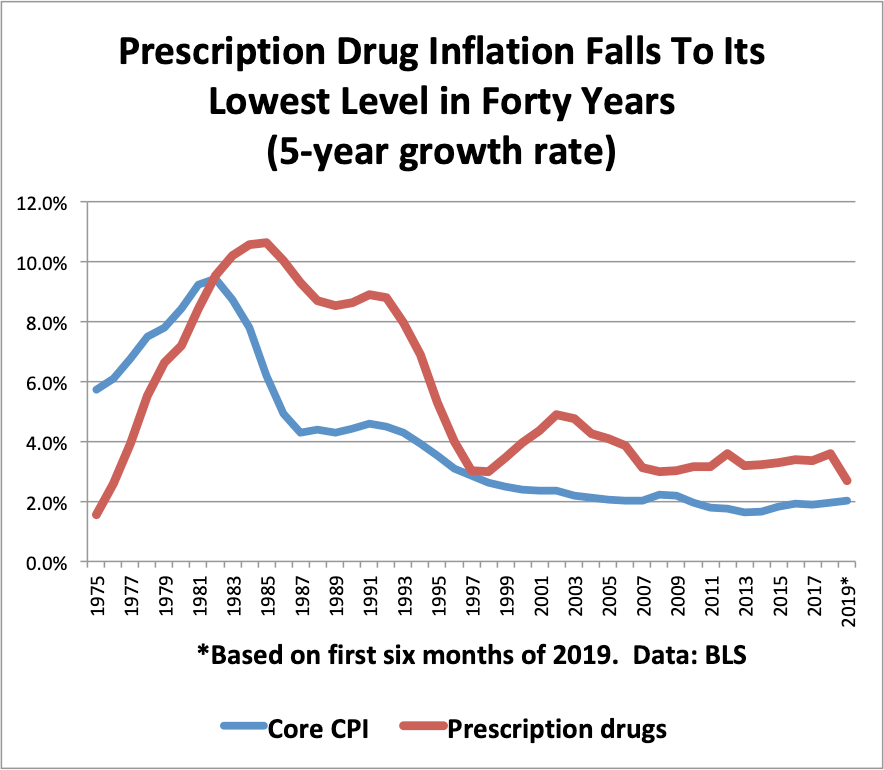
In the first five months of 2018, the average price of prescription drugs rose by 2.5%, according to data from the Bureau of Labor Statistics. That’s almost identical to the overall consumer price inflation of 2.4%. So there’s no sign from the BLS data of excess drug price increases in 2018. 

Finally, we do a five year look-back (2012-2017), which includes the high cost years of 2014 and 2015.  We find that net spending on medicines rose by $68 billion over that stretch, or 26.7%. By comparison, total personal health care spending rose by $591 billion over that stretch, or 25.0%. In other words, generic and branded medicines only contributed 12% of the increase in personal health care spending between 2012 and 2017.  Net spending on medicines rose at roughly the same rate as all other healthcare costs. 

Another useful comparison: Between 2012 and 2017, health care labor costs rose by an estimated $231 billion,  contributing almost 40% of the increase in personal healthcare spending.  These are mostly propelled by the rapid increase in the healthcare workforce, which has increased by 1.4 million since 2012 alone.

All told, policy makers who are concerned about healthcare costs would be better off focusing on restraining the runaway growth of healthcare workers.


Langhorne for Forbes, “The Teacher-Powered Schools Movement: Transforming Teachers From Industrial Workers To Professionals”

Julie Cook was ready to leave teaching. She’d worked in both urban and suburban districts and in three different states. No matter where she taught, she ended up frustrated with the lack of autonomy given to, and professionalism expected from, teachers.

Top-down policies dictated what she taught, on what timeline, and how her students were assessed. Supervisors didn’t understand why she wanted to create curriculum. And her colleagues treated teaching like a by-the-hour job, rather than a profession.

“They clocked in and out, presented information, and left the rest up to the powers that be,” she says.

In 2002, just as she’d finally decided to leave the field, Cook was offered a position at Souderton Charter School Collaborative, a teacher-powered school in Souderton, Pennsylvania.

“Teachers at our school have full or partial autonomy over our professional development, budget, curriculum, assessments, teacher evaluations, school policies, scheduling, and hiring,” she explains. “I was invited to create, decide, collaborate, and lead. I no longer felt crushed.”

She’s been teaching there ever since.


Continue reading at Forbes.

Kane for the New York Daily News, “What a Justice Kavanaugh will mean for health care”

President Trump’s nomination of Judge Brett Kavanaugh to fill the seat on the Supreme Court vacated by Justice Anthony Kennedy have left many to wonder: What will replacing an often swing vote with a more conservative one mean for health care? There are many pending cases in lower courts that, if they make it a more conservative Supreme Court, could define health policy for years to come.

Preexisting conditions

Nineteen conservative states, led by the Texas attorney general, are seeking to overturn the Affordable Care Act. The U.S. Department of Justice announced that it would not defend the law in court. The agency argued that with the abolishment of the individual mandate penalty in 2019, community rating and guaranteed issue — the rules that protect those with preexisting conditions — are unconstitutional. If the case makes it to the Supreme Court, the newest member could be a deciding vote on whether or not preexisting condition protections should continue.

Abortion

Though a recent poll found that both men and women support by a two-to-one margin Roe v. Wade, which struck down state laws restricting access to abortion, a number of abortion-related cases are working their way through lower courts. They directly ask critical questions, from at how many weeks abortion should be allowed to what type of facilities and providers can terminate a pregnancy. These cases could all be opportunities for the high court to preserve or limit access to abortion in the United States.

Continue reading at the New York Daily News. 

Langhorne for The Washington Post, “Following New Orleans’s Lead on Charter-School Education”

The big moments of historical importance don’t go unremarked, but quieter milestones often pass with little notice unless we stop to commemorate them and note their significance. On July 1, one of those modest but meaningful events will occur when New Orleans marks a change that might sound like a dry bureaucratic reshuffling, but is in fact a remarkable event in the history of American education.

Recall that nearly 13 years ago, one of the effects of the Hurricane Katrinacataclysm was to largely wipe out the city’s abysmal public schools. New Orleans’s educational system was essentially rebuilt from the ground up as a laboratory for charter schools — not a school district with a few charters sprinkled among traditional institutions, but an almost wholly charter-filled system largely run by the state of Louisiana.

The Recovery School District experiment proved successful; New Orleans public schools have improved faster than those of any other city in the nation over the past decade. But 80 percent of the schools were run by the state’s Recovery School District. An indication of the RSD’s success — and of New Orleans’s resurgence as a thriving metropolitan center — is the state’s decision to hand over responsibility for the school district to a locally elected school board on July 1.

Continue reading at The Washington Post.

Five Ideas for a Pro-worker, Pro-employer Agenda

In the aftermath of President Donald Trump’s election and inauguration, former Democratic presidential candidate Sen. Bernie Sanders urged Democrats to remake themselves as warriors in opposition to big business as the strategy for winning back voters.

“We need to … make it crystal clear that the Democratic Party is going to take on Wall Street, it’s going to take on the greed of the pharmaceutical industry, it’s going to take on corporate America that is shutting down plants in this country and moving our jobs abroad,” Sanders said on CNN in February 2017.

Many progressives have taken that advice to heart. As in many past election cycles, corporate-bashing rhetoric has been the bread-and-butter of many progressive candidates and their supporters pressing for greater governmental intervention on issues such as corporate governance, wages, and worker benefits.

New Projections Make Clear We Can’t Afford the Trump Agenda

Yesterday, the non-partisan Congressional Budget Office published their first long-term budget outlook since the passage of last year’s tax cuts and February’s spending increases. In contrast to April’s budget and economic outlook, which made budget projections only for the next decade, the long-term budget outlook offers budget projections over the next 30 years – and it shows a significantly worse picture. The projections should dissuade policymakers who want to extend or double down on the unaffordable policies enacted by the Trump administration and Congress over the past year.

Over the next 30 years, CBO projects the that our national debt relative to the size of the economy will nearly double – from 78 percent of gross domestic product today to 152 percent of GDP in 2048. This would be well over the all-time high reached at the end of World War II, when our national debt topped out at 106 percent of GDP.

But there’s a big difference between our fiscal situations in 1946 and today. Back then, our debt was the result of temporary borrowing to respond to a national emergency. After the war ended, the federal government ran balanced or near-balanced budgets almost every year for the next three decades. That, combined with a post-war boom in economic growth, resulted in the national debt plummeting to just 23 percent of GDP in 1974. Our current and future debts, however, are caused not by temporary borrowing but by a structural mismatch between revenue and spending that will only grow worse as time goes on. And with potential economic growth projected to be just half of what it was in the aftermath of WW2, this structural mismatch is one that will be virtually impossible to grow our way out of.

The main problem is the unsustainable growth of social insurance programs that provide health care and retirement benefits. As our population ages, CBO projects that annual spending on these programs will increase by 5.4 percent of GDP over the next 30 years – four fifths of which is attributable to growth in just two programs: Social Security and Medicare. Because federal revenue will grow more slowly than spending on these programs, the government must borrow more and more money each year to help finance them – and that comes with a higher cost of debt service.

In 2018, the federal government will spend about $316 billion on interest payments (equivalent to 1.6 percent of GDP). By 2048, CBO projects that interest on the debt would consume 6.3 percent of GDP under current law – nearly five times today’s levels. In contrast, CBO projects that discretionary spending (the portion of the federal budget appropriated annually by Congress) will shrink from 6.3 percent of GDP in 2018 to 5.5 percent of GDP in 2048, which means that interest on the debt will eventually cost more than all discretionary spending combined.

To put these figures in perspective, discretionary spending – which is divided evenly between defense and non-defense programs – has never fallen below 6 percent of GDP since the end of WW2. CBO warns that could change as soon as 2021. The crowding out of discretionary spending has significant ramifications for our ability to invest in the future, as discretionary spending funds critical public investments such as education, infrastructure, and scientific research. These investments help to spur innovation and productivity which are essential to long-term economic growth and future prosperity. Meanwhile, CBO estimates that allowing our irresponsible fiscal policy to continue could reduce the size of our economy by $2500 per person come 2048.

As concerning as these projections are, they could be even worse if the policies enacted over the past year are allowed to remain in place. In December, Washington Republicans rammed through a package of tax cuts that will cost almost $2 trillion before much of them are scheduled to expire by the end of the next decade. A bipartisan budget deal just two months later then paved the way for nearly $300 billion in additional spending over the next two years, but these elevated spending levels are assumed by CBO to expire after 2019. Although these laws will result in debt levels that are significantly higher in the near term, neither has a substantial impact on the long-term budget outlook after 2041 because most of their policies won’t be in effect for over the latter two thirds of the projection period.

But extending current policies – or making them permanent – would dramatically worsen our fiscal situation. The Committee for a Responsible Federal Budget estimates that doing so would result in the national debt surpassing its post-WW2 record by 2029 (echoing PPI’s estimates from earlier this year). And by 2048, CRFB projects the national debt would be almost double the size of the economy. Simply put, we cannot afford to maintain the policies put in place during the first year of the Trump administration, let alone double down on them as many Congressional Republicans have proposed.

Instead, policymakers need to heed CBO’s warning and reverse course immediately. If they permanently increase revenue by 11 percent, cut spending by 10 percent, or adopt some combination of the two beginning in 2019, policymakers could stabilize our debt at current levels for the foreseeable future. If they wait another 10 years to act, however, the size of the policy changes needed to stabilize the debt at today’s levels would increase by half. That translates into an additional cost of over $600 (in 2019 dollars) per person per year. With unemployment at historically low levels, there is little justification for continuing to rack up massive debts today at the expense of taxpayers tomorrow.

Langhorne for Forbes, “Mohammed Choudhury on Empowered Educators, Controlled Choice, And The Third Way For Urban Districts”

Big things are quietly happening in San Antonio Independent School District (SAISD).

Ever since Pedro Martinez became superintendent in 2015, creating innovative schools and putting kids first have been at the heart of the district’s values.

Under Martinez’s leadership, the district has begun to create real change and build a system of great schools that provides educational opportunities for all families.

One of the district’s crucial steps in this educational journey was hiring Mohammed Choudhury as Chief Innovation Officer. Before coming to San Antonio, Choudhury served as the founding director of Dallas Independent School District’s Office of Transformation and Innovation.

In the year and a half since he’s been in San Antonio, Choudhury has been overseeing a new innovation zone through which the district is using a growing network of in-district charters as a vehicle to build socioeconomically diverse learning environments and to ensure that all students have access to best-fit schools. In order to prevent the creation of “islands of affluence” and ensure that high-needs families have equitable access, the district has implemented controlled choice for its open enrollment choice schools and programs.

Continue reading at Forbes.

Populism Watch: In the U.S. and EU, Battles For Human Rights at the Border

The entire transatlantic world is embroiled in heated debates over the treatment of immigrants and refugees. Trump’s decision to revoke his own family separation policy, after it sparked outrage across the country and drew scrutiny by members of both parties in Congress, put a spotlight on just how inhumane the treatment of migrants, including asylum-seekers, can be. In Europe, Italy and Malta refused to let a Doctors Without Borders boat carrying nearly 700 migrants to dock, prompting Spain to offer its ports. To the north, German Chancellor Angela Merkel agreed to seek stricter measures on migrants in Germany. Below, what to follow on immigration in the coming weeks.

United States: What impact will Congress have on the separation of families at the southern border?

Trump signed an executive order on June 20th to halt the separation of families at the southern border. The policy had resulted in children and babies taken from their parents and held in cage-like structures. Many prominent Republicans, including Maine Sen. Susan Collins, Utah Sen. Orrin Hatch, and CNN National Security Analyst and previous NSA director Michael Hayden spoke out against the policy. Sen. Collins stated that the policy was “traumatizing to the children who are innocent victims, and it is contrary to our values in this country.” However, a recent Quinnipiac poll suggests the family separation policy is supported by 55 percent of her fellow Republicans.

As Trump’s executive order could be short-term, Congress is still moving forward on a number of bills. Senate Democrats introduced the Keep Families Together Act on June 7th. New York Rep. Jerrold Nadler introduced a bill in the House to limit separation at or near ports of entry on June 19th. The bills had 48 and 194 co-sponsors, respectively, as of June 21st. Republicans have put forth both a hardline approach by Virginia rep. Bob Goodlatte, and a so-called “compromise” bill that would end the separation policy and provide deportation protections and a path to citizenship for Deferred Action for Childhood Arrivals, while allocating $25 billion in funding for Trump’s border wall, limiting authorized and unauthorized immigration, and continuing to detain asylum-seekers. Goodlatte’s bill failed on the House floor June 21st, and voting on the “compromise” bill was delayed.

Europe: How will the EU hold up amid refusals to let refugee boats dock?

Italian Interior Minister Matteo Salvini and Maltese Prime Minister Joseph Muscat played a game of “not it” when a boat carrying 692 rescued migrants attempted to dock in their countries. Spanish Prime Minister Pedro Sanchez allowed the migrants to dock at his ports on June 17th, ending the impasse. As the boat was first spotted by the Italian coast-guard, Italy was obligated to take in the migrants until their asylum requests would have been decided, per EU policy. The ability of EU supporters to hold the union together amid these divisions could impact its future stability, and the state of intra-European relations. European leaders plan to meet Sunday to discuss this and other migration challenges.

Amid threats to the coalition between German Prime Minister Angela Merkel’s Christian Democrats and right-of-center Christian Social Union, Merkel has agreed to seek stricter immigration measures ahead of an end-of-the-month EU summit. In response to the immigration challenges arising in Germany, Trump tweeted: “The people of Germany are turning against their leadership as migration is rocking the already tenuous Berlin coalition. Crime in Germany is way up. Big mistake made all over Europe in allowing millions of people in who have so strongly and violently changed their culture!” His statement is incorrect (crime in Germany at a 25 year low), ill-considered, and needlessly alienates a key European ally.

Given the continuing advance of populist, anti-immigrant sentiment across the Western democracies, we can expect fresh controversies to arise at national borders. Every country has a right to determine who it admits, and on what terms, and to enforce its immigration laws. But that right doesn’t relieve any country of the moral duty to treat immigrants – even unwanted ones – humanely and with some concern for their reasons for coming. That’s a lesson President Trump keeps learning, the hard way.

Kane for RealClearPolicy, “Trump’s Newest Assault on Obamacare: Preexisting Conditions”

Two weeks ago, the U.S. Department of Justice (DOJ) filed a legal brief in support of a Texas lawsuit that would kill one of the most popular provisions of the Affordable Care Act (ACA): the one that ensures people with past medical problems can get affordable health insurance. It’s the latest twist in the Trump administration’s unrelenting campaign to sabotage “Obamacare,” even if that means pricing sick Americans out of health coverage altogether.

The DOJ’s intervention raised eyebrows since it marked a further politicization of a federal agency whose mission is to enforce laws passed by Congress. Instead, it is trying to unravel the law that President Trump and his party failed repeatedly to “repeal and replace.” It’s an undemocratic run around the legislative branch, an attempt by President Trump to win in court what he could not win in Congress.

Generally speaking, if you have a preexisting condition — a chronic condition such as asthma, a past cancer diagnosis, or pregnancy — and are covered by Medicare, Medicaid, or private group insurance, you are protected financially from the costs of those conditions. But prior to the ACA, those in the individual, or non-group, market could be denied coverage for being sick or pregnant. In fact, 18 percent of individual market applicants were denied coverage before the ACA and many more did not apply for coverage or were offered it only at unaffordable prices. Today, roughly 27 percent of adults (52 million people)not eligible for Medicare have preexisting conditions — these people would be the most at risk if these protections are thrown out.

Continue reading at RealClearPolicy. 

PPI Proposes Countering China with Smart, Targeted Strategy-Not Tariffs & Trade Wars-to Secure American Competitiveness

The President’s blunt goal of reducing America’s trade deficit with China won’t address the threat of China’s high-tech mercantilism

WASHINGTON —The Progressive Policy Institute (PPI) today released a new report by Ed Gerwin, Senior Fellow for Trade & Global Opportunity, proposing a smart, targeted long-term U.S. strategy to combat China’s state-directed technology mercantilism, instead of the unfocused protectionist approach being pursued by the Trump Administration.

“The Trump Administration is right to highlight the threat that China’s state-directed technology mercantilism poses to America’s economic future,” says Gerwin. “But the Administration’s strategy—based on duties that damage the American economy and ‘America First’ policies that alienate our allies—is flawed, and won’t change China’s bad behavior. Neither will doubling down on that ill-considered strategy through this week’s announcement of additional trade taxes on $200 billion in Chinese-origin goods.”

“Instead of tariffs and trade wars, the United States needs to pursue a tough, targeted, long-term strategy that enlists allies, enforces rules and writes new ones, focuses negotiations, and ratchets up pressure on China—all while advocating aggressively to keep global markets open. We detail such a strategy in our new report.”

According to Gerwin, the linchpin of China’s future-oriented mercantilism is an extensive array of plans, policies, rules, and practices to enable the transfer and assimilation of foreign technology and intellectual property for China’s benefit. To achieve these goals, China is employing many unfair or illegal measures, including using foreign ownership restrictions and licensing approvals to compel American companies to transfer their technology, and directing and funding a highly coordinated effort by Chinese state-owned and private firms to acquire foreign tech firms. China’s conduct poses a threat to the United States, Gerwin notes, where IP-intensive industries alone support more than 45 million jobs and represent 39 percent of U.S. GDP.

But threatening duties on Chinese products is unlikely to upend China’s innovation mercantilism, Gerwin argues. Duties are likely to increase American consumer prices and reduce vital technology investments, while a tit-for-tat tariff war with China could cost an estimated 455,000 American jobs, most in less-skilled sectors. The Administration’s “go-it-alone” approach to trade is also alienating allies in Europe, Japan, Korea, and elsewhere who should be natural allies in opposing China’s technology mercantilism. Finally, there’s significant concern that President Trump may undercut the long-term effort required to address Chinese mercantilism by, instead, focusing on short-term “wins.”

America should keep all options on the table in opposing China’s abusive innovation practices, including targeted and intensifying trade sanctions, writes Gerwin. But these tactics must be part of a smarter, focused, long-term U.S. strategy that includes:

  • Working more closely with—and not needlessly alienating—trade partners who also face threats from China’s unfair technology practices;
  • Using the WTO much more aggressively to launch a bold series of WTO challenges to China’s multiple rules violations;
  • Leading a global effort to establish new rules and norms to address China’s unfair innovation practices that aren’t covered by existing global trade rules, including new rules to limit digital protection-ism and unfair competition by SOEs; and
  • Designating a single, high-level official to lead focused negotiations to seek specific and verifiable commitments from China on ending China’s use of abusive practices that harm American competitors in innovative industry sectors

Gerwin calls on Congress to play a more active role in confronting China’s high-tech mercantilism by:

  • Establishing a clear set of negotiating objectives for China that underscore the primacy of eliminating China’s abusive innovation policies;
  • Providing additional resources to support ramped-up investigation, consultation, and enforcement related to China’s unfair trade and technology practices;
  • Amending current law to broaden Executive Branch authority to use national security reviews, export controls, and other tools to address security and industrial base threats posed by China’s acquisitions and technology demands; and
  • Establishing an escalating series of sanctions that would kick in if China fails to make verifiable progress in eliminating abusive innovation practices, potentially including reciprocal restrictions on Chinese technology licensing, the withdrawal of U.S. scientific and technical cooperation, and/or targeted sanctions on Chinese products based on stolen or unfairly obtained American know-how.

###


read more here:PPI_China_2018