Goldberg, Pincus Testify on Value of Pre-Dispute Arbitration Agreements

The U.S. House Committee on the Judiciary’s Subcommittee on Antitrust, Commercial, and Administrative Law held a hearing on pre-dispute arbitration clauses on Thursday, May 16, 2019.  PPI Center for Civil Justice Director, Phil Goldberg, and Andy Pincus, who served as general counsel of the Commerce Department under President Clinton, testified in support of pre-dispute arbitration clauses because of the value they provide to consumers, employees and businesses in avoiding prolonged litigation and resolving disputes.

The other participants in the hearing included Gretchen Carlson, formerly of Fox News, and Lt. Commander Kevin Ziober, each of which discussed their experiences with pre-dispute arbitration.  Deepak Gupta of Gutpa Wessler and Prof. Myriam Gilles of the Cardozo School of Law advocated for legislation that would ban the use of these agreements.

Mr. Goldberg, who was testifying on his own behalf, explained that progressives agree that the civil justice system is a public good and a keystone of American economic and political liberty because it facilitates the peaceful resolution of disputes.  But, we also know that it has its limitations and is subject to abuse. The major reason that pre-dispute arbitration is being increasingly common is because it achieves these goals of peaceful, quick and conclusive dispute resolution often better than the civil justice system for many claims.

In particular, Mr. Goldberg continued, pre-dispute arbitration agreements can be critical for consumers, employees and businesses to have access to justice in cases that are of modest value and where there is a premium on maintaining relationships after the dispute is resolved.  In litigation, plaintiffs’ firms often will not take cases valued at under $100,000 – $200,000, and the adversarial nature of litigation generally poisons the sides against each other.

In contrast to the litigation system, as Mr. Pincus explained on behalf of the U.S. Chamber Institute for Legal Reform, pre-dispute arbitration is a fair, less-complex, and lower cost alternative to our overburdened court system.  Also, empirical studies show that consumers and employees do as well or better in arbitration as in litigation: they prevail on their claims at the same rate or more frequently, and they recover as much or more when they do prevail.

Mr. Goldberg’s written testimony is here and a video of the House hearing is here.

Do-Something Congress No. 10: Fighting Inequality by Reinventing America’s Schools

Progressives are rightly concerned about inequality, but some overlook the crucial role that underperforming public schools play in perpetuating poverty and inequality in America. The poor quality of many school systems is a serious impediment to social mobility for children from low-income and minority families, who can’t easily pick up and move to communities with good schools. The number of students taking college remediation classes has soared, and too many students graduate high school underprepared to enter either college or the workforce.

First-rate schools are key to delivering on America’s core promise of equal opportunity. That’s true for U.S. students everywhere – not just for kids trapped in poor schools in poor communities. In international comparisons, even students from America’s best suburban school districts consistently score below students from other advanced countries in Asia and Europe.

America’s public education system was designed for the Industrial Era. The centralized, bureaucratic approach that we inherited from the 20th century no longer works for the majority of America’s students. We need a new model, and fortunately one is emerging from cities that have embraced profound systems change, including New Orleans, Denver, Washington, D.C., and Camden, N.J. All have experienced rapidly improving student outcomes as a result.

These four cities are building 21st century school systems, founded upon the four pillars of school autonomy, accountability for performance, diversity of school designs, and parental choice. Essentially, 21st century school systems treat many of their public schools like charter schools, even if they call them “innovation schools,” “partnership schools,” or “Renaissance schools.”

Although transforming our K-12 education system to meet the needs of the modern era is primarily the responsibility of state and local governments, Washington can play an important catalytic role by creating incentives for change. In particular, Congress can create financial incentives for states that strengthen charter authorizing and for districts that create autonomous schools, hold schools accountable for performance, and replace failing schools.


THE CHALLENGE: AMERICA’S K12 PUBLIC EDUCATION SYSTEM IS DESIGNED FOR THE INDUSTRIAL ERA

For a century, our public education system was the backbone of our success as a nation. By creating one of the world’s first mass education systems, free to all children, we forged the most educated workforce in the world – a key pillar of our economic strength. But all institutions must change with the times, and since the 1960s, the times have changed. The Information Age economy has radically raised the bar students must meet to secure jobs that support a middle-class lifestyle. Meanwhile, America’s public school population has grown more diverse, necessitating differentiated approaches to education. Yet our 20th century school districts too often produce cookie-cutter schools that fail to motivate or meet the needs of different students.

Traditional Public Schools are Failing Too Many Students

Overall, our traditional public schools “work” for less than half of our students. Of those who attend public schools, 17 percent fail to graduate on time. Even more graduate but lack the skills necessary to succeed in today’s job market. Almost a quarter of those who apply to the U.S. Army fail its admissions tests, more than a third of those who go on to college are not prepared for first-year courses, and half of college students never graduate. A large portion of middle- and high-schoolers are bored by their public schools; only one in three rate their school culture positively. And among developed nations, the United States ranks 18th or worse in high school graduation rates and in the bottom half in math, science, and reading proficiency (1).

Traditional School Structures are Bureaucratic, Inflexible, and Discourage Innovation

Our traditional public schools struggle to respond to the challenges of today’s world, held back by their traditional district structures, rules, and union contracts. After all, 20th century bureaucracies were built to foster stability, not innovation.

By continuing to assign students to schools based on their neighborhoods, we not only reinforce racial and economic segregation – creating a system with schools of concentrated poverty and concentrated wealth – but we also limit our ability to create innovative schools with diverse and specialized learning models.

Moreover, by clinging to the hierarchal organizational model of a centralized system, we remove decision-making authority from those educating the students. Principals and teachers best understand the needs of their students, but they lack control over school-level decisions that affect student learning. Principals often do not control their staffs, budgets, curricula, or learning models: those decisions are made at district headquarters. They cannot adapt their schools to meet the specific needs of their students, because the centralized system has been designed to treat all students the same.

Since 1983, the U.S. has seen wave after wave of school reforms. Unfortunately, most have been of the “more-longer-harder” variety: more required courses and tests, longer school days, higher standards, and harder exams. Few have reimagined how school districts and schools might function.


THE GOAL: CREATE 21ST CENTURY SCHOOL SYSTEMS IN DISTRICTS ACROSS URBAN AMERICA

By embracing a 21st century school model based on accountability for performance, school autonomy, choice, and a diversity of learning models, we can create public school systems that meet the needs of all students. This model has created the fastest improvement in urban America, in cities like New Orleans, Washington, D.C., and Denver.

In such systems, the central office no longer runs all schools directly; instead, it is responsible for overall policy, oversight, enforcement of compliance, evaluation of schools, and matching school supply to demand. Most 21st century school systems are made up, at least in part, of public schools operated by independent organizations, usually nonprofits. They are freed from many of the top-down mandates that constrain district-operated schools, so school leaders can craft unique programs and make school-level decisions. In exchange for increased autonomy, these schools are held accountable for their performance by a district or authorizer, who closes or replaces them if their students are falling too far behind.

Many of the public schools in these systems are schools of choice, but they are not allowed to select their students. If too many students apply, a school holds a lottery to see who gets in—ensuring that all families have an equal shot at quality schools. Districts that have embraced this approach have created computerized enrollment systems that give all families a chance to select their top choices—a kind of lottery for all students.


THE PLAN: INCENTIVIZE STATES TO CREATE 21ST CENTURY SCHOOL SYSTEMS

Although most education legislation occurs at the state level, Congress can incentivize states to create 21st century school systems.

Congress should offer financial incentives for those states that improve their charter laws. One approach would be to expand or revise the U.S. Department of Education’s existing Grants to State Entities, awarded for the preparation, opening, replication, or expansion of high quality charters and for the improvement of state agencies that oversee charters.

The State Entities Program, one of six distinct grant programs included under the Department of Education’s Charter Schools Program, replaced the State Education Agencies program in FY 2017. The State Entities Program expanded grant eligibility from state education agencies to governors, statewide charter authorizing boards, and nonprofit charter support organizations (2). In FY 2017, the program distributed $144.7 million in grants of varying amounts to nine states (3).

Two proposed changes could improve this program. First, no state should qualify for a grant if it caps the number of charter schools it authorizes. Adding this requirement would direct more aid to states that are expanding their use of charters.

Second, in addition to the principal eligibility criteria, the application has six weighted priority preferences, through which a candidate can earn extra points in the selection process. The sixth preference, “best practices for charter school authorizing,” should be worth double its current weight, and, to receive these points, a state entity should have to demonstrate that its authorizers close failing charter schools, rather than merely implement authorizer training. Currently, the state entity must only demonstrate the extent to which it has taken steps to ensure all authorized public chartering agencies implement best practices for charter school authorizing.

In order to be eligible for these preference points, states with multiple authorizers should also have to develop a clear guideline for authorizer accountability. In particular, it should require that authorizers close any charter school with student scores for academic growth that fall in the bottom 10 percent of public schools in the state for three years in a row. Applicants should also be required to have a strong process in place for preventing authorizers with a large portfolio of failing charter schools under their oversight from authorizing new schools. Similarly, applicants should have a procedure in place for revoking authorizing status from authorizers who fail to shutter consistently failing schools.

In addition to modifying the existing State Entities Program, Congress should create a separate program that awards grants to school districts that partner with nonprofit organizations to take over and redesign district schools, with new staffs. The Texas Education Agency has implemented incentives for districts to create such “partnership schools,” and it is working well. In Texas, the nonprofits selected as partners must have acceptable academic performance and financial ratings for the last three years. When they enter the partnership, they get access to district facilities and better financial deals (4).

Many urban districts have some form of the partnership model, including Denver, Indianapolis, Philadelphia, Atlanta, San Antonio, Tulsa, New Orleans, Camden, N.J., and Springfield, Massachusetts. The schools in the partnerships are given autonomy to control their budgets, staffing, schedules, and learning models. In return, they are held accountable through multiyear performance agreements and replaced if they fail.

A federal grant program could encourage districts to enter partnerships with nonprofits, awarding $2 million per school for each of the first three years. The first year would be a planning year for the takeover and redesign, followed by two years of operation. Deciding which schools would become partnership schools would be left to the districts.

These grant programs alone would not be as effective as districts redesigning their systems to operate on the pillars of autonomy, accountability, family choice, and diversity of school designs. But they would encourage states and districts to implement strategies that have proven to improve student outcomes more rapidly than any other methods used at scale.

 

[gview file=”https://www.progressivepolicy.org/wp-content/uploads/2019/05/EdDoSomething_Final10.pdf”]


  1. David Osborne, Reinventing America’s Schools: Creating a 21st Century Education System (New York, NY: Bloomsbury, 2017), 1-2.
  2. “Federal Charter Schools Program (CPS) and Authorizers,” National Association of Charter School Authorizers, at https://www.qualitycharters.org/research-policies/archive/federal-charter-schools-program/
  3. “Awards,” Office of Innovation & Improvement, U.S. Department of Education, at https://innovation.ed.gov/what-we-do/charter-schools/state-entities/awards/.
  4. David Osborne and Emily Langhorne, “Texas has Ambitious Plans to Transform Urban Schools,” U.S. News & World Report, Apr. 13, 2018, at https://www.usnews.com/news/best-states/articles/2018-04-13/commentary-texas-has-ambitious-plans-to-transform-urban- schools.

Opportunities for Innovation: Community Responsive Special Health Services in Charter Schools

After Hurricane Maria devastated Puerto Rico, almost 25,000 students left the island. Puerto Rico’s Department of Education closed a quarter of its schools in response to their intensified economic crisis, damaged facilities and infrastructure, and decreased student population. Those students who remained missed an average of 78 days of school. Faced with this catastrophe, legislators passed the Education Reform Act on March 29th, 2018, which, among other things, allowed for the creation of charter schools.

Charter schools (or Escuelas Alianzas as they are called in Puerto Rico) are free public schools that receive government funding but operate independently of the school district in which they are located. Freed from the top-down mandates that constrain district-operated schools, charter schools receive increased school-level autonomy in exchange for greater accountability for results. Puerto Rico’s Governor Ricardo Rosselló believed that the Education Reform Act could redesign the public school system to meet the demands of the 21st century, by decentralizing to give school leaders more autonomy.

The hurricane further damaged an already struggling system, critically impacting both health and education in Puerto Rico. According to a survey of over 95,000 students in Puerto Rico, 45.7 percent reported damage to their own homes, 32.3 percent experienced shortages of food or water, and 16.7 percent still had no electricity five to nine months after the hurricane. Many Puerto Ricans still do not have consistent access to clean drinking water, food, and health care.

The Boys and Girls Club of Puerto Rico—who had been waiting for this opportunity for years—opened Proyecto Vimenti, the island’s first and only charter school, under the leadership of executive director Eduardo Carrera. According to Carrera, the Boys and Girls Club opened the school with the intention to “break the generational cycle of poverty.”  The U.S. Census Bureau estimated that 57 percent of children in Puerto Rico lived below the poverty line before the hurricane.

Through its partnership with the Boys and Girls Club, Proyecto Vimenti has been able to provide special services to its students. They provide special health services like eye exams and hearing tests in addition to many other offerings. When the school provided health screenings to their kindergarteners and first graders, they discovered that many of its students had untreated vision and hearing problems. Through these screenings, school officials were able to provide assistive supports like glasses early in a child’s education  and thereby avoid many special education misdiagnoses.

However, Proyecto Vimenti is not the first charter school to see the connection between a student’s health and their academic performance. Students with health problems such as asthma, poor vision, diabetes, and tooth pain are more likely to be chronically absent, resulting in poorer academic outcomes and increased likelihood of dropping out of school. Unsurprisingly, children living in poverty are disproportionally affected by  health issues. Charter schools, often serving the poorest students, are able to use their flexibility to form community partnerships that can provide these important health services within their schools. Their autonomy allows them to implement innovative solutions in ways that district-operated schools seldom can.

Consider the case of Native American Community Academy (NACA) in Albuquerque, New Mexico. Founded in 2006, NACA, a charter school serving middle and high school students, has integrated health education and improving wellness as core elements of the school’s mission. NACA received a grant from the U.S. Department of Health and Human Services in 2011 to build a school-based health center. The health center provides a variety of services such as dental care and access to a primary care physician. The school leadership intentionally sought out community partners who had expertise with Native American students and the specific health problems their community faces. NACA now has over 150 community partners including the University of New Mexico and First Nations Community Healthsource. NACA’s model, which connects the specific health needs of the student’s community with student wellness, has been so successful that the network has grown to seven campuses throughout the state.

KIPP Ujima Village Academy and KIPP Harmony Academy in Baltimore also saw the value of connecting health services to their school. These two schools, housed in the same building, serve over 1,500 students, approximately 83 percent of whom receive subsidized meals. Within its building, KIPP houses a clinic run by the Johns Hopkins Children’s Program. KIPP and its health services partners believe they can reduce chronic absenteeism by providing urban children in poverty with health and psychosocial care.

Staffed by two nurses, a nurse practitioner, and a pediatrician, the clinic provides vision exams, dental services, and behavioral health care in addition to other primary services. Students can be treated on site, which means that parents do not have to leave work to take their child to an emergency center, and health staff can better manage students with a chronic condition, such as asthma or diabetes, because of the regularity with which they see them. In Baltimore, access to regular health care is especially important for students with asthma, as the prevalence of childhood asthma within the city is over twice the national average, approximately 20 percent compared to about 10 percent.

For KIPP, the results of the clinic are telling. After two years of operation, the two schools combined had a 23 percent drop in chronic absenteeism among students with asthma.

Funding realities make implementing health services in every public school a challenge. In a time when only 39 percent of public schools have a full time nurse, it‘s not surprising that only 2.5 percent of public schools offer on-site primary-care services. Indeed, the two KIPP schools received a five-year, five-million-dollar grant from the nonprofit Rales Center to fund their clinic

However, it’s also no coincidence that the Rales Center chose to bestow their grant upon a charter school. Dr. Kate Connor, the medical director of the Rales Health Center, explained that when deciding where in Baltimore to locate the new health clinic, KIPP was the obvious choice.  She said, “[KIPP] is really oriented towards educational innovation, and their leadership had begun to recognize the necessity of providing comprehensive wraparound services in order to support students’ not just direct educational needs but other things that determine educational success and relate to educational success in the lives of kids and families.”

Statement on the Passing of Alice Rivlin

America lost a titan today with the passing of Alice Rivlin. Simply put, Alice was the mother of modern fiscal analysis. The Congressional Budget Office only exists as it does today because of her strong leadership as its founding director. Alice resisted political pressure and established the CBO as Washington’s non-partisan umpire of fiscal debates, and as a result, everyone who works in American fiscal policy has benefited from her public service. But Alice Rivlin didn’t just analyze economic policy, she made it better. As the first woman director of the Office of Management, Alice helped President Clinton balance the federal budget for the first time in a generation. She shaped monetary policy as vice chair of the Federal Reserve, saved D.C. from fiscal ruin as the head of its financial control board, and developed innovative proposals for everything from bending the health cost curve to reshaping the relationship between federal and state governments.

Many of us at PPI have had the privilege of working with Alice over the years. In Alice we found a kindred spirit: someone who believed in the importance of investing in the next generation without leaving them the bill. As chair of the BPC’s Debt Reduction Taskforce and a member of President Obama’s fiscal commission, Alice was instrumental in crafting the two most influential bipartisan deficit-reduction plans of the last decade. At the same time, her support for fiscal responsibility didn’t stop her from championing federal investments in education, infrastructure, health care, retirement security, and so many other important public goods our society needs. Alice understood what too many in DC do not: robust public investment and responsible fiscal policy are not contradictory, they are in fact complementary.

We were lucky to benefit from her guidance when we launched our Center for Funding America’s Future last year and will miss her greatly as we continue our work moving forward.

Repairing Credit: The Right Way to Fix a Broken System

If you think your credit report is accurate, there is a good chance you are wrong. According to the Federal Trade Commission (FTC), one in five Americans has a potentially material error in their credit file, and one of the biggest contributors is medical bills—with half of all medical bills containing an error.

In fact, mistakes on credit reports have become so pervasive that around a third of all complaints filed annually to the Consumer Financial Protection Bureau (CFPB) resulted from problems with consumer credit reports.

Credit report errors are a serious threat to the financial well-being of American families. As Senator Elizabeth Warren has noted, “credit reports regularly contain errors that can make it harder for families to access credit, find jobs, and get housing.” And as many consumers know all too well, it’s very difficult to get those errors corrected.” (1)

Under the Fair Credit Reporting Act, the company that furnished the information to the credit bureau must conduct an investigation to verify the information and correct a mistake, if they find one. Unfortunately, consumers who want to try to fix mistakes on their credit report face three daunting obstacles.

First, the system put into place by the credit reporting agencies heavily favors creditors and other data furnishers. Credit bureaus almost exclusively depend on lenders (such as banks, credit unions, credit card providers, and mortgage underwriters).

Consumers contacted the credit reporting agencies approximately eight million times in 2011 to initiate a credit dispute. But only a small fraction of those disputes was resolved internally by credit bureau staff. According to the CFPB, 85 percent of credit report disputes are passed on to data furnishers (the lenders) to investigate and resolve. (2) Unfortunately, in most cases the disputes are then shelved unless the consumer perseveres.

Second, the credit report agencies earn their profits by providing services such as credit checks to the very entities that provide the data used to create the credit reports – banks, mortgage lenders, credit card companies, retailers, and other businesses that provide credit. This creates a serious conflict of interest.

Third, despite several notable efforts to try to empower consumers, trying to correct errors on your credit report is still tedious, confusing, and time consuming.

CREDIT REPAIR ORGANIZATIONS AND COMPANIES

Because the system is rigged against them, many consumers turn to credit counseling agencies or credit repair companies. The dispute system designed to help consumers fix the problem favors the position of the debt collector over the consumer. Specifically, the credit bureau is only legally required to check with the creditor or debt collector and ask them whether they stand by their claim. As long as the creditor says you owe money, the dispute is resolved in their favor. As the National Consumer Law Center concludes: “Credit bureaus have little economic incentive to conduct proper disputes or improve their investigations.” (3)

Credit counseling agencies are typically a free resource from nonprofit financial education organizations that review your finances, debt and credit reports with the goal of teaching you to improve and manage your financial situation.

A credit repair company is a firm that offers to improve your credit in exchange for a fee. Unfortunately, the quality of these firms varies greatly. Some credit repair firms are highly reputable and follow best practices. Unfortunately, a significant cohort of credit repair firms are not good actors and, in some cases, have committed outright fraud. In 2016 the Consumer Financial Protection Bureau (CFPB) stated that “more than half of people who submitted complaints with the CFPB about credit repair chose the issue ‘fraud or scam’ to describe their complaints.”

There are some telltale signs for consumers trying to separate the bad actors from legitimate credit repair firms. Companies should be avoided that:

  • Demand an upfront payment.
  • Don’t provide a written agreement that includes cancellation rights for consumers.
  • Guarantee they’ll raise your credit score or fix an error.
  • Have multiple complaints against them with the Consumer Financial Protection Bureau or the attorney general’s office in the state where they operate.
  • Suggest they can remove legitimate negative information.
  • Offer to create a new credit profile based on a new employer identification number, rather than your Social Security number.

In contrast, responsible credit repair companies not only follow federal and state law but also:

  • Offer a free consultation
  • Have a track record and consistently solid reviews from past clients.
  • Have an attorney on staff.
  • Are licensed, bonded and insured.

WHAT NEEDS TO CHANGE?

To protect consumers, some policymakers have suggested new regulations to further police the credit repair industry. They note that credit repair firms don’t do anything someone with a bad credit report couldn’t do on their own. Anyone can dispute credit errors on their own behalf. But the Do-It-Yourself approach can be dauntingly complicated and time-consuming for harried families.

In essense, paying for credit repair assistance is really no different than paying an accountant or purchasing software to do your taxes – something 90 percent of Americans do according to the Internal Revenue Service.

It is important to note that there is already existing legislation to regulate the credit repair system. The Credit Repair Organizations Act (CROA) was signed into law in 1996 to protect consumers from the unscrupulous practices commonly used by several credit scammers.

Because of CROA, credit repair organizations are not permitted to misrepresent the services they provide, including guaranteeing the removal of negative credit listings. Credit repair organizations are also not permitted to attempt to create a “new” credit file or advise you to lie about your credit history. The Act also bars companies offering credit repair services from demanding advance payment, gives consumers certain contract cancellation rights as well as the right to sue a credit repair organization that violates CROA. (4)

CROA is a sensible law, and despite criticisms that it does not go far enough in regulating the credit repair industry, the law does provide consumers with protections against bad actors in the credit repair sector without eliminating legitimate credit repair firms. CROA needs strengthening, not in the form of new regulations but rather more effective enforcement.

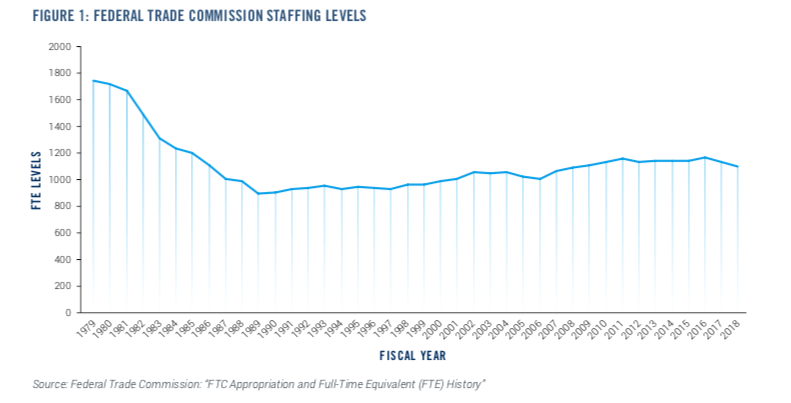
Under CROA, the Federal Trade Commission (FTC) is the primary enforcement body at the federal level. The problem is the FTC is severely underfunded and understaffed. In a Senate hearing last year Commissioner Rebecca Slaughter said the FTC’s staff level is 50 percent below its level at the beginning of the Reagan administration in 1981. Senators Jerry Moran (R-Kan.) and Catherine Cortez Masto (D-Nev.) agreed the FTC needs more resources and is “understaffed.” (5)

As Table 1 confirms, FTC staffing levels dropped dramatically during the 1980s and have never really recovered. Yet, over the same time, the responsibilities of the agency have dramatically changed and expanded. Today the FTC has to address some 2.7 million complaints a year in areas from debt collection, to identify theft, to imposter scams. (6)

Better enforcement of CROA would obviate the need to pile on new rules. Unfortunately, in fact, Congress has added to the FTC’s workload even as its workforce has shrunk. The simplest solution is to provide the FTC with additional resources dedicated to enforcing CROA and protecting consumers from those credit repair companies that have acted fraudulently or in bad faith.

To pay for this increase in supervisors, a small annual fee could be placed on the credit reporting agencies (Equifax, TransUnion, and Experian). To create an incentive for these agencies to be more responsive to consumer complaints about credit reporting agencies, the fee could be lowered or raised in synchronization with the number of consumer complaints about their credit reports.

OTHER REMEDIES

Another approach to fixing the current system is to go to the source of the problem, eliminating some of the causes for the extraordinary amount of errors made by the credit reporting industry. As Aaron Klein of the Brookings Institution has noted, there are three major reasons why credit scores are so inaccurate: “size, speed, and economic incentives of the system.”

One way to change the incentive structure would be to create some consequences for credit rating companies that frequently give lenders inaccurate data about borrowers. Lawmakers could consider legislation that would penalize credit reporting agency error rates above a certain level. Klein’s approach would use a random sample method (5 to 10 percent of complaints) to review credit rating firms’ performance. Another approach would be to grade the credit bureaus on their error and response rates.

CONCLUSION

While it is tempting to lump all credit repair firms into the same basket, many of these firms act in good faith and follow CROA to the letter of the law. Yet there is no doubt that a significant number of these companies are misleading consumers and sometimes acting fraudulently. If lawmakers really want to crack down on these bad actors, however, the first step should be strengthening enforcement of existing law.

Otherwise, spawning new laws and regulations would likely enmesh all credit repair firms in new layers of regulatory complexity and compliance burdens, making it even harder for consumers to detect and correct errors on their credit reports. In CROA we have the consumer protection law we need, now it’s time to focus on oversight and enforcement.

[gview file=”https://www.progressivepolicy.org/wp-content/uploads/2019/05/CreditFinal.pdf”]

(1)  Brian Schatz Press Release: “Following Equifax Breach, Schatz, Warren, McCaskill, Colleagues Reintroduce Legislation to Help Consumers Catch And Correct Credit Report Errors,” September 11, 2017

(2)  Kelly Dilworth, “Consumer watchdog report details credit bureaus’ work,” Creditcard.com, December 13, 2013

(3)  Aaron Klein, “The Real Problem with Credit Reports is the Astounding Number of Errors,” Brookings Institution, September 28, 2017

(4) 15 USC Chapter 41, Subchapter II-A: Credit Repair Organizations

(5) Kate Patrick, “FTC Asks for More Control Over Big Tech, Privacy Issues,” Insidesources.com, November 30, 2018

(6)  Federal Trade Commission, “FTC Releases Annual Summary of Complaints Reported by Consumers,” March 1, 2018

(7)  Aaron Klein, “The Real Problem with Credit Reports is the Astounding Number of Errors,” Brookings Institution, September 28, 2017

(8)  Ibid

Mandel for Medium: “Tech/Telecom/Ecommerce sector grew by 7.3% in 2018, Political Implications”

Many of the Democratic presidential candidates are vying to see who can be toughest on the tech sector. But here’s the paradox: New data shows that the tech boom is a major force driving down unemployment, lifting economic growth, and helping voters — precisely the people that the Democratic candidates are trying to reach.

The key here is that the economic data produced by the government is not typically presented in a form that easily shows the benefits of the tech boom. Software firms, for example, are spread across at least three different industries. Ecommerce — related activities are spread across at least two industries, electronic shopping and warehousing. And telecom includes at least two three industries, telecom services, communications equipment, and data processing and hosting.


Read the full piece on Medium by clicking here. 

Kim for Medium: “How to get more companies to put people over profits”

Corporate profits are soaring. Yet Americans’ paychecks are inching upward by comparison. It’s no wonder many Americans feel anxious despite an economy that, by the numbers, is booming.

This disconnect between shareholders’ prosperity and workers’ precarity has led many on the progressive left to question the very future of capitalism. Some 2020 presidential candidates, such as Sens. Elizabeth Warren and Bernie Sanders, now routinely paint Big Business as the enemy of middle-class mobility and have called for drastic measures to rein in corporate power and mandate better behavior.

It might be too soon, however, to write off U.S. companies as a force for good.


Read the full piece on Medium by clicking here. 

Kane for Medium: “How Medicare-For-All Would Politicize Health Coverage”

Last week the Trump administration announced that it would give health care workers greater leeway to refuse, on religious grounds, to provide services that enable birth control use, abortion, sterilization, or assisted suicide. Specifically, the rule bars employers from requiring their employees to participate in delivering health care services they believe their religion proscribes. Such services could include scheduling a vasectomy, prepping a room for a sex change surgery or billing for an abortion.

Democrats slammed the move, which they described as a political plum tossed to religious conservatives who form an important part of President Donald Trump’s base. If they take back the White House in 2020, it won’t take them long to reverse the rule issued by the Department of Health and Human Services (HHS) Office for Civil Rights (OCR).


Read the full piece on Medium by clicking here. 

Ritz for Forbes, “Keep the White Walkers Out of Our Tax Code”

Millions of Americans watched the 70th episode of HBO’s Game of Thrones last Sunday to see who would win the ultimate battle between the people of Westeros and the undead army of the White Walkers. But there is another undead threat here in America that has gotten far less attention, one that marches not on our lands and castles, but on our tax code: they’re called “tax extenders.”

What exactly are tax extenders, you may be wondering, and how are they at all similar to the mythical antagonists from Westeros? Tax extenders were a package of “temporary” provisions that that gave preferential tax treatment to particular industries or activities. For nearly 30 years, Congress voted to extend the life of these provisions – which primarily benefited niche special interest groups – for just one or two years at a time. The main purpose of this ritual was to hide the true long-term costs of these special-interest handouts from the American people.

Continue reading at Forbes.

Long for Medium: “Under Legislation, Policymakers Would Micromanage Freight Rail Employment”

Republicans despise federal micromanagement, but that hasn’t kept Rep. Don Young of Alaska from hopping aboard the Washington-Knows-Best Express. He recently introduced a bill mandating that freight trains have a minimum of two crew members on board trains at all times.

While Young justifies his bill on safety grounds, the bill also appears to reflect pressure from rail workers’ unions fearful that automation is putting their members out of jobs.

Here’s the backstory: Following the fatal 2008 Chatsworth train collision in Los Angeles, President Bush signed the Rail Safety Improvement Act into law. The law required freight railroads, by the end of 2020, to integrate Positive Train Control (PTC) — a nationwide system of technologies that constantly process thousands of data points to stop a train before human error-caused accidents occur. One of the benefits of PTC was that it was a win-win for consumers and the railroads, enhancing safety and allowing railroads to boost productivity by moving to one-person crews somewhere down the road.


Read the full piece on Medium by clicking here. 

Do-Something Congress No. 9: Reserve corporate tax cuts for the companies that deserve it

Americans are fed up seeing corporate profits soaring even as their paychecks inch upward by comparison. Companies need stronger incentives to share their prosperity with workers – something the 2017 GOP tax package should have included.

Though President Donald Trump promised higher wages as one result of his corporate tax cuts, the biggest winners were executives and shareholders, not workers. Nevertheless, a growing number of firms are doing right by their workers, taking the high road as “triple-bottom line” concerns committed to worker welfare, environmental stewardship and responsible corporate governance. Many of these are so-called “benefit corporations,” legally chartered to pursue goals beyond maximizing profits and often “certified” as living up to their multiple missions. Congress should encourage more companies to follow this example. One way is to offer tax breaks only for high-road companies with a proven track record of good corporate citizenship, including better wages and benefits for their workers.

THE CHALLENGE:  Good corporate citizenship is punished, not rewarded, in a market that puts profits first.

The pressure to return profits to shareholders – the tyranny of so-called “shareholder primacy” – is one reason companies have been disinvesting in their workers. As Brookings Institution scholars Bill Galston and Elaine Kamarck have noted, many companies are increasingly reverting to “short-termist” behavior to avoid missing the quarterly earnings targets promised to shareholders (1). For instance, one notable survey of more than 400 CFOs found that 80 percent would “decrease discretionary spending on R&D, advertising and maintenance … to meet an earnings target” and 55 percent would “delay starting a new project” even if it meant sacrificing long-term value (2).

Companies also don’t seem to be raising wages or investing in worker training. Even as many firms have been reporting some of their best profits in years during this recovery (3), companies are cutting back on benefits like health insurance and offering less on-the-job training than they once did. And despite their recent uptick, workers’ wages haven’t caught up to where they should be. According to a Brookings Institution analysis, real wages for the middle quintile of workers grew by just 3.41 percent between 1979 and 2016, and actually fell slightly for the bottom fifth.

Corporate short-termism is bad for workers, who don’t get the wages and training they deserve. It’s also bad for companies, which are shortchanging their long-term health to satisfy short-term shareholder demands. But as long as current corporate culture remains fixated on companies’ stock prices, firms will feel tremendous pressure to put short-term profits above all other priorities – and often at workers’ expense.


THE GOAL:  ENCOURAGE MORE BUSINESS TO BE “TRIPLE-BOTTOM LINE” CONCERNS THAT PUT PEOPLE ON PAR WITH PROFITS

A small but growing number of firms have begun to reject the hold of “shareholder primacy” and have organized themselves as “triple-bottom line” companies committed equally to social and environmental good as well as profit. Among these is the growing number of “benefit corporations” specially organized under state law with the purpose of “creating general public benefit.” Since 2010, 34 states and the District of Columbia have passed legislation legally recognizing benefit corporations and protecting them from shareholder lawsuits for decisions that don’t maximize profits. Notably these states include Delaware, which is the leading “domicile” – or legal home – for most of America’s major companies. A significant number of benefit corporations have also won third-party certification from the nonprofit B Lab as “Certified B Corps” – essentially a Good Housekeeping seal of approval for benefit companies that have met strict standards for worker treatment, environmental stewardship and social responsibility. Among the many factors considered for certification are the share of workers who get formal training; rates of employee retention and internal promotion; the share of workers receiving tuition reimbursement or similar benefits for training and education; the extent to which “worker voice” plays a role in the company’s governance; pay equity; and company practices to reduce its environmental footprint.

According to the nonprofit B Lab, more than 2,500 businesses globally are certified B Corps. While the vast majority of these businesses are small, certified B Corps include such well-known U.S. and global brands as outdoor clothing maker Patagonia, Cabot Creamery, Ben and Jerry’s Ice Cream, and New Belgium Brewery, the makers of Fat Tire beer.  A small but growing number of B Corps are now publicly traded, including cosmetics company Natura; Sundial Brands, a subsidiary of Unilever; and Silver Chef, a company that finances commercial kitchen equipment purchases for restaurateurs.  These firms are proof that companies with an avowed social mission can in fact succeed in a cutthroat capital market. If more companies follow suit, the result could be a dramatic and beneficial shift away from the stranglehold of shareholder primacy and toward better corporate practices.


THE SOLUTION: OFFER TAX BREAKS TO “BENEFIT CORPORATIONS” AND HIGH-ROAD FIRMS THAT DEMONSTRATE SOCIAL RESPONSIBILITY

Many companies may feel they can’t “afford” to invest in their workers if it affects the bottom line for their shareholders. Targeted tax cuts to reward high road companies such as certified benefit corporations could, however, change the calculus for some companies and encourage them to change their behavior. These tax benefits could be structured in one of two ways:

  • Option One: Preferential tax rate.

As PPI has previously proposed, one option is to modify the new corporate tax rate to establish a preferential “public benefit corporation” rate for businesses that meet “high-road” requirements. Only the most deserving companies should qualify for the new 21 percent corporate tax rate; all others should pay a rate that is two to three percentage points higher.

To be entitled to these benefits, companies would meet one of two requirements: (1) that they be legally organized as “public benefit corporations” in their state and can provide good evidence of how they are fulfilling that mission; or (2) they must meet a minimum set of standards for worker treatment and investment, to be promulgated by a new standards-setting body authorized by Congress (effectively behaving like benefit corporations without the formality of legal status). To set the required standards, Congress could establish an inter-agency “workers’ council,” including representatives from labor and business, to establish guidelines for public benefit corporation rate eligibility (though enforcement would be left to the IRS). Companies would apply for a discounted tax rate in the same way that charities and nonprofits apply to the IRS for tax-exempt status, with the proviso that companies must also report annually on their performance, either in their public filings or in separate submissions to the IRS.

  • Option two: Benefit corporation tax credit.

A second option for structuring a high road company tax incentive is to create a tax credit for benefit corporations like the “sustainable business tax credit” offered by the city of Philadelphia. Under this benefit, first launched in 2012, Philadelphia businesses that are either certified B Corps or that can show they meet similar standards of social and environmental responsibility can qualify for a tax credit of up to $8,000 against their revenues. Up to 75 firms can apply for the credit on a first-come, first-served basis.

This structure might be especially beneficial for small and medium-sized benefit corporations structured as “pass-through” entities not subject to the corporate tax rate. As Jenn Nicholas, co-founder of the Philadelphia-based graphic design firm Pixel Parlor told Governing magazine, the credit has helped her afford higher wages and other benefits for her 10 workers. “It’s a challenge to be profitable and provide benefits to our employees,” Nicholas said. “Every tiny bit helps, and it feels like somebody is looking out for us when the general climate [for small businesses] is the opposite” (10).

While some policymakers have proposed requiring companies to treat their workers more fairly, tax incentives for high-road businesses are a better approach. Top-down mandates tend to invite resistance or evasion and will not succeed in changing the overall spirit of corporate culture in favor of shareholders over workers. Encouraging companies to reform themselves will ultimately prove the more enduring tactic. As more businesses see that they can indeed “do good and do well,” the grip of shareholder primacy will weaken, and workers will benefit.


Sources: 

1) Galston, William A., and Elaine C. Kamarck. More builders and fewer traders: a growth strategy for the American economy. Washington, DC: Brookings Institution, 2015.

2) Graham, John R., Campbell R. Harvey, and Shiva Rajgopa. The Economic Implications of Corporate Financial Reporting. N.p., 2005.

3) Bureau of Economic Analysis. “Gross Domestic Product, Third Quarter 2018 (Second Estimate); Corporate Profits, Third Quarter 2018 (Preliminary Estimate).” News release. November 28, 2018. Accessed March 28, 2019. https://www.bea.gov/news/2018/gross-domestic-product-third-quarter-2018-second-estimate-corporate-profits-third-quarter.

4) Kim, Anne. Tax Cuts for the Companies That Deserve It. Washington, DC: Progressive Policy Institute, 2018.

5) Shambaugh, Jay, Ryan Nunn, Patrick Liu, and Greg Nantz. Thirteen Facts About Wage Growith. Washington, DC: Brookings Institution, 2017.

6) B Lab. “State by State Status of Legislation.” benefitcorp.net. Accessed March 28, 2019. https://benefitcorp.net/policymakers/state-by-state-status.

7) Title 8: Corporations, Delaware Code §§ CHAPTER 1. GENERAL CORPORATION LAW; Subchapter XV. Public Benefit Corporations-361-386 (2017).

8) B Lab. “Certified B Corporation: About B Corps.” Benefitcorp.net. Accessed March 28, 2019. https://bcorporation.net/about-b-corps

9) Id.

10) Kim, Anne. “The Rise of Do-Gooder Corporations.” Governing, Jan 2019.

Creating a 21st Century Education System: Reinventing America’s Schools – An Abridged Version

For a century, our public education system was the backbone of our success as a nation. By creating one of the world’s first mass education systems, free to all children, we forged the most educated workforce in the world. The creation of standardized, unified school systems with monopolies on free schooling had a dramatic impact on this country, helping us build the most powerful, innovative economy on Earth.

But all institutions must change with their times, and since the 1960s, the times have changed. First television emerged to dominate the lives of young people, undermining their desire and ability to read. Then the cultural rebellion of the 1960s and ‘70s brought new problems, including widespread drug use and the decline of the two-parent family. Teen pregnancy soared, the percentage of children raised by single mothers tripled, arrest rates for those under 18 shot up, and gang activity exploded. Meanwhile immigration picked up, doubling the percentage of public school children from households that didn’t speak English, from 10 to 20 percent. At the same time, our Information-Age economy radically raised the bar students needed to meet to secure jobs that would support middle class lifestyles.

Today our traditional public schools “work” for less than half of our students. More than one in five families chooses something other than a traditional public school—a private school, a public charter school, or home schooling. Among those who do attend public schools, 16 percent fail to graduate on time. Even more graduate but lack the skills necessary to succeed in today’s job market. Almost a quarter of those who apply to the U.S. Army fail its admission tests, more than a third of those who go on to college are not prepared for first-year college courses, and almost half of them never graduate. Among industrialized nations, the U.S. ranks 22nd in high school graduation rates and in the bottom half in math, science, and reading proficiency.

Since 1983, we have seen wave after wave of school reforms. Unfortunately, most have been of the “more-longer-harder” variety: more required courses and tests, longer school days and hours, higher standards and harder exams. Few have reimagined how schools might function, given our new technologies.


PPI’s Ben Ritz Discusses Social Security Trustees Report on C-SPAN

PPI’s Ben Ritz joined an expert panel on Capitol Hill last week to discuss the recently published report by Social Security’s trustees. The annual report projected that the program’s trust funds face insolvency within the next 16 years, after which point beneficiaries face the prospect of an across-the-board cut of 23 percent. All panelists encouraged policymakers to close the gap between Social Security’s revenues and spending sooner rather than later, which Ben noted is critical for ensuring the changes are fair to younger and older Americans alike.
Watch the full panel here on C–SPAN.

Langhorne for Forbes, “Bookshare: How One Nonprofit Is Improving The Lives Of Students With ‘Reading Barriers'”

Emery Lower loves to read. She loves Harry Potter, Bridge to Terabithia and Pride and Prejudice. Since beginning sixth grade, she’s developed an interest in graphic novels, especially mangas; in particular, she recommends The Tea Dragon Society. Each year that Emery has taken the State of Texas Assessment of Academic Readiness exams, she’s earned a “masters grade level” score on the reading section.

Only a few years ago, however, Emery couldn’t read. By the end of first grade, she hadn’t finished a book independently. She hated reading and didn’t even like it when her parents read to her because they wanted her to look at the text as they read the story.

“Any time Emery had homework in kindergarten and first grade, it would take hours and a lot of crying – mostly her but sometimes me,” says her mother Brandy Lower. “She was mentally exhausted when she came home from school because she’d spent all day trying to decode words and not being able to do it.”

That’s because Emery, like millions of other children in the United States, suffers from dyslexia, a learning disability that affects areas of the brain that process language. People with dyslexia struggle with decoding: the ability to relate speech sounds to letters and words.

“I would look at the page and say a word out loud, but it didn’t click in my brain,” Emery says. “I didn’t know letters made words, that they had to spell something. I thought that any random group of letters could be a word. Reading was not fun at all for me.”

Then, she found Bookshare, and, slowly, her life began to change.

Continue reading at Forbes.

In Win-Win Decision, FDA Approves Innovative Harm Reduction Technology

The Food and Drug Administration (FDA) should be complimented for following a data-based approach to innovation and clearing the sale of heat sticks. These are new electrically heated tobacco systems that slowly heat tobacco, rather than burning it, with much fewer harmful chemical byproducts. The agency took almost two years to rigorously analyze the health impact of the innovative product, with the trade name IQOS, including the effect on the young. The goal: To give current smokers a safer alternative to health-destroying cigarettes—a “harm reduction” strategy.

A harms-reduction approach is appropriate. In 2017, the Centers for Disease Control and Prevention estimated 34.3 million adults smoke in the United States, with a public health cost of approximately $300 billion annually.

As PPI has written in the past, a harms-based regulatory approach, like the FDA took on heat sticks, is imperative to achieving advancements in both public health and economic growth. By contrast, a regulatory approach based on precaution inherently fails to maximize economic and social benefits.

Indeed, we also applaud the FDA for paying attention to social benefits and costs. For example, with recent concern over rising youth smoking in the U.S., the FDA rightfully placed restrictions on how heat sticks are marketed to youth. The restrictions limit how heat sticks are marketed via websites and on social media by requiring advertising to be targeted to adults. Heat stick manufacturers must also notify the FDA about how they plan to restrict youth access and limit youth exposure to the products’ marketing.

Column: The Education Investment States Should Be Making

As the idea of “free college” gains popularity, Virginia and Iowa are instead focused on career and technical education.

In the midst of record low unemployment, many states are nonetheless struggling with ongoing skills gaps — shortages of workers with the right skills for in-demand jobs.

At the start of 2019, according to the Department of Labor, as many as 7.3 million jobs remained unfilled. These included a substantial number of “middle-skill” jobs requiring some schooling beyond high school but not a four-year degree. They were in fields such as health care, IT, welding and truck driving. The American Trucking Associations, for instance, reported a shortage of 50,000 drivers in 2017.

One reason these gaps exist is underinvestment in career and technical education. Of the more than $139 billion in annual federal student aid spending for higher education, just $19 billion goes to career and tech ed. Students generally can’t use federal Pell Grants to fund short-term, non-college-credit training programs, such as for welding certifications and commercial drivers’ licenses. Federal dollars under programs such as the Workforce Innovation and Opportunity Act are typically limited to the lowest-income workers.

Read Anne Kim’s full opinion piece in Governing by clicking here.