Understanding the New “Median Employee Pay” Statistics

Summary: The new “median employee pay” statistics tell us very little about pay. However, they do illuminate the future of economic statistics.

The median center of the United States population, as calculated by the Census Bureau, is Pike County, Indiana, in the rural southwest corner of the state. A visit with a resident of Pike County, with a density of 38 people per square mile, might tell you something important about the rural Midwest, but it wouldn’t give you any insight into Silicon Valley or New York City.

That, in a nutshell, is the problem with the new “median employee pay” figures that companies are now required to publish. These figures provide us with some useful pieces of information that were hidden before. It’s interesting to know that the median employee at GE, for example, earns $57,211 per year, while Ford’s median employee receives $87,783.

But we’re learning that “median employee pay” for a company has a lot more to do with geographic scope and the nature of the corporate business model than with the actual level of pay in the company. For example, median employee pay at megabank Citigroup is $48,249, while median employee pay at Bank of America is $87,115. Does that mean that comparable workers get paid twice as much at Bank of America? No, it merely reflects that two-thirds of Citigroup employees are outside the United States, many in lower-wage countries. By contrast, Bank of America’s business is mostly focused in the US.

Another odd set of numbers comes out of the utility industry. Median employee pay at The Southern Company, a gas and electric utility employing 31,000 workers in 34 states, was reported at an eye-popping $138,000. Meanwhile, the AES Corporation, with three-quarters of its operations outside the US, reported median employee pay of $49,229. These two numbers tell us nothing, however, about pay for comparable workers.

A different set of issues arises in retailing. The need to staff weekend and evening hours means that many retailers employ a large number of part-time workers to cover off-hours. Similarly, the annual surge in holiday shopping requires hiring an enormous number of seasonal workers. Moreover, there’s a large amount of turnover in the retail industry, which means that many workers hired for a permanent position may not have been working for that employer for a full year at the time when the count is made.

As a result, the reported median employee pay for most retailers is not directly comparable to other sectors of the economy. For example, Macy’s reports median employee pay of $13810, as of October 29, 2017. That number reflects the reality that 54% of its workers are part-time or seasonal. Similarly, Walmart is reporting median pay of $19177, and Loew’s is at $23905. Amazon reported a median employee pay of $28446, and Nordstrom’s median pay is at $30105.

Meanwhile, Connecticut-based tech manufacturer Amphenol, a major global designer and manufacturer of electronic products such as fiber optic connectors, reported median pay of only $12179. But as the company points out in its proxy, that’s because the majority of its employees are in low-wage countries. However, its US employees have a median pay of $54532.

Indeed, in the bigger picture, the data on employee median pay is telling us something important about the ongoing changes in economic statistics. Today, economic and labor statistics mainly come from government statistical agencies. These agencies mainly do expensive surveys which cover the whole country. These surveys are carefully curated and standardized, and systematically designed to be comparable over time and across the economy. The national unemployment rate and inflation rate come from surveys such as these, which were originally designed in the middle of the 20th century.

However, these surveys are increasingly expensive and often lag changes in the economy. Moreover, it’s getting hard to justify sending out teams of interviewers when companies have so much business data on their servers already.

As a result, going forward, economic statistics will be based much more heavily on “organic” data, generated in the normal process of doing business. That’s good news and bad news. The good news is that information technology allows companies to generate new types of economic data that weren’t possible before. Median employee pay, for example, would have been prohibitively expensive to require as recently as ten years go. Most companies just didn’t have the global pay databases that would allow them to do these kind of calculations.

The bad news is that these new types of data—such as median employee pay—may not be comparable across companies, either because they use different calculation methodologies or because different companies have objectively different business models. The median employee in a global company with large operations around the world is very different than the median employee of a company whose operations are based solely in one region of the United States.

The danger is that journalists and politicians treat these new types of organic data as if they were the old type of government-curated statistics. They are not. Comparisons of median employee pay across companies tell us more about how the companies are organized and about their industry than they do about the level of pay.

To put it a different way: If you had a magic wand and could ask corporations to produce one new statistic about their operations, you likely would not have asked for “median employee pay.”

Marshall for POLITICO, “How Emmanuel Macron Became the New Leader of the Free World”

In addition to being Trump’s ideological opposite, the French president is a beacon for progressives hoping to find their way back to the halls of power across the democratic world.

Europe’s most dynamic political leader, Emmanuel Macron, pays a state visit to Washington this week. The French president has struck up a surprisingly cordial relationship with President Donald Trump, especially when you consider that Macron has emerged as the West’s most formidable opponent of the kind of populist nationalism Trump channels here.

Speaking last week to the European Parliament, Macron warned of a “European civil war” and urged the European Union to defend liberal democracy against a surging tide of illiberal nationalism. “Faced with the authoritarianism that surrounds us everywhere, the answer is not authoritarian democracy, but the authority of democracy,” he declared.

The JFK-style antithesis was a reminder that U.S. presidents used to give stirring speeches like this in Europe. But that’s not happening today because Trump identifies more with the other side—with right-wing nativists and neo-nationalists who want to keep immigrants out; raise barriers to global commerce; weaken or leave the EU to protect “national sovereignty;” and, especially in Eastern European countries like Hungary and Poland, undermine internal checks on strongman rule.

In effect, Macron has stepped audaciously into the vacuum created by Trump’s abdication of America’s historic role as keeper of the liberal democratic flame. Although some have anointed Germany’s Angela Merkel the new “leader of the free world,” she’s been preoccupied with shoring up a weak coalition government and stanching defections from her conservative base to the far-right Alternative for Germany party.

In addition to being Trump’s ideological opposite, Macron can be viewed as something of a beacon for progressives hoping to find their way back to the halls of power across the democratic world. As a progressive, young outsider who rode a wave of voter revolt against the governing establishment, Macron managed to capture the populist’s insurgent spirit without embracing their reactionary demands. That, in a nutshell, is the task facing other progressive parties as they struggle to expand their popular appeal.

Continue reading at POLITICO.

Bledsoe for USA Today, “Democrats must embrace shale gas boom to win elections and climate battle”

Democrats don’t have enough power to shape climate change policy. They can win the midterm elections if they embrace the shale oil and gas boom and their role in it.

Millions of Americans are rightly urging immediate, serious action to address climate change on this Earth Day weekend. Democratic candidates should carry a winning version of this message right into the midterm elections: They must denounce the climate nihilism of the Trump administration, and highlight the stunning clean energy revolution Democratic policies have done much to create.

But these candidates should be smart about how they respond to climate change provocations from President Trump, Environmental Protection Agency administrator Scott Pruitt and others. In the swing states and districts they need to win back Congress, Democrats must also vocally support the shale natural gas boom that has been overwhelmingly good for American consumers, workers and the climate.

When voters are presented with an agenda that emphasizes a transitional role for domestic gas and oil along with renewable energy as part of climate protection, they will support Democrats over Trump’s climate denial and coal-dust memories.

Continue reading at USA Today.

Are Democrats Really the Party of Fiscal Responsibility? (Part 2)

Earlier this week, we published a blog exploring the relationship between budget deficits and unemployment under both Democratic and Republican presidents over the last 40 years. Our analysis found that deficits under Democratic presidents rose and fell with unemployment (which is what should happen when adhering to responsible counter-cyclical fiscal policy), while deficits under Republican presidents did not. Moreover, we found that deficits under Democratic presidents were consistently lower than those under Republican presidents facing comparable economic circumstances. Below is a chart depicting the data upon which our analysis was based:

Following the blog’s publication, a lively discussion ensued on Twitter over how much credit a president deserves for the fiscal situation on their watch. Marc Goldwein of the Committee for a Responsible Federal Budget and Brian Riedl of the Manhattan Institute rightly pointed out that Congress plays a major role in crafting federal fiscal policy and should be taken into consideration when adjudicating fiscal records by party.

As a result, we decided to make a second chart that focused on partisan control of Congress instead of the White House. The underlying data is the same as the chart above, with the exception of projections for 2019 and 2020, which were removed because nobody knows what the composition of Congress will look like after this year’s midterm elections. (We considered doing a third chart that combines the partisan composition of both the presidency and Congress, but there weren’t enough data points for every possible permutation to draw any reasonable conclusions.)

The chart above shows that, under comparable economic circumstances, deficits under divided Congresses have generally been slightly lower than deficits under unified Congresses. The chart also shows that deficits under unified Congresses have been roughly identical in level regardless of which party is in control. But there is one key way in which the partisan control of a unified Congress matters: when at least one chamber of Congress was controlled by Democrats, budget deficits have historically had a modest correlation with unemployment. When Republicans were in full control of Congress, however, deficits have had little to no relationship with the unemployment rate.

This finding appears to reinforce our conclusion from the previous blog: under Democratic governance, budget deficits have been consistent with responsible counter-cyclical fiscal policy. Under Republican governance, they have not.

There are many possible rationales for why Democrats appear to have a better budgetary track record than Republicans. Goldwein hypothesized that “Republican Congresses make Democratic presidents their best (fiscal selves) while they enable Republican presidents to be their worst fiscal selves.” David Leonhardt of the New York Times, whose column last the weekend inspired PPI’s first analysis, suggested that although this phenomenon may have some effect, there have also been instances (specifically in the early years of the Clinton administration) in which Democrats pursued responsible fiscal policy of their own volition that cannot be explained by this “external pressure” theory.

Regardless of the reason, there is relatively strong evidence that the federal budget over the past 40 years has been more responsibly managed under Democrats than Republicans – at least in the short term. Riedl noted that our analysis ignores the impact of policy changes implemented under a president (or Congress) that are inexpensive in the short term while costing more in later years. A cursory review of the record suggests to us that Democrats would likely still come out ahead under this metric over the past 40 years, but for now it remains a very real blind spot we hope to address at some point in the future when we have more time to compile and analyze the data.

Another good point Riedl made is that the biggest contributor to long-term budget deficits is the rising cost of social insurance programs that were created by Democratic administrations more than 40 years ago. These programs, the largest of which are Social Security and Medicare, are growing roughly twice as fast as the economy as more and more baby boomers move into retirement and begin collecting benefits. Other categories of federal spending, meanwhile, are projected to shrink relative to the size of the economy.

Although Democrats have generally been the more fiscally responsible party since the Carter administration, they still need to present voters with a credible plan for making their social insurance legacy from earlier years more fiscally sustainable. Doing so would cement their recent superiority on the issue of responsible fiscal stewardship and save young voters – a key component of the Democratic Party’s base – from being buried under a mountain of debt.

A Tax Day Review of Trump’s Tax Cuts

When taxpayers file their tax returns this time next year, four out of five will likely see a smaller tax liability than they do today, due to major tax legislation enacted last year. But these savings to taxpayers will be nothing more than a mirage: after accounting for the true cost of this legislation, what looks like a free tax cut today will turn into a massive tax increase on the middle class tomorrow.

For years, policymakers in both parties have supported reforming the tax code by eliminating so-called “tax expenditures” (provisions in the tax code that reduce a taxpayer’s tax liability if they engage in certain preferred behaviors) and using the savings to reduce tax rates. Donald Trump and Congressional Republicans, however, were unable to tackle tax expenditures to the degree necessary to offset their desired rate cuts. Instead of paring back their ambitions or working with Democrats on a bipartisan tax reform bill, the GOP opted to abandon revenue-neutral tax reform and pursue a package of deficit-financed Trump tax cuts.

Many Republicans argued that their tax bill (formerly known as the Tax Cuts and Jobs Act before it was renamed for procedural reasons) would generate enough economic growth to pay for itself. But according to the non-partisan Congressional Budget Office, this legislation will actually cost nearly $2 trillion over 10 years. Even CBO’s official estimate understates the true cost of the Trump tax system, as Republicans set arbitrary expiration dates for many expensive provisions to minimize the bill’s official cost and subsequently enacted additional tax cuts. If current tax policies are made permanent, as many Republican leaders intend to do, CBO estimates that they will increase deficits by roughly $3 trillion over the 10-year window.

This game is one the GOP played before. In 2001 and 2003, President Bush and Congressional Republicans enacted costly tax cuts that were set to expire after 10 years. But in 2013, over 80 percent of the Bush tax cuts were made permanent, dealing a major blow to federal finances. The Trump tax system is imposed on top of these tax changes, further reducing revenue in 2018 to the point that revenue as a percent of gross domestic product (GDP) will be below where it was at any point in the Reagan administration.

Unlike the Bush tax cuts, which were enacted when the federal budget was in surplus, the Trump tax system takes an existing budget deficit and makes it even worse. Spending is 3 percent of GDP higher today than it was in 2001 thanks to the growth of mandatory spending programs, which are those with funding determined by formula rather than congressional appropriations. The largest of these programs, Social Security and Medicare, are projected to grow twice as fast as the economy over the next decade as more and more baby boomers move out of the workforce and onto the benefit rolls. By 2026, thanks to the combination of tax cuts and rising spending, every dollar of incoming revenue will be spent on mandatory spending programs and interest on the debt.

Every dollar Congress appropriates thereafter for national defense; public investments, such as infrastructure and scientific research; or basic functions of government, such as our courts system and law enforcement, will be borrowed money. At some point, this borrowing will become unsustainable and policymakers will have to reduce deficits with spending cuts, tax increases, or some combination of the two. The American people will be the ones who must foot the bill for these policy changes and those costs will dwarf the benefits of whatever tax cut they see this time next year.

According to the Urban-Brookings Tax Policy Center, the cost per household of the debt incurred to finance the Trump tax system in 2018 alone is $1,610. If the burden of future deficit reduction is spread evenly, every household that receives a tax cut of $1,610 or less in 2018 will effectively be getting a tax increase over the long-term. When accounting for this impact, it becomes clear that the Trump “tax cuts” are essentially a massive tax hike on those who can least afford to bear it.

Of course, the burden of deficit reduction is unlikely to be equally shared. Older Americans, who are likely to exit the workforce or pass away before the debt comes due, will reap all the benefits of tax cuts now and pay little of the cost. Future workers, on the other hand, will bear the brunt of deficit reduction later without receiving any benefit from the tax cut today. Moreover, as Tax Policy Center notes in their analysis, if deficit reduction is predominantly done by cutting welfare spending that benefits low-income beneficiaries, the Trump tax system plus its financing will be even more regressive than it appears in the chart above.

The American people are acutely aware of these trade-offs. Prior to the implementation of the Trump tax system, several polls showed that voters across the political spectrum – including most Republicans – wouldn’t even support cutting their own taxes if it meant increasing federal budget deficits, let alone those of the ultra-rich. Policymakers should immediately replace the irresponsible Trump tax system with real tax reform that puts our money to better use elsewhere.

Osborne and Langhorne for The 74, “NAEP Scores Show D.C. Is a Leader in Educational Improvement – With Powerful Lessons for Other Cities”

The latest edition of the Nation’s Report Card — the 2017 National Assessment of Educational Progress — got a lot of ink last week. While results nationally were a yawn, the scores from Washington, D.C., hold powerful lessons for other cities. Together, D.C. charter and district public schools have improved faster than those of any state over the past decade, by far, while district schools have improved faster than those of any other urban district that takes the exam.

NAEP is widely considered a more reliable measure than state tests because there are no stakes attached, so schools have no incentive to cheat or spend time preparing their students. But because the random sample of students who take the test changes every two years, short-term results tend to bounce around. Looking at a decade or more smooths things out and provides a more trustworthy gauge.

In D.C., that takes us back to the pivotal year of 2007, when the city council did away with the elected school board and gave power over D.C. Public Schools to the mayor, who appointed Michelle Rhee as chancellor. Since then, DCPS has embraced some of the most profound reforms of any traditional district.

Meanwhile, D.C.’s charter sector, which has grown to educate 47 percent of public school students in the city, has won plaudits as the “healthiest charter sector” in the country from the National Alliance for Public Charter Schools.

So D.C. provides a fascinating laboratory. We can compare a rapidly improving traditional district to a vibrant charter sector.


Continue reading at The 74.

Are Democrats Really the Party of Fiscal Responsibility? Yes, But…

Over the weekend, David Leonhardt published an op-ed in the New York Times entitled “The Democrats Are the Party of Fiscal Responsibility.” Leonhardt argues that Democrats get insufficient credit for the fact that federal budget deficits drop when their party holds the White House while deficits rise when Republicans take control.  We believe Leonhardt is correct in his assessment of the partisan fiscal record, and it’s worth exploring why Democrats don’t get more credit for their accomplishments.

The most commonly used metric for evaluating a country’s fiscal situation is the budget deficit as a percent of gross domestic product, because the same budget deficit in dollars is less significant in the context of a larger national economy than it would be in a smaller one. The government is generally considered to be more fiscally responsible when it minimizes the deficit as a percent of GDP.

The exception to this rule is during an economic downturn. When the economy contracts, deficits can rise as a percent of GDP even if they remain at the same level in dollars. Additionally, temporary stimulus (in the form of either tax cuts or spending increases) is an important tool for combatting these economic downturns. Counter-cyclical deficits allow the government to pump money into the economy when it needs it the most, stimulating demand and reducing unemployment. Some programs, such as Unemployment Insurance, act as “automatic stabilizers” because they do this automatically during a recession without additional action by policymakers.

Leonhardt controls for these factors by comparing deficits as a percent of potential GDP (which is largely unaffected by swings in the business cycle) and by subtracting the impact of automatic stabilizers. In his analysis, Leonhardt found that deficits fell under every Democratic president since Jimmy Carter and rose under every elected Republican president since Ronald Reagan.

This measure, however, still penalizes presidents who choose to use additional stimulus beyond automatic stabilizers to bolster a flailing economy under their watch. An alternative way to analyze the data would be to compare deficits relative to unemployment under the presidents of each party. Below is a chart showing the correlation between deficits and unemployment under both Democratic and Republican presidents in every administration since Jimmy Carter:

Under Democratic presidents, the trend is essentially what one would expect to see from good counter-cyclical fiscal policy: When unemployment rises, so too do deficits. When unemployment falls, deficits fall as well (to the point where they actually became surpluses during the prosperous years at the end of the Clinton administration). This trend suggests a responsible stewardship of the federal budget under Democratic presidents.

The picture under Republican presidents, on the other hand, is very different. When a Republican occupies the White House, deficits have historically had little correlation to unemployment. The trend is continued by President Trump, who supported massive deficit-financed policies over the past year despite the fact that unemployment is just over four percent today. As a result, the non-partisan Congressional Budget Office now projects deficits over the remainder of Trump’s term that are significantly higher than those under any Democratic president presiding over an economy with less than seven percent unemployment.

If the fiscal record of Democratic presidents is so obviously superior to that of Republican presidents, why do Democrats not get credit for being the “party of fiscal responsibility”?

The first reason is that deficits reached their highest level in the modern era (9.8 percent of GDP) during the first year of the Obama administration. This unusually large deficit was a direct result of the 2008 financial crisis that President Obama inherited, and after excluding years in which average unemployment exceeded 8 percent, it becomes apparent that deficits under Democratic presidents have been consistently lower than deficits under Republicans facing comparable economic circumstances. Nevertheless, many voters still associate Democrats with the record-high deficits of the early Obama era.

Another reason Democrats don’t get more credit for declining deficits under their presidencies is that presidents simply do not deserve all the credit for deficit reduction that occurs on their watch. Both Presidents Clinton and Obama had to contend with at least one chamber of Congress being controlled by Republicans for six of their eight years in office. Congressional Republicans, despite being incredibly profligate under Republican presidents, have regularly demanded deep spending cuts when a Democrat occupies the oval office – spending cuts which contribute to declining deficits.

But the main reason Democrats don’t get credit for being “the party of fiscal responsibility” is that they often approach the subject with ambivalence. Many Democrats have been reluctant to criticize the GOP’s fiscal record either because they believe Republicans have demonstrated that deficits don’t matter politically or because they fear that admitting the importance of fiscal responsibility now will constrain their ability to deficit-finance progressive priorities in the future. Until Democrats resolve this ambivalence, voters won’t give the party credit for its responsible stewardship.

Donald Trump has handed Democrats a unique opportunity to correct course. With unified control of the federal government, Republicans have blown a massive hole in the federal budget. The nation may never again see an annual budget deficit below $1 trillion after 2020 if current policies remain in place. At a time when deficits are high and trust in government is low, Democrats need to demonstrate they have plan to pay for their policies if they expect voters to support further expansions of government. Now is the time to hold Republicans accountable for their reckless fiscal policy and offer the electorate a compelling alternative.

For more on this topic, please see our second blog that focuses on the fiscal record of each party in Congress.

Osborne and Langhorne for US News, “Texas Has Ambitious Plans to Transform Urban Schools”

In public education, the nation’s fastest-improving cities have embraced both charter schools and charter-like “innovation” or “renaissance” schools: public schools with real autonomy (some run by nonprofit organizations), real accountability for performance (including closure if their students are falling too far behind), and a variety of learning models from which families can choose. Those rapidly improving cities include New Orleans, Washington, Denver, and Chicago.

Imagine the progress possible if a state decided to push its urban districts to emulate such models. Texas is doing just that, using carrots – including $120 million in grants and assistance over two years – and sticks to convince urban districts to embrace the new approach.

“I think Texas has used district-level incentives and implementation support for districts who want to move more towards 21st century school systems in a far more thoughtful way than any other state,” says Chris Barbic, who ran Tennessee‘s Achievement School District for its first four years and now invests in state efforts to turn around struggling districts and schools through his position at the Houston-based Laura and John Arnold Foundation.

Continue reading at US News.

Kim for Washington Monthly, “The Mirage of ‘Full Employment'”

Low unemployment rates mask soft spots in the job market, especially among rural Americans and minorities.

For the last several months, Republicans have been resting on the laurels of positive job growth and low unemployment—proof, they say, of the Trump economy’s strength. In March, the nation’s official jobless rate stood at 4.1 percent, the lowest it’s been since the peak of the Great Recession and a level that many economists say is at or approaching “full employment.”

Certainly on paper, the labor market looks to be nearly as tight as it was during past expansions, such as during the boom of the late 1990s and early 2000s. In reality, however, the low official unemployment rate masks some serious weaknesses in the economy, including in the parts of the country that are the strongholds of Trump’s support.

Rural job growth, for example, is lackluster in comparison to that of cities. And while college graduates and the highly-skilled are in demand, minorities and lesser-skilled workers are still struggling. The share of people actually participating in the labor market is also significantly lower than in the past, including among “prime-age” adults between the ages of 25 and 54 who are the backbone of the job market. Simply put, fewer Americans are working or even looking for jobs. This means the decline in jobless rates reflects to some extent a shrinking pool of Americans looking for work.

Continue reading at Washington Monthly.

PPI Analysis of CBO’s 2018 Budget and Economic Outlook

The latest report published yesterday by the non-partisan Congressional Budget Office shows the United States faces a rapidly deteriorating fiscal situation. Beginning in 2020, the federal government will spend over $1 trillion more than it raises in revenue every single year in perpetuity. The government has to borrow money to finance these soaring deficits and that additional borrowing threatens to take our national debt to unprecedented heights.

Based on CBO’s projections, PPI estimates that by 2029, the national debt relative to the size of the economy (as measured by gross domestic product) will surpass the record-high level reached just after World War II. This estimate would be six years earlier than the one in CBO’s 2016 and 2017 budget projections, where it was estimated that the national debt wouldn’t surpass its previous record until 2035, and 13 years earlier than the estimate from CBO’s 2015 budget projections.

PPI’s analysis assumes recently enacted fiscal policies, including December’s Trump-Republican tax cut and February’s bipartisan budget deal, remain in place even though they are scheduled to expire under the law as currently written. This approach differs from CBO’s baseline estimates, which assume that policies scheduled to expire under current law will do so despite the fact that many lawmakers have made clear they intended for these policies to be made permanent.

According to CBO, the federal government will need to borrow $2.7 trillion more over the next decade just to cover the cost of legislation enacted by Donald Trump and the Republican-controlled Congress since June. But if these policies are extended, as PPI assumes they would be, CBO says it would add another $2.6 trillion to the gap between federal revenue and spending over the next 10 years.

Tax Cuts Are the Primary Cause of New Deficits, But Spending is the Long-Term Challenge

As the chart below illustrates, the vast majority of the difference between CBO’s 2017 baseline and today’s current policy projections is attributable to lower revenue estimates. Thanks to the budget-busting tax cuts passed by Congressional Republicans and signed by Donald Trump last year, federal revenue as a percent of total economic output will be lower over the next five years than it was for almost every year of the Reagan administration. These tax cuts clearly will not pay for themselves despite promises to the contrary by their supporters.

Although Republican tax cuts account for most of the difference in projections, increased spending from the February’s bipartisan budget deal also contributes to the worsening deficit. The impact of this increased spending, however, is somewhat masked in the chart above by other changes in CBO’s estimates not directly related to the effects of legislation. The upshot is that current policy spending projections over the next decade are largely the same as CBO’s baseline estimates from last year.

Current spending levels are relatively reasonable in the short term. Until 2020, projected federal spending as a percentage of GDP will actually be below where it was for most of the Reagan administration. But in the medium- and long-term, out-of-control spending growth will become increasingly problematic. By 2028, spending as a share of GDP is projected to reach the level it was in 2010 at the height of post-financial crisis stimulus.

Unlike in 2010, future deficits will not be a temporary spike in borrowing to stabilize a collapsing economy. Rather, these deficits will be driven by the rapid growth of mandatory spending programs (those which have spending determined by formula, instead of annual appropriations by lawmakers). The largest of these programs, Social Security and Medicare, provide benefits primarily to older Americans and will grow roughly twice as fast as the economy over the next decade as more and more baby boomers retire. Medicaid, a social insurance program which serves many lower- and middle-income Americans of all ages, is also projected to grow over the next decade albeit at a slower rate.

Growing Deficits Threaten to Crowd Out Critical Public Services

The longer policymakers put off the difficult decisions about how to make major social insurance programs financially sustainable, the more debt must be incurred to finance the deficit. That debt comes at an enormous cost: by 2026, all incoming revenue will be consumed by mandatory spending programs and rising interest payments to service our debt burden. This unsustainable trend puts enormous pressure on the discretionary programs that Congress appropriates funding for annually.

Discretionary spending consists of two categories: defense and non-defense (domestic) discretionary spending. Both were increased significantly in the February budget deal, but nevertheless would shrink relative to GDP under current policy. The trend is particularly concerning for domestic discretionary spending, as it includes critical public investments such as infrastructure and scientific research that provide long-term economic benefits. Under current policy, this category of spending is soon likely to fall to its lowest level in modern history.

Other mandatory programs outside of Medicare, Medicaid, and Social Security are also feeling the pressure. Many Republicans are now seeking draconian cuts to programs that serve low-income populations, such as the Temporary Assistance for Needy Families (TANF) and Supplemental Nutrition Assistance Programs (food stamps), even though this category of spending is also projected to grow significantly slower than the economy. It is ill-advised to cut programs that serve our most vulnerable when they contribute little to our country’s long-term fiscal challenges.

By 2026, interest on the debt will be more expensive than these other mandatory programs, defense, or domestic discretionary programs. Moreover, as the above chart shows, the growth in interest costs over the next decade is almost twice as big as the decrease in all these categories of spending combined. Solving our fiscal challenges would thus free up resources for these valuable public services and save future generations from being buried under a mountain of debt.

The takeaway for policymakers is clear: in the short term, they should “repeal and replace” the disastrous tax cut package enacted by Republicans last year. But in the medium-to-long term, leaders in both parties must come together and address the growth of spending on major social insurance programs. Only a combination of the two can provide the United States with a bright and prosperous fiscal future.

Yarrow for the Baltimore Sun, “Americans are losing faith in god, politicians and even science”

It’s not surprising that at a time when it’s hard to trust Facebook, the president and Congress that truths we once found self-evident have given way to disbelief. Many Americans have discarded once taken-for-granted beliefs in democracy, science, God, hard work, reputable information, patriotism, marriage and good manners. Some of these currents cross class, age and party lines, although they are especially common among younger Americans, the less educated and those on the political extremes.

Let’s be clear: This is not disagreement (“you’re wrong”); it is disbelief (“it’s not true”). Today’s Age of Disbelief is not unique to the United States, but it is particularly troubling in a nation long characterized by its Lockean optimism, belief in reason and faith in institutions.

What are the contours and dimensions of this disbelief? Who are the disbelievers and where did their disbelief come from? What does it mean for American society and politics? And what can be done about it?

Continue Reading at the Baltimore Sun.

House GOP’s Balanced Budget Amendment Proposal is a Sham

On Thursday, House Republicans will vote on a constitutional amendment proposed by Rep. Bob Goodlatte (R-VA) that would require the federal government to balance its budget every year. The vote, which is virtually guaranteed to fall short of the two-thirds super majority necessary for passage, is nothing more than a cynical ploy to give the party of debt and deficits a veneer of fiscal responsibility while they make no serious effort to earn it. Anyone who is truly concerned about soaring deficits should ignore this distraction and focus on the real record of the Republican-controlled Congress.

In December, the same House Republicans who now ostensibly want to reduce budget deficits championed a partisan tax cut that instead grew the gap between revenue and spending by $1.9 trillion over 10 years. In February, they voted to increase deficit spending by roughly $400 billion over two years. As if more than $2 trillion of additional deficits over two months wasn’t enough, Republicans are hoping to pile on even more borrowing later this year with yet another round of tax cuts. On our current path, deficits over the next decade could total $15 trillion.

Closing this gap through spending cuts alone, as most Republicans would presumably seek to do, would require lawmakers to immediately and permanently cut more than one-quarter of all non-interest spending. If they sought to exempt defense spending or entitlement programs such as Social Security, the cuts to non-exempt programs would need to be even deeper. Simply mandating the budget be balanced doesn’t liberate policymakers from the painful trade-offs required to make it happen.

Should Congress and the president fail to adopt the policy changes necessary to comply with the balanced budget amendment of their own volition, there is no enforcement mechanism in the Goodlatte proposal to compel them. Ill-equipped courts would inevitably be asked to determine national economic policy that should be crafted by the legislative and executive branches.

The Republican crusade for this poorly crafted amendment is particularly dubious considering that most economic experts, including those who are sincerely and deeply committed to promoting fiscal responsibility, don’t believe in the necessity of a balanced budget. Small deficits can be sustainable as long as the debt burden that finances them is growing slower than the economy. For this reason, most informed deficit hawks believe the goal should be to stabilize and reduce the debt as a percentage of gross domestic product rather than to balance the budget.

In fact, requiring a balanced budget in every year could be quite harmful if it prevents the government from using temporary borrowing to stabilize the economy during a downturn. The Goodlatte proposal would only allow spending to exceed revenue in a given year if supported by a three-fifths super majority in both the House and the Senate. When economic output falls, this onerous requirements would make it incredibly difficult for the federal government to maintain even pre-recession spending levels, let alone provide the kind of economic stimulus necessary to prevent a recession from turning into a deep depression.

The sole reason House Republicans are pushing this half-baked proposal now is to give themselves a fig leaf to cover their shameful legislative record. When Congress returned to Washington yesterday, the Congressional Budget Office greeted them with updated projections showing federal budget deficits that were trillions of dollars higher than those projected last year. Republicans hope their constituents will ignore the real damage they’ve done to our nation’s finances if they merely affirm their support for balancing the budget in principle.

Democrats and deficit hawks shouldn’t let the GOP off the hook so easily. They should repudiate this meaningless show vote and demand Congressional Republicans either put up or shut up. Making our fiscal policy sustainable requires real solutions; the proposed balanced budget amendment is nothing more than a sham to avoid them.

This post has been updated to reflect that the version of the amendment being voted on is different than the version Rep. Goodlatte posted on his website last week. That version, which can still be found here, would have also required a three-fifths super majority in both chambers to raise additional revenue and an even larger two-thirds super majority to authorize spending more than one fifth of economic output.

New CBO Report Highlights the Cost of Trump’s First Year

WASHINGTON — Ben Ritz, director of the Center for Funding America’s Future at the Progressive Policy Institute (PPI), today released the following statement after new fiscal projections released by the nonpartisan Congressional Budget Office (CBO) this afternoon demonstrated the enormous cost of policies adopted during the first year of Trump’s presidency:

“The national debt is now on track to reach unprecedented heights over the next decade thanks to the policies adopted by Donald Trump and the Republican-controlled Congress. According to CBO, the federal government will need to borrow $2.7 trillion more over the next decade just to cover the cost of legislation enacted since June – the most expensive of which was last year’s tax cut. The American people cannot afford to foot the bill for this reckless fiscal policy.

“Importantly, CBO’s estimates assume that many policies expire as they are scheduled to under current law. If current policies were instead made permanent, they would add another $2.6 trillion to the gap between revenue and spending. Under this scenario, CBO warns that the national debt held by the public would equal 105 percent of gross domestic product by 2028. That level would be just one percentage point below the all-time high reached at the end of World War II.

“With unemployment at 4.1 percent and economic growth continuing to be strong, now is the time when America should be reducing its budget deficits, not adding to them. Policymakers shouldn’t wait until the middle of a crisis to address this growing problem. Republicans, who have spent years proselytizing against debt and deficits, now have an obligation to prove that it wasn’t just empty rhetoric.

“But Republicans aren’t the only ones who need to change their budgetary behavior. Although Trump and his administration have significantly worsened our nation’s fiscal challenges, he did not create them. As more and more baby boomers retire, the largest programs in the federal budget – Medicare and Social Security – are projected to grow roughly twice as fast as the U.S. economy. Even before the most recent tax cuts were enacted, CBO consistently warned that projected revenues would be insufficient to cover the soaring costs of these programs.

“Simply reversing the policies enacted by the Trump administration isn’t enough for Democrats. The party that champions spending on public investment and social insurance must present the public with a credible plan to pay for it. Democrats should not allow the young voters who put them in office to be buried under a mountain of debt.”

Ben Ritz is available for comment.

How Ecommerce Helps Less-Educated Workers

Ecommerce has been a major job creator for less-educated workers, at a time when many of their traditional positions have been disappearing.

Between 2007 and 2017, overall US employment of workers with at least a high school diploma and less than a bachelor’s degree dropped by almost 1 million jobs. That’s according to our tabulation of the Current Population Survey.

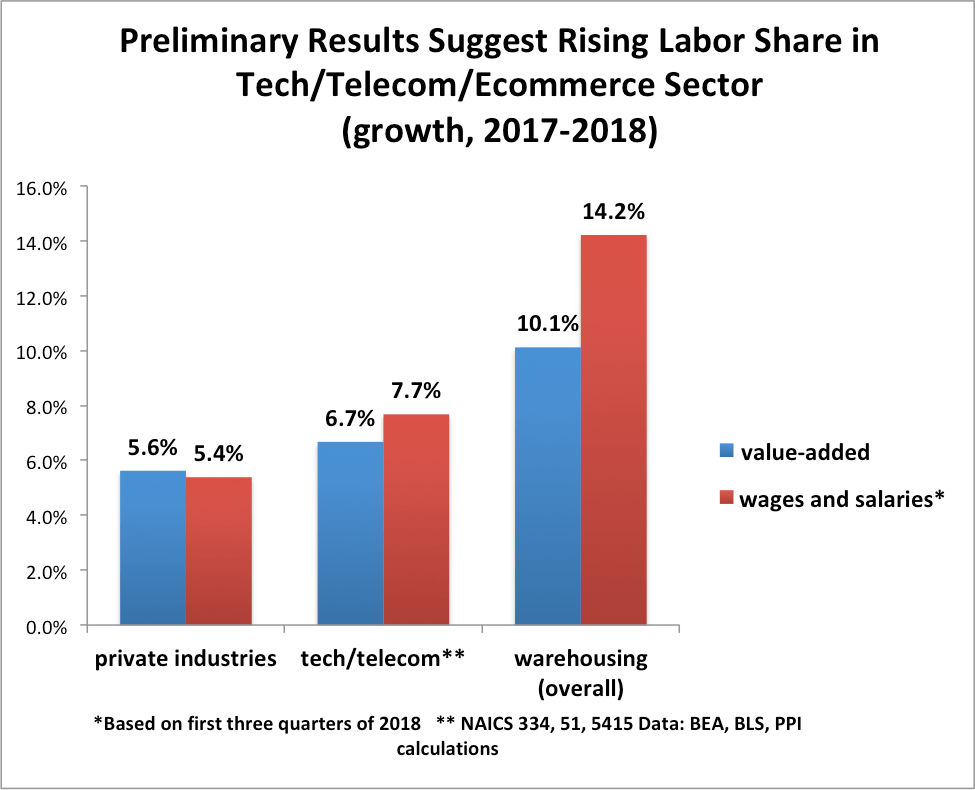
However,  ecommerce leaders such as Amazon, Walmart, and Chewy.com have been bucking that trend by building fulfillment centers that employ large numbers of workers without college degrees. The ecommerce industries–electronic shopping, warehousing, and couriers and messengers–created jobs for  roughly 270,000 less-educated workers between 2007 and 2017. Most of those gains have come in the past three years.

These workers are tech-enabled–they do not have college degrees, but they work closely with robots and other technology. As a result, as we have shown, real wages for production and nonsupervisory workers in the warehousing industry have been rising rapidly. Real hourly earnings for production and nonsupervisory workers in the warehousing industry are up by 6% over the past year

By comparison, brick-and-mortar retail companies have reduced their employment of less-educated workers by roughly 100,000 over the 2007-2017 stretch. That means ecommerce plus brick and mortar retail combined have been a net plus for less educated workers.  (Note that our analysis intentionally omits workers who do not yet have their high school diploma).

From Illinois to Pennsylvania: A Moderate Winning Streak

Is moderate Democrat turnout in recent special elections an indicator of what’s to come?

It was down to the wire, but Rep. Dan Lipinski’s victory over a left-wing challenger in Illinois’ primary election this week keeps alive a moderate Democrat winning streak. Lipinski, who represents Illinois’s 3rd Congressional District, narrowly edged out challenger Marie Newman by 2.4 percent of the vote. Newman enjoyed the backing of Washington pressure groups incensed by Lipinski’s deviations from progressive orthodoxy – he is personally opposed to abortion and voted against the Affordable Care Act. She also was endorsed by Sen. Bernie Sanders, who carried the district by 9 points against Hillary Clinton in the 2016 Democratic primary. Nonetheless, Democratic primary voters stuck with Lipinski.

Coming on the heels of wins by Conor Lamb and Doug Jones in a district and a state that Donald Trump won handily in 2016, Lipinski’s success completes a moderate Democratic trifecta. In Pennsylvania’s 18th District, which Mitt Romney won by 17 points and Trump by 20 points, Lamb had to attract Republican-leaning voters to win. While toeing the party line on health care, entitlement reform and unions, the ex-Marine also took independent stands on guns, immigration and abortion issues and expressed his willingness to work across party lines in Congress. That combination proved attractive to moderate and swing voters who put him over the top. Also impressive was Doug Jones’ U.S. Senate victory in deep-crimson Alabama. Exit polls from the special election to fill Jeff Sessions’ (R) vacant senatorial seat showed that Jones won moderate voters by a stunning 47 points. Of course, Jones had the good fortune to run against accused pedophile Roy Moore, but his tempered positions on gun rights and abortion helped him become the first Democrat elected to the Senate from Alabama since 1992.

The lesson from these elections, of course, isn’t that moderate Democrats always do better than liberals. The main takeaway is that the party’s candidates must be well-matched, politically and culturally, to the districts and states they seek to represent.

Being a good candidate isn’t simply a matter of checking ideological boxes or filling out interest group questionnaires. There can be no “one-size-fits” all electoral strategy for winning in every region of a country as big and diverse as ours. In Illinois, Newman charged that Lipinski is not a “true Democrat” because of his views on abortion and same-sex marriage. Democratic primary voters thought otherwise. And that should give pause to the progressive purity police.

Judge’s Climate Change Science Day Misses the Point

Yesterday’s science day in a federal courtroom in San Francisco underscores the problem with the recent spate of climate change tort suits.  These lawsuits, which we recently wrote about in The Hill, seek to impose massive liability against fossil fuel producers for selling energy products, including home heating fuel and gasoline for cars, that many scientists have determined contribute to global climate change.  Rather than work through Congress and the Environmental Protection Agency on establishing sound policies, environmental lawyers are hoping to have a judge force the companies to reduce carbon dioxide emissions and pay for what they claim are climate change injuries.

On one hand, I admire Judge William Alsup, a Clinton-appointee who is hearing the case in San Francisco, for holding this science day.  He clearly believes in immersing himself into the subject matter of a case so that he can grasp the allegations and ask good questions.  He famously studied up on Java computer programming before hearing a dispute between Oracle and Google over the lines of code in the program.  In preparation for hearing the climate change case, he asked the parties to educate him on topics ranging from what caused the ice ages to the molecular reasons that carbon dioxide absorbs infrared radiation.

Climate change public policies, though, are different from private disputes over JAVA or other technologies.  They do not lend themselves to being resolved in litigation, where plaintiffs choose who to sue and trials are governed by rules of evidence.  The allegations here go to the role of fossil fuels in powering the world.  Our national energy policy involves balancing many complex political issues, including energy independence from foreign countries, accessibility of natural resources, affordability for American families and businesses, and environmental concerns, among others.

The last time climate change tort suits were brought, one of the cases (American Electric Power v. Connecticut) went all the way up to the Supreme Court.  During oral arguments, Justice Ginsburg rightfully expressed concern about setting up a federal judge, such as Judge Alsup here, to become a “super EPA.”  The Supreme Court dismissed the claims in American Electric Power, saying Congress and the EPA are “better equipped to do the job than individual district judges issuing ad hoc, case-by-case decisions.”  Thus, in the end, it does not matter whether Judge Alsup can acquire the skills and knowledge to make these policy decisions.  Establishing America’s energy policy is not his job to do.

Phil Goldberg is the Director of the Progressive Policy Institute’s Center for Civil Justice and Office Managing Partner for Shook Hardy Bacon LLP in Washington, D.C.