Kane for Providence Journal, “Senate bill stifles R.I. innovation”

Under Gov. Gina Raimondo, Rhode Island is aiming to rebuild its economy — once factory-based — around advanced industries​​ such as biotech and software. With such projects as the Providence Innovation & Design District, the goal is to create good-paying jobs by attracting leading-edge companies to the state.

How odd, then, that the state legislature is considering a bill that would block an important health care innovation that would not only lower costs, but improve care as well. Senate Bill 2404 would dramatically restrict the use of online vision tests, an emerging telemedicine technology that is in use today. That’s bad news for Rhode Island.

Continue reading at the Providence Journal.

Statement on the Passing of Peter G. Peterson

The next generation lost a champion today with the passing of Peter G. “Pete” Peterson. While many leaders proselytize against debt and deficits when it’s politically convenient, Pete was one of the few whose concern for our nation’s fiscal future was truly sincere. For decades, he consistently advocated for using a responsible combination of spending cuts and tax increases to minimize the burden being placed on young Americans by a growing national debt. Pete worked respectfully with both Democrats and Republicans in pursuit of these solutions, making him a paragon of civility and bipartisan pragmatism in an era where such traits seem to be in short supply.

In addition to his advocacy, Pete was well-known for his philanthropy. In 2008, Pete donated half of his fortune to start the Peter G. Peterson Foundation. The foundation has contributed to think tanks across the political spectrum and offered educational and professional opportunities to young Americans of all ideological stripes. Many leaders talk of empowering the next generation but Pete actually did so. Our condolences go out to Pete’s family, his staff, and the broader budget community during this difficult time.

Langhorne and Amann for The Washington Monthly, “The Hidden Piece of Good News in Congress’s Budget Deal”

The bipartisan budget deal that Congress agreed to last month failed to solve the plight of the Dreamers and extends tax cuts that will add billions to the deficit. Still, quietly buried in the text of the law is much-needed good news for low-income mothers and their children: a provision reauthorizing federal support for home visiting programs that help prepare young children for school.

The new spending bill provides $400 million a year for five years to the Maternal, Infant, and Early Childhood Home Visiting Program (MIECHV), passed by Congress in 2010. The program provides at-risk pregnant women and new parents with services such as home medical care, parental training, and nutrition guidance. Giving low-income children a more stable start ends up significantly diminishing future public expense on healthcare and supplementary education. In short, home visiting programs help alleviate inequality while creating positive long-lasting results that reverberate throughout whole communities.


Continue reading at The Washington Monthly.

Even After Budget Deal, Discretionary Spending Remains Low

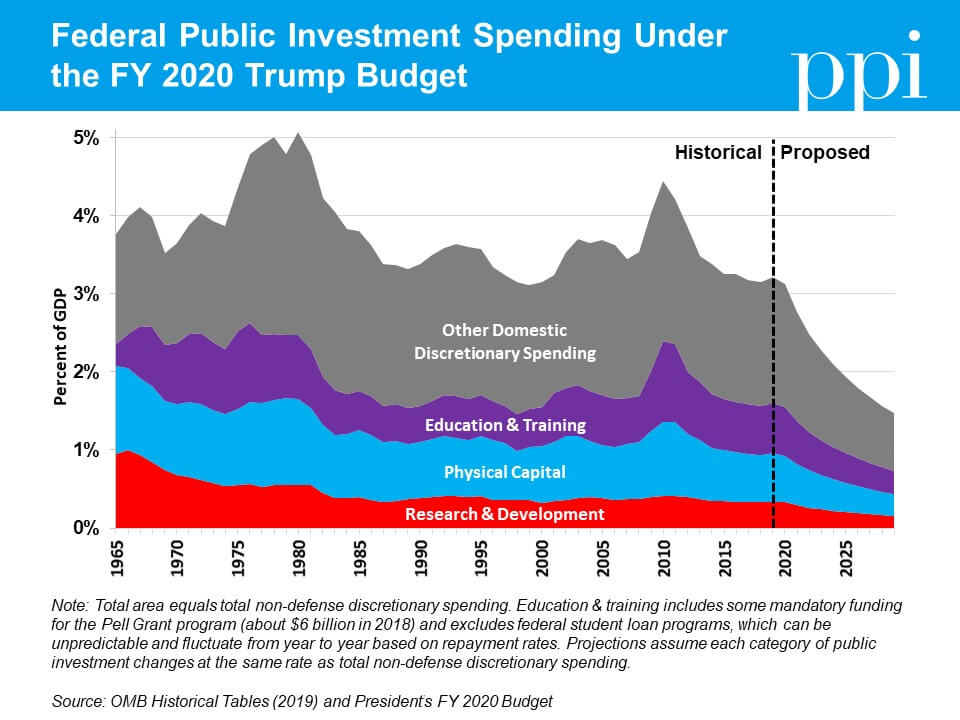
Although February’s bipartisan budget deal significantly increased discretionary spending, the portion of the federal budget appropriated annually by Congress remains near record-low levels. Both defense and non-defense (domestic) discretionary spending are falling relative to the size of the economy – a trend that has serious long-term implications for our nation’s ability to make critical public investments that strengthen the foundation of our economy.

Domestic discretionary spending is the category of federal spending that encompasses virtually all non-defense, non-entitlement programs. These programs include critical public investments such as infrastructure and scientific research that provide long-term benefits to our society. It is also the part of the budget that Congress has the flexibility to use for addressing unexpected crises such as natural disasters and economic downturns. Reducing the resources available for domestic discretionary spending thus risks jeopardizing many core government functions and the future health of our economy.

Unfortunately, that’s exactly what policymakers have been doing in recent years. The Budget Control Act of 2011 capped both categories of discretionary spending as part of a broader effort to reduce future deficits. When Congress failed to reach a bipartisan agreement on taxes and other categories of federal spending, the BCA automatically triggered an even deeper, across-the-board cut to discretionary spending known as sequestration. While the sequester has been lifted several times since it first took effect, discretionary spending consistently remained far below the original BCA caps.

That trend ended with the Bipartisan Budget Act of 2018. This budget deal not only lifted discretionary spending above sequester levels – it also went above and beyond the original BCA caps for two years. Nevertheless, projected domestic discretionary spending for Fiscal Year 2019 is significantly below the historical average as a percentage of gross domestic product. Moreover, even if policymakers extended these policy changes beyond the two years covered by the BBA, we project that domestic discretionary spending could fall to just 3 percent of GDP within the next decade – the lowest level in modern history.

The story is similar for defense spending. Thanks to the pressure put on by the sequester, defense discretionary spending fell to just under 3.1 percent of GDP in FY2017. Under the BBA, defense spending would increase to 3.4 percent of GDP in FY2019 before falling again. Unlike domestic discretionary spending, however, defense would remain above the all-time low it reached before the 2001 terrorist attacks throughout the next decade.

None of this is to say that policymakers should abandon any semblance of fiscal discipline when it comes to discretionary spending. The budget deal set domestic discretionary spending levels above those requested in President Obama’s final budget while also setting defense spending above the levels requested by President Trump. This fact suggests that the immediate spending increase was more than either party really needed to fund its priorities. Sharp spending increases without a clear purpose are more likely to lead to waste as government officials lose the incentive to make tradeoffs and efficiently target taxpayer resources.

Moreover, the budget challenges that led to the original imposition of the Budget Control Act remain serious. PPI criticized the BBA because we believe that any spending increase above the original BCA caps – which were meant to be a down payment on much-needed fiscal discipline – should be offset so as not to further exacerbate the nation’s already ballooning budget deficit. Thanks to both it and other recently enacted legislation, the federal government is now running an annual budget deficit that may never fall below $1 trillion again.

But when policymakers are ultimately forced to confront the nation’s long-term fiscal challenges, they should focus their efforts on the tax code and non-discretionary programs that are growing on auto-pilot faster than the economy. Discretionary spending isn’t the main driver our budget deficits, and most of the savings achieved by cutting internal waste should be redirected towards more beneficial public investments. A great nation invests in its future and cutting those investments too deeply will only hurt us in the long run.

Building Middle Class Wealth with American Development Accounts

U.S. social policy traditionally has emphasized supporting income for low-income families, to the neglect of wealth-building strategies.1 While income supports are essential for covering daily expenses, upward mobility depends on saving and building personal assets, especially completing post-secondary education, purchasing a home, or creating a business.2

Moreover, inequality of wealth in America is worse than income inequality. That’s why it’s time for a new approach to empowering low-income and working Americans. U.S. social policy in the 21st century should stress social investment and wealth creation, not just income transfers to support consumption. This report proposes a new policy – American Development Accounts (ADAs) – intended to help younger workers and blue-collar households rise into the middle class by enabling them to save and accrue assets.

State Drug Price Transparency and Price Gouging Laws: Why They May Raise Health care Costs

In October 2017, Governor Jerry Brown of California signed a “drug price transparency bill,” requiring pharma and biotech companies to give advance notification of significant price increases and provide specific justifications. Brown hailed the bill as a big step toward holding down spending on health care. “Californians have a right to know why their medical costs are out of control,” said Brown.

Many other states are finding the pharma industry to be a tempting target, especially with all the media attention given to a small number of high-profile price hikes. In Maryland, a new “price-gouging” law restricts generic and off-patent medicines from “excessive and not justified” price increases. Nevada has tackled the cost of diabetes medicines such as insulin, requiring drug makers that have raised list prices by a significant amount to release data about the costs of making and marketing the drugs. Other states like New York, New Hampshire, and Maine are considering legislation that would take various approaches to controlling drug pricing as a solution to rising health care costs.

But a new study by the Progressive Policy Institute suggests that state-level drug price laws potentially harm competition and boost drug costs, while doing very little to slow down the overall growth of health care costs. First, we describe the range of state-level drug price laws – both the ones that have been enacted and the ones that are under consideration.

Langhorne for RealClearEducation, “To Help Troubled Students, Teachers Need Support Not ‘Guidance'”

Three students stabbed in one week. That’s how 2018 began for New Rochelle High School in Westchester, New York. These school stabbings came just months after the highly publicized, fatal stabbing of a student at Urban Assembly School for Wildlife Conservation in the Bronx.

As Americans try to understand the increase of violence in their public schools, the Obama administration’s 2014 school discipline reforms have received a lot of attention. The policy, written by the Department of Justice and the Department of Education, took the form of a discipline guidance letter. It warned school districts that if their disciplinary procedures showed a disparate impact on students based on race, then the federal government could investigate them for civil rights violations. It also encouraged districts to use alternative discipline programs and classroom management practices in place of traditional discipline policies.

Although the guidance never became a formal regulation, schools districts across America began to implementcontroversial reforms in an effort to reduce their rates of out-of-school suspensions.

The letter had good intentions. As a former high school teacher in the Fairfax Public Schools, I don’t favor out-of-school suspensions for low-level, first offenses; most of the teachers I know don’t either. Disparities between the out-of-school suspensions of white students and students of color are well-documented, and teachers are acutely aware of the pipeline that runs from out-of-school suspensions to prison.

However, teachers also don’t want their hands tied.


Continue reading at RealClearEducation.

The Ecommerce Counterfactual

I’ve been arguing that the shift to ecommerce has improved the position of workers, by increasing the number of jobs and boosting wage payments. In a nice twitter discussion last week, Jose Azar pointed out that I had not specified a counterfactual, and he was right.

So here I will make up for that omission, at least a bit. Let’s start by laying the groundwork. The direct employment impact of ecommerce primarily shows up in three industries: Retail, couriers and messengers, and warehousing and storage. Most ecommerce fulfillment centers are reported in the warehousing and storage industry, though some are found in the electronic shopping, which is part of retail.  The companies that deliver the packages seem to be mostly reported in the couriers and messenger industry. And of course the brick-and-mortar stores hurt by ecommerce are in the retail industry.

Let’s look at the recent employment history of these three industries (see table below). We will focus on hours worked by production and nonsupervisory workers in what we call the “consumer distribution sector,” the  combination of retail, couriers and messengers, and warehousing and storage.

The Jobs Impact of Ecommerce
Percentage change, aggregate hours worked, production and nonsupervisory workers
2014-2017
Retail 3.8%
Couriers and messengers 19.9%
Warehousing and storage 33.5%
Total (consumer distribution sector) 6.3%
All private sector 5.8%
The consumer distribution sector is defined as including retail, couriers and messengers, and warehousing and storage

Data: BLS CES

According to BLS CES data, aggregate weekly hours of production and nonsupervisory workers in the warehousing and storage industry are up 34% over the past 3 years, reflecting the rapid expansion of ecommerce fulfillment centers.  Aggregate weekly hours of production and nonsupervisory workers in the courier and messenger industry are up 20%, and hours worked in retail are up 4%

Taken together, hours worked in the consumer distribution sector are up 6.3% over the past 3 years. That’s faster than the 5.8% gain in hours worked in the overall private sector of the economy.

How does this gap compare to the historical pattern? We’ll look at the previous two business cycles, 1990-2000 and 2000-2007.

Let’s start with the 1990-2000 business cycle. Even though Amazon was founded in 1994, ecommerce was fairly insignificant for the labor market in this decade. In 2000 Amazon had only 6 fulfillment centers in the United States, and employed a grand total of 9,000 full-time and part-time workers globally. In total, ecommerce amounted to less than 1% of retail sales in 2000.

During this decade, hours worked in the private sector grew at a 2.1% annual pace. By comparison, hours worked in the consumer distribution sector grew at only a 1.6% annual rate.

The next business cycle was terrible for employment. Between 2000 and 2007, private sector hours growth slows to a 0.5% rate,  while consumer distribution sector hours rose at only a 0.2% pace.

However, it’s worth noting that the gap between  hours growth in the private sector and consumer distribution sector narrowed as ecommerce became more important. By 2007, ecommerce amounted to about 3.5% of retail sales.

From 2007 to 2017, the share of ecommerce rose to roughly 9%.  At the same time, hours growth in the consumer distribution sector accelerated to an 0.6% annual pace. The gap with the private sector narrowed even further, to less than 0.1 percentage points.

And when we focus on the last three years–the period of the supposed retail apocalypse–we see that hours growth in the consumer distribution sector is now outpacing private sector hours growth, even as Amazon and other online retailers have opened up ecommerce fulfillment centers all over the country.

How can this be? The short answer is that ecommerce is sucking unpaid hours out of the household sector. In effect, consumers are paying workers do their picking, packing, and driving for them. Ecommerce is hours-creating, rather than hours-destroying.

This analysis is indicative rather than conclusive, of course. But it suggests that ecommerce has had a positive effect on hours growth in the consumer distribution sector, relative to private sector hours overall.


Marshall for The Daily Beast, “Democrats Shouldn’t Help Trump Build Walls”

Donald Trump loves walls and he loves tariffs, which are walls of another kind – barriers to open trade. In his mind, walling off the outside world is the key to making America great again.

From this warped perspective, his decision last week to slap tariffs on steel and aluminum imports makes perfect sense. But it has provoked strenuous objections from Republican and business leaders and most economists, not to mention U.S. allies and trading partners.

All this political blowback looks like a gift to Democrats, but there’s a hitch: The party doesn’t know its own mind on trade. Polls show sizeable majorities of rank and file Democrats favor free trade. But the national party’s message is dominated by a militantly anti-trade faction led by organized labor, Rustbelt politicians and left-wing populists. This group, in fact, seems to be offering the only praise for Trump’s tariffs.

Continue reading at The Daily Beast.

Soaring Real Wages for Ecommerce Workers

There’s a lot of talk about labor monopsony these days.  But at least in ecommerce, the labor market seems to be working the old-fashioned way—booming demand for fulfillment center workers and package delivery workers is leading to sharply rising real wages. Over the past year, employment of production and nonsupervisory workers in the warehousing industry has risen by 5%, while employment of production and nonsupervisory workers in the courier and messenger industry has soared by a striking 8.7% (all figures in this post are 3-month averages).

At the same time, real hourly earnings for production and nonsupervisory workers in the warehousing industry are up by 6% over the past year, while real hourly earnings for production and nonsupervisory workers in the courier and messenger industry are up by 2.6%.   Meanwhile the private sector as a whole showed no real wage gain at all.

Can we expect this to continue? There’s no reason why not.  There’s no great surge of unemployed workers coming out of retail to hold down wages.  Indeed, the number of production and nonsupervisory workers in retail is up 76K in February over a year earlier.

At least for now, ecommerce is the place to be.


Gerwin for The Hill, “‘Go-it-alone’ trade strategies are neither wise nor effective”

On March 1, after weeks of “absolute chaos” within his administration, Trump held a hastily arranged “listening session” with metals executives.

Trump announced — to the surprise of his staff — that he’d be imposing import tariffs of 25 percent on steel and 10 percent on aluminum, and that these tariffs would last “a long period of time.” Trump reportedly chose 25 percent duties because a round number “sounds better.”

Reaction to Trump’s informal announcement was swift, widespread — and harsh. The stock market, which Trump cites as confirmation of his economic genius, plunged 420 points. The Wall Street Journal called the tariffs the “biggest policy blunder” of Trump’s presidency.

Continue reading at The Hill. 

International Women’s Day: #TBT Elect More Women to End Gridlock

Happy International Women’s Day! Around the world, people are celebrating the power, value, and achievement of women, while bringing attention to many gender based inequalities that continue to pervade society today. In honor of this day, we revisit a 2012 op-ed from PPI Director of Domestic & Social Policy Anne Kim, “Elect More Women to End Gridlock.”

In her piece for The Hill, Kim argues that many female politicians are more likely to approach policy in a bipartisan manner than are their male colleagues from the same state. Kim backs up this point with studies suggesting that women tend more toward personality traits of “agreeableness” and cooperation on average than do men.

In spite of this valuable bipartisanship in public policy discussions, women still face barriers to holding political office. Kim explains that the United States still has a long way to go before reaching a congressional gender balance anywhere near equal, or even on par with many other countries globally. Additionally, many aspects of modern campaigning — including pressure to constantly fundraise, little privacy, and time away from family — tend to be particularly meaningful deterrents for women considering a run for office. Before women are adequately represented in U.S. political representation, Americans must grapple with these factors. In the past few years, a wave of powerful female candidates has become a key part of the American electoral landscape. Last year in Virginia alone, 11 of 15 House of Delegates seats flipped from Republicans to Democrats also flipped from a man to a woman. Hundreds of women are in the running for American congressional seats this year, a number on track to break records once official filings are finalized. In the context of the upcoming 2018 elections, Kim’s 2012 call for hope still rings true: “if enough women make it to Congress this November, they may indeed prove to be the better bridge builders and compromise brokers Washington desperately needs.”

Senate Democrats’ Deficit-Neutral Infrastructure Plan Clarifies the Cost of Tax Cuts

Senate Democrats yesterday unveiled an ambitious $1 trillion infrastructure proposal that would invest in everything from roads and railways to hospitals and high-speed broadband. And in sharp contrast to recent proposals by the Trump administration, this new Democratic proposal includes a plan to fully pay for itself.

The proposal calls for repealing three elements of the recently-enacted Republican tax bill that almost exclusively benefit the wealthiest taxpayers, as well as closing the “carried interest loophole” that allows certain earnings on Wall Street to be taxed at a lower rate than other compensation. It would also raise the top corporate tax rate from 21 percent to 25 percent – the average rate among OECD countries and the level originally proposed by House Ways and Means Chairman David Camp (R-MI) back in 2014.

Spending in the new proposal is broken down into 19 different categories, each with its own budget and parameters for implementation. The package as a whole includes additional guidelines, such as encouraging the adoption of innovative technologies and long-term financing mechanisms, to accompany proposed spending. If fully implemented, the proposal’s authors believe it would create 15 million good-paying jobs.

Compare that to the proposal offered last month by the Trump administration, which claims to increase infrastructure investment by $1.5 trillion even though the administration’s budget provided no additional funding for it. The Trump proposal would also privatize a wide variety of physical assets, such as waterways and interstate highways, that the Democratic proposal would retain for public use.

Another advantage of the Democratic proposal is that it makes clear to voters the true cost of the Republican tax cut enacted last year – something PPI has been urging Democrats to do since before passage of the bill. For less than half the cost of this terrible tax cut, voters could have gotten a robust 21st century infrastructure that would benefit our economy for generations to come. That message could be a powerful one heading into the midterm elections, especially if paired with a credible and comprehensive Democratic framework for “repealing and replacing” the GOP tax bill.

Senate Democrats should be commended for including suggested funding mechanisms in their proposal. Whereas Republicans added over $2 trillion of tax cuts to the national debt, the Democrats’ infrastructure proposal would be fully funded and deficit-neutral. If implemented in a timely and cost-effective way, their proposal might even reduce budget deficits because of the high economic returns on well-targeted infrastructure investment. The stark contrast between these two approaches to fiscal policy is just further evidence that only one of the two political parties in Washington is making any attempt to pay for its proposed policies.

But when they find themselves in a position to implement these policies, Democrats should keep in mind that simply paying for their new proposals isn’t sufficient.

The federal government is now spending $1 trillion more than it raises in revenue every year – a gap that is projected to more than double over the next decade. It will be impossible to sustain social programs as they’re currently structured, let alone fund new ones, without major reforms to both existing spending and the tax code. The government cannot afford to commit every dollar of additional revenue to new promises until it finds a way to pay for the ones we’ve already made.

For these reasons, Democrats would be wise to use yesterday’s proposal as merely the starting point for crafting a complete fiscal policy: one that sustainably finances both public investments and a strong social safety net without placing an undue burden on young Americans. A fiscally responsible public agenda along these lines is what the Democratic Party needs, and it’s what our country deserves.

Gerwin for the WSJ, “In America’s Absence, the TPP Goes On”

The remaining 11 countries are to sign a renegotiated deal Thursday. U.S. companies will suffer.

When President Trump announced the U.S. would pull out of the Trans-Pacific Partnership in January 2017, he likely thought he’d consigned the proposed trade pact to history’s dustbin. After all, America was by far the largest and most influential country set to participate.

But TPP lives on. Its survival illustrates how the Trump administration’s “America First” trade policies are isolating the U.S. and how other potential miscalculations—especially terminating the North American Free Trade Agreement—would further distance American businesses and workers from vital global opportunities.

On Thursday the 11 remaining countries will sign a renegotiated version of TPP. Now called the Comprehensive and Progressive Agreement for Trans-Pacific Partnership, or TPP-11, the agreement creates a free-trade area comprising half a billion people and one-seventh of the global economy.

Continue reading at The Wall Street Journal.

Langhorne for The Hill, “Stop asking teachers if they’ll kill children”

Whenever we had lockdown drills, I’d get angry with my students. The lights were off, the door was locked, and students were seated silently under their desks. For about three minutes.

Then, the whispers began. Muted laughter followed; Phone screens flashed as students texted their friends, taking advantage of this “break” from learning.

After the drill, I tried to impress its importance upon them, but the routine would play out the same next time.

I couldn’t blame them. The majority of these students weren’t even born when Columbine happened. They were a generation who’d grown up with mass shootings and a 24-hour news cycle.

Continue reading at The Hill.

New Analysis Highlights Dire Fiscal Situation

New projections from the non-partisan Committee for a Responsible Federal Budget show that Donald Trump and the Republican-controlled Congress have plunged the United States back into trillion-dollar deficits at a time when most economists believe we should be whittling them down.

According to CRFB’s estimates, which are based on a methodology similar to the one used by official scorekeepers at the Congressional Budget Office, the policy changes made since last fall will likely result in $6 trillion being added to the national debt over the next decade if they’re allowed to remain in place. This is in addition to $10 trillion of new debt that was already projected to accumulate under the law as it was previously written.

If the government continues on this trajectory, our national debt will be more than double the level it was when Donald Trump took office by the end of the decade. Annual budget deficits will triple. Annual spending on interest payments will quadruple. And economic growth won’t be able to keep up with any of it.

Many of the fiscal challenges facing the United States predate the current administration. But whereas CBO previously projected annual budget deficits to exceed $1 trillion beginning in 2022, CRFB’s analysis warns that we now face trillion-dollar deficits this year. By 2028, the budget deficit will swell to 2.4 trillion, which would be over 8 percent of gross domestic product – a level not seen outside of the Great Recession since World War II.

The primary contributors to this deteriorating fiscal situation are the Republican tax bill (formerly known as the Tax Cuts and Jobs Act) and the February budget deal (the Bipartisan Budget Act of 2018), which together account for over half of the additional borrowing expected over the coming decade. Funding for disaster relief, overseas military engagements, and other “emergencies,” as well as policies that were supposed to expire last year but were nonetheless extended without being offset, were expected to add another trillion dollars to the debt. Finally, Republican efforts to undermine the Affordable Care Act by defunding cost-sharing reductions would further grow government debt by increasing the cost of health care.

The CRFB report notes that when President Obama left office, “paying for new legislation and securing the solvency of various trust funds would have been sufficient to prevent debt from rising rapidly as a share of GDP.” Since then, legislation spearheaded by Republicans has “turned a dismal fiscal situation into a dire one.”

Most of the blame belongs to the GOP, but Democrats are not completely innocent either. Many supported the February budget deal that not only reversed harmful sequestration but also busted through less restrictive spending caps originally intended to be a down payment on fiscal discipline, as well as some of the other policy changes mentioned above that were adopted without offsets. Both parties now have their hands on the shovel being used to dig our fiscal hole deeper and, as this new analysis makes clear, they need to put it down.