Bridging The Data Gap: How Digital Innovation Can Drive Growth and Jobs

Seldom has the world stood poised before economic changes destined to bring as much palpable improvement to people’s lives and desirable social transformation as “big data.”

Breathless accounts abound of the huge amounts of data that citizens, consumers and  governments now generate on a daily basis in studies ranging from the French Prime Minister’s Commissariat général à la stratégie et à la prospective study on Analyse des big data: Quels usages, quels défis to Viktor Mayer-Schönberger and Kenneth Cukier’s seminal Big Data: A Revolution That Will Transform How We Live, Work and Think.

But the larger revolution will come not from the exabytes of data being generated on a daily basis, but through the vast advances in analytics that will help us convert this information into better lives, and better societies. Already, many companies are using the new information to offer more tailored products and services to customers; consumers are receiving more effective healthcare; clever administrations are cutting pollution and commuter transit times; people of all types are being entertained and educated in fascinating new ways; and entrepreneurs who seize the opportunity are helping raise North America and Europe from the longest economic recession since statistic-taking began.

Download the full report here.

Michael Mandel and Paul Hofheinz presented their paper today at the PPI & Lisbon Council joint event: New Engines of Growth: Driving Innovation and Trade in Data

Data, Trade and Growth

We show in this paper that the architecture of the Internet dictates that current trade statistics significantly underestimate the magnitude and growth of cross-border data flows. As a result, the contributions of cross-border data flows to global growth and to small businesses are being significantly underestimated. This suggests that trade and tax policy should place more emphasis on maintaining cross-border data flows. Moreover, policies that discourage cross-border data flows, such as data localization and high tax rates on cross-border data, should be avoided if possible. Statistical agencies should explore adding data as a separate trade category, along with goods and services.

INTRODUCTION
The architecture of the Internet is designed as a “network of networks.” As such, one of its key attributes is making the passage of data from one network to another easy. So, when a user sends an email, views a video, or downloads a file from a website, the data may pass through a large number of different networks on the way from its origin to its destination, with the routing virtually transparent to the user.

This architecture has proven to be extremely flexible and powerful, both nationally and globally. Individuals, small businesses, and corporations with Internet access can easily access data of all sorts from around the world. Similarly, companies can efficiently and cheaply provide services such as email and web search on a global basis, in many cases without charge.

One sign of the Internet’s global success is the rapid growth of cross-border data flows. Cross-border data flows are growing far faster than conventionally measured trade in goods and services. According to TeleGeography, a consulting firm that keeps track of international data flows, demand for international bandwidth increased at a compound annual rate of 49% between 2008 and 2012.1 By comparison, the overall volume of global trade in goods and services, adjusted for inflation, rose at an average rate of 2.4% over the same period.

Continue reading and download the full report.

Axelrod has something Miliband needs: an understanding of swing voters

It’s not unusual for Britain, ahead of a national election, to be swarming with American political consultants. What is odd is seeing top members of President Obama’s political team deploy to opposite sides in the coming battle.

David Axelrod, Obama’s chief consigliere, has just signed on to help Labour craft its strategy for next year’s election. But in what many Democrats regard as a dumbfounding act of apostasy, Jim Messina, who ran Obama’s 2012, has hired out to David Cameron’s Tories.

Perhaps the two high-priced operatives, who know each other well, will simply cancel each other out. But in truth they bring very different skills to their respective campaigns. Messina is a master organiser who oversaw Obama’s state-of-the-art voter mobilisation effort in 2012.

Axelrod is a strategist who helped Obama wrest the Democratic nomination from Hillary Clinton and go from first-term Senator to first black President in 2008.

It’s hard to say how Axelrod’s talents will translate into the British context. The impact of campaign consultants – who always have a 50-50 chance of winding up on the winning side – is routinely exaggerated by political reporters and insiders.

Consultants are rarely better than the candidates they serve and, let’s face it, Axelrod is likely to find in Ed Miliband a somewhat less charismatic commodity than Barack Obama.

But Axelrod does have something Miliband needs, and it’s not a passion for grappling with inequality, as some media reports have said. The Chicago-based Axelrod is a man of middle America, not a creature of Washington. He has an intuitive grasp of the pragmatic nature of US voters, especially those without strong partisan attachments.

In short, where Messina is a whizz at energising true believers, Axelrod knows how to talk to swing voters.

What those voters want is a plan for reviving economic dynamism and opportunity, not a “populist” narrative that casts them as helpless victims of an all-powerful plutocracy. Their answer to inequality is not to pull down the mighty, but to create more jobs with decent pay, get wages growing again along with productivity, and rebuild middle class prosperity.

In America at least, this difference between a politics centred on economic aspiration and one centred on class grievance is crucial. Like Bill Clinton before them, Obama and Axelrod fashioned successful presidential campaigns by stressing the former.

Axelrod deftly read the public mood in 2008. There was a powerful revulsion to politics as usual in Washington. Axelrod presented Obama as the ultimate outsider, turning his relative lack of political experience into a key selling point. This experience may prove useful for Milliband and Labour, who likewise must craft a powerful argument for political change even as the UK economy improves.

In any event, Axelrod’s feel for the kind of ideas that move persuadable voters will likely prove an asset.

This article was originally published by the London Times here.

Uncluttering State Tax Systems

Over the last week, as you’ve raced to file your taxes by the deadline today, you’ve no doubt been bombarded on talk radio, cable TV, and the opinion pages about how complex and anti-growth the federal income tax system has become. Tax reform is indeed long overdue, but it’s not just the federal code that needs fixing: Many state tax systems are regressive, economically distorting, and mind-numbingly complex.

This month, the Progressive Policy Institute unveiled a unique study ranking the tax systems of all 50 states plus the District of Columbia — the State Tax Complexity Index. The index measures complexity in terms of the number of loopholes lurking in the code. What we discovered surprised us.

First, it doesn’t matter whether states rely on income or sales taxes, or whether they have a single rate or multiple rates — all of these systems can be honeycombed with complicated tax breaks, despite what you may have heard from advocates of a national sales tax or “flat tax.” For example, Hawaii and California, two states with very progressive income-tax systems (Hawaii has more marginal rates than the federal code) ranked among the least complex tax systems in terms of special tax preferences. Meanwhile, states with no individual income tax ranged all over the spectrum; for example, Washington ranked near the top of our complexity scale, Texas finished in the middle, and Alaska was toward the bottom. And states that have a flat tax clustered in the middle of our survey, with the exception of Utah, which tied for 37th.

Second, reducing complexity by eliminating tax breaks can finance lower tax rates and also increase progressivity, because such preferences mostly benefit higher-income individuals and businesses.

Choosing how to measure tax complexity across all types of tax systems was a challenge. The only feature that all systems shared was tax expenditures — tax provisions that provide a targeted benefit to specific individuals and groups, and thereby reduce government revenue. Common tax expenditures include deductions, credits, exclusions, deferrals, and rebates.

Some progressive analysts view tax expenditures as an indirect and more politically palatable form of government spending that obviates the need for new programs and administrative bureaucracies. Conservatives usually see them as a way of chipping away at tax burdens on affluent families and businesses. Either way, the growth of tax expenditures greatly increases tax complexity, because they spawn a special set of regulations that multiply over time and often lead to growing inconsistencies and inequities.

How do we know tax expenditures add to complexity? According to the IRS, the average person filing a 1040 form (which includes those taxpayers who chose to itemize their deductions) devotes 16 hours, the equivalent of two full work days, to the task. The 1040EZ form (which limits the number of deductions, credits, and other tax expenditures), by contrast, takes just four hours.

Tax expenditures don’t just clutter up the tax code; they also leak revenues and usually bestow their benefits upon the least needy among us. Federal tax expenditures cost the government over $1 trillion a year. Because you have to itemize to take advantage of deductions and credits, and because the value of deductions is tied to one’s tax bracket, upscale taxpayers reap the lion’s share of the benefits, whether we’re talking about deductions for charity, for home mortgages, or for health care. One big exception to this general rule is the Earned Income Tax Credit, which is specifically targeted to minimum- and low-wage workers as an incentive and reward for work.

Whether at the state or federal level, the lesson is clear: If simplicity is your goal, you have to reduce the number of tax breaks. Switching to a flat or sales tax isn’t the answer. Closing loopholes will also help governments pay their bills the old-fashioned way, by raising revenue instead of piling up public debt. Plugging revenue leaks will ease pressure for raising tax rates, which should be kept as low as possible. And eliminating tax breaks will reduce economic distortions and help channel capital investment to its most productive uses, rather than those favored by politicians.

That’s just as true on the state level as it is in Washington, D.C. So if federal lawmakers ever do get around to serious tax reform, they should invite the nation’s governors to the table, too.

This op-ed was originally published by Real Clear Politics, read it on their website here.

Why Sovaldi Boosts Medical Productivity

Insurers and politicians have been complaining that Sovaldi—Gilead’s new cure for hepatitis C—costs too much at $84,000 per treatment.

But that complaint, while accurately reflecting short-term financial incentives,  perversely misses the real point. In the long-term, the real budget-buster for the U.S. healthcare system is the cost of managing and treating chronic conditions such as diabetes, Alzheimer’s, and hepatitis C (which is the most common chronic bloodborne infection in the United States, according to the CDC). If pharma companies can produce straightforward cures for these chronic and costly syndromes, the long-term financial picture of the healthcare system looks much better.

Moreover, Sovaldi is almost certainly productivity-enhancing, substituting a one-time drug treatment for labor-intensive long-term medical management of a chronic disease.  As the illustrative calculation below shows, the productivity gains could be significant.

That’s a big deal. The U.S. healthcare system is on a long-term unsustainable path, gobbling up a larger and larger share of the nation’s skilled workforce to care for an aging population.  Policymakers should encourage and reward drug companies that come up with innovative and effective cures for chronic diseases, rather than punishing them.

Illustrative calculation: In earlier work, we have described a concept called gross medical productivity—that is, a measure of how many labor hours of health care workers are needed to produce the same clinical outcomes for a given population.  Over the past decade, the gross medical productivity of the health care system has fallen sharply, as the number of health care workers rose by 23%, much faster than the 9% increase in the size of the U.S. population over the same stretch.

Let’s do an illustrative calculation showing how drugs such as Sovaldi can help reverse the trend and boost gross medical productivity.  Assume that Americans infected with hepatitis C require 5 extra hours a year of medical attention, on average. That includes all the patients receiving liver transplants and medication, averaged against infected people who are receiving no care at all. With roughly 3 million Americans infected, that means an extra 15 million hours of work for healthcare workers.

So suppose that sustained treatment could reduce the number of infected hepatitis C patients from 3 million down to 1 million. That means 10 million fewer person-hours per year  (2 million x 5 person-hours per year), which translates into a corresponding increase in productivity. 


SmartData Collective: What the Internet of Things Means for Physical Industries

SmartData Collective’s Mark van Rijmenam highlighted PPI’s Michael Mandel remarks on the Internet of Things and the video of his participation in the Washington Post “All Things Connected” event.

He explains that “the Internet has transformed digital industries, while the Internet of Things will transform physical industries.” He estimates that 20% of GDP comes from the digital industries, which means that 80% comes from the physical industries. This shows that the transformation of physical industries can have a massive impact on the GDP. In addition he explains why he believes that the Internet of Things will be a job creator instead of a job destructor, as is often thought of technological advances.

Read the article and find the video here.

The Hill: Don’t reform the tax code on the backs of over-taxed energy producers

William F. Shughart II, writing for the Hill, referenced an observation made by the Progressive Policy Institute that major U.S. energy companies are “Investment Heroes.”

A high-growth strategy requires strong investment — private and public — in our nation’s productive and knowledge capacities.

To read the rest of the article, visit The Hill’s website here.

Keystone Pipeline: Important Debate for Yesterday

Listening to the Republicans in Congress, one might think that the Keystone XL pipeline is the biggest energy issue facing the country today and that swift approval of the controversial project is vital to America’s interests. Election-year politics aside, however, the merits of the case for the pipeline have been eclipsed by changing circumstances.

When the project was first proposed and the political battle lines were drawn, America was importing significantly more oil than we were producing. That is no longer the case. Thanks to the boom in shale and unconventional oil production, the United States is on the verge of becoming the world’s largest oil producer. From an energy security and geopolitical perspective, the Keystone pipeline has become largely irrelevant. The question today is not whether we should import heavy crude from Canada (supposedly as an alternative to importing from less friendly countries). The critical question today is what American should do with the glut of oil we are producing ourselves.

The arguments for the pipeline are rupturing. We no longer need Canada’s tar sands oil to enhance our “energy security.” This claim rested on the specious notion that having access to large sums of crude from close by would cushion U.S. consumers from price shocks at the pump. Even if this were true, the last time I checked North Dakota was closer to home than Alberta.

The only serious argument left to Keystone proponents is that building the pipeline and processing Canadian crude in the United States will create jobs. Given our painfully slow recovery, of course, that is not an argument to be taken lightly. But America’s new energy reality points to a different path toward a renewal of national prosperity. Instead of building a pipeline to import another country’s heavy and difficult crude, we should build pipelines to safely and economically move America’s own lighter, sweeter crude to market. Investing in revamped refinery capacity that is more suited to processing our own oil, as opposed to the heavy oils of Canada and Venezuela, would not only create jobs, but would be more consistent with our new place in the energy world. Such a course would make it easier to balance the twin imperatives of spurring domestic economic growth and competitiveness and lowering U.S. greenhouse gas emissions.

On the merits, we should put this anachronistic debate to bed. We have far more important energy policy questions to discuss that are actually rooted in the facts and circumstances of today.
Should we lift the ban on exports of petroleum? This issue raises a host of questions, but global oil market dynamics suggest that the ban is itself anachronistic. I have concerns that added incentives to extract domestic oil could have negative environmental impacts, but we can manage those and can extract great value from our domestic resources without sacrificing environmental best practices and without opening up currently protected areas to development. Further, I am attracted to the idea of dedicating a fraction of export revenue to conservation and clean energy (which we did when we opened up offshore resources), as the think tank Third Way has proposed.

Can we come to consensus on natural gas exports in light of new resource and global political realities? I favor exports, but not at the expense of reasonable environmental safeguards around fracking that will not in any significant way deter responsible developers from producing the resource.

And we must put climate change back on the national energy policy agenda. If the Keystone debate has served any purpose, it has helped opponents raise the volume (if not always the quality) of the discourse around climate. XL opponents feel strongly that America should not abet exploitation of the difficult-to-develop and energy-intensive tar sands, lest we be complicit in the negative climate impacts that would result. I happen to agree with that argument, but the real question now is this: As U.S. oil production surges, why should our political leaders keep fighting over a project we simply don’t need?

While it likely won’t happen until the silly season of the midterm elections is over, we need to focus our energy debates on the issues that matter today. That will be enough of a challenge without spilling blood over yesterday’s battles.


This op-ed was originally published by Real Clear Politics, read it on their website here.

The State Tax Complexity Index: A New Tool for Tax Reform and Simplification

Across the political spectrum there is broad agreement that tax reform is long overdue. Yet reform remains an elusive goal—not just in Washington, but also at the state level. Ideological standoffs, the excessive influence of special interests, the impending midterm elections, and mistrust of government are just some of the road blocks to reform.

This policy report undertakes a unique examination and comparison of the complexity of all 50 state tax systems plus the District of Columbia – the State Tax Complexity Index (“Index”). The Index measures complexity in terms of the number of tax expenditures for each state revenue system and highlights several findings that are relevant to the national tax reform debate.

The report includes a short history of state income tax systems and demonstrates the shortcomings in state income tax systems across different systems and taxation methods. Weinstein comments:

State tax systems tend to mirror the flaws so evident in our federal tax code: they are regressive, economically distorting and absurdly complex.

He continues:

“Although some continue to argue for a national sales tax or ‘flat tax,’ our study shows the best way we can promote simplicity in state tax codes is to eliminate cumbersome and seldom used tax breaks. Eliminating these breaks would reduce complexity, increase government revenue and finance lower tax rates across the board. Doing so would also increase fairness, as most breaks only benefit higher-income individuals and businesses.”

Read the full brief, including the index, here.

USA Today: Mortgage reform roils Washington

USA Today‘s Darrell Delamaide quoted PPI’s Jason Gold on GSE reform.

He recalled the debate over the future of the two government-controlled entities that back most mortgages today — Fannie Mae and Freddie Mac — caused by the new bipartisan Senate bill that would wind down and replace Fannie and Freddie with a complex mix of private lending and government guarantees. He reminded with PPI that reform should prevail over liquidation regarding Fannie and Freddie.

Shuttering the GSEs completely … makes little sense. The idea that you can completely dismantle a housing finance infrastructure that is the foundation of an $11 trillion market is a fantasy the likes of which is only found in Washington.

Read the entire USA Today article here.

Bloomberg West: Does Tech Help the San Francisco Economy?

PPI’s Michael Mandel spoke on Bloomberg Television‘s “Bloomberg West” on April 4th to discuss the pros and cons of tech tax breaks. He identified the lessons to be taken from the San Francisco tech boom example and gave his arguments for why governmental support of tech has been imperative for economic growth in San Francisco:

The Tech Info boom has the potential to spread jobs and spread growth across a broader part of society than people think. [In SF] they were very encouraging and welcoming to tech firms, they offered some very targeted tax breaks. […] If a city administration is focused on attracting tech firms, that is actually a potent force for development.

Watch the entire video on Bloomberg Businessweek here.

Bringing U.S. Energy Policy Into the 21st Century

U.S. lawmakers don’t drive around in 1970s-era cars, yet they don’t seem to mind energy policies that are equally out of date. Attempts to export shale oil and gas, for example, have run smack into legal and regulatory barriers as old as a Gran Torino.

Energy companies have been urging Congress to lift the lid on exports and start treating oil and gas again like any other commodity that’s freely traded in world markets. Tapping global demand for U.S. shale oil and gas, they say, will spur domestic production and create even more jobs in a sector that’s already racked up robust employment gains.

Russia’s naked power play in wresting Crimea from Ukraine has given fresh impetus to the export push.

From outraged Republicans to eastern Europeans living anxiously in Moscow’s shadow come calls to use America’s shale windfall to wean Europe off dependence on Russian gas, oil and coal.

The idea that surging U.S. gas and oil production is a new source of geopolitical power is a seductive one, though there are practical difficulties inherent in using energy as an instrument of foreign policy.

Vladimir Putin’s Russia is not as scary as the Soviet Union, but it remains an energy superpower. Moscow supplies Europe on average with roughly a third of its energy; many Baltic and central European countries rely almost completely on Russian gas, oil and coal. Some observers think such realities have muted Europe’s reaction to Putin’s aggression.

Taking market share from Moscow would diminish its political leverage, while also weakening its petro-centric economy. Energy accounts for as much as a quarter of Russia’s GDP, 60 percent of its exports, and the lion’s share of its revenues. The problem, of course, is that Washington doesn’t export oil and gas, companies do. They go where the profits are, not where geopolitics dictates.

In any event, U.S. gas and oil exports are stalled by old laws and rules as well as potent domestic opposition. For example, the 1975 Energy Policy and Conservation Act bars most exports of U.S. crude oil. Exporting natural gas isn’t illegal, but it requires getting the U.S. Department of Energy’s approval to build terminals for liquefying the gas so it can be shipped overseas. Amid industry complaints that the Department of Energy is slow-walking approvals, Congress recently held hearings on ways to expedite LNG export licenses.

America’s import-oriented energy policies are a legacy of the 1970s energy crises. They are predicated on an assumption of fossil fuel scarcity and U.S. vulnerability to volatile global oil markets. Today’s reality is abundance, thanks to horizontal drilling techniques and shale fracturing, aka, “fracking.” Next year, the United States is expected to overtake Saudi Arabia as the world’s largest oil producer.

The energy world has been turned on its head, but U.S. policies haven’t changed. Powerful interests are invested in preserving the status quo. Chemical companies, which use natural gas as a feed stock, say ramping up exports would raise domestic gas prices and thereby threaten a revival in U.S. manufacturing. Some analysts say we’d be better off using more natural gas in the transportation sector, for cars as well as heavy-duty trucks, because this would cut both carbon emissions and oil imports.

The fiercest opposition to exporting oil and gas comes from environmental activists. In an open letter (PDF) to President Obama, a coalition of environmental groups led by anti-XL Pipeline crusader Bill McKibben, slammed the administration’s plans for building LNG terminals along U.S. coastlines. “We believe that the implementation of a massive LNG export plan would lock in place infrastructure and economic dynamics that will make it almost impossible for the world to avoid catastrophic climate change,” the letter asserts. Most of the nation’s fossil fuel reserves, it adds, should stay “in the ground.”

It’s highly unlikely, though, that the public will support attempts to stuff the shale genie back in its bottle. According to the U.S. Energy Information Administration, jobs in the oil and natural gas industry grew by 32 percent between 2007 and 2012, even as overall employment fell 11.4 percent. The glut of cheap gas is also a boon to energy-intensive industries in the United States, which are beginning to attract significant investment from Europe, where energy costs are much higher.

Moreover, it’s not a foregone conclusion that taking advantage of America’s shale bonanza will bring on an environmental catastrophe. On the contrary, fuel switching in the electricity sector from coal to natural gas already has brought a 10 percent decline in U.S. greenhouse gas emissions, according to the Environmental Protection Agency. If gas catches on as a transport fuel, that also would yield lower emissions. In any event, fossil fuels will continue to be a major part of America’s fuel mix for decades to come, green fantasies notwithstanding, and lawmakers must manage the nation’s energy portfolio — including zero-carbon-emitting nuclear energy—in a way that both spurs economic growth and reduces the risks of global warming.

In truth, no one really knows what will happen if America once again becomes a major energy exporter. We can’t say for sure whether domestic prices will spike, or how global markets would react to an influx of U.S. oil, or what the net effect on global carbon emissions would be. Nor is it certain that exports by energy companies would buttress U.S. diplomacy. The sensible course is to experiment—to lift restrictions on oil and gas exports at a measured pace, measure economic and environmental impacts, and make adjustments as we go. That should be part of a political bargain in which Democrats agree to ease export controls in return for GOP support for more public investment in research and development of renewable fuels and clean technology.

What makes no sense is to let the dead hand of 40-year-old energy policies constrain America’s freedom of action today. As the shale revolution approaches its 10th anniversary, it’s time to bring U.S. energy policy into the 21st century.

This piece was originally published at the Daily Beast.

Connections Between Communications Networks: Should the FCC Breathe Life Into Internet Middlemen?

The NetflixComcast arrangement has brought fresh accusations of so-called “net neutrality” violations. The flames were stoked when Netflix’s CEO, in a blog posting, bemoaned the plight of “intermediaries” such as Akamai, Cogent, and Level 3; he advocates new “net neutrality” rules to prevent Internet service providers (ISPs) from charging a toll for interconnection to these Internet middlemen. Some commentators fear that, if direct connections between ISPs and content providers such as Netflix proliferate, Internet middlemen “will become mere resellers of access” or “may be cut out of the loop altogether.”

In light of the D.C. Circuit’s decision in Verizon v. FCC , which rejected the FCC’s effective prohibition of payments from content providers to ISPs, a widespread acceptance is emerging for case-by-case review of discrimination complaints by a content provider against an ISP. In this middle ground, pay-for-priority deals would be tolerated but the arrangements would be policed for abuses by the FCC. Should the same protections be extended to resolve interconnection disputes involving Internet middlemen?

Although I accept the case for regulatory protections of content providers, the FCC may not be the right venue to deal with the antitrust and political aspects of interconnection disputes involving Internet middlemen. Before explaining why, however, a brief refresher on how we got here is in order.

The term “net neutrality” was first coined by Tim Wu to describe a world in which all packets on the Internet are equal and should be treated that way by ISPs. This vision implies no favoritism of an individual content provider’s packets over another’s. And the strong form of net neutrality implies that if there is priority treatment of a content provider’s packets, it should be priced at zero.

Peering arrangements between networks have always been outside the purview of net neutrality, because the FCC had expressed the view for years that the backbone market was competitive and not in need of regulation. In their dealings with ISPs, Internet middlemen such as Cogent carry the packets of myriad content providers, making discrimination vis-à-vis an individual content provider impractical. Moreover, unlike “settlement-free” peering, exchanges of unequal amounts of traffic between two networks have involved positive prices for years, which is also inconsistent with the zero-pricing principle of net neutrality. Accordingly, the FCC did not extend net-neutrality protections to peering arrangements in its Open Internet Order (see footnote 209).

Flash forward to the Netflix-Comcast arrangement, which bypasses the middlemen. To the extent that such direct connections become the new norm, these intermediaries may find themselves marginalized, or even obsolete. What role, if any, should the FCC play in preventing such a development? Stated differently, should ISPs be forced to deal with these middlemen at regulated interconnection rates?

The answer to this question can be informed by a limiting principle that should define the scope of the FCC generally: Is there some important social objective not recognized by antitrust laws for getting the FCC involved in these affairs?

Setting aside any of the particulars of the Netflix-Comcast arrangement, an ISP could make life difficult for these middlemen by requiring content providers to purchase data transport or content delivery services (“middle-mile services”) from the ISP as a condition of getting access to its customers (or getting a working connection). As a variant of this strategy, an ISP could refuse to supply terminating access to middlemen, forcing the content provider to deal directly with the access provider.

It is not clear how additional protections for these middlemen, above and beyond those afforded by antitrust laws, would advance any important social objective: Why is it a good thing to promote standalone providers of these middle-mile services via regulatory protection? Unlike content providers, who generate positive spillovers (information and artistic content can be viewed as “public goods”) and thus cannot be expected to monetize their investment, the Internet middlemen are more akin to resellers of a homogenous product (data packets), and are likely to capture the entire value-added of these services.

The best justification I can conceive for the FCC’s providing a backstop for these middlemen is that it is better for providers of these services to be independent from the provision of broadband access, because their independence ensures that content providers will get “better” treatment in middle-mile services. But the question of whether this “better” treatment is a worthy social objective is really a political judgment that should come from Congress, not the FCC.

To the extent that independent firms can provide middle-mile services at a lower cost than ISPs, basic Coasian economics predicts that market forces should ensure their survival. Why would Comcast, in its “make or buy” decision, exclude Akamai from the market if doing so would impose higher costs on Comcast? Over the last three months, Akamai has outperformed the Nasdaq index (a 30% return versus virtually no return), indicating that financial markets are not discouraged by these direct, pay-for-priority developments.

Moreover, to the extent any exclusionary conduct by an ISP leads to higher prices or lower output, the antitrust laws offer all the protection these middlemen need. Competition laws were designed to prevent, among other things, a dominant firm from leveraging its market power from one market (broadband access) into another (data transport or content delivery service). Because these cases could get a serious hearing in an antitrust court, middlemen do not need any additional regulatory protection.

In what appears to be a plea for regulatory intervention, Cogent’s CEO recently claimed that ISPs “are attempting to leverage their monopoly on broadband residential Internet connections to increase their profits by imposing tolls on traffic requested by their customers and delivered by other Internet service providers.” Although such comments likely caught the telecom regulator’s attention, by articulating an antitrust claim, Cogent made a pretty good case for why no FCC involvement was needed.

The case for preemptive protections for Internet middlemen is ultimately based in politics, rather than economics. Either we let the market naturally develop and let middlemen live or die on the economic merits, or Congress bans vertical integration in this space because it produces a political outcome we cannot tolerate. There is no added economic benefit for the FCC to dicker around the margins.

This article was originally posted by Forbes, read it on their website here.

Mandel Speaks at All Things Connected Washington Post event

Michael Mandel, chief economic strategist at the Progressive Policy Institute, described the Internet of Things as the “extension of the Internet to the physical world. He told the audience at Washington Post Live’s All Things Connected forum, “The Internet has transformed digital industries, while the Internet of Things will transform physical industries.”

Senate hearing on student loans did not HELP

Yesterday’s hearing of the Senate Health, Education, Labor and Pensions (HELP) Committee on student loans seemed to clearly answer the question of who is to blame for our $1.2 trillion and climbing student debt debacle. The only problem is, it was inaccurate. That makes the conversation unproductive regarding making federal aid policy effective.

If you believed the hearing, private lenders, loan servicers (TIVAS), and greedy state guaranty agencies (GAs) are to blame. During the hearing Sen. Patty Murray (D-Wash.) prided her role in passing recent cuts to GA-collected fees, as “providing relief to struggling borrowers.”

This is little more than politically charged rhetoric. There is no question young Americans are struggling more than any other age group, and this is exacerbated by student debt. But in reality, the finger-pointing for whom to blame is not so cut and dry, and any real improvement to the student aid system must reflect that.

Just as with the subprime mortgage crisis, everyone involved played a role in driving our student debt burden. States have decreased funding for public universities (for example, Colorado is expected to stop all funding by 2022), schools have increased tuition to fill the difference, borrowers have little incentive to make smart borrowing decisions, for-profit institutions have a less than stellar track record, and funding has been readily available regardless of credit backgrounds to enable equal access and opportunity. Of course, there is also the epidemic lack of financial literacy of student borrowers. Lenders, school counselors, parents, or the borrowers themselves could all be to blame.

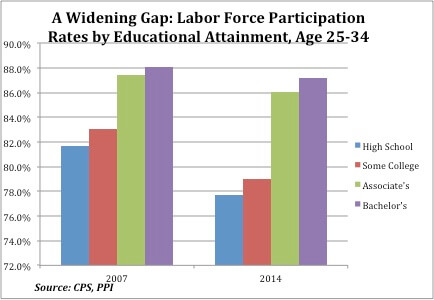
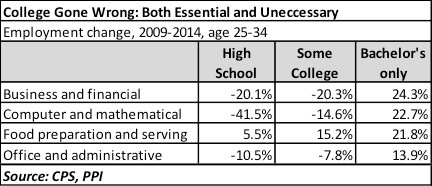
Moreover, the underlying dominance of four-year college model is also partly to blame. The fact is not all four-year degrees are created equally, and not all jobs require a four-year degree. Yet the lack of other viable options for workforce success could explain why everyone is encouraged to pursue a four-year degree. It could partly explain the astonishing rise in graduate school over the last decade, as poor employment prospects force college graduates to find ways to stand out, and the rising student debt that comes along with it.

Certainly some private loan servicers are not completely innocent, and may not always put student interests above their own short-term goals. But the harsh tone taken by Sen. Elizabeth Warren (D-Mass.) yesterday does not address the larger issues at play. Her comment, “Sallie Mae has repeatedly broken the rules and violated its contracts with the government, and yet Sallie Mae continues to make millions on its federal contracts,” even prompted the Department of Education to come to Sallie Mae’s defense.

Indeed, not all private-sector participants among the accused are approaching borrowers with mal-intent. Take for example state guaranty agencies (GA), the legacy administrators of the Federal Family Education Loan Program (FFELP) for a given state. Left out of the hearing discussion seemed to be the important fact that GAs are non-profit companies designated by the Department of Education. Their fees are used for an important cause – for extensive financial literacy training programs set up across state networks. The more their fees are cut, the fewer financial literacy services they will be able to provide.

The demonization of private loan servicers might lead one to think that federalizing student loan servicing would solve the problem. However, isolating TIVAS is counter-productive. Not only are student loan servicers not the greedy profiteers they are made out to be, but there is no reason to believe the government would be more cost-effective at loan administration. Further, there is no evidence that expanding the federal role in student loan administration would do much to relieve the existing student debt burden.

Instead, Congress should work with TIVAS and GAs as partners as they work to reform the federal student aid program. Just as the issues surrounding the student debt burden are systemic, so too must be the solution. Pointing fingers at a select few accomplishes little, even if it does sound good during election season.

If there is any take-away from yesterday’s hearing, it is that student loans have become the latest issue in need of greater awareness and education concerning all of the aspects. There are over 80 million young Americans under age 20 that are counting on policymakers to get the federal aid system right for when they invest in college. Luckily, since the re-authorization of federal student aid programs is almost certain to get postponed for yet another year, it is not too late.

This article was originally posted by The Hill, read it on their website here.

TechCocktailDC: 5 Factors That Determine Whether The Internet of Things Can Save the US Economy

PPI’s Michael Mandel was quoted in an article by Ronald Barba for Tech Cocktail DC. He was cited in “5 Factors That Determine Whether The Internet of Things Can Save the US Economy” on the figures for Internet of Things (IoT), the environmental necessity of the IoT, the recognition of IoT as a job creator,  and on the benefits this affords the workforce:

Mandel thinks that the Internet of things will eventually prevent the need for human trainers; rather, we can simply learn new skills through innovative solutions that connect the digital and physical spaces.

Read the entire article on Tech Cocktail website here.