TechCocktailDC: 5 Factors That Determine Whether The Internet of Things Can Save the US Economy

PPI’s Michael Mandel was quoted in an article by Ronald Barba for Tech Cocktail DC. He was cited in “5 Factors That Determine Whether The Internet of Things Can Save the US Economy” on the figures for Internet of Things (IoT), the environmental necessity of the IoT, the recognition of IoT as a job creator,  and on the benefits this affords the workforce:

Mandel thinks that the Internet of things will eventually prevent the need for human trainers; rather, we can simply learn new skills through innovative solutions that connect the digital and physical spaces.

Read the entire article on Tech Cocktail website here.

The Need to Support Business Investment

Here’s the situation: Fundamentally, investment is what drives productivity and growth. Unfortunately, more than six years after the Great Recession started, business investment is still weak. The chart below shows  nonresidential investment in structures and equipment as a share of GDP. It’s pretty easy to see that such capital expenditures have basically plateaued below 8.5% of GDP, compared to more than 9.7% at the time when the economy went into the tank.

From a policy perspective, given this weakness in investment, we should be doing everything we can to increase the incentives for capital spending. The best course is probably wholesale reform of the corporate tax system, but politically that’s out of the question right now.

A second-best alternative is to extend “bonus depreciation.” Bonus depreciation, which allows companies to immediately expense a certain portion of their capital spending, has the effect of lowering the hurdle rates for new investment.The provision officially expired as of the end of 2013. But Congress can renew bonus depreciation for 2014.

Extending bonus depreciation is not a panacea for the country’s economic ills. But at a time when Congress is deadlocked, bonus depreciation may be one of the easier ways of keeping business investment from weakening even more.

Forbes: Why CIOs Need To Think About The Internet Of Things

Forbes’ Howard Baldwin wrote an article on March 26th about the Internet of Things and its importance for CIOs, referencing PPI’s Michael Mandel presentation for the Washington Post‘s “All Things Connected” event:

The webinar launched with one of the best explanations of the Internet of Things I’ve heard, from Michael Mandel, chief economic strategist, Progressive Policy Institute. He described the Internet of Things as the “extension of the Internet to the physical world. The Internet has transformed digital industries, while the Internet of Things will transform physical industries.” The former represent about 20% of the GDP, Mandel said, but physical industries – manufacturing, transportation, public service, health care – represents the other 80%. That in turn represents a huge impact to the economy.

Read the entire article on Forbes website here.

Where Government is Working

With the federal government in gridlock, cities step into the breach.

Welcome to New Orleans, city of the future.

Wait, New Orleans? The decadent old tourist trap that’s been trading on its fading cultural glories for decades? That’s right – the Crescent City has its mojo working again.

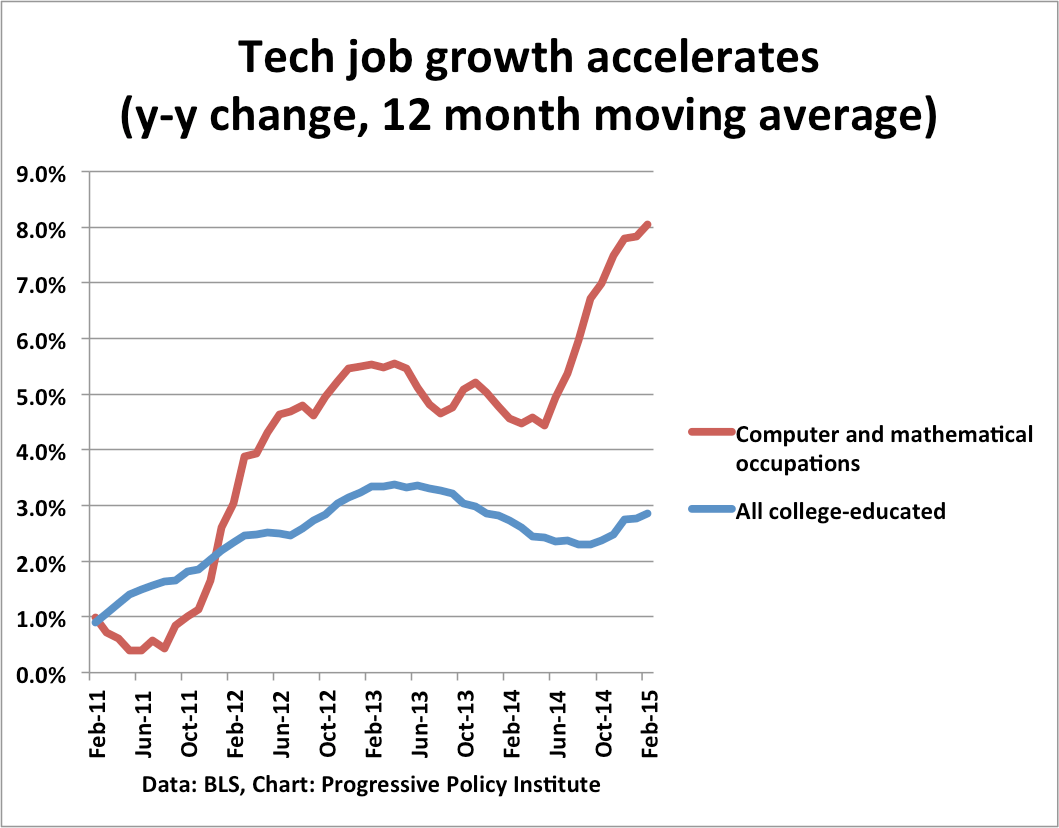
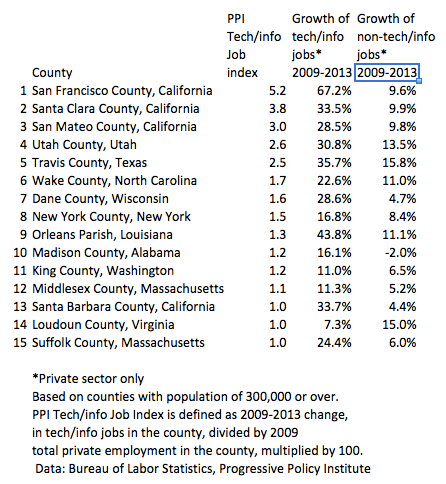
Since the ravages of Hurricane Katrina, the Big Easy has reinvented itself as a mecca for entrepreneurship and a magnet for young and highly educated workers. Forbes ranked New Orleans number one in IT job growth. Another ranking of America’s “cities of aspiration,” which blends economic performance, quality of life measures and demographics, lists New Orleans second behind Austin, Texas. New Orleans is also leading the transformation of urban education. An amazing 79 percent of its students attend charter schools, and — more amazing still — they are on track to become the first inner city students in the nation to outperform their counterparts in the rest of the state.

New Orleans also benefits from dynamic political leadership and a cooperative civic culture. Mayor Mitch Landrieu is a tough-minded progressive who has cut the city’s budget by a quarter, spun off inefficient public health clinics and forced the city’s regulators to dramatically speed up licensing and permitting. Voicing a pragmatism that’s all too rare in the ideological hothouse of Washington, Landrieu notes that “government can be too big and too small at the same time.” He has also launched the New Orleans Business Alliance, the city’s first public-private partnership for economic development, and has used the money freed by his “cut and invest” approach to upgrade municipal infrastructure and improve public safety (an astronomical murder rate is the city’s biggest problem).

What’s happening in New Orleans, however, is hardly unique. It’s emblematic of a larger story: A renaissance in local governance as Washington sinks deeper into paralysis.

While Congress becomes both more ideologically polarized and less productive than ever, local governments are innovating, collaborating and equipping their citizens and communities with tools for successful problem-solving.

This “metropolitan revolution”, as Bruce Katz and Jenifer Bradley of the Brookings Institution have dubbed it, illustrates the genius of American federalism. Its subtle dynamics seem to ensure that not every level of our government can be broken at the same time.

It’s also a dramatic role reversal from a couple decades ago, when the nation’s big cities were synonymous with failure and decline. From New York to Detroit, Cleveland to Los Angeles, U.S. urban centers were beset by deindustrialization and toxic waste, rising poverty, soaring crime rates, municipal corruption, racial friction and middle class flight to the suburbs.

Overwhelmed by these economic and social maladies, many urban leaders took refuge in victimhood and looked to Washington for salvation. As I’ve noted elsewhere, many cities seemed to develop a cargo cult mentality, waiting like Pacific islanders during World War II for pallets of federal aid to drop miraculously from the sky – which never came.

What came instead was a new wave of reform-minded mayors preaching self-reliance and homegrown solutions to local problems. These included pragmatic progressives like John Norquist in Milwaukee, Ed Rendell in Philadephia, Cory Booker in Newark and Martin O’Malley in Baltimore, as well as moderate Republicans Rudy Guiliani and Michael Bloomberg in New York. They used innovations like data-driven analysis and community policing to drive crime rates down. They experimented with ways to reduce welfare dependency and demolished public housing complexes that concentrated and isolated the poor. A few brave souls took over abysmal inner city school systems, cutting swollen bureaucracies, launching innovative charter schools, and holding principals and teachers accountable for student performance.

Metros on Top

Today, America’s cities and metro regions are the star performers of our federal system. They are America’s main hubs of economic innovation and dynamism and are reviving the U.S. economy from the ground up.

Houston, for example, as Derek Thompson of The Atlantic notes, has added more than two jobs for every one it lost in the Great Recession. Katz and Bradley report that cities like Portland and Tampa are concentrating on boosting exports into global markets. In Northeast Ohio, Cleveland and other cities are collaborating on joint strategies to become a hub of advanced manufacturing, targeting 3-D printing in particular. After the recession/financial crisis, Bloomberg launched an imaginative competition to attract engineering and applied science campuses to New York, to lessen the city’s economic dependence on Wall Street.

To Katz and Bradley, it all adds up to “an inversion of the hierarchy of power in the United States.”

The urbanologist Alan Ehrenhalt sees another kind of inversion at work in America’s metropolitan regions. As he explained in an interview with Smartplanet.com:

The demographic inversion simply means that, contrary to where we were a generation ago, with the inner city meaning “the place where poor people live” and the exurbs being where the affluent flee to; in the future, the center of the city is going to be where affluent people choose life. Not necessarily by tens of millions, but in significant numbers. Suburbs are going to be the place where immigrants and the poor congregate.

What’s behind this change? The disappearance of heavy manufacturing from many cities, says Ehrenhalt, has made them more attractive places to live. So has the steady decline in crime rates over the past several decades. And millennials in particular seem to find urban life more exciting than the placid suburbs most of them grew up in.

O Come Emanuel

If there’s a poster child for the metro revolution it’s probably Chicago Mayor Rahm Emanuel. A former adviser to President Clinton and Member of Congress, the acerbic Emanuel left his job as President Obama’s Chief of Staff to run for Mayor after longtime Mayor Richard Daley decided to call it quits. “Washington is dysfunctional politically, and it’s not just a momentary thing,” he explained to the New York Times’ Tom Friedman.

We’ve always said that there’d be a day when all that the federal government does is debt service, entitlement payments and defense. Well, folks, that day is here. So, federal support for after-school programs has shrunk. We added to ours, but I had to figure out where to get the money. The federal government is debating what to do with community colleges. We’ve already converted ours to focus on skills development and career-based education. I worked for two great presidents, but this is the best job I’ve had in public service.

None of this means Washington is at risk of becoming irrelevant – sorry, conservatives. But it does argue the merits of a serious push for a systematic decentralization of decisions and resources to state and local governments. It’s time to revisit former Congressional Budget Office chief Alice Rivlin’s ideas for devolving large responsibilities from Washington. And even during the present political stalemate, there are things Congress and the White House can do to enable local leaders to succeed. One is a generous waiver policy to allow for greater state and local experimentation. Combining lots of small programs – the federal government has 82 for teacher training alone – into broad, performance-based grants would also promote both local flexibility and efficiency.

Most important, progressives should get out of the habit of treating Washington as the line of first resort when some urgent problem demands a governmental response. Congress, the National Journal reports, is more ideologically polarized than ever. Not coincidentally, the previous Congress was the least productive in modern times. The current one – already effectively closed for serious business until November’s midterm elections — could turn out to be even more barren of legislative achievement.

And since no one seems to know how to throw the engines of polarization and hyper-partisanship into reverse, Washington is likely to remain mired in impotence and inertia for quite a while.

But don’t give up on democracy in America just yet. As conservatives try to undermine public confidence in government yet further, progressives should look outside Washington to local governments that are proving to be effective instruments for advancing the common good.

The piece is cross-posted from Republic 3.0.

College – Worth it or worth less?

College has never been worth so much – or so little.

New research from the Pew Center shows the wage gap between those with a college degree and those without is at an all-time high. Moreover, the college wage premium has actually been widening. Yet at the same time, real average earnings for young college graduates are at historic lows – down 6 percent from 2007 levels, even as the labor market recovers. Average student debt per borrower has climbed to a staggering $29,400.

Does this double-sided truth about the “value” of college mean that today’s four-year model is sustainable, or is it a sign that change is coming?

At first blush, one might conclude that going to college – specifically a four-year college – is a necessity. But that misses the point of what’s actually driving the wage gap between college and non-college grads, something that young college graduates already know – that not all of this boost is because of a lift-off in the bachelor’s degree job market.

In reality, a college degree is worth “more” in large part because a high school diploma is worth so much less. My research shows college graduates, particularly recent graduates, are increasingly taking lower-skill jobs at the expense of their less educated peers. Because many new jobs being created are low-skill instead of middle-skill, college graduates are getting first dibs, squeezing those with less education from the workforce.

Even worse, the price to compete for these lower-skill jobs is getting higher. As college becomes less affordable, and the labor market less generous, fewer people are able to buy the seemingly only ticket in town for success. New Fed data shows outstanding student debt increased $53 billion in the last 3 months of 2013 alone, with student loans dominating all new borrowing by young Americans under 30 in 2013. Succeeding in today’s higher education model allows for little margin of error: either you make the sacrifice and get the four year degree, or it’s game over.

No group epitomizes the failings of the current college system more than those who enrolled in college but failed to graduate – college drop-outs. Though often left out of the conversation, the latest figures show that the average four-year completion rate for those entering four-year colleges was 38.6 percent and that the six-year completion rate is still just 58.8 percent (rates are lower for two-year schools, but many transfer to other institutions). Minorities and low-income Americans are even less likely to complete college, exacerbating already growing inequality.

College drop-outs face the worst struggle of all. On average, they make little more than those with a high school diploma but are still saddled with thousands in student debt. They are at the highest risk of defaulting on their student loans, by some estimates up to four times more likely than graduates. They are the most vulnerable in terms of financial security, from slipping into a hole they cannot climb out of.
The large share of college drop-outs is evidence that the current structure of postsecondary education as the main vehicle for workforce preparation isn’t working.

Their fate is also an indication that the future of college may – and should – look very different. The ongoing revolution of low-cost, high speed broadband makes education more accessible, affordable, and customizable. This, coupled with decreasing returns on the four-year college model, should lead to more post-secondary pathways into the workforce (such as German-style “apprenticeships”). These alternative pathways have the potential to be just as effective at preparing people for the world of work, except at a lower cost. The nature of today’s innovative data-driven economy means preparing for tomorrow’s high-skill, high-wage jobs will naturally include digitally-oriented training and a dynamic curriculum.

The ideal post-secondary system of the future should correct some of the biggest workforce challenges facing Americans today. These are Americans who are unable to afford college, or who don’t want to take on thousands in student debt to succeed.

One way this could happen is if the current four-year model of college becomes one of several options after high school. Instead, what we could see is employers becoming better integrated into the workforce preparation process, as current workforce demands are unmet and training becomes a lower cost proposition that can be virtually administered. We may also see a renaissance in vocational training, which can cost-effectively prepare workers for well-paid technical and even computer and data-driven jobs. Industry certifications could take the place of a degree. It may be that only a few will pursue a four-year degree, much like a doctorate-level credential is pursued today, in specialty fields.

Still, wholesale change is unlikely to happen quickly, so long as the generous federal student aid system in place prolongs the current college model. The federal government administers more than 90 percent of new student aid – to the tune of more than $100 billion annually – but demands little accountability on the part of institutions and borrowers in terms of graduation rates and employment success.

For the millions of young Americans who’ve already been left behind, reform can’t come soon enough. That’s why the conversation to rethink college must begin now.

This piece is cross-posted from Republic 3.0.

Politico Magazine: Rand Paul’s Foreign Policy Is a Mess

If the Crimea crisis has revealed flaws in President Barack Obama’s passive “realism,” it has also exposed the utter incoherence of Rand Paul’s foreign policy—which, despite a reputation for being principled and bold, is in fact all over the place.

If that sounds too harsh, try making sense of the Kentucky senator’s contorted response to Russia’s aggression in Ukraine. Paul, the latest favorite for the GOP’s 2016 presidential candidate, came out blasting in a recent Time op-ed, declaring that Russian President Vladimir Putin “must be punished” for violating Ukraine’s sovereignty and asserting that Obama isn’t up to the job. “If I were president, I wouldn’t let Vladimir Putin get away with it,” Paul huffed.

Such gasconade seemed out of character for the anti-war libertarian. He opposes U.S. intervention just about everywhere—whether in Syria, which he sees as an invitation to another Iraq-style quagmire, or Iran, where he rejects preemptive U.S. strikes in favor of diplomacy or, failing that, a containment policy. Sure enough, the day after his Time article appeared, Paul was back to his usual dovish tone. In a Brietbart op-ed, he prescribed the “strategic use of soft power” to counter Putin and accused unnamed politicians—clearly his GOP presidential rivals—of beating their chests: “What we don’t need right now is politicians who have never seen war talking tough for the sake of their political careers.” Those who invoke Ronald Reagan to justify their bellicosity, he added, should remember that some similarly overzealous hawks called the Gipper an appeaser for negotiating nuclear arms accords with Soviet leaders.

Confused?

Let’s step back to January 2011, when the ophthalmologist-turned-politician Paul rode the high tide of Tea Party insurgency into the U.S. Senate. Despite having zero international experience, he was nothing if not clear and consistent on foreign policy. Like his father and libertarian icon, the now-retired Texas congressman Ron Paul, Rand called for America to mind its own business instead of trying to solve other countries’ problems. He regularly excoriated GOP neoconservatives for having pushed the nation into protracted and costly wars during the Bush administration, and made no secret of his desire to get America out of the superpower business.

Continue reading at Politico Magazine.

National Journal: An Old Idea, Tolling Federal Highways

Fawn Johnson, writing for National Journal, quoted former Pennsylvania Governor Ed Rendell on the need for further investment in national infrastructure.  Johnson was the moderator for PPI’s Investing in Jobs and Infrastructure: Twin Keys for Metro Growth event last week and her quote comes from Rendells opening remarks at that event.  In explaining the need for infrastructure invesement, Rendell said:

The argument against tolling on federal highways has been, ‘We paid for it once.’ OK, we paid for it once. …It’s like buying the $45,000 car of your dreams and for the next four or five years not putting a penny into it. It’s silly.

To read the rest of the article, visit National Journal’s  website here.

Thanks To Bill Clinton, We Don’t Regulate The Internet Like A Public Utility

A DC federal court struck down the FCC’s “net neutrality” regulations earlier this year, but did nothing to resolve an ongoing debate over whether or how the government should regulate the Internet.  At the heart of the controversy lies a central question – should we regulate the Internet as we did the old telephone network and other so-called “common carrier”?

In a paper to be released this week by the Progressive Policy Institute, I examine the past two decades’ experience to shed light on this question.  And the answer that keeps coming up is that proposals for strict utility-style regulation of the Internet have two things in common.  First, they are based on the presence of a “natural monopoly” for broadband that simply does not exist.  And second, where they have been tried, utility-style rules have been the greatest single obstacle to investment in broadband infrastructure.

From the earliest days of the Bell monopoly, our telephone system was built around an explicit bargain.  In exchange for a guaranteed and low-risk profit, the Bell system would provide quality, reliable phone service to the nation.  This bargain was deemed necessary because it was assumed that phone service was a “natural monopoly” where the costs of infrastructure were so high that competition wasn’t possible.  But by the 1990s, those assumptions had completely broken down.  Microwaves and coaxial cable could carry phone calls, phone lines could deliver video, and an “information superhighway” loomed in the future.

The Clinton Administration’s Telecommunications Act of 1996 sorted this mess out and launched the age of modern Internet policy – trusting market forces and technological innovation to the maximum extent.  It was an act of incredible political maturity.  Its authors knew something remarkable was about to happen and that government could best serve it by stepping back and letting private investment happen.

So the 1996 Act drew a line – the old phone system would remain regulated as a “common carrier,” but the emerging new world of “information services” would be allowed to develop on its own free from utility-style requirements such as government oversight of prices, forced sharing of infrastructure with competitors, or rigid traffic management rules.  As a result, we have seen over $1.2 trillion in investment since the 1996 Act, and the innovation, growth and new services the Act’s framers imagined.

Further light is shed by the treatment of the incumbent phone companies.  As a transitional measure, the Act preserved the utility model for the telcos, which were forced to share any infrastructure they built with all comers at a government supervised price (well below its long-term cost).  That requirement smothered investment since no one would build new infrastructure if they had to share it with competitors at a loss.  The result was initial stagnation in DSL broadband.  And when that requirement was later –overturned, investment followed there as well – more evidence of the dangers of the utility model in this space.

Europe still relies on these utility-style regulations and has used its state post and phone monopolies to build out broadband.  The results haven’t been pretty.  Per capital investment in broadband in the U.S. is nearly double that of Europe.

As a result, our major European trading partners are anchored near the bottom of the Internet speed charts – Germany is 27th in the world on the most recent Akamai speed rankings, France is 34th, Italy 48th.  The US by contrast is 8th, trailing small, dense, and highly urbanized places like Japan, South Korea, and Hong Kong, in contrast to the U.S.’ sprawling geography.  No one wonder EU Digital Policy chief Neelie Kroes says Europe “needs to catch up” in broadband.

The “natural monopoly” pro-regulation arguments depend on clearly does not exist.  America now has three different broadband technologies fully deployed and competing for customers (cable, telco, and 4G wireless).  The U.S. is near the top of global rankings in both high-end service, with 85 percent of households served by networks capable of 100 mpbs or more and the most affordable entry-level wired broadband of any nation in the OECD.  Imagine what would ensue if we were to change course and regulate the Internet as a monopoly utility?  Which of the three technologies would regulators adopt?  How would we ensure continued investment?

The Internet is undeniably incredibly important.  But that importance doesn’t mean that we should treat it as a public utility.  Bringing back the days of Ma Bell won’t fulfill broadband’s remarkable promise.

This article was originally posted by Forbes.  You can read the original post on their website here.

A Brief History of Internet Regulation

EXECUTIVE SUMMARY
Proposals to regulate the Internet are often presented as “new” solutions to deal with modern problems, but the most significant of these proposals, such as “network neutrality” and common carrier rules on unbundling and interconnection, are actually vestiges of long-outmoded ways of thinking about telecommunications policy. This paper explores the relevant regulatory history, offering critical context to today’s Internet policy debates.

From the early days of the AT&T monopoly well into the 1990s, regulators, the courts and the Congress engaged in a lengthy effort to protect consumers and ultimately bring competition into the markets for local and long-distance telephone service. This included strict “common carrier” utility regulations and mandatory interconnection requirements and ultimately the 1984 Modified Final Judgment, which forced the breakup of AT&T into regional Baby Bells. From the beginning of “community antenna TV” through the 1990s, a parallel but more limited effort was made to regulate the nascent cable industry. While these regulations had some success, technological change quickly outstripped them—both in the telephone business and the emerging field of high-speed data—and a bipartisan consensus formed in the early 1990s that additional steps were needed to promote competition in all these arenas.

The result was the Telecommunications Act of 1996, watershed legislation that marked the end of the telephone age and the beginning of the Internet age from a policy perspective. The Act embraced and codified the FCC’s distinction between traditional telephony/telecommunications services and the emerging world of information services, with strict common carrier rules limited to the former. On the telephone side, this meant a stifling regime of mandatory “unbundling” and rigid price controls, while giving the private sector more latitude to innovate and invest on the “information services” side. The 1996 Act may not have specifically contemplated the rise of the broadband Internet (the idea of an “information superhighway” was in the air, but the exact form it would take was still unclear as a matter of both technology and policy), but by protecting information services from the common carrier framework, the Act set the stage for the dynamic growth we have seen in American broadband.

The result was a boom in cable broadband investment that telecommunications providers attempted to counter by offering DSL services. But any new DSL capability they constructed had to be leased out to competitors at below market prices under the unbundling regime, which limited their efforts. When fiber and DSL were relieved of their unbundling obligation in the early 2000s, however, capital poured in and these services flourished as fixed-broadband competitors to cable. In fact, that competition drew a competitive response from cable, in turn leading to a virtuous cycle of improvement and enhancement resulting in the United States ascending to the upper reaches of the International broadband rankings.

This background sheds important light on current calls to impose “new” regulations on broadband either through “network neutrality” rules or by reclassifying it as a “telecommunications service” subject to common carrier obligations. While advocates suggest otherwise, these proposals are clearly not new, but would represent a return to the dated—and in the view of this paper failed—approach that the bipartisan 1996 Act was designed to sweep away. Most of these proposals for network micromanagement, forced sharing of investments, and government influence on pricing have been associated with low investment and innovation. These rules may have made sense when the problem was how to protect consumers in the days of the sanctioned Ma Bell monopoly, but the business and consumer landscape is dramatically different today in almost every regard.

Ultimately, three key lessons emerge from this policy review. First, information services and telecommunications services really are different, and broadband has flourished as an information service free from ill-fitting and stifling common carrier constraints. Second, investment and capital flow to where regulation (or the absence thereof) encourages them to flow. And third, technology, business models, and consumer behaviors change and, as they change, the meaning and effect of different regulatory proposals change as well.

Download the entire report.

The Hill: Been there, done that on broadband

A DC federal court struck down the FCC’s “net neutrality” regulations earlier this year, but did nothing to resolve an ongoing debate over whether or how the government should regulate the Internet.  At the heart of the controversy lies a central question – should we regulate the Internet as we did the old telephone network and other so-called “common carriers”?

In a paper to be released this week by the Progressive Policy Institute, I examine the past two decades’ experience to shed light on this question.  And the answer that keeps coming up is that proposals for strict utility-style regulation of the Internet have two things in common.  First, they are based on the presence of a “natural monopoly” for broadband that simply does not exist.  And second, where they have been tried, utility-style rules have been the greatest single obstacle to investment in broadband infrastructure.

From the earliest days of the Bell monopoly, our telephone system was built around an explicit bargain.  In exchange for a guaranteed and low-risk profit, the Bell system would provide quality, reliable phone service to the nation.  This bargain was deemed necessary because it was assumed that phone service was a “natural monopoly” where the costs of infrastructure were so high that competition wasn’t possible.  But by the 1990s, those assumptions had completely broken down.  Microwaves and coaxial cable could carry phone calls, phone lines could deliver video, and an “information superhighway” loomed in the future.

The Clinton administration’s Telecommunications Act of 1996 sorted this mess out and launched the age of modern Internet policy – trusting market forces and technological innovation to the maximum extent.  It was an act of incredible political maturity.  Its authors knew something remarkable was about to happen and that government could best serve it by stepping back and letting private investment happen.

Continue reading at the Hill.

Sens. Johnson, Crapo On The Right Track to Housing Reform

The housing sector is one of the pillars of the U.S. economy. That’s why we have marveled at the many partisan and radical proposals to reform the federal housing finance system that would have trashed both what’s good and what’s bad with the current system. PPI continues to maintain that any reform proposal must stabilize U.S. housing markets, reduce the government’s over-sized footprint in housing finance and protect taxpayers from a repeat of the housing bailout.

While the full details aren’t yet available, a bipartisan proposal from Senators Tim Johnson (D-South Dakota) and John Crapo (R-Idaho) seems to move the housing debate out of the ideological realm and closer to reality. Their blueprint ensures the continued availability to homebuyers of long-term, fixed-rate mortgages, and proposes creation of a fee-based insurance fund, similar to the Federal Deposit Insurance, to shield taxpayers from having to bailout the housing finance sector in the future.

There are still many details in question, but we think Senators Johnson and Crapo have pointed the housing debate in a more promising direction.

Infrastructure Investment and Economic Growth: Surveying New Post-Crisis Evidence

Does an increase in government spending create or destroy private sector jobs? Or more particularly, does additional spending on infrastructure—fixing existing roads and bridges, or building new ones—generate positive spillover effects for the rest of the economy? This question featured prominently in the 2009 debate over the size of the fiscal stimulus package. The Obama Administration, led by Christina Romer of the Council of Economic Advisors, wrote in January 2009, “we expect the proposed recovery plan to have significant effects on the aggregate number of jobs created, relative to the no-stimulus baseline.”

In response, conservative economists and politicians argued that rather than creating new jobs, government spending on infrastructure would crowd out private sector hiring. Over 200 conservative economists expressed stimulus skepticism, with a Cato Institute statement proclaiming “we the undersigned do not believe that more government spending is a way to improve economic performance.”The net result: The Obama administration ended up getting less to spend on infrastructure than it would have and should have.

What’s more, the debate over the size of the spillover effect—also known as “multipliers”—left lasting scars and hardened battle lines. Since then, proponents of higher infrastructure spending, including business stalwarts such as the U.S. Chamber of Commerce, have faced intense skepticism about the economic benefits of improving our transportation infrastructure. For example, the Department of Transportation funding programs were reauthorized in 2012 only after three years of temporary stop-gap extensions, with funding levels essentially unchanged from the previous authorization in 2005.

In this paper, we try to go beyond the sterile back and forth to uncover the real story about the economic spillovers from infrastructure spending. In particular, we look at a series of new studies that have been done since the 2009 policy arguments, using a wide variety of data sources and analytical techniques.

Download the full brief, including a breakdown of the returns on different types of investments, here.

Cuomo schools De Blasio

“We will save charter schools,” New York Gov. Andrew Cuomo (D) assured thousands of students and their families at a recent rally in Albany. Save them from whom, you wonder? From another Democrat, New York Mayor Bill de Blasio.

The rift between these bull elephants of New York politics isn’t personal. Rather, it illuminates simmering tensions between the Democratic Party’s reform and “populist” camps.

De Blasio thrilled the latter by campaigning last year against the Big Apple’s growing inequality, and vowing to tax the rich to pay for pre-school for low-income kids. Many on the Democratic left see him as just what they’ve been waiting for — an unapologetic champion for a new politics of economic and racial justice.
When it comes to charter schools, however, de Blasio sounds more like the paleoliberals of the 1970s and 1980s, whose distaste for reforming broken public sector systems — urban schools, welfare, public housing – did much to discredit Democrats in the voters’ eyes.

The flap began last week when the de Blasio administration withdrew permission (granted by its predecessor, Michael Bloomberg) for three charter schools to share space with schools run by the school district. The target of this eviction notice is Success Academy, a nonprofit network of charter schools, all of which are co-located with district schools. It’s run by Eva Moskowitz, a sharp-elbowed former city councilwoman who has opened 22 schools in mostly poor neighborhoods over fierce resistance from the city’s education establishment and its political allies.

De Blasio objects to co-location because he sees charters as free riders on the traditional school system. During the campaign, he said Moscowitz’s schools must “stop being tolerated, enabled, supported” by the city’s Education Department. And it’s not just space; the mayor also has shifted $210 million from a charter school expansion fund he inherited to other purposes.

De Blasio’s visceral aversion to the city’s charters is strange on several levels. First, it ignores the fact that, far from being invasive parasites on the district schools, charters are public schools too, even if they aren’t controlled by the central bureaucracy. They must take all comers (space permitting) and they receive significantly less in public money per each student ($13,527) than the district schools ($19,000). The mayor apparently believes that because charters solicit funds from private foundations and philanthropists, they aren’t truly public schools, and they are rolling in dough. Most aren’t, but in any case what’s so terrible about using private donations to improve urban schools?

Second, whereas the city provides buildings to all of its traditional schools, charters must find and pay rent on their own space. The facilities challenge, in fact, has been a major constraint on charter growth nationally. Take Washington, D.C., where nearly half the students are enrolled in charters. As a D.C. charter school authorizer, I was struck by how much time and energy school leaders spend on trying to find suitable and affordable space — even though the city is awash with vacant school buildings.

Third and most important, many charters are giving impoverished minority students what they’ve been denied too long — a quality education. Success Academy Harlem, one of the charters de Blasio wants to expel, had the highest-performing 5th graders in New York’s state math assessment last year. At the district school it shares space with, only five percent of the students passed the test.

So why do self-proclaimed “progressives” want to punish schools that are doing a good job of educating disadvantaged kids? The conventional answer is that they are carrying water for the adults in the traditional system — especially teachers unions. That’s often true, but there’s another explanation: Populists have a genuine ideological bone to pick with charters, because they inject market concepts of choice and competition into public education.

Progressive education reformers are more pragmatic. What matters to them is closing achievement gaps, not preserving the centralized, one-size-fits all model for school governance. For them, the “public” nature of public education lies not in a uniform school system, but in a commitment to uniformly high standards for all students. What charters offer, reformers say, is room for innovation and diversity within public education. Above all, they offer accountability for results. When charters don’t succeed, they can and should have their charters yanked. De Blasio, on the other hand, wants a moratorium on closing failing district schools.

The progressive reform camp, fortunately, has some formidable assets: Bill Clinton, who first put charters on the national agenda two decades ago; President Obama and Education Secretary Arne Duncan; lots of Democratic mayors, governors and legislators in the 42 states that have charter schools; and, legions of black and Hispanic parents who are demanding better schools for this kids.

Oh yes, and Andrew Cuomo, who vowed to make sure the city’s charters have “the financial capacity and physical space and government support to thrive and grow.” Thus did the governor school the new mayor in what it really means to be a progressive.


This article originally appeared in The Hill, you can read it on their website here.

Marketplace Business: Ghetty Images and IP Rights

Michael Mandel, PPI’s Chief Economist, was interviewed by Dan Weissmann of Marketplace Business to help unwrap Ghetty’s decision to offer 35 million of its protected images to the public for free. Mandel explained why the status quo wasn’t working:

If you have content that gets used by somebody else, and it gets used for free, then your only option is to sue them, and that’s a really terrible option.”

You can listen to the interview on Marketplace’s website here.

Financial Times: Obama seeks poll dividend from wage fight

Barney Jopson, writing for Financial Times, quoted Will Marshall, PPI president, on President Obama’s plan to raise the minimum wage.  The article explores the popular support for a minimum wage hike and the conservative economic arguments against the President’s policy.  Marshall presents an alternative, progressive option to lessen America’s growing inequality:

Will Marshall, president of the Progressive Policy Institute, a think-thank that was close to Bill Clinton’s White House, says minimum wage hikes are a populist but outdated leftwing perennial. Tax credits would be a more efficient way of helping the working poor.

“This agenda doesn’t go to the overriding concern of the American people, which is to revive economic growth,” he says.

To read the entire article, visit the Financial Times website here.

Putin Is a Threat to the Free World America Helped Build

In occupying Crimea, Vladimir Putin has brought the Russian bear, snarling and clawing, out of its post-Cold War hibernation. An anxious world awaits America’s response.

President Obama’s challenge is three-fold. The first and most urgent task is to discourage Putin from authorizing deeper incursions into Ukrainian territory on the pretext of protecting their Russian-speaking compatriots from “fascists.” That could be the thread that unravels Ukraine‘s independence.

Sending Secretary of State John Kerry to Kiev this week is a welcome gesture of U.S. solidarity, but in truth there is little Washington can do to stop Putin from grabbing a larger chunk of the country. No one is prepared to go to war over Ukraine, and the Russian strongman knows it. Nonetheless, Obama should spell out an escalating chain of penalties Russia will incur for further aggression.

Second, Washington must orchestrate a global chorus of condemnation of Russia’s blatant violation of Ukraine’s sovereignty, reinforced by sustained diplomatic and economic pressure on Putin to withdraw his troops. The third task is to solicit economic aid to help stabilize Ukraine’s fragile new government and lessen its dependence on Russia.

Pundits are calling the crisis the gravest test to date of Obama’s international leadership. Perhaps, but there’s a larger question: Can the divided U.S. government, which can scarcely pass a budget or fill key posts, muster a coherent and forceful reply to Putin’s attempts to bully Russia’s neighbors into submission?

This shouldn’t be a partisan issue, but some Republicans just can’t help themselves. Russia’s aggression, they charge, is the bitter fruit of Obama’s weakness. Never mind that Putin also invaded neighboring Georgia in 2008 on George W. Bush’s watch.

Evidently, the “blame America first” mentality that Republicans used to attribute to Democrats has migrated from the left to the right of the political spectrum.

Occupying Crimea is part of Putin’s grand strategy to restore a strong Russia that’s once again respected — i.e., feared — and halts the advance of Western-style democracy into what Moscow regards as its historic sphere of influence. This complicates Putin’s plan to organize a “Eurasian Union” of compliant autocracies as a counterweight to the European Union.

The Russian leader and former KGB operative has called the 1991 break-up of the Soviet Union a tragedy. But that doesn’t mean he has grandiose visions of recreating Stalin’s old empire. Instead, the wily Putin is trying to revise, not reverse, the Cold War settlement. That’s why he’s focusing on countries on Russia’s borders with large ethnic or Russian-speaking populations. Putin would like to reabsorb as many of them as possible, which is why he doesn’t want these countries to follow the Baltics and Eastern Europe in turning to the West. In championing supposedly endangered Russian minorities, and reestablishing the Russian Orthodox Church as the state religion, Putin is trying to revive the old Russian nationalism of the Tsars.

Unfortunately, he also seems bent on resurrecting the worst features of that tradition — creeping imperial expansion, stifling autocracy, paranoia about being “encircled” by enemies and resentful envy of the modern West, led nowadays by America.

This backsliding from the hopeful days of post-Soviet Russia, when Boris Yeltsin tried to put his country on a “normal” course toward market democracy, is a tragedy for Russians, not just their fearful neighbors. Fabricating conflicts with newly independent neighbors and whipping up anti-Americanism strikes a revanchist chord, especially among older Russians. Moreover, such antics distract the world’s eye from popular protests in Russia, as well as harsh crackdowns on dissent and civil society, and the ruthless stamping out of real political competition.

President Obama hasn’t paid nearly enough attention to the rising authoritarian tide in Russia. Instead, in classic “realpolitik” fashion, the White House keeps emphasizing the need to win Russia’s cooperation on what it regards as more important issues, like reaching a political resolution of Syria‘s civil war (though Moscow has no interest in Assad’s departure) and striking a nuclear deal with Iran.

More fundamentally, Obama appears to have internalized the critique — which now joins the anti-war left to the libertarian right — that America’s problems abroad stem mainly from our own moralizing and overreaching, not what bad actors elsewhere do. That’s why he has demoted freedom and democracy as U.S. foreign policy goals, and stood aloof from the Syrian bloodbath, even as the human and strategic costs of inaction keep mounting.

Let’s hope the Ukraine crisis jolts the president out of his solipsistic complacency. Russia’s resort to brute force to intimidate its neighbors is a threat to the international system shaped and sustained mainly by American power over the last half-century. Are we really too war-weary, overstretched or poor to rise to this new challenge? Not unless our leaders think we are.

This op-ed was originally posted in Real Clear World, you can read the original article on their website here.