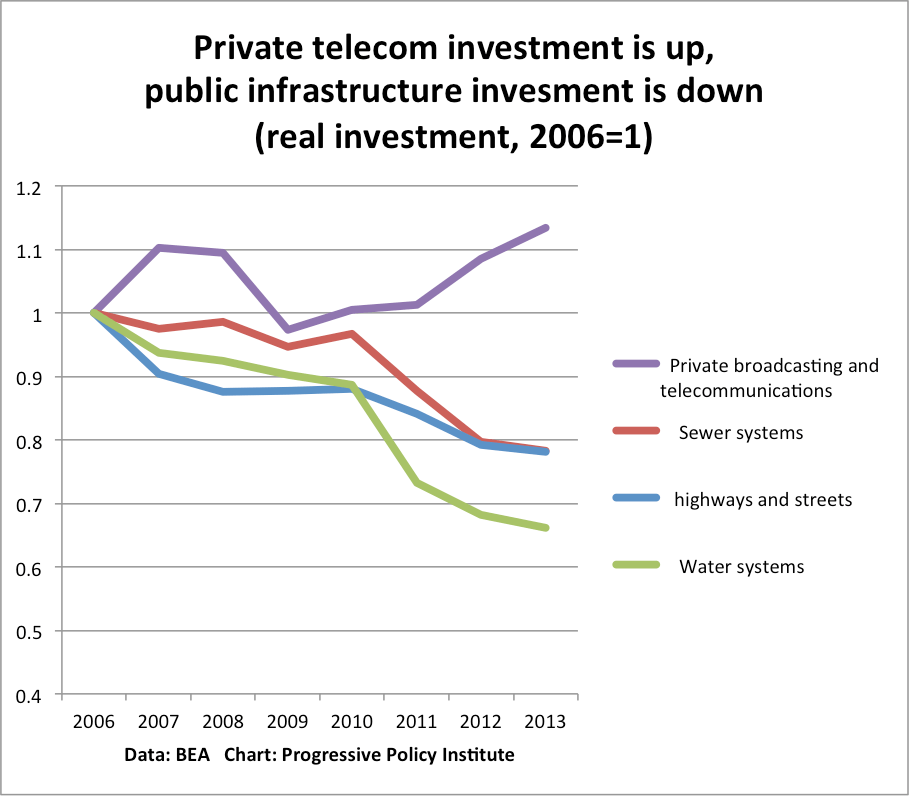
A Merger of Necessity

The proposed merger between Comcast and Time Warner highlights the vast gap between the imagined world the broadband industry’s critics and the real world in which these companies must compete.

For years, the critics have advocated forcing companies such as Verizon and Comcast to share their infrastructure with their competitors or mandating that the broadband market only offer one level of service. Their argument is that America’s broadband is gripped by a “cable/telco duopoly” that uses its market power to slow innovation and gouge the consumer. And the Comcast-Time Warner combination is their new monster under the bed.

In fact, the substance of these criticisms is simply wrong. The latest rankings from Akamai show the U.S. eighth and rising in global Internet connection speeds, and a new report from the International Telecommunications Union depicts U.S. wireline broadband as being the most affordable among our trading partners as well.

But even more dissonant are the data on profitability. In a new study set to be released next week by the Progressive Policy Institute, I examine the rates of profit of two subgroups of the Fortune 500 — companies that provide the Internet (from ATT and Verizon down to Level 3 and Frontier) versus companies who reside on it (from Apple and Microsoft to Facebook and Yahoo). The (average weighted) rate of profit on sales for the “providers” is 3.7 percent, versus 24.4 percent for the “residers.” Calculated on assets, the rates are 2.1 percent versus 17.7 percent, respectively.

So the companies that use the broadband Internet are making six to eight times the margins of the allegedly monopolistic companies who provide it — the exact opposite of what you’d see if the price gouging accusation was real.

The problem is that advocates for regulation simply don’t get the competitive dynamics of the broadband industry. And if we don’t have that understanding, we can’t understand the Comcast/Time Warner merger.

In the rotary phone world, “connectivity” — dial tone — created all the system’s value, once you had a phone. But the Internet is different. Rather than a “dumb” signal, Internet connectivity is part of a multi-part parlay with devices, services, applications and other components that deliver value to the consumer. All of these components compete for a larger slice of the integrated customer value pie.

Consider the iPhone. Its vaunted voice recognition technology, for example, has been around for a long time. It’s only been offered in phones now because mobile broadband is powerful enough to let the cloud deliver the service to the user in real time.

So the innovation that makes the iPhone and its applications more valuable to consumers was really the faster speeds offered by mobile service providers. And this is the competitive reality today. The device, website, app and content companies are capturing most of the benefits created by the connectivity “providers,” hence their lusher margins. Yet the providers must continually innovate and improve their service so their customers will bring those devices and applications to the providers’ platforms. In essence, the “providers” are caught in a loop in which they innovate, the downstream device and service providers capture the value created by those innovations, and the providers must then innovate all over again. No wonder the residers make money far outstripping providers.

And it’s not just the mobile market. Watch bandwidth-munching UltraHD TV — so-called “K4” — as it enters the consumer market, now that there’s enough bandwidth to support it. Will the set-makers make the margin, or the broadband providers who made the new sets possible?

So, unlike their caricature as duopolists, provider market power is extremely limited. They are essentially high fixed-cost systems that must continually attract new customers to spread their fixed costs over a larger base, even as other companies garner most of the benefits of their innovation.

And they have little power over content as well. If Comcast were to block, say, YouTube, would you keep their service, or switch to Verizon, ATT, Sprint, Dish, DirectTV or any of several other provides to get what you want to see? And which is the danger — that Comcast will charge you to reach YouTube, or that YouTube will one day charge Comcast to be on its system? In the real world, content, not connectivity, has the muscle.

And this is the backdrop against which we should see the Comcast/Time Warner merger. Comcast’s offerings will immediately improve the service Time Warner’s customers receive. And that will make the combined company a better competitor and innovator in the competitive cage match in which the providers of connectivity, devices, apps, services, content fight for a share of the value the broadband world creates. Rather than a denial of competition, the proposed merger demonstrates that active, aggressive competition is underway in broadband, and Comcast is girding itself for that content. The right policy is to let them do so.

This article was originally posted in The Baltimore Sun, read it on their website here.


China’s Data Fog

China recently released its January trade data, showing export growth of 10.6% and performing way above predictions – if you believe the numbers.  Many don’t.  After last year’s round of inflated figures, stories began to appear about just how businesses were cooking the books.  For example, some corporations were sending their goods on a “round trip” to Hong Kong and back, whereby a good produced in China goes “abroad,” to count as an export for tax purposes, and then is brought back to the mainland and sold at a premium because the same good is now also an “import.” Businesses being less than honest is neither a new nor a China-specific phenomenon — but as with every accomplishment the Chinese seem to be doing it bigger and more prolifically than most.

Exports aren’t the only quarter where domestically counted economic indicators have come under criticism.  Former Prime Minister Li Keqiang was quoted in a 2007 communique recently released by Wikileaks describing the data used to report China’s GDP as “man-made.”  In 2013, a Chinese university released a Gini coefficient estimate, a measure of a country’s rich-poor gap, at .61.  A short month later the Chinese government released their first official estimate in a decade coming in at 0.47 – where 0 is perfect equality and 1 is extreme disparities in wealth. (The U.S. for comparison is a middle-of-the-pack nation with a World Bank Gini coefficient of .45).  Foreign economists familiar with China labeled the official number, politely, as ‘optimistic.

These examples highlight two related, but separate issues: Chinese economic data is manipulated at both the macro and at the micro level.  Government offices are incentivised to report good numbers and individual firms/households are incentivised to hide their wealth and keep it out of China.  Exacerbating the government’s stranglehold on numbers with any meaning is the aggressive harassment of investigative reporters.  Last December’s reporterpocalypse, whereby in retaliation for “biased” articles Beijing held up the visas for dozens of foreign reporters, was resolved only by United States Vice President Joe Biden’s direct intervention.  Even so, China has continued the trend of kicking out individual journalists with the banning of another New York Times reporter two weeks ago.  Of course, no one has it as rough as the Chinese national reporters, who are subject to intimidation, jail time, and annual mandatory classes on how to be a loyal “marxist” reporter.

Formerly, China’s data fog wouldn’t have much global impact.  But in an age of unprecedented investment, trade, and interdependence China’s behavior is a problem for actors worldwide.  U.S. current Foreign Direct Investment in China is a cool $51 billion, most of which is tied up in manufacturing and outside of finance.  American investors need to know the true quality of the environment in which they spend U.S. dollars.  Furthermore, globalization has led to the unprecedented integration of economies whereby governments need accurate data from abroad to determine domestic competitiveness.  Finally, as the 2007 financial crises demonstrated – failure in the number one (and presumably two) global economy has consequences far beyond a single state’s borders.

Can the US or other outside forces encourage transparency?  The fact is that the United States government has little to no political capital in Beijing.  When Chinese officials are approached directly by US counterparts, their “advice” is interpreted as at best, condescending and at worst, part of a massive beltway plot to keep China down.  This situation illustrates one aspect of a global sea change where the most effective ambassadors aren’t coming from the government, they are the corporations.

For corporations however, the need for accurate information is tempered by other considerations.  Companies operating in China have an obvious vested interest in staying on the good side of local/national authorities.  It’s hard enough to get things done even when you are courting, bribing and hiring the relatives of the right people.  But that doesn’t mean we should underestimate how much China wants to attract foreign business, and the leverage that this desire gives investors.  With the roll out of Shanghai’s new Free Trade Zone, Beijing has shown its hand.  The government desperately wants to shift the focus of China’s economy away from heavy industry and towards financial and service sectors – ideally with foreign role models around to “unleash diversity and competition.”

Encouraging transparency in China, the United States’ biggest trade partner and the number two global economy, is good economic policy and a smart business strategy.  Both official and commercial actors need to participate in lobbying for transparency.  In the end, the prospects of foreign businesses in China contribute to the development of the US and the global economies.  Governments and the participating corporations are responsible for pressuring China to do the right thing, and as their relative power shifts, pressure is best applied through multiple governmental and business channels.


How Season 2 of House of Cards Murders the 25th Amendment

As the nation binges on Season 2 of “House of Cards,” we have witnessed ruthless House Majority Whip Frank Underwood (Kevin Spacey) maneuver for the vice president to resign and for himself to be appointed to the position. It’s no spoiler to say that Underwood clearly won’t be content to remain a heartbeat away from the presidency.

But the biggest casualty of “House of Cards” might well turn out to be the 25th Amendment, which governs vice presidential succession. Once again, the amendment has, at least in popular fiction, been transformed from a pragmatic constitutional provision into a Machiavellian route to power. And that’s a shame, because in a real-world time of crisis it could be incredibly valuable — but only if an ongoing stream of fictional portrayals hasn’t distorted its public image beyond recognition.

The 25th Amendment was enacted in 1967 during the height of the Cold War, at time of hair-trigger tensions and the ever-present reality of nuclear missiles mounted on fast-flying intercontinental ballistic missiles. The need for near-instantaneous decision making and continuity of the command authority during the Cold War was clear, yet the nation had twice found itself with a vacancy in the vice presidency, for nearly 4 years after Truman succeeded to the top job 1945 and again for over a year after the Kennedy assassination.

This problem was rooted in an oversight of the founders. They had crafted a vice presidency to assume executive authority in the case of the death, resignation, or removal of a president, but had not provided a way to fill the ensuing vice presidential vacancy before the next regularly scheduled general election. As a result, between 1789 and 1967, through a combination of presidential and vice presidential deaths and resignations, the VP slot had been vacant 16 times for some 40 years in total, or nearly 20 percent of American history.

Depending upon the Law of Presidential Succession at the time, the secretary of state or the speaker of the House were bumped up to next in line to the Oval Office. But the former lacked democratic validation, while the latter was not part of the sitting administration, and might even be its vehement political enemy. The 25th Amendment was thus enacted to enable the president to fill a vacancy in the vice president position, subject only to confirmation by simple majorities of both houses of Congress.

On “House of Cards,” Underwood’s machinations have arranged for the unhappy sitting Vice President to step down and for him to be named in his stead, with various types of murder and mayhem enacted along the way. This is a far cry, however, from how the mild-mannered and upstanding Gerald Ford actually found his way to the Oval Office via the 25th Amendment in 1974.

After VP Spiro Agnew was pressured to resign due to bribery charges, Nixon looked around for a harmless placeholder until the 1976 election. Neither he nor Ford, imagined that Nixon would himself likewise be forced from office, following what Ford termed the “long national nightmare” of the Watergate crisis. A longtime member of the House, Ford had never been elected by any constituency larger than the area around Grand Rapids, Michigan, yet he assumed full executive authority, more in sadness than in triumph. Now though, thanks to “House of Cards,” what was then a constitutional lifeline is now best known as a vaguely illegitimate back route to power.

And “House of Cards” is not the only fictional outlet to rough up the 25th Amendment, which includes two other provisions addressing another oversight of the founders: what to do about a president who was not dead but was severely incapacitated. Section 3 of the amendment allows for the president to designate the VP to temporarily become acting president. This can be initiated by a still-conscious president, as has been done three times by presidents who were anesthetized for brief medical procedures. Its intention was for such short-term situations or, even more so, for protracted periods such as following Woodrow Wilson’s stroke in 1919 or Dwight Eisenhower’s heart attack in 1955.

Predictably, though, television took this sober precaution to an outlandish level on the long-running series “The West Wing,” in which the daughter of Democratic President Jed Bartlet (Martin Sheen) was at one point kidnapped by terrorists. This created an insoluble conflict-of-interest for the president, leading him to invoke Section 3 of the 25th Amendment and to temporarily to step aside. Conveniently, the vice president on the series had also recently resigned. This enabled the next in line, a boorish Republican speaker of the House (John Goodman), to briefly become commander-in-chief and thus to play havoc with the administration’s policies.

Most controversially, Section 4 of the 25th Amendment enables vice presidents themselves to initiate the power transfer, provided that they have the counter-signatures of a majority of cabinet officials. The single time this provision unambiguously should have been enacted was in 1981 after an assassination attempt left Ronald Reagan unconscious. But a mere three months into their term, Vice President George H.W. Bush was determined to create even a hint of an unseemly power grab, and never invoked the amendment despite Reagan’s manifest incapacitation. One of the indelible images of that day was mass confusion at the White House and the infamous, and erroneous, declaration by Secretary of State Alexander Haig that he was in charge while Bush was traveling back to DC.

Of course, popular culture has likewise since latched onto this scenario, most famously in the Hollywood movie “Air Force One,” in which the president’s plane has been hijacked with him aboard. Although this was hardly the circumstances originally envisioned for the amendment, it undoubtedly applied — the president (Harrison Ford) could hardly have been more incapacitated than while evading terrorists at 35,000 feet.  But the vice president (Glenn Close) stalwartly refuses to make the correct choice to temporarily transfer power to herself, despite urging from a cabinet more sensible than herself.

So, what do these fictional scenarios have in common with reality? Not very much. But they do play to an enduring fascination with convoluted Shakespearean scheming to seize the throne, such as in “Macbeth” and “Richard III.” Hopefully, the 25th Amendment will never need to be invoked in such dramatic circumstances. But, the reality is that it conceivablycould be — and in a moment of crisis and confusion, the perception of order and legitimacy may count for a lot. It certainly won’t help if the public’s most enduring impression of the mechanism  for orderly succession involves the scheming of Frank Underwood.

This piece was originally published in The Daily Beast, you can read it on their website here.


Obama Goes Big on Infrastructure

President Obama’s new budget proposes a bold, $300-billion push to modernize the nation’s aging and inadequate transportation systems over the next four years. Here at last is a call for action on the scale we need to get the U.S. economy out of its slow growth rut and back on a high-growth path.  Two generations of federal underinvestment in public infrastructure has left much of it in disrepair, deterred private investment and limited the economy’s growth potential.

There’s only one problem: Obama’s plans to get America moving again by improving roads, ports and transit systems have been repeatedly stalled by ultra-conservatives within the GOP.  It’s bad enough that there are those in Congress who automatically oppose whatever Obama proposes.  But many far-right politicians also seem to have forgotten what they learned in Economics 101 – investment in public goods like transport, water and energy infrastructure are essential foundations for robust economic growth.

PPI’s forthcoming paper highlights new research conducted post-crisis confirming that the economic returns from infrastructure spending are enormous.  In fact, our analysis shows an emerging consensus that for every $1 spent on transportation infrastructure, the increase in economic growth is between $1.5 and $2.

The United States faces an enormous deficit in transportation investment – almost $900 billion by 2020 by some accounts. Yet there’s no doubt that modern transport systems are essential to our nation’s competitiveness – to facilitate U.S. international trade, regional commerce, and local access to essential services. Not having access to fast and reliable public transit services could disproportionately affect the low-income and inner city populations relying most on fast and affordable public transit to get to work.

So we applaud President Obama’s proposal, and hope that Congress will finally start investing in America too.

Tech Hubs Have Better Inequality Performance since 2007 Than Other Large Cities

The title of the NYT article seems to say it all: “Study Finds Greater Income Inequality in Nation’s Thriving Cities.” The implication is that the tech/info boom is increasing inequality.

But a closer look at the Brookings data underlying the article shows exactly the opposite.  In fact, based on the Brookings data, tech hubs have on average seen a smaller increase in inequality than other large cities since 2007.

Let’s walk through the evidence. The Brookings study used Census data to measure the change in the 95/20 ratio for large cities from 2007 to 2012. Their list of 50 large cities included 9 tech hubs–San Francisco, Boston, NYC, Denver, Austin, Seattle, San Jose, Raleigh, Colorado Springs.

1. Out of those 9 tech hubs, only 2 (22%) had a statistically significant increase in inequality from 2007 to 2012, according to the Brookings report. Out of the remaining 41 cities, 17 (41%) had a statistically significant increase in inequality form 2007 to 2012.

2. The median increase in inequality for the tech hubs was 0.4 percentage points, compared to 0.7 percentage points for the remaining cities.

3. The average increase in inequality for the tech hubs was 0.8 percentage points, compared to 0.9 percentage points for the remaining cities.

4. Two tech hubs (Denver and Seattle) had declining inequality over this period, compared to only one non-techhub (El Paso).

Preliminary conclusion: Tech hubs have seen better inequality performance since 2007, compared to other large cities.

Caveats: This is a real-time preliminary analysis of the Brookings data. I reserve the right to modify it (or correct mistakes!!) in response to comments. Go for it!


Time: America’s Big Cities Are Inequality Hot Spots

Time‘s Denver Nicks referenced an observation made by the Progressive Policy Institute on the positive effects that tech hubs have on income inequality.

Nicks cited a study from the Brookings Institution and concluded that income inequality was broadest in big cities, mostly because of the stagnation of lowest incomes since the recession and the housing crisis. The PPI noted that income inequality grew slower or even decreased in tech hubs:

Income inequality actually increased at a slower rate in tech hubs than in non-tech hubs in Brookings study, and two tech hubs (Denver and Seattle) actually saw a decrease in income in equality in recent years compared to just one non-tech hub (El Paso).

Read the entire Time article here.

NYT: Race Gap on Conventional Loans

In the New York Times Lisa Prevost  referenced PPI Senior Fellow Jason R. Gold’s proposal to mitigate the inequitable access to loans in the conventional market between minority applicants and nonminority applicants.

The statistics show that Black and Hispanic applicants are far more likely to be turned down and that they are opting for F.H.A. loans that can prove expensive because of the high mortgage insurance premiums. This situation leads to a problematic dual housing market based on racial and ethnic groups. Before the need of a broadening of the lower-down-payment availability, Gold suggested the creation of HomeK accounts. This system would enable workers to single out up to 50 percent of their contributions from a retirement account into this HomeK account:

The HomeK accounts would give workers the option of using up to half of their contributions to 401(k) retirement savings for a down payment on their first home.

Read the entire New York Times article here.

KUOW: Is The Tea Party Over?

Raymond Smith, PPI senior fellow, was interviewed by Ross Reynolds of KUOW-Seattle on the Tea Party’s waning influence.

Smith made it clear that the Tea Party was declining, but not gone yet. He explained that in the long run, the Tea Party wasn’t a sustainable party in the U.S. two-party system, like many others fringe parties. It is more like a political movement, an anti-system party without any chance to take power:

In a two-party system, either it gets control of one of the two major parties, or it burns itself out.”

Listen to the entire KUOW-FM interview here.

Private Sector Investment and Innovation Must Be Encouraged

PPI has consistently argued that in most cases, pro-investment and pro-innovation policies will give the best long-term results for raising the living standard of ordinary Americans, boosting domestic production, creating jobs and raising real wages. Today, private investment and nonresidential investment in equipment and structures as a share of GDP is still significantly below pre-recession levels. As a result, we believe that government policymakers should pay close attention to promoting investment, innovation, and productivity.

These principles should influence the government approach to mergers such as proposed combination of Comcast and Time Warner Cable. Antitrust authorities should assess the merger on the basis of how it might affect investment, innovation, and productivity as well as competition grounds. In addition, PPI research, based on official government statistics, shows that investment in the tech/info sector is creating job opportunities for blacks and Hispanics.  These benefits should be part of the merger assessment process as well. (See https://www.www.progressivepolicy.org/2014/01/can-tech-help-inner-city-poverty/).

Protecting the Environment for Innovation: A Regulatory Improvement Commission

A Regulatory Improvement Commission would solve the issue of regulatory accumulation, the layering on year after year, of new rules atop old ones. The fundamental problem is not that government keeps creating new rules, but that it never rescinds old ones. As a result, U.S. businesses and entrepreneurs are enmeshed in an ever-growing web of complex rules that are sometimes duplicative, sometimes in conflict with each other, and sometimes obsolete. Like barnacles on a ship’s hull, the sheer number and weight of regulations imposes a drag on economic growth. Regulatory accumulation also raises the costs of entry to entrepreneurs, and creates big opportunity costs as the time and attention of business managers is consumed by compliance with rules rather than creating new products or better business processes.

This problem demands an institutional response. It is unrealistic to expect the same agencies that promulgated rules to eliminate or modify them. Some new entity must be created and charged exclusively with pruning old rules that inhibit innovation and entrepreneurship. PPI has proposed creation of a Regulatory Improvement Commission (RIC) to fill this vacuum. It is modeled on the Defense Base Realignment and Closure Commission (BRAC), which Congress created in 1990 to create a politically feasible way to reduce excess military infrastructure.

The RIC would consult experts, business and the public to draw up a list of regulations that should be eliminated or improved, and present it to Congress for an up or down vote. As a small body that convenes occasionally, and relies largely on staff loaned to it by Congressional and Executive Branch offices, its costs would be negligible. The savings — both in terms of retiring costly rules and reducing the drag of regulatory accumulation of economic growth and entrepreneurship — could be enormous.

Like BRAC, the RIC would provide political cover to Members of Congress, who otherwise would have to vote individually on rules often defended by entrenched and politically powerful interests. The process of “getting it done” has already begun: Sens. Angus King and Roy Blount last year introduced bipartisan legislation in the Senate to establish the RIC.

The above remarks were prepared for delivery at the Kauffman Foundation’s 2014 State of Entrepreneurship event on February 12.

For recent PPI work on regulatory reform, see our latest policy memo and op-ed.

Speaker Boehner on Debt Limit Hot Seat

WASHINGTON, D.C.—PPI President Will Marshall released the following statement on the House’s impending vote on increasing the debt limit:

Speaker Boehner’s decision to bring a ‘clean’ debt limit increase to the House floor this evening is a welcome if belated concession to political reality. It acknowledges President Obama’s point that raising the debt limit doesn’t enable new spending, but only ensures that America honors the bills it’s already agreed to pay. And it’s an unmistakable repudiation of the Tea Party’s destructive fiscal brinkmanship over the last several years.

“Nonetheless, the Speaker still must find enough Republican votes to get the debt ceiling increase through the House. A failure will call into question both Boehner’s ability to lead the House majority and the Republican Party’s willingness to put partisanship aside and govern in the national interest.”

– END –

How Do Tea Parties End?

Just how close is the Tea Party to its demise? Last week, Fox News didn’t even bother airing the group’s official response to Barack Obama’s speech, in which the president forcefully called for an end to tactics that prevent the government “from carrying out even the most basic functions of our democracy.” Even Speaker of the House John Boehner, who seemed so downtrodden last year, now has an extra spring in his step, and is daring to push for immigration reform over the vocal objections of the far right. All but the most extreme Republicans have abandoned their shutdown tactics, and though the GOP still vows to repeal Obama’s signature health law given the chance, the changing power dynamics on Capitol Hill are palpable.

Indeed, it’s been a rough few months for the Tea Party. Fewer Americans than at any time since 2010 now call themselves members or supporters of the group. The tactic of running far-right candidates in Republican primaries clearly cost the GOP control of the Senate in 2010 and again in 2012. Their intransigence also helped to prevent Mitt Romney from defeating the president they have so vilified. All this has sparked counter-mobilization by the GOP Old Guard too: Since last fall’s ill-conceived Tea Party-led gambit to shut down the government, defund the Affordable Care Act and potentially default on the national debt, establishment Republicans have boldly lashed out at conservative outside groups that once had them cowering in fear, while pouring millions of dollars into races across the country to bolster moderates against right-wing insurgents.

At the same time, some of the leading Tea Party figures on the national stage are now departing from elective office, including Rep. Michele Bachmann (R-Minn.), who won’t seek reelection this year, and Jim DeMint of South Carolina, who left the Senate last year to become president of the Heritage Foundation. Others have consolidated their positions as national laughingstocks—most notably former veep wannabe Sarah Palin, but also the filibustering, Dr. Seuss-reading Sen. Ted Cruz (R-Texas) who seems to be following the same trajectory, only faster. Others have been busy distancing themselves from the Tea Party, such as Sen. Marco Rubio (R-Fla.) taking a more moderate stance on immigration and Sen. Rand Paul (R-Ky.) choosing to emphasize civil liberties over more radical tactics..

There may still be plot twists, turns and even reversals ahead for the Tea Party, but the main question now is not if the group is in decline but what its endgame will be. Tea Party proponents have been quick to claim a long and victorious lineage in U.S. history, ranging from their namesake tax revolt in Boston in 1773 to the 1978 anti-tax Proposition 13 rebellion in California. It’s no surprise that the Tea Party is eager to stress such antecedents, since both led to huge victories: the American Revolution and the rise of Reaganism. Both historic episodes also share a heroic story of grassroots anti-government struggle followed by a supposed triumph of liberty.

So how does the Tea Party’s story end? Consider a wider lens, one that includes comparable movements in other democracies. The Tea Party is but one example of a common form of political insurgency—one that almost always loses in the long run. This kind of counter-establishment movement is common enough that comparative politics has a term for it: the “anti-system party”—a group that seeks to obstruct and delegitimize the entire political system in which the government functions. As explained by Giovanni Sartori, the Italian political scientist who coined the term in 1976, an anti-system is driven not by “an opposition on issues” but “an opposition of principle.”

“An anti-system party would not change—if it could—the government but the very system of government,” Sartori wrote. “[A]n anti-system opposition abides by a belief system that does not share the values of the political order within which it operates.”

Sartori had foremost in mind the various communist parties active in Western Europe during the Cold War, but the concept has been applied to movements as varied as right-wing nationalists, radical libertarians and ethnic separatists all across the world.

Without adopting the phrase itself, the Tea Party in both words and deeds has positioned itself as America’s newest anti-system party. Claiming the mantle of patriotism, Tea Partiers say they love the United States while hating the U.S. government—its practices, its rules and especially its procedures for achieving compromise and consensus. The litany of anti-government Tea Party efforts is by now familiar. In Congress: shutting down the government, abusing the filibuster, threatening a default on the debt. During elections: suppressing the minority vote under the guise of fraud prevention, undermining the Voting Rights Act, aggressively gerrymandering for partisan advantage, challenging the citizenship of the president. In political rhetoric: vilifying the “47 percent” who are “bribed” by the welfare state, denouncing Republican-inspired and market-based health care reforms as socialism, lamenting the passing of the white Christian conservative hegemony of “real America.”

The Tea Party’s rhetoric and actions may be bold, but they are not sustainable. While anti-system parties’ ideal outcome would be to take over and re-make the political system entirely, this rarely happens—it requires a full-blown revolution, not mere incremental change. To the chagrin of most Tea Partiers, the world’s preeminent anti-system party was undoubtedly the Bolsheviks during the late tsarist era in Russia.

More typically, anti-system parties are seduced into becoming a part of existing structures of power, such as when the French Communist Party joined Socialist-led governments when they came to power the 1980s and 1990s. More often, however, anti-system parties bring political ruin upon themselves through their own excesses and then dissolve into political irrelevance, which is increasingly the trajectory of The Tea Party.

This process is well underway not only in the United States but also in several other Western democracies in which anti-system parties emerged after the global financial meltdown of 2008-2009. One telling example is Britain, where in 2010 the Eurosceptic, right-wing populist UK Independence Party (UKIP) launched a challenge to the Conservative-Liberal coalition government. The party has been rallying behind a leader, Nigel Farage, who has been dubbed “the British Ted Cruz.” But under Britain’s winner-take-all electoral system, the UKIP now seems likely to swing the next general election back to Labour by siphoning votes off in regions that would otherwise be Tory strongholds, thus ensuring the UKIP’s own political irrelevance.

In Italy, the anti-system Five Star Movement had a robust third-place showing in the 2013 national elections, winning one in four votes. But the group then refused to join a new government, instead maintaining what they deemed a principled unwillingness to compromise. Similarly, in Greece, the radical-left Syriza Party placed a strong second in 2012 elections but decided not to join a broad coalition, instead becoming the country’s main opposition party. In both Italy and Greece, the political system has already begun to move on and forge fresh political alliances and new majority configurations—all without the participation of the anti-system parties, whose members preferred to remain obstructionists rather than part of the solutions to their countries’ crises.

Although such self-defeating behavior usually seals the fate of anti-system parties, a more hopeful endgame suggested by Sartori is that of “reciprocal relegitimization.” In this scenario, both sides of the conflict accept the basic legitimacy of the other, and the perspectives of the anti-system parties become integrated into a new consensus. Think of nascent democracies such as post-apartheid South Africa and post-Pinochet Chile. Some bitterly divided former communist countries in Europe, such as Poland and the Czech Republic, have also been able to reconcile forces of both right and left and to refashion themselves as model European states. Those unable to do so, notably Ukraine today, face ongoing strife.

Although the United States is generally not as polarized as these societies, the U.S. government has been bitterly divided in recent years. Fortunately, the basis for reciprocal relegitimization in the United States has, in fact, already begun to come into focus, coinciding with the Tea Party’s weakening. The eleventhhour vote last fall to reopen the federal government and avert a catastrophic default offered the faint outlines of a centrist governing coalition. The measure passed the Senate 81–18 and the House 285–144, with support from the leadership of both parties in both houses and from the president. The subsequent budget deal, struck between Rep. Paul Ryan (R-Wis.) and Sen. Patty Murray (D-Wash.) and passed into law in December despite Tea Party laments, rolled back the mindless cuts of the 2013 sequester and promises to avert future crises. In the House, as throughout much of the nation, Republicans have begun to move beyond the Tea Party’s thrall.

So what happens next? Asked about oppositional “third party” movements in American history, the historian Richard Hofstadter famously said they are like bees—“once they have stung, they die.” The Occupy Movement, the Tea Party’s ostensible left-wing anti-system counterpart, already had its day, made its mark and has expired as a political force. The Tea Party has most definitely stung. Now there can be but one last stage ahead.

This op-ed was originally published by Politico Magazine.

Has the FCC Chairman Solved the Net Neutrality Quagmire?

Up until the D.C. Circuit’s recent decision in Verizon v. FCC, extreme voices of the political spectrum dominated the “net neutrality” debate. The far left pressed for extensive government interference in the dealings between broadband providers and websites. And the far right questioned the FCC’s authority and need to regulate Internet services. The D.C. Circuit truncated both sides of the distribution of voices; by rejecting the left’s draconian methods, and by affirming the FCC’s authority and basis to regulate Internet services, the Court paved the way for a reasonable compromise. To satisfy the Court, however, the new regulatory regime must leave “substantial room for individualized bargaining and discrimination in terms” of special-delivery arrangements; else it would amount to an outdated mode of regulation called “common carriage.”

The solution, which Bob HahnBob Litan and I have been peddling for a few years, involves the FCC making case-by-case decisions or “adjudication” in administrative law. In a nutshell, the FCC would permit special-delivery arrangements between broadband providers and websites, but the agency would police abuses of that newfound discretion through a complaint process. Adjudication would ensure consumer protections on the Internet, and it will bolster the incentives of both websites and broadband providers to invest at the edges and the core of the network, respectively, generating even more benefits to consumers.

Fortunately, the two Bobs and I are no longer the sole defenders of adjudication. In the two weeks since the decision, adjudication has been endorsed by Professor Kevin Werbach in the Atlantic, Professor John Blevins in the Washington Post, and Professor Stuart Benjamin in his blog post. Most importantly, the concept was floated by FCC Chairman Tom Wheeler in a recent speech in Silicon Valley, and made even more explicit in his speech at the State of the Net conference this week. From an economic perspective, adjudications are the most efficient and most equitable solution available to the Commission. Continue reading “Has the FCC Chairman Solved the Net Neutrality Quagmire?”

Keep Nuclear Energy On The Table

On Tuesday, President Obama’s State of the Union address touched briefly on the all-of-the-above energy strategy that his administration has made a priority for the past few years. However, one thing missing from his remarks about energy was nuclear power. Nuclear energy production must remain an important component of any successful U.S. energy strategy and part of the global climate change solution.

As President Obama rightly noted, “[America’s] energy policy is creating jobs and leading to a cleaner, safer planet.” Nuclear power isn’t the only answer to American energy needs, nor should it be. But it is an important part of the well-balanced solution. The United States is leading the way to safer and more economical plants and the sector continues to innovate and improve the technology for the next generation of nuclear energy facilities. Progressives must not run from supporting nuclear energy and should continue to consider it a viable clean energy alternative as part of a comprehensive energy plan.

Congress Should Heed the President’s Call and Pass Patent Troll Reform

In his State of the Union address, President Obama promised to go it alone on many issues, but there is one issue where he will find Congress to be a willing partner: ending patent trolling.

Over the past year, Democrats and Republicans have quickly coming together to try to solve this growing area of litigation abuse that has been vexing America’s high-tech economy. In these lawsuits, shell businesses called Patent Assertion Entities (PAEs) – or derogatorily “patent trolls” – game the patent litigation system. They purchase dormant patents, wait for others to independently develop comparable technology, and then file patent infringement suits which is a strict liability tort. As the President explained last year, PAEs “don’t actually produce anything themselves.” They ‘see if they can extort some money’ by claiming they own technology others developed.

The President has made good on his promise to step up his efforts to stop patent litigation abuse. In his State of the Union address, he made a short, but important call for reform, saying “let’s pass a patent reform bill that allows our businesses to stay focused on innovation, not costly and needless litigation.”

At the end of last year, the House passed Judiciary Chairman Goodlatte’s bill to reform the patent and litigation systems by a 325 to 91 vote – a rare, large bipartisan margin. Around the same time, Senate Judiciary Chairman Leahy introduced his own bill with some, but not all of these measures. It is time for everyone to come together and get something done.

The American people want their government to work again, and patent troll reform has a strong chance to succeed even in today’s bitter political climate. Democrats and Republicans both understand that patent trolling is pure litigation prospecting. It does not serve justice or inventors. Leaders of both parties should heed the President’s renewed call to pass patent troll reforms that support innovation, both as an American ideal and as a way to create jobs for the American people.

The American Prospect: Investments and Entitlements

Entitlement programs have tended to squeeze out public investment. What is there to be done about that?

Having rolled the rock of entitlement reform up Mt. Sisyphus more than a few times over the last decade or so, I know it’s important to begin with the obligatories.  I prefer to define the challenge as “modernizing social insurance” but in truth such semantic fine-tuning doesn’t make the politics of reform easier.  Any suggestion that Medicare and Social Security need fixing touches the rawest of liberal nerves. It’s seen as sacrilege – literally, as Vice President Biden might say — by votaries of the programmatic status quo. This quasi-religious fervor has never made much sense to me, given the utterly pragmatic and experimental spirit in which FDR conceived Social Security. Nonetheless, let me say for the record that I’m reasonably fond of Social Security, Medicare and Medicaid and, far from compassing their destruction, would like to see them reformed for the benefit of my children and theirs.

So what’s the problem? Leaving aside some lesser flaws and anachronisms — including the fact that the basic Social Security benefit isn’t generous enough — the big entitlement programs present us with two large dilemmas. As currently structured, they squeeze out public investment and they create generational inequity. This post focuses on the former, economic problem, because it tends to get less attention than the distributional problem. Since the government’s resources are always going to be finite, it’s important that it strike a sensible balance between spending that supports present consumption and public investment that makes Americans more productive and competitive down the road. Today the balance is badly out of whack.

Regardless of where they stand on entitlement reform, most progressives agree that jobs and economic growth should take precedence over austerity. What I think many are missing is the link between constraining the growth of social insurance costs and a stronger economy. America is stuck in a slow growth trap. Since 2000, the economy has averaged less than 1.8% GDP growth a year, its worst performance since before World War II era. The slowdown in job and GDP growth, as well as middle class wage stagnation, began before the recession-cum-financial crisis of 2007-2008.

The basic problem, in other words, is structural. Due mainly to lagging business investment and innovation, eroding competitiveness, and skill shortages, our economy has lost its productive mojo. Americans have grown accustomed to consuming more than they produce, and borrowing to make up the difference.  Federal spending priorities have reinforced this consumption bias. Since the 1960s, Washington has been channeling an ever-rising proportion of the revenues it raises into consumption, especially of health and retirement benefits, while the portion of the budget devoted to economic and social investment has shrunk.

Feeding this dynamic is the inexorable growth of automatic, formula-driven spending on older Americans. Such “mandatory” spending now accounts for 60% of the nation’s budget. Meanwhile, discretionary spending (excluding defense), has fallen to just 17 percent. (In 1962, the ratio was roughly reversed: Discretionary spending (including defense) 67% percent of federal spending, mandatory spending 26%.) With most of federal spending on autopilot, the domain of democratic deliberation, where our elected representatives debate the nation’s needs, decide which priorities are worth funding and figure out how to pay for them, keeps shrinking. Lawmakers oversee a dwindling portion of the nation’s income and outgo, most of which already has been pre-committed to the big entitlement programs by politicians who are long dead.

I can think of many things to call this “crowding out” phenomenon, but progressive is not one of them. After all, domestic spending supports priorities liberals once fought and bled for. These include common goods like transport, water, and other vital infrastructure that supports economic growth; our national commitment to science and technology, perhaps our prime source of comparative advantage in global competition; and, the public education and training institutions that make “equal opportunity” more than a hollow slogan. Also being starved are progressive programs to help people lift themselves out of poverty, curb hunger, and expand early learning opportunities for families that can’t afford costly day care, not to mention environmental protection, public health and law enforcement.

Medicare and Social Security, which alone account for more than 37% of federal spending, are on track to absorb (along with interest on the debt) almost every dollar of revenue Washington collects over the next several decades. Meanwhile, the Urban Institute estimates that federal spending on children will decline about 20 percent over the next decade.  This growing disparity seems perverse at a time when poverty rates are higher for children than seniors (18 versus 14.8 percent in 2012, as measured by the Supplemental Poverty Measure). From the standpoint of investing in children and families, uncontrolled mandatory spending on seniors is like a fiscal version of the Doomsday Machine from Dr. Strangelove.

The fiscal skirmishing in Washington has aggravated this systematic whittling down of public investment. Since 2011, the Obama administration and Congressional Republicans have agreed to nearly $4 trillion in debt reduction over the next decade. Of the $2.7 trillion in savings thus far (excluding the effects of the odious “sequester” in future years), $1.55 trillion has come from spending cuts, $700 billion in new revenues from the fiscal cliff deal, and about $450 billion in interest savings. In other words, for every dollar in new revenue, lawmakers have cut spending by $2, and almost all of that has come out of the hide of domestic spending.

This is the inevitable consequence of twin ideological obduracies – the GOP’s anti-tax fanaticism and Democrats’ denial of the need to align social insurance with the inescapable reality of an aging society.  And it suits conservatives just fine. Before the Murray –Ryan budget deal softened the sequester’s bite (for two years anyway) The Wall Street Journal’s Stephen Moore chortled over the sequester’s “success:”

The sequester is squeezing the very programs liberals care most about – including the National Endowment for the Arts, green-energy subsidies, the Environmental Protection Agency and National Public Radio. Outside Washington, the sequester is forcing a fiscal retrenchment for such liberal special-interest groups as Planned Parenthood and the National Council of La Raza, which have growth dependent on government largess.

One reason enough Republicans voted to partially suspend the sequester is that it will also eviscerate defense spending. There was a time when the GOP identified itself as the part of national strength and “resolve” expressed through more military spending. Today Tea Party types and libertarians apparently feel more threatened by the federal government than by America’s enemies.

Of course, progressives could avoid a zero-sum conflict between entitlements and domestic programs by borrowing more money or hiking taxes. Unfortunately, either expedient collides with economic and political reality. More borrowing would propel the national debt to 100 percent of GDP and beyond, driving up interest and shrinking the “fiscal reserve” we’ll need to combat future downturns. Given the halting recovery, big tax hikes now are economically dumb as well as politically infeasible. Many liberals have convinced themselves that the entitlements can be made solvent as the boomers surge into retirement simply by raising the payroll tax. This is probably the least progressive “solution” imaginable. By making labor more expensive, it would discourage employers from hiring workers, especially young and low-skilled ones. And it would transfer more wealth from young workers to retirees.

What progressives ought to do instead is strike a more equitable balance between mandatory and domestic spending (if not eliminate the distinction altogether by bringing entitlements on budget). Yet when President Obama dared to endorse “chained CPI,” a more accurate inflation measure that would reduce cost-of-living adjustments for Medicare and Social Security recipients, he was instantly flamed by lefty activists. Declared Stephanie Taylor of the Progressive Change Campaign Committee:

You can’t call yourself a Democrat and support Social Security benefit cuts. The president is proposing to steal thousands of dollars from grandparents and veterans by cutting cost-of-living adjustments, and any congressional Democrat who votes for such a plan should be ready for a primary challenge.

Will Democrats allow themselves to be intimidated by such reactionary liberalism, as Republicans now cower before Grover Norquist and the Club for Growth? If progressivism means anything, surely it’s a commitment to adapting old policies and programs to new economic and social realities. As custodians of America’s venerable social insurance programs, progressives are responsible for ensuring they work for future generations as well as for past ones. Today that means making the Big Three solvent amid an unprecedented demographic bulge; rebalancing the intergenerational compact to avoid putting unjust financial burdens on the young; and shifting public resources from consumption – especially by well-off retirees – to investments aimed at accelerating growth and social mobility.


This op-ed was originally published by The American Prospect as part of their forum titled: Progressive Perspectives on the Future of the New Deal/Great Society Entitlement Programs. You can find this piece, as well as the other articles in the discussion, on their website here.