PPI Applauds Obama’s Call for Year of Growth and Opportunity

WASHINGTON, D.C.—Progressive Policy Institute Chief Economic Strategist Michael Mandel released the following statement after President Obama’s State of the Union Address:

“The Progressive Policy Institute strongly supports many of the proposals and thoughts advanced by President Obama in tonight’s State of the Union address. We agree with his emphasis on ‘concrete, practical proposals to speed up growth, strengthen the middle class, and build new ladders of opportunity into the middle class.’ Growth should come first on the progressive agenda, not redistribution. Increasing the minimum wage, as the President proposed, is a good idea, but only as part of a larger high-growth strategy.

“Equally important, we believe that the President is on the right track when he highlights innovation, investment, and technology. PPI’s research suggests that tech growth enables progressive goals, boosting jobs and creating opportunities for blacks and Hispanics. Indeed, from 2009 to 2013, employment of blacks and African-Americans in computer and mathematical occupations grew by 41 percent and employment of Hispanics in computer and mathematical occupations rose by 33 percent, far outpacing the overall growth of jobs over the same stretch. That’s why we were gratified to hear the President announce a deal with tech companies to help connect many schools, making it easier for inner city and rural students to take advantage of the opportunities created by growth.

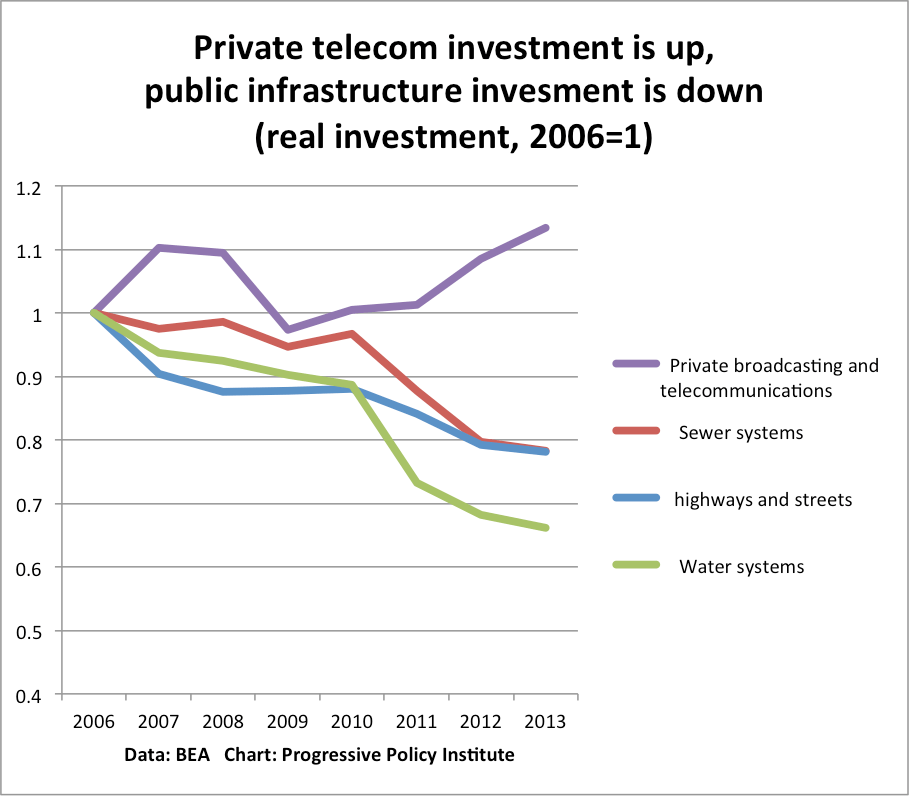
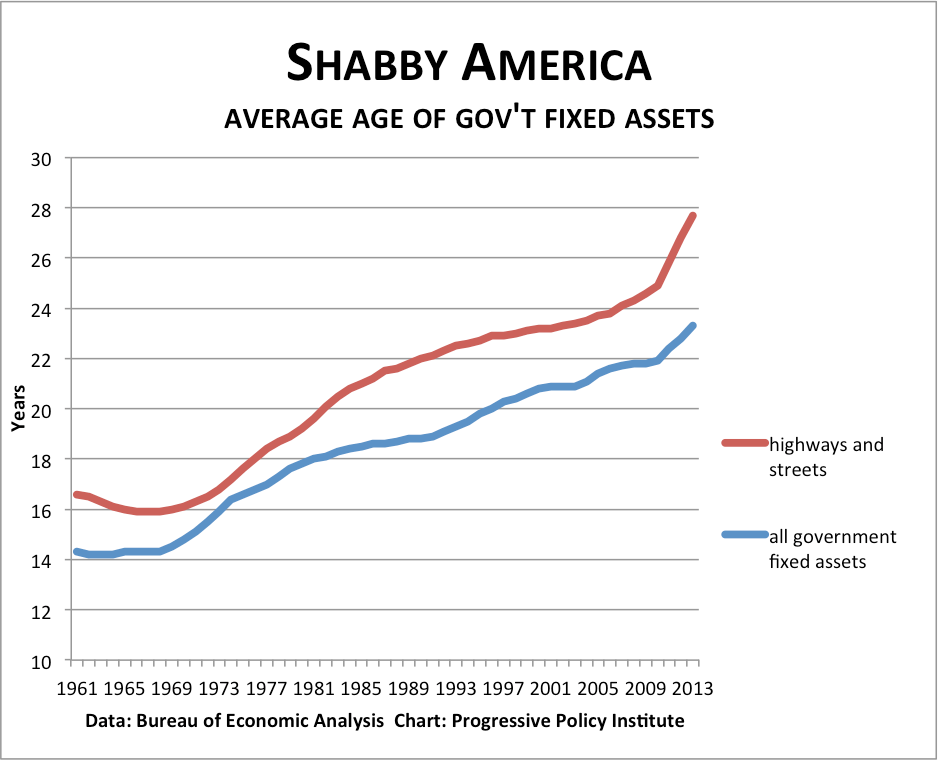
“We applaud the President’s observation that ‘first-class jobs gravitate to first-class infrastructure.’ Studies released after the financial crisis confirm the economic benefits of spending on roads, highways and bridges. The country, states, and localities will gain in multiple ways from an increase in infrastructure spending.

“We appreciate President Obama’s willingness to tackle tax reform to lower rates for businesses that create jobs here at home. However we note that there are a variety of ways to accomplish this goal, some better than others.

“Finally, President Obama is right to make increasing college access and affordability a top legislative priority. Record levels of student debt at a time of historically low real earnings and high underemployment threaten to saddle an entire generation. It is clear the current structure of postsecondary education is no longer working.

“America needs a high-growth strategy. President Obama’s proposals would take some big steps in that direction.”

– END –

Financial Times: Barack Obama battles a sense of drift on State of the Union goals

Barney Jopson writing for Financial Times quoted Michael Mandel, PPI’s Chief Economic Strategist, this morning.  Jopson’s article reflected on the President Obama’s accomplishments of 2013 in an effort to project the substance of tonight’s State of the Union address. The article discusses the President’s successes and failures at passing legislation since his last address, Mandel comments that:

Michael Mandel, chief economic strategist at the centrist Progressive Policy Institute, says the president should get credit for the result regardless of how it was achieved.

Read the entire Financial Times article here.

How Young People are Being Left Out of the Economic Recovery

The latest unemployment figures seem promising for the young, but peeling back the numbers reveals that those without college degrees are being left out of the job market.
From the looks of it, young Americans are finally on their way to economic recovery. The latest jobs figures show unemployment for young Americans—those age 16-34—fell to 10.5 percent in December, down from a high of 15.1 percent in November 2009 and by a full 2 percent since last summer.A closer look, however, reveals not all young Americans are sharing equally in the labor market recovery. In fact, some young Americans are hardly experiencing a recovery at all. And many that are seeing a rebound in their economic fortunes still have a long way to go.Happily it doesn’t have to be all doom and gloom. There are ways policymakers can help struggling young Americans reclaim their future, starting with making their plight a bigger priority in 2014.As it has been for years, young Americans with a college degree are much better off than those without one. The stark contrast is evident when looking at labor force participation rates, which is the share of the population that is counted as employed or unemployed. For young Americans with a post-secondary degree, labor force participation rates have been stable since 2010, but for those with some college or only a high school diploma, rates continue to fall. For young Americans without a college degree, it appears unemployment is falling at the expense of labor force participation.Still, as young college graduates are all too aware, a four-year college degree is no longer a guaranteed ticket to financial success.  It turns out that those with a college degree are finding jobs, but increasingly ones that are lower-skill. The result is a rise in underemployment and historically low real earnings. In 2012, young Americans age 18-34 working full-time with a bachelor’s degree earned about $54,300, in real terms. This is only slightly higher than the 16-year record low set in 2011, and in annual terms remains $3,300 below where it was pre-crisis in 2007.

Adding insult to injury is the rising student debt burden, about 90 percent of which comes from a decades old federal aid system that needs reform. Under the current system, college students are essentially stuck in the middle of a game of chicken between generous federal aid and rising college tuition. For example, the “historically low” increase in college tuition last year was still three times the average increase in real earnings for young college graduates in 2012. With average debt levels now at a staggering $29,400 per borrower, many young Americans and their parents are understandably rethinking the value of a college education.

As tough as young college graduates have it, this is still far better than the reality of young Americans without a degree. New PPI research finds that the unemployment rate for young Americans age 16-34 with only a high school diploma, though falling, remains over 14 percent, compared to 5 percent for young college graduates. Worse, real average annual earnings for young Americans with only a college degree were just $32,900 in 2012, still about 4 percent lower than real earnings in 2007.

Fortunately, opportunities exist for policymakers to help. With a concerted effort, we can design policies that directly target young Americans in and out of school and encourage better alignment of the skills of young Americans have with the needs of employers. This may include comprehensive education reform, redefining post-secondary education and training, addressing the rising cost of college and student debt, and promoting investment and asset building activities.

For example, over the next year, the Higher Education Act (HEA) is coming up for reauthorization. HEA could provide policymakers with an opportunity to reaffirm the value of college, by using the administration of federal student aid to encourage alternative forms of higher education.  Going to a four-year college is so ingrained in society it seems to be the only acceptable option after high school; there is now almost one four-year college for every U.S. county. As a result, poor performing colleges get a free pass that doesn’t do anyone any favors—especially their graduates.

The first step to helping young Americans in 2014 is to convince policymakers to take their economic struggles seriously. If policymakers use the start of a new year as a new start for young Americans, 2014 could be a better year for all 80 million young Americans. Moreover, it could lay the groundwork for economic growth and prosperity in America for years to come.

 This piece was originally published by The Daily Beast, you can read it on their website here.

Can Tech Help Inner City Poverty?

Tech/information companies these days flock to high-density urban areas such as New York and San Francisco. Fewer and fewer entrepreneurs want to put their startup out somewhere in a suburban office park.  Instead, they place their new firm in places which are attractive to young tech workers.

As a result, the tech/information boom is generating jobs in downtown areas that are more accessible to inner city workers, who are typically less likely to have cars. What’s more, there’s a social element: If tech/information companies are located in dense downtown areas, they are more likely to want to help local schools.

The question is: Who is going to get those jobs? As has been repeatedly reported,  tech has a major diversity problem, especially in the startup community (see, for example, this recent article).  Organizations such as All Star Code, Black Girls Code,  and CoderDojo NYC are helping connect inner city youth with tech opportunities, but it’s a slow process.

However, despite the diversity problems, there are reasons for optimism in the broader tech/information industry, going beyond startups. In fact, we’ve just gotten a round of new data from 2013 which shows how tech growth is helping black and Hispanics. This new data enables us to update previous results that we reported.  Take a look at the chart below.


From 2009 to 2013, employment of blacks and African-Americans in computer and mathematical occupations grew by 41%,  compared to 7.5% growth for black workers in all occupations. Over the same period, the employment of Hispanics in computer and mathematical occupations rose by 33%, compared to 15% for Hispanic workers in all occupations.

What kind of tech jobs are we talking about? The data doesn’t give a clear picture, although it looks like blacks and Hispanics are getting a wide range of tech jobs, from software developers to customer support. But here’s a couple of charts that give more insight.

This chart shows that  black workers are getting a rising share of  computer and mathematical jobs, while their share of  in managerial and professional occupations, a much broader classification.  That suggest that educated black workers are shifting over to tech.

The situation is somewhat different for Hispanic workers, who have gained ground both in tech jobs and in the broader managerial/professional occupations at roughly the same rate.  In this case the rise in the Hispanic share of tech jobs is part of a broader set of gains in high-skill jobs.

Encouraging Investment in America

In an ideal world, Congress would take up tax reform comprehensively, as part of a high-growth strategy. In fact, PPI is currently working on a tax framework for progressives, for how to modernize the entire tax system for individuals and corporations.

Unfortunately, the reality is that wholesale reform is not currently a politically viable option. Therefore, we must consider discrete pieces of tax legislation, with the idea that as long as we are promoting innovation and growth, small measures are better than nothing. One such tax measure currently up for Congressional debate is an extension of the so-called “bonus depreciation” deduction, first enacted in 2008. The intention of the deduction is to encourage U.S. companies to invest domestically, by allowing them to deduct 50 percent of their capital expenditure costs upfront instead of over time. In other words, it makes it more financially attractive for U.S. companies to invest in America – be it to increase factory production, purchase new transportation equipment, or deploy broadband networks.

PPI has done extensive research on the importance of encouraging domestic investment as part of a high-growth strategy. Our annual “U.S. Investment Heroes: Companies Betting on America’s Future” report highlights the top 25 U.S. companies investing in America’s productive capacity, through their domestic investment in plants, properties, and equipment. In our 2013 report, we found that “several companies on our list highlighted this measure [bonus depreciation deduction] in their discussion of 2012 capital investments” as a key reason for their strong U.S. investment.

Investment is the building block for job creation and gains in wages and standard of living. That means we must do everything we can to promote economic growth through investment, including the extension of the bonus depreciation deduction.

The Fiscal Times: College Grads Are Elbowing Aside Less Educated for Jobs

Eric Painin, writing for The Fiscal Times, featured recent work by Diana Carew, an economist for PPI, on recent graduates and their struggle to find employment. Painin used Carew’s recent report Jobs and Wages for Young Americans: Is Recovery Coming? to draw attention to the “Great Squeeze” in employment for Young Americans, writing:

“Since 2009, many of the occupations with the fastest employment gains for young people have been lower-skill jobs that typically pay less, according to a new report by economist Diana G. Carew of the Progressive Policy Institute.

Production, health care support and food preparation and serving occupations were the three main occupational groups to see gains for young Americans across all levels of educational attainment. The downside is that all three groups have mean hourly earnings significantly lower than the national average for all occupations.

Notably, young college graduates saw a 15 percent increase in office and administrative employment while more generally employment in this group declined, the report stated. “This is consistent with the argument that young college graduates are struggling with high underemployment,” Carew wrote – and in the process are squeezing their less educated rivals aside.”

Find the full article on The Fiscal Times‘ website here.

Young Americans: Is Recovery Coming?

Young Americans – the 80 million Americans age 16-34 – have had a rough recession and an almost non-existent recovery. This is reinforced by the latest jobs report, which shows unemployment falling at the expense of labor force participation, now a historically low 70.9 percent. For young Americans age 16-24, labor force participation is just 54.8 percent. Looking ahead, is recovery ever coming?

Four telling facts about jobs and wages for young Americans suggest a labor market recovery is coming, although it will be gradual and uneven by educational attainment. Specifically, young Americans with a postsecondary degree are more likely to be employed, but the nature of their employment suggests they are taking lower-skill jobs at the expense of their less educated peers. These facts also suggest there is more that policymakers could be doing to boost young Americans’ long-term economic and financial well-being.

Read the full brief, including three charts and a table on young Americans in the recovery, here.

Providence Journal: How the U.S. government helped give us the Internet

The Internet has become so integral to our everyday lives that it is easy to forget how young it is. Mosaic, the first graphical web browser, came out in 1993. Since then, the Internet’s phenomenal growth has transformed the way billions of people around the world communicate, learn, work, trade, campaign, mate, protest, plot and form communities.

All this seems inevitable in retrospect, but it wasn’t. In the 1990s, U.S. policymakers faced critical choices about who should build the Internet, how it should be governed, and to what extent it should be regulated and taxed. For the most part, they chose wisely to open a regulated telecommunications market to competition, stimulate private investment in broadband and digital technologies, and democratize access to the Internet.

The story of how scientists, engineers, entrepreneurs and venture capitalists created the technical basis for the digital revolution is familiar. Much less is said about the visionary policymakers who created the legal and regulatory framework that enabled the Internet’s exponential growth.

Controversial at the time, their decisions drew fire from both sides of the aisle. Conservatives complained that Washington’s efforts to expand access to the Internet constituted — you guessed it — a “war on the Web.” Liberals demanded a more aggressive regulatory stance to prevent predatory companies from dominating the digital economy. Also stoking fears of monopolies and demanding regulation were incumbent businesses threatened by new technologies and start-ups.

In steering a pragmatic course between ideological poles, the “digital policy pioneers” showed not only foresight, but a quality even rarer in Washington: humility. Instead of trying to direct the Internet’s evolution, they relied on competition to set prices and they let consumers decide which devices, technologies and services would thrive in the digital marketplace.

Key digital policy milestones include the Clinton administration’s 1993 blueprint for building an “information superhighway,” the landmark 1996 Telecommunications Act, and the 1998 framework for global e-commerce developed by White House adviser Ira Magaziner.

The most important pioneers, however, were President Clinton and Vice President Al Gore. They recognized before most that the new digital technologies were creating something fundamentally different, not just a high-tech version of the old telephone system.

As “Clinton’s idea mill,” PPI played a strong supporting role. During the 1990s, we launched a New Economy Task Force. The Task Force brought together high tech entrepreneurs from Silicon Valley and elsewhere with leading members of Congress to hammer out new “Rules of the Road” for nurturing the nascent digital economy.

The policies that took root in the ’90s were refined and strengthened during the Bush and Obama administrations. Digital policy, in fact, remains a rare, bipartisan exception to the zero-sum logic of polarization that has paralyzed our national government.

Our current leaders must work hard to maintain that consensus. After all, the vibrant innovation ecosystem that has grown up around the Internet is a prime catalyst for jobs and economic growth. According to research by Michael Mandel, PPI’s chief economic strategist, demand for apps has led to 750,000 new jobs since the iPhone was introduced in 2007.

The broadband Internet also is a powerful magnet for private investment. In 2013, telecom and tech companies topped PPI’s ranking of the top 25 companies that invested the most in the U.S. economy. And America is moving at warp speed toward the “Internet of Everything,” which promises to spread the productivity-raising potential of digital technology across the entire economy.

Nor are the Internet’s benefits exclusively economic. Ev Erhlich, in a report for PPI outlining a “Progressive Broadband Agenda,” stresses ways the Internet can help to reinvent “social” sectors like education, health care, as well as the delivery of government services.

In short, U.S. policymakers need to continue to get digital policy right, because our country’s prosperity and social progress depend upon it. That’s especially true now, as the open and decentralized Internet faces a new array of challenges. These include the backlash to the National Security Agency revelations; Europe’s determination to impose strict “data protection” rules that could deter transatlantic data trade; nationalist demands for “data localization,” which would impede cross-border data flows; the Internet’s use by criminals and terrorists for sinister purposes; and, a growing push by authoritarian countries, especially Russia and China, to subject the Internet to international regulation.

As we look back over the last two decades, it’s clear that the free and open Internet isn’t just a technological marvel. It’s also a major political achievement — and one that looks all the more impressive when juxtaposed to the partisan paralysis that afflicts Washington now. And it’s an achievement that needs defending today.


This piece was originally published by the Providence Journal, you can read it on their website here.

PPI Economic Experts Weigh In On ‘Net Neutrality’ Court Decision

WASHINGTON, D.C. — Progressive Policy Institute senior fellows Hal J. Singer and Ev Ehrlich today released the following statements after a U.S. Court of Appeals struck down rules by the Federal Communications Commission (FCC) prohibiting Internet service providers from restricting user access to legal Web content:

Hal J. Singer is a senior fellow at PPI:

In its decision to vacate the anti-discrimination and anti-blocking rules of the Open Internet Order, the D.C. Circuit correctly recognized that the FCC used a heavy-handed, ‘common carrier’ approach to regulating Internet access providers in their dealings with websites—despite the Commission’s classification of Internet access providers in a manner that exempts them from treatment as common carriers.

“By effectively proscribing pay-for-priority deals and thereby compelling Internet service providers to provide enhanced services to websites at no cost, the FCC veered backwards into a 20th century, common-carrier approach to regulating a 21st century service.

“The Court appears to have left open alternative regulatory approaches that would permit ‘individualized bargaining’ between Internet access providers and websites while protecting against discrimination in favor of affiliated or preferred websites, including case-by-case adjudication of disputes if and when they arise.

“Hopefully the Commission can now focus its attention on designing such rules in a way that is more consistent with its proper, light-handed approach to all things Internet.”

Ev Ehrlich is a senior fellow at the Progressive Policy Institute and president of ESC Company, a Washington, DC based economics consulting firm:

Today’s Court decision is not a clear-cut victory for any one side in the Internet policy debate, but it is a victory for that debate.

“On one hand, Verizon, which sued the FCC, challenging their authority to regulate them, got what they wanted. The Court agreed that the 1996 Telecommunications Act protects them from being regulated as a common carrier, meaning that the FCC can’t tell them how to manage their networks. That’s a big win—the decision essentially means that if the FCC lacks the authority to mandate specific network practices such as ‘net neutrality.’

“But on the other hand, the Court agreed that the FCC, under its mandate to promote and extend the Internet (which is found in the same 1996 law), can do just about anything that the law doesn’t explicitly prohibit. So the broad authority the Court found in the FCC’s mandate may limit the FCC from taking a few specific actions (like imposing net neutrality), but doesn’t take away their seat at the table.

“What happens next?  Presuming this decision stands, one possibility is that the FCC decides to wade into the crux of the matter and classify the broadband Internet as really just another ‘telecommunications service.’ That is, the 1996 law divided communications into a heavily-regulated ‘telecommunications’ component based on the legacy phone system, and an essentially unregulated ‘information services’ component, within which the Internet burgeoned.  The FCC, urged on by neutrality advocates, could announce that the Internet was really ‘just another phone service’ and impose new regulations on it. But this risks being laughed out of court using the Frank Zappa test, as enunciated in his classic You Are What You Is—a cow don’t make ham.

“There are plenty of real issues surrounding the Internet—such as extending it to the unserved, protecting our privacy, and using it to improve our schools, health care system, local governments.  If the Court gets us past a sterile, theoretical argument over ‘neutrality’ and on to this more pressing agenda, it will have turned out to be a very positive one, and a victory for the debate itself.

– END –

Innovation from 9 to 5: China’s Economic Test

China is investing more in R&D than the European Union, according to soon-to-be-released data from the Organization for Economic Cooperation and Development (OECD).  This milestone reflects a multi-pronged effort by Chinese policy makers to spur economic innovation. Other measures include incentives to lure foreign educated Chinese back home,  patent targets and subsidies, and a strong emphasis on market driven change and innovation across sectors in the recent national memo from President Xi.

The Chinese strategy of focusing resources on modernization has paid big dividends for the national economy and Chinese workers since Deng Xiaoping opened China to Nixon and the world in the 1970s. First heavy than light industry flourished under focused, deliberate state nourishment, leading China to its present status as the world’s second-largest economy. But this model of state-directed development faces new challenges as the standard of living rises and factories face competition from other countries with even cheaper labor, such as Vietnam and Bangladesh. Now that Chinese workers face threats to their job security, the government is asking: How can we innovate our way up the economic value chain?

The Chinese Communist Party has long justified its political monopoly by acting as the benign steward of transformative economic growth. But as growth rates flag, the difficulty of moving toward higher-valued added activities has presented the Chinese version of “it’s the economy stupid.” Unfortunately for President Xi Jinping, the party’s authoritarian ways are antithetical to the type of culture that has traditionally led to the entrepreneurial innovation the party seeks to develop.

Innovation is inherently disruptive. But the business environment, the legal environment, and societal pressures in China combine to foster businesses and businessmen who curry favor with officialdom and make few waves. Chinese schools feature rote memorization of the “correct” answers to any and all questions, stifling any instinct a student may have to think outside the box. Recently, the government officially endorsed a rehashing of ancient Confucian thought emphasizing obedience and deference to authority. Professors who ask China to follow its own constitution and develop rule of law get sacked.  Beijing would like to believe that it can suppress freedom of speech and thought, forego a genuine rule of law, and maintain strict political control, all while building a dynamic, modern economy. It has done an impressive job of organizing the economy around the imperative of “copy to catch up.” But it’s a lot harder to force people to be creative by decree.

After decades of following Western models of economic development, Chinese politicians now denounce the predetermined path in favor of forging a new “Chinese way” of combining free markets with controlled government. Ideally, China would develop an economy driven by a flexible, creative, innovative work force without transitioning to the classically liberal social and governmental structure traditionally necessary to cultivate that kind of human capital. The writing on the wall reads: “Be creative and daring! Only at work, never in any other capacity.”  China’s attempt to quarantine innovation underpins the success or failure of their targeted economic transformation and with it the fortunes of the CCP. It is dangerous to join the chorus of voices heralding China’s downfall since 1949, but this contradiction looks like a giant roadblock on the path forward.

NY Times: New York, the Silicon City

For all the talk of New York’s “tale of two cities” economic divide, last week Mayor Bill de Blasio took charge of a local economy that has far outperformed the rest of the country since the financial collapse — and not just in a small corner of Manhattan, but across the city. Driven by the expansion of the technology and information sector, New York City today has more private-sector jobs than during the 2007-8 peak of the finance-driven boom years.

New York has, over the last decade, become a tech city to rival San Francisco, Boston and Seattle. And it has done so by moving away from its old reliance on the finance and legal sectors, and the industries like hospitality that rely on them. The challenge for Mr. de Blasio is continuing that trend, and making sure all New Yorkers benefit from it.

Mr. de Blasio’s predecessor, Michael R. Bloomberg, can justifiably boast about New York’s rise to prominence as a “digital city.” On his watch, the technology and information sector has become the city’s second-most-powerful economic engine, after financial services. New York now has 10 percent of the country’s jobs in the “Internet publishing and web search portal” industry, up from just over 6 percent in 2007.

Surprisingly, over the past couple of years, the city’s minority populations have been among the main beneficiaries of this boom. Since 2010, the number of blacks working in computer and mathematical occupations — the Census Bureau’s term for tech-related jobs — in the city has risen by 19.7 percent, based on a preliminary analysis of new census data.

Continue reading at the New York Times.


Why Tech Growth Enables Progressive Goals

In my New York Times op-ed, “New York, the Silicon City,” published today, I show how the growth of the tech/information sector has been a force for creating opportunity in New York City, not inequality. Moreover, the laudable progressive goals of New York’s new mayor, Bill de Blasio, are best achieved by embracing tech, rather than running away from it. In New York City, the tech/information boom has diversified the local economy and enabled the city to outperform the rest of the country despite the financial bust being centered in Wall Street. Moreover, the tech boom has benefited minorities, and been far better for the outer boroughs than the finance/real estate boom which preceded it.

There’s a more general principle at work here: Tech growth should be seen as enabling progressive goals, rather than fighting them. Innovation shakes up the existing order, creating opportunities for those who would otherwise be closed out.  Nationally we’ve seen a tremendous increase in recent years in the number of minorities getting degrees in computer and information sciences. For example, The number of bachelor’s degrees in computer and information sciences granted to Hispanic and Latino students rose by 44% over the past three years. (see this post).  The growth of the tech sector is a path to a new middle class.

Final note: If anything, we have too little innovation, not too much.

Will GOP Stiff Jobless?

STATEMENT BY WILL MARSHALL:

Today, Will Marshall, President of the Progressive Policy Institute, issued the following statement on legislation proposed in the Senate to extend unemployment insurance benefits:

“The Senate is set to vote this evening on extending unemployment insurance for 1.3 million Americans whose benefits expired at the end of 2013. With the jobless rate still at seven percent following the weakest “recovery” in post-war history, this should be a no-brainer. In days past, legislation to help jobless families keep food on the table and roofs over their heads during economic emergencies has garnered broad, bipartisan support.

“Not only is it morally right to lend a helping hand to people out of work through no fault of their own, it’s good economics, since the unemployed are likely to put every dollar of their benefits right back into the economy. Nonetheless, Senate Republicans are balking on the grounds that Democrats aren’t proposing offsetting budget cuts to pay for the $6.5 billion extension.

“Their commitment to fiscal discipline is selective and phony, since it seems to apply mainly to spending on the poor, vulnerable and jobless, not to taxes on the affluent. But maybe that’s slightly less offensive than Sen. Rand Paul’s insulting warnings against encouraging dependency on government. Either way, the vote is shaping up as a test of the Republican Party’s basic decency, and the early returns don’t look good.”

Will 2014 Be the “Year of Tech Opportunity” for Minorities?

Today’s tech/information boom is creating new opportunities for minorities in the U.S.. Since 2009, the number of blacks working in computer and mathematical occupations has risen by 37%, and the number of Hispanic/Latino workers in computer and mathematical occupations has risen by 35%. By comparison, the total number of workers in computer and mathematical occupations have only risen by 14% over the same period.

The tech/information boom is following in the same path as the tech-driven New Economy boom of the 1990s, which was the best period for black and Hispanic/Latino workers in recent memory.  The 1990s New Economy boom  cut the unemployment rate for blacks nearly in half.   Meanwhile the employment-population ratio for Hispanics and Latinos climbed to an astounding 66% during the New Economy boom.

Why are minorities seeing gains in the  tech/information sector today? First, the sector needs workers. According to data from The Conference Board, the number of want ads for computer and mathematical occupations are up 60-70% since 2009.  Tech/information firms are complaining that they can’t get the people that they need.
 

Second, education matters. The number of bachelor’s degrees in computer and information sciences granted to Hispanic and Latino students rose by 44% over the past three years, even while associate degrees in computer and information sciences granted to Hispanic and Latino students rose by 49% over the same period.  Computer and information sciences degrees granted to black students rose by 25% (bachelors) and 34% (associates) over the past three years as well.

*
 
These trends show no sign of slowing down. This suggests that the tech/information boom will continue to open doors in 2014.

 
*These figures for the growth of computer and information sciences degrees for blacks are likely to be somewhat understated because the 2011-2012 data includes a category for two or more races that the 2008-2009 data does not have.


Washington Monthly: What If the US Had a Multiparty System Like Germany’s?

With the U.S. still barely recovered from to al partisan gridlock and political dysfunction, Germany has once again formed a “grand coalition” bringing together the two main center-right and center-left parties, which collectively won more than 70% of the vote in last September’s parliamentary elections. The biggest sticking point? Figuring out the best mechanism for determining the country’s minimum wage.

How do the Germans manage to produce such cooperation and consensus in a system of five parties – and what might politics look like if the U.S. had such a multiparty system? Part of the answer in Germany lies in the intricate construction of its electoral process which, for obvious historical reasons, was designed after World War II to decentralize and disperse power.

Members of the lower house of parliament, the Bundestag, are chosen through a process in which each German citizen has two votes. The first vote, as in the U.S., is cast for an individual person to represent a specific electoral district. The second, and ultimately more influential, vote is cast directly for a political party and determines the overall party composition of government.

Such use of a proportional representation system almost guarantees that Germany will have a multiparty system. But in order to avoid chaotic hyper-fragmentation among parties (as found, for instance, in Italy) Germany enforces a threshold of 5% for a party to enter into the Bundestag. Essentially, any party that fails to gain at least 5% of the national vote is excluded from parliament, a provision that has proven useful in promoting centrism and marginalizing extremes, including both neo-fascist parties and the remnants of the old Communist Party in East Germany.

In all, the German system has tended to yield parliaments with about five parties represented — which is also roughly what the U.S. political system might produce under similar rules.

Consider first the Democrats in the U.S., who have long been a loose coalition between classic “blue collar voters” (who have a strong interest in issues like labor rights and the social safety net) and socially liberal voters (who are focused more on themes of multiculturalism and diversity). Of late, the two branches have been cooperating well. But the old fault lines can still turn up, such as in the debate over immigration, in which one wing is mostly concern about domestic wage competition and the other side places more emphasis on the civil rights of minorities. It’s not hard to imagine the blue-collar Democrats and the socially liberal Democrats forming separate parties under a proportional representation approach.

The Republicans, it’s now evident, are much more fragmented, consisting of a rump of “Establishment Republicans,” a Tea Party cohort maniacally focused on reducing the size of government, and a religious right that prioritizes “traditional values.” Clearly these groups do overlap, as perhaps best illustrated by the fondness of Michele Bachmann both for overturning Obamacare and for heralding the arrival of the Rapture. In a multiparty system, these various branches wings would likely sort into three separate parties – thus totaling five parties across the political spectrum, as is usually the case in Germany.

This year in Germany, the 5% threshold led to this exclusion of the small, free-market oriented Free Democratic Party, which has served as the junior partner since 2009 in the government led by Angela Merkel’s Christian Democratic Union. This forced Merkel to turn to the Social Democrats to reach a governing majority.

Naturally, each major party would prefer to have unilateral control over government, but the decision to form a broad governing coalition between the German center-right and the center-left is hardly unprecedented: the same situation prevailed from 2005 to 2009, a period during which Germany weathered the global economic downturn far better than most countries. Just as the American two-party system has led to sharp polarization, the German multiparty system has pushed them towards greater accommodation.

“Grand coalition” governments are not panaceas. Most notably, they often suffer from an inability to offer more than incremental changes and a tendency to fracture under stress. In the longer run it’s also problematic not to have the government in power checked by forceful opposition from a major party outside government.

Still, such arrangements promote broad consensus and enhance the stability of a political system , given that the governing coalition incorporates parties supported by 7 in 10 voters. The last time the U.S. had anything remotely like such a grand coalition was in the period after 9/11 when leaders from both parties coalesced around President George W. Bush and Democrats made little attempt to use their one-vote Senate majority to obstructionist ends.

The 11th-hour vote on October 18 to reopen the U.S. federal government and avert a catastrophic debt default also offered the faint outline of a centrist governing coalition: the measure passed the Senate by 81-18 and the House by 285-144, with the support of leaders of both parties in both houses and of president. The more recent Ryan-Murray budget deal also offers prospects of reasonable compromise. This makes it all the more intriguing to imagine what American government could accomplish with the four years of the sort of sensible, centrist politics and policy making that seems likely to prevail in Germany thanks (at least in part) to its multiparty system.

This piece was originally published by Washington Monthly, you can read it on their website here.

Forbes: Calling America’s New Digital Pioneers

On Forbes today, prominent technology journalist Larry Downes calls for a new generation of “digital policy pioneers” to accelerate the transition from old telephone networks to the all-IP world of voice and data communication. Last month, Downes moderated a unique PPI forum that honored some of the nation’s original “digital policy pioneers” – policymakers whose decisions propelled the Internet’s explosive growth from its infancy in the early Clinton years to a World Wide Web with three billion users worldwide.

Featuring Ira Magaziner, William Kennard, Larry Irving, Michael Powell and Karen Kornbluh, that event highlighted bipartisan efforts to create an enabling legal and regulatory framework for digital innovation. Downes urged the FCC to embrace the same approach to “light touch regulation” as it tackles the unfinished business of retiring legacy telephone infrastructure and moving voice services onto IP networks.  Downes writes:

Today in Washington, there’s a new generation of digital policy pioneers. Let’s hope they can rise to the new challenges of the IP revolution. And heed the wisdom of the first generation who, thankfully, are still providing guidance and leadership.

Find the full article on the Forbes website here.