Wingnut Watch: The GOP’s ‘Movement Conservative’ Conquest Achieved

Last week was a pretty good week for hard-core conservative ideologues in terms of their domination of the Republican Party. In the Fox News/Washington Examiner presidential candidates’ debate on Thursday night, every single would-be president on the stage—even Jon Huntsman—rejected a hypothetical deficit reduction deal involving a 10-1 ratio of spending cuts to tax increases. At the same event, an extended exchange in which Tim Pawlenty went after Michele Bachmann for being a windy bomb-thrower who had never actually been able to accomplish anything in public life went pretty well for the windy bomb-thrower. Meanwhile, the discussion of cultural issues featured differences of opinion that ranged from hard-core opposition to same-sex marriage (with the exception of the pariah Huntsman) and abortion to hard-core opposition to same-sex marriage and abortion enshrined in the U.S. Constitution.

At the Iowa GOP Straw Poll on Saturday, over half the votes were cast for two candidates generally considered to be minor fringe characters in the House Republican Caucus until quite recently, Michele Bachmann and Ron Paul. Tim Pawlenty, who began his national political career calling for a Republican Party that would be amenable to the views and practical needs of Sam’s Club shoppers, ended his audition for Electable Conservative Alternative to Mitt Romney with an ignominious third-place finish. Given his world-class organization in Iowa, T-Paw’s poor showing in this test of organizing strength indicated his failure to make the sale to serious conservatives, and he dropped out of the race the very next morning. Other than Bachmann and Paul, the candidate with the most to boast about on Saturday was Rick Santorum, who managed to get past Herman Cain to finish fourth and keep alive a campaign focused almost entirely on representing the most extreme right-wing cultural views (Santorum’s big moment in the Thursday debate was probably his passionate defense of a ban on abortions where the woman in question had been raped).

Bachmann’s narrow win over Paul in the Straw Poll was significant in Wingnut World for three reasons. First, it confirmed Paul’s continued marginalization in the GOP because of his highly unorthodox views on foreign policy and defense (in the debate, Paul spent an extraordinary amount of time defending Iran’s pursuit of nuclear weapons, and went all Chomsky in attacking the CIA’s meddling in Iran in the 1950s, not a major concern of conservative Republicans then or now). Second, it lifted Bachmann into the top tier of candidates moving towards the actual delegate-selection contests next year. And third, it confirmed the relevance of wingnut-friendly Iowa in the nominating process; a Paul win would have called that relevance into question.

Meanwhile, down in South Carolina, the long-awaited announcement of Rick Perry’s presidential candidacy further tilted the field to the right. His speech, delivered at the annual gathering of devotees of the fervent take-no-prisoners conservative website RedState.com, was a masterpiece of the rawest ideological red meat. Perhaps the most significant moment was when Perry slipped into a tirade about high taxes a nasty comment about the injustice of low-to-moderate-income Americans owing no federal income taxes while “we” are expected to pay more. The desire to raise taxes on the poor is one of the more ironic preoccupations of Tea Party activists, reflecting the reverse class warfare sentiments made so plain in the foundational “rant” by Rick Santelli that launched their movement back in 2009.

Bachmann and Perry, both major figures in the iconography of both the Tea Party Movement and the Christian Right, now represent two-thirds of the viable Republican presidential field for 2012. Realization of that fact has some of the more Establishment-minded Republicans a bit panicked. The New York Times columnist Ross Douthat looked at the field on Sunday and didn’t like what he saw:

No one doubts Romney’s intelligence or competence, but he has managed to run for president for almost five years without taking a single courageous or even remotely interesting position. The thinking person’s case for Romney, murmured by many of his backers, amounts to this: Vote for Mitt, you know he doesn’t believe a word he says.

But his phoniness would remain a weakness even if he won the presidency. He’s a born compromiser pretending to be a hard-liner, and the hard-liners know it—which means he would enter the Oval Office with conservative knives already sharpened and ready for his back.

Rick Perry has many of the qualities that Romney seems to lack: backbone, core convictions, a killer instinct and a primal understanding of the right-wing electorate. He also has the better story….

What Perry doesn’t have, though, is the kind of moderate facade that Americans look for in their presidents. He’s the conservative id made flesh, with none of the postpartisan/uniter-not-a-divider spirit that successful national politicians usually cultivate.

And Douthat didn’t even address Bachmann’s even more strident stance. He concluded his column with that most thread-bare of Republicans cries for help: a plea to Chris Christie to repudiate months of disavowals of candidacy by jumping into the race. Other elite malcontents are promoting a candidacy by the very epitome of conservative fiscal orthodoxy, Paul Ryan, a more reliable figure than Romney who is also more seemly than Perry.

Aside from these desperate measures to add to the field the big debate in the chattering classes right now about the Republican nominating contest is whether it’s effectively a Romney-Perry contest or if Bachmann can remain viable by winning Iowa. Either way, the pressure will remain on Romney to perpetually prove his conservative bona fides, and the most GOP “moderates” can hope for, as Douthat observes, is that he’s lying through his teeth.

Any doubt that the “movement conservative” conquest of the GOP has now been consummated should pretty much be consigned to the trash bin. The main question now is whether conservatives prefer their presidential candidate to be cool and shifty, or raw and shrill.

Photo credit: DonkeyHotey

Political Memo: The “Centrist Premium”: The High Cost of Moderation

For most of the last 30 years, self-described ideological moderates have comprised a plurality of the American electorate. While the share of moderates has dropped slightly in recent years, 38 percent of voters in 2010 still described themselves as such.

In Congress, on the other hand, moderates are decidedly—and increasingly—a minority. Among Democrats, the moderate New Democrat and Blue Dog Coalitions suffered heavy losses among their respective memberships in 2010 and are now outnumbered by their liberal counterparts in the Progressive Caucus. Among Republicans, moderate members are an even rarer species. In fact, there are only 33 members of the moderate Republican Main Street Partnership who are not also part of the 177-member conservative Republican Study Committee.

Analysts have offered up structural explanations—such as gerrymandering and the current political primary system—for why there aren’t more moderates in elected office to reflect America’s true ideological complexion. This paper looks at another structural disadvantage that moderate candidates and incumbents face: campaign finance.

For better or for worse, financing plays a major role in a candidate’s viability and success. Financing buys the ads and ability to raise a candidate’s profile, counter the opposition and turn out the vote. A hefty campaign war chest can be enough in itself to discourage potential rivals. According to the Federal Election Commission, House Congressional races cost a grand total of nearly $1.1 billion in 2010—or $2.5 million per seat. Moreover, elections are becoming increasingly expensive. The spending in 2010 was nearly double the $563 million spent just a decade ago in 2000.

Read the entire memo.

Policy Brief: Labor and the Producer Society

Our country is struggling to find a way out of overlapping economic crises. One is cyclical: an agonizingly slow, jobless recovery from a recession made worse by a financial crash. The other crisis is structural. Our economy suffers from a dearth of capital investment and innovation, mismatches between workers’ skills and available jobs, and unsustainable budget and trade deficits.

Even before the recession struck late in 2007, the Great American job machine was sputtering. According to a recent report by the McKinsey Global Institute, “Between 2000 and 2007, the United States posted a weaker record of job creation than during any decade since the Great Depression.” Not only are good jobs vanishing, wages have been falling for all but the top U.S. earners.

One explanation for America’s ebbing dynamism is a long pause in innovation. Since 2000, technological advances have stalled, outside of the dynamic communications industry. In particular, tighter regulation—for good or for bad—appears to be slowing innovation in the healthcare sector.

Research from the Kauffman Foundation also points to a loss of entrepreneurial verve. The number of business start ups, which Kauffman says generate most of U.S. net job growth, has plummeted by about a quarter since 2006.

If there’s a bright spot in the U.S. economy, it’s the recovery of corporate profits and stock prices since 2009. Yet these developments also highlight a stark inequity: Returns on capital are up, but returns on labor are down.

The U.S. economy seems to have arrived at an inflection point. As the Obama administration puzzles over how to rekindle growth, one thing should be clear: There can be no going back to the old economic model of debt-fueled consumption, where U.S. households borrowed to maintain their living standards, aided and abetted by government deficits.

Read the entire policy brief.

Did the Debt Deal Open the Door to a Third Party?

Most political reporters have chalked up the debt ceiling deal as a “W” for House Republicans and a humiliating loss for President Obama. But when we consult actual voters, the political scorecard looks quite different.

Americans, says veteran pollster Stan Greenberg, aren’t just irritated by the games politicians play, they are “explosively angry” at Washington. There’s no love lost for either party, but Congressional Republicans now actually rank lowest in public esteem. The only “winners” in the debt limit fiasco were potential third party candidates.

According to Greenberg’s latest Democracy Corps survey, a majority of Americans (53 percent) say they would consider voting for a third party candidate. That could just be a momentary measure of public disgust, but it also points to the first serious opening for a challenge to the two-party duopoly since Obama took office. And when you break down the numbers by party affiliation, or lack of it, things start to get interesting.

By a whopping, 45-point margin (70-25) independents are the most receptive to a third party candidate. These voters swung decisively toward Obama in 2008, cementing his majority, but they are utterly up for grabs in 2012.

Democrats, on the other hand, are the most solid in their partisan commitment. By 57-39 percent, they reject the idea of a third party challenge. The big surprise is how open Republicans seem to be to bolting from their party’s ticket. A substantial majority (58-38) say they are willing to consider a third party alternative, with 38 percent “strongly” willing.

It’s hard to know exactly what to make of this. Maybe these numbers register tepid enthusiasm for GOP front runner Mitt Romney (the poll was taken before Michele Bachmann won Iowa’s straw poll and Rick Perry threw his Stetson in the ring). It’s possible GOP voters just don’t see the candidate yet who can unhorse Barack Obama. But since there aren’t many GOP moderates left, there’s another, more chilling possibility: Maybe the current crop of GOP hopefuls aren’t conservative enough for a sizeable chunk of the Republican base.

In any case, what Greenberg describes as the “unsettled” nature of Republicans’ partisan attachment could be good news for Obama and the Democrats. It could portend renegade candidacies that splinter conservatives; it’s not difficult, for example, to imagine Ron Paul running on a libertarian line if he doesn’t win the GOP nomination.

On the other hand, the public’s increasingly sour mood toward politics as usual has thrown the spotlight on a new political venture called Americans Elect. It’s a non-profit (full disclosure: I’ve volunteered to help) that is organizing a virtual or online nominating convention next June. The basic idea is to use the internet and social media to bypass the duopoly and give voters who don’t feel at home in either party a way to directly chose their own presidential ticket and platform.

Americans Elect isn’t a third party but is offering what it describes as a “second process” for choosing the next president. And it’s working to ensure that whoever wins the internet-based convention will be guaranteed ballot access in all 50 states.

I’ll have more to say about this intriguing experiment in empowering voters later. For now, it’s enough to say that the debt debacle has whetted Americans’ appetite for something completely different in national politics – and political entrepreneurs are responding.

The Consumption Economy Is Dying-Let it Die

With the stock market plunging, we’ve heard plenty of warnings that a “pullback” in consumer spending could trigger another recession. Let me suggest an alternative. The last thing this economy needs is more debt-fueled consumer spending which mainly creates jobs overseas. Instead, we should be focused on boosting investment in physical, human, and knowledge capital.

Now, who am I to be dissing the American consumer? Don’t I know that consumer spending “accounts for 70% of economic activity,” as many economic reporters have written in recent weeks? (Indeed, if I have to read that number in another story, I might be forced to go all Office Space on a piece of expensive consumer electronics.)

It’s true that consumer spending creates economic activity. But it’s not true that all that economic activity is in the United States. Many of the consumer goods we buy are imported. If you buy a shirt or television, you are stimulating manufacturing jobs in China, or perhaps Mexico. You aren’t doing as much to stimulate jobs at home.

This is true across the economy, but a helpful example is the clothing, or apparel, industry. Since the fourth quarter of 2007, clothing purchases by consumers have increased by about 5% in real terms, according to the latest figures from the Bureau of Economic Analysis. Over roughly the same period, shipments from U.S. apparel factories fell by 31% in real terms, while apparel jobs fell by 26%. The winner: Factories in China and elsewhere making clothes for the U.S. market.

It’s not just clothes, of course. In many stores, it’s getting harder and harder to even find products that say “Made in the U.S.A.” That’s one reason why much of the economic stimulus escaped out the back door in the form of imports.

Now, this doesn’t mean imports are evil. When we buy goods from overseas, we generate some jobs in retail and wholesale. If you buy a shirt for cheaper than it would otherwise be if we made it here, you have more money left over to buy other things, like health care.

But the big problem with consumer spending is that if you buy a product made outside the U.S., it doesn’t encourage domestic investment. And that’s what we really need. In the past, a dollar spent on a shirt would start a virtuous circle, as the clothing factory expanded, adding more workers and buying new sewing machines. That investment in new machines, in turn, would create more business for the sewing machine company, who would then hire more workers who would need new shirts.

Today, the cycle is happening overseas. We have a genuine investment shortfall in the U.S., where both business and government are way below historical norms for spending on equipment, buildings, software, and infrastructure.

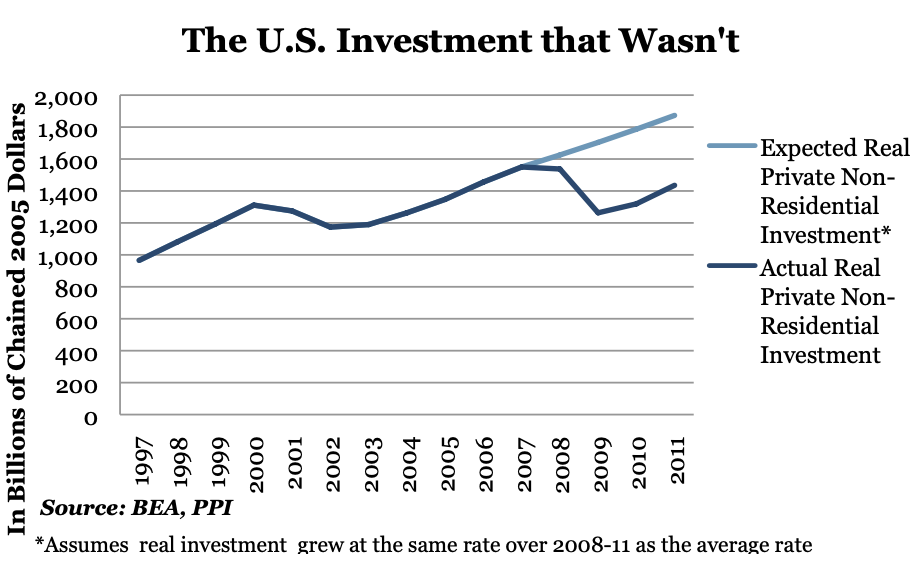
Consider this: Personal consumption in real terms is 11% below its long-term trend, based on the 1997-2007 period. That sounds bad enough. But nondefense government investment is 17% below its long term trend, as state and local governments cut back. And counting all private sector enterprises, nonnresidential investment is a stunning 25% below its long-term trend.

nonresidential investment.png

These figures are devastating for our economic future, both short and long-term. Low investment means fewer jobs and weaker productivity growth. The longer the investment shortfall lasts, the more damage it does. However, we’re not going to close the shortfall by encouraging debt-financed consumer spending. Instead, we need to redirect resources to productive investment.

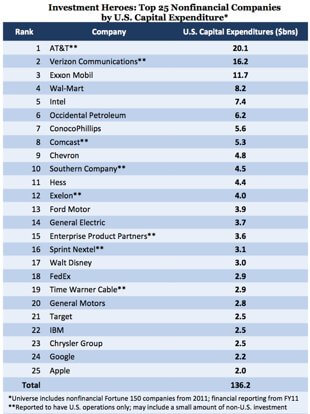
Here’s a couple of examples of what we can do. First, I like to see the Obama administration publicly identify and applaud “investment heroes”: the top companies who are investing domestically in either physical capital or knowledge capital (R&D, design, and other forms of intellectual investment). The bully pulpit of the president can be a wonderful tool, if it directed toward the right cause, and this would send a signal of the importance of investment.

Second, Obama should come out in favor of countercyclical regulatory policy. We should accelerate the regulatory approval process during periods of economic weakness to boost corporate investment, just as countercyclical monetary and fiscal policy have been used to stimulate consumer spending. This is a message that has to be sent from the top to encourage regulators to consider the effects of their action on the economy.
The potential list of policies to boost investment goes on and on, including targeted infrastructure spending, as I described in my previous Atlantic piece, and perhaps a rationalization of the corporate tax code.

But what’s important is that none of these policies is about boosting consumer spending. If we want Americans to prosper, we need consumer spending to become less important to the economy, not more. In the end, we need a production economy, not a consumption economy.

The piece was originally written for the Atlantic.

Photo credit: Grace

Wingnut Watch: Wisconsin Recall Relief and Iowa Showdown

There is joy and relief in Wingnut World today thanks to the narrow failure of Wisconsin Democrats to win enough recall elections to take over the state’s Senate chamber (needing three new seats out of the six being contested, Democrats won two and lost the crucial third by just over 2,000 votes). Though this was a very unusual election in which vast quantities of last-minute conservative money (a total of $8 million was spent in the pivotal district, a bit more than the average state legislative race) probably made the difference, you can expect many jabberers from the Right to call this the final, definitive victory of the people over “labor bosses” determined to keep Scott Walker from giving job-creators the encouragement they need to invest in the state. Next week’s recall elections for two Democratic senators, which are not expected to go well for Republicans, probably won’t get as much national attention. Democrats will then have a tough decision to make about whether to seek a recall of Walker next year. But overall, the main importance of the Wisconsin struggle is that it will likely become a sort of laboratory for what the contending parties—and their ideological allies—will do nationally in 2012.

Aside from Wisconsin, and the continued preparatory skirmishing over the budget timeline set out in the August 1 debt limit, there are two main preoccupations among conservative activists and talkers. One is the war of interpretation over economic developments, including the threat of a double-dip recession, the Standard & Poor’s downgrading of its rating for federal bonds, and the extreme instability of U.S. and global stock markets. So far few, if any, conservatives are bending their general line on the ontological necessity of sharp and immediate federal spending cuts and radical deficit reduction measures in the face of poor economic growth indicators. For example, conservatives have shown no signs of interest in the president’s call for extension of the payroll tax cuts agreed to last December. Presidential candidate Michele Bachmann gets points for audacious consistency in arguing that the bond downgrading, explained by S&P as in no small part attributable to pessimism about future debt limit agreements because of Republican fanaticism on taxes, was actually caused by the debt limit agreement itself.

The second preoccupation in Wingnut World, as in the broader world of political junkies, is with the developments in the Republican presidential race that will unfold over the next few days. In Iowa, a presidential candidate debate on Thursday will immediately be followed by Saturday’s State Republican Party straw poll in Ames. The debate, sponsored by Fox News and the conservative Washington Examiner, will include not only the candidates competing in the Straw Poll, but also Mitt Romney, who is not, and could therefore be the target of zingers from rivals desperately trying to create some turnout-generating buzz in Ames.

In terms of what is likely to happen at the Straw Poll, there is a general consensus that Tim Pawlenty has the best organization but little enthusiasm; Michele Bachmann has the most enthusiasm but a questionable organization; Rick Santorum could well surprise people by doing better than Herman Cain; and Ron Paul, with the right combination of committed supporters and superior organization, could win the whole thing if turnout is not very high. Both Pawlenty and Bachmann really need a win in Ames. But it’s Pawlenty who needs it the most, having focused on Iowa for many months and positioned himself to become the “electable conservative alternative to Mitt Romney” down the road. His limited financial means and terrible poll standings across the country—and the impending entry of another “electable conservative alternative to Mitt Romney,” Rick Perry—could mean curtains if he doesn’t pull off the Straw Poll victory.

Speaking of Perry, he’s apparently going to announce or at least semi-announce his candidacy in South Carolina in the friendly confines of the annual get-together of Erick Erickson’s Red State community. The fact that his speech in Charleston occurs the very same day as the Straw Poll has caused some angst among Iowa Republicans, who view it as an effort to horn in on their media attention. So it’s not surprising Perry is planning to scurry up to Iowa (to Bachmann’s original home town of Waterloo) on Sunday. From Perry’s point of view, a Paul win in Ames, damaging Bachmann and perhaps finishing off T-Paw, and making the entire exercise (which he skipped) otherwise irrelevant, would be ideal. But even before announcing, Perry has managed to vault himself into the top tier of candidates, essentially succeeding in taking over T-Paw’s spot as the putative “unity candidate” between the electability-challenged Bachmann and the ideologically-challenged Romney. That’s quite a feat for a guy who keeps flip-flopping on hot-button social issues; has gotten dangerously cozy with religious extremists; has a habit of startling his fellow-conservatives with stunts like his 2008 championship of Rudy Guiliani; and has never been terribly popular in his own state.

Photo credit: WordShore.

Where Americans Can Cut Back

Dollar billWhere can Americans cut back if the economy slips back into recession again? After all the talk about the “new frugality” and the deepest recession in 75 years, it might seem like households have tightened their belts as much as possible.

Surprisingly, however, the economic figures show several key areas where Americans have actually increased consumption compared to 2006, the year when housing prices peaked. Judge for yourself whether we can cut back more or not. (Note: all consumption changes are measured in inflation-adjusted 2005 dollars, comparing the 2nd quarter of 2011 with the second quarter of 2006)

1. Clothing — Consumption: + 8.9% since 2006

Despite the economic weakness, Americans spent on clothing at an almost $350 billon annual rate in the second quarter of 2011. Nothing seems to stop the waves of inexpensive shirts, dresses, and coats coming from overseas. Clothing imports from China, especially, are up 37 percent since 2006, and Americans are snapping them up. Perhaps we could buy a a few less t-shirts with funny sayings on them?

2. Personal care products — Consumption: +14.4% since 2006

We like to look our best, even in a recession. Perfume, makeup, shampoo, shaving cream and razors, body gels–Americans spend about $100 billion a year on these personal care items. Not only that, we’re spending more on imported cosmetics, which are up 26 percent since 2006. Are all those goos and gels really necessary?

3. Televisions — Consumption: +287.4% since 2006

No, that’s not a misprint. The government adjusts for the size of the television, among other things, and the average size screen has soared since 2006. If we don’t adjust for size and other variables, Americans are spending 12.7% more on televisions today compared to 2006. Total personal consumption outlays on televisions, according to the BEA: About $40 billion, pretty much all imported. Do you really need an even bigger TV?

4. Alcoholic Beverages (off-premises) — Consumption: +10.7% since 2006

Perhaps it’s not surprising that Americans need an extra drink these days. Still, the total home spending on alcoholic beverages is about $110 billion, at annual rates, according to the Bureau of Economic Analysis. A few less glasses might put a few extra dollars in the pocket.

Remember, all these figures apply to Americans in the aggregate. Those people who have been out of work for months or years don’t have room to cut back at all.

And remember–when journalists write that “consumer spending is 70 percent of economic activity,” they are completely wrong. What the U.S. economy needs is more production, not more consumption–and in a globalized economy, the two are not synonymous at all. And that, my friends, will be the subject of tomorrow’s post.

Photo credit: iChaz.

STATEMENT: PPI Warns of Rigid Ideologues on Supercommittee

PRESS CONTACT: Steven Chlapecka – schlapecka@ppionline.org, T: 202.525.3931

WASHINGTON D.C. –PPI issued the following statement on the new congressional “supercommittee”:

“The composition of the congressional supercommittee gives leaders of the Senate and House of Representatives a unique opportunity to forge a bipartisan plan for deficit reduction. PPI encourages both Democratic and Republican congressional leadership to appoint pragmatic members and give them the political flexibility needed to make difficult sacrifices that put our country’s future before partisan interest.

“If the supercommittee is composed of rigid ideologues who staunchly refuse to compromise on increased tax revenues or reformed entitlement programs, this week’s legislation will trigger unnecessary cuts to discretionary and defense spending. PPI fears these draconian cuts would further weaken our economy, sacrifice overdue investments in infrastructure and education, and cripple our military. Failure to compromise on the deficit’s biggest drivers–entitlements and taxes–should not jeopardize these national priorities.”

Wingnut Watch: Pivoting to Ames

Formally, at least, Wingnut World was divided over the big votes earlier this week on the debt limit increase “compromise” package. Even as conservative blogs (generally) urged a “no” vote, with varying degrees of heat, House Republicans approved the bill by a robust 174-66 margin. The House Tea Party Caucus even favored it 33-29, though the major “splits” were less ideological than institutional; virtually anyone with a connection to the House GOP leadership or in a senior committee position voted “yea.”

But in the immediate wake of the vote, conservatives seem to have united in a strategy of utilizing the “deal” to plot an incessant, scorched-earth campaign for more spending cuts, and particularly an assault on entitlements. The deal certainly does provide many opportunities for additional fights: an appropriations battle prior to the end of the fiscal year (less than two months from now), which will almost certainly involve another effort to shut down the government; a “disapproval” vote for the president’s scheduled second-stage increase in the debt limit, which will probably occur in early October; the “debt committee” struggle over additional deficit reduction measures in November, which will occur against the background of pending automatic spending cuts that will occur in December if no action is taken; and then a longer-term fight over tax policy in 2012 in anticipation of the expiration of the Bush tax cuts at the end of that year.

While many wingnuts are relishing these battles, they will involve some intra-conservative tensions, especially in terms of the priority assigned to protection of defense spending and avoidance of revenue increases, and the relative emphasis placed on entitlements cuts as opposed to even deeper discretionary spending cuts than are already baked into the cake in the debt limit deal. On the former front, it’s worth noting that three presidential candidates who opposed the deal—Mitt Romney, Tim Pawlenty and Michele Bachmann—all cited fears of defense cuts as a factor. Efforts to resolve the conflict between defense hawks and anti-tax militants will probably push conservatives into the perilous territory of insisting on major cuts in Social Security, Medicare benefits and Medicaid. The programs are all protected in the “deal” from automatic cuts and the cuts themselves are unpopular and reinforce Democratic attacks on earlier Republican support for Paul Ryan’s radical Medicare and Medicaid proposals. Indeed, one of the major conservative grievances about what is otherwise a pretty solid victory for their cause is that the “deal” did not provide bipartisan cover for significant changes in the big entitlement programs.

All these issues, of course, will be problematic for the GOP presidential candidates, for whom the schedule of regular fiscal battles through the nominating process and into the general election campaign, will represent at best a major distraction, and at worst a long series of right-wing litmus tests in which there is only one right answer. Without question, this scenario will make it hard for any eventual nominee to “pivot” to a swing-voter friendly general election strategy.

At the moment, though, the would-be 45th presidents have other, more immediate, fish to fry. The candidates competing in the August 13 Iowa GOP Straw Poll are moving into the pre-event mobilization phase, buying tickets for anyone they think will vote for them in Ames that day, gassing up the vans and buses, planning entertainment for attendees, and managing expectations. The big question according to most handicappers is whether Pawlenty’s statewide organization can overcome Bachmann’s enthusiasm and momentum. There’s some talk that Ron Paul could sneak past both Minnesotans and pull off an upset. Rick Santorum’s organizational efforts could well push him past Herman Cain, who does a lot better in the polls but hasn’t spent much time in the state.

Meanwhile, a candidate who is not competing in Ames but is expected by most observers to announce his candidacy soon afterwards, Rick Perry, is having some issues with his outreach to the Christian Right. After last week’s conspicuous Perry flip-flop towards support for a federal constitutional amendment banning gay marriage, he’s now executed a similar maneuver on abortion, eschewing earlier statements in favor of state control of that subject and endorsing a federal constitutional ban. Additionally, there are signs that the big prayer rally he is sponsoring in Houston this weekend could have an attendance problem. A spokesman for the event, however, had this to say:

We are not really concerned with the quantity of people that come. It’s frankly more about the powerful event that will speak to those who do come. It’s never been about the numbers.

That’s probably code for what matters to Team Perry–who is on the podium representing important Christian Right factions, not who is in the seats taking in the show. They are basically props.

Photo Credit: Gage Skidmore

Jim Arkedis Quoted in Bloomberg

PPI’s Jim Arkedis, director of PPI’s Progressive Security Project, was quoted this morning in Bloomberg News:

Still, Democrats argue that Republicans also face political risks over the threatened defense cuts. Centrist Democrats — those who are fiscally conservative and favor a strong national defense — joined Republicans to push the debt measure through Congress, and they will challenge Republicans to help produce a deficit-reduction package both parties can accept, said Jim Arkedis of the Progressive Policy Institute’s Progressive Security Project.

“The extent to which Republicans are willing to sacrifice revenue increases specifically as a trade-off for defense cuts – – that’s going to be where the rubber meets the road,” Arkedis said.

Read the full article here.

STATEMENT: PPI Supports Debt Deal, but Warns It’s Not Enough to Stabilize Debt

PRESS CONTACT: Steven Chlapecka – schlapecka@ppionline.org, T: 202.525.3931

WASHINGTON D.C. — PPI President Will Marshall issued the following statement on the debt limit agreement before Congress:

“The final compromise reached in the debt ceiling debate marks a disappointing end to a standoff that had already reached new lows in self-destructive political brinksmanship. After holding the U.S. economy hostage for weeks in the name of principled deficit reduction, congressional Republicans have exacted a deal that fails to address the structural drivers of our deficits. We were taken to the brink of economic catastrophe, yet this deal still won’t stabilize the debt, reform the tax code, or ensure Social Security’s long-term solvency.

“President Obama, for his part, passed on the opportunity to stand behind the balanced deficit-reduction approach endorsed by his own Fiscal Commission. The negotiated proposal passed by the House and before the Senate today includes a significant down payment on deficit reduction, but it is an inauspicious start for any long-term plan to pay down our debt. The cuts included in this package focus too much on discretionary spending alone, while tying Congress’s hands to balance those cuts with additional revenue from comprehensive tax reform.

“For all its flaws, the deal has defused the Tea Party’s time bomb and given us another chance at forging a constructive, bipartisan deficit plan. The key to those hopes lies with the special committee of Congress. Unless the committee is willing to go beyond the target in the legislation and tackle revenues and entitlement, this deal will fall far short of what it is needed.

“We need to watch carefully who is chosen to serve on the special committee—whether they are simply stalking horses for the leadership or in fact willing to make hard choices for the benefit of the country. In addition, it is vital that the Obama Administration be engaged in direct and regular communication with the special committee, otherwise this process cannot succeed.

“We are happy there is a trigger built into the deal, in case the special committee fails to deliver its proposals, but we are concerned the triggers do not go into effect until a year after the special committee is created. Furthermore, the one-sided enforcement mechanism also tips the scales too much toward discretionary spending reductions, Excessive cuts of $850 billion would be slashed from the Pentagon’s budget—an amount larger than recommended by the Simpson-Bowles Commission. We wish the trigger had applied to revenues as well.

“We hope that President Obama will show the resolve Americans need from their president to salvage this situation and recapture the political debate going forward. The surest approach to doing that is to fight for the principles endorsed by his Fiscal Commission, including broad tax reform to lower rates and eliminate tax expenditures to raise significant money for deficit reduction. And parallel to that, the president and Congress must put real entitlement reform on the table. Republicans have succeeded in ensuring spending cuts will be included in any deal—it’s now up to President Obama and congressional Democrats to restore balance to the final package between now and 2013.”

STATEMENT: PPI Supports Debt Deal, but Warns It’s Not Enough to Stabilize Debt

PRESS CONTACT: Steven Chlapecka – schlapecka@ppionline.org, T: 202.525.3931

WASHINGTON D.C. — PPI President Will Marshall issued the following statement on the debt limit agreement before Congress:

“The final compromise reached in the debt ceiling debate marks a disappointing end to a standoff that had already reached new lows in self-destructive political brinksmanship. After holding the U.S. economy hostage for weeks in the name of principled deficit reduction, congressional Republicans have exacted a deal that fails to address the structural drivers of our deficits. We were taken to the brink of economic catastrophe, yet this deal still won’t stabilize the debt, reform the tax code, or ensure Social Security’s long-term solvency.

“President Obama, for his part, passed on the opportunity to stand behind the balanced deficit-reduction approach endorsed by his own Fiscal Commission. The negotiated proposal passed by the House and before the Senate today includes a significant down payment on deficit reduction, but it is an inauspicious start for any long-term plan to pay down our debt. The cuts included in this package focus too much on discretionary spending alone, while tying Congress’s hands to balance those cuts with additional revenue from comprehensive tax reform.

“For all its flaws, the deal has defused the Tea Party’s time bomb and given us another chance at forging a constructive, bipartisan deficit plan. The key to those hopes lies with the special committee of Congress. Unless the committee is willing to go beyond the target in the legislation and tackle revenues and entitlement, this deal will fall far short of what it is needed.

“We need to watch carefully who is chosen to serve on the special committee—whether they are simply stalking horses for the leadership or in fact willing to make hard choices for the benefit of the country. In addition, it is vital that the Obama Administration be engaged in direct and regular communication with the special committee, otherwise this process cannot succeed.

“We are happy there is a trigger built into the deal, in case the special committee fails to deliver its proposals, but we are concerned the triggers do not go into effect until a year after the special committee is created. Furthermore, the one-sided enforcement mechanism also tips the scales too much toward discretionary spending reductions, Excessive cuts of $850 billion would be slashed from the Pentagon’s budget—an amount larger than recommended by the Simpson-Bowles Commission. We wish the trigger had applied to revenues as well.

“We hope that President Obama will show the resolve Americans need from their president to salvage this situation and recapture the political debate going forward. The surest approach to doing that is to fight for the principles endorsed by his Fiscal Commission, including broad tax reform to lower rates and eliminate tax expenditures to raise significant money for deficit reduction. And parallel to that, the president and Congress must put real entitlement reform on the table. Republicans have succeeded in ensuring spending cuts will be included in any deal—it’s now up to President Obama and congressional Democrats to restore balance to the final package between now and 2013.”

# # #


Stimulus for Entrepreneurs

The debt-ceiling stalemate is distracting policymakers’ attention from what should be their number one economic priority: putting Americans back to work. Big jolts of conventional stimulus, through public spending or tax cuts, are off the table for now, but Washington could try a different tack — stimulating entrepreneurship.

So says economist Robert Litan of the Ewing Marion Kauffman Foundation, who unveiled last week a creative menu of proposals for rebooting America’s entrepreneurial spirit. These ideas have been incorporated into the Startup Act, a bipartisan proposal endorsed by an unlikely pair of political bedfellows, House Majority Leader Eric Cantor (R-Va.) and Senator Jon Tester (D-Mont.)

Litan’s offering came on the heels of a new Kauffman study that shows why Congress should be thinking about ways to spur entrepreneurship. Startup job growth, which Kauffman says is the main engine behind net job growth in the United States, has been slowly declining. This drop began before the Great Recession. What’s more, the survival rate of new firms is declining, along with the number of jobs created on average by new startups.

No one seems to know why start-ups have been losing momentum. But Litan, also a senior fellow at the Brookings Institution, argued that public policy can be a catalyst for new business creation, just as it can also put obstacles in the way of entrepreneurs. The Startup bill’s provisions fall in four main baskets: selective immigration reform, easier access to capitol, streamlining the commercialization of new ideas, and resetting the regulatory burden on businesses.

Immigration reform: The bill advocates green cards for any foreign student that completes a STEM (science, technology, engineering, and mathematics) degree at a U.S university and more easily available visas for non-American future entrepreneurs. Litan specifically suggested targeting talented individuals currently working in America on 6-year H-1 visas, a demographic that starts new firms at a higher rate than the rest of the workforce, as an easy starting point for reform.

Financing startups: At a time when credit is tight, the bill would generate capital to finance new startups from two sources: tax breaks and easier access to public markets. It proposes a capital gains exemption for long-term investments (those held over five years) in startups with a market value of less than $50 million. To give more startups a fighting chance to survive, the bill also would exempt them from the corporate income tax for the first five years. In addition, the act suggests would allow shareholders of startups under $1 billion in market value to decide whether or not to comply with the Sarbanes-Oxley Act, arguing that the cost of compliance for startups far outweighed any benefits compliance could provide.

Patent Reform: The bill also endorsed recent patent reform passed by both the House and Senate designed to make the process more efficient. Under this approach, smaller startups would be allowed to pay less for a priority patent review.

Regulatory Reset: Finally the plan calls for regulatory reform as well as data collection on individual states – ranking them on how well they create a favorable climate for startups. It would require a cost-benefit analysis for all proposed rules and subject them to automatic, 10-year sunset requirements. State rankings would provide states with the motivation to decrease their regulatory burden and attract more new business.

At a recent forum, Litan noted that the government seems to be out of fiscal policy bullets to jolt the economy back to life. By creating a climate more conducive to the birth and survival of new firms, however, the U.S. could spur job creation at a relatively modest cost that won’t break the bank.

Photo Credit: Ewing Marion Kauffman Foundation

Wingnut Watch: Jim DeMint’s Filibuster, T-Paw and Bachmann’s Catfight.

Like most politically active Americans, the residents of Wingnut World are heavily focused on the debt limit negotiations. Unlike many politically active Americans, hard-core conservatives by and large are just fine with a failure to reach any agreement. In some cases, it’s because they don’t buy the idea that failure to raise the debt limit will cause a default on federal government obligations. The “Full Faith and Credit Act”, introduced some time back by Sen. Pat Toomey (R-Club for Growth) and backed by most Tea Party groups, is designed to bolster that case by directing the Treasury to pay creditors, the armed services, and Social Security recipients first if the debt limit is reached (this approach, of dubious legality, would virtually guarantee a major shutdown of unprotected federal programs).

Then there are those conservatives who don’t necessarily dispute that a debt limit increase is necessary to avoid a default, or that a default would produce economic havoc, but nonetheless argue that cutting federal spending, taxes and debt is more important (economically and morally) in the long run. Thus, they are adamantly opposed to any deal that doesn’t meet the politically impossible “Cut, Cap and Balance” template. This is the official position of the 183 conservative organizations, including those that have signed onto the “Cut, Cap and Balance” Pledge, along with nine presidential candidates (ten if you count likely candidate Rick Perry), 12 senators and 39 House Members. There is no deal anywhere in the works that these folks can support without subjecting themselves to charges of hypocrisy and betrayal. And the senators among them—including wingnut Big Dog Jim DeMint—have regularly threatened a filibuster against any deal they don’t like, which would produce highly dangerous delays even if it is not backed by sufficient votes to thwart the majority.

Outside this circle of solemn oaths to wreck the national economy if it’s necessary to pursue their ideological agenda, conservatives vary in what they might consider acceptable, with some focused on the precise extent of the concessions that might be wrung from the administration and congressional Democrats, and some standing with Senate Minority Leader Mitch McConnell in making political point-scoring against the administration the top priority. Virtually no conservatives have conceded the possibility of a deal including revenue measures that aren’t pared with tax rate cuts. And on top of everything else, profound institutional rivalries between House and Senate Republicans that have already become a problem in coordinating GOP strategy will make expeditious final action difficult. It’s going to be a very long week.

Meanwhile, on the presidential campaign trail, the rivalry between those Minnesota twins, Michele Bachmann and Tim Pawlenty, has been heating up. T-Paw has recently taken several shots at Bachmann’s record in Congress—and lack of executive experience—along with making what looked to be a thinly veiled reference to her medical condition as a possible problem (he later flatly stated he had never seen Bachmann suffer from any incapacity in fulfilling her duties). Bachmann fired back harshly with a denunciation of Pawlenty’s earlier positions on health reform, climate change, and TARP, suggesting he had a lot in common with Barack Obama.

The knife-fight reflects the fact that Pawlenty is fighting for his political life in Iowa, and can ill afford to lose badly to Bachmann at the August 13 Iowa GOP Straw Poll. But both Minnesotans are increasingly laboring under the tall shadow of Texas Governor Rick Perry, who is reportedly 99% sure to announce a candidacy next month. Already in the double-digits in national and some state polls (a statute that poor T-Paw has yet to reach after months of campaigning), Perry probably benefitted from the decision of the Iowa GOP to keep him off the Straw Poll ballot, which means he doesn’t have to rush his announcement and won’t suffer from a poor showing in Ames. But Perry also courted controversy on the Right the other day by expressing indifference to New York’s recent legalization of same-sex marriage on states’ rights grounds:

“Our friends in New York six weeks ago passed a statute that said marriage can be between two people of the same sex. And you know what? That’s New York, and that’s their business, and that’s fine with me,” he said to applause from several hundred GOP donors in Aspen, Colo. “That is their call. If you believe in the 10th Amendment, stay out of their business.”

This comment immediately attracted criticism from Christian Right leaders, including Gary Bauer and Iowa kingmaker Bob Vander Plaats, who don’t think their “marriage is between a man and a woman” stance is a matter of state preference any more than individual preference. Perry’s stance, and the casual attitude he conveyed in talking about it, could give Bachmann fresh traction in her struggle to compete with the Texan for Christian Right support.

No Bargain for America

When you compromise between a good plan and a bad plan, you get a less good plan. So what happens when you compromise between two bad plans? We’re about to find out, as Congress this week tries to reconcile deficit reduction blueprints drawn up by House Speaker John Boehner and Senate Majority Leader Harry Reid.

That we are now reduced to fallback House and Senate plans reflects the failure of the nation’s political leadership to rise to the occasion and forge a common approach to solving the debt crisis. The road not taken was the “grand bargain” every serious budget analyst knows is substantively and politically the only way to control the debt: trade more tax revenues for cuts in the unsustainable growth of entitlement spending.

While it’s easy to assume a posture of Olympian detachment and blame both sides for this failure of nerve, it’s wrong. The grand bargain died because House Republicans killed it. As President Obama said last night, it was scuttled by the “ideological rigidity” of Tea Party extremists who are trying to dictate national fiscal policy from the House.

Recall that once it was clear that he couldn’t get a “clean” bill raising the debt limit, President Obama decided to go big. That is, he pushed for a big debt reduction package of about $4 trillion, which would stabilize and eventually shrink the debt. That idea appealed to Boehner – at first. But when House GOP freshmen made it clear they would not vote to raise revenues, insisting that our massive deficits be closed through spending cuts alone, Boehner walked away from talks with the President. Not once, but twice.

As liberals ruefully noted, the House GOP’s zero-concessions approach contrasted sharply with Obama’s pliability. First he agreed to trillions of dollars of domestic spending cuts. Then he offered to put entitlements on the table, causing conniptions among the “progressives” who oppose long-overdue reforms in Medicare, Medicaid and Social Security. The president endorsed a package that was 3-1 spending cuts over tax revenues. Rather than accept it and declare victory, conservatives demanded unconditional surrender.

So now the spotlight shifts to the Boehner and Reid plans. Both fall well short of what the country needs. Boehner calls for a two-step process: First, Congress would cap discretionary spending and raise the debt ceiling by $1 trillion. Then a bicameral joint committee would be charged with finding another $1.8 trillion in savings. If Congress approves the second tranche, it would lift the debt ceiling by the same amount.

The Reid bill also would cut discretionary spending by nearly $3 trillion over the next decade, and leave revenues untouched. But as critics have rightly pointed out, that includes savings from military spending as the U.S. interventions in Iraq and Afghanistan wind down that have been accounted for already. Nonetheless, Obama last night endorsed Reid’s approach, which has the virtue of extending the debt ceiling until after the next presidential election.

Neither bill, of course, offers a permanent solution to the debt crisis. It’s not even clear that each could pass its respective House of Congress. It’s not hard to imagine Tea Party types balking because the bill doesn’t cut deeply enough, or because they’d rather force the country into default as a way of defunding federal programs. Some Senate liberals are chafing over Reid’s approach, which does not ask the rich to pay higher taxes or even close tax loopholes, thereby putting the entire burden of debt reduction on domestic spending.

In the end, as everyone expects, some kind of package will be cobbled together to avoid a prolonged default. But that means the whole sorry spectacle, replete with dogmatic posturing and politically evasive behavior will drag on into next year.

Photo Credit: Robert Reed Daly