
Trade Fact of the Week: Kung Fu Panda 4’s Chinese box office earnings are down 65% from the Kung Fu Panda 3 record.

FACT: Kung Fu Panda 4’s Chinese box office earnings are down 65% from the Kung Fu Panda 3 record.


THE NUMBERS: Kung Fu Panda series box office –
World U.S. China
KFP1: $632 million $215 million   $26 million
KFP2: $665 million $165 million   $92 million
KFP3: $520 million $143 million $154 million
KFP4: $544 million $193 million   $50 million*

* As of end-June 2024. 

WHAT THEY MEAN:

Here’s the Smithsonian’s National Zoo happily joining First Lady Dr. Jill Biden last May to announce the coming arrival of a new pair of giant pandas — Bao Li and Qing Bao — this fall.  As the bears prepared for the flight east from their suburban Sichuan home to Connecticut Avenue NW, their cartoon cousin Po from the Kung Fu Panda series’ fourth installment was crossing the Pacific in the other direction. His reception in China was a bit lukewarm though, with box office down nearly two-thirds from the third KFP film. Why the drop? Some possibilities …but some background [minor spoiler alert] first:

Set in an animated version of ancient China, DreamWorks Animation’s 4-film Kung Fu Panda series centers on martial arts enthusiast panda Po. Something of a bumbler as KFP1 opens, Po to everyone’s surprise turns out to be an incarnation of the legendary “Dragon Warrior.” Trained by elderly Master Shifu, Po leads other martial arts adepts to defeat evil, foil villains, and emerge as hero of the Valley of Peace and leader of the Panda Village. KFP’s first installment drew its largest audience in the United States. Chinese interest, with the incorporation of traditional wuxia storylines and qi themes, escalated over the first three films to the point at which KFP3’s $154 million Chinese box office was nearly a third of global revenue and outdid U.S. sales by $11 million. But eight years later, interest seems off.  What happened?

1. Reviews not so good: One very simple explanation: Chinese viewers liked the earlier movies more.  The major fan-sites rated each of the first three KPF’s above 70% (“enjoyable and well-made”), while KFP4 dropped to about 60% (“average and passable”).  Among more formal reviewers, China Youth groans — “how surprised the audience was 16 years ago, how disappointed they are now” — and Xinhua concurs: “[T]he movie’s absorption and application of Chinese elements seems to have reached the end of its rope. … Po’s adventures have become less exciting.”

2. Growing preference for local films: There’s also a bigger picture, with Chinese-made films in general gaining relative to foreign productions. Chinese box-office revenue is up from $6.6 billion in 2016 to $7.3 billion in 2023, and from 17% to 23% of global box office. As the audience has grown, viewers’ tastes have changed noticeably though not drastically. While foreign films continue to draw, local productions have caught up over the past decade. Among the 423 films China screened in 2016, the 31 U.S. productions averaged $79 million, five times the $15.6 million average for Chinese-made films. By 2023, the Chinese-film average had jumped to $28 million, and the U.S. average dropped to an equal $28 million. From this perspective, KFP4’s lower earnings might illustrate local films’ rising entertainment value, and consequently diminishing passion for foreign movies. A table has the figures:

Year # of movies shown in China Total box office Average box
office per movie
# of U.S.
movies*
Average box office
per U.S. movie
2016 423 $6.6 billion $15.6 million 31 $79 million
2023 510 $7.3 billion $14.3 million 35 $25 million
2024
YTD
104 $3.0 billion $28.0 million 10 $28 million


3.  Co-production and Cultural Match:
A third explanation looks to some unique advantages for KFP3 as a U.S.-China co-production by DreamWorks and its joint venture with the China Film Group Corporation. (Oddly named Oriental DreamWorks; since updated to Pearl Studio after a buyout by the Chinese partner.) This appears to have given KFP3 special technical and cultural cachet, through work by the Chinese partner’s staff on costumes, hairstyles, etiquette, and lip-movement. One example is the female panda and ribbon dancer Mei Mei, for whom the Shanghai animation team corrected dynastic inconsistencies in clothing articles.  Another is the production of a Mandarin version with new lip animation synchronized with Chinese words, to avoid ‘uncanny valley’ and dubbing issues and improve viewing. This anecdote got picked up by the U.S.-China Economics and Security Review Commission, as a relatively unobjectionable case of “Directed by Hollywood, Edited by China (as opposed to a more political “Made in Hollywood, Censored by Beijing”).

4. Co-production and Policy Advantage: Maybe a bit less subtly, official co-production status gave KFP3 a boost KFP4 lacked, with a prized launch-date and avoidance of revenue-sharing systems imposed on foreign content. The Chinese government now allows 34 foreign films in per year — up under WTO rules from quotas of 10 in 1994 and 20 in 2002 — and also regulates release dates.  KFP3 got a great opening night during the blackout period before Chinese New Year and the subsequent Golden Week.  (Lunar New Year often falls in February, and the vacation week afterwards means February often gets China’s largest box office.)  Foreign films rarely if ever get this window; KFP4’s March 22, for example, wasn’t nearly so good.

So: Some mixed reviews, some changing tastes, some particularly good animation quality in KFP3, and some policy favoritism. All this noted, KFP4 still drew double the box office for this year’s Chinese films and topped all others during its opening weekend. So, not a rapturous but still a polite Chinese reception for animated Po, and by no means a bomb. Bao Li and Qing Bao will probably do better this fall at the Zoo, though.

Special Note: Research and drafting for this week’s Trade Fact by Ruowei Yu, a Google Public Policy Fellow with PPI this summer. Ms. Yu is a junior at Georgetown University, concentrating in Government and Economics.

FURTHER READING

Intros & credits:

The National Zoo announces an arrival this November: Bao Li and Qing Bao

WSJ (subscription required) on Hollywood, the animated pandas, and the Chinese media empire.

Georgetown expert Amb. Barbara Bodine on “panda diplomacy.”

And Chinese journalists, unhappy with American portrayals of the previous two pandas’ departure as ‘ankling’, call out “false narratives.”

Dolly back: Hollywood, China, & “Sino-American relations”:

The 2012 agreement to increase market access for U.S. movies.

The U.S.-China Security and Economic Commission’s Directed by Hollywood, Edited by China looks from Hollywood to Beijing and back, & asks who is changing whom?

From PEN International, an essay on artistic freedom, political censorship, and the choices they entail: “Made in Hollywood, Censored by Beijing.”

Fade to black?

Looking at 2023 global box office, trade journal Deadline feels pessimistic about future foreign-film growth in China.

And some prequels: 

Three book recommendations on Chinese & American high and pop culture, film and TV, and their past collisions:

Jianying Zha’s China Pop (2000); a bit dated but lots of insight and human detail on high-end Chinese cinema, popular culture, and politics in the 1990s.

A little later, Rachel DeWoskin’s Foreign Babes in Beijing (2006) on expatriate life in the boom era, a well-deserved plug for the 1st-century BCE classic Biographies of Famous Women, and DeWoskin’s own experience starring in a “blonde home wrecker” role in a mass-market Chinese TV soap-opera.

And Yunte Huang’s Charlie Chan: The Untold Story of the Honorable Detective (2011) looks back at the Chan character’s long career, from the original real-world model (1890s Honolulu policeman Chang Apana) to the 1920s novels, the 1930s films and their reception in Nationalist China, Asian roles in old Hollywood, and more recent Asian-American community intellectual debate.

ABOUT ED

Ed Gresser is Vice President and Director for Trade and Global Markets at PPI.

Ed returns to PPI after working for the think tank from 2001-2011. He most recently served as the Assistant U.S. Trade Representative for Trade Policy and Economics at the Office of the United States Trade Representative (USTR). In this position, he led USTR’s economic research unit from 2015-2021, and chaired the 21-agency Trade Policy Staff Committee.

Ed began his career on Capitol Hill before serving USTR as Policy Advisor to USTR Charlene Barshefsky from 1998 to 2001. He then led PPI’s Trade and Global Markets Project from 2001 to 2011. After PPI, he co-founded and directed the independent think tank ProgressiveEconomy until rejoining USTR in 2015. In 2013, the Washington International Trade Association presented him with its Lighthouse Award, awarded annually to an individual or group for significant contributions to trade policy.

Ed is the author of Freedom from Want: American Liberalism and the Global Economy (2007). He has published in a variety of journals and newspapers, and his research has been cited by leading academics and international organizations including the WTO, World Bank, and International Monetary Fund. He is a graduate of Stanford University and holds a Master’s Degree in International Affairs from Columbia Universities and a certificate from the Averell Harriman Institute for Advanced Study of the Soviet Union.

Read the full email and sign up for the Trade Fact of the Week.

Gresser for The Hill: Trump’s tariffs could mirror Hoover’s Depression-era results

By Ed Gresser

As the Republican Convention continues this week, candidate Donald Trump’s ideas for a second-term trade policy look remarkably similar to those of his long-gone but never-quite-forgotten Republican predecessor: Herbert Hoover.

Hoover’s 1928 program — a higher tariff across the board — is the obvious ancestor of Trump’s proposed 2024 program of 10 percent tariffs on goods from all countries and 60 percent on Chinese-made products. This would mean a national rate of around 12.5 percent, the highest U.S. tariff since the late 1930s.

Would a Trump tariff in 2025 bring the same results Hoover’s Smoot-Hawley Act got then?

Keep reading in The Hill.


Maag for RealClearEducation: America’s Got Talent, But Needs a Tax Policy to Unleash It

By Taylor Maag and Zach Boren

Surprisingly, President Biden and former President Trump have common ground on a key workforce policy: more apprenticeships. Both presidents support “earn while you learn” opportunities by incentivizing apprenticeships with employers and using their executive powers to expand them. Earlier this year, President Biden issued an executive order focused on expanding Registered Apprenticeship programs in the federal government, while former President Trump established an apprenticeship advisory committee — led by notable CEOs — aimed at broadening their availability across the country.

A bipartisan policy of “more apprenticeships” is especially relevant now, when most good-paying jobs require at least some postsecondary education and employers report a serious shortage of skilled workers. It’s a policy that meets two needs with one deed — apprenticeships help reduce student debt and address employers’ workforce needs in a tight labor market. Tax incentives for apprenticeships have even gained bipartisan support in Congress, uniting conservatives and progressives. They have been successfully implemented in countries like Canada, the U.K., and Australia, where they have far more employer-sponsored apprenticeships on a per-capita basis.

Amidst this need and interest, many Americans still view a four-year degree as the only path to economic security. Yet the reality is that the majority, 62% of American adults, don’t have one. What’s more, the college earnings premium is declining due to skyrocketing tuition costs and low completion rates, and fewer young people attend college now than in 2018.

Keep reading in RealClearEducation.

Ritz for Forbes: The RNC Platform Would Make Inflation Worse

By Ben Ritz

The theme of the Republican National Convention’s opening night in Milwaukee was “Make America Wealthy Again.” Speakers one after the other blamed the Biden administration and Democratic policies for the high inflation rates that plagued the country for much of the last three years. But at the same time, delegates approved a new party platform crafted by former President Donald Trump that would actually make inflation worse.

One of the first planks of the GOP’s new platform is “End Inflation and Make America Affordable Again.” Although Republicans want to place the blame for rising prices on President Biden, much of the inflation experienced over the past three years was due to factors entirely outside the president’s control, such as supply-chain bottlenecks and the residual effects of the COVID-19 pandemic.

The primary mechanism by which the president can worsen inflation is by adding to the federal budget deficit: if the federal government pumps more money into the economy through spending than it removes in taxes, those extra dollars help bid up the prices of goods and services. And on this measure, Republicans could make a decent argument: policies enacted during the Biden administration added more than $4 trillion to deficits over the 10-year window conventionally used for fiscal estimates by the Congressional Budget Office.

Keep reading in Forbes.

Manno for The 74: Some Lessons from Britain’s New Push for Education and Workforce Training

By Bruno Manno

Britain’s Labour Party celebrated July Fourth with an overwhelming victory. It will hold at least 411 of the 650 seats in Parliament, taking power after 14 years of Conservative rule with a clear mandate for change.

Its Manifesto, or party platform, describes five national missions, including one on education and workforce training named “Break down barriers to opportunity.” Details are provided in a companion 130-page report focused on “Learning and Skills.

Labour’s education and workforce training agenda for working families in the United Kingdom is similar to those numerous states and communities in the U.S. are creating under the banner of career pathways programs. It also has similarities to the bipartisan bill reauthorizing the Workforce Innovation and Opportunity Act, which was approved by the U.S. House of Representatives and is under consideration by the Senate.

Keep reading in The 74.

Johnson for Infinite Scroll: What is the purpose of liberalism?

By Jeremiah Johnson

When attacks like this happen, the first and most obvious thing that every political figure does is to condemn the violence. I think this is the morally correct choice, but it’s worth unpacking why.

It’s not a secret that in my day job I am quite liberal and vocally anti-Trump. I think he’s a genuinely dangerous person, far beyond the typical partisan disagreements I have with other Republicans. I think given the opportunity, he would gladly seize authoritarian power. He has little respect for human rights, democracy, the rule of law, or anything else other than his own profit and power. He has a history of encouraging political violence himself. I’d even say that if he were to drop dead of a heart attack tomorrow, the world would be a better place for it. So why exactly, ask some voices, should we be concerned for Trump? If he’s so awful, if he’s such a danger to democracy, if he promotes violence himself… why do we need to condemn violence against him?

When I try to wrap my head around difficult or painful topics, I tend to fall back on my core values. Before I am anything else – a Democrat, a New Yorker, an American – I am a liberal. I condemn political violence because I’m a liberal, and because I remember the purpose of liberalism.

Keep reading in Infinite Scroll.

Lewis for The Hill: Face it, Democrats: Not all unions are allies

By Lindsay Mark Lewis

Lost in the deluge of campaign coverage these days is any meaningful coverage of one of the Biden administration’s signal achievements.

Less than a year ago, the president made history by walking a United Auto Workers (UAW) picket line demanding that General Motors give the nation’s blue-collar workers a raise. The union’s president, Shawn Fain, declared at the time, “We know the president will do right by the working class.”

When the UAW prevailed, anyone paying attention could see the outlines of the old progressive coalition emerging through a political fog — the Democratic Party, organized labor and working-class voters all rowing in the same direction.

Keep reading in The Hill.


Ainsley for The Financial Times: Labour must heed warnings from the global centre-left

By Claire Ainsley

It is a quirk of the British political system that the leader of the opposition goes from inhabiting cramped parliamentary offices to rubbing shoulders with leaders of the free world within such a short time. Sir Keir Starmer looked at ease at the Nato summit this week. But he faces a difficult new role as champion of a troubled global centre-left.

Political parties love a winner. And centre-left parties around the world are hungry to learn how Labour defeated the long-dominant Conservative party. Next week, the European contingent will gather at Blenheim Palace for the European Political Community meeting. Starmer would do well to use the time to learn from the problems besetting his global colleagues.

In many other countries, centre-left parties are incumbents facing difficult re-elections under pressure from a revived far right. Opposition is high: a majority of voters in every EU country except Poland, which changed government in 2023, think that their country is headed in the wrong direction, according to research by Datapraxis for the Progressive Governance summit in Berlin recently.

Keep reading in The Financial Times.

Ainsley for The Economist: A former adviser to Keir Starmer on what his victory can teach the global left

By Claire Ainsley

The Labour Party’s thumping victory in Britain’s general election seems to have bucked the trend of declining support for social-democratic parties, particularly in the face of fervour for the populist right. The left and centre in France have only staved off a triumph of the far right by standing down candidates to form a united front. In Germany the main party in the ruling coalition, the SPD, finished third in the European Parliament elections in June, behind the far-right Alternative für Deutschland. Those elections saw an overall shift to the political right in Europe.

Labour’s success is all the more striking because of the speed of the party’s turnaround under Sir Keir Starmer. When he was elected leader in April 2020, Labour had been defeated by the Conservatives for a fourth consecutive time, with Boris Johnson’s Tories winning a comfortable majority that included dozens of seats the party hadn’t won for decades, or ever.

The election of a Labour government after 14 years of Conservative rule is a shot in the arm for the global centre-left. But it is vital to understand why and how Labour won, before taking any comfort that this marks the start of the centre-left’s comeback.

Keep reading in The Economist.

PPI Announces Hiring of Kevin Becker as Congressional Policy Fellow, Supporting the Blue Dog Coalition

Becker will be placed within the Blue Dog Coalition for one year

WASHINGTON — Today, the Progressive Policy Institute (PPI) announced that Kevin Becker has been hired as a Congressional Policy Fellow to support the work of the Blue Dog Coalition. Becker will be placed within the office of U.S. Representative Mary Peltola (D-Alaska), Blue Dog Coalition Co-Chair for Policy and Legislative Strategy, and will provide critical policy, communications, and administrative support.

“I am looking forward to working with the Blue Dog Coalition to promote common-sense solutions and provide tangible results for the American people,” said Kevin Becker. “My prior time in Representative Mary Peltola’s office provided me with an admiration for a progress-centered approach to public policy and I am eager to work with the coalition to promote those ideals nationwide.”

A native of Glenview, Illinois, Becker attended American University in Washington, where he served as public relations director and staff writer for the investigative journalism publication American Way of Life. Becker interned with Rep. Peltola for nearly a year before joining Capitol Hill Consulting Group as a full-time legislative intern during his final semester.

The Progressive Policy Institute (PPI) is a catalyst for policy innovation and political reform based in Washington, D.C. Its mission is to create radically pragmatic ideas for moving America beyond ideological and partisan deadlock. Learn more about PPI by visiting progressivepolicy.org.

The Blue Dog Coalition is an official caucus in the U.S. House of Representatives comprised of fiscally responsible Democrats, who are leading the way to find commonsense solutions. The Blue Dogs are dedicated to pursuing fiscally responsible policies, ensuring a strong national defense for our country, and transcending party lines to get things done for the American people. Learn more about the Blue Dogs by visiting https://bluedogcaucus-golden.house.gov/.

###

Media Contact: Ian O’Keefe, iokeefe@ppionline.org

Jacoby for Washington Monthly: A Hello to Arms

By Tamar Jacoby

I’m not sure what made me do it. Living in a war zone, you get used to the emotional ups and downs. But there’s growing uncertainty here in Ukraine, and finally, something prompted me to act.

I woke up one morning a few weeks ago with a new sense of dread and urgency. What if things really were going sideways? What if the Russians managed to break through in Chasiv Yar, a pivotal battle on the eastern front that could unleash a cascade of additional Russian wins further to the west? And what, if anything, could I do to make a difference? What was the point of writing another op-ed piece?

So I started calling around. Did friends have any ideas? A few hours later, I decided to buy a drone for a unit fighting in Chasiv Yar.

Keep reading in Washington Monthly.

Trade Fact of the Week: Panama Canal worker mortality down 99.9% from the 1906-1914 project to the 2006-2016 expansion.

FACT: Panama Canal worker mortality down 99.9% from the 1906-1914 project to the 2006-2016 expansion.


THE NUMBERS: Panama Canal shipping –
Ship Transits Cargo
2023 14,080 511 million tons
2015 13,874 331 million tons
1965 11,834   71 million tons
1915      969     5 million tons


WHAT THEY MEAN:

To build the Panama Canal, 56,000 workers dug a trench 41 feet deep across 48 miles of peninsula, including a rock ridge 275 feet high and 8 miles across. Over eight years, they moved 177 million cubic meters of earth and rock weighing half a billion tons. When it opened at the end of June 1914, the Gatun Locks — the largest concrete structures ever built until the 1930s — could lift and float ships up to 965 feet long and 106 feet wide.  This meant nearly all world shipping, and transit time from New York to San Francisco fell by half.  As a quick table shows, the Canal opening by itself equaled the logistical effect of replacing sailing ships with steam a generation earlier, and maritime technology has needed a century to halve passage time again:

Clipper ship record, 1854 89 days
Pre-Canal steamship record, 1900 59 days
Panama Canal average, 1920s 30 days
Current 15 days

A century later, with the Canal grew too narrow and shallow to accommodate for the world’s largest ships, the Panamanian government’s $5.2 billion expansion project moved another 52 million cubic meters of earth and stone.  Its conclusion at the end of June in 2016 deepened the navigation channels and opened new locks on the Pacific and Atlantic (180 feet wide and 60 feet deep, as compared to Gatun’s 110 and 42). The result hasn’t had quite the epochal shipping impact of the original, but has raised cargo volume by about 60%, from about 300 million tons of cargo a year in the early 2010s to 510 million tons a year since 2016. Before the re-digging, the largest ship the Canal could handle was a “Panamax” vessel of 52,500 deadweight tons; now it’s able to handle LNG tankers en route to Asia, and 14,000-TEU container ships coming east.

Another aspect of the two excavations, and the century separating them, illustrates not only logistical progress and engineering achievement but human progress.

Visionary 19th and early 20th-century projects took a large toll. The initial French attempt to build the Canal in the 1880s, before the discovery of the mosquito vector for yellow fever, proved beyond the reach of 19th-century technology and failed at the cost of 22,000 lives. The successful early 20th-century American effort wasn’t much safer: 5,609 of the 56,000 workers — mostly recruited from Barbados, Jamaica, and other Caribbean islands — died over the eight years of construction. The Canal Commission’s 1910 report, as a typical example, records 548 employee deaths, including 376 from disease (especially yellow fever and malaria, despite energetic efforts to control mosquito breeding), and 164 from industrial accidents including dynamite explosions, railroad accidents, electrocutions, drownings, and “accidental traumatisms, various.”

The expansion program’s record, telescoping a century’s worth of public health and worker-safety policy development, is a remarkable change.  We haven’t found a detailed worker mortality report of this type for the last decade’s expansion program, but (a) an online source of uncertain reliability, quoting an official at the 2016 conclusion ceremony, says there were seven, and (b) an ILO workplace death and injury table suggests that the whole of Panama averages 4 to 6 workplace deaths a year among its 2 million workers. Sometimes things do get better.

* TEU: “twenty-foot equivalent unit,” the acronym used to describe the number of twenty-foot shipping containers a vessel can carry.

FURTHER READING

Today:

The Panama Canal Authority has current cargo statistics.

… and an explanation of the expansion project eight years later.

Perspective from the U.S. Embassy/Panama City.

And live camera at the five Locks.

Looking back, with a human perspective:

The Canal Commission’s massive labor recruitment on Barbados is said to have brought 40 percent of the island’s working-age men to Panama, and cut the population from 200,000 in 1900 to 172,000 in 1910. The total workforce added 12,000 from the United States, 16,000 from other Caribbean islands, and 8,000 from Europe and Latin America to the 20,000 Barbadians.  A tenth of them died during construction – 5,609 people, including 4,290 Caribbean workers – of yellow fever, malaria, landslides, explosions, railway accidents, and other illnesses and workplace injuries.  By country, the Canal Commission’s 1910 death toll included 167 workers from Barbados, 113 from Jamaica, 49 from Martinique and Guadeloupe, 60 from other Caribbean islands, 48 from Spain, 36 from Colombia and Panama, and 31 from the United States.

We Were Giants” — Barbados remembers the 20,000 at the 2014 Canal centennial.

Perspective from Smithsonian Magazine on labor recruitment, segregation in the Canal project , and health policies.

NIH reflects on the achievements and flaws of the Canal builders’ yellow fever and malaria control program.

And as a primary source, the Isthmian Canal Commission’s 1910 report; see Appendix P for statistics on worker health, mortality, and disease control.

ABOUT ED

Ed Gresser is Vice President and Director for Trade and Global Markets at PPI.

Ed returns to PPI after working for the think tank from 2001-2011. He most recently served as the Assistant U.S. Trade Representative for Trade Policy and Economics at the Office of the United States Trade Representative (USTR). In this position, he led USTR’s economic research unit from 2015-2021, and chaired the 21-agency Trade Policy Staff Committee.

Ed began his career on Capitol Hill before serving USTR as Policy Advisor to USTR Charlene Barshefsky from 1998 to 2001. He then led PPI’s Trade and Global Markets Project from 2001 to 2011. After PPI, he co-founded and directed the independent think tank ProgressiveEconomy until rejoining USTR in 2015. In 2013, the Washington International Trade Association presented him with its Lighthouse Award, awarded annually to an individual or group for significant contributions to trade policy.

Ed is the author of Freedom from Want: American Liberalism and the Global Economy (2007). He has published in a variety of journals and newspapers, and his research has been cited by leading academics and international organizations including the WTO, World Bank, and International Monetary Fund. He is a graduate of Stanford University and holds a Master’s Degree in International Affairs from Columbia Universities and a certificate from the Averell Harriman Institute for Advanced Study of the Soviet Union.
Read the full email and sign up for the Trade Fact of the Week.

Ainsley for The Hill: Why UK Labour’s win is a shot in the arm for Democrats

By Claire Ainsley

This weekend, something shifted in the public mood in Britain.

There were no street parties or jubilant scenes greeting the new Labour government, unlike the last time the Labour Party broke a long period of Conservative rule, an occasion marked with a dawn party at London’s Royal Festival Hall in 1997. But as the new Prime Minister Keir Starmer took to the steps of Downing Street to offer a new kind of leadership, and broke party traditions with a slew of expert appointments as incoming ministers, it’s like a weight has lifted.

People don’t expect miracles in this age of tight finances, but they have given change a chance. As a neighbor commented with a wry smile, “It’s a start.”

How did the United Kingdom go from electing a fourth consecutive Conservative government led by Boris Johnson with an 80-seat parliamentary majority in 2019 to electing a Labour government in a landslide less than five years later? And can this victory offer the Democratic Party hope that there is a way to defeat the political right and win big?

Keep reading in The Hill.

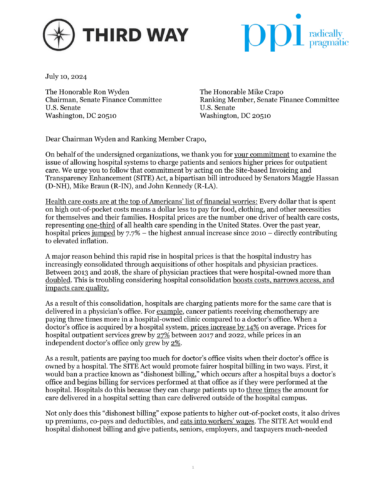
PPI Leads Letter to Advance Site-Neutral Payment Reform to Protect Patients from High Hospital Bills, Promote Fairer Billing

WASHINGTON — Today, the Progressive Policy Institute (PPI) is leading an open letter with nearly 30 other organizations calling on the Senate Finance Committee to advance site-neutral payment reform through the Site-based Invoicing and Transparency Enhancement (SITE) Act, a bipartisan bill introduced by Senators Maggie Hassan (D-N.H.), Mike Braun (R-Ind.), and John Kennedy (R-La.). PPI has long been supportive of site-neutral payment reform and legislative efforts to address this issue.

Medicare, and in many cases, commercial insurers, pay hospital-owned facilities higher rates than independent medical practices and other outpatient facilities for the exact same services. These higher payment rates actually create an incentive for hospitals to acquire these independent practices, resulting in higher prices charged to patients and taxpayers. The SITE Act would promote fairer billing by both ending dishonest billing practices that occur when a hospital acquires a doctor’s office and charges hospital prices despite performing services in the same location, and it would enact site-neutral payment reform to ensure Medicare reimburses providers at the same price for the same service.

Millions of Americans and their families are deeply concerned about the high cost of living and struggling to afford medical care. Every dollar that is spent on high out-of-pocket costs means a dollar less to pay for food, clothing, and other necessities for themselves and their families. This leads to difficult decisions about prioritizing immediate financial needs over preventive or ongoing medical care.

“Ending harmful billing practices like the policies suggested in the SITE Act is crucial in reducing the financial strain that comes from irrationally high medical costs,” said Erin Delaney, PPI’s Director of Health Care Policy. “It is critical that the Senate Finance Committee move forward with this important piece of legislation.”

Read and download the letter here.

The Progressive Policy Institute (PPI) is a catalyst for policy innovation and political reform based in Washington, D.C. Its mission is to create radically pragmatic ideas for moving America beyond ideological and partisan deadlock. Learn more about PPI by visiting progressivepolicy.orgFind an expert at PPI and follow us on Twitter.

###

Media Contact: Ian O’Keefe – iokeefe@ppionline.org

Jacoby in NBC News: The shadow of Trump looms over the NATO summit

As for Ukraine’s future security arrangements, U.S. and European officials say they hope to hammer out a statement at the summit promising an “irreversible” path to NATO membership for Kyiv.

But that language may not be enough to secure Ukraine’s place in the NATO alliance if Trump is elected, said Tamar Jacoby, the Kyiv-based director of the New Ukraine Project at the Progressive Policy Institute think tank.

“If you want to be in the West, you have to be tied to the West, and indeed, you have to be ultimately protected by the West. And so, in a way, NATO membership is the most important thing that Ukrainians are fighting for,” Jacoby said.