
** Programming note: This week, Domain Awareness is rather abridged, but we promise it’s for good reason! PPI’s national security team is on the move this week, with Mary Guenther representing at the International Aeronautical Conference in Turkey, and Danielle Steitz and Tamar Jacoby on their way to Warsaw for this year’s Warsaw Security Forum. We are excited to be working with the Forum as a programming partner, and are delighted to have Rep. Jason Crow and Rep. Jim Himes leading our delegation. If you or a colleague will be in Warsaw and are interested in engaging with some of PPI’s side programming, please feel free to reach out to Danielle Steitz or John Michael Dieng — we’d love to see you there!
By Danielle Steitz
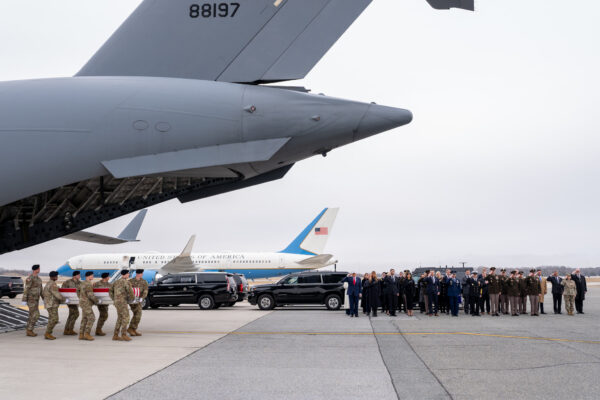
The Associated Press this week published a moving exclusive report that features firsthand accounts and interviews with survivors and family members of those lost in the Iranian attack on Port Shuaiba, Kuwait. The attack, which took place on March 1, 2026, remains the deadliest known attack on U.S. forces to date, with six soldiers killed and dozens more injured by an Iranian drone strike that targeted the Army’s tactical operations center at Port Shuaiba. New survivor accounts describe Army leaders’ decision-making around force protection at Port Shuaiba despite a shortage of counter-drone defenses and intelligence assessments that identified the port as a likely Iranian target, raising questions as to whether the loss of life could have been avoided.
PPI Expert Assessment:
Danielle Steitz, Director of National Security Policy: One of the most striking aspects of the interviews with soldiers deployed at Port Shuaiba was how clearly unprepared they believed the installation was for the exact kind of Iranian drone attack they experienced. One survivor even commented that the unit’s safety officer, MAJ Cody Khork, had expressed concerns that low-flying drones were not being considered in the issuance of “all-clear” orders — and yet was pushed by higher-ranking officers to clear soldiers to leave the relative safety of concrete bunkers and return to the operations center. MAJ Khork was one of the six soldiers killed when a low-flying drone smashed through the roof of the operations center just minutes after an all-clear had been issued.
Commanders owe a fundamental duty of care to their soldiers when it comes to force protection; while soldiers understand that they may be ordered into harm’s way to achieve a mission objective, it is incumbent upon commanders to avoid exposing them to unnecessary risk. The Army owes these soldiers and their families a clear-eyed assessment of what went wrong, why force protection warnings and intelligence assessments were disregarded, and why soldiers whose critical work reportedly required them to be within range of Iranian attacks were not adequately prepared or protected.
In a recently published op-ed, PPI’s Head of Space Policy Mary Guenther and Director of National Security Policy Danielle Steitz highlight the Trump administration’s clampdown on commercial remote sensing data over the Middle East, a move that restricts Americans’ access to truth and places ad hoc and indefinite restrictions on the remote sensing data industry. Guenther and Steitz argue that Congress’s attempt to establish a formalized process for these restrictions through the Intelligence Authorization Act is a step in the right direction, but striking the right balance between national security and access to data is critical and requires voices in addition to the national security establishment at the table.

