
By Danielle Steitz
Lately, it seems like every day begins with a torrent of headlines from an increasingly complex and rapidly changing global landscape. Wars in Europe and the Middle East prompt fears of escalation and geopolitical confrontation, while proliferating technologies like artificial intelligence threaten to reshape the security landscape. Political, security, economic, and technological concerns are increasingly intertwined, making the global landscape fraught with tensions and trade-offs. And in the United States, the erratic and unprincipled leadership of the Trump administration is confounding America’s allies while emboldening her adversaries, creating a more unpredictable and dangerous world.
PPI seeks to offer a path for navigating this increasingly chaotic global environment through understanding the domains in which we operate, which is why we are proud to announce the launch of Domain Awareness. While there are countless stories each day that demand attention, PPI’s new weekly digest offers a curated list of the top stories that policymakers and practitioners need to read, paired with commentary from PPI’s policy experts. We hope you will join us each week as we seek to understand current events and trends, and as we offer pragmatic policy solutions towards a more stable and secure future.
By Danielle Steitz
On Wednesday, the U.S. military formally withdrew from Iraq, bringing two decades of U.S. military presence to a close. The departure of the final 2,500 Americans stationed in Erbil marks the end of Operation Inherent Resolve in Iraq, which brought American forces back to the country in 2014 as part of a multinational military campaign against jihadist Islamic State forces. The departure of the American military contingent from Iraq marks a milestone moment, with Iraqis commemorating the withdrawal with a three-day “celebration of sovereignty” while expressing complicated feelings about the legacy of American military presence and concern over Iraq’s future in the face of growing threats from Iranian-backed militia groups operating in the country.
PPI Expert Assessment:
Danielle Steitz, Director of National Security Policy: Iraq is again solely responsible for its own security, leading some Iraqi citizens to question what will be different this time than in 2011, when American withdrawal and weak Iraqi governance opened the door for the rapid spread of ISIS. While Combined Joint Task Force-Operation Inherent Resolve will continue its counter-ISIS mission from its relocated headquarters in Jordan, the Iraqi government must now rein in increasingly powerful militia groups that Iran views as key partners in its conflict with the U.S. and America’s Middle East allies. The U.S. withdrawal was negotiated by the Biden administration in 2024 and therefore predates the Trump administration’s war with Iran, but when paired with an ongoing review of U.S. presence in the Middle East in light of the conflict, it reflects a bipartisan desire to move past the legacy of the “forever wars” of Iraq and Afghanistan.

by Danielle Steitz
As the Iran War stretches into its seventh month, efforts to find a diplomatic resolution to the conflict continue, but with little to show for it. Qatari shuttle diplomacy and indirect talks on the sidelines of the UN General Assembly between U.S. and Iranian negotiators led to an Iranian proposal that reportedly called for restarting nuclear talks and reopening the Strait of Hormuz after the U.S. lifts both its naval blockade and its oil sanctions and reinstates a region-wide ceasefire. President Trump rejected this proposal and acknowledged that he may resume strikes against Iran – much to the dismay of Republican candidates in tightly contested elections, who are increasingly calling for the war to end quickly.
PPI Expert Assessment:
Danielle Steitz, Director of National Security Policy: Both the Trump administration and the Iranian regime seem to believe that time is on their side, and that dragging out the conflict to maximally inflict economic and political damage on the other is their best path to victory — effectively turning the conflict into a waiting game to see who blinks first. But with polling data continually showing overwhelming American disapproval of the war and gas prices spiking to a new highest recorded average diesel price, members of the president’s party are increasingly concerned that the war will prove to be a drag on their electoral chances in a midterm election that is poised to be a referendum on the president’s performance. With the economy and affordability continuing to be a chief concern for Americans and control of both the House and Senate in the balance, the pressure to bring the war to an end appears to be mounting — but thus far, it has yet to sway Trump from his “inflict economic pressure and wait it out” approach.
by Mary Guenther
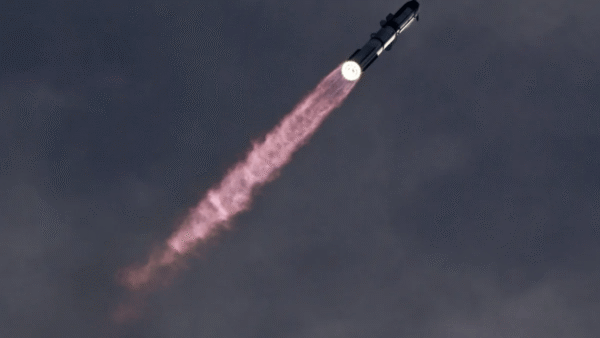
The next-generation launch vehicle from SpaceX successfully completed its first orbital test flight this week. This Starship vehicle will be dramatically more capable than SpaceX’ current workhorse, the Falcon class of vehicles, allowing for each launch to deploy 20 times more Starlink broadband satellites. SpaceX launches the majority of government payloads for civil and national security agencies alike, and NASA is reliant on Starship for its Artemis program.
PPI Expert Assessment:
Mary Guenther, Head of Space Policy: The Department of Defense currently uses the Falcon class of vehicles for most of its national security launches through the National Security Space Launch (NSSL) program. SpaceX plans to phase out the Falcon class of vehicles after it completes the missions it’s currently on contract for to allow the company to focus on Starship. The Starship will be a transformational capability for the American space program, opening possibilities for crewed and cargo missions that nothing on the market can offer today. A number of companies’ spacecraft and scientific missions in process today are only feasible because of the Starship. However, there are questions about whether there could be a gap between the Falcon 9 and the Starship, which would exacerbate launch capacity constraints for companies looking to fly their spacecraft.
by Mary Guenther
A satellite launched by the National Reconnaissance Office (NRO) in 1988 shattered in orbit this week, generating a large debris field of space trash that will make it harder to use the popular orbit it was flying in. The orbit is home to over 200 satellites, including aging NOAA weather satellites. The satellite’s mission was to find and listen to Soviet radar systems, though given that the project was fully declassified earlier this year, it’s safe to assume it was retired sometime in the past several decades. It’s unclear whether the breakup of the satellite was caused by an old component rupturing or if it was hit by a small piece of debris.
PPI Expert Assessment:
Mary Guenther, Head of Space Policy: This is the kind of incident the space community has been concerned about for some time. There are a host of old (primarily) U.S. and Soviet spacecraft and rocket bodies left in orbit that are vulnerable to this kind of event. Modern licensing processes require that satellites deorbit no later than five years after the end of their mission to avoid a build-up of space junk. And there are new companies exploring technologies that would help old or disabled spacecraft deorbit, though it’s unclear at this time whether governments will be interested in contracting them to clean up old satellites from the Cold War era. This incident may spur further thinking in that direction.
by Danielle Steitz
The Navy announced this week that it has awarded the contract for its sixth-generation F/A-XX fighter jet to Boeing, a key next step in getting the next generation of fighters into service as a replacement for the F/A-18 Super Hornet and EA-18G Growler airframes. The award had reportedly been delayed for over a year by a fight that saw the White House and Pentagon advocating for delay of the award and reductions to the program’s budget while the U.S. Navy and Congress pressed for rapid fielding of the fighter given its centrality to naval aviation in a potential conflict with China.
PPI Expert Assessment:
Danielle Steitz, Director of National Security Policy: It is heartening to see the F/A-XX fighter program overcome the bureaucratic obstacles that had long delayed this contract award. While uncrewed systems like the Collaborative Combat Aircraft will provide a force multiplier to aviators in future conflicts, effective combat deployment of these systems still requires a next-generation strike fighter to “quarterback” and manage the battlespace. This contract being awarded without further delay will help to keep downstream aviation industrial base suppliers engaged and working — ideally without any further disruption or delay in producing and deploying these critical aircraft.
“America’s Next Military Advantage is Trusted Data” by Jeremy Bayer in RealClearDefense
This article clearly identifies the next challenge to tackle in the age of information-integrated military operations: how to ensure data remains protected and verifiable while still enabling sharing and interoperability. American innovation is driving technology solutions forward, but the national security architecture must keep pace in adopting those solutions.
Surviving Chaos: Geopolitics When the Rules Fail by Mark Leonard
In his new book, Leonard, the co-founder and director of the European Council on Foreign Relations, argues that the international liberal order is collapsing into what he describes as “Un-Order” — a permanent state where there is no longer agreement on fundamental rules, facts, or even the concept of global governance. In navigating this new reality, Leonard argues for leaders to move away from trying to restore a dead system, and instead to adopt the mindset of “artisans,” who embrace improvisation and build resilience in order to weather constant disruption.

